ZAWTAR AL GHARBIYEH: The US ambassador to Lebanon on Tuesday visited a southern village that recently came under the control of the Lebanese army as part of a framework agreement with Israel.
The US-backed June agreement states that the Israeli military will withdraw from areas of south Lebanon it occupied in parallel with the deployment of the Lebanese army, starting with “pilot zones”, under the condition that militant group Hezbollah disarms.
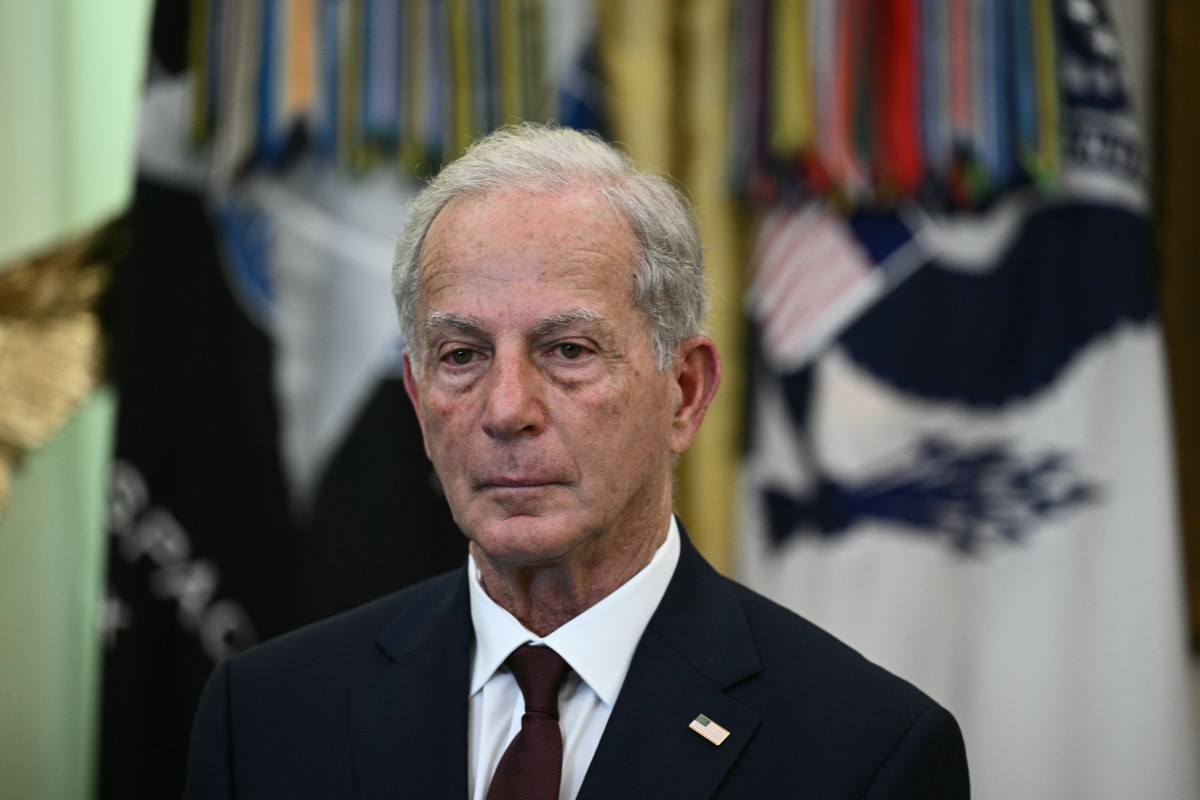
An AFP correspondent saw a convoy carrying the US envoy, Michel Issa, entering the village of Zawtar al-Gharbiya, where he visited a church, according to Lebanon’s official National News Agency (NNA).
The news agency said an Israeli drone surveyed the area during the visit, reporting Israeli military vehicle movements in the neighbouring town.
Israeli troops remain deployed in what it calls a “security zone”, a stretch of Lebanese territory about 10 kilometres (six miles) deep along the border.
It recently blew up a strategic Hezbollah location at the Ali al-Taher ridge in the Nabatieh region, creating a blast so powerful that a 4.1 tremor was registered.
Fresh talks between Israel and Lebanon over the implementation of the framework agreement were due to be held this month, but were postponed to October.
A source from the Lebanese presidency told AFP that during the last round of talks in August, Israel refused to discuss new “pilot zones” without ensuring that the Lebanese army had full control of the first ones.
The Israeli and Lebanese ambassadors to Washington are due to meet this week to discuss the implementation of the agreement.
Lebanese President Joseph Aoun also visited Zawtar al-Gharbiya on Saturday, where his office said he inspected army units and observed nearby Israeli military positions.
Violence declined following the June framework agreement and a wider US-Iran deal, but Israel has pressed its attacks on Lebanon.
Hezbollah, which pulled Lebanon into the war in March with strikes on Israel, rejects the negotiations with Israel and refuses to disarm, but has not claimed any recent attacks.
Israeli strikes have killed more than 4,300 people since the hostilities began in March, according to Lebanese authorities.
A massive explosion tore through the strategic Ali Al-Taher ridge overlooking Nabatiyeh on Thursday night after the Israeli military detonated what it said was a Hezbollah underground complex extending for more than 2 kilometers beneath the heights.
Lebanon’s National News Agency said the blast was felt across Nabatiyeh and surrounding areas. Israel said it had destroyed command centers, weapons stores, living quarters, rockets, missiles, drones and other military infrastructure and had achieved “operational control” of the ridge both above and below ground.
Prime Minister Benjamin Netanyahu and Defense Minister Israel Katz said the operation completed the consolidation of Israel’s self-declared security zone inside southern Lebanon.
For residents of Nabatiyeh below, the destruction gave dramatic new urgency to a political argument that has been building for weeks: Who can actually protect the south?
When Lebanese Army vehicles appeared in greater numbers on the streets of Nabatiyeh, residents welcomed the soldiers with flowers and handfuls of rice.
Lebanese children give flags to a Lebanese soldier at the entrance of the village Adaiseh, in south Lebanon. REUTERS/File
The army had not been absent from the southern Lebanese city, as a security source later stressed. But the enhanced deployment — and its unusual public reception — carried unmistakable political weight.
For decades, Nabatiyeh has been synonymous with the influence of Hezbollah and the Amal Movement. Yet the soldiers arrived a day after more than 400 people signed an appeal demanding that the Lebanese state assume responsibility for the city’s security, deploy the army in and around it, and restore decisions of war and peace exclusively to legitimate institutions.
Known as “Nabatiyeh 2,” as the second of such petitions, the appeal may not prove that Hezbollah’s southern heartland is turning decisively against the organization. Its significance lies somewhere subtler; it suggests that some southerners — long-cast as steadfast Hezbollah loyalists — are beginning to question not their hostility toward Israel, but whom they trust to protect them from it.
Bahjat Mirza, a signatory whose family has been rooted in Nabatiyeh for generations, rejected accusations the initiative was politically motivated.
“These appeals are coming from people of the land — people who are not politically inclined in any particular direction,” he told Arab News.
“This appeal is not politically motivated. It is simply a civil appeal by Lebanese citizens to their government to deploy the army and official security forces on the ground. In my opinion, they should have been there since 1948, since 1969, since 1975.”
Dr. Ali Hassan Wehbe, another supporter of the appeal, is a Lebanese dentist, political and social analyst and former parliamentary candidate who ran in the 2022 elections. His dental clinic in Nabatiyeh has been destroyed three times during successive conflicts — in the 2006 war, again in 2024 and most recently in 2026.
He said the campaign was fundamentally about preventing Nabatiyeh from suffering still greater destruction.
“The appeal is, first and foremost, about removing Israel’s pretext and saving Nabatiyeh,” Wehbe told Arab News, stressing that “Israel bears the primary responsibility for this destruction and this barbarity.”
But he rejected suggestions that calling for state security forces amounted to betrayal.
Smoke billows during Israeli airstrikes in the southern Lebanese city of Nabatiyeh on Oct. 16, 2024. AFP/File
“Has bringing the Lebanese Army and the Lebanese state into Nabatiyeh suddenly become forbidden? Has this become an act of treason against the country?” he said.
“Which is preferable — for the Lebanese Army to enter, or, God forbid, for the Israeli army to enter? Of course, the Lebanese Army should enter. They are our sons.”
The appeal explicitly holds Israel responsible for occupation, killing and destruction. But it also demands accountability from those who controlled security decisions and promised that their weapons could protect southern Lebanon.
Without repeatedly naming Hezbollah, the target of that criticism is clear.
Its most politically charged declaration is that Nabatiyeh must not become “a barricade for any axis” — a challenge to the city’s place in a regional confrontation closely linked to Iran. The appeal also rejects what it describes as the “duality of decision-making” inside Lebanon.
This is not merely a request for more soldiers or better policing. It explicitly demands for the state to become the sole authority responsible for security, and for no armed party outside its institutions to determine when Lebanon goes to war.
“Hezbollah’s position on this is irrelevant,” Mirza said. “Anybody’s position is irrelevant — even if the president of the country disagreed with us. We are asking the Lebanese state to protect its citizens.”
Wehbe put it more starkly.
“We are not a bargaining chip and we are not a negotiating card,” he said. “Nabatiyeh is the artery of the south. It is the heart of Jabal Amel.”
For him, the conclusion is straightforward: “We have no alternative to the state.”
The struggle over Ali Al-Taher
The immediate trigger for the second appeal was the clear and devastating fate of Ali Al-Taher, the strategic heights described as the “gateway to Nabatiyeh.”
The petition argues that an opportunity existed to place the area under Lebanese Army control before Israel claimed operational control of it. For critics, the episode has produced a simple argument: Territory that was not handed to the Lebanese state ultimately fell under Israeli control.
That argument acquired added force on Thursday when Israel detonated the underground complex beneath the ridge, after weeks of bombardment and ground operations. The blast was powerful enough to register as a magnitude-4.1 seismic event about 13 kilometers west-southwest of Nabatiyeh.
The aftermath of an Israeli demolition on the Ali Al-Taher ridge in the southern Lebanese area of Marjayoun, which triggered a magnitude-4.1 tremor (L), and the moment of the explosion (R). AFP/File
The Israeli military said the network contained a central command complex belonging to Hezbollah’s Badr unit as well as weapons storage rooms and facilities that allowed fighters to remain underground for prolonged periods. Israel said its troops would remain in the area to prevent Hezbollah from rebuilding its presence there.
Political writer Sateh Noureddine, who comes from the southern town of Arabsalim, said the loss of the heights was not as recent as Israel’s announcement suggested.
“The Ali Al-Taher hills fell some time ago,” he told Arab News. “The information indicated that Hezbollah’s members had evacuated them weeks ago, not now.”
Noureddine said he did not believe a deal had been responsible for the area falling into Israeli hands. He did, however, question the timing of Israel’s announcement.
“What I find strange, and what raises more than one question, is why Israel announced the fall of Ali Al-Taher now,” he said.
“I believe this indicates that Israel will undertake a military operation more significant than Ali Al-Taher, through which Benjamin Netanyahu will seek to make electoral gains in the Oct. 27 election.”
The second appeal is markedly more urgent than the first. Mirza said it was issued after continued Israeli bombardment of Nabatiyeh and its surrounding villages created a growing fear that the city itself was gradually disappearing.
“It became very clear, with Israel’s dominance and the continued bombing of cultural and historical sites in Nabatiyeh and the surrounding villages, that we felt the city was gradually being destroyed,” he said.
For Wehbe, that fear is intensely personal.
“Since I was 10 years old, I have lived through displacement and wars,” he said. “We do not want to keep mourning our children. We do not want to keep living on memories. We want to live in the present and build the future.”
Residents are no longer debating only a theoretical future danger. They have watched destruction reach the approaches to the city and are contemplating what another escalation could mean for their homes, families and livelihoods.
Hezbollah’s supporters gather around the coffins of militants killed in Israeli attacks during their funeral in the southern city of Nabatiyeh on November 2, 2025. AFP/File
For years, Hezbollah and Iran were associated among their supporters with power, protection and deterrence. Residents are now confronting destroyed villages, lost territory and the possibility of still greater devastation.
That does not necessarily amount to a complete political realignment. But it has shaken some of the assumptions on which Hezbollah’s relationship with its popular base was built.
The political debate was once largely about who represented the south. For some residents, the more urgent question is now whether there will be a south left to represent.
‘Nothing but words and threats’
Ali Al-Amin, editor-in-chief of Janoubia, a news website opposed to Hezbollah, said the party was becoming increasingly defiant as the pressure surrounding it intensified.
“Hezbollah has no options other than to continue attacking the authorities in general, while the circle of protest against the party is expanding in the south amid fears of further Israeli incursions and of the entire south falling under occupation,” he told Arab News.
“Even Hezbollah’s supporters have begun to voice their unease over what the wars in support of Gaza and Iran have produced. Voices are rising even from within Hezbollah’s own constituency because the equation on the ground has become exposed.
“All the evidence has shown that the party says one thing and does another. It has become clear that it possesses nothing but words and threats.”
Al-Amin said Hezbollah’s failure to confront Israeli forces at Ali Al-Taher was particularly damaging because of the importance the organization had previously attached to the area.
“Hezbollah did not resist the Israelis when they advanced toward Ali Al-Taher, even though it had described it as the ‘mother of all battles,’” he said.
He warned that Hezbollah’s response to its growing isolation could eventually transform the purpose of its weapons.
“The danger today is that Hezbollah’s defiance could change the function of its weapons, turning them from weapons intended to resist Israel into weapons used to confront the Lebanese state,” Al-Amin said.
“Hezbollah is trying to find pretexts for not handing over its weapons. But if we observe the trajectory, we find that the party’s argument is weakening and being depleted over time. This is what Israel has done through the escalation of its military operations.
“Today, the testing ground has shifted north of the Litani River, rather than remaining south of it.”
Wehbe, however, framed his challenge to Hezbollah differently. He stressed that many of those behind the appeal had themselves supported or participated in the resistance — Hezbollah’s preferred euphemism — in previous decades.
“My message to Hezbollah’s leadership is this: Deal with this opposition rationally and calmly, because this opposition was itself a stronghold of the resistance,” he said.
He also urged Hezbollah to rein in supporters who had accused the signatories of treason or incited against them.
“Are we no longer allowed to express our pain?” he asked. “Are we no longer allowed to say: Enough displacement?”
Dissent is not new — but its focus may be
Public opposition to Hezbollah and Amal inside Nabatiyeh is not unprecedented.
During Lebanon’s 2019 uprising, protesters in the predominantly Shiite city openly challenged both movements. Those demonstrations broke longstanding taboos and exposed anger over corruption, patronage, economic mismanagement and Lebanon’s sectarian political system.
An Israeli flag flies over the medieval Beaufort Castle, known locally as Qalaat al-Shaqif or Shaqif Arnoun, in southern Lebanon on May 31, 2026. AFP/File
Some of the people supporting the latest appeal may belong to that established opposition constituency. More than 400 signatures, while notable, cannot be treated as representative of hundreds of thousands of people across southern Lebanon. Nabatiyeh has not suddenly ceased to be a major center of Hezbollah and Amal support.
What may be changing is the nature of the criticism.
In 2019, much of the anger focused on governance and economic failure. “Nabatiyeh 2” strikes much closer to Hezbollah’s foundational claim to legitimacy: that its independent arsenal is necessary because it can defend the south more effectively than the Lebanese state.
The appeal asks whether that claim still holds after the scale of destruction inflicted on southern communities and the loss of territory Hezbollah’s weapons were supposed to protect.
Noureddine argued that the growth of public opposition was evidence that the party’s political structure was beginning to disintegrate.
“Hezbollah is on its way to disappearing — its leadership and political bureau alike,” he said. “It is living through its final phase. The party’s political body has begun to disintegrate, and nothing will remain except scattered cells that carry on its path and may disappear underground.”
“The number of people signing the Nabatiyeh appeal is doubling every day,” he added. “This is an indication of growing opposition to a party that is fading away.”
His assessment is among the most categorical offered by Hezbollah’s critics and remains fiercely disputed by its supporters. There is no evidence that the organization has lost its dominant position within its traditional constituency.
Nevertheless, the willingness to make such arguments openly is itself significant in a region where public criticism of Hezbollah’s security role has historically carried a high political and social cost.
Joelle Abboud, a member of the Lebanese Kataeb Party’s political bureau, said the demand for state sovereignty over southern villages had never belonged to one community or political faction.
People stand on the rubble of a destroyed house after returning to the southern Lebanese city of Nabatieh on Apr. 20, 2026. AFP/File
“The voices that have recently risen to demand state sovereignty through the army in southern villages reflect what has always been a national demand across all sects,” she told Arab News.
“The emergence of Shiite voices making that demand today is evidence that Hezbollah’s weapons did not deter Israel, and that the war continued to an Iranian rhythm, with Lebanese youth used as fuel for an Iranian project.”
Abboud said the reception given to the army in Nabatiyeh showed that southerners wanted the state to assume the role long claimed by Hezbollah.
“The welcome received by the Lebanese Army in Nabatiyeh is evidence that southerners are eager to see the state become the alternative to militia weapons,” she said.
“Diplomacy is a difficult path, but it is effective in achieving stability. What is required today is the implementation of the Lebanese government’s decisions to confine weapons to the state.”
For now, “Nabatiyeh 2” — with signatories including doctors, engineers, lawyers, bankers, journalists, academics, writers, activists and MP Firas Hamdan — is not proof that southern Lebanon has turned against Hezbollah. It is evidence that a question once difficult to voice publicly is becoming harder to suppress.
After decades in which Hezbollah presented itself as the indispensable defender of the south, some people within its traditional environment are looking toward the Lebanese Army and asking whether only the state can protect them.
Whether this is simply the cry of a frightened city facing another battle, or the beginning of a deeper transformation in Hezbollah’s relationship with the society from which it draws much of its power, remains unanswered.
But after the explosion beneath Ali Al-Taher shook Nabatiyeh on Thursday night, that question is no longer abstract.
KFAR RUMMAN, Lebanon: Hundreds of people in south Lebanon gathered on Tuesday to mourn two Hezbollah members and their family, among them a three-month-old infant, killed by an Israeli strike a day prior.
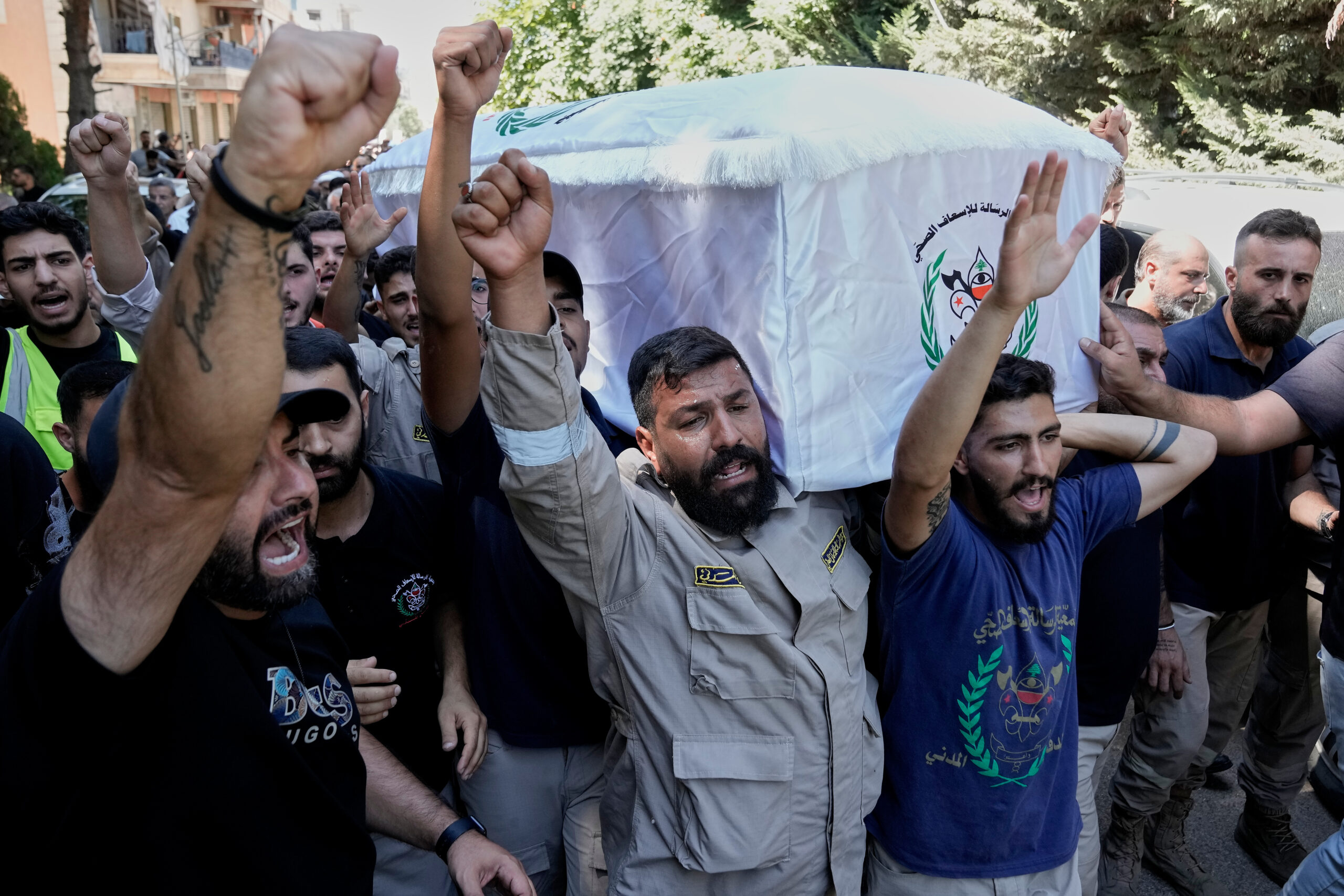
The two brothers’ coffins, draped in the Iran-backed group’s yellow flag, portraits of them in camouflage fatigues fixed to the front, led the procession through the village battered by repeated conflict over nearly three years.
Another 10 coffins were covered in Lebanese flags, indicating that the rest of the Farhat family killed when Monday’s strike levelled their home were civilians.
Israel has launched airstrikes and a ground invasion in south Lebanon during the Middle East war, which erupted with joint US-Israeli attacks on Iran and spread to Lebanon after Hezbollah targeted Israel in support of its backer.
The fighting in Lebanon had calmed since a US-Iran memorandum of understanding and a framework agreement between Israel and Lebanon were both agreed in June.
But Beirut still reports recurring Israeli strikes, which it says have killed more than 4,300 people in total since March, and Israeli forces continue to occupy what it calls a “security zone” in the south.
A separate strike on Kfar Rumman on Monday killed an 18-year-old rescuer with the Risala Association, linked to the Hezbollah-allied Amal movement, the organisation said, who was mourned alongside the Farhat family on Tuesday.
“We have 13 killed including grandfather and grandmother, husbands and wives, and their children including a three-months old infant,” deputy mayor Nureddine Nureddine told AFP from the funeral.
“Someone put an end to these crimes,” Nureddine said, adding that the strike that killed the Farhat family “occurred at night, while they were sleeping”.
“There was no military activity, nothing.”
An AFP correspondent saw people marching to the cemetery, waving Hezbollah flags as women dressed in black wept, holding pictures of the dead as an Israeli drone flew overhead.
“Death to America, death to Israel,” mourners yelled.
– ‘A shred of honour’ –
The Israeli military said on Monday that it had struck Hezbollah “infrastructure sites” across southern Lebanon after the launch of two explosive drones towards its troops, as well as “several terrorists” it said were transferring weapons.
“The claim that several uninvolved individuals were harmed as a result of the strikes is being reviewed,” it said, adding that the military “will continue to operate to remove threats while remaining committed to the ceasefire agreement”.
Since Friday, at least 28 people have been killed in Israeli attacks on southern Lebanon, according to Lebanon’s health ministry.
Standing next to a picture of his own son, a Hezbollah member killed by Israel, Ghaleb Baalbaki slammed the Lebanese government for continuing direct talks with Israel.
“If they have even a shred of honour, the first thing they should do would be to stop the negotiations,” he said.
The lull in violence that began in June had allowed hundreds of thousands of displaced people to return home.
“Kfar Rumman was coming back to life, there were more than 1,400 people” in the town before the latest escalation, Nureddine said,