At least two bases in England hosting U.S. Air Force aircraft are operating under beefed-up security protocols, a U.S. official told us Monday afternoon. The official was responding to our questions about what appeared to be unusual aircraft movements out of RAF Mildenhall. It is unclear what spurred these measures, how long they have been in place or whether they are connected to an ongoing investigation into whether Iran was behind a security incident at RAF Fairford in September that reportedly prompted the hasty departure of B-1 Lancer bombers.
“Enhanced force protection measures are in effect across RAF Lakenheath and RAF Mildenhall,” the official told us. “We constantly assess a variety of factors that determine what measures we institute or modify to protect our installations, our people and their families. We are working closely with our host nation counterparts to minimize impacts from enhanced force protection activities and ensure the safety of U.S. personnel, their families and the local community.”
The official declined to say what steps were taken.
“For operational security reasons, we do not discuss specific force protection measures,” the official added.
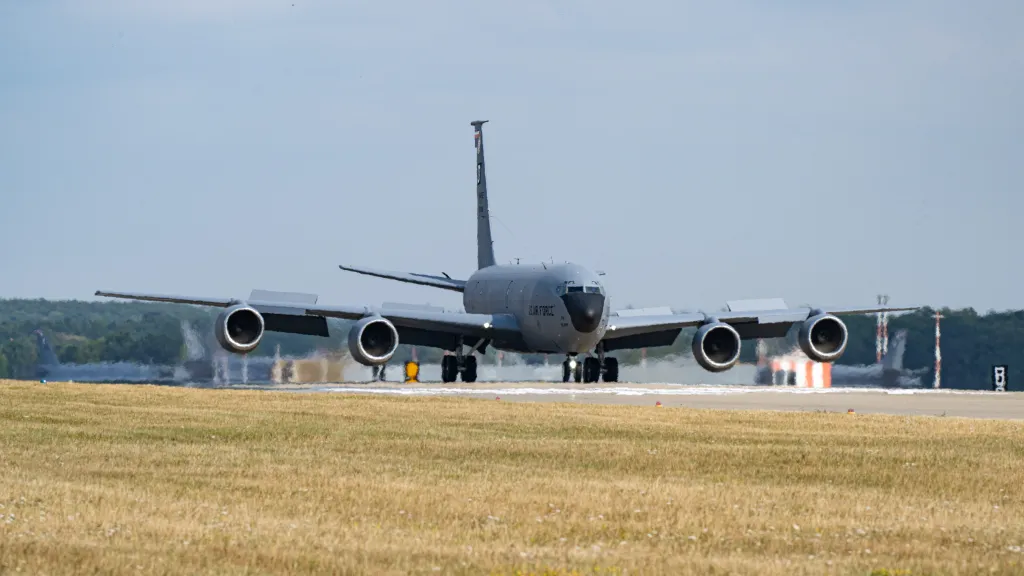
A U.S. Air Force KC-135 Stratotanker from the 100th Air Refueling Wing taxis down a runway after landing at RAF Mildenhall, England, July 22, 2026. (U.S. Air Force photo by Senior Airman Aidan Martínez Rosiere) Senior Airman Aidan Martinez RosiereA U.S. Air Force F-15E Strike Eagle aircraft, assigned to the 492nd Fighter Squadron, takes off for Atlantic Trident 25 at RAF Lakenheath, England, June 12, 2025. (U.S. Air Force photo by Airman 1st Class Sierra Casteel) Airman 1st Class Sierra Casteel
Both bases also see frequent flights transiting to other locations.
As we noted earlier in this piece, the official was responding to our questions about unusual aircraft movements out of Mildenhall. They were first noticed by the @DefenceGeek open-source flight tracker account.
“Over the course of today, a number of US Air Force assets at RAF Mildenhall (EGUN) have made unannounced/unexpected movements to other locations, with several of those movements in motion presently,” DefenceGeek wrote on X. “The initial few this morning I assumed were due to heavy fog in the area, but other information is now suggesting something else… – Several KC-135s have moved to Spangdahlem (ETAD) or Prestwick (EGPK) – CV-22Bs have moved from Mildenhall to Lakenheath It remains unclear if there is an ongoing exercise or information of a potential threat (following the incident at RAF Fairford)…”
UPDATE: US Assets at RAF Mildenhall Dispersing
For those commenting and asking, no, the NOTAMs regarding RAF Mildenhall are not related to what is currently going on. The two NOTAMs are for Veterans Day (Wednesday) and Thanksgiving (end of November).
DefenceGeek also noted that RAF Lakenheath posted a notice this morning on Facebook urging vigilance in spotting and reporting drones.
US Assets at RAF Mildenhall Dispersing?
Over the course of today, a number of US Air Force assets at RAF Mildenhall (EGUN) have made unannounced/unexpected movements to other locations, with several of those movements in motion presently. The initial few this morning I assumed… pic.twitter.com/vVVA0cRljN
“Our strongest security asset is an observant community,” the RAF Lakenheath Facebook post read. “Staying vigilant and reporting suspicious activity, including unauthorized drone activity, helps protect our Airmen, families and mission. If you see something unusual on or around the Tri-Base area, report it to Security Forces.”
It is unclear what connection, if any, the Lakenheath post has to the enhanced force protection status. U.S. Air Forces in Europe – Air Forces Africa (USAFE) declined to discuss security measures. The command oversees U.S. Air Force operations in Europe and Africa.
“U.S. Air Force aircraft rotate between installations and operating locations for a variety of reasons including training and real world requirements,” USAFE told us. “U.S. military aircraft are hosted in accordance with access, basing, and overflight agreements with our Allies and partners. Due to operations security, we will not provide further information on movement of assets.”
The departures from Mildenhall took place amid an ongoing flow of refueling tankers and other aircraft to the Middle East as President Donald Trump continues to mull whether to resume strikes against Iran. This afternoon, Trump wrapped up his meeting with Qatari Prime Minister Mohammed bin Abdulrahman Al Thani to discuss a flagging effort to resolve the conflict with Iran through diplomacy.
It should also be noted that in late November 2024, Lakenheath, Mildenhall and two other RAF bases hosting U.S. forces experienced drone incursions, which we were the first to write about.
As we mentioned earlier in this piece, security concerns about bases in England hosting U.S. Air Force aircraft and personnel were raised following an incident at RAF Fairford.
Like Mildenhall and Lakenheath, RAF Fairford is a major hub for U.S. military aircraft in the United Kingdom. It is a regular host of strategic assets, including bombers and U-2 spy planes. It also acts as a pit stop for other aircraft, including fighters, that are being ferried to and from the United States. Bomber strikes launched from Fairford were a central aspect of major U.S. combat operations against Iran earlier this year.
A U.S. Air Force Rockwell B-1 Lancer bomber at RAF Fairford in Gloucestershire. (Photo by Ben Birchall/PA Images via Getty Images) Ben Birchall – PA Images
In late September, five men were arrested on suspicion of driving bomb-laden vans toward it. They were soon released on bail after no explosives were found, but two men were later arrested, one of who was “charged with assisting a foreign intelligence service, which police earlier said they believed to be Iran,” according to the BBC.
We can’t say for sure what prompted the enhanced security at RAF Lakenheath and RAF Mildenhall or whether the aircraft movements at Mildenhall are precautionary or just normal shifting of resources. We will continue to monitor the situation and provide updates when warranted.
The Pentagon is reportedly aiming for U.S. military installations to be able to continue essential operations for at least 90 days, or roughly three months, without any external support. The installation of new small nuclear reactors and other infrastructure is key to this part of a larger plan called Fortress America. The main intent is to ensure America’s armed forces can remain functional and ready to protect the homeland in the face of any massive disruptions to power grids and other supply chains due to major conflicts or other crises. For years, TWZ has been sounding the alarm about the glaring vulnerabilities of America’s critical civilian energy infrastructure, including to drone swarms and cyberattacks, which could cripple key military capabilities right where they live.
Fox News was first to report on the 90-day base resiliency goal yesterday, citing documents it said it reviewed. This is part of the extremely wide-reaching Fortress America initiative the Pentagon announced last month, which covers everything from improved physical and cyber defenses at facilities to securing reliable access to critical defense industrial resources. The “Fortress” in Fortress America is technically an acronym that stands for Federal Operations for Resilience, Troop Resources, Energy Supply, and Survivability.
Today, at Secretary Hegseth’s direction, the Department of War is announcing FORTRESS America—a national insurance policy for the American homeland.
Every major military installation in America will generate its own power.
“Under FORTRESS [sic], every major military installation in the continental United States would be expected to sustain essential operations independently for at least 90 days, including access to electricity, water, fuel and communications,” according to Fox.
Fox News’ story also includes comments about Fortress America from Pentagon chief spokesperson Sean Parnell, but it is unclear if he explicitly confirmed the 90-day target. TWZ has reached out for more information.
“Power is combat now. Without electricity, you lose communications, water, logistics, assembly lines and just basic military command structures,” Parnell told Fox. “We don’t want to rely on standard civilian municipal infrastructure to run our national defense. We just simply can’t. It’s an intolerable risk.”
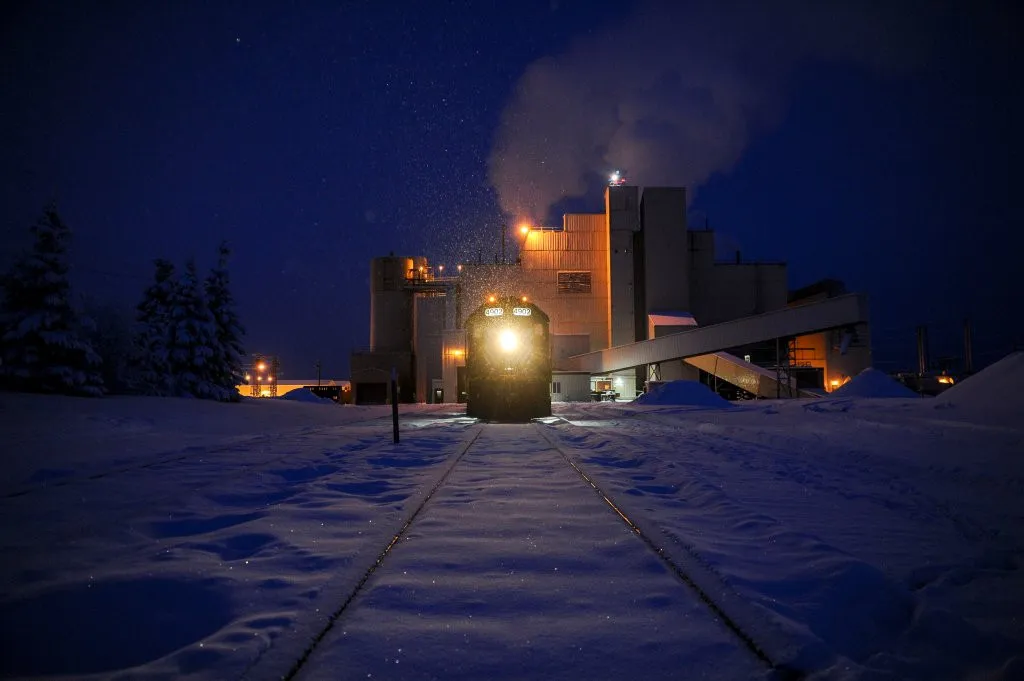
A train seen delivering coal to the power plant at Eielson Air Force Base in Alaska. USAF
Secretary Pete Hegseth made similar comments when he first unveiled the Fortress America initiative during a speech to service members at the U.S. Marine Corps’ base in Quantico, Virginia, in September.
“We are launching Fortress America, a national insurance policy for the American homeland,” Hegseth said at that time. “Every major military installation in America is going to generate its own power, independent of the civilian grid. If an adversary takes down the grid by cyber attack, by sabotage, or by any means, our bases stay lit, our aircraft keep flying, our command centers never go dark.”
Fox News’ report says that “portable nuclear reactors,” as well as “large-scale battery storage and microgrids capable of disconnecting military installations from the civilian electrical grid,” are key elements of the plan to achieve this independence when it comes to generating electricity.
The U.S. military, in cooperation with the Department of Energy, has already been heavily investing in the development and installation of so-called microreactors at bases across the country. In August, the U.S. Army, in partnership with the Pentagon’s Defense Innovation Unit (DIU), notably cut new deals with five companies as part of a plan to install more than 20 microreactors at bases, starting in 2028. This effort, called the Janus program, is not limited to Army installations.
The video below offers an overview of one of several microreactor designs the U.S. military is currently pursuing.
Introducing Kaleidos, a Portable Microreactor from Radiant
Establishing new microgrids and other supporting energy infrastructure has also been an important focus for the U.S. military in recent years.
Details about how bases are expecting to maintain supplies of water and fuel, as well as communications connectivity, for 90 days or more are, as yet, still not entirely clear. All branches of the U.S. military have already been exploring new and novel options for ensuring the availability of water and fuel in future contingencies, though generally with more of an eye toward tactical operations. Relevant developments, including the possibility of using a process called carbon transformation to turn ambient air into fuel, could easily be applicable in a homeland defense scenario.
Fox News’ story also makes no mention of how sufficient food for personnel at these facilities would be sustained, but that would have to be part of the equation. In his remarks in September, Secretary Hegseth also made clear that making sure supply chains delivering munitions, medicine, and even blood would be unbroken in any future crisis was part of the Fortress America vision. As already mentioned, the initiative also extends much more broadly into matters of physical force protection, cyber defense, and the resilience of America’s defense industrial base.
“For decades, we built the most powerful military in the world,” Hegseth said at Quantico. Then we “regrettably made it dependent on foreign mines for rare earths, on overseas factories for microchips, on foreign supply chains for weapons, and on a civilian power grid to keep the lights on at our bases.”
Secretary Pete Hegseth signs a missile component during a visit to a defense contractor’s facility in Febraury 2026. US Military
“We’re bringing our critical supply chains home: the rare earths, the specialty metals, the semiconductors, the propellants, mined in America, refined in America, built in America by American workers,” he added at the time. “We are building long-overdue strategic reserves, deep enough to fight through disruption.”
More specific details about how the Pentagon now intends to pursue these aims have yet to be more fully defined.
“The Under Secretary of War for Acquisition and Sustainment is directed to stand up the FORTRESS America Program Office within thirty (30) days,” according to a memo dated September 30, which was released after Hegseth’s September speech. “The Program Office shall report directly to the Under Secretary of War for Acquisition and Sustainment who will appoint a member of the Senior Executive Service to lead the day-to-day operations, assisted by a two-star Military Advisor, and shall begin as a lean core cell that scales to full operating capability within months – delivering results in weeks, not years”
There is also a question of how much of the Fortress America initiative will actually be new. As mentioned, just when it comes to increased energy resiliency, including through the installation of new microreactors, this is something that has already been top of mind for the U.S. military for years now. In 2022, the U.S. Army had a publicly stated goal for every one of its bases to have its own microgrid by 2035 as part of a larger plan to reduce dependence on fossil fuels. In 2024, the Department of the Air Force rolled out its own Installation Infrastructure Action Plan (I2AP) that included a target to have new microgrids in place at 16 bases by Fiscal Year 2030. In May, the U.S. Navy announced plans to demonstrate the ability of the supercarrier USS Gerald R. Ford to act as a floating nuclear power plant as part of broader “energy resilience and mission assurance” plans.
A stock picture of the USS Gerald R. Ford. US Navy
“The [Fortress America] program aligns basing and infrastructure projects to ensure they are collectively advancing toward greater independence,” the aforementioned September 30 memo itself notes.
There are additional questions to be answered as to how the U.S. military expects to fund its expansive Fortress America ambitions and the schedules for implementing them. This will all be heavily influenced by how much the initiative leverages efforts that were already ongoing. At the same time, concerns about underinvestment in infrastructure modernization, in general, across America’s armed forces, and the worrisome cascading impacts thereof, are hardly new.
There are still key elements of the Fortress America initiative that have yet to be fully proven out. This is particularly visible when it comes to microreactors, which hold the promise of being simpler and safer to build and operate compared to traditional nuclear power plants. Despite significant progress with this technology just in recent years, environmental, proliferation, and other concerns continue to be raised. You can read more about all of this can read more about here.
Today, the Department of War will execute Operation Windlord, the first C-17 airlift of a nuclear reactor, in partnership with the Department of Energy and Valar Atomics.
Three C-17s Globemasters carrying the 8 modules of the Ward250 reactor will fly from March ARB to Hill AFB. pic.twitter.com/uIL7LMxACQ
— Isaiah Taylor – making nuclear reactors (@isaiah_p_taylor) February 15, 2026
On top of all this, it should be noted here that the U.S. military and the rest of the U.S. government already have mechanisms in place to ensure the key functions can continue, even in the midst of the gravest of crises, such as a limited nuclear attack. This is known as continuity of government planning, and includes a network of hardened and otherwise resilient facilities designed to support continued military operations and other activities in those ‘doomsday’ scenarios. But these facilities are few in number and are focus on strategic capabilities compared to what the Fortress America plan envisions.
At the same time, the dangers posed to civilian power grids in the United States, in particular, are only growing in scale and scope, both in the physical and cyber domains. Existing domestic U.S. energy infrastructure is aging and has been increasingly strained to meet routine day-to-day demands for decades now.
The potential for uncrewed aerial attacks on power plants and power lines has been real for years. The basic barrier to entry when it comes to weaponized drones, including converted commercial types, is also already low. Drone threats, broadly speaking, are only set to expand as swarming technology and artificial intelligence-driven capabilities continue to proliferate, as you can read more about this in this past TWZ feature. A well-informed enemy could concentrate a small number of resources on highly critical points in the grid to have vastly outsized effects, using drones or any other kinetic means.
The threat of various types of cyberattacks is also no longer limited to blockbuster movies and other popular media. This was made clear all the way back in 2021 with the ransomware attack on Colonial Pipeline, a key American oil pipeline system, and has only become more evident since then, including in the course of the war in Ukraine. U.S. authorities have run major exercises to help prepare for exactly these kinds of threats in the past. These are also capabilities where the barrier to entry has been steadily lowering over the years. Increasingly open access to powerful artificial intelligence agents with the ability to overwhelm networks and software to find critical vulnerabilities faster than humans can react is perhaps the most concerning layer of risk.
We have been reporting on this coming together for some time, it’s incredibly important. More so than a new fighter or an additional destroyer every couple years. Absolutely critical, and becoming more so with each passing day. Yes it’s scary, but it’s far scarier not doing this https://t.co/u09x0PeHZ7
If a major conflict with a global competitor like China were to break out, physical and cyberattacks on energy infrastructure would be an extremely attractive avenue to hobble U.S. military forces, including airpower, before they can even leave their bases. The capacity to threaten grids in the United States, at least to certain degrees, has become worryingly within reach of smaller nation-states, as well as non-state actors and even lone wolf attackers, too. Firmly attributing cyberattacks to a nation-state, at all, can be challenging.
There is also a secondary component to all of this for responding to major natural disasters, which are another way U.S. grids can end up being knocked out for extended periods of time. These same circumstances could easily leave military bases, as well as their surrounding communities, without access to fresh water and other supplies. The U.S. military routinely plays a key role in responding to such crises.
“This is not a wait-and-see kind of a thing. We want to move out pretty quickly to get to that energy [resilience]. Those solutions can include investments in microgrids, battery backup storage,” a senior U.S. defense official said last week at a Defense Writers Group roundtable, according to a separate report from Air & Space Forces Magazine. “First and foremost, it’s doing the assessments of the installations to make sure we understand power generation and where we’re going to go with that, and then getting those deployed.”
The Pentagon is certainly making a new push now to make sure that, as Secretary Hegseth put it last month, “America cannot be starved out, shut down, or cut off.” However, there is clearly still work to be done to meet a goal of bases being able to go three months without outside help and the many other aims of the Fortress America plan.