MILWAUKEE — Something about American Family Field in the regular season disagrees with the Dodgers.
They began this road trip with a pair of statement series, sweeping the Angels and edging out the Padres. But their momentum came to a grinding halt when they fell 5-1 to the Brewers on Friday in Milwaukee.
“I don’t think people appreciate how well this team plays baseball,” manager Dave Roberts said before the game. “There’s not a lot of fanfare as far as name recognition. But the way [Brewers manager] Pat Murphy gets these guys to play, it’s a fun brand of baseball.
“They don’t strike out much. They put the ball in play. They bunt, they hit and run, they steal bases, they can pitch. It’s a good matchup. Last year, during the regular season, we couldn’t beat these guys once, so I expect us to play better baseball this year.”
That brand of baseball was a bit of a nightmare for Dodgers starter Justin Wrobleski in the first inning. The Brewers batted around en route to a five-run rally. Five of their six hits were singles. The one exception was William Contreras’ three-run homer.
The next inning, they tacked on another run when Contreras singled and then scored when Andrew Vaughn’s double ricocheted off the wall in the right-field gap.
Wrobleski turned around his outing by blanking the Brewers for the next three innings, but the deficit proved to be too steep for the Dodgers to overcome.
Wrobleski has only given up more than two runs in one other start this season. That one also featured one high-scoring inning and a mid-game adjustment.
The Dodgers’ offense, in contrast to the Brewers’, didn’t record a hit off Brewers starter Logan Henderson until the fourth inning. He faced the minimum through the first three innings — a leadoff walk erased when Shohei Ohtani was caught stealing.
Finally in the fourth, Ohtani worked a 2-2 count and lined a hung change-up into right field. Then Freddie Freeman and Andy Pages drew walks to load the bases with two outs. But the Dodgers failed to capitalize.
The Dodgers again threatened after the Brewers replaced Henderson with left-handed reliever Shane Drohan, drawing a pair of walks to put runners on first and second. But the inning ended with a long flyout from Max Muncy, just a few feet shy of a base hit.
They needed some help from the Brewers’ defense to finally put a run on the board. Third baseman Luis Rengifo mishandled a ground ball to let Teoscar Hernández reach base in the seventh inning. A single from Dalton Rushing and a fly out from Miguel Rojas moved him to third. Ohtani delivered the sacrifice fly.
The Dodgers’ Max Muncy leaves the game after being hit by a pitch during the eighth inning against the Brewers at American Family Field on Friday in Milwaukee, Wisc.
(Patrick McDermott / Getty Images)
The Dodgers may have to deal with additional repercussions. Muncy exited in the top of the eighth inning after being hit in the hand/wrist by a pitch.
Muncy shouted as soon as the 95.5-mph sinker struck him, and he appeared to cradle his right arm. After consulting with an athletic trainer, he touched first base and was replaced by Santiago Espinal.
The severity of Muncy’s injury was not immediately clear.
Chris Taylor retires
The MiLB transaction log Friday showed that former Dodger Chris Taylor has retired after a 12-year major-league career. He spent a decade with the Dodgers, was named the 2017 NLCS MVP, won two World Series, and was an All-Star in 2021.
First-year baseball coach Dino Flores of Fremont High teaches health, and for the entire semester, he had a freshman from Venezuela, Roiber Colmenares, sitting in class.
One day, Colmenares asked Flores a strange question.
“Hey Mr. Flores,” he said in Spanish. “Do you know how I can join the baseball team?”
“Yes I do,” Flores said.
Colemenares told him playing baseball was all he did in Venezuela.
Then Flores had Colemenares show him how to field a ground ball with an imaginary ball in class.
“That’s when I knew we had something special,” Flores said. “Just his movement you could tell he’s a baseball player.”
With Colmenares leading the way, Fremont has advanced to face Hamilton in Friday’s 2:30 p.m. Division III final at Stengel Field. The Division II final will have South East playing Roosevelt at 5:30 p.m. at East Los Angeles College.
“He’s our best hitter and best pitcher,” Flores said of the 5-foot-8, 140-pound freshman.
Fremont used to be a baseball power, having won five upper-division City titles, the last in 1963. There also was a 3A title in 1992.
“The history is well documented,” Flores said.
This is a daily look at the positive happenings in high school sports. To submit any news, please email eric.sondheimer@latimes.com.
SAN DIEGO — The good people of New York like to consider themselves tough. If you can make it there, as Frank Sinatra crooned, you’ll make it anywhere.
Do not confuse hot takes with sounding tough. Two New York sports talk hosts this week took daft shots at Joe Davis and came off — in the last adjective with which any true New Yorker would want to be described — as soft.
Let’s rewind: Davis is the lead voice of the Dodgers on SportsNet LA. He is also the lead voice of the national baseball broadcasts on Fox. In the latter role, he called last Saturday’s game between the New York Yankees and the New York Mets.
At one point, Mets outfielder Carson Benge dropped an easy fly ball. Without missing a beat, Davis said: “Oh, no! Oh, no, the Mets!”
It was the perfect call. The foibles of the Mets are so many and so weird that Mets fans themselves have embraced a term for them: LOLMets. You can learn all about it in a 23-minute YouTube video narrated by a former Mets pitcher.
Commentator Stephen Nelson, Dodger Shohei Ohtani, interpreter Will Ireton, Dodger Roki Sasaki and broadcaster Joe Davis address fans during Dodger Fest at Dodger Stadium on Jan. 31.
(Jae C. Hong / Associated Press)
Firing one manager (Willie Randolph) at midnight in Anaheim? Dumping another manager (Carlos Beltran) before he could manage a game because he was the only player cited in the commissioner’s report on the Houston Astros’ cheating scandal? Opening this season with baseball’s highest payroll and spending some time with baseball’s worst record?
“This year, and in recent years, there have been so many moments where it looks like the Mets are right there, ready to make a run or win the division or win a championship, and then something just tends to go wrong,” Davis said in San Diego Tuesday.
“They were in a stretch right there where every single day, they were getting a stud hurt. They put together a winning streak against the Tigers, then Clay Holmes has the comebacker break his ankle.”
The next day, Benge totally clanked it, and Davis totally nailed it — in the moment, not with some scripted phrase waiting in his pocket.
“You hope that your reactions in those moments — in any moment in this job — are authentic,” Davis said. “You don’t have much time for it to be anything else.”
On Monday, Evan Roberts — a host on WFAN, New York’s top-rated sports station — unloaded on Davis for “mocking” the Mets.
“Joe Davis has become a clown for the Los Angeles Dodgers and we all hear it,” Roberts said, in remarks posted by the Awful Announcing website.
Got anything else?
“I think he’s a Dodger fanboy,” Roberts said. “I think he wants to just make love to Shohei Ohtani every time he talks about him … He’s a great broadcaster, and I’ll admit it. But, for now, I think Joe Davis is a Dodgers shill and it’s obnoxious.
“And I’d give him this advice, not that he cares, he doesn’t care: Don’t go to the Dodger parade and be the emcee. It’s a bad look. It just is. You’re sitting there as the national voice and now you’re pom-pom waving at the Dodger parade. Come on, man.”
Davis works for the Dodgers. When the boss wants you to emcee the World Series championship rally, you do. Would the Mets’ broadcasters do the same? When the Mets win their first World Series championship since 1986, we’ll find out.
Let’s hear from Sal Licata, formerly at WFAN and now working independently: “What’s up with Joe Davis, by the way? You Dodger homer. ‘Oh no, the Mets,’ that’s a national unbiased broadcast? You biased Dodger blue fool.”
There always will be people who claim Davis is biased toward the Dodgers, just as people claimed his predecessor, Joe Buck, was biased toward the St. Louis Cardinals. Buck worked for Fox on weekends and called Cardinals games during the week.
And, for the people who see only what they want to see, Davis is the voice of baseball’s evil empire. Maybe that aggravates New Yorkers, but consider how aggravated we are that we have to fight through hellish traffic to get to Dodger Stadium or a television set by 5 p.m. so we can see our team play in the World Series because the East Coast needs to see the game in prime time.
Or how annoyed we are that we get televised Yankees-Red Sox games shoved down our throats when Red Sox management has opted for irrelevance and the best rivalry in baseball is here, between the Dodgers and Padres.
Better yet, how about we all chill? It’s just a game. We could break bread with New York’s famous bagels, except the New York Times told us we have the better bagels.
For Ross Stripling, baseball was something of an accidental career.
He walked onto the team at Texas A&M, majoring in business finance, planning to stick around campus long enough to earn a master’s degree. After his junior year, he turned down a six-figure bonus offered by the Colorado Rockies. After his senior year, he accepted a six-figure bonus to sign with the Dodgers, only to blow out his elbow after one season in the minor leagues.
He was 24. He was at peace. He called home.
“I think the right thing to do is to say I did this baseball thing and go start my life,” he told his father.
If you’re a Dodgers fan, you know the rest of his baseball story: In his major league debut, Stripling was five outs from a no-hitter when Dodgers manager Dave Roberts yanked him. In his nine years in the major leagues, including five with the Dodgers, he pitched in the All-Star Game and the World Series, and he once pitched with his “Chicken Strip” nickname on the back of his game jersey.
His father knew best. Instead of giving up on baseball when he needed Tommy John surgery, his father encouraged Stripling to use the yearlong rehabilitation process as a way to explore what a future without baseball might look like. His grandfather set him up with an internship at an investment firm.
Five years ago, Stripling and his mentor from that firm founded their own financial services company, called Skyward Financial. Now, 21 months after Stripling threw his last pitch in the major leagues, he is throwing a new one: Hey, young athletes coming into a lot of money, I’ve lived in that world, and I’ll show you how to protect your money and build toward generational wealth.
“It’s not me trying to become the next Wolf of Wall Street,” Stripling said. “This is genuine. I want to help kids and their families out in a space that has gotten out of hand in a hurry.”
Matthew Houston, the mentor, said Stripling blew away the brokers when he interviewed for that internship.
“He brings with him, like, a two-inch folder stuffed with handwritten stock reports he had written on minor league bus trips,” Houston said. “He handed us a couple of them, and they were legit Wall Street reports, him doing analysis of stocks. We were falling out of our chair.”
Stripling soon earned his broker’s license. Over the past decade, Houston estimated, he and Stripling might have traded messages about markets and clients “25 to 50 times a day.” One night, Houston watched Stripling pitch on television. Not long after the game ended, he heard the ping of a text message.
“I had just seen him on TV, and it’s like, ‘What do you think about Celgene and Gilead in the biotech sector?’” Houston said. “My mind was blown.”
You don’t need to have played in the major leagues to realize how much money athletes make. Major brokerages want a piece of that money. Some even use former athletes to recruit current ones.
Marc Isenberg, the former director of financial education for Morgan Stanley’s sports and entertainment group and author of the “Money Players” guide for young athletes, wished Stripling well but said he would face significant competition from firms with bigger names and greater resources.
“It’s oversaturated,” Isenberg said. “Almost every single Wall Street firm, to compete for athletes and entertainers, has a sports and entertainment group.”
And it’s not just the behemoths. Stripling checked with a basketball agent, who said he represents 24 college players that each have a different money manager.
There is nothing revolutionary about Stripling’s message: limit the flashy spending now in favor of prudent savings and investment, so you can grow your money through and beyond your career.
Stripling believes he can win by concentrating on young athletes, the ones suddenly showered in six- or seven-figure payments from draft bonuses, college revenue sharing payments, and name, image and likeness deals.
“I’ve seen the first-rounders come in and blow money on cars and houses and gambling,” Stripling said, “and I’ve seen the first-rounders like (former Dodgers shortstop Corey) Seager, who probably hasn’t spent a dime of his signing bonus.”
In a presentation for young athletes — and for the pro teams and college athletic departments that might invite him to speak — Stripling’s firm uses his story of a baseball prospect that got a $900,000 up-front payment and spent the $500,000 after taxes on a red Lamborghini. If the prospect had invested that $500,000 over 30 years into a fund that tracked the S&P 500, he would have made $8.6 million.
“That was the dumbest decision I’ve ever seen anyone make,” Stripling said.
“I have these stories from being in the locker room. I hope that, as a player, my story resonates more than a guy from Goldman Sachs saying, ‘Yeah, we’ve got a couple good ETFs.’”
Stripling would love the chance to speak at one of the Dodgers’ morning meetings in spring training, where players hear briefings about everything from safety and security to social media.
“I’d like to learn more about it, but I’d be open to putting him in front of the guys,” Roberts said. “I definitely trust him.”
In the meantime, Stripling has a federal record. All brokers do. One form requires brokers to list their employers and job descriptions over the last 10 years. Among all the wealth strategists and financial advisors and registered representatives, Stripling’s form is the one with the job history that starts with this line: “LA Dodgers, Pitcher.”
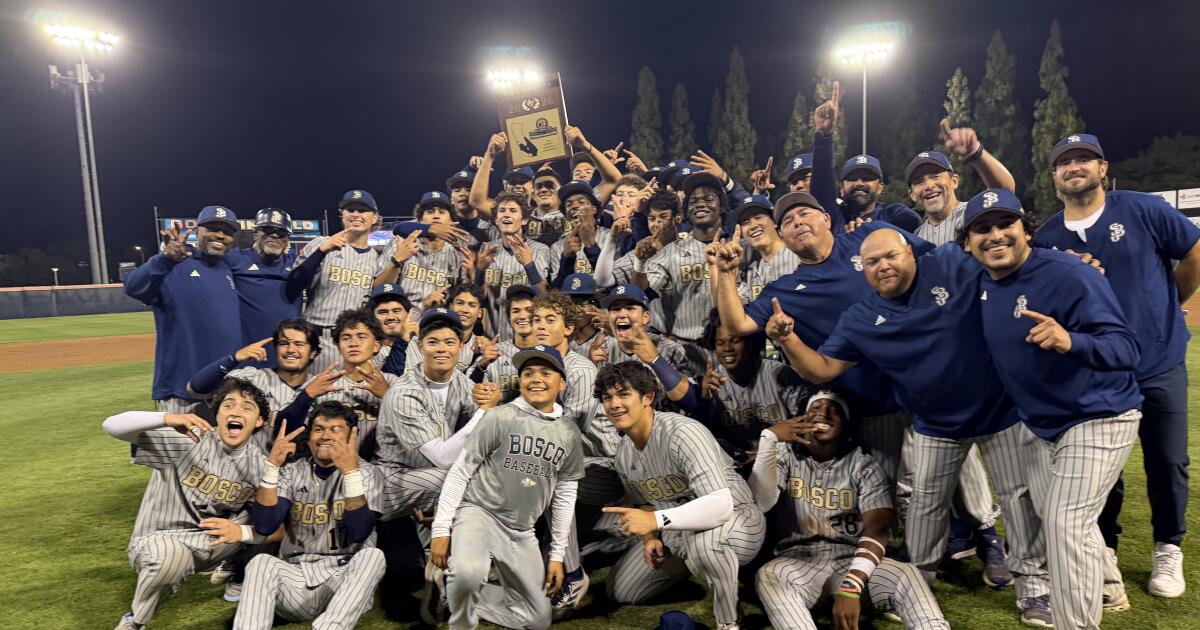
Ranked No. 1 in preseason, St. John Bosco’s baseball team suffered some surprising losses during the National High School Invitational and Boras Classic, losing three straight at one point.
“The little bump in the road was our last opportunities to get guys in there for non-Trinity League games to see what they could do,” coach Andy Rojo said.
The computer rankings didn’t appreciate St. John Bosco’s experimentation. The Braves closed the regular season with 11 straight wins and a Trinity League title, but were punished when the Southern Section Division 1 playoff pairings came out Friday. Orange Lutheran, second place to the Braves, was given a No. 4 seed ahead of No. 6 St. John Bosco.
The disrespect will only add to the motivation for the defending Division 1 champions. St. John Bosco finished the regular season 22-5 and 14-1 in the Trinity League.
It’s another lesson in this new era of relying on computer algorithms for playoff pairings. The people running the computers won’t release their secrets about how teams are really ranked. It’s locked up like the recipe for Kentucky Fried Chicken. Two things are certain for all computer rankings: Head-to-head matchups are really not important and league finish doesn’t matter. Those are two criteria that used to be among the most important in the days when humans put together pairings, so you can understand why old-timers are having a hard time adjusting.
“We feel good,” Rojo said.
And he should. For Southern Section Division 1 baseball, it really doesn’t matter where you are ranked. The 16 teams are so good that everyone is set to go through a gauntlet and may the best team rise to the top.
Orange Lutheran is seeded No. 4 in the Division 1 baseball playoffs.
(Nick Koza)
St. John Bosco opens the playoffs on Tuesday in pool C facing probably the best opening opponent in Crestview League champion Cypress. St. John Bosco has ace Julian Garcia ready to go, but Cypress has multiple pitchers ready to compete. Sierra Canyon is the highest seed in pool C and opens at home against Oaks Christian.
Big VIII League champion Norco received the No. 1 seed for the first 16-team pool play tournament in Division 1. There are four four-team pools with the chance to lose one game and not go home. The first- and second-place finishers in each pool will advance to the single elimination eight-team quarterfinals.
“I love the double elimination,” Rojo said. “If you have a bad day, you get to redeem yourself.”
The other eight divisions remain 32 teams and single elimination.
The Braves effectively managed pitches for Garcia all season in his return from arm surgery that forced him to miss all of 2025. He was even taken out with a no-hitter in the sixth inning against Mater Dei while sticking with 85 pitches to preserve him for the playoffs. He’s had a pitcher-of-the-year season with a 7-1 record, 0.72 ERA and 69 strikeouts in 48⅓ innings.
The big change for the 2026 playoffs for St. John Bosco from 2025 is that closer Jack Champlin will be the No. 2 starter. Sophomore Brayden Krakowski has shown he can be an effective closer. A major decision by Rojo was to shake up his batting order after the three-game losing streak. He switched Jaden Jackson and James Clark, with Jackson becoming the leadoff man and Clark batting second.
“They’re both thriving,” Rojo said.
And so is St. John Bosco, whether computer believes it or not.
Santa Clarita Christian at Academy of Academic Excellence
Nuview Bridge at Burbank Providence
Bishop Diego at Nordhoff
Magnolia at Indian Springs
Banning at Artesia
Salesian at Anaheim
Hesperia Christian at Schurr
FRIDAY’S SCHEDULE
SECOND ROUND
DIVISION 1
Pool A Round 1 Winner vs. Pool A Round 1 Winner
Pool A Round 1 Loser vs. Pool A Round 1 Loser
Pool D Round 1 Winner vs. Pool D Round 1 Winner
Pool D Round 1 Loser vs. Pool D Round 1 Loser
Pool C Round 1 Winner vs. Pool C Round 1 Winner
Pool C Round 1 Loser vs. Pool C Round 1 Loser
Pool D Round 1 Winner vs. Pool D Round 1 Winner
Pool D Round 1 Loser vs. Pool D Round 1 Loser
FIRST ROUND
DIVISION 3
Arlington at Mira Costa
Redondo Union at Ridgecrest Burroughs
Dos Pueblos at Burbank Burroughs
Edison at Damien
Orange County Pacifica Christian at Palos Verdes
Warren at West Ranch
San Dimas at Cajon
Crescenta Valley at St. Francis
Oakwood at Agoura
Garden Grove Pacifica at Chino Hills
Bishop Amat at Corona del Mar
Fullerton at San Juan Hills
Charter Oak at Beckman
South Torrance at Millikan
Summit at La Canada
Simi Valley at Arcadia
DIVISION 5
Paloma Valley at Citrus Valley
Moreno Valley at Irvine
Cathedral at Calvary Baptist
Sunny Hills at Long Beach Poly
Tahquitz at Quartz Hill
Kaiser at Oak Hills
Heritage Christian at Paramount
Loara at Santra Barbara
Montebello at Long Beach Wilson
Jurupa Hills at Santa Fe
Temescal Canyon at Arrowhead Christian
Capistrano Valley Christian at Riverside Prep
Culver City at Cerritos Valley Christian
Mayfair at St. Bonaventure
Bishop Montgomery at Cerritos
Rancho Verde at St. Bernard
DIVISION 7
Palmdale at New Roads
Carpinteria at Flintridge Prep
North Torrance at Baldwin Park
Beverly Hills at Grace
Pasadena Poly at Santa Paula
Milken at Fontana
Patriot at Viewpoint
Placentia Valencia at Victor Valley
Riverside Notre Dame at Hemet
South El Monte at Buena Park
University Prep at Golden Valley
Jurupa Valley at Campbell Hall
Arroyo at Miller
Carter at Adelanto
Nogales at Garden Grove
San Jacinto Valley at Norwalk
DIVISION 9
Redlands Adventist Academy at Dunn
Santa Monica Pacifica Christian at Lennox Academy
Downey Calvary Chapel at Crossroads Christian
Coastal Christian at St. Monica Academy
Mesa Grande at San Bernardino
San Luis Obispo Classical at Ojai Valley
Loma Linda Academy at Webb
Santa Maria Valley Christian at Yucca Valley
Lucerne Valley at Rolling Hills Prep
United Christian Academy at Ambassador Christian
Riverside Bethel Christian at Desert Hot Springs
Anza Hamilton at Westminster
Pomona at Temecula Prep
Cobalt at Environmental Charter
Garden Grove Santiago at Gorman Charter
Animo Leadership at St. Pius X-St, Matthias Academy
Note: Second Round in Divisions 2-9 May 19; Third Round in Division 1 May 19; Quarterfinals in all divisions May 22; Semifinals in all divisions May 26; Finals in all divisions May 29-30.
I walked around a street fair in Irvine over the weekend, checking out the crowd while waiting for my daughter’s dance team to perform. We were a few short miles from Angel Stadium, but you wouldn’t have known it: lots of people wearing Dodgers caps, someone wearing a Shohei Ohtani cap, someone else wearing an Ohtani jersey, someone else wearing a Clayton Kershaw jersey, a dog wearing a Dodgers bandana, and people repping the Padres, Giants, Athletics and Yankees.
After 25 minutes, someone walked by in an Angels cap.
If the passion wanes, apathy can set in. I wondered if that is where the Angels might find themselves now, with a slice of their fan base finding a more enjoyable way to spend its summers than watching one losing season after another, and with the shadow of baseball’s best team extending ever more securely into Orange County.
Something else happened over the weekend that made me wonder. On the heels of a winless road trip, and on the day before the Angels would claim the worst record in the major leagues, Angels general manager Perry Minasian said this to reporters: “Our best baseball is in front of us. There’s no doubt about that.”
No doubt?
Angels general manager Perry Minasian declined to predict in the team would make the playoffs this season.
(Elsa Garrison / Getty Images)
On the Angels’ broadcast the previous night, reporter Erica Weston presented play-by-play announcer Wayne Randazzo with a birthday gift: a figurine of Grogu, a character in the Star Wars family. Randazzo said he would keep Grogu in the broadcast booth, as a good luck charm for the Angels.
“We certainly could use one,” Randazzo said.
Minasian, the sixth-year general manager, has yet to deliver a team that finished better than 17 games out of first place. On Wednesday, I asked him to explain why he was so confident in saying he had “no doubt” the team’s best days were ahead.
“We’ve been very competitive,” Minasian said. “Our wins and losses aren’t where we want them to be, but we have lost a lot of one-run games, a lot of tough games.”
The Angels have lost six one-run games. So have the Yankees, the team with the best record in the American League.
The Angels’ run differential is minus-14. They are four games behind in the AL West, where the first-place Athletics have a .500 record and a minus-21 run differential. You never know.
So far, however, the Angels’ offense is all about the three true outcomes: They strike out the most of any major league team and rank among the top six in walks and home runs, but they do not rank among the top 10 in runs. Only five teams have given up more runs.
“Going to the bullpen has been a harbinger of danger for the Angels,” Randazzo told viewers. The Angels’ bullpen entered Wednesday with a 5.35 earned-run average, the highest in the AL.
Owner Arte Moreno cut payroll this year, amid the implosion of the FanDuel regional sports networks. Edwin Díaz was not walking through the bullpen door.
Angels owner Arte Moreno.
(Ashley Landis / Associated Press)
But the Dodgers find solid bullpen arms in ways beyond buying them: Evan Phillips was cast off by the Baltimore Orioles during a 110-loss season; Alex Vesia was acquired from the Miami Marlins after putting up an 18.69 ERA in his first five major league games.
“We’ve had guys like that,” Minasian said.
He cited Brock Burke, a waiver claim who gave the Angels two solid seasons in middle relief. Minasian traded him last winter for outfielder Josh Lowe, and any general manager would trade a middle reliever for a middle-of-the-order bat. To this point, Lowe has a .198 on-base percentage and a .287 slugging percentage.
Lowe is but a data point in illustrating this primary point: Minasian’s margin for error is smaller than it otherwise would have been if Moreno had not withdrawn from the market for top-tier free agents or had approved trading Ohtani for elite prospects that would have accelerated rebuilding. Smaller, but other teams do more with less.
“We’ve got to be able to develop our own players,” Minasian said.
On the day Minasian said he had “no doubt” better days were ahead for his team, the Angels, their triple-A affiliate and their double-A affiliate all were in last place.
Analysts perennially rank the Angels’ farm system among baseball’s worst. Minasian said he’ll put his faith in four homegrown starters: José Soriano, Reid Detmers, Jack Kochanowicz and Walbert Ureña. Their combined ERA so far: 2.99.
“When you look at good teams and sustainable winners, they build rotations, whether that’s through trades or free agency or your own,” Minasian said. “We’re doing it with our own. You can’t microwave that overnight.”
You can’t make fans wait forever for October either. Angels fans have heard enough about building a competitive team and needing patience.
They have not seen their team in a playoff game in 12 years. When are they going to see that?
Angels pitcher Walbert Ureña delivers against the New York Mets at Angel Stadium on May 1.
(Luke Hales / Getty Images)
“I’m not in the prediction business,” said Minasian, whose contract expires after this season. “They’re going to see a team that plays hard every day. They’re going to see young, talented players day in and day out.”
That’s fine, but when are they going to see a winning team?
“The proof will be in the pudding,” he said. “It doesn’t matter what I say. I could say all these things. At the end of the day, we’re going to go play 162 games. We’ll see where we end up and who’s done what, and we’ll go from there.”
On Wednesday, the Angels won a series for the first time since April 12. They’re 3-2 with Grogu in the broadcast booth.
The schedule gets more challenging: a trip to Toronto and Cleveland, then back to the Big A to play the Dodgers. The same distant Angel Stadium seat available on the resale market for Wednesday’s game for $5 (fees included) is available for $103 for the opener of the Dodgers series.
Orange County loves a winner. There was a long line at that Irvine street fair to collect souvenirs from one booth — the one for the Anaheim Ducks.
HIGH SCHOOL BASEBALL, SOFTBALL SCORES Tuesday’s Results
BASEBALL
CITY SECTION El Camino Real 1, Granada Hills 0 Rise Kohyang 16, CNDLC 15 San Fernando 6, Granada Hills Kennedy 2 Santee 10, LA Jordan 4 University Prep Value 5, Smidt Tech 4
SOUTHERN SECTION AAE 4, University Prep 3 Anaheim 7, Placentia Valencia 6 Arlington 3, Bishop Amat 2 Artesia 8, Garden Grove Santiago 1 Ayala 8, Mira Costa 3 Bethel Christian 18, Packinghouse Christian 1 Bishop Montgomery 3, Redondo Union 2 Bloomington 10, Arroyo Valley 0 Brentwood 10, Shalhevet 0 Buena Park 3, Segerstrom 2 California 7, Whittier Christian 6 Calvary Baptist 27, Crossroads Christian 0 Cantwell-Sacred Heart of Mary 6, Alhambra 4 Carter 5, Eisenhower 4 Chaminade 1, St. Francis 0 Charter Oak 8, West Covina 7 Chino 6, Montclair 5 Chino Hills 5, Rancho Cucamonga 2 Citrus Valley 2, Arrowhead Christian 1 Coastal Christian 5, Valley Christian Academy 3 Compton 14, Dominguez 3 Compton Centennial 5, St. Pius X-St. Matthias Academy 3 Covina 7, Hacienda Heights Wilson 0 Don Lugo 12, Diamond Ranch 1 Eastvale Roosevelt 7, Apple Valley 2 Elsinore 8, San Jacinto 0 El Modena 4, Anaheim Canyon 1 Estancia 15, Bolsa Grande 4 Etiwanda 3, Upland 1 Fontana 10, Rim of the World 3 Garden Grove 6, Santa Ana 0 Glenn 11, San Gabriel 0 Grand Terrace 4, Kaiser 0 Hesperia Christian 15, Excelsior Charter 14 Huntington Beach 3, Gahr 2 Indio 6, Coachella Valley 5 Katella 4, Fullerton 1 Laguna Hills 8, Ocean View 6 Lakeside 9, Indian Springs 5 La Serna 3, Laguna Beach 2 Lennox Academy 10, HMSA 9 Loara 5, Heritage Christian 4 Long Beach Cabrillo 5, Long Beach Jordan 1 Long Beach Wilson 6, Long Beach Poly 3 Los Osos 5, Damien 0 Maranatha 9, Valencia 3 Mary Star of the Sea 10, Glendale 4 Millikan 8, Lakewood 0 Mission Viejo 4, Aliso Niguel 1 Newbury Park 6, Oxnard 4 Ontario 4, Chaffey 1 Orange 2, Irvine 1 Orange County Pacifica Christian 3, Costa Mesa 1 Orange Lutheran 6, Mater Dei 5 Oxnard Pacifica 6, Channel Islands 1 Rowland 8, Northview 5 Santa Ana Calvary Chapel 2, Tustin 0 Santa Fe 9, La Salle 3 Santa Monica 6, St. Monica 4 Servite 1, Cypress 0 Shadow Hills 2, Xavier Prep 1 Sherman Oaks Notre Dame 7, Loyola 1 Sierra Canyon 6, Alemany 5 Silver Valley 3, Lucerne Valley 2 Southlands Christian 9, Avalon 2 St. Anthony 6, Paramount 1 Summit 7, Hesperia 0 Tahquitz 10, Colton 1 Temescal Canyon 3, West Valley 2 Thacher 13, Dunn 7 Trabuco Hills 6, Capistrano Valley Christian 2 Trinity Classical Academy 3, Desert Christian 0 Troy 4, South Pasadena 3 United Christian Academy 14, Anza Hamilton 8 Vasquez 12, Faith Baptist 0 Webb 9, Fairmont Prep 3 Western 8, Whitney 3 Westminster 8, Godinez 2 Whittier 8, Los Amigos 1 Woodcrest Christian 16, Los Altos 1 Yucaipa 10, La Quinta 2
INTERSECTIONAL Cathedral 14, Sotomayor 3 CIMSA 10, Public Safety Academy 0 SLOCA 19, Shandon 2
SOFTBALL
CITY SECTION Animo Robinson d. AHSA, forfeit Smidt Tech 17, Alliance Bloomfield 7
SOUTHERN SECTION Alhambra 26, San Gabriel 5 Alta Loma 5, South Hills 4 Anaheim Canyon 4, Cypress 0 Arlington 7, Orange Vista 4 Arroyo 23, Garey 3 Beaumont 2, Redlands East Valley 0 Bell Gardens 7, Mark Keppel 4 Brea Olinda 7, Sonora 5 Cantwell-Sacred Heart of Mary 5 Carter 12, Grand Terrace 3 Castaic 14, Canyon Country Canyon 8 Cerritos 9, Artesia 0 Chaffey 16, Ontario 3 Charter Oak 10, West Covina 0 Chino 11, Montclair 4 Citrus Valley 8, Cajon 7 Colton 11, Summit 7 Compton 13, Long Beach Jordan 11 Compton Early College 21, Compton Centennial 6 Costa Mesa 23, Godinez 11 Covina 10, Hacienda Heights Wilson 3 Crean Lutheran 17, Esperanza 7 Don Lugo 11, Diamond Ranch 1 Elsinore 13, West Valley 0 El Toro 11, Beckman 0 Firebaugh 17, Bellflower 16 Fontana 15, Rim of the World 5 Foothill Tech 15, Carpinteria 0 Fountain Valley 19, Corona del Mar 6 Fullerton 9, Segerstrom 1 Garden Grove Pacifica 12, El Modena 7 Gahr 9, La Mirada 7 Gardena Serra 14, St. Bernard 6 Hart 16, West Ranch 0 HMSA 13, Environmental Charter 3 Huntington Beach 20, Newport Harbor 0 Indio 25, Coachella Valley 0 Lakewood 8, Long Beach Wilson 6 La Salle 12, St. Monica 1 Los Alamitos 2, Marina 1 Los Altos 7, Colony 3 Lynwood 24, Dominguez 10 Mater Dei 9, JSerra 5 Millikan 22, Long Beach Cabrillo 0 Mission Viejo 8, Capistrano Valley 2 Moorpark 3, Simi Valley 1 Murrieta Valley 7, Great Oak 6 Northview 10, Rowland 0 Oak Park 10, Grace 3 Oaks Christian 20, Calabasas 0 Orange Lutheran 3, Santa Margarita 0 Paraclete 16, Lakewood St. Joseph 15 Paramount 12, Norwalk 4 Pasadena Poly 30, Westridge 17 Ramona Convent 12, Mary Star of the Sea 2 Rancho Mirage 19, Palm Desert 18 Rialto 9, Jurupa Hills 3 Riverside King 9, Ramona 1 Riverside Notre Dame 4, Bloomington 3 Royal 13, Camarillo 12 San Clemente 14, Tesoro 2 San Gorgonio 15, Arroyo Valley 10 San Jacinto 17, Tahquitz 6 Santa Ana Calvary Chapel 8, Ocean View 5 Schurr 19, Montebello 2 Silver Valley 20, Lucerne Valley 9 St. Anthony 7, Bishop Conaty-Loretto 1 St. Paul 12, Bishop Amat 8 Sunny Hills 19, Troy 1 Thousand Oaks 4, Agoura 3 Torrance 2, South Torrance 0 Tustin 3, Laguna Hills 2 United Christian Academy 13, La Sierra Academy 0 University Prep 15, Victor Valley 5 Valencia 19, Golden Valley 0 Valley Christian 13, Maranatha 0 Vasquez 11, Santa Clarita Christian 1 Ventura 13, Santa Clara 2 Viewpoint 5, Burbank Providence 1 Warren 2, Downey 1 Westlake 9, Newbury Park 3 Whittier Christian 10, Heritage Christian 0 Yorba Linda 3, Villa Park 1 Yucaipa 23, Redlands 0
Chris Clarke had gone the traditional route, pitching for three years at USC after starring at Newbury Park High, then toiling for six more seasons in the Chicago Cubs’ minor league system after being a fourth-round draft pick in 2019.
But his big-league dream abruptly became a wake-up call last August when the Cubs released him a week before his wife gave birth to their first child. No more paychecks. No more health insurance.
“It was surreal,” Clarke said. “In fact, it was so incredible, I didn’t feel anything. My body went numb. There was a moment in the third inning when everybody was screaming. I couldn’t hear myself talk.”
It was the most people ever crammed into Kyle Field, the nation’s fourth-largest college stadium, trailing only Michigan (107,601), Oregon (106,572) and Ohio State (102,780).
Clarke pitched for the opposing team, the Texas Tailgaters, one of five squads created by Bananas founders Jesse and Emily Cole that serve as touring partners to face the yellow-clad star attraction. All six teams practice at a complex in Savannah, Ga.
The game in College Station attracted the largest crowd in the Bananas’ six-year history, and Clarke shined, striking out five in four innings. He also entertained, as all players in the Banana Ball Championship League are cheerfully required to do.
“The amount of joy it brings to fans and even people online, it’s really something,” Clarke said. “There definitely is a winner and a loser — which holds some weight — but for the most part, fans are there because it’s a really good show.”
Clarke, a 6-foot-7 right-hander, was the third overall pick in the inaugural Banana Ball draft held in November. Tailgater coaches contacted him beforehand to gauge his interest and he told them, “Pick me.”
March 2019 photo of former USC pitcher Chris Clarke during the 2019 Dodger Stadium Classic.
(John McGillen/USC Athletics)
That level of bold fits right in. Banana Ball is fast-paced, hilarious and maximizes fan engagement. It features innovative rules: Fouls caught by fans count as outs, for example, and batters who walk get to run the bases until all nine defensive players have touched the ball. Choreographed dances, acrobatic tricks, a pitcher on stilts and other antics keep the entertainment flowing.
“I like to think of every game as a stepping stone to the next show,” Clarke said. “Whether it goes well or is terrible, we will make it better for next time. Banana Ball is a relaxed culture, so when it comes to the entertainment stuff, there is no fear of failure. We are seeing what works and what doesn’t.”
Guest stars are frequent and on Saturday, the Bananas sent Texas-grown YouTube sensation Tyler Toney, a member of the sports comedy troupe Dude Perfect, to the plate as a pinch-hitter. Clarke struck him out on four pitches: a called strike, a swinging strike, a ball Clarke purposely launched high into the stands for laughs, then strike three swinging on a cut fastball.
It was a rare humbling moment for Toney, who, with fellow Dude Perfect members Cody Jones, Garrett Hilbert, and twins Cory and Coby Cotton, generates more than $20 million annually from YouTube, merchandise and tours.
Clarke had watched Dude Perfect videos religiously when he was at USC and was starstruck to meet them in person.
“Dude Perfect is the reason I failed econ twice,” he said. “I watched every single Dude Perfect video. To meet them and shake their hands was fun. It was the only moment in my life where I was a fanboy.”
He’s also a breadwinner again for his family. The burgeoning popularity of Banana Ball has made the gig more lucrative than playing in the minor leagues.
“I’m making five times as much and playing half the time,” Clarke said. “My contract is also for 12 months of the year. In affiliated baseball, it’s only six months. So, there’s that. I’ve never met anyone in baseball who has had the luxury to spend time with a newborn child. To come to Banana Ball and actually feel like there is respect, a culture and guidelines, that was something I hadn’t experienced.”
It is also giving him notoriety. Twenty-five Banana Ball games this year are being streamed on the ESPN app and Disney+, with select games airing across ESPN networks and ABC. The first Bananas broadcast on ABC will take place at Autzen Stadium in Eugene, Ore., June 27 and 28. The games have been sold out since October.
Highlights from Saturday’s game flooded social media and traditional outlets alike. Family friends and former teammates reached out to Clarke. What was it like pitching in front of 100,000 people? Are you improving your dance moves?
“The entertainment side of it takes pressure off performance,” he said. “Performing well is still very much there, but there is a level of relaxation that makes it easier.”
Clarke admits he thinks back to USC and the 2019 season, when he posted a stellar earned-run average of 1.03. He also occasionally misses the heightened competition and quest to make the major leagues of affiliated baseball.
He pitched two seasons in triple A and is only 27. Would he leave Banana Ball next year if an MLB team offered him an invite to spring training?
“I’m not in a situation to close any doors,” he said. “That’s the mindset that got me here. I wanted to investigate Banana Ball and I told them I’d give them a full year for us both to evaluate it. Either way, I think it’s a win. Just comes down to what’s best for my family.”
Meanwhile, more games in packed stadiums await. In addition to a handful in football stadiums against the Bananas, the Tailgaters will play three games a week against other Banana Ball League teams throughout the summer, mostly in minor league baseball stadiums from Tulsa, Okla., to El Paso, Texas, to Nashville, Tenn., to Charlotte, N.C.
Exponentially larger crowds than those venues are accustomed to are a given.
The ninth in an occasional seriesof profiles on Southern California athletes who have flourished in their post-playing careers.
When the Dodgers drafted David Lesch in January 1980, they had visions of his fastball lighting up radar guns at Dodger Stadium.
He never made it that far.
Lesch never climbed above the lowest rung on the minor league ladder, where he pitched just 10 innings and gave up more runs, hits and walks than he got outs. Less than 18 months after he was drafted, Lesch, wracked by a rotator cuff injury, was released, his major league dream over before he was old enough to legally buy a beer.
“I went to Disney World after that,” he said.
But that wasn’t the only decision the Dodgers made that changed Lesch’s life. When he was drafted, the team gave him just a small bonus, but sweetened the deal by offering to pay for college if he ever went back to school. For the team, it seemed a safe bet.
“They probably have this algorithm saying ‘this is the No. 1 draft pick. If he doesn’t make it, he’s not going back to college. He’ll be assistant baseball coach of his high school or something,’” Lesch said.
Oops.
Lesch not only went back to college, but he also wound up getting three degrees, including a master’s and a PhD from Harvard. It was arguably the most important investment in humanity the Dodgers made since signing Jackie Robinson, because Lesch went on to become one of the world’s top experts on the Middle East, writing 18 books and more than 140 other publications while advising four presidents and a cadre of United Nations diplomats.
David Lesch interacts with students in his history class at Trinity University in San Antonio.
(Lucero Salinas / Trinity University)
“That was the best deal,” Lesch, 65, said by phone from San Antonio, where he is the Ewing Halsell Distinguished Professor of History at Trinity University.
“Without that I probably could not have said yes to Harvard because of the price. The Dodgers committed to paying.”
And by doing so, the Dodgers may have altered history just a bit.
Lesch’s regular meetings with Syrian president Bashar al-Assad, which ended with Lesch facilitating an important if temporary breakthrough in U.S.-Syrian relations? The diplomatic and conflict-resolution work in Syria and the wider U.N. initiatives on regional issues throughout the Middle East? The thousands of students Lesch inspired to go on to perform important diplomatic and public-service roles of their own?
None of that happens if Lesch’s shoulder had held on or if the Dodgers had reneged on their deal.
“It was very fortunate that he hurt his rotator cuff. Baseball’s loss is academia’s gain,” said Robert Freedman, a scholar and expert on Russian and Middle Eastern politics who taught Lesch at the University of Maryland Baltimore County.
“I’ve been teaching for, I guess, 60 years now and I can tell when a student can see a complex problem and can penetrate right to the heart of the problem very quickly. He was one of those students.”
Still, it took a slightly offhand comment from Freedman, who now teaches at Johns Hopkins, to launch Lesch on his post-baseball career.
“We were having lunch and he was looking for a project and I mentioned to him ‘you know, there hasn’t been a good American scholar doing work on Syria for many, many years,’” he said.
“That struck his interest.”
Playing a child’s game and managing life-and-death Middle East politics share very little in common. But Lesch made the transition seamlessly.
“It is like he’s several different people, or has been,” said journalist and author Catherine Nixon Cooke, whose book “Dodgers to Damascus: David Lesch’s Journey from Baseball to the Middle East” traces those parallel lives.
“I’m wondering if, in a sense, it all worked out the way it was supposed to,” Cooke continued. “Even though his dream was to be a major leaguer, David certainly has reinvented himself to this really remarkable man following a completely different path.
“It was the Dodgers who paid for him to go to Harvard and so it’s kind of a weird thing. Baseball took away his dream because he got hurt, but baseball also gave him his backup plan.”
Lesch was still a teenager when, 20 minutes into his first spring training camp in Vero Beach, Fla., Dodgers manager Tommy Lasorda plucked him off a minor league practice field to pitch batting practice in the main stadium.
It was the first time — and nearly the last — that Lesch faced big-league hitters. And it didn’t start well.
Batting practice pitchers throw from behind an L-shaped screen that protects them from comebackers and Lesch had never used one. That, combined with his understandable nervousness, caused him to short-arm his first fastball, which sailed at Cey’s head, sending him sprawling into the dirt.
“He got up and gave me this mean look,” Lesch said. “I remember it so vividly right now. I really thought I was going to be released that day.”
Instead, he gathered himself and finished the session, earning pats on the back from both Garvey and Lasorda. The incident, he said, has colored the rest of his life.
“I’ve met with presidents, prime ministers, been in war zones, all sorts of things,” Lesch said. “Anytime I say ‘well, you know, this should make me nervous,’ I think about that episode and the fact that I made it through and did OK.”
In high school, Lesch had focused on basketball and baseball. Academics? Not so much. So after spending his freshman year of college at Western Maryland College, he transferred to Central Arizona, a junior college, so he would be eligible for the January 1980 draft, allowing him to trade his books in for a baseball.
The so-called secondary draft, which was discontinued six years later, was specifically targeted toward winter high school graduates, junior college players, college dropouts and amateurs who had been previously drafted but did not sign. As a result, the bonuses teams offered winter draft picks were just a fraction of what players taken in the June draft received.
Lesch’s was so low, he can’t even remember what it was.
“I want to say $10,000 to $15,000,” he said. “No more than $20,000.”
When it became clear the Dodgers weren’t going to budge on the money, Lesch’s father, Warren, a family physician in suburban Baltimore, pulled out the Harford County phone book and looked up the number for Baltimore Orioles coach Cal Ripken Sr. Lesch played high school ball against Ripken’s son Cal Jr., who had been a second-round draft pick of the Orioles two years earlier. So his father thought the Ripkens might have some advice on what to ask of the Dodgers.
David Lesch, a former Dodgers draft pick, stands on the baseball diamond at Trinity University in San Antonio.
(Lucero Salinas / Trinity University)
“Ripken goes ‘does your son like school and is he smart?’” Lesch’s older brother Bob remembers. “So Ripken suggested if they offer you XYZ bonus money, take less and say ‘I’ll take this amount, but you have to cover education if he doesn’t make it.’”
Neither side thought that clause would ever be triggered; Lesch, a big, intimidating right-hander who threw bullets from behind Coke-bottle eyeglasses, wasn’t headed to a classroom, he was going to Dodger Stadium.
Until he wasn’t.
Lesch missed a couple of weeks with a back injury. By overcompensating for the sore back, he developed paralysis in the ulnar nerve in his right arm, limiting him to five appearances in his first minor league season.
He arrived healthy for his second spring in Vero Beach and threw three no-hit innings in his first outing against double-A and triple-A players, creating such a buzz that Ron Perranoski, the Dodgers’ major league pitching coach, showed up to watch his second game. By then the shoulder and back stiffness that shortened his first season had returned, and Lesch was rocked. Perranoski left early and unimpressed.
Lesch’s delivery had one major flaw: He threw directly overhand, as opposed to three-quarters or even sidearm, which can increase velocity but also places additional strain on the shoulder and elbow. As a result, his fastball could top out in the mid-90s one day, but when the stiffness and pain returned, it left him throwing in the low 80s.
The inconsistency continued to plague Lesch, and eventually the Dodgers decided they’d seen enough and released him. When he got back to Maryland, Lesch’s father sent him to see an orthopedic surgeon, who found the problem wasn’t in his back or elbow but rather the rotator cuff.
“We didn’t live in the era of pitch counts. So he just pitched,” said David Souter, a high school and college teammate who went on to develop big-league pitchers.
“He had the ability if he was developed and stayed healthy. I think he probably overthrew and tore his rotator cuff and nobody knew it.”
If Lesch had come along 10 years later, when rotator cuff surgeries were common, he might have returned to the mound. But in 1981, a rotator cuff injury was a death sentence for a pitcher.
“It’s just a crapshoot based on physiology,” Lesch said. “I probably was destined. Something would have happened.”
If he could do it over again, Lesch said he would change one thing.
“I’d throw sidearm,” he said. “It’s much less stress.”
He threw to big league hitters just one more time. Following the strike that interrupted the 1981 season, Ripken Sr. phoned Lesch back and asked him to throw batting practice at Memorial Stadium to help the Orioles prepare for the resumption of play. As a reward, the Orioles let Lesch hit — he never had batted in the minors — and he drove a pitch over the left-field wall, then dropped the bat and walked away.
He never stepped on a major league field again.
The Dodgers’ investment in Lesch’s education appeared manageable when he enrolled at a satellite campus of the University of Maryland, in part because his brother Bob was the school’s sports information director.
But it was 1981 and the Middle East was at the forefront of geopolitics. Lesch became convinced the Middle East would be central to world affairs for decades to come. Inspired and encouraged by Freedman and another professor, Lou Cantori, he applied to graduate school at Harvard, Georgetown, Johns Hopkins and the University of Chicago, knowing he couldn’t afford any of those schools on his own.
“I probably could not have said yes to Harvard when they accepted me because of the price,” Lesch said. “The Dodgers had committed to paying and whatever it was, it was a lot more collectively — my undergraduate MA and PhD — than I had gotten in the bonus.”
That wasn’t the only time his baseball background worked in his favor. Years after starting at Harvard, Lesch stumbled upon written evaluations of his application and learned that his grade-point average and other factors were similar to those of other applicants, but it was his athletic career that had swung enough votes in his favor to get him accepted.
“Failure is at the core of sports. And so you have to have this resiliency,” Lesch said. “What a lot of the top colleges have found is that these young kids out of high school who somehow get a 4.6 GPA, they come in — and I’ve seen this as a professor — they get their first C and they’re distraught.
“Athletes stick with it. They say ‘how can I turn this around? How can I get better?’ Admissions departments across the board have looked at athletes much differently.”
The struggles Lesch experienced on the diamond did not follow him into academia. Yet becoming an expert on the Middle East definitely was a backup plan.
“His first passion was clearly baseball and basketball,” said Souter, the former teammate. “Every kid dreamed … that.”
If the shoulder injury wasn’t a strong enough sign that that dream was over, the fire that destroyed Lesch’s childhood home a few years later was. The flames, which severely burned both his parents, also erased his baseball career, consuming all the photos and memorabilia he had collected, save for the championship ring from his one minor league season, which he found buried in the embers. It was the only thing to survive the blaze intact.
David Lesch’s championship ring from his one minor league season, the only surviving keepsake of his professional career after a his family’s home was destroyed in a fire.
(Courtesy of David Lesch)
A post-graduate trip to Syria, the first of more than 30 visits he has made to the country, sealed the deal a few years later. The love he once had for baseball he now felt for a strange and mysterious place that was as old as history itself yet as secretive as the classical ciphers.
Soon Lesch was helping arrange high-level meetings between Syrian president Hafez al-Assad and President George H.W. Bush, a baseball fan who seemed as interested in Lesch’s Dodgers days as his Middle Eastern expertise. But his big break came during the first presidential term of Bush’s son George W. Bush, when Bashar al-Assad, who succeeded his father as Syria’s president, welcomed Lesch for the first of many interviews that informed his book, “The New Lion of Damascus: Bashar al-Assad and Modern Syria.”
“His forte is listening,” Cooke, the biographer, said of Lesch, whose polite, unassuming manner reflects an adult life spent mostly in San Antonio. “When he goes in to try to mediate something, he is a big listener. There is a side of David that doesn’t talk much. But he’s listening.”
The book humanized al-Assad and opened, for a time, the possibility of normalized relations between Syria and the West, with Lesch serving as an unofficial liaison between Damascus and Washington, as well as other Western capitals.
“He’s absolutely a critical player in what we would call two-track diplomacy,” Freedman said. “If the government wants to reach out but doesn’t want to take the political consequences, they send somebody to sound out the situation.
“It’s absolutely critical that we have people like that who can speak the language and understand the overall context, which sadly is lacking in the current administration.”
David Lesch teaches students in his history class at Trinity University in San Antonio.
(Lucero Salinas / Trinity University)
But that opening closed as quickly as it opened. Lesch’s close contacts with al-Assad raised suspicions among some in Syria, and Lesch was poisoned twice. His relationship with al-Assad was severed completely shortly afterward when he criticized al-Assad for failing to implement promised reforms and becoming a “bloodthirsty tyrant.” The Syrian civil war took nearly 700,000 lives and displace another 6.7 million people before al-Assad and his family fled into exile in Russia in 2024.
“Many governments think that they can reduce war to a calculation,” Lesch said. “What we cannot measure accurately or fully appreciate is the human element. We cannot assess a people’s sense of grievance, passion, revenge, ideological commitment and historical circumstances that shaped the nature of their response and staying power.
“This is where academics can make a contribution to policy, giving it the depth and insight gleaned from years of study and learning the culture and the people.”
Baseball’s loss wasn’t just academia’s gain. It may prove to be humanity’s as well.
“I don’t really have any regrets,” Lesch said. “My career turned out great. I could not think of doing anything else at this point and, in fact, in a way I’m glad [baseball] didn’t work out.”
Hi, and welcome to another edition of Prep Rally. I’m Eric Sondheimer. One week to go in the high school baseball regular season. Birmingham made a big move in the City Section.
Get our high school sports newsletter
Prep Rally is devoted to the SoCal high school sports experience, bringing you scores, stories and a behind-the-scenes look at what makes prep sports so popular.
By continuing, you agree to our Terms of Service, which include arbitration and a class action waiver. You agree that we and our third-party vendors may collect and use your information, including through cookies, pixels and similar technologies, for the purposes set forth in our Privacy Policy such as personalizing your experience and ads.
Birmingham rises
Sophomore catcher Jordan Lindsay is all smiles for Birmingham after RBI double in the fourth inning.
(Craig Weston)
Two sophomores, pitcher Carlos Acuna and catcher Jordan Lindsay, rose up last week to push Birmingham to within one win of clinching the West Valley League baseball championship and earning a rare No. 1 seed for the City Section Open Division playoffs.
Acuna is set to start on the mound Monday against Cleveland, and that would wrap up the first league title for coach Matt Mowry since he took over the program in 2007. He’s won five City titles.
The big series this week in the City Section involves South Gate and Garfield. They are tied for first place in the Eastern League. Along with Bell, the league could have a record three teams chosen for the Open Division playoffs if South Gate comes through.
In the Southern Section, the final week is all about trying to lock up an automatic playoff berth so as not to have to rely on computer rankings for an at-large berth when playoff pairings are announced on Saturday at 1 p.m.
Norco (Big VIII), St. John Bosco (Trinity), Ayala (Palomares), Huntington Beach (Sunset), Cypress (Crestview) have clinched high seeds in the Division 1 playoffs. Harvard-Westlake (Mission) is closing in on the Mission League title. Orange Lutheran is No. 2 in the Trinity, but who gets No. 3? Mater Dei needs a win over Orange Lutheran in a three-game series this week to help its chances.
According to last week’s Southern Section power rankings, these are the 16 teams that would make up the Division 1 playoffs with one week to go: 1. Norco, 2. Harvard-Westlake, 3. Orange Lutheran, 4. Corona, 5. Ayala, 6. Sierra Canyon, 7. St. John Bosco, 8. Sherman Oaks Notre Dame, 9. Temecula Valley, 10. Cypress, 11. Huntington Beach, 12. Oaks Christian, 13. Etiwanda, 14. La Mirada, 15. Corona Santaigo, 16. Maranatha.
Norco won two of three games from Corona in a terrific three-game series to win the Big VIII League title. Both teams should be in the 16-team Division 1 field.
Servite pulled off a 1-0 win over Orange Lutheran even though the Lancers’ Gary Morse threw a no-hitter.
Brentwood 6-foot-5 junior pitcher Jack Kaplan has been having a terrific season, including a perfect game. He has 77 strikeouts in 44 innings. His pitching coach is former UCLA and MLB pitcher Tim Leary.
Blake Bowen of JSerra ended his high school career this week with nine home runs this season, including one in each victory of a three-game series with Santa Margarita. Here’s the report.
Castaic shared the title with West Ranch in the final season for coach Darrell Davis. Sophomore Orion Gonzalez is hitting .390 with 30 hits.
Mattias DiMaggio of Dos Puebos is a freshman baseball player hitting above .500.
(Dos Pueblos)
Few are having a better season than Dos Pueblos freshman Mattias Di Maggio. And yes, he’s a distant relative to Joe DiMaggio. Here’s the report.
Softball
The Trinity League softball race has gotten tight, with Orange Lutheran and JSerra both entering this week tied for first place at 5-3. Pitcher Liliana Escobar of JSerra has been leading the Lions’ surge. Orange Lutheran closes league play with a game at Santa Margarita on Tuesday. JSerra is at Mater Dei, with Escobar ready to deliver.
Granada Hills and Carson are looking like the top two teams in City Section softball. Granada Hills has a two-game lead in the West Valley League with three games to play. Carson has clinched at least a share of the Marine League title.
Norco (24-2) and Murrieta Mesa (23-1) continue on a collision course for the Southern Section playoffs. Pairings will be announced next Monday.
Loyola’s Ejam Johannes offers the “shoosh” sign after anchoring the winning 4×100 relay team. He also won the Mission League 400 and 200 titles.
(Craig Weston)
The Southern Section track and field prelims are set for Saturday. It’s all about qualifying and advancing and making sure batons are not dropped and violations don’t occur during relays.
The sites: Trabuco Hills (Division 1), Ontario (Division 2), Yorba Linda (Division 3) and Carpinteria (Division 4).
The Mission League finals last week featured two top Loyola athletes, Ejam Johannes and Zion Phelps. Here’s the report.
There’s lots of speed in the 100 meters. The Southern Section championships will take place in two weeks at Moorpark High.
The City Section will hold league finals this week.
Volleyball
Mira Costa’s Ruby Cochrane (facing) tries to block a tip attempt by JSerra’s Emma Champagne in the Southern Section Division 1 girls’ beach volleyball final. Cochrane and partner Olga Nikolaeva won, 21-19, 17-21, 15-13.
Mira Costa swept JSerra to win the Southern Section girls beach volleyball championship. Here’s the report.
Venice won the City Section team title.
Granada Hills is seeded No. 1 in the City Section boys volleyball playoffs. Here’s the pairings.
Grant Chang of Chatsworth delivers a kill against Granada Hills. He learned he was accepted to MIT.
Birmingham ended Palisades’ reign as City Section boys lacrosse champions. Here’s the report.
NFL star offers lessons
Indianapolis Colts safety Camryn Bynum (0) gestures toward the stands. He played at Corona Centennial.
(Kyusung Gong / Associated Press)
There are so many lessons to be learned from former Corona Centennial defensive back Camryn Bynum, who is returning this month to hold a camp at his alma mater.
He was once fifth string on Centennial’s JV team as a sophomore. He decided to work harder and look where his path has taken him.
David Schuster is moving from Mission College Prep to head football coach at Ontario Christian….
JV coach Miguel Mayorga has been promoted to varsity basketball coach at Golden Valley….
Former Chatsworth star Alijah Arenas announced he is returning to USC next season….
Caleb Martin, a former assistant basketball coach at Oaks Christian, Harvard-Westlake and Vanguard, is the new head coach at St. Margaret’s….
Former Sherman Oaks Notre Dame basketball player Tyran Stokes has committed to Kansas….
Muir has received a $2-million donation from Mamba and Mambacita Sports Foundation to build a synthetic softball diamond. The field will be named, “Kobe and Gianna Bryant Field.” …
Matt LemMon has resigned as football coach at Garden Grove….
Former St. John Bosco and Notre Dame linebacker DJ Morgan is the new football coach at Leuzinger. He was the defensive coordinator….
Anaheim Canyon and Fullerton are changing their mascots next season because of a new state law requiring public schools to remove Native American team names that could be considered derogatory. Canyon will go from being the Comanches to the Cobras this fall. Fullerton will change from Indians to RedHawks….
Senior pitcher Alex Martinez of Sylmar has committed to the University of Redlands. His uncle was the late Glenn Martinez, a former assistant commissioner with the Southern Section and longtime baseball coach….
Alex Koers is the new girls basketball coach at Brea Olinda….
Harvard-Westlake has announced the appointment of Asha Prithviraj as its inaugural girls’ football coach. She previously worked at Mater Dei. 2026 will be the first season for flag football at Harvard-Westlake….
Pasadena Marshall Fundamental has dropped 11-man football for the 2026 season….
CJ Cooper is the new boys basketball coach at Capistrano Valley Christian….
Receiver Braylen Ross of Crean Lutheran has committed to Arizona…
Defensive back JuJu Johnson from Long Beach Poly has committed to UCLA….
Defensive lineman Alifeleti “Tolo” Tuihalamaka of Oaks Christian has committed to USC….
Uriel Villa is the new boys water polo coach at Orange Lutheran….
Palisades won its 17th consecutive City boys tennis title. Here’s the report.
From the archives: Isaiah Magdaleno
Isaiah Magdaleno from Crespi High has become one of the top pitchers for Hawaii and a pro prospect.
(Crespi)
Former Crespi pitcher Isaiah Magdaleno thrilled Hawaii baseball fans Friday night by striking out 16 and throwing a one-hitter in a win over UC Riverside.
He was primarily a relief pitcher starting out at Hawaii but has now become a pro prospect with his starting pitching. He’s 5-4 this season with a 2.75 ERA and 88 strikeouts in 72 innings.
He was the pitcher of the year in the Mission League in 2022.
In his first pitching start of the season, the Mission League pitcher of the year, Isaiah Magdaleno, takes down the No. 1 team in California. Crespi 3, Notre Dame 1. pic.twitter.com/nWEEhB25LP
From West Virginia, a story on adding flexibility to transfer rule.
From The562.org, a story on a $100,000 donation for Long Beach sports teams.
From The Athletic, a story on former Sherman Oaks Notre Dame basketball player Tyran Stokes.
Tweets you might have missed
With Japanese players so good and so fundamentally sound in baseball, someone needs to organize a trip to Japan for high school baseball coaches to see if there’s something to be learned.
The best freshman baseball player in Southern California lives in Santa Barbara. Mattias Di Maggio of Dos Pueblos has 34 hits, a .515 batting average, 9 home runs and four saves as a left-handed pitcher. He’s struck out once in 66 at-bats.
Southern California Jewish Sports Hall of Famers at ECR no longer coaching softball. Now coaching at Northridge LL and West Valley softball. pic.twitter.com/g7kzM0UK2H
Congrats to Loyola Swim, winners of the Mission League title for the 20th consecutive season and owners of another undefeated league record — their 22nd perfect season in the last 23 years! #LoyolaSwimming | #GoCubspic.twitter.com/3a3FPelh4D
— Loyola High School Athletics (@LoyolaAthletics) May 1, 2026
Parents crying about an entire team being punished because of an ineligible player, please stop. Those who kept quiet and didn’t say anything, it’s on you. The administrators who didn’t look hard enough, it’s on you, too. Cheaters need to be caught early not late.
Have a question, comment or something you’d like to see in a future Prep Rally newsletter? Email me at eric.sondheimer@latimes.com, and follow me on Twitter at @latsondheimer.
Did you get this newsletter forwarded to you? To sign up and get it in your inbox, click here.
ST. LOUIS — Dodgers right-hander Emmet Sheehan first met MLB.com researcher extraordinaire Sarah Langs during the World Series last year. But he’d known of her before that.
Langs, who turned 33 on Saturday, made her mark on the industry early in her career. Even as a young writer, her talent for digging up interesting stats, along with her contagious positivity and love for the game, set her apart in a crowded media landscape.
Langs was aware of Sheehan too, not only for his blossoming major league career, but also the message stitched into his glove: “K ALS.”
Oh my goodness 😭😭😭😭 this is so incredibly meaningful 🥺🥺🥺🥺
Langs was diagnosed in 2021 with Amyotrophic Lateral Sclerosis, a progressive neurodegenerative disease, also known as Lou Geherig’s disease after the Hall of Fame New York Yankees first baseman. Langs advocates for ALS research, partnering with Project ALS, and frequently highlights others who are raising awareness and funds for the cause.
“Just getting the chance to meet her was awesome,” Sheehan said in a conversation with The Times. “She’s a great advocate and a really smart mind in the world of baseball. So it’s awesome to have her.”
When Sheehan pitches, Langs posts pictures of the message on his glove. For his start Friday, Langs’ post included the caption: “May is ALS Awareness Month. Fitting that Emmet Sheehan is on the mound tonight. His gloves all say ‘K ALS.’ How lucky are we to have that sentiment represented on an MLB mound?!”
The next day, MLB posted a video of Sheehan wishing Langs a happy birthday and letting her know he was gifting her a glove as a token of his appreciation.
“I’m happy I get to be a part of the league where [ALS research and awareness] is kind of a main focus,” Sheehan said Saturday, also highlighting Chicago Cubs broadcaster Jon “Boog” Sciambi’s work through Project Main Street. “It’s been really cool.”
Sheehan has displayed “K ALS” on his gloves since college, when he joined a Boston College program that embraced the cause.
Pete Frates, who popularized the ALS Ice Bucket Challenge in 2014, was a former B.C. baseball standout. And he returned to serve as the director of baseball operations in 2012, the year he was diagnosed with ALS.
During Sheehan’s first year at Boston College, he got to spend time with Frates and his family before Frates died in December 2019.
“We talked about it a ton,” Sheehan said. “It was a huge part of our program. So it was a good opportunity to learn about it and just how terrible the disease is and how it can affect people.”
The lesson stuck with him. And now, as a major league player, he’s passing it on.
For Blake Bowen and his JSerra High baseball teammates, their final week of the high school baseball season could not have gone any better.
The 6-foot-4 senior hit three home runs during a three-game sweep of Santa Margarita. But the Lions finished their season on Friday with an 11-17 record, which means there will be no postseason.
“Too little, too late,” coach Brett Kay said.
Bowen came on strong, finishing with nine home runs and a .360 batting average. His ability to hit the ball hard and far should make him a high draft pick this summer.
“It’s the best power I’ve ever seen for a high school player,” Kay said.
Bowen is a former football player who began focusing only on baseball after transferring to JSerra from Riverside King. He plays baseball like he did in football — with an aggressiveness.
“Once he comes into his own, he’s going to be special,” Kay said.
The Lions had a young team that was hurt by injuries. One of the impressive young players was freshman Joey Koenig, who showed he can hit and will get a chance to pitch in the future.
This is a daily look at the positive happenings in high school sports. To submit any news, please email eric.sondheimer@latimes.com