Barack Obama

This millennial illustrates why Iowa is a swing state

As a teenager before he was even allowed to vote, Charlie Comfort organized for then-Sen. Barack Obama in his hometown of Oskaloosa, Iowa.

Now he’s a Republican.

Meet Charlie. He lives in Waterloo.

He’s 23 and this will be his third presidential caucus.

Charlie’s first foray into politics was during the 2008 campaign. He met Obama at the Smokey Row Coffeehouse, one of the most popular stops for candidates in Oskaloosa, on the Fourth of July in 2007.

Obama campaign volunteers. (Handout)

It was Malia Obama’s 9th birthday, and the shop’s staff put the candidate’s daughter’s name up on the marquee inside.

After Obama spoke, Charlie ran home excited and ready to help.

He wasn’t old enough to vote but dedicated hours to organizing his neighbors, teachers and anyone else who would listen. The Obama campaign said Charlie, a high school student, made more phone calls than any other volunteer in town.

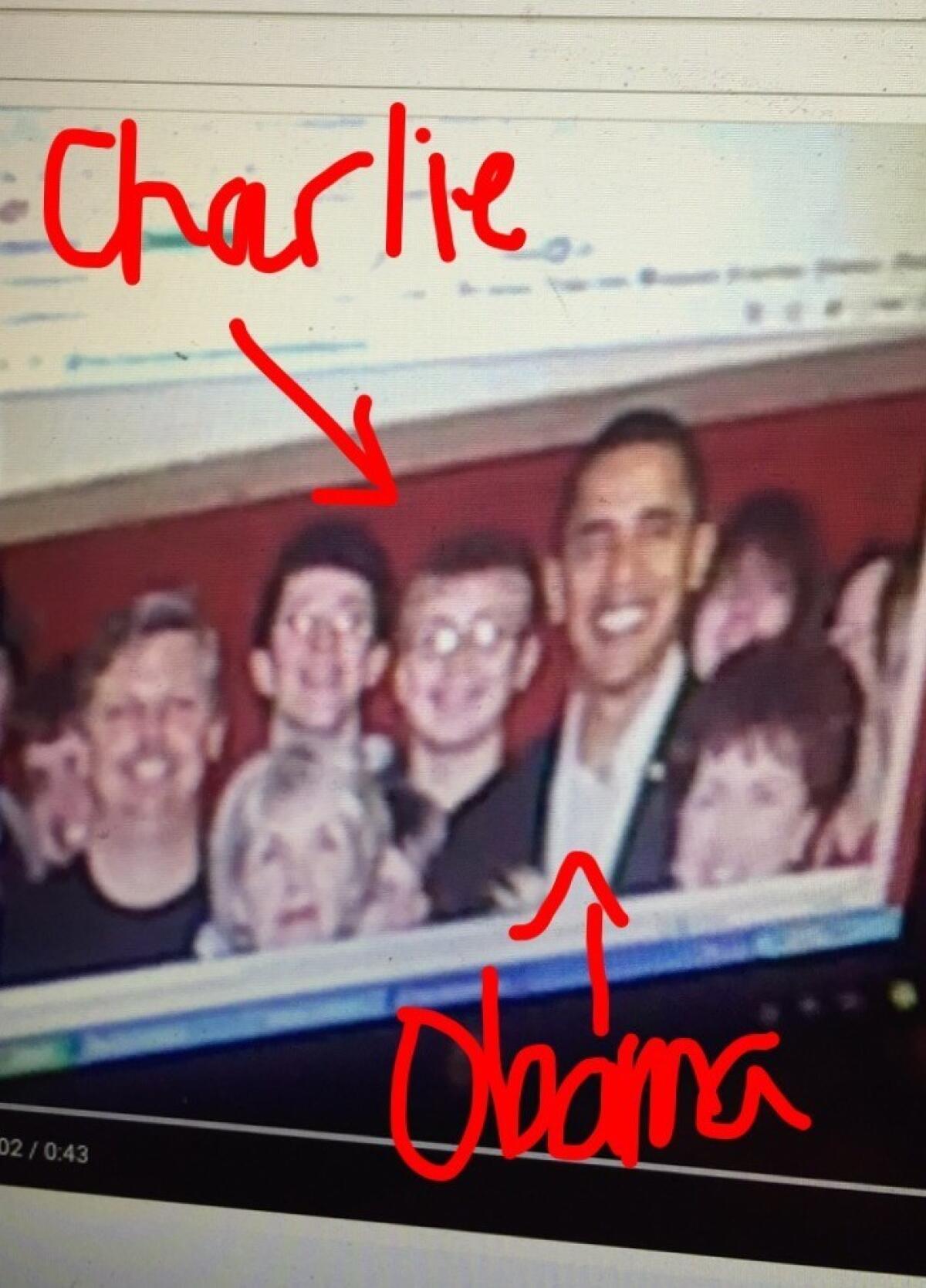
His hard work — at age 15 — earned him a prime spot next to the candidate in this group photo.

The Comfort family was the subject of a front-page story in the Washington Times the morning of the caucus.

Why?

They clearly illustrated the divided nature of the state: Martha Comfort backed Hillary Clinton, Keith Comfort preferred John Edwards and their son was traveling all over the region to put up Obama lawn signs instead of finishing his homework.

Here they are, eight years ago.

Martha Comfort, a legal assistant in town, was working as a Clinton precinct captain. Keith Comfort, a banker, was a little more passive about his support for Edwards, who would ultimately come in second in the caucuses (and later drop out of the race).

Here’s a semi-awkward clip where I tried to get them to pretend they were in a caucus.

SIGN UP for our free Essential Politics newsletter >>

Eight years later, Charlie is a Republican.

Before we get to how that happened, it’s important to note the teenager used the skills he built as a political organizer to run for office himself.

At the age of 19 in October 2011, he became the youngest school board member in Oskaloosa’s history after unseating a 17-year incumbent and getting all his friends to vote.

His interest in education policy had an unintended consequence — he didn’t like that Obama, for whom he’d worked so hard to get to the White House, had not revamped the No Child Left Behind Act as promised. He found himself intrigued by the Republican candidates coming to town in the hopes of winning the Iowa caucuses and challenging Obama in 2012.

In the 2012 Iowa caucuses, he was a Newt Gingrich precinct captain.

But he changed his mind on the way in, and his first caucus vote ultimately went to ex-Sen. Rick Santorum. “I appreciate he spent so much time in Iowa,” Charlie says now.

Once Mitt Romney won the nomination, Charlie set out to help the GOP in the swing state.

That fall, he appeared in a piece by “PBS NewsHour.” (About four minutes into the piece, interviewed at the Smokey Row coffee shop, of course.)

Fast forward four years, and he’s got a tough choice to make.

Charlie has moved from Oskaloosa to Waterloo and is working in marketing. He spent his weekend “chasing the candidates around” because he was undecided as the long campaign for the caucuses comes to a close.

Like most Iowans interested in this quirky process, he’s met many of the hopefuls as they make their way across the state. He even introduced former Florida Gov. Jeb Bush at an event at Smokey Row in October. But that didn’t really help him make up his mind.

“I am disappointed by all the anger, rhetoric and hatred that has been spewed by the party this year,” he says. “I am disappointed that the candidates who would support more moderate values have balked on that to try and get more of a conservative base turning out and I don’t think the Republican platform has been expressed as well as it could.”

Martha and Keith Comfort are still Democrats.

But they also are still split on their preferred candidate.

Keith Comfort gave his first-ever political donation, to Sen. Bernie Sanders. Martha Comfort isn’t working on Clinton’s behalf this time, but she’s still in her corner — probably.

“Now I’m on the fence and I may lean towards Bernie,” she says. “I like what he stands for and I look at Hillary and she really does have the experience but she does have some baggage. But I guess everybody does.”

Then again … “I’m leaning to Hillary because she’s realistic about what she’s promising. She knows what takes place in the office of the president and the process to get things through Congress.”

She says she’ll be resolute in her choice before walking into her neighborhood caucus meeting Monday night: “Nobody is going to persuade me there, even if my husband is across the room.”

As for Charlie, he’s made up his mind.

Iowa caucusgoer Charlie Comfort and presidential hopeful Carly Fiorina

Iowa caucusgoer Charlie Comfort and presidential hopeful Carly Fiorina

Charlie Comfort and Carly Fiorina. (Courtesy of Charlie Comfort)

He didn’t even need the whole weekend.

“This is who I plan to caucus for,” Charlie said Saturday via Facebook Messenger.

It wasn’t intended to have dramatic effect, but the photo didn’t come through for several minutes.

But there he is, smiling next to former Hewlett-Packard Chief Executive Carly Fiorina, considered a long shot in Iowa and nationally.

“She seems genuine, authentic. She has a business background and has experience with policymakers, whether it be domestically or foreign. Ultimately, I think she is in it for the right reasons — to help fix America,” he said.

“I am very impressed with her secretary-to-CEO story. Only in America.”

For more, go to www.latimes.com/politics

ALSO:

Everything you need to know about the Iowa caucuses and why they matter

From west to east, Iowa voters have starkly different realities and fears

How Martin O’Malley could decide who wins the Democratic caucuses in Iowa

Source link

Trump declares ‘economic warfare’ against Iran amid stalled talks

Aug. 19 (UPI) — President Donald Trump declared “economic warfare” against Iran on Wednesday night amid stalled diplomatic efforts to end the war.

Few specifics were offered about what this apparent intensification of Trump’s maximum pressure campaign would look like, but the president said it would be “the MOST CRUSHING ECONOMIC OPERATION EVER TAKEN AGAINST ANY COUNTRY!”

“This will be Economic Warfare and Isolation on an unprecedented scale,” Trump said in his social media statement.

Financial institutions, businesses, airports and government entities accused of providing “any type of lifeline to Iran” will face what Trump called “TREMENDOUS Economic Consequences,” though he did not elaborate further.

“Oil smuggling, swap lines, cash transfers, exchange houses, ship registries, front companies — It all needs to stop NOW,” he said. “You know who you are. This will be an ECONOMIC D-DAY.”

To enforce the plan, Trump called on all U.S. allies to work with Washington to isolate Iran.

“These maniacs are on the ropes, and these HISTORIC MEASURES will cripple them and their ability to project terror worldwide,” he said.

The announcement came hours after Trump told reporters at the White House that there are more sanctions the United States could impose on Iran.

“Well, we have things that we could sanction,” he said. “We have very draconian sanctions and we’ll see what happens.”

Earlier Wednesday, Trump also said formal negotiations with Iran could restart “at some point,” while suggesting there was no urgency to resume talks.

“Right now, I think the situation is so good, but maybe at some point,” he said.

Trump has long relied on economic pressure as a means to coerce Iran. During his first term, after unilaterally withdrawing the United States from an Obama-era multinational accord aimed at preventing Iran from obtaining a nuclear weapon, Trump launched his maximum pressure campaign of sanctions and other punitive measures against Tehran, failing in its objective to force Iran back to the negotiating table on a new deal. Instead, Iran began gradually reducing its compliance with the nuclear accord.

Trump reinstated that maximum pressure campaign after returning to the White House last year. The Treasury has since folded its sanctions efforts into a campaign it calls Economic Fury, complementing Operation Epic Fury, the U.S. military campaign that began Feb. 28 and ended May 5, though the broader war continues.

Trump has been seeking a phased end to the war, but negotiations have stalled over competing demands concerning the Strait of Hormuz. The United States is seeking to restore freedom of navigation through the important energy route, while Iran is seeking to retain the leverage it gained by restricting passage through the strait.

Source link

Trump says Kim Jong Un has responded to his request for talks

SEOUL, Aug. 18 (UPI) — U.S. President Donald Trump said Monday that North Korean leader Kim Jong Un has responded to his overtures for talks, one day after he ordered a sweeping reduction in U.S.-South Korea joint military exercises, citing his “very good relationship” with Kim.

Trump made the remarks during a press availability in the Oval Office, fueling speculation that his directive could be aimed at reopening dialogue with Pyongyang.

Asked why Kim had not responded to his requests for a conversation, Trump replied, “How do you know he hasn’t responded?”

“He has,” Trump said when pressed. He declined to elaborate, saying only that developments were “very positive.”

Trump went on to tout his personal relationship with Kim, saying the North Korean leader had “always treated me with great respect.”

“I understand him. He understands me,” Trump said. “He didn’t like Biden. He didn’t like Obama. He didn’t like anybody, but I get along with him very well.”

In a Truth Social post on Sunday, Trump said the allies’ Ulchi Freedom Shield drills, which began Monday, are expensive and “send a signal that is totally inappropriate and hostile” to North Korea. He said Pyongyang “has been unthreatening and respectful” while he has been in the White House.

Trump also noted that South Korea declined his request to help with the denuclearization of Iran.

“Therefore, and based on the fact that it is too late to cancel, I have instructed Secretary of War, Pete Hegseth, to substantially reduce the Joint Military Exercises!” he wrote.

In a text message to reporters on Monday, an official with Seoul’s Joint Chiefs of Staff said the Ulchi Freedom Shield drills had started as scheduled.

“The UFS exercise is proceeding as planned,” the official said.

Later in the day, the presidential Blue House released a statement saying that Seoul was “paying close attention” to Trump’s comments, adding that it hoped friendly relations between Washington and Pyongyang would lead to meaningful peace talks between the two countries.

“To this end, we will exert necessary diplomatic efforts as a pacemaker under close cooperation with the United States,” the statement said.

The Blue House added that it has actively participated in international discussions for a cease-fire in Iran and freedom of passage in the Strait of Hormuz and is “closely discussing practical and military contribution measures with the U.S. side.”

As of Tuesday, it was not clear what aspects of the exercise would be reduced under Trump’s order. In a statement reported by news agency Yonhap, the Pentagon said it “is actively working on executing the Commander-in-Chief’s directive.”

The order drew criticism from Democrats in Congress, who warned that reducing the exercises could undermine military readiness and weaken confidence in U.S. security commitments.

“When President Trump cuts military exercises to flatter a dictator or punishes South Korea for declining to join a war he started, all of our allies — and adversaries — think that America’s commitments are negotiable,” Sen. Jack Reed, the ranking member of the Senate Armed Services Committee, said in a statement. “Kim Jong Un has won a propaganda victory and South Korea, one of our strongest allies, has been punished for no reason beyond Trump’s ego.”

Peter Lee, a research fellow at the Seoul-based Asan Institute for Policy Studies, said Trump’s order reflects his transactional approach to the alliance and longstanding skepticism about the costs of U.S. military commitments in South Korea.

“This latest directive should also be seen as a reminder that President Trump still has many cards he can play to pressure South Korea,” Lee told UPI. “The task for the Lee administration is therefore how to reduce this ‘unfaithful ally’ narrative that President Trump periodically returns to and instead lean into the ‘model ally’ framing that others such as [Defense] Secretary Hegseth have touted.”

Victor Cha, Korea chair at the Center for Strategic and International Studies, said Trump’s move went beyond his repeated public overtures to Kim and appeared aimed at drawing the North Korean leader back to the negotiating table.

“This is really the first concrete action he’s taken to try to entice Kim, and he’s used the timing of these exercises as the way to do it,” Cha said during a CSIS discussion Monday.

Pyongyang has not yet publicly responded to Trump’s announcement, and Cha said he did not expect an immediate reaction.

“I’m sure it’s a message that’s been heard … but I don’t think the North Koreans are going to respond right away,” he said. “I think they’re going to bide their time and wait a little bit.”

Trump similarly called for suspending or scaling back the exercises since his first term, when he pursued direct diplomacy with Kim that included summits in Singapore and Hanoi and a brief meeting at the DMZ.

After the Singapore summit in 2018, Trump surprised observers by announcing that the United States would halt what he called “provocative” joint military exercises with South Korea. That year’s Ulchi Freedom Guardian exercise was canceled, while several subsequent drills were reduced in scale.

In his White House press availability, Trump denied that he was prioritizing North Korea over Washington’s allies in South Korea.

“I’m actually making it much safer,” he said in response to a question.

Trump also elaborated on his request for South Korea’s assistance with the war in Iran, saying he raised the issue in a recent call with President Lee Jae Myung.

“I said, ‘Would you like to give us a little hand? We don’t need help with Iran, but if you’d like, give us a hand with Iran.’ He said, ‘No thanks,'” Trump said.

Trump said he viewed Seoul’s refusal as a matter of “fairness,” citing the cost of maintaining U.S. forces in South Korea and his longstanding push for Seoul to shoulder more of the expense.

“We have 39,000 soldiers over there guarding you from Kim Jong Un, your next-door neighbor, and you are not going to help us on a very easy military operation in Iran,” he said.

The United States has roughly 28,500 troops stationed in South Korea.

Later Monday, Trump posted a meme of Kim on his Truth Social account. The image showed the North Korean leader surrounded by military officials and speaking into a telephone, with the caption: “Hey Donald, we cool … right?”

Source link

Trump says negotiations with Iran to resume Monday

Aug. 2 (UPI) — President Donald Trump said Sunday night that negotiations with Iran toward ending the war will resume Monday, about a month after formal talks between the two unraveled and preceded a return to open conflict.

Speaking to reporters aboard Air Force One en route to Washington after spending a weekend at his Bedminster, N.J., golf club, Trump said talks with Iran will begin Monday afternoon, claiming, as he has repeatedly throughout the war, that Iran wants “to make a deal.”

“We’ll see if it’s true,” he said. “I’d love to do that. Save a lot of lives. Save a lot of unnecessary power, to be honest with you.”

Trump had called off what he advertised as a massive attack on Iran over the weekend, stating it was at the request of allies and Tehran, which he said had agreed to “the parameters of a deal.”

Aboard his plane, he identified Saudi Arabia, the United Arab Emirates and Qatar as the nations that had asked him to hold off.

“It would have been a massive attack. We were all set to go. But when the allies ask to call it off, you go to sort of say, ‘well, let’s see,'” he said. “And the reason they asked they think there’s a deal.”

Trump has long sought a deal with Iran to constrain its nuclear program, going back to his first administration when in 2018 he unilaterally pulled the United States from an Obama-era multinational accord in order to fashion a new one, and imposed sanctions on Tehran to force it to the negotiating table.

In late February, the United States and Israel attacked Iran with the aims of destroying its remaining nuclear capabilities and inciting regime change, instead igniting the five-month-long war, during which Tehran has laid military claims to the vital Strait of Hormuz.

An April cease-fire created conditions for a memorandum of understanding to be signed in mid-June that was to lay the foundation for ending the war. Amid negotiations on implementing the MOU, disagreements arose over its stance on the vital energy route, which led to a resumption in fighting last month.

Monday’s negotiations would be the first publicly acknowledged since early last month. Trump said the discussions will concern the Strait of Hormuz and led into nuclear talks.

He said that the three allies believe “a deal is imminent.”

Trump called off the attack after speaking with Saudi Crown Prince Mohammad bin Salman over the phone. Trump said Sunday that bin Salman warned him that the consequences of the attack would be unpredictable.

“I mean, will they be flooded with people pouring into their country,” he said. “A lot of bad things can happen.”

Trump said it would have been “the biggest attack since World War II” and “disastrous” for Iran.

The United States is seeking to restore freedom of navigation through the strait, while Iran is trying to maintain some form of control over commercial vessels that pass through it.

According to the nonpartisan, Washington-based Institute for the Study of War, Iranian negotiators may be willing to make what it called “limited compromises” with the United States over Tehran’s control of the strait, though what those concessions may be were not entirely clear.

Source link

Federal court approves use of Tennessee’s new congressional map

July 24 (UPI) — A federal court has allowed Tennessee to use a new congressional map that eliminates the state’s only majority-Black district in November’s midterm elections, rejecting a challenge from civil and voting rights advocates.

The three-judge panel on Thursday denied a motion filed by Black Memphis voters for a preliminary injunction against implementing the map, ruling they lacked evidence of racial motivation for the map’s unorthodox mid-decade redistricting, which could be explained by a political motivation.

“The road to a reliably 9-0 map runs through Memphis. Thus, political motivations readily explain the map’s dilutive effects,” the panel, which consisted of two Trump appointees and one Obama appointee, wrote in its decision.

With the ruling, Tennessee may use the map in next month’s primaries.

November’s midterms have been of increasing concern for President Donald Trump, who has repeatedly voiced worries about impeachment proceedings and investigations if Republicans lose the House to Democrats, and has pushed GOP-led states to redraw their congressional maps to create additional Republican-favored districts.

Texas was the first last summer to agree to Trump’s request, sparking a gerrymandering arms race, with at least 10 states have redrawn their maps. All but Democrat-led California and North Carolina, which has a Democratic governor, are Republican-led.

Tennessee’s GOP-majority legislature passed its redistricting map to eliminate the one Democrat-held seat in May, a week after the Supreme Court issued a controversial decision that weakened a key part of the Voting Rights Act, by greatly limiting the use of race in drawing electoral districts.

The three Black Memphis voters, along with the Black Clergy Collaborative of Memphis, the Memphis A. Philip Randolph Institute and the Equity Alliance sued days later, alleging that the new map unlawfully discriminates against Black Memphis voters by dismantling a district where they had long been able to meaningfully participate in the political process.

In its ruling Thursday, the court said that the plaintiffs had to show that the map redraw was racially motivated, which they failed to do.

“The map’s effects — breaking Black Memphians into three separate congressional districts — are readily explainable by political motivations,” the court said.

“It’s no secret (supported by Plaintiffs’ own statements) that city voters prefer Democratic candidates and that rural voters prefer Republican candidates. So, it makes sense that Tennessee’s legislature would split Memphis into thirds when attempting to create a map that favors Republican candidates. And it’s no surprise that the resulting map would also split the Black population of Memphis into thirds.”

Amber Sherman, a plaintiff in the case, said the court’s decision further disenfranchises Black voters in Memphis.

“It’s painful to know we’ll head into another election under a map that was designed to weaken the Black voters in Memphis,” she said in a statement.

“We deserve the same opportunity to shape our future as anyone else.”

Source link

Trump signs EO shrinking monuments, angering environmentalists

July 14 (UPI) — President Donald Trump has signed a pair of executive orders shrinking two southern Utah national monuments by more than a million acres each, sparking anger from environmentalists who say the moves will open the formerly protected lands to exploration.

The executive orders reduce the size of the Grand Staircase-Escalante National Monument from 1.87 million acres to about 181,500 acres and the Bears Ears National Monument from 1.36 million acres to 121,100 acres. Both are located in redrock country.

Trump signed the orders on Monday in the Oval Office while surrounded by Utah’s Republican leadership, including Gov. Spencer Cox, Sens. Mike Lee and John Curtis and several GOP House representatives.

“This is a big day for Utah,” Cox said.

The executive orders mark the latest development in the nearly decade-long tug-of-war over the size of the monuments, though Republicans have opposed Grand Staircase-Escalante National Monument and its 1.7-million-acre boundary since President Bill Clinton designated it in 1996. The Bears Ears National Monument was designated by President Barack Obama in late 2016.

During his first term, Trump shrunk both monuments — Bears Ears by 85% and Grand Staircase-Escalante by almost half — only for President Joe Biden to restore both of them to their previous boundaries in 2021.

Republicans, including Cox, argue that the monuments violate the Antiquities Act, which limits the designation to the smallest parcel of land necessary for the proper care and management of the objects to be protected. In a White House fact sheet on the executive orders, the Trump administration argues that the term “objects of historic or scientific interest” has been stretched to include landscapes and biodiversity.

“Now, we care. We definitely care about protecting these antiquities and will continue to do so. The problem is with these giant monument designations, there are resources that come with those,” Cox said at the White House press conference.

“We’re grateful that the president has made a determination that we need to rightsize these monuments.”

He added that this will not remove protections already in place, but will make “the monuments more manageable so that we have the resources necessary to continue to protect these antiquities.”

Trump criticized the size of the monuments, saying the designations prevented the public from using the land.

“You can’t go hunting. You can’t go fishing. You can’t do anything. You can virtually not even walk on it,” he said, though the Utah Division of Wildlife Resources states that people can hunt and fish in both monuments.

Environmental groups have been fighting to maintain the size of both monuments since Trump originally shrunk them, pointing to the fact that Grand Staircase-Escalante was designated due to its wide array of scientific and historic resources and Bears Ears was created following a proposal by five Tribal Nations.

Scott Braden, executive director of the Southern Utah Wilderness Alliance, said Monday’s executive orders make clear that Utah is the “epicenter of Republican efforts to dismantle and obliterate America’s system of public lands.”

“These two landscapes deserve to be protected for current and future generations of Utahns and Americans, not opened to exploitation,” Braden said in a statement, adding that the group would challenge the executive orders in court.

“We are confident that President Trump’s reckless and unlawful acts will be rejected and the monuments restored.”

According to the Center for Western Priorities, the executive orders may open the land formerly part of the monuments for sale or lease to oil, gas, mining and logging companies within 60 days.

“The people of Utah and the entire country have spoken with one voice: These lands belong to all of us, not Mike Lee, President Trump or the mining companies his kids are in business with,” CWP Executive Director Aaron Weiss said in a statement.

Source link

Former CIA director Brennan sues Trump administration to protect records

John Brennan, former director of the Central Intelligence Agency, testifies in 2017 on Russian meddling in the 2016 U.S. presidential election during a House Intelligence Committee hearing on Capitol Hill in Washington, D.C. Brennan is suing the Trump administration, asking a judge to preserve all records of a Department of Justice investigation against him. File Photo by Kevin Dietsch/UPI | License Photo

July 1 (UPI) — John Brennan, former director of the CIA and a longtime foe of the Trump administration, filed a lawsuit Wednesday asking a federal court to preserve all records related to the administration’s investigation of him.

The Justice Department has been eyeing Brennan for months, with lawyers interviewing former intelligence officials and issuing subpoenas as part of a conspiracy investigation, The Washington Post reported.

Justice Department officials have alleged that Brennan and others violated President Donald Trump‘s civil rights in a conspiracy back to the Obama administration that included efforts to prosecute Trump and investigate his ties to Russia, The Post said. Rep. Jim Jordan, R-Ohio, also referred Brennan to the Justice Department, alleging that he lied during testimony to Congress.

Brennan’s attorneys requested that a judge order the administration to preserve any internal records and communications from the investigation.

The records could be used as part of defense arguments that the investigation and any prosecution are part of Trump’s attempt to vindictively punish Brennan, the attorneys said, citing an administration policy “of using criminal process and prosecution to punish the president’s perceived adversaries,” The Post said.

“Administration officials from the acting attorney general to the FBI director and the counselor overseeing the Brennan investigations have been publicly declaring Director Brennan a criminal, not only before securing a conviction in court but even before a full investigation and indictment,” the lawyers wrote, CNN reported.

“And, certain officials in the Department of Justice are engaging in demonstrably irregular prosecutorial activity in order to gin up a case that will satisfy the president’s direction,” they wrote.

Brennan has also said the court should preserve any records that could be used in any broader “grand conspiracy” investigation by the Justice Department. He has denied any wrongdoing. The lawsuit names Trump, acting Attorney General Todd Blanche, FBI Director Kash Patel and prosecutors in Florida overseeing the investigation.

Source link

Judge strikes down SNAP bans on soft drinks, candy

June 23 (UPI) — A federal judge has ruled that the Trump administration cannot allow states to bar federal food assistance recipients from using their benefits to buy soft drinks, snacks and candy, finding the Agriculture Department lacked the authority to approves such restrictions.

About 42.1 million low-income individuals across the nation receive federal food assistance through the Supplemental Nutrition Assistance Program, better known as SNAP, which allows recipients to use the benefits to purchase most foods, excluding alcohol, tobacco and hot prepared foods.

Amid soaring obesity rates across the United States, 22 states received waivers from the Trump administration to exempt certain foods and beverages from the federal definition of food to ban SNAP recipients from using the benefit to purchase these items. Though the waivers vary by state, they all target high-calorie, sugary foods, such as soft drinks, energy drinks, candy and others.

In March, five SNAP recipients in Colorado, Iowa, West Virginia, Tennessee and Nebraska sued the Trump administration over its approval of waivers, saying the restrictions were vague, complicated and counterintuitive, causing significant confusion for both them and retailers, while harming SNAP recipients who rely on sugary beverages to manage chronic health conditions, such as diabetes.

In her ruling Monday, U.S. District Judge Amy Berman Jackson found the Agriculture Department’s waivers violated the Administrative Procedure Act, stating the department acted in excess of its authority and without following public input noticed procedures as required by law.

“The secretary purports to waive not just a mere administrative or technical obstacle, but the very definition of ‘food’ as it was laid down by Congress,” the President Barack Obama appointee wrote in her 68-page ruling.

“Neither the USDA nor the states can force this square peg into a round hole to avoid the plain language of the statute and the requirement of 2026(k),” which requires SNAP projects to be consistent with the program’s food-assistance purpose.

The National Center for Law and Economic Justice, which filed the lawsuit, celebrated Monday’s ruling as “a major step in restoring essential food assistance to the millions of families that rely on SNAP nationwide.”

“This decision makes clear that the USDA cannot bypass the legal guardrails that establish how SNAP must operate across the country,” Katie Deabler, senior attorney at the NCLEJ, said in a statement.

“It affirms that families deserve a program that works without confusion.”

Source link

Justice Department blocked from releasing Biden biographer’s recordings

June 19 (UPI) — A federal judge on Friday told the U.S. Department of Justice it cannot release a transcript and recording of former President Joe Biden and his biographer’s conversations.

Although U.S. District Court Judge Dabney Friedrich had earlier in the day denied Biden’s request for an injunction, she nonetheless told the department to wait three weeks for the release as his lawyers file an appeal, ABC News and CBS News reported.

Redacted versions of a transcript and recording of conversations between Biden and the ghostwriter of his biography, Mark Zwonitzer, were set to be released by the Justice Department on Friday afternoon after Friedrich’s initial ruling.

The recordings had been set for release to the conservative think tank The Heritage Foundation, which filed a Freedom of Information Act request in 2024 based on reports of Biden’s handling of sensitive and secret government records during the years between serving as vice president to President Barack Obama and being elected to the White House himself.

“Biden has not identified any public harm that would arise absent an injunction in this case,” Friedrich wrote in her decision.

“The harm to Biden’s diminished privacy interest is outweighed by the public’s interest in the Zwonitzer materials and FOIA’s ‘policy of broad disclosure of Government documents in order to ensure an informed citizenry, vital to the functioning of a democratic society,” she wrote.

Biden’s attorney’s argued that the conversations for his book were not intended to have been released and that the public’s only interest is because of the government records case, which investigators referred to in their report.

Biden was not charged or alleged of any wrongdoing after the investigation because while evidence suggested that he “willfully retained and disclosed classified material,” his guilt for having done so could not be fully established for a successful prosecution, investigators said at the time.

President Donald Trump presents a Medal of Honor to Tom Ripley on behalf of his father, John W. Ripley, during a Medal of Honor award ceremony in the East Room of the White House on Thursday. Photo by Aaron Schwartz/UPI | License Photo

Source link

Obama Presidential Center opens in Chicago

1 of 4 | Former President Barack Obama and former First Lady Michelle Obama appear on stage as they surprised administration and campaign alumni in Chicago ahead of the dedication ceremony of the Obama Presidential Center, Wednesday. The center opens Thursday and will be open to the public beginning Friday. Pool Photo by Pablo Martinez Monsivais/UPI | License Photo

June 18 (UPI) — The Obama Presidential Center will open Thursday in Chicago with a long list of celebrities attending.

The grand opening will be livestreamed starting at 11 a.m. CDT Thursday on Obama.org and on the Obama Foundation’s social media accounts. The opening is invitation-only, and there are no more tickets for the Midway Plaisance Park watch party in Chicago.

The center will be open to the public beginning Friday, and it’s expected to see up to 1 million visitors per year. Tickets, which are $30, are sold out through October.

The center is a 19-acre space on the south side of Chicago that features a tall building that includes a museum of the Obamas’ lives. It shows what life was like in the Obama White House.

The campus also has a branch of the Chicago Public Library, an NBA regulation-size basketball court and Women’s Garden dedicated to women leaders in Chicago. It also has an auditorium, a media suite that visitors can use, a Wetland Walk, a fruit and vegetable garden and a playground.

But it’s not a presidential library and doesn’t house the Obama presidential documents. Those are in the mostly digital Barack Obama Presidential Library run by the National Archives, though the center does have some artifacts on display that are on loan.

Some of the celebrities planning to perform are Bruce Springsteen, Christina Aguilera, John Legend, Stevie Wonder, Jennifer Hudson, Marc Anthony, The Roots, Common, Eddie Vedder, Bono and The Edge, Tems and Marsai Martin.

Every living president will be there except President Donald Trump.

CEO of the Obama Foundation Valerie Jarrett has said Trump is welcome to visit the museum, and they’d love to give him a tour. She said he simply was not invited to the dedication.

“I can tell you that this is a celebration for those who helped get President Obama where he is. And this is a gift to them,” Jarrett said. “And so the people who will be here are the people who’ve been helpful along the way.”

Source link

U.S. sanctions Iran’s new Hormuz authority amid strait talks

May 28 (UPI) — The U.S. Treasury announced late Wednesday that it has sanctioned an Iranian entity, newly created to oversee and manage the Strait of Hormuz, as the Trump administration seeks to force Tehran to relinquish control over the vital energy trade route.

The strait has been an issue of contention between the United States and Iran, which are locked in negotiations to end the war.

Iran restricted navigation of the strait after the United States and Israel attacked the country in late February, igniting the war. Washington responded by imposing a military blockade of Iran’s ports, cutting it off from maritime trade.

Since imposing the restrictions, Iran has been adamant about maintaining control of the route, through which about one-fifth of the world’s energy trade flows. The Trump administration has repeatedly threatened that there will be free navigation of the strait again, one way or another.

Earlier this month, Iran launched the Persian Gulf Strait Authority to manage the strait.

The Treasury sanctioned the PGSA on Wednesday, accusing it of being an attempt by Iran’s Islamic Revolutionary Guard Corps to monetize the international waterway.

Treasury Secretary Scott Bessent described the mechanism in a statement as the Iranian military’s “latest attempt to extort global maritime trade.”

Bessent said the Wednesday blacklisting was part of Economic Fury, the Treasury’s rebranding of President Donald Trump‘s maximum pressure campaign of sanctions and other trade measures from his first administration seeking to coerce a new nuclear weapons deal from Iran.

The United States has been tightening its financial vise on Iran since 2018 when Trump first imposed sanctions on Tehran after unilaterally withdrawing the United States from a multinational Obama-era nuclear accord aimed at preventing Iran from securing a nuclear weapon.

Trump reimposed the campaign following his return to the White House in early 2025. It was renamed following the start of the military operation Epic Fury that began Feb. 28.

Treasury officials said Wednesday that through the maximum pressure campaign, the Trump administration has denied Iran access to tens of billions of dollars’ worth of revenue.

The sanctions generally prohibit those named from accessing the U.S. financial system and bar U.S. persons and companies from doing business with them. They also expose foreign financial institutions that knowingly facilitate significant transactions for those sanctioned to potential secondary sanctions.

Sen. Tom Cotton, a Republican from Arkansas, had over the weekend called on Bessent to sanction the PGSA, stating the United States “must ensure every actor enabling the terrorist Iranian regime is held accountable.”

“I support the use of existing authorities to impose sanctions on the PGSA, its officers and any foreign entity that pays, processes or facilitates tolls to Iran for passage through the Strait of Hormuz,” he said in a statement.

Iran has rejected the notion that it is running a toll. Iranian Foreign Ministry Spokesperson Esmaeil Baqaei has said that Iran charges fees to cover costs associated with navigational services and environmental protection measures.

Iranians rally after a ceasefire announcement at Enqhelab Square, in Tehran on April 8, 2026. Photo by Behnam Tofighi/UPI | License Photo

Source link