But hours later, a message on his u/paulmccartney profile said: “Paul McCartney has been banned.”
One fan on the forum declared: “What clownery is going on here that Paul McCartney himself gets banned? I wanted to see the photos but now I can’t.”
The account has since been allowed back on Reddit — but with the photos message still deleted.
It is unclear why he got the boot in the first place.
The forum warns there must be no advertising on its list of rules. Reddit also has a zero-tolerance policy towards spam, banning things judged as responsible for “artificially inflating exposure to unwanted or irrelevant content”.
Sir Paul, who also played the Fonda Theatre venue on Saturday, releases his 19th solo studio album, The Boys of Dungeon Lane, in May.
Kenyan distance runner Albert Korir has admitted to doping, prompting officials on Monday to ban him for five years.
Long a fixture at the New York Marathon, Korir tested positive for a blood-boosting substance in three separate samples taken in October while he was training to run in the New York Marathon on Nov. 2. He finished third in the race.
A verdict issued by the Athletics Integrity Unit said that Korir’s results since October will be disqualified, including that third-place finish in New York.
The three positive results provide “clear evidence of the athlete’s use of a prohibited substance on multiple occasions which is expressly identified in the definition of aggravating circumstances,” the verdict stated.
The punishment was reduced by one year because Korir, 32, admitted to taking a banned substance without requesting a hearing. He is banned until January 2031.
Korir will keep his 2021 New York Marathon title. He also was runner-up in 2019 and 2023, and finished third in 2024 in addition to 2025. His other first-place finishes came in the 2019 Houston Marathon, the 2017 Vienna Street Race and the 2019 and 2025 Ottawa Race Weekend.
Korir tested positive for Continuous Erythropoietin Receptor Activator (CERA), a long-acting agent that stimulates red blood cell production much like the banned substance EPO. It is used legally to treat anemia associated with chronic kidney disease and typically is administered once every two to three weeks.
The World Anti-Doping Agency said in October that Kenya had made “significant” progress in tackling doping but the country remains on probation while it seeks to improve its monitoring.
The action by WADA occurred after Kenyan runner Ruth Chepngetich, the world marathon record holder, was banned for three years after admitting the use of Hydrochlorothiazide (HCTZ), a banned diuretic used as a masking agent.
There are multiple hotels in the village to choose from. One of the most popular is the Giethoorn Old Art Hotel.
With rooms starting from £70, guests can even rent boats to take to the water themselves.
Another is Hotel Giethoorn, where guests can get a very authentically Dutch breakfast with fresh bread and toppings like hagelslag(which are chocolate sprinkles), cheese, or sliced meats.
No cars are allowed in the village, but it can be navigated by foot, or via boats – of which there are many.
These vary from large tour boats which you can hop on, or if you fancy being a captain yourself, self-navigated Whisper Boats can be hired out, as can Sloops, from €17.50 (£15.23) per hour.
Anyone taking the wheel doesn’t need a boating licence, just to be over the age of 16.
There are rules though, and one is that if you’re navigating your own boat and come across a tour boat – you must move out of the way as they have a VIP pass.
Like on the tube, there’s a certain side to stick to, and this is the right.
And anyone on the water cannot be too noisy – there are water police around.
Those wanting to avoid the water, or wanting to see the village at a different angle, can see it by foot.
There are around 180 narrow wooden bridges across the water and from here you can see more of the village’s pretty thatched cottages.
The village is usually quite busy with tourists and is a popular daytrip destination from the city of Amsterdam.
For those who want to stay a little longer without the crowds, the village tends to be quieter after 4pm.
If you fancy a similar experience but with fewer crowds, the nearby village of Dwarsgracht is also navigated via canals but is considered much-less busy than Giethoorn.
To explore both is possible as the villages are just a 10-minute cycle apart.
Transgender women athletes will be excluded from the Olympics beginning with the 2028 Los Angeles Games after the International Olympic Committee implemented a new eligibility policy on Thursday.
Eligibility for women’s competition will be determined by a one-time, mandatory genetics test, according to the IOC. The test requires screening through saliva, a cheek swab or a blood sample.
No woman who transitioned from being born male competed at the 2024 Paris Summer Games, and it is unclear if any transgender women currently compete at an Olympic level. The new policy, however, aligns with President Trump’s executive order banning transgender athletes from participating in women’s or girls’ sporting events in the United States.
The eligibility policy approved by the IOC is not retroactive and does not apply to recreational sports programs.
The IOC said in a statement that it “protects fairness, safety and integrity in the female category.
“Eligibility for any female category event at the Olympic Games or any other IOC event, including individual and team sports, is now limited to biological females.”
Until now, individual sports federations determined whether transgender women were allowed to compete in women’s categories, with the IOC providing only recommendations. Sports that placed restrictions on transgender athletes included track and field, boxing, swimming and rugby.
The IOC Executive Board approved the new policy after 18 months of study. It mirrors the guidelines approved by the World Athletics Council in June, determining eligibility for the female category through screening for the absence or presence of the SRY gene.
The IOC policy leans on scientific research that considers the presence of the SRY gene fixed for life and represents evidence that an athlete has experienced male sex development. Athletes who screen negative for the SRY gene will be eligible to compete in women’s sports.
SRY (which stands for sex-determining region Y gene) is found on the Y chromosome. In the cell, it binds to other DNA, leading to testis formation, according to the National Library of Medicine. Even men who lack Y chromosomes still have a copy of the SRY region on one of their X chromosomes, which accounts for their maleness.
Jane Thornton, the IOC medical and scientific director, last year presented to the executive board findings that transgender athletes born with male sexual markers retained physical advantages, even those that had received treatment to reduce testosterone.
Kirsty Coventry, a former gold-medal Olympics swimmer from Zimbabwe, was elected a year ago as the first woman president of the IOC. She campaigned on the importance of protecting the women’s category.
“At the Olympic Games, even the smallest margins can be the difference between victory and defeat,” Coventry said Thursday in a statement. “So, it is absolutely clear that it would not be fair for biological males to compete in the female category.”
Some surprising items are restricted under airport security rules when travelling with hand luggage only
Vita Molyneux and Ketsuda Phoutinane Spare Time Content Editor
04:52, 22 Mar 2026
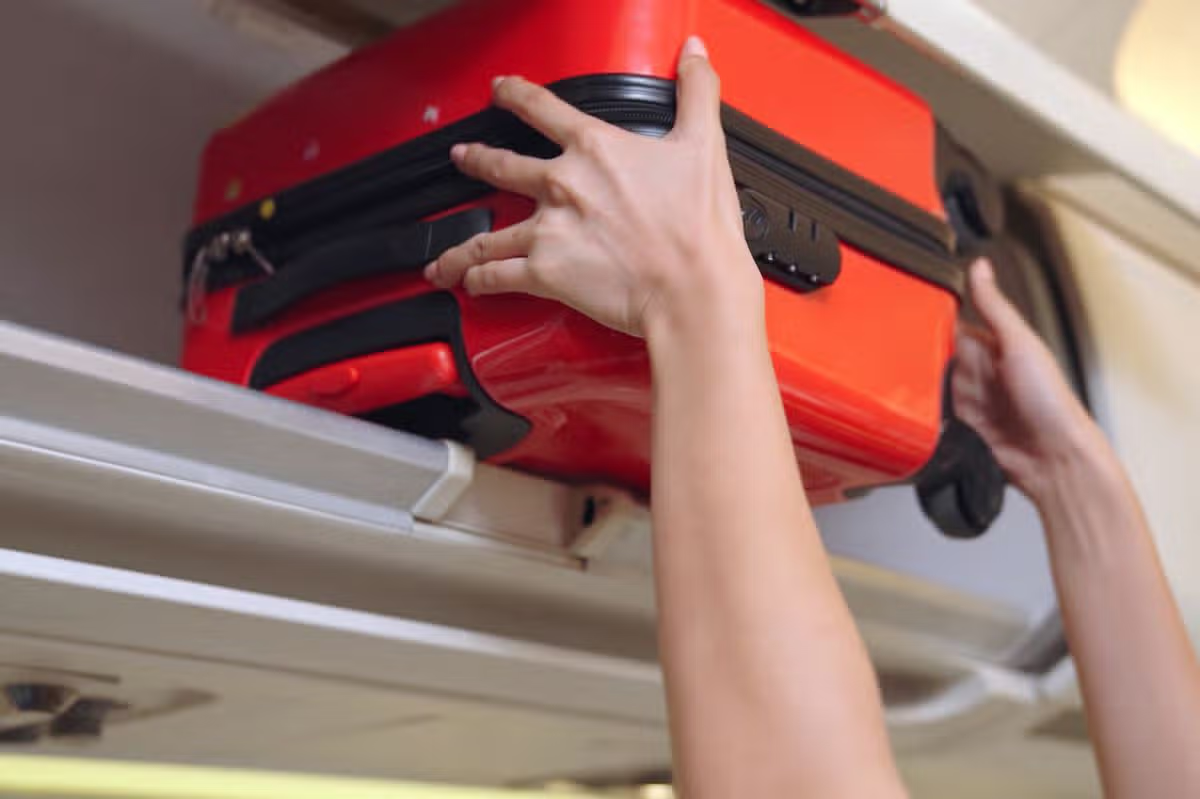
Double check the rules before you fly(Image: Jose A. Bernat Bacete via Getty Images)
If you’re jetting off this Easter and planning to cram your essentials into a carry-on bag, there are certain items that could land you in hot water without you even realising.
Hand luggage liquids generally need to be under 100ml to pass through airport security, including water bottles, face oils, moisturisers and hand gel.
However, some items that aren’t technically liquids can still cause issues at security. Fulton Umbrellas have put together a list of some surprising items you can and can’t take with you on your journey.
First up is soft cheese, which if you’re travelling back to the UK from the EU, falls under the 100ml limit. The same applies for jams, chutneys, sauces and anything sold in liquid form like antipasti or olives, reports the Express.
Some countries have even stricter rules when it comes to travelling with food, so always check before you pack.
Another item to avoid packing in your carry-on is protein powder. This is because powders can interfere with x-ray machines and will therefore need to be manually checked by staff.
This can be a time-consuming process, so it’s quickest and safest to just leave it at home. And if you really can’t do without it, pop it in your checked bag.
Surprisingly, in the UK, there is one item you are permitted to take on board that you might not expect. If you’re only taking carry-on luggage but fancy indulging in a bit of arts and crafts on the plane, you are allowed to bring a small pair of scissors on board.
The standard guideline in the UK is that any pair of scissors with a blade length less than 6cm is permissible.
For anything larger, it’s advisable to pack them in your checked luggage. Different airlines may have varying regulations regarding items with blades, so it’s wise to verify if you need to carry scissors with you.
March 13 (UPI) — A State Department official was barred Friday from going to Brazil because of a proposed visit to jailed former Brazilian President Jair Bolsonaro, who is in prison for plotting a coup four years ago.
The official, Darren Beattie, was approved for a visa to attend a critical minerals summit next week, but his visa was pulled because the meeting with Bolsonaro was determined to be outside his diplomatic authorization, Brazil’s Supreme Court ruled Thursday, Bloomberg and The Guardian reported.
After the ruling, current Brazilian President Luiz Inacio Lula da Silva ordered his government to revoke Beattie’s visa entirely, at least partially because U.S. President Donald Trump denied Brazilian health minister Alexandre Padilha a visa and revoked visas held by his wife and daughter.
“That American guy who said he was coming here to visit Bolsonaro, he’s been barred from visiting and I have forbidden him from to Brazil so long as they don’t free up the visa of my health minister, which has been blocked,” Lula said Friday.
Bolsonaro is serving a 27-year prison sentence after he was convicted for plotting a coup after losing the 2022 election to Lula.
The charges were based on Bolsonaro’s supporters storming government buildings in January 2023 — a plan that had started in 2021, before the 2022 election — in an effort to prevent Lula from taking office.
Brazilian Foreign Minister Mauro Vieira said that although Beattie’s visa application included the minerals summit and meetings with other Brazilian officials, he only asked for the other meetings after asking for the Bolsonaro visit.
Trump and many within his administration, including Beattie, have been critical of the Brazilian Supreme Court and the country’s officials for jailing Bolsonaro on the coup charges.
“It should be noted that a visit by a foreign state official to a former president in an election year may constitute undue interference in the internal affairs of the Brazilian state, Vieira told the Supreme Court.
Lula and Flavio Bolsonaro, who is the son of the former president, are currently locked in a close race for Brazil’s presidency after a poll found them tied for the first time with 41% of participants, which would lead to a runoff election.
The Brazilian presidential election is scheduled for Oct. 4, and a runoff would be Oct. 25.
President Donald Trump speaks during an event celebrating Women’s History Month in the East Room of the White House on Thursday. Photo by Bonnie Cash/UPI | License Photo
The BBC war drama depicts a fictional nuclear attack on Britain by Russia and its devastating aftermath – and was so disturbing it was banned from broadcast for two decades
The nuclear war drama was deemed ‘too horrifying’ for British viewers(Image: Anadolu, Anadolu via Getty Images)
In the face of escalating conflicts worldwide – from the intensifying US-Israel joint operation against Iran in the Middle East, Israel’s ongoing war on Gaza following Hamas’ October 2023 attack, to the four-year-long Russia-Ukraine war still in progress – it’s no exaggeration to say we’re witnessing a catastrophic level of global unrest.
Amidst this turmoil, the looming threat of nuclear warfare is ever-present. The aftermath of such a conflict would bring about unimaginable destruction and devastation – the fallout is too horrific to contemplate.
This chilling scenario was portrayed in a BBC documentary from 1965, a film so disturbing it was banned from television broadcast for two decades by the British Broadcasting Corporation itself.
At the time, the corporation justified its decision to prohibit the documentary, stating: “The effect of the film has been judged by the BBC to be too horrifying for the medium of broadcasting. It will, however, be shown to invited audiences..”
The controversial pseudo-documentary finally aired in Great Britain on 31 July 1985, twenty years after its initial scheduled screening date of 6 October 1965. This broadcast coincided with the week leading up to the 40th anniversary of the Hiroshima bombing, reports the Express.
The War Game is currently available for free streaming on BBC iPlayer or can be bought for £5.99 on Amazon Prime Video.
Written, directed and produced by Peter Watkins for the BBC, The War Game depicted a fictional nuclear strike on Britain by the Soviets and its devastating consequences.
The docu-film’s official synopsis states: “In this British documentary, a hypothetical Chinese invasion of South Vietnam triggers a new world war between East and West. In the town of Rochester, Kent, the anticipation of a nuclear attack leads to mass evacuations.
When a stray missile actually explodes, the ensuing firestorm blinds all those who see it. It’s not long before the fabric of society is ripped apart owing to radiation poisoning, a lack of infrastructure and rioting for food and other necessities.”
On 13 April 1966, The War Game had its premiere at the National Film Theatre in London, where it screened until 3 May. Barred from broadcast, the 47-minute docu-drama subsequently appeared at numerous international film festivals, including Venice, where it secured the Special Prize.
The recognition continued – the prohibited BBC production went on to claim the Academy Award for Best Documentary Feature in 1967, alongside two BAFTAs for Best Short Film and the UN Award.
Boasting a near-flawless 93% approval rating on review aggregator site Rotten Tomatoes, The War Game has earned widespread acclaim from critics and viewers.
One reviewer commented on the docu-drama: “Nothing that you have heard or read can fully prepare you for Peter Watkins’ 1965 faux documentary on the aftermath of a nuclear attack on Great Britain.”
Another reviewer added: “One of the most disturbing, overwhelming, and downright important films ever produced.”
A third critic described it as essential viewing, noting: “It was produced by the British Broadcasting Corp. but never televised because it was felt its showing would be both horrifying and depressing. It is. It also is realistic, informative and shattering. It is a movie that everyone should see.”
Whilst one critic said: “Still packs a whallop. Will stick with you for life. Don’t say I didn’t warn you,” another commented on the nuclear war drama, “One of the most skillful documentary films ever made.”
Viewer reactions mirror this sentiment, with one audience member writing in an extensive review: “The War Game, although created as a TV movie for the BBC for the 20th anniversary of the bombing of Hiroshima and Nagasaki, is easily the one of the most disturbing movies I have ever seen, on par only with Gus van Sant’s “Elephant. ” It accurately portrays the effects and aftermath of a nuclear attack and uses a handheld documentary style that makes everything chillingly real.
“There were several times during the film when I had to remind myself that Britain had never suffered a nuclear attack and the footage I was looking at was not real. There are very few films that have left me in the state that this one did when it was over. Much like “Schindler’s List” or “American History X,” this is the kind of movie I think everyone should watch because it is so incredibly informative and brings the viewer so much closer to understanding the pain and monstrosity of a nuclear attack.”
Another viewer described it as: “A harrowing punch in the gut that nothing prepared me for. Unforgettable.”
Meanwhile, one audience member remarked about Watkins’ drama: “Really shook me up and left me reeling for a while after seeing it. Peter Watkins ruined my 3 day weekend with this masterfully done piece of film. Needs to be required viewing for every being capable of understanding images and sound.”
The War Game can be streamed free of charge on BBC iPlayer until July 2026, or purchased for £5.99 through Amazon Prime Video.
One UK village is known for its strict preservation rules managed by the Fitzwilliam Wentworth Amenity Trust, which dictate everything from the colour of front doors to banning takeaways
For those who enjoy putting their personal stamp on their home decor, England’s ‘strictest’ village might not be the ideal place to settle down. In this locale, creativity takes a backseat as virtually everything is painted in a uniform shade of green. Fast food lovers and supermarket shoppers might also want to give the Yorkshire village of Wentworth a wide berth, as both takeaways and supermarkets are strictly off-limits.
The historic estate village is renowned for its stringent conservation rules, overseen by the Fitzwilliam Wentworth Amenity Trust. Takeaways, supermarkets, and ‘flashing neon signs’ are all prohibited in an effort to maintain the village’s traditional charm.
Instead, dining options are confined to a handful of classic establishments such as the Rockingham Arms, the George and Dragon pub, and the Village Tearooms.
Every front door in the village must adhere to a specific hue known as “Wentworth Green” (alternatively referred to as Hollybush Green or BS 14C39). Drainpipes and gates typically need to match this colour, whilst window frames should be painted off-white.
The majority of the village’s buildings boast external walls constructed from local sandstone, and any alterations must receive the trust’s approval.
Content cannot be displayed without consent
Influencer Robbie Thompson, who boasts a following of 87,500 on Instagram, recently posted a reel about the village, dubbing it the “strictest village in England”.
In his video, he revealed that the village’s pubs, shops, and restaurants exclusively serve British cuisine and that a traffic and tourism steering group keeps a close eye on parking and traffic levels.
Robbie, who bills himself as a ‘champion of British food’, also revealed the village shop – fittingly called The Village Shop – stocks English jams, chutneys, teacakes, black pudding pork pies and what he describes as an “incredibly good” steak and ale pie served with mushy peas, mint sauce and gravy.
Over at the tea room (simplu named The Village Tea Room), Robbie insists proprietor Jane whips up the “lightest lemon sponge you’ll ever eat”.
As for the local pubs, you’ll discover more British staples including Scotch Eggs and Sticky Toffee puddings, the influencer reports.
He further notes you’ll come across honesty boxes scattered throughout the village flogging locally-sourced honey and eggs.
The post proved a massive hit, clocking up over 53,000 likes, with one person gushing: “Love this.”
Someone else commented: “That steak pie with mushy peas looked real legit though.”
A third person weighed in: “I’m Filipino and I love visiting villages like this. I always say British people should be proud their culture.”
Though one viewer couldn’t resist joking: “Looks like they could do with a kebab shop.”