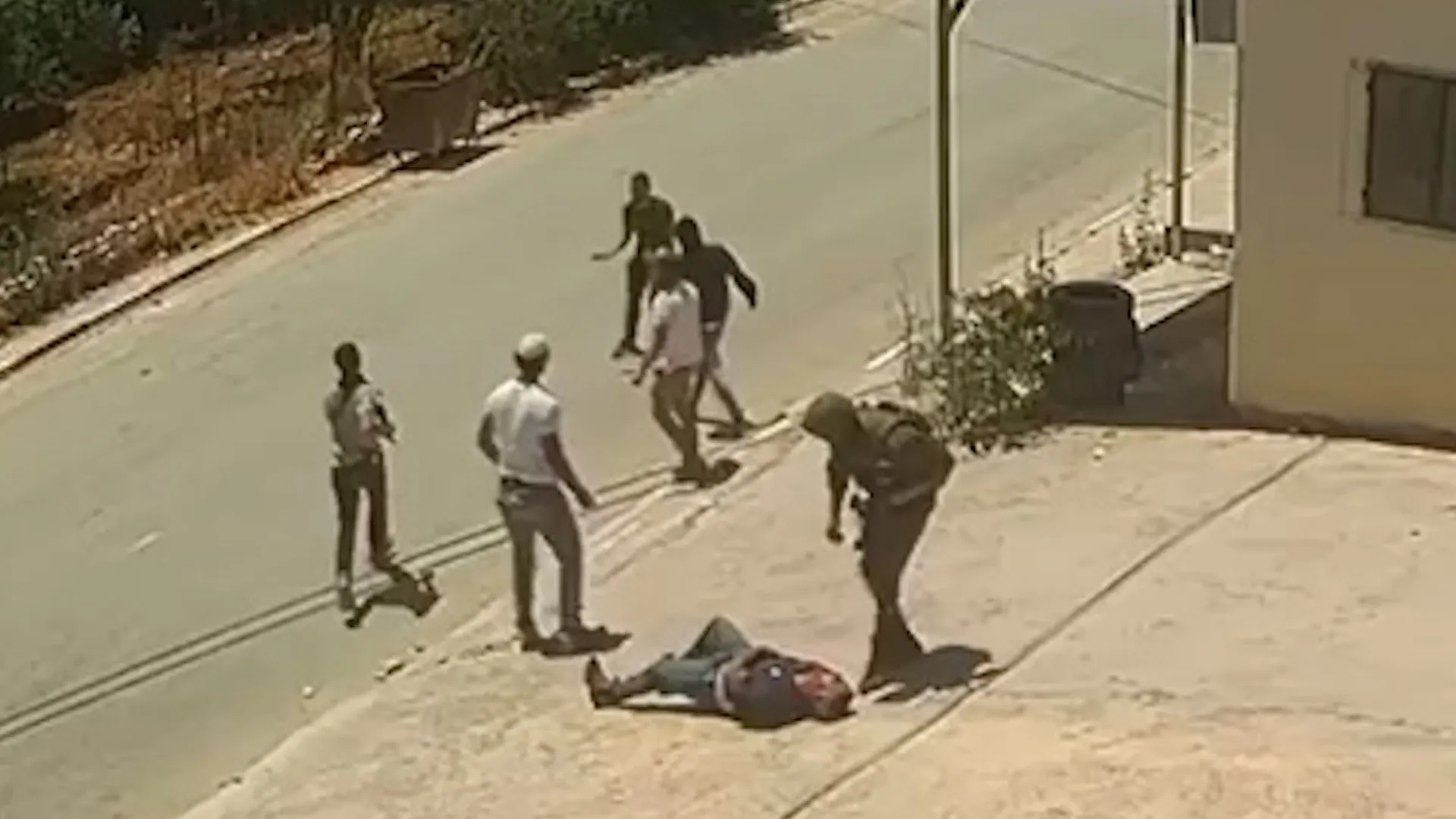
A surveillance camera caught a brutal assault by an Israeli soldier and settlers on two young Palestinians in the occupied West Bank. Video shows them slamming the victims onto the ground and repeatedly beating them, including with a plank of wood, leaving them motionless on the ground.
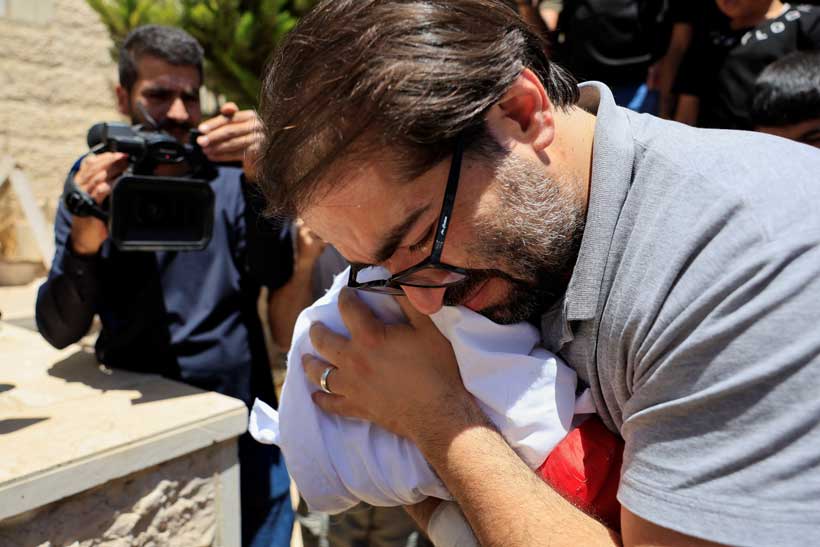
Israeli forces reportedly killed a seven-month-old Palestinian baby, Sam Fahd Abu Haikal, and injured his parents in the Tel Rumeida area near Hebron on Friday evening, according to the Palestinian health ministry. The baby’s grandmother described how the family stopped their car after seeing Israeli military vehicles when shots were fired at them. She recounted that a bullet hit the baby in the face and lodged in his mother’s cheek, while also grazing the father’s finger. The parents were treated for their gunshot wounds.
The Israeli military stated that during operations in Hebron, soldiers fired shots at a vehicle they thought was approaching them quickly. They acknowledged that three Palestinians, later determined to be “uninvolved civilians,” were injured, and the incident is under investigation. Tel Rumeida has a history of violence as Israeli settlers live with military protection among the Palestinian community. Recent EU data indicates over 700,000 settlers reside in East Jerusalem and the West Bank while more than 3 million Palestinians live there.
When the European Union issued its latest tranche of sanctions against Israeli settler groups and their leaders, Regavim, founded in part by the country’s Finance Minister Bezalel Smotrich, these groups welcomed the measures as a “badge of honour.”
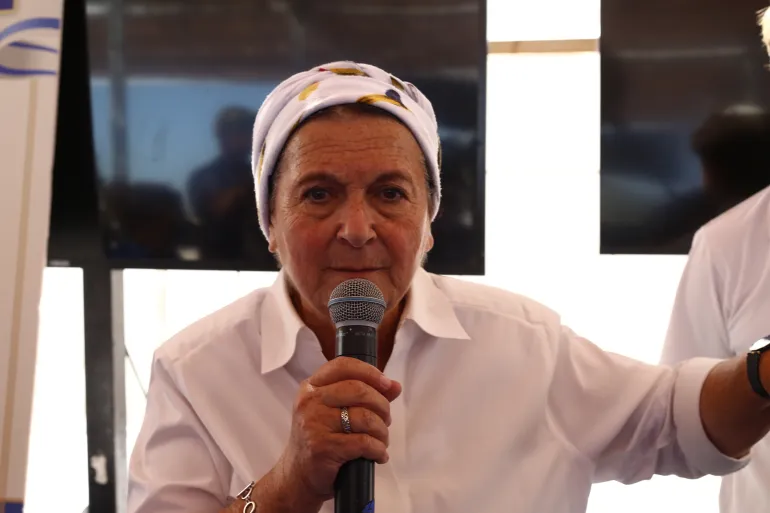
Another sanctioned figure, Daniella Weiss, whose movement, Nachala, has held conferences on the Gaza border to discuss plans for settlement expansion into the occupied Palestinian territory, likewise dismissed the European penalties as “ridiculous” and “banal”.
Recommended Stories
list of 4 itemsend of list
In total, the EU sanctioned four entities and three individuals associated with the settler movement, which includes high-profile characters such as Weiss, Regavim and its director, Meir Deutsch, and the Amana cooperative association, which offers logistical and financial support to settlements in the occupied West Bank.
Even government figures have been targeted in recent Western actions. Finance Minister Bezalel Smotrich, a son of the settler movement, was sanctioned by the United Kingdom, Canada and several other countries for his alleged role in supporting or enabling violence in the West Bank, highlighting how the settlement project has the support of the highest echelons of the Israeli state.
Overall, the nonchalant response from the targeted figures and entities suggests that none of the EU measures will do anything to stop settlement expansion or make individuals accountable for the growing wave of violence against Palestinians.
Ironically, the largely toothless measures might instead become a source of domestic prestige for their leaders, analysts say, as few would expect these hardline settler figures to spend their summers in Paris or London and thus be affected by the sanctions. Instead, a wave of terror in the occupied West Bank will likely continue, with the tacit support of the government.
Endemic violence
In the eyes of many activists and observers who spoke to Al Jazeera, the EU’s focus on group and individual “violations” falls far short of articulating the scale of the highly coordinated settler attacks or the extent to which the state and society support them.
Following the Hamas-led attack of October 2023, United Nations and human rights monitors have documented systemic lethal settler attacks in places such as the South Hebron Hills, where residents of villages like Susiya and Umm al-Khair have been killed or seriously injured in collective incursions.
In the northern West Bank, Palestinian residents of villages around Nablus and Ramallah have seen their homes, vehicles and olive groves torched during nighttime settler raids. Entire Bedouin herding communities in the Jordan Valley have also been forcibly displaced following sustained campaigns of intimidation and violence.
All of this underscores the depth and breadth of settler activity, which, according to people on the ground, has the direct support of the Israeli government.
“It’s gotten much worse since October 2023. They now have the courage to attack into the heart of densely populated Palestinian villages. I see them, they came into the heart of my village outside Ramallah, they feel safe to do so,” Tahseen Alayan, deputy director of Al-Haq, told Al Jazeera.
“If you buy a sheep, they will steal it. If you build a house, they will destroy it. If you buy a car, they will burn it.”
Daniella Weiss, founder of the Nachalot Association, described the EU sanctions as “ridiculous” and “banal” [Enes Canli/Anadolu Agency]
Examples of Israeli government complicity in these settler raids are not hard to find, and the statistics indicate collective efforts to entrench Israeli control over the West Bank, which has been occupied since 1967.
Israeli forces and settlers are accused of killing an estimated 1,168 people in the occupied West Bank since October 2023 and injuring a further 12,666 Palestinians. Another 33,000 people have been displaced, while Israel has also detained nearly 23,000 Palestinians in the West Bank during this period, many without charge.
“The violence does not happen in a vacuum,” Alayan continued. “This is an extension of the Israeli government; settlement is at the core of their identity. They are protected by the government and by the occupying services, and they freely admit it.”
A tragic incident that comes to mind is settler Yinon Levi, who allegedly shot dead Palestinian activist Awdah Hathaleen in Masafer Yatta last year. Despite the murder being captured on video, Levi nevertheless remains at large.
“Even if they are ever prosecuted, the sentences rarely reflect the severity of the crime,” Alayan said. “These people return to their homes and are seen as heroes.”
‘Entitlement and superiority’
This sense of impunity that settlers appear to be imbued with cannot be detached from the appointment to ministerial positions of leading figures or sympathisers of the settler movement – notably Ben-Gvir and Smotrich, the latter born in an illegal settlement in the occupied Golan Heights.
In a sign of state-settler cooperation to achieve direct control of the West Bank, in contravention of the Oslo Accords, Israel last year announced plans for the establishment of the E1 settlement that would link occupied East Jerusalem with its growing Maale Adumim bloc.
According to plans outlined by Smotrich, when established, this settlement would kill any hopes of the creation of a Palestinian state in the West Bank and Gaza and fulfil a biblical prophecy that many in the movement have been working towards.
Israeli far-right Finance Minister Bezalel Smotrich holds a map of an area near the settlement of Maale Adumim, a land corridor known as E1, outside Jerusalem in the occupied West Bank, on August 14, 2025, after a news conference at the site [Menahem Kahana/AFP]
Daniel Bar-Tal, a professor of social-political psychology from the Department of Education at Tel Aviv University, interpreted the thinking behind the settlers leading this violence across the West Bank.
“It is divine order to settle West Bank. With divine order you do not argue but achieve it in the way Yehoshua carried it 3,000 years ago when he entered the promised land,” he explained. “He achieved it with sword, so we need to do the same.”
Shai Parnes of the Israeli human rights group B’Tselem told Al Jazeera that the absence of international pressure has bolstered the alliance between the state and settler movement.
“The Israeli regime is an apartheid regime based on Jewish supremacy and institutionalised discrimination against Palestinians,” Parnes told Al Jazeera.
“Any Israeli, civilian or soldier, who harms a Palestinian receives full immunity and support from the Israeli systems, and Israel itself receives this from the international community. These facts explain the Israelis’ sense of entitlement and superiority.”
Palestinian Nazem Saleh Shoman stands inside a pen at a sheep farm that was set on fire the previous night by Israeli settlers in the Palestinian village of Khirbet Abu Falah in the central occupied West Bank [AFP]
Yehouda Shenhav-Shahrabani, one of Israel’s leading sociologists, described the channelling of “Jewish supremacy” from the individual to the group, to the state, and back again, as a “closed loop”.
This, he said, fosters a sense of superiority among individuals, and when combined with a militarised society, makes violence against the native Palestinian population, who are in the way of realising this supposed biblical prophecy, almost inevitable.
“Some believe they’re in the West Bank because God said it was theirs. Others are there because they’re too poor to be anywhere else, and have been told they’re superior anyway,” he said.
“Two-thirds of the time, these same people are soldiers. They carry guns all the time. Looking on while they carry out this violence against Palestinians are other soldiers who believe almost exactly the same thing, and behind them politicians. Like I said, it’s a closed loop.”
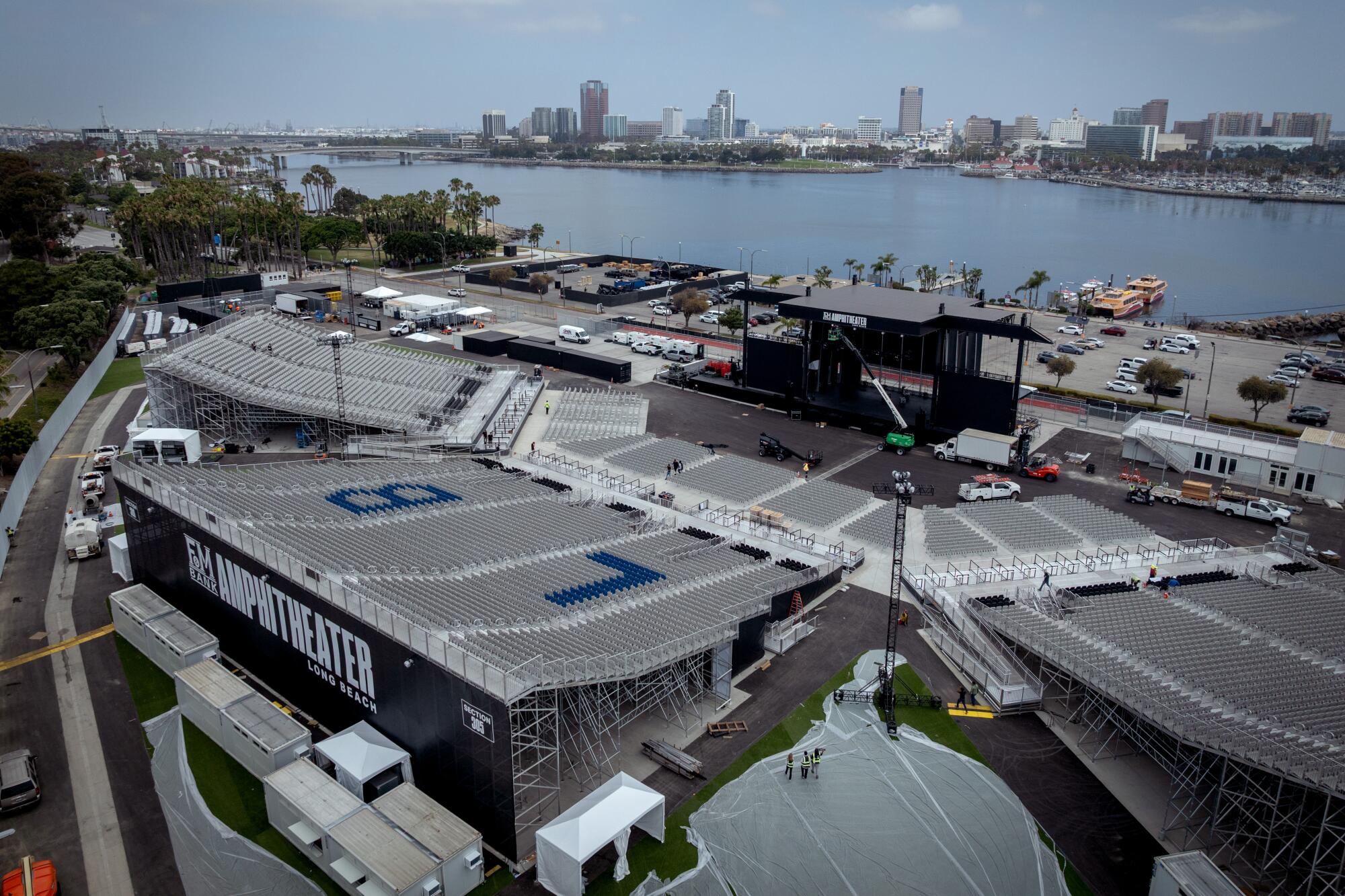
A waterfront amphitheater roughly twice the size of the Greek Theatre and two-thirds the size of the Hollywood Bowl is set to open this week in Long Beach — and there’s a lot riding on its success.
City leaders hope F&M Bank Amphitheater of Long Beach, located next to the famed Queen Mary, will supplant declining revenues from oil extraction and lead to an uptick in tourism. Concert promoters, meanwhile, see it as filling an important gap in Southern California’s music venue market.
The temporary amphitheater, which has a maximum capacity of 11,000, is meant to be a precursor to a permanent “Long Beach Bowl,” which is being pitched as the largest waterfront venue on the West Coast. The site opens June 6 with a performance by native son Snoop Dogg, and is expected to last for up to 10 years.
The new amphitheater represents a years-long dream of Mayor Rex Richardson, who began championing an outdoor performance venue on the waterfront in 2023. Soon after the closure of Irvine’s FivePoint Amphitheatre in October of that year, he accelerated those plans by proposing this facility. The general feeling was that Irvine’s loss could be Long Beach’s gain.
“This will be a place where memories are made, where music brings people together and where our city shows up on the big stage,” he said during a January groundbreaking. “The amphitheater represents direction to invest in our city’s future, to embrace our creative economy [and] to shape how people experience Long Beach for generations to come.”
Good vibes by the water is the driving energy behind the temporary venue.
(Eric Thayer / Los Angeles Times)
While Los Angeles and Orange County have no shortage of cavernous indoor arenas, the region has recently lacked a proper “summer shed” capable of hosting many national amphitheater tours, said Nick Storch, head of global artist development for booking agency Independent Artist Group. Those tours typically play venues larger than the Greek, Irvine’s Great Park Live or Costa Mesa’s fairgrounds-adjacent Pacific Amphitheatre, but smaller than the Hollywood Bowl.
Such tours, Storch said, are of “massive” importance to the concert industry. “With amphitheaters, it’s not just the music — it’s the experience of being outside and watching a concert, getting a bite to eat with your friends and all those kinds of things,” said Storch, whose agency’s clients Motley Crue and Five Finger Death Punch will perform at the F&M Bank Amphitheater in September.
“FivePoint was a great venue to help artists that are in that in-between stage, and not fully ready for arenas,” he said. “Long Beach having an amphitheater is going to grow the market again.”
Amphitheaters are also crucial to veteran artists with established fan bases. The long-running hard rock band Tesla — who also will perform at the F&M Bank Amphitheater in September — has not played a show in Los Angeles or Orange counties since the closure of FivePoint, which hosted the group twice.
Brian Wheat, the band’s bassist and manager, said he’s excited the new venue will help change that. “Sheds are great in the summertime, and outdoor summer gigs always create a great atmosphere for both bands and fans,” he said.
Much like the F&M Bank Amphitheater, FivePoint Amphitheatre was designed to serve as a temporary venue following the closure of Irvine Meadows Amphitheatre, which operated from 1981 to 2016. (From 2000 to 2014, it was known as Verizon Wireless Amphitheater.)
At 11,000 seats, the amphitheater is roughly two-thirds the size of the Hollywood Bowl. Its permanent replacement will be “architecturally iconic,” said Mayor Rex Richardson, while this temporary version is likened to a “summer shed.”
(Eric Thayer / Los Angeles Times)
From its opening in October 2017 until its closure, FivePoint hosted nearly 500 concerts, including artists such as KISS, Dave Matthews Band, Charlie Puth, Morgan Wallen and Luke Combs.
Venue operator Live Nation — which manages more than 300 facilities across the country — initially hoped to build a permanent amphitheater nearby, but scrapped those plans in 2023 after the Irvine City Council ended negotiations. Soon after, Live Nation announced the venue would shutter.
After learning of Live Nation’s fallout with Irvine, Richardson and members of his economic development team attended the final FivePoint concert, a performance by the Zac Brown Band, to “explore the feasibility if we were to do the same thing.”
Three months later, Richardson announced plans to build a temporary amphitheater in Long Beach to bridge the gap until a permanent facility — which he envisions as an “architecturally iconic and significant” waterfront venue akin to San Diego’s Rady Shell at Jacobs Park — can be permitted, financed and constructed.
The site’s location is central to its appeal, said Dan Hoffend, executive vice president of North American venues for Legends Global, the operator for F&M Bank Amphitheater. “If you sit in the very top row — what you would consider the worst seat in the house — it’s a spectacular view,” he said. “The Queen Mary is sitting there in all its glory. You’re looking across the harbor. What would be perceived as the worst seat is actually the best seat because you see it all.”
Long Beach Mayor Rex Richardson, left, and amphitheater general manager Tra Jones sit in the stands. Even from the nosebleeds, you still have a view of the waterfront at the F&M Bank Amphitheater.
(Eric Thayer / Los Angeles Times)
Tra Jones, general manager of the new amphitheater and a Long Beach native, said he’s striving to make it feel less stopgap and utilitarian than FivePoint.
“It doesn’t have a temporary feel at all,” he said. “We looked at all our surroundings and said, ‘What does this look like from a stylistic point of view?’ We leaned into the port/SteelCraft vibe — a very cool industrial look. When you walk in, you’re experiencing a vibe. That’s what we want to resonate with concertgoers coming here.”
The word “vibe” also pops up frequently in conversation with Richardson. Under his watch, Long Beach recently started branding itself as “Vibe City,” which he said is an attempt to encapsulate the charm of L.A. County’s second-largest city, and the state’s seventh-largest.
“Long Beach is special, but it’s hard to explain why if you haven’t been here,” he said. “Because you have to experience it for yourself, the best way to describe it is that it’s a vibe.”
Still, Richardson is aware that vibes can only go so far. During an April meeting with residents of downtown Long Beach, attendees were more interested in discussing homelessness and a recent uptick in traffic fatalities than how a new concert venue might add to the city’s cultural cachet. Some downtown residents have circulated a petition regarding noise-related concerns.
“The job of the mayor is to meet the needs of your residents today — keeping a roof over your head, making sure it’s safe to walk down the street, making sure you have access to amenities and services in your community — but also to think about the future,” he said.
That means finding a way to offset revenues from oil extraction, which currently finance many municipal services, and are projected to drop from more than $50 million annually to around $21 million by 2035. According to Richardson, the new amphitheater — managed by Legends Global, but owned by the city — will help cover that shortfall. The venue is projected to be profitable within five years and generate nearly $29 million in revenue by 2036.
Oil revenues, which pay for city services, are projected to drop by more than half. The amphitheater is being pitched as a budget gap solution.
(Eric Thayer / Los Angeles Times)
“We were fortunate that revenue from oil provided a lot of our services and built our beautiful waterfront, but as California moves away from oil production, we have to plan a more sustainable future by investing in what we know will be here in the long haul,” Richardson said. “In order to do that, we have to invest in arts and culture and tourism.”
Richardson is betting on music at a time when other cities — including Los Angeles — are doubling down on sports, warehousing or data centers. The amphitheater is also meant to remind the world of the city’s impact on pop culture.
From War to Warren G and Sublime to Snoop, Long Beach has a rich musical history. The city hosted the first concerts by the Beach Boys and No Doubt, while Rock & Roll Hall of Famers Elvis Presley, the Eagles and Iron Maiden all graced the stage of the Long Beach Arena.
While that venue currently holds more conventions than concerts, Long Beach has hosted notable outdoor music festivals in recent years, including Warped Tour, Day Trip and Dreamstate. Richardson believes the success of those events helped prove the city’s viability as a concert destination.
“This is the first step toward a legacy of leaving our city in a more economically resilient position,” Richardson said. “At every big turn in our city’s economy, we’ve leaned on arts as a way forward, and this is no different.”
Even the bleacher seats represent Long Beach pride at F&M Amphitheater.
June 3 (UPI) — A 15-hour standoff at a California bank ended with the suspect shot dead and all hostages freed, police said Wednesday.
The man had barricaded himself inside the Chase Bank building on Chester Avenue and 17th Street in Bakersfield at about 1 p.m. PDT Tuesday. Police were sent to the downtown bank for a bomb threat, and when they arrived they found a man was inside the bank with several hostages, though some were able to escape.
Buildings in the area were evacuated, and police responded with SWAT teams, hostage negotiators and a bomb squad.
Twice on Tuesday evening, hostage negotiators convinced the suspect to release a hostage.
But around 4:20 a.m. Wednesday, the situation “concluded following an officer-involved shooting” by FBI personnel, the Bakersfield Police Department said in a press release. It also said the department was not involved in the use of force.
The number of people taken hostage wasn’t immediately clear, but those who remained in the building were unharmed.
“We are aware of the ongoing situation occurring at the building where our branch is located on the ground floor,” a Chase Bank spokesperson told CBS News in a statement. “The branch is currently empty, and we are working with authorities.”
The area around the building was still closed Wednesday morning. Police told the public to avoid the area and allow for extra travel time.
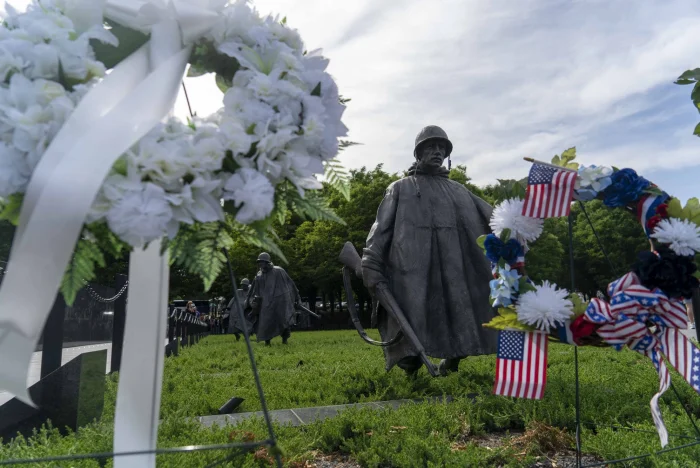
Wreathes are seen amongst the statues at the Korean War Veterans Memorial during Memorial Day weekend in Washington on May 27, 2023. Memorial Day, which honors U.S. military personnel who died while in service, is held on the last Monday of May. Photo by Bonnie Cash/UPI | License Photo
A digital register of land ownership in the West Bank is seen as an escalation of Israel’s occupation.
Published On 29 May 202629 May 2026
Occupied East Jerusalem, Palestine – A controversial Israeli plan to digitally register property ownership in the occupied West Bank is a “dangerous colonial occupation step that represents a direct assault on the historical and legal rights of the Palestinian people to their land and property”, the Palestinian Land Authority has said.
The Palestinian Jerusalem Governorate and the Colonization and Wall Resistance Commission (CRRC) have urged Palestinians in the West Bank not to engage with any Israeli “entities, committees, platforms, or procedures” of lands and property.
Recommended Stories
list of 4 itemsend of list
Israel reportedly launched the online “Land Registry and Settlement of Rights” platform on which it plans to “update” property ownership in the occupied West Bank on Wednesday this week.
The Jerusalem Governorate and the CRRC have called on the international community, the United Nations, the International Criminal Court and all international human rights and legal institutions to “take their urgent responsibilities to stop these illegal procedures and hold the occupying state accountable for its continuous violations against the Palestinian people, their land, and their resources”, they said.
Moayad Shaaban, head of the CRRC, which is part of the Palestine Liberation Organization, said the move reveals “the occupation’s transition from traditional policies of field control to digital and administrative colonial engineering aimed at imposing permanent legal realities on the occupied Palestinian territory”.
‘Annexation’ by land registry
In May 2025, the Israeli Security Cabinet launched a new, aggressive land settlement process throughout the West Bank, with the aim of “completing the legal and administrative annexation of the occupied territories through fully registering the lands under Israeli authority”, the Jerusalem Governorate said.
Then, in July 2025, Israel’s parliament approved a symbolic measure calling for the annexation of the occupied West Bank. The move was first tabled in 2024 by Israel’s far-right Finance Minister Bezalel Smotrich, who himself lives in an illegal Israeli settlement.
On February 15, 2026, the permanent acquisition and registration of approximately 58 percent of Area C – the part of the West Bank over which Israel exerts total control – began.
(Al Jazeera)
Under that decision, Palestinian land registration in the Israeli “Tabu” – the land registry extract – began for the first time since the occupation of the West Bank in 1967. It is a final measure that will be difficult to challenge in Israeli courts, the Israel Hayom newspaper reported in February.
With the onset of land settlement, the Israeli Land Registry unit will take over the regulation and registration of land ownership in Area C. It also has the power to issue sales permits and to collect fees. Israel aims to complete the full settlement of 15 percent of the West Bank by the end of 2030.
Some 700,000 Israeli settlers already live in the West Bank and East Jerusalem, as illegal settlement has expanded under the government of Prime Minister Benjamin Netanyahu.
Rights groups say settlement approvals, along with rising settler violence against Palestinian communities, have accelerated since Israel launched its genocidal war on Gaza on October 7, 2023.
EU says the sanctioned individuals and groups violated a range of rights, from the right to physical and mental integrity, to the right to education.
Published On 28 May 202628 May 2026
The European Union has sanctioned four entities and three individuals it says are “extremist Israeli settlers” responsible for “serious” human rights abuses against Palestinians in the occupied West Bank.
The EU said they had violated a range of rights, including the rights to physical and mental integrity, privacy and family life, freedom of religion and education.
The sanctions include the Nachala Settlement Movement and its director, Daniella Weiss. The EU says the group “encourages and facilitates coercive acts that lead to the forced displacement of Palestinians”.
Israeli NGO Regavim and its director, Meir Deutsch, are also on the sanctions list for lobbying “for the demolition of Palestinian property” in order to expand Israel’s control over the entirety of the West Bank, plus the demolition of an EU-funded Palestinian primary school.
Also sanctioned is the Hashomer Yosh NGO and its president, Avichai Suissa for supporting “at least 28 violent outposts and settlements”. It also recruits armed volunteers and provides guards who engage in violent attacks, the EU added.
The Amana cooperative association of the settler movement Gush Emunim was also sanctioned, the EU stating it had likewise “played a key role in initiating, financing, and facilitating at least 30 violent outposts and settlements”.
Long-awaited sanctions
With Thursday’s additions, the EU said it now sanctions 136 persons and 41 entities from a range of countries under its Global Human Rights Sanctions Regime.
The regime was created in 2020, and applies to acts such as genocide, crimes against humanity and other serious human rights violations or abuses.
The measures targeting Israeli settlers because of violence against Palestinians were long-awaited, having been blocked by the self-styled illiberal government of Hungary’s former premier Viktor Orban.
However, the appointment of new Prime Minister Peter Magyar saw the veto quickly lifted earlier this month.
Israel earlier condemned the sanctions, asserting that Jews have the right to settle in the occupied West Bank, despite that being in violation of international law.
In 2025, the expansion of Israeli settlements reached its highest level since at least 2017, when the United Nations began tracking data.
Since the start of Israel’s genocidal war on Gaza, the West Bank has been gripped by almost daily violence involving Israeli troops and settlers. More than 1,000 Palestinians have been killed in the territory, according to the UN.

![Israeli far-right Finance Minister Bezalel Smotrich holds a map of an area near the settlement of Maale Adumim, a land corridor known as E1, outside Jerusalem in the occupied West Bank, on August 14, 2025, after a press conference at the site. [Menahem Kahana/AFP]](https://i0.wp.com/www.aljazeera.com/wp-content/uploads/2025/08/AFP__20250814__69HV6DR__v1__HighRes__IsraelPalestinianConflictSettlementPolitics-1755194568.jpg?w=640&ssl=1)