ball

NFL, referees good to go with new collective bargaining agreement

There will be no replacement referees — and therefore, hopefully, no “Fail Mary” repeat — in the NFL this fall.

The league and the NFL Referees Assn. have avoided a work stoppage by agreeing on a new collective bargaining agreement that runs through the 2032 season.

The current deal was scheduled to expire May 31. The sides having been negotiating since the summer of 2024, and the NFL had begun the hiring process for replacement officials last month.

“This agreement is a testament to the joint commitment of the league and union to invest in and improve officiating,” NFL executive vice president of football operations Troy Vincent said in a statement. “It also speaks to the game officials’ relentless pursuit of improvement and officiating excellence. We look forward to working together for the betterment of the game.”

Terms of the agreement have not been released, but the Associated Press reported in March that the league had increased its offer to a 6.45% annual growth rate”growth rate” = increase? in compensation over a six-year labor deal.

“We see this new CBA as a partnership with the league that benefits our membership but also seeks to make our game better,” NFLRA president Carl Cheffers said in a statement. “It is good to get these negotiations behind us so we can focus on preparing for the 2026 season.”

No such agreement between the sides was reached during the 2012 offseason, leading to a lockout that lasted 110 days. It all culminated in Week 3 of that season with the notorious “Fail Mary” call at the end of the Green Bay Packers-Seattle Seahawks game on “Monday Night Football.”

With the Seahawks down by five in the closing seconds, quarterback Russell Wilson threw deep to receiver Golden Tate in the end zone. Green Bay defender M.D. Jennings appeared to come down with the ball first, with Tate attempting to wrestle the ball away.

Two officials stood above the players, with one signaling touchdown (meaning Tate caught the ball, Seattle wins) and the other signaling touchback (meaning Jennings caught the ball, Green Bay wins). The final call on the field was a touchdown, which stood after a lengthy review.

It got worse. The next day, the NFL released a statement saying the officials missed a pass interference call on Tate that would have negated the touchdown. A day after that, the NFL and the referees union announced a new collective bargaining agreement that brought the regular officials back for that weekend’s games.

The Associated Press contributed to this report.

Source link

When Banana Ball calls: Former USC pitching star’s career gets surreal

Chris Clarke had gone the traditional route, pitching for three years at USC after starring at Newbury Park High, then toiling for six more seasons in the Chicago Cubs’ minor league system after being a fourth-round draft pick in 2019.

But his big-league dream abruptly became a wake-up call last August when the Cubs released him a week before his wife gave birth to their first child. No more paychecks. No more health insurance.

So imagine how jarring it was for Clarke to take the mound in front of a record 102,000 fans in the Texas A&M football stadium Saturday, which had been converted to accommodate (sorry Dodgers) the most popular team in baseball: the Savannah Bananas.

“It was surreal,” Clarke said. “In fact, it was so incredible, I didn’t feel anything. My body went numb. There was a moment in the third inning when everybody was screaming. I couldn’t hear myself talk.”
It was the most people ever crammed into Kyle Field, the nation’s fourth-largest college stadium, trailing only Michigan (107,601), Oregon (106,572) and Ohio State (102,780).

Clarke pitched for the opposing team, the Texas Tailgaters, one of five squads created by Bananas founders Jesse and Emily Cole that serve as touring partners to face the yellow-clad star attraction. All six teams practice at a complex in Savannah, Ga.

The game in College Station attracted the largest crowd in the Bananas’ six-year history, and Clarke shined, striking out five in four innings. He also entertained, as all players in the Banana Ball Championship League are cheerfully required to do.

“The amount of joy it brings to fans and even people online, it’s really something,” Clarke said. “There definitely is a winner and a loser — which holds some weight — but for the most part, fans are there because it’s a really good show.”
Clarke, a 6-foot-7 right-hander, was the third overall pick in the inaugural Banana Ball draft held in November. Tailgater coaches contacted him beforehand to gauge his interest and he told them, “Pick me.”

March 2019 photo of former USC pitcher Chris Clarke during the 2019 Dodger Stadium Classic.

March 2019 photo of former USC pitcher Chris Clarke during the 2019 Dodger Stadium Classic.

(John McGillen/USC Athletics)

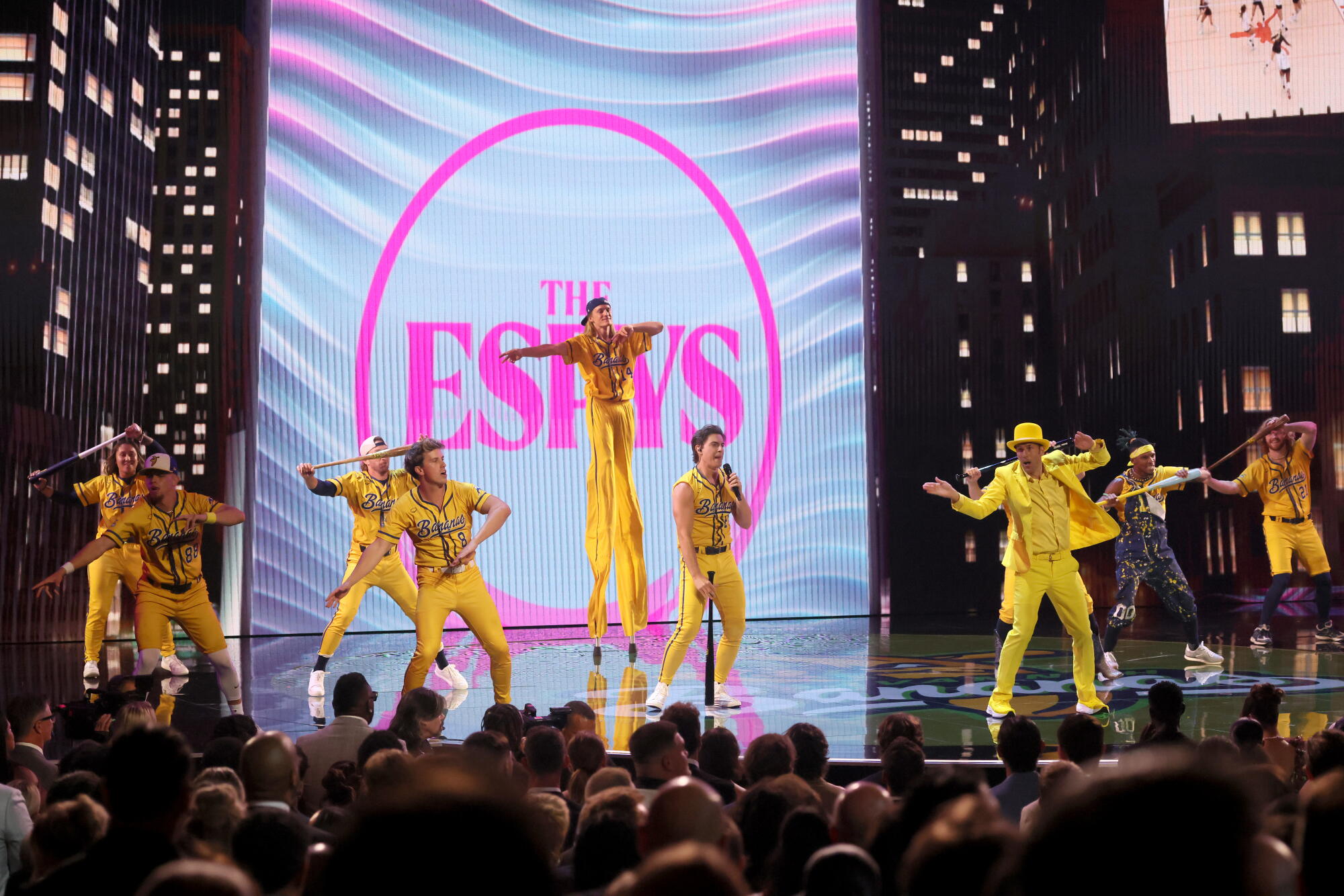
That level of bold fits right in. Banana Ball is fast-paced, hilarious and maximizes fan engagement. It features innovative rules: Fouls caught by fans count as outs, for example, and batters who walk get to run the bases until all nine defensive players have touched the ball. Choreographed dances, acrobatic tricks, a pitcher on stilts and other antics keep the entertainment flowing.

“I like to think of every game as a stepping stone to the next show,” Clarke said. “Whether it goes well or is terrible, we will make it better for next time. Banana Ball is a relaxed culture, so when it comes to the entertainment stuff, there is no fear of failure. We are seeing what works and what doesn’t.”

Guest stars are frequent and on Saturday, the Bananas sent Texas-grown YouTube sensation Tyler Toney, a member of the sports comedy troupe Dude Perfect, to the plate as a pinch-hitter. Clarke struck him out on four pitches: a called strike, a swinging strike, a ball Clarke purposely launched high into the stands for laughs, then strike three swinging on a cut fastball.

It was a rare humbling moment for Toney, who, with fellow Dude Perfect members Cody Jones, Garrett Hilbert, and twins Cory and Coby Cotton, generates more than $20 million annually from YouTube, merchandise and tours.

Clarke had watched Dude Perfect videos religiously when he was at USC and was starstruck to meet them in person.

“Dude Perfect is the reason I failed econ twice,” he said. “I watched every single Dude Perfect video. To meet them and shake their hands was fun. It was the only moment in my life where I was a fanboy.”

He’s also a breadwinner again for his family. The burgeoning popularity of Banana Ball has made the gig more lucrative than playing in the minor leagues.

“I’m making five times as much and playing half the time,” Clarke said. “My contract is also for 12 months of the year. In affiliated baseball, it’s only six months. So, there’s that. I’ve never met anyone in baseball who has had the luxury to spend time with a newborn child. To come to Banana Ball and actually feel like there is respect, a culture and guidelines, that was something I hadn’t experienced.”

It is also giving him notoriety. Twenty-five Banana Ball games this year are being streamed on the ESPN app and Disney+, with select games airing across ESPN networks and ABC. The first Bananas broadcast on ABC will take place at Autzen Stadium in Eugene, Ore., June 27 and 28. The games have been sold out since October.

Highlights from Saturday’s game flooded social media and traditional outlets alike. Family friends and former teammates reached out to Clarke. What was it like pitching in front of 100,000 people? Are you improving your dance moves?

“The entertainment side of it takes pressure off performance,” he said. “Performing well is still very much there, but there is a level of relaxation that makes it easier.”

Clarke admits he thinks back to USC and the 2019 season, when he posted a stellar earned-run average of 1.03. He also occasionally misses the heightened competition and quest to make the major leagues of affiliated baseball.

He pitched two seasons in triple A and is only 27. Would he leave Banana Ball next year if an MLB team offered him an invite to spring training?

“I’m not in a situation to close any doors,” he said. “That’s the mindset that got me here. I wanted to investigate Banana Ball and I told them I’d give them a full year for us both to evaluate it. Either way, I think it’s a win. Just comes down to what’s best for my family.”

Meanwhile, more games in packed stadiums await. In addition to a handful in football stadiums against the Bananas, the Tailgaters will play three games a week against other Banana Ball League teams throughout the summer, mostly in minor league baseball stadiums from Tulsa, Okla., to El Paso, Texas, to Nashville, Tenn., to Charlotte, N.C.

Exponentially larger crowds than those venues are accustomed to are a given.


Source link

Dodgers beat Astros, but Shohei Ohtani’s hitless streak grows

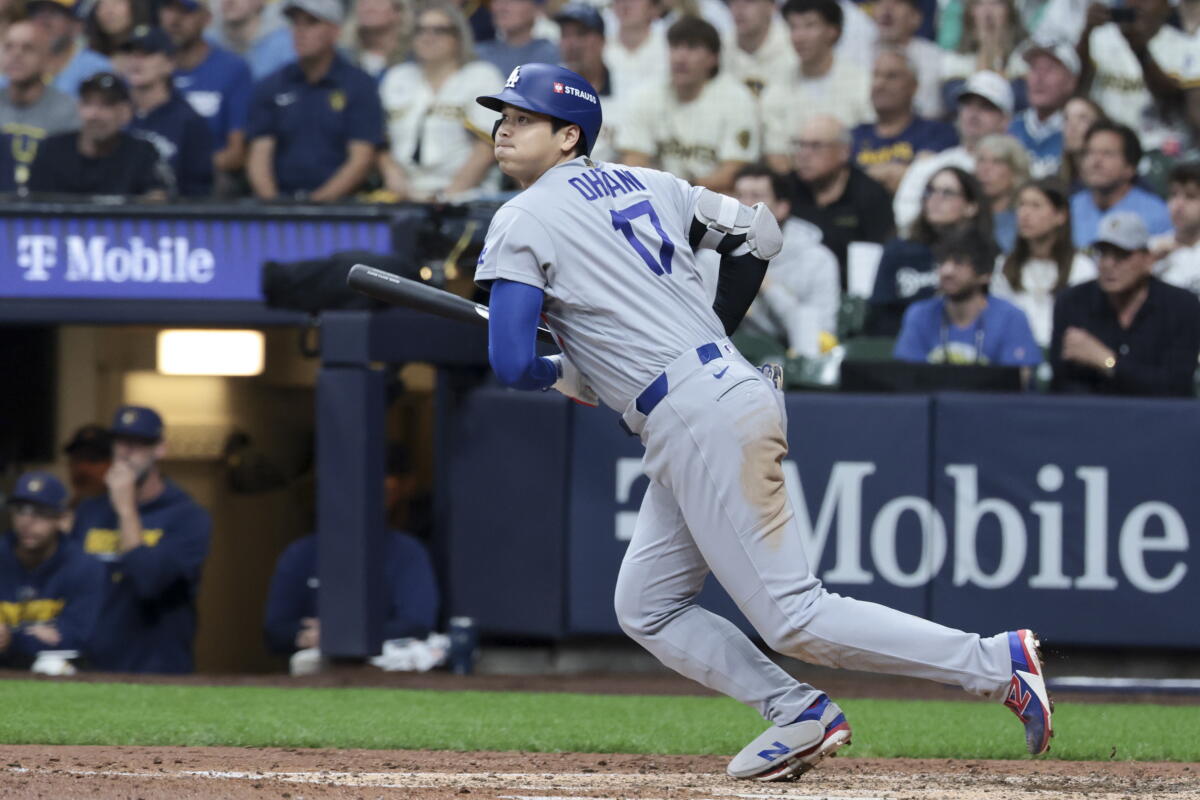
It was the perfect time for Shohei Ohtani to step up to the plate. The Dodgers’ offense was rolling again, ready to make a statement with a third-inning rally against the Astros. They loaded the bases and turned over the batting order.

Then Ohtani chased a sinker off the plate and chopped a slow bouncer to Astros third baseman Isaac Paredes, giving him an easy play at second. A far departure from the eye-popping exit velocities that Ohtani’s swing usually produces, the run-scoring grounder was soft enough to avoid a double play.

In the Dodgers’ 8-3 win Monday against the Astros, Ohtani’s hitless streak stretched to five games, his longest such skid since 2022, when he also went five games without a hit (May 24-28).

“I do feel like over the course of my career it’s just a reality that I’m not exactly hitting at the best of my ability at this time of year,” Ohtani said last week through interpreter Will Ireton. “At the same time, as a player, I do want to be better and get to that position where I’m feeling really good. It’s a balancing act of the two.”

The rest of the Dodgers’ offense finally broke out on Monday, against a snakebitten Astros pitching staff.

Alex Freeland ended the Dodgers’ homerless streak at six games with an opposite-field shot into the Crawford boxes in the second inning. Leading off the third, Kyle Tucker hit a solo home run of his own, giving the Dodgers their first multi-homer game in two weeks.

Seven Dodgers combined for 13 hits, with Freeland and Will Smith leading the pack with three apiece. Tucker and Freddie Freeman each contributed a pair of RBIs.

The offensive surge just didn’t extend to Ohtani.

Kyle Tucker hits a solo home run for the Dodgers in the third inning against the Astros on Monday.

Kyle Tucker hits a solo home run for the Dodgers in the third inning against the Astros on Monday.

(Tim Warner / Getty Images)

In contrast to his offensive struggles, Ohtani has been dominant on the mound. He earned a pitcher of the month award for the first time in his career Monday after recording a 0.60 ERA in five starts in March and April.

Unhappy with just one-sided success, however, Ohtani shook up his routine with early on-field batting practice Monday.

“Most of the times when he does this, it works,” manager Dave Roberts said.

Ohtani took on-field batting practice before Game 3 of the 2025 NL Championship Series and then hit three home runs in Game 4. He usually prefers the batting cages for his pregame BP. But Monday marked the second time this season that he moved his session to the field.

“If you hit a ball down the line the other way in the cage, it kind of looks like it’s a foul ball,” hitting coach Aaron Bates said. “Whereas on the field you can see it’s fair, you can kind of see the spin of the ball a little better. It just kind of changes up the environment a little bit. The depth perception, too, helps a lot.”

Hitting the ball the other way was one of Ohtani’s goals.

Dodgers starting pitcher Yoshinobu Yamamoto delivers during the first inning Monday against the Astros.

Dodgers starting pitcher Yoshinobu Yamamoto delivers during the first inning Monday against the Astros.

(Ashley Landis / Associated Press)

Amid his slow offensive start, Ohtani’s swing has become pull-happy. He’s been hitting the ball to the right side at 53.4% entering Monday, compared to 43.2% last season, according to Statcast.

“It’s more about timing and feel for him, backing up the baseball,” Bates said. “When he gathers correctly and hits through the baseball, obviously we’ve seen what he’s capable of doing. But just kind of managing his at-bats right now, trying to get to the big part of the park.”

For the first time since 2023, Ohtani is also balancing a full starting pitcher’s workload with his offensive responsibilities.

“It is easier to maintain something good when things are going well,” Ohtani said. “But when things are not going well, it’s not easy, in the sense that I have to make sure that I’m healthy and not overdoing it in terms of repetition. So while I’m working on certain things, it’s also a balancing act of making sure I’m not overdoing it physically and making sure that I’m healthy.”

No matter what, it’s going to take a greater physical toll. Case in point: after hitting on the field Monday, Ohtani also threw a bullpen session.

The Dodgers have tried to help him manage his workload by giving him days off from hitting on some of his pitching days. Those pitching-only days weren’t a regular occurrence when Ohtani was with the Angels, but now Ohtani is also preparing for what’s expected to be a deep postseason run.

The Dodgers have given Ohtani two pitching-only days already this season, but Roberts said he plans to have Ohtani hit when he pitches against the Astros on Tuesday.

“It’s doable,” Roberts said when asked about Ohtani trying to fix his swing while pitching. “The bottom line is, there’s no other alternative. He’s going to DH a lot. He’s going to pitch a lot. Now, how best we preserve him and keep him strong and healthy is the question.”

Ohtani’s search for his usual offensive production will continue at least another day. He drew two walks Monday. And the best contact he made was on a fly out to center field (91.2 mph exit velocity) in the seventh inning.

Source link

Man from viral video gives home run ball back to young Guardians fan

Guardians fan Evelyn Moore got a pretty cool souvenir from Monday’s game against the Tampa Bay Rays — a two-run home run ball hit by Cleveland second baseman Daniel Schneemann.

The 11-year-old softball player from New Philadelphia, Ohio, almost got the ball right after Schneemann hit it in the bottom of the fifth inning.

But, as seen in video footage that quickly went viral on social media, a man appeared to snatch it away as Evelyn was trying to pick it up near the rail in the left-center field stands at Progressive Field.

He eventually gave it to her, however, and now the girl’s mother wants folks on social media to leave him alone.

“This man’s life shouldn’t be ruined over this,” Nikki Moore-DeVore said. “Jokes and memes are one thing, but it’s getting excessive. It’s too much.”

Moore-DeVore said her family — which also includes her husband, Jon DeVore, and her son, Theo Moore, 9 — attend several Guardians games a year. They sit in the outfield stands, where Evelyn — an avid baseball fan and baseball card collector — likes to take her glove down to the rail and try to persuade Cleveland outfielders to toss her a ball.

Video of Schneemann’s home run shows the ball flying over the left-center field wall, where a bearded man wearing a throwback Cleveland Indians hat and T-shirt tried to catch it in the air. Instead, it bounced off his hands toward the rail to his left.

Two baseball players wearing batting helmets smile and bump hands

Cleveland Guardians’ Daniel Schneemann, right, is greeted at the plate by teammate David Fry after hitting a two-run home run in the fifth inning of a game against the Tampa Bay Rays on Monday in Cleveland.

(Sue Ogrocki / Associated Press)

Evelyn ran down from her seat two rows up, dropped to the ground and attempted to secure the ball in front of her. The man ran over and also dropped to the ground next to her, starting a brief struggle for control of the ball.

The man eventually emerged triumphantly.

“I did not really see how the ball came over to us. I just saw it bounce in our direction and my daughter go down to get it,” Moore-DeVore said. “And I saw the scuffle kind of from behind, but I couldn’t see much of the hands or anything like that. I just saw the shoulders shifting around.

“And then she got up empty-handed, and people started booing. The guys sitting in front of me were like, ‘That was her ball!’ My husband was booing. He was not happy, but we didn’t want to ruin the game.”

Evelyn also was upset by the turn of events, her mother said, “but she didn’t cry.”

“She actually took it like a champ,” Moore-DeVore said. “Every inning, she still went up to the rail to try to get one of the players to throw a ball to her. She didn’t give up.”

Meanwhile, Theo approached the man to request he return the ball to his sister. Moore-DeVore said her son told her the man politely refused.

“I was just proud of him for going over there and taking it upon himself to try to help his sister,” Moore-DeVore said.

The Rays broadcast of the game showed the incident involving Evelyn and the man, with the announcers taking the girl’s side. On social media, fans shared the video and shamed the man for his behavior, with some looking to make his identity public.

Later in the game, Rays sideline reporter Ryan Bass visited the family at their seats and presented both kids with baseballs.

That’s when Evelyn became emotional.

“She cried happy tears,” her mother said. “I think she just felt seen. The incident made her feel small, and Ryan made her feel seen.”

Bass posted about the moment on X.

“We had to make it right,” Bass wrote, adding in a separate post: “We got the chance to make a sweet little girl’s night. There’s nothing better. Kindness is free. Always remember that.”

Before the bottom of the eighth inning, Evelyn went down to her usual post at the rail to try to persuade an outfielder to toss her a ball. She returned with the home run ball from three innings earlier.

“She came back with the biggest smile on her face: ‘Mom, he gave it back to me!’” Moore-DeVore said. “The guys in front of me were like, ‘yeah, he’s, like, getting a lot of social media flack.’ … I’m sure he realized eventually that it was probably the wrong action to take, just not good etiquette.”

In return, Moore-DeVore said, Theo offered the man — whose name has not been revealed despite the internet’s attempts — one of the balls that Bass had given him and his sister.

“He respectfully declined,” she said, “so my son gave it to another kid.”

Moore-DeVore said both of her kids are “on cloud nine” over how everything turned out — and she wants everyone else to get over it as well.

“I don’t want this one moment to ruin this guy,” she said. “And my kids, they wouldn’t want that. They’re sweet kids. I feel like, if kids their age can forgive and offer him a peace offering, grown adults and other fans can, too.”

Source link

Bronny James settling into Lakers playoff role

While leading the Lakers to a commanding 3-0 lead over the Houston Rockets in the first round of the Western Conference playoffs, LeBron James has stepped out of his airtight postseason mindset for only a few fleeting moments.

He has a good reason.

“All those moments has been with Bronny,” James said Friday after leading the Lakers to a 112-108 win over Houston. “It keeps getting better and better. It’s like, wow.”

Steadily growing under the postseason spotlight, Bronny James scored his first playoff points Friday in a five-point, 26-second flurry in which he drained a three behind a screen from his dad and then hit a reverse layup to complete the NBA’s first father-son postseason alley-oop. The Lakers can clinch the first-round, best-of-seven series Sunday at Toyota Center.

Without Luka Doncic (hamstring) and Austin Reaves (oblique) to run the Lakers’ halfcourt sets, the team has placed an emphasis on running in transition. When Deandre Ayton blocked a shot at the rim with 7:18 remaining in the second quarter, LeBron corralled the rebound and pushed the ball up the court. Bronny, the youngest player on the Lakers’ roster, knows he can beat anyone up the court. He locked eyes with his dad as they sprinted toward the basket.

It’s been a while since Bronny caught a lob from his 41-year-old dad. Maybe not since last year’s training camp, he estimated. Getting to connect again while contributing to the Lakers’ thrilling overtime win is “what I always wanted,” Bronny said.

“Especially a playoff game, the first playoff bucket is great for me, great for my confidence and how I approach the rest of the playoffs,” he added.

The 21-year-old got his first postseason rotation minutes in Game 1, starting the second quarter. The Crypto.com Arena crowd cheered when he got his first touch of the ball.

He had one turnover and two fouls in his nearly four-minute shift. Several of his passes were slightly off the mark, forcing teammates to reach for the ball. Assistant coach Greg St. Jean pulled him aside for words of encouragement before the second-year pro returned to the bench. He didn’t reenter the game.

LeBron remembered the nerves he had during his first postseason game in 2006 against Washington, he said after Game 1, and there was little advice he could give his son that would make the experience easier until he actually did it.

“I was nervous for my first playoff game too,” Bronny said. “I definitely think I’ve gained a little more confidence and relaxed myself over these three games.”

The Lakers are going to need his minutes. Still waiting for Doncic and Reaves to return, the Lakers can’t turn down any advantageous shots, coach JJ Redick said.

Seeing him confidently step into a three-pointer Friday was even more important than the fact that Bronny made the shot for his first playoff points.

Lakers guard Bronny James, left, and Rockets guard Reed Sheppard chase after a loose ball during Game 3 on Friday night.

Lakers guard Bronny James (9) and Rockets guard Reed Sheppard (15) chase after a loose ball during Game 3 on Friday night in Houston.

(Michael Wyke / Associated Press)

“The amount of confidence that a young kid in our league can get from a postseason game is like — a regular-season game would never,” LeBron said. “You will never get nervous from a regular-season moment ever again when you play meaningful postseason games and postseason minutes. And he’s done that, and I think that’s pretty cool for his career, for his confidence.”

Not only has Bronny gained confidence in his shot, but also Redick praised his improvement on defense throughout the season. Against the famously physical Rockets, the 6-foot-2 guard doesn’t look out of place on defense. In the moments LeBron zooms out to realize his son is playing, he marvels at his oldest child’s attention to detail, improvements on the ball and defensive mindset.

Bronny is appreciative of the coaches’ trust in him. The former five-star recruit out of Sierra Canyon High still is growing into his career, especially after surgery for a congenital heart defect derailed his brief college experience at USC. That he didn’t get to play a March Madness game will irk him for the rest of his life, Bronny said. But the Lakers’ postseason run isn’t a bad consolation prize.

“Got to do it in the playoffs,” Bronny said, “and that’s just the best feeling.”

Injury updates

Austin Reaves remains questionable for Game 4 in Houston on Sunday . Reaves participated in an individual shooting workout Saturday.

Reaves and Doncic are less than four weeks removed from their Grade 2 injuries suffered April 2. Doncic remains out for Game 4, but with the Lakers close to extending their season into the second round, Doncic’s potential postseason return becomes more realistic.

Needing a win Sunday to extend his season, the Rockets’ Kevin Durant is questionable because of a left ankle sprain. The superstar forward missed Game 1 because of a bruised right knee and injured his ankle late in Game 2. He has been receiving treatment “around the clock,” Rockets coach Ime Udoka told reporters Saturday. Durant was running on an underwater treadmill during Friday’s game and will test the ankle again beforeGame 4.

“Every day that goes by, the likelihood goes up,” Udoka said of Durant playing. “But I thought he might be OK [Friday] based on shootaround and that’s different going half speed and then ramping it up right before a game. And so you really can’t tell, but he’s doing everything he can to get back.”

Source link

Are you a believer? Lakers leave no doubt in Game 3 win over Rockets

LeBron James was exhausted. Marcus Smart was drained. Luke Kennard was invisible.

The Lakers were cooked, the playoff magic finally drained from a team without its two leading scorers, a team in the process of making every conceivable mistake, reality bouncing off their feet and ricocheting off their hips and falling out of their hands.

On a jarring Friday night at Houston’s Toyota Center, the Rockets led by six with 30 seconds remaining and had possession of the ball. They just needed to get it upcourt. They just needed to play catch.

The Lakers were done.

And if you believe that, then you don’t believe what they believe.

They believed Smart would steal a terrible backcourt pass, absorb a terrible shooting foul and make three free throws.

They believed James would knock away a dribble on the next possession, run to beyond the three-point line, take a pass from Kennard and sink a game-tying trey.

They believed in the miracle of forcing this game into overtime, then believed in the destiny of a 112-108 victory to take an historically insurmountable three-games-to-none lead in a first-round playoff series they should have lost.

How frantic was that finish? In the postseason over the last 29 years, NBA teams that led by six or more points in the last 30 seconds are now 1,713-2.

“It was just a gutty win for us,” James said.

Gutty, gritty, growling, great, great win.

“Everything that we needed to do, even when it wasn’t pretty, we just kind of found a way to do it,” said coach JJ Redick. “And … we’re playing hard. I mean, that’s what you have to do to put yourself in a position to win.”

Lakers center Deandre Ayton, right, and guard Marcus Smart slap hands as they celebrate in overtime during their win Friday.

Lakers center Deandre Ayton, right, and guard Marcus Smart slap hands as they celebrate in overtime during their win Friday.

(Kenneth Richmond / Getty Images)

They are true believers, this bunch, as much as any Laker team has believed since the 2020 championship run, perhaps more than any other Lakers team in history.

They believe in their legendary leader, LeBron. They believe in the playoff-tough Smart. They believe in their connectivity, in their desperation, in their destiny.

They believe this is a special team. Once they get their two injured scorers back — and Austin Reaves and Luka Doncic are apparently returning faster than anyone imagined — they believe this could be a championship-contending team.

They will find out in the next round, when their opponent will be either the defending champions from Oklahoma City or the the Phoenix Suns.

Even if they finish off the Rockets in a sweep — and this series is already over considering NBA teams are 159-0 with a 3-0 lead — they will be considerable underdogs moving forward.

Surely they were lucky that star Kevin Durant didn’t play in two of these three games, including missing Friday’s Game 3 with a sprained ankle.

Surely they can’t keep winning games with 21 turnovers and half as many offensive rebounds and blown 15-point leads.

Surely that even if Reaves and Doncic return, they will revert to being the same team that lost to Oklahoma City by 43 points and lost to San Antonio by 16 in their most recent meetings while at full strength.

Surely they’re not this deep and committed and inspired as they’ve shown in these first three games.

Right? Wrong. Were you watching?

The Rockets used numerous Lakers mistakes and defensive mistakes to take the lead in the final five minutes and seemingly hold it for a series-changing victory. The dagger appeared to be a fastbreak dunk by Alperen Sengun to give the Rockets a 101-95 lead and eventually the ball with the crowd roaring and barely 30 seconds left.

Little did they know the Lakers had them right where they wanted them.

“We’ve talked … about elevating everything,” said Redick, later adding, “You have to elevate your poise, you have to elevate your composure, recognizing that there’s going to be moments where the crowd’s going crazy or you get down, they make a run, whatever it may be. We weathered a lot tonight. … And then, in that moment, just to have the poise to just keep playing.”

The Lakers had that poise. The Rockets lost their cool.

In that moment… what was Jabari Smith Jr. doing throwing a looping backcourt pass to apparently nobody? And after Smart grabbed it and threw up a desperate three… what was Jae’Sean Tate doing fouling him?

“I see Tate running really fast and I’m like, ‘OK, he probably not going to be able to stop in time,’” explained Smart. “So, I just pulled up right away and he ran right under me, exactly what happened. So, it was a smart play. That’s part of my vet, being a vet and my vet savvy. Been in the league for 12 years. I picked up some tricks from some guys.”

Even after the vet’s three free throws, the Rockets still could have easily won this, but… what was Reed Sheppard doing casually dribbling the ball upcourt without noticing James behind him? James knocked the ball away for the steal, eventually got it back, and drained a trey with 13 seconds remaining for the eventual overtime-sending gut punch.

“We don’t have the luxury of being passive or being complacent,” James said. “Our whole mindset is we have to do everything it takes in that particular game and that particular moment in that particular possession in order for us to win basketball games, because we don’t have a long leash of error. We don’t have a lot [of room] for error.”

Once they reached the extra period, well, it was over the moment an angrily stunned Sengun threw a towel to the floor in front of the Rockets’ bench moments after the end of regulation.

The Rockets were unnerved and eventually undone.

Smart started the extra period by hitting a three, then kept the Lakers’ mojo going with a flying save of a rebound that became a Rui Hachimura layup.

Soon thereafter James went to the floor fighting for a ball, then missed a shot that Smart came out of nowhere to grab the offensive rebound, leading to two free throws that eventually put the game out of reach.

Even on a night when James scored 29 points, had 13 rebounds, and threw an ally-oop pass to son Bronny for a reverse layup — so cool! — the hero here was Smart.

He was signed by the Lakers last summer for his postseason toughness and savvy, and he showed every bit of it Friday, with 21 points, 10 assists and five steals. Not to mention, eight points in overtime.

“You got to leave it all on the court, because you never know,” Smart said. ”Because you never know. It can be taken away at any moment, right? And with two of our best players down, we got to play desperate. We got to be the most desperate team and that’s how we have been playing and that’s how we are winning, right? The chemistry has been built because of that.”

It’s a chemistry that works. It’s a chemistry that has built a faith even amid Friday night’s immeasurably high hurdle, a faith that should persist beyond the framework of this finished first-round series.

Down six. Thirty seconds left. Steal the game. Steal the series.

Believe.

Source link

LeBron James, Lakers showcase their clutch-time prowess vs. Rockets

LeBron James tapped the ball away from Houston’s Reed Sheppard. Marcus Smart fired a two-handed pass to James, who bobbled it and slapped it to Luke Kennard. Kennard faked a shot. He whipped a pass back to James.

Down three with 14 seconds left in regulation of Game 3 of the first round of the Western Conference playoffs Friday, James lined up a three. Two Houston players ran into each other while desperately trying to defend the shot.

With the ball hanging in the air and the game on the line, was there ever a doubt on the Lakers’ bench?

“Absolutely not,” guard Bronny James said. “It’s the Lakers.”

Already one of the league’s best clutch-time teams, the Lakers stirred up magic again Friday, overcoming a six-point deficit in the final 30 seconds of the fourth quarter to earn a 112-108 overtime win over the Houston Rockets. The Lakers took a commanding 3-0 lead in the best-of-seven series and will go for their first playoff series sweep since the second round in 2010 on Sunday in Houston.

The Lakers already won two nervy road games over the Rockets during the regular season. But the hero from those wins was dressed in a crisp white T-shirt and gray pants Friday. Luka Doncic, nursing a left hamstring injury, even took off his white jacket during the dramatic overtime. He had no reason to worry with James at the helm.

The 41-year-old played 45 minutes and four seconds, hit the game-tying three-pointer with 13.6 seconds left in regulation and had a team-high 29 points, 13 rebounds and six assists. Smart had 21 points, 10 assists and, for the second straight game, five steals, including one with 27.8 seconds left in regulation that set up three critical free throws.

The veterans have played in 406 combined playoff games and, hoping to add another win, showed the mentality shaped through each one.

Lakers forwards Jarred Vanderbilt, left, and LeBron James celebrate after their overtime against the Houston Rockets.

Lakers forwards Jarred Vanderbilt, left, and LeBron James celebrate after their overtime against the Houston Rockets in Game 3 on Friday night.

(Michael Wyke / Associated Press)

“We’re just trying to have that killer mentality right now,” said Smart, who had eight of the Lakers’ 11 overtime points. “We got them on the ropes and then it’s our job to try to finish.”

The Rockets were desperate to avoid the dreaded 0-3 hole. They stormed back from a 15-point first-half deficit and took a one-point lead with 4:59 remaining on a three-pointer from Sheppard. The Houston crowd, which did not fill up until well into the first quarter, erupted.

James turned the ball over for the fourth time in the fourth quarter when Alperen Sengun tipped a bounce pass away from Kennard. Sengun appeared to punctuate the season-saving win with a one-handed dunk over James with 40.6 seconds left in the fourth quarter.

In the moment, Lakers forward Rui Hachimura admitted later, the Lakers felt a slight dip in their energy. They needed something to turn the tide.

Smart intercepted a lazy pass by Houston forward Jabari Smith Jr., and Jae’Sean Tate fouled the Lakers guard on a three-point attempt with 25.4 seconds left. He made all three free throws. The crowd grew restless. When James hit the game-tying three, those wearing the Rockets’ red T-shirts stood in stunned silence.

A vocal minority of Lakers fans were buzzing.

“Next play. Next play,” Lakers coach JJ Redick said of the Lakers’ mindset during the critical stages of the game. “I mean, look, there’s a lot of things that happened tonight that were not perfect. … But you just kind of get onto the next play. And that, to me, is a hallmark of poise; that’s a hallmark of composure.”

While the Lakers had the league’s best record in clutch time games during the regular season (22-8), the Rockets ranked 16th. With a 22-23 record in games within five points in the final five minutes, the Rockets had the fifth-most clutch-time losses. Only Indiana, Memphis, Brooklyn, Dallas and New Orleans had more such losses.

Houston coach Ime Udoka called the foul on Smart “terrible.” Instead of passing to a wide-open Sengun, Sheppard tried to split a double-team on the decisive turnover. Sengun’s attempt at a game-winner when he got stood up by Jaxon Hayes on a turnaround baseline floater wasn’t the play the Rockets drew up, Udoka said.

“Horrendous mistakes,” the third-year Rockets coach said. “I don’t want to say youth or scared of the moment or whatever the case.”

The Rockets, who lost in seven games in the first round of the playoffs last year, were without star Kevin Durant for the second time this series. He missed the game with a sprained left ankle, an injury he sustained in the fourth quarter of Game 2. He was sidelined for Game 1 because of a knee contusion he picked up in practice. The 37-year-old was remarkably durable this season, ranking second in the NBA in minutes played. His presence was a lifeline for a team that lost point guard Fred VanVleet to a torn anterior cruciate ligament last September.

Durant was ruled out about 90 minutes before tip off. When told of the injury update during his pregame news conference, Redick was not fazed. The Lakers know who they have on their side.

Source link

Is baseball next? Ping-pong robot beats elite humans in AI milestone

A few days ago came the astonishing news that the world record in the half-marathon was obliterated by a 5-foot-5 humanoid robot named Lightning in Beijing.

Now a robot named Ace has achieved another milestone for AI and robotics by defeating expert-level humans at table tennis in Tokyo, according to a study published Wednesday in the scientific journal Nature.

What’s next, a robotic baseball player named Babe that swats 500-foot home runs and throws 120 mph pitches, eclipsing Shohei Ohtani’s real-life achievements and commanding a billion dollar contract?

It’s all fun and games until it isn’t.

Extraordinary athletic achievements by AI robots might seem innocuous, especially compared to far more grave threats described by various experts, including the landmark publication “An Overview of Catastrophic AI Risks” by the Center for AI Safety in 2023.

To name a few: Misinformation and social media manipulation; job displacement and economic inequality; cybersecurity threats; lethal autonomous weapons; environmental impact; psychological dependence; and ultimately, the existential risk to humanity of losing control of rogue AI systems.

For now, let’s get back to ping-pong.

Ace was developed by good, old Sony, the 80-year-old makers of gaming consoles, televisions, smartphones, cameras and audio equipment that we enjoy every day.

Of course Sony has an AI research division, and while most consumers were still going ga-ga over PlayStation 5 Pro 2TB, it developed the first robot to attain expert-level performance in a competitive physical sport that requires rapid decisions and precision execution.

Ace integrates nine synchronized cameras and three vision systems to track the spinning plastic ping-pong ball. Its lightning-fast processing time would be the envy of even Lightning, the humanoid robot that broke the world record in the half-marathon by nearly seven minutes.

“Here we present Ace, to our knowledge the first real-world autonomous system competitive with elite human table tennis players,” the study said. “Ace addresses the challenges of physical real-time interaction through a new, high-speed perception system using event-based vision sensors and a new control system based on model-free reinforcement learning, as well as state-of-the-art high-speed robot hardware.”

Ace showed out in matches that followed International Table Tennis Federation rules and were officiated by licensed umpires. Most of the matches took place in 2025 — before table tennis tale “Marty Supreme” even hit theaters — although Ace defeated professional players as recently as March.

One such human is Mayuka Taira, who said in comments provided by Sony AI to Reuters that the robot’s strengths are what one might expect: unpredictability and an absence of emotion.

“Because you can’t read its reactions, it’s impossible to sense what kind of shots it dislikes or struggles with, and that makes it even more difficult to play against,” Taira said.

Initial real-world applications of Ace-like robots likely would be in manufacturing and service industries, although untapped potential lies across sports, entertainment and safety-critical environments, according to the study.

“These results highlight the potential of physical AI agents to perform complex, real-time interactive tasks, suggesting broader applications in domains requiring fast, precise human–robot interaction,” the study said.

Those domains certainly could include baseball diamonds, basketball courts and gridirons. Hockey rinks could be lumped in provided robots can skate.

AI already is used in MLB. The vaunted Automated Ball-Strike system (ABS) uses AI-powered Hawk-Eye camera technology and computer vision to determine if pitches are strikes or balls. Twelve high-speed cameras track ball flight and AI delivers the definitive call to the scoreboard within seconds of a challenge.

A robotic batter facing a robotic pitcher with calls made by ABS might eliminate any disagreements over balls and strikes.

Terrifying.

Reuters contributed to this story.

Source link