baggage

easyJet passengers must follow 1 baggage rule or risk having to pay more money

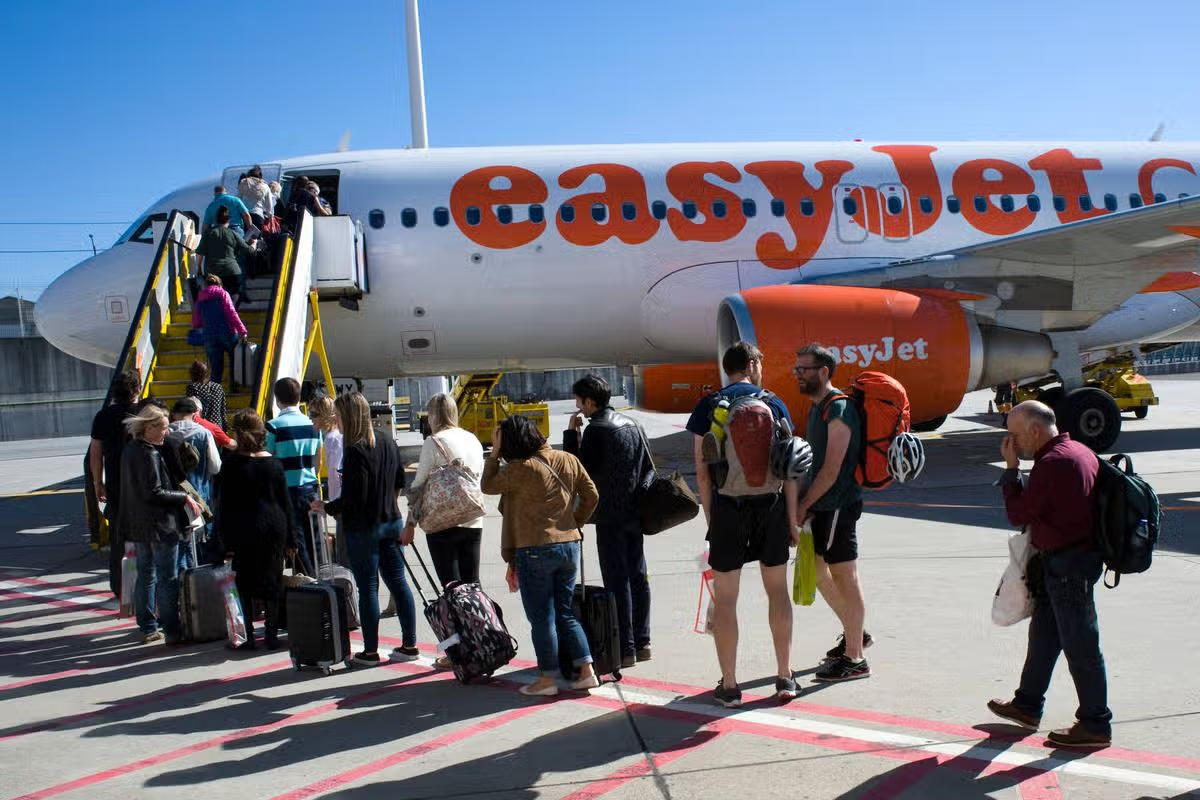
Lots of people travel with easyJet, but there’s a certain rule passengers need to follow. If they don’t stick to it, they could end up having to pay more money

Lots of people jet off abroad at this time of year, but there’s important information you need to be aware of if you travel with easyJet. After all, travellers need to be clued up on everything there is to know as the summer holiday season gets going, with countless people dreaming of some time in the sun.

If you’re set to travel soon, and you’re flying with easyJet, there are some crucial travel tips you need to come to terms with before you depart. This is information you don’t want to ignore, as failing to follow the guidelines could see you having to cough up extra cash during your journey.

This isn’t the only occasion travel advice has been highlighted either. Not too long ago, tips were also given to people to help them bag the best plane seats to avoid germs.

What can cost you extra?

Everyone wants to squeeze as much value as possible out of their holiday budget, so it pays to know exactly what baggage is included before you book. Many travellers tend to focus on the headline ticket price, but baggage fees can swiftly add a considerable sum to the total cost of a trip.

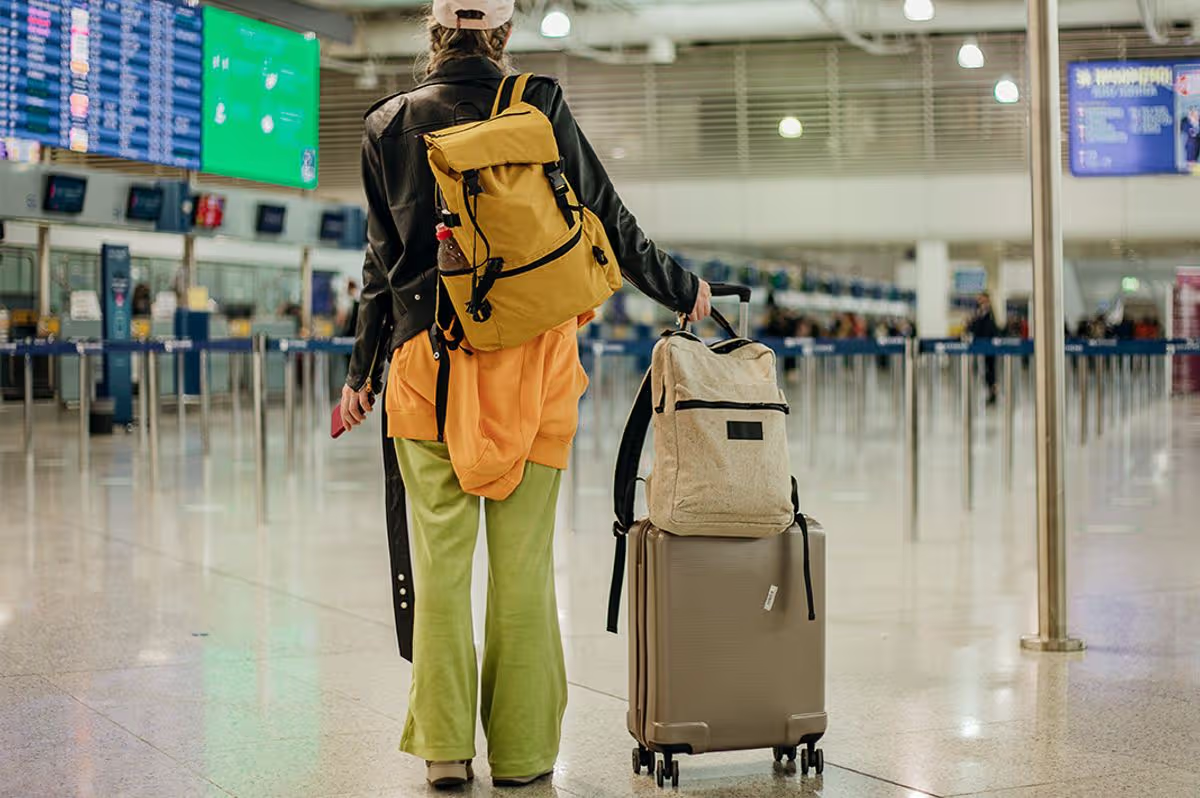
According to Ricky Durrance, travel expert at package holiday specialists Teletext Holidays, getting to grips with easyJet’s baggage rules can save you a tidy sum and help you make the most of your baggage allowance. The good news is that every easyJet passenger is allowed to bring one small bag on board without any extra charge.

However, that’s where things get complicated as, if your bag won’t fit beneath the seat in front of you, you’ll probably need to pay an additional fee.

Overhead locker space is restricted and frequently comes at a price, so it’s worth weighing up whether a checked bag represents better value. The easyJet website states: “Our low fares include one small cabin bag free of charge.

“Your bag can weigh up to 15kg, but we do ask that you’re able to lift and carry it yourself. You can purchase additional bags online when you make your booking or any time before you travel, via Manage bookings on our website or mobile app.

“Buying online is always cheaper than at the airport. Fees vary depending on the route selected, flight and time of booking.”

However, it’s crucial to remember that, if you wish to pay for a large cabin bag, charges can be steeper during busy travel periods. For couples and mates travelling together, it’s worth crunching the numbers to determine whether sharing a checked suitcase makes more financial sense before you book.

Things you may be overlooking

Managing your baggage allowance can be a right faff, and it becomes even trickier when your suitcase eats up a substantial chunk of the weight limit. easyJet’s large cabin bag allowance permits up to 15kg.

However, many hard-shell cabin cases tip the scales at between 3.5kg and 4.5kg when empty, meaning the usable space for clothes and other belongings can end up being considerably less than anticipated.

You may find yourself with as little as 10.5kg available for packing, which can disappear remarkably quickly. In contrast, a shared 23kg checked bag using a similarly weighted case still leaves upwards of 18.5kg free for packing, which can make a world of difference.

Ricky added: “It’s also worth knowing that booking your baggage allowance sooner rather than later can help save you money.”

easyJet’s baggage fees tend to be cheaper when added at the point of booking rather than closer to the departure date. For those booking a package holiday rather than directly through the airline, it’s worth checking this as early as possible, ideally at the time of booking.

When airlines levy extra charges for every kilogram and each bag, careful planning of your luggage before you travel is absolutely crucial, according to Ricky.

Source link

Jet2 explains extra baggage allowance rules for families

A customer claimed they had been told different things by Jet2 staff

Jet2 has stepped in to clear up confusion over its baggage policy. The update came after a query from a passenger with a group booking.

The traveller sought clarification as their reservation included two adults and a six-month-old infant. They explained: “Told we get two extra carry ons such as a buggy and travel cot that will be checked into the hold at the gate.” They mentioned they had two 22kg suitcases and recalled being informed on a previous Jet2 holiday that they were entitled to “an extra 10kg for the baby”.

According to guidance on the Jet2 website for bookings with children, passengers receive “an extra 10kg allowance for infants” and can also take “up to two items per child or infant free of charge”.

State Pensioners to face major tax change

Differing messages

The customer’s query was whether the additional 10kg could be combined with one of the 22kg cases, creating a 32kg allowance. They said they had received contradictory information on this issue on their last trip with Jet2.

The passenger said: “On the way out with you we were told it’s fine to have a 32kg case (22kg + the 10kg). On the way back we were told the 10kg should be a separate small checked case.

“Please can you clarify which it is and what the rules are because on our last holiday with you we were told different things.” Jet2 responded to settle the matter: “The additional 10kg is applied to one adult’s baggage, allowing for a total of one bag at 32kg and one bag at 22kg.”

Extra items free of charge

When it comes to the two additional items you’re permitted to bring without charge, these may include:

  • A collapsible pushchair, pram or buggy
  • A car seat or booster seat
  • A baby carrier
  • A travel cot.

Each item must not exceed 32kg in weight. Should you bring any further items or anything beyond this weight limit, the standard excess baggage charges will apply.
Source link

EasyJet probed in Italy over alleged unfair baggage pricing on booking platforms

Published on

The Autorità Garante della Concorrenza e del Mercato (AGCM), Italy’s antitrust authority, announced on Tuesday that it opened a formal probe into easyJet Airline Company Limited over alleged unfair commercial practices.


ADVERTISEMENT


ADVERTISEMENT

The case centres on how the carrier structures and presents baggage fees on its website and mobile app, with the regulator alleging that passengers were routinely given a distorted picture of what they were actually paying.

According to the AGCM, easyJet’s platform set bundled checked baggage and sports equipment for round trips as the automatic default, presenting only an overall average price for the service, even when customers had no intention of purchasing it for both legs of their journey.

The regulator contends that anyone wishing to add luggage for one leg only was forced to interrupt the booking process to override this setting, a step most consumers would be unlikely to notice or navigate.

The investigation will assess whether easyJet’s booking system created unclear pricing conditions and limited consumers’ ability to make fully informed choices.

At the time of writing, easyJet has not publicly commented on the case.

Italy’s AGCM previous actions

This is not the first time easyJet has appeared before Italian authorities.

In May 2021, the AGCM imposed a €2.8 million fine on the airline alongside Ryanair and Volotea, after all three failed to offer cash reimbursements for flights cancelled when Italy lifted its COVID-19 travel restrictions, issuing vouchers instead.

EasyJet appealed, but the Lazio Regional Administrative Court in Rome rejected the challenge in February 2025.

The AGCM has shown no hesitation in pursuing the sector more broadly.

In December 2025, it fined Ryanair €255 million for abusing its dominant position in air travel to and from Italy.

The Italian authority concluded the carrier had deployed an “elaborate strategy” to obstruct travel agencies from purchasing its flights, including through facial-recognition checks, payment blocks and mass account deletions, a ruling Ryanair immediately vowed to appeal.

Source link

Ryanair to increase staff bonus for applying £65 baggage fine on passengers

The budget airline is set to increase the staff bonuses for catching those out who travel with oversized baggage as travellers will be issued a £65 fine for the large luggage

Ryanair is planning to increase staff bonuses for hitting passengers with oversized baggage fines.

Michael O’Leary is set to increase the bonuses given to staff members who dish out additional charges to those with oversized luggage.

The chief executive said that after it emerged that his staff were incentivised to catch passengers out the number of travellers stopped with oversized baggage had dropped.

The budget airline staff are currently paid €2.50, roughly £2.17, for every oversized bag they identify.

Passengers are made to pay an additional €75 (£65).

The change could see workers receive a €3.50 bonus for everyone they catch out, according to The Times. This bonus for Ryanair workers was already increased in November 2025 from €1.50.

“The number of outsized bags is falling from, I don’t know, 0.0001 [per cent] to 0.00001,” O’Leary said.

“As the numbers fall, I think we will up the rate of commission, from €2.50 to €3.50 or so.

“Everybody must know, do not show up with a bag that doesn’t fit in the sizer because you will be charged.”

All fares include one small personal bag (40 x 30 x 20 cm) that must fit under the seat.

Cabin bags can be purchased and weigh up to 10kg, the (55x40x20cm) item must fit in the overhead locker.

At the time of the incentive increase last year, O’Leary said about 200,000 passengers per year have to pay extra to put carry-on luggage in the hold, and he has no sympathy for “chancers” trying to bring “rucksacks” aboard.

The CEO added: “We’re the airline with the lowest air fares in Europe,”

“Those are our rules. Please comply with the rules, as 99.9% of our 200 million passengers do, and you won’t have any problem.”

He claimed if people “comply with the bag rules then everyone will board faster” and there will be “fewer flight delays”.

The announcement comes after the Ryanair boss said that airport bars should stop serving alcohol early in the morning.

The CEO claimed his airline is being forced to divert flights almost daily because of drunken, aggressive passengers.

Pubs in airports do not follow the same licensing rules as bars outside these environments do.

Mr O’Leary said that changing this will support his airline and others because it would help cut out aggressive behaviour in the skies.

Source link

Simple flight tip could get your suitcase off the baggage carousel first

It can be frustrating waiting for your suitcase to appear but one strategy could help you get your bags off the baggage carousel first

Airport security checks and baggage restrictions can turn holidays into a source of stress, and the anxiety only intensifies as you wait to see whether your suitcase has actually made it off the plane.

The dread of lost luggage hangs over many travellers right up until the moment they spot their bag on the carousel — and even then, there’s the worry that someone else might accidentally grab it. But there’s a straightforward trick that could see your suitcase come off the plane first, allowing you to get your holiday underway without unnecessary delays.

Guidance from Escape.com suggests checking in for your flight as late as you possibly can. The logic? Late check-ins mean your luggage gets loaded last, and in theory, should emerge first upon landing, according to Thomas Lo Sciuto, a ramp worker and gate agent at a regional US airport.

The airport worker explained: “Your best option is to be one of the last passengers to check your bags. This is because bags will always be loaded front to back on the bag carts.”

That said, bags aren’t solely loaded according to check-in times. Anyone who can’t stomach the idea of leaving check-in until the eleventh hour will be relieved to hear that weight is also a factor in certain circumstances, reports the Express.

SmarterTravel told HuffPost that US aviation giant Delta, which flies out of Terminal 3 at London Heathrow Airport (LHR), sorts luggage into large and small loads to ensure proper weight distribution across the aircraft. As passengers check in their luggage, it gets sorted into “cans” – large containers that hold multiple bags and can be transported as one unit.

SmarterTravel said: “In other words, how far back your bag ends up depends on the weight of the can and the needs of the plane, not when you check it.”

Aircraft with a single aisle typically “loose-load” bags one by one rather than bundling them into cans, as is the case with wider-bodied planes. When this happens, checked bags generally go into a holding area.

Luggage gets transported to the aircraft and loaded shortly before departure, meaning its chances of being loaded first hinge on when it was checked in.

If a bag was checked in early, it could end up at the rear of the storage space, meaning it would be last onto the plane and potentially first off.

Other tactics to ensure your bags come off the carousel first upon landing include marking them as “fragile”.

News.com.au suggests this clever trick often results in your luggage being loaded onto the aircraft last and therefore unloaded first, which can significantly reduce your wait at the carousel.

That said, when opting for “fragile” stickers, travellers ought to strip off any old tags from their bags to prevent mix-ups. To make luggage stand out, opting for vibrant colours, customised tags, or securely fastened ribbons could help your bags catch your eye more easily.

The most reliable way to get out of the airport as swiftly as possible is to travel with hand luggage alone. Make certain this meets your specific airline’s requirements to avoid being forced to check your cabin bag at the gate.

A personal item, sometimes referred to as a small bag, needs to fit beneath the seat directly in front of you and typically measures no larger than 40x30x20cm.

Cabin bags are stowed in the overhead locker and can generally weigh up to 10kg, with dimensions not exceeding 56x45x25cm.

Among UK carriers, British Airways typically provides the most generous complimentary hand luggage allowance on its basic tickets.

Travellers can bring one 23kg cabin bag (56x45x25cm) and one smaller personal item (up to 40x30x15cm) without charge.

Jet2 and Virgin Atlantic similarly permit a complimentary cabin bag (10kg, 56x45x25cm) alongside a personal item.

Source link

You could soon see ROBOT baggage handlers dealing with your summer holiday luggage as major airline trials humanoid crew

ROBOT baggage handlers will replace humans during an experimental project as a major airline trials a humanoid crew.

The pilot programme was announced by Japan Airlines, where Chinese-made robots will be integrated into ground operations at Haneda Airport in Tokyo.

A new program at Haneda Airport in Japan could see human baggage handlers replaced with robots Credit: Reuters
The robots are programmed to raise an arm when task is complete Credit: Reuters

The country’s biggest airport will host the three-year experiment, where the machines will be tasked with cleaning planes, as well as loading and transporting baggage.

Looking further into the future, the androids could also be operating ground support equipment including baggage tractors, catering trucks and power units.

The airline said bipedal robots were the best suited to working in airport environments, as opposed to other types of robotic machines.

This is because they are quicker and are able to move within and adapt to cramped spaces.

NAN-DROID TO RESCUE

Moment Ukrainian troops use robot to save OAP, 77, from Russia shelling


YAPPY RETURNS

25 Mini facts as ‘new’ model marks 25 years of production – & gets robot dog

The airline said bipedal robots were the best suited to working in airport environments because they are quicker and can adapt to smaller spaces Credit: EPA
The robots will be integrated with human staff throughout the program to carry out tasks including cleaning planes Credit: Reuters
If the project goes well, the androids could be given further tasks in the future Credit: Reuters
The project is being rolled out just in time for summer in Japan Credit: Reuters

“Being human-shaped allows their introduction without significant modifications to existing airport facilities or aircraft structures,” a Japan Airlines spokesperson said.

“By combining cutting-edge AI technology with the unique flexibility of humanoid forms, the project aims to realise a sustainable operational structure through labour savings and workload reduction.”

“Currently, the aviation industry faces a serious challenge in ground handling labour shortages,” they continued.

The airline said this was because of increased tourism and a declining working-age population in Japan.

“Ground handling operations require highly skilled personnel to maintain safety, such as aircraft marshalling and baggage/cargo handling, while also imposing significant physical burdens,” they said.

Baggage handlers do one of the least glamorous and thankless jobs in the modern world.

Many workers suffer with back injuries and are often faced with complaints about lost and damaged belongings.

The robots were trialled in Haneda this week, with a demonstration showing a skinny 51-inch robot tapping and pushing large storage containers on rollers.

To demonstrate that a task had been completed, the robots raise a hand.

The machine is made by Unitree Robotics of China and has 43 separate moving parts.

“While airports appear highly automated and standardised, their back-end operations still rely heavily on human labour and face serious labour shortages,” said Tomohiro Uchida of GMO AI & Robotics, the airline’s partner on the project.

Source link