backers

Billionaire-tax backers say they have enough signatures — times two — to qualify for ballot

Supporters of a billionaire tax said Sunday that they had gathered nearly twice as many signatures as necessary to qualify the controversial proposal for the November ballot.

Opponents of the proposal argue that it already has driven wealthy Californians — crucial to funding the state’s volatile budget — to other parts of the nation. Advocates, however, say the proposed tax is critical to compensate for federal healthcare funding cuts that will harm the state’s most vulnerable residents.

“Most Californians and most billionaires recognize how reasonable and necessary this proposal is — both to keep emergency rooms open and to save California businesses from closing,” said Suzanne Jimenez, the chief of staff of the Service Employees International Union-United Healthcare Workers West, the chief proponent of the effort. “A very small group of the most controversial billionaires on the planet tried to stop” this effort, she added, but when “our growing coalition files these signatures, David will have won the first round against Goliath.”

The union, which represents more than 120,000 healthcare workers, patients and consumers, launched the effort to counter massive healthcare funding cuts that President Trump signed last year. The California Budget & Policy Center estimated that as many as 3.4 million Californians could lose Medi-Cal coverage, rural hospitals could shutter, and other healthcare services would be slashed unless new funding was found.

The proposal would impose a one-time tax of up to 5% on taxpayers and trusts with assets valued at more than $1 billion, with some exclusions, such as property. The levy could be paid over five years. Ninety percent of the revenue would fund healthcare programs, and the remaining funds would be spent on food assistance and education programs. The proposal would cost the state’s richest residents about $100 billion if a majority of voters support it.

Supporters need to submit the signatures of nearly 875,000 registered voters to county elections officials by June 24. They say they have gathered nearly 1.6 million signatures.

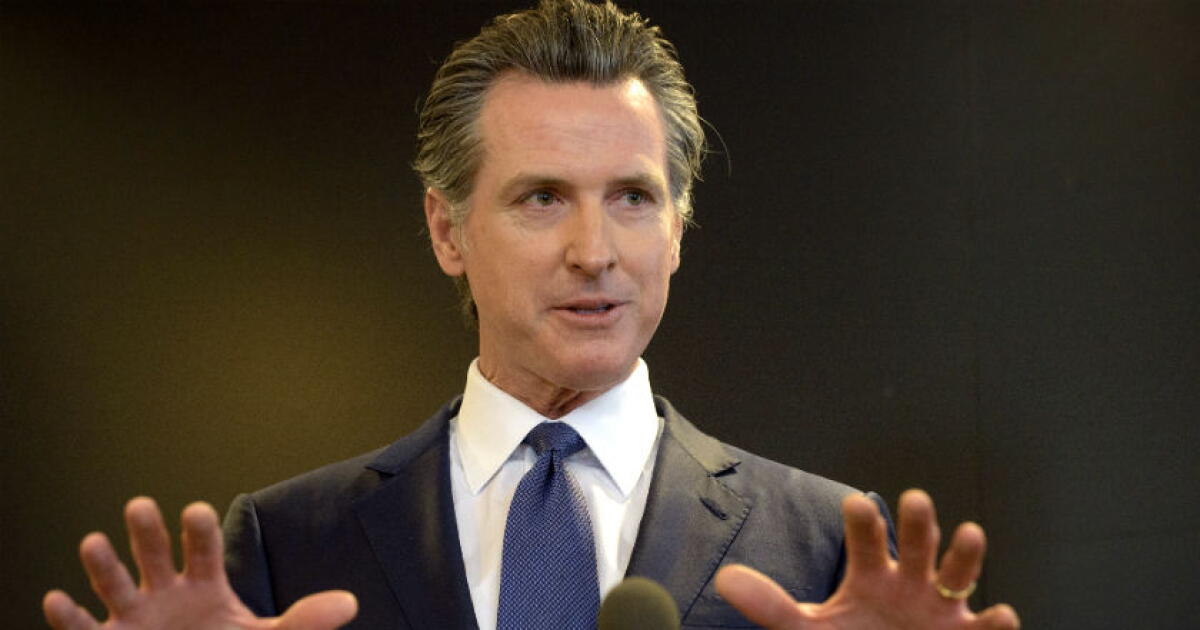
Opponents of the measure, which has divided liberals — Sen. Bernie Sanders (I-Vt) supports it while Democratic California Gov. Gavin Newsom opposes it — said the proposal would destroy California’s economy and budget, while doing nothing to address the state’s underlying financial issues.

“This wealth tax would have a devastating impact on our economy, state budget, and the cost of living for all Californians,” said Rob Lapsley, president of the bipartisan California Business Roundtable. “The measure doesn’t do anything to reduce the state’s $35-billion-plus budget deficit and does nothing to address the decade of overspending that led to the structural deficit. In fact, because the state relies so heavily on high-income-earner tax revenue, this measure could lead to reduced budget revenue in the long term as highly mobile wealthy individuals leave the state to avoid this new tax.”

He also argued that the proposal could result in higher taxes for all Californians.

“This is an everyone tax that is called a billionaire tax,” Lapsley said, “and we will ensure Californians understand the truth on the devastating consequences this initiative will have.”

Source link

Democrats call for review of Paramount’s Middle Eastern financial backers

Democratic lawmakers are demanding scrutiny into Paramount Skydance’s financial backers amid rising concerns about potential foreign influence of U.S. media properties.

In a letter this week to Federal Communications Commission Chairman Brendan Carr, seven U.S. senators criticized Carr’s suggestion that Paramount’s $111-billion bid for Warner Bros. Discovery, backed by billionaire Larry Ellison and his family, was on a fast track to receive FCC approval with scant oversight.

Such complicated mergers typically receive an intense government review. The proposed merger would combine two legendary film studios, dozens of cable channels, HBO, CBS and two major news organizations, CNN and CBS News.

Ellison and his son, David, who chairs Paramount, are friendly with President Trump, who has long agitated for changes at CNN, which is slated to be absorbed by Paramount.

The company has said it expects to complete the deal by the end of September.

The Democrats expressed concerns that the fix may be in. Trump’s Justice Department has been reviewing whether the merger would violate U.S. antitrust laws, but a key deadline passed last month without comment from the department’s antitrust regulators.

Also at issue is the Middle Eastern money the Ellison family has been expecting to pull off Paramount’s leveraged buyout of its larger entertainment company rival. The acquisition would leave the combined company with nearly $80 billion in debt.

Late last year, Paramount disclosed that it had lined up $24 billion from wealth funds representing the royal families of Saudi Arabia, Qatar and Abu Dhabi, who would then become equity partners in the combined company.

Paramount has described the funds as largely passive investors, saying the royal families would not have input into corporate decision-making. They also would not control seats on the Paramount-Warner board.

Congressional Democrats previously have warned about potential national security concerns. The senators, led by Cory Booker (D-N.J.) and Chuck Schumer (D-N.Y.), remain concerned, particularly because the transaction will help shape the future of Hollywood production and the direction of key news outlets, including CNN, which maintains a strong presence around the world.

Members of the party have called on Carr to conduct “a full and independent” analysis of the foreign ownership interests before signing off on the merger. The FCC could play an important role, they said, because the tie-up includes Paramount-owned CBS, which holds FCC broadcast station licenses.

Paramount declined to comment. FCC officials did not respond to a request for comment.

Booker and Schumer pointed to Carr’s comments at an industry conference in Spain earlier this month. During an appearance at the Mobile World Congress, Carr suggested the Paramount-Warner deal could be swiftly approved because the foreign investment would warrant only a “very quick, almost pro forma review,” Carr reportedly said.

The FCC has a duty to examine foreign ownership, the lawmakers said, referencing the U.S. Communications Act, which forbids owners from outside the U.S. from holding more than 25% of the equity or voting interests in an entity that maintains an FCC license.

The lawmakers mentioned the FCC’s move earlier this year to tighten its foreign ownership framework to bolster transparency.

Paramount has not yet disclosed its final list of equity partners.

The company previously disclosed its proposed partners in Securities & Exchange Commission filings. However, last month, the composition of the Paramount-Warner deal changed when Larry Ellison agreed to fully guarantee the $45.7-billion in equity needed to finance the $31-a-share buyout of Warner investors.

Before Ellison stepped up, Warner board members had expressed concerns about Paramount’s financing. The tech billionaire’s increased involvement helped carry the Paramount deal over the finish line. Netflix bowed out Feb. 26, ceding the prize to Paramount.

Still, Paramount is expected to line up billions of dollars from outside investors.

It would be significant if Saudi Arabia’s Public Investment Fund, the Qatar Investment Authority and Abu Dhabi’s L’imad Holding Co., contributed $24 billion to the deal, the Democrats wrote.

“This is not incidental capital, it represents roughly one-fifth of the total transaction value,” Booker and the others wrote. “And it is not clear that this will be the only foreign investment.”

Initially, Paramount included Chinese technology company Tencent Holdings as a minority investor, but Paramount later removed Tencent from the investor pool due to concerns about its problematic status — it has been blacklisted by the U.S. Department of Defense.

Bloomberg News reported earlier this month that Tencent might return to the fold.

“This constellation of foreign investment from China and from Gulf States, with complex and sometimes competing relationships with the United States, demands rigorous, not perfunctory review,” Booker and the others wrote.

The letter also was signed by Sens. Dick Durbin (D-Ill.), Elizabeth Warren (D-Mass.), Richard Blumenthal (D-Conn.), Sheldon Whitehouse (D-R.I.) and Mazie K. Hirono (D-Hawaii).

They keyed in on the role of Saudi Arabia’s sovereign wealth fund, saying it was controlled by Crown Prince Mohammed bin Salman “whom the U.S. intelligence community concluded ordered the murder of Washington Post journalist Jamal Khashoggi in 2018.”

The proposed $24-billion investment would give “these governments a significant financial stake in the future content, licensing, and strategic decisions of a combined entity that includes some of the most-watched news and entertainment networks in America.”

It is also unclear whether the current tensions in the Middle East over the Iran war will have an impact on Paramount’s investor syndicate.

Trump’s son-in-law Jared Kushner, a proposed Paramount investor, also withdrew late last year.

Paramount shares held steady at $9.17. The company’s stock is down 31% since Feb. 27, when the company prevailed in the Warner auction.

Source link