babies

Born too soon: Premature babies fight for survival in Gaza | Gaza News

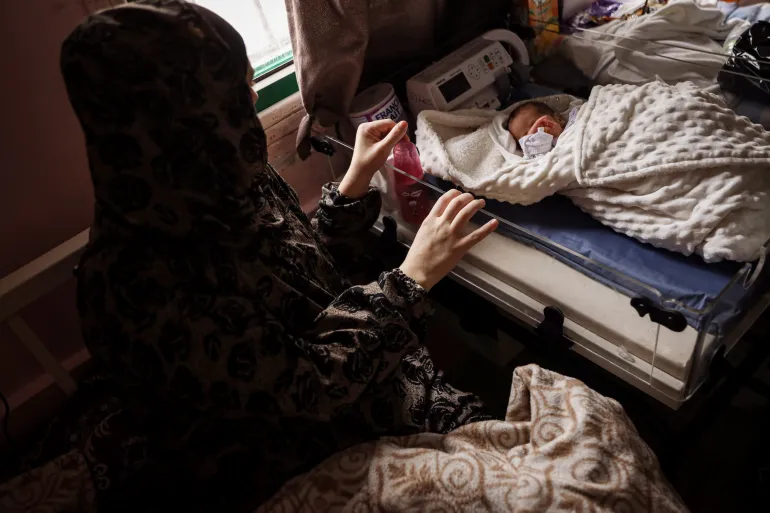
Noor Salem, 30, stands beside an incubator at a neonatal intensive care unit in central Gaza, where her baby, Yazan Al-Khalidi, lies attached to tubes and monitors.

She watches his tiny body behind a sheet of quartz glass, tracking his meagre breathing and the slightest movement he makes.

Yazan was born eight months into Noor’s pregnancy, his body appearing bluish in the first moments of life.

This required immediate transfer to the neonatal intensive care unit at Al-Aqsa Martyrs Hospital in Deir el-Balah, after it became apparent that Yazan was born with breathing issues.

Instead of being able to hold her baby in the first moments after his birth, Noor is now forced to sit by the incubator and wait for Yazan’s condition to improve.

Yazan is Noor’s second child, having lost her first baby shortly after birth during the famine in Gaza in 2025, brought about by Israel’s ongoing genocide in the enclave.

During her pregnancy with Yazan, she endured shortages of basic necessities and a constant fear of losing another child.

Yazan Al-Khalidi, born in the eighth month of pregnancy. After birth, he experienced breathing difficulties. [Eman Abu Zayed/Al Jazeera]
Yazan Al-Khalidi, born in the eighth month of pregnancy. After birth, he experienced breathing difficulties [Eman Abu Zayed/Al Jazeera]

“I was afraid throughout my pregnancy because I had already lost my baby before. I was afraid I would go through the same pain again,” she said.

“When he was born, and I saw that he was not moving or crying like other babies, I felt terrified. I did not know what would happen to him. All I wanted was for him to survive.”

Noor waits for daily updates from doctors, hoping Yazan will overcome his health difficulties and return to her arms.

Rising premature births in Gaza

There has been a sharp increase in premature births and underweight newborns, as well as stillbirths and birth defects, since the genocide in Gaza began on October 7, 2023.

UNICEF has repeatedly warned about a crisis in premature births in Gaza, with one in every five newborns requiring intensive neonatal or thermal care. Maternal malnutrition, prolonged psychological stress and declining prenatal care services have all had an impact on both mother and child.

Dr Afnan Abu Hasaballah, an obstetrician and gynecologist working with UNRWA and Al-Awda Health Hospital in Nuseirat refugee camp, has personally witnessed the impact of this on the health of pregnant women and newborns.

She says many pregnant women arrive at hospitals suffering from severe stress and exhaustion after repeated displacement, deprivation of essential goods and bombings.

“Constant fear, repeated displacement, lack of food and clean water, and limited access to prenatal care all increased the risk of premature birth,” she says.

The Israeli siege on Gaza is also leading to severe malnutrition, and one of the main issues affecting both expectant mothers and their fetuses, leading to more premature births and low birthweights for newborns and requiring intensive care.

Inadequate nutrition also increases the risk of anemia, exhaustion for expectant mothers, pregnancy complications and restricted fetal growth.

“Many pregnant women during the war were unable to access sufficient or balanced food, and this directly affected the health of mothers and newborns,” Dr Abu Hasaballah says.


Pressure on Gaza health services

Al-Aqsa Martyrs Hospital is the only hospital with a neonatal unit in the whole of central Gaza, serving thousands of expectant mothers and causing immense pressure on overstretched health workers.

“We were working under enormous pressure, with shortages of incubators, ventilators, medications and basic supplies, in addition to repeated power and fuel shortages, which posed a direct threat to babies inside the incubators,” Dr Abu Hasaballah says.

Premature babies require continuous monitoring, oxygen, respiratory support, proper nutrition and treatment, something that health workers with their limited resources and time are not always able to provide.

“When these resources become unavailable, the risk of serious complications increases, including breathing difficulties, low body temperature, infections and low blood sugar,” Dr Abu Hasaballah says.

“Unfortunately, we may lose babies who could have survived if they had received basic care.”

The separation of mothers from their babies shortly after their birth is one of the hardest experiences for mothers to endure. This abrupt separation causes immense anxiety for both mothers and babies, with the most common question doctors at neonatal units are asked is whether their children will survive. Doctors and nurses do what they can to reassure the mothers and save the children.

“Instead of holding their baby and celebrating, mothers see them transferred directly to the incubator or intensive care unit. Their fear is doubled because the war has affected everything, from medical equipment and supplies to electricity shortages and overcrowding in hospitals,” says Dr Abu Hasaballah.

“We continued working day and night without sleep, and we did everything we could to save every child, but in many cases, the babies’ needs were greater than the resources available.”

Akram Abu Jiab, head of Qutoof Al-Khair Foundation, which supports pregnant women and newborns by providing vitamins and nutritional supplements for mothers, as well as medicines and medical supplies for children. [Eman Abu Zayed/ Al Jazeera]
Akram Abu Jiab, head of Qutoof Al-Khair Foundation, which supports pregnant women and newborns by providing vitamins and nutritional supplements for mothers, as well as medicines and medical supplies for children [Eman Abu Zayed/Al Jazeera]

New challenges for mothers

Once the parents and babies are discharged, a new struggle for families begins amid a landscape where a mother’s health has been impacted by deprivations and stresses of the war. Essential baby care items, such as sterilisation kits and baby formula, are absent or unaffordable.

“Many families have lost everything because of displacement, leaving mothers without baby clothes, diapers, blankets, formula or clean water,” Dr Abu Hasaballah says.

In Nuseirat refugee camp, central Gaza, Qutoof Al-Khair Foundation supports pregnant women and newborns by providing vitamins, nutritional supplements, medicines and essential medical supplies.

Akram Abu Jiab, head of the foundation, says his staff is dealing with growing demand for their services among pregnant women and new mothers who are unable to access enough food and healthcare to sustain their babies’ health.

“Premature babies require special care and continuous medical follow-up even after being discharged from incubators,” he says.

“However, many families are facing significant challenges in securing the basic medical and nutritional needs of their children.”

Despite the foundation’s efforts to reach as many mothers and children as possible, their efforts can only go so far.

“The scale of needs far exceeds the available resources. The gap between needs and support continues to grow every day,” he says.

“Behind every baby born in Gaza is a mother trying to protect her child under exceptional circumstances. Supporting mothers and children at this stage is not a luxury; it is a necessity to protect the lives of the next generation.”

Source link

Japan’s pet care industry booms as ‘fur babies’ outnumber infants | Business and Economy News

Tokyo, Japan – While walking his toy poodle in the park near his home in Ikeda, Gifu Prefecture, Shin Ohta had an idea.

“My dog often stops walking during our strolls. I would carry him every time, but his weight of nearly 5kg [11lbs] started to become a real burden,” Ohta told Al Jazeera.

Recommended Stories

list of 4 itemsend of list

“I knew there had to be a better way.

Ohta works in sales for Japan’s oldest baby carrier manufacturer, Lucky Industries, which has produced more than 40 million baby carriers since its founding in 1934.

He has spent his career making baby carriers, but after that walk, he wondered if the same expertise could be applied to pets.

After consulting a veterinarian to ensure the design was viable for dogs, Ohta helped Lucky Industries launch its first line of dog hip carriers in 2022: Nu-i.

Earlier this year, the company joined dozens of other brands at Tokyo’s annual Interpets conference, a showcase of Japan’s rapidly growing pet care market.

During the first weekend of April, stalls lined the walls of the Big Sight convention centre, selling everything from walk-in pet dryers to the latest organic cat treats.

Few of the pet owners attending the event had their four-legged friend on a leash, instead ferrying them to and fro in well-decorated pet strollers, or the doggy equivalent of baby slings.

Many pets were decked out in colourful outfits, fur clips, and diapers.

Pets in Japan now outnumber children under 15 by more than 2 million.

Unicharm displays products at the Interpets Conference, held at the Tokyo Big Sight Conference Centre in Tokyo, Japan, on April 3, 2026 [Genevieve Mansfield/Al Jazeera]

According to market intelligence company Euromonitor, the country’s pet care market was worth 880 billion yen ($5.4bn) in 2025, up from 689.6 billion yen ($4.2bn) in 2020.

As Japan’s birthrate continues to fall and the population of children shrinks, companies that once built their businesses on babies, selling nappies, slings, and strollers, are increasingly turning their attention to pets.

Betting on pets at the Interpets conference, Unicharm’s expansive stall was lined with dog and cat nappies from its latest “Mannerware’” line.

The Tokyo-based company has been one of the great cross-market successes of the pet care boom.

After making its name selling feminine hygiene products and disposable diapers, Unicharm expanded into pet diapers in 2001.

Since then, pet care products have become one of the company’s main growth engines.

While the personal care market for people is larger, the pet care sector has higher profit margins.

According to Unicharm’s financial results for 2025, the company’s pet care division had a profit margin of 15.4 percent that year, compared with personal care’s margin of 10.7 percent.

Isshu Uehara, a Unicharm spokesperson, said that as of 2025, the pet care business accounted for 17 percent of the company’s total sales, with plans to increase that share to 20 percent by 2030.

“Japan’s birthrate is declining,” Uehara told Al Jazeera.

“Lifestyle changes, such as remaining single, marrying late, and the growth of childless, dual-income households, have led to a greater number of people seeking emotional connections through pets.

“As a result, we’re seeing the growth of ‘pet humanisation’, or treating pets like family members or children rather than just animals.

“Customers want to buy premium products to extend pets’ lifetimes, and share experiences with them, like dining together or going out to cafes and friends’ houses,” Uehara added.

Dogs pose in well-decorated pet carts at the Interpets Conference at the Tokyo Big Sight Conference Centre on April 5, 2026."For the second two, they are both from the Unicharm stand at the Interpets conference, but I took those on April 3, 2026. Same location.
Two pets pose at the Interpets Conference on April 5, 2026 [Genevieve Mansfield/Al Jazeera]

Unicharm is not alone.

Across Japan, stroller brands like AirBuggy and clothing companies like Sweet Mommy have made similar leaps, applying expertise built around infants to a growing market of pet owners.

Lucky Industries CEO Hiroyuki Higuchi pointed to the company’s origins to explain the shift towards pets.

“When the company started, Japanese families had many children, and mothers needed carriers to be able to work around the house,” Higuchi told Al Jazeera.

But now, Japanese families are shrinking. While there has been a rise in single-person households and childless dual-income households, families with only one child have become more common as well.

A national survey of fertility trends found that between 2002 and 2021, the proportion of households with only one child increased from 10 percent to nearly 20 percent.

“With fewer babies around, it has been harder to come up with new ideas for baby products,” Ohta said.

“Now, my life is centred around my dogs, as are the lives of many of my friends. When we meet up, we talk about our pets.”

“Compared to the baby goods market, the pet sector is doing better,” said Higuchi.

“Companies see it as a reliable sector… In Japan, dogs are seen as babies, as part of the family. Just like many Japanese carry their babies in slings or carriers, so can dog owners,” Higuchi added.

Dogs pose in well-decorated pet carts at the Interpets Conference at the Tokyo Big Sight Conference Centre on April 5, 2026." For the second two, they are both from the Unicharm stand at the Interpets conference, but I took those on April 3, 2026. Same location.
Unicharm displays pet care products at the Interpets Conference on April 3, 2026 [Genevieve Mansfield/Al Jazeera]

Barbara Holthus, a sociologist and director of the German Institute of Japan Studies, said pet humanisation has been a growing trend in recent years.

“Before, a dog or cat might have just been an additional family member, but with fewer other family members and fewer children in the house, the focus becomes very concentrated on this animal,” Holthus told Al Jazeera.

“But it’s more diverse than just replacing children. Animals take on many different roles,” Holthus added. “A pet can also replace a partner. After a divorce, people sometimes get pets.

After someone gets widowed, they get a pet. Sometimes, a pet is seen as a play partner for an only child.”

Holthus sees Japan as a prime example of changing family structures, including the emergence of the “multi-species family”.

Holthus said decreasing birth rates, as well as factors such as loneliness and rising urbanisation, help explain why the trend of humanising pets has been particularly pronounced in Japan.

As for why infant brands are turning to pets, Holthus offered a simple explanation.

“It’s understandable,” she said.

“Of course, companies want to make money, and due to demographic change, their market is getting lost.”

Source link

Netflix star welcomes twins with TV hunk husband and shares first snaps of ‘rainbow babies’

NETFLIX host Natalie Joy, best known for presenting Age of Attraction, has given birth to twins with her Bachelor star husband Nick Viall.

The couple took to Instagram to announce the safe arrival of the babies, revealing their names in their heartwarming post.

Natalie Joy has given birth to twins with her Bachelor star husband Nick Viall, taking to Instagram to announce the safe arrival of the babies Credit: instagram
Nick gained fame through his appearances on The Bachelorette and as The Bachelor himself, with him meeting his wife through Instagram years later Credit: Getty

Under an adorable snap of the babies lying together asleep, the caption read: “Dove Tomlin Viall & Iris Parker Viall – our rainbow babies!!!!!”

The couple are already parents to daughter River Rose, who was born two months before they got married in April 2024.

Nick gained fame through his appearances on The Bachelorette and as The Bachelor himself, with him meeting his wife through Instagram years later.

The happy news comes after Nick revealed that Natalie suffered a third devastating miscarriage last year on his podcast, The Viall Files.

FIT COUPLE

Love Island winners quit reality TV & launch business worlds away from showbiz


NOTORIOUS START

Reality fans realise star of controversial show went on to be big presenter

Under an adorable snap of the babies lying together asleep, the caption read: “Dove Tomlin Viall & Iris Parker Viall – our rainbow babies!!!!!” Credit: instagram
The couple are already parents to daughter River Rose, who was born two months before they got married in April 2024 Credit: Instagram/ Nickviall

Natalie was absent from the episode, usually featuring alongside her husband during recording.

Nick addressed Natalie’s unusual absence, saying: “As you can see, Natalie is not with us.

“There’s no really easy way to talk about this…”

He then got candid with his listeners as he revealed the heartbreaking news.

“Sadly, Natalie experienced another miscarriage. It is her third this year, our third this year…

“There’s no really good way to say it, it f**king sucks.

“She’s obviously at home resting, healing, both physically and emotionally.”

Natalie first suffered a miscarriage in January 2025, before enduring a second pregnancy loss just two months later.

Nick explained to his listeners: “When it happens the first time, the doctors and everyone kind of acknowledge that, while terrible, this is that something that can happen.

“And everyone’s just… don’t freak out, there’s nothing wrong, it sadly can be a part of this process.”

Nick went on: “And then it happened the second time, you know, obviously we have a lot of amazing blessings in our life, first and foremost being River, minus like some morning sickness and things like that, we were very lucky to have a fairly easy pregnancy…

“Really no complications, which was such an amazing blessing.

“Despite what’s going on right now with us, our doctor keeps reminding us that that is the best sign of our future ability to grow our family.

“But right now obviously there’s a little bit of uneasiness. It’s far less normal to have two and three back to back.

“Now we’re kind of in that very scary process of running tests and finding out more about ourselves, and it’s like this weird thing of like you want them to find something, but you don’t want them to find something.

“Because if they find something, you don’t know what that means. We’re in this kind of very uncharted territory of fact finding. Which sucks.”

Nick also said: “I really just wanted to be transparent with you guys ’cause I know she wasn’t there yesterday, people started to notice, and we’re already getting messages with like a lot of concern.

“So overall, Natalie is doing OK physically and healing and she’s OK in that respect and emotionally, we’re currently dealing with that.”

Source link

Britain makes official apology to women forced to give up their babies

British Prime Minister Keir Starmer formally apologized Thursday to women and their children caught up in a historic forced adoptions scandal in England and Wales over an almost three-decade long period between the 1950s and 1970s. File Photo Betty Laura Zapata/EPA

July 2 (UPI) — Outgoing British Prime Minister Keir Starmer apologized in person Thursday to women and some of their children who were caught up in a historic forced adoptions scandal in England and Wales dating back to the 1950s through the 1970s.

Stamer issued a formal apology on behalf of the British state, calling the taking of an estimated 185,000 babies from unmarried women, railroaded into allowing their children to be put up for adoption, a “stain on our history.”

The shame is not yours. The shame was never yours. The shame is ours,” he said in a statement to the House of Commons after earlier hosting a group of survivors in Downing Street.

“Mothers, many young, vulnerable, and without support were coerced, bullied, or misled into feeling that they had no choice but to have their children taken away from them. What a thing to do,” he said.

Speaking as some of those whose lives were severely impacted watched on from the public gallery, Starmer said that what happened to them and to tens of thousands of mothers, children and families “should never have happened.”

“It is a stain on our history,” he said.

Starmer said the victims had “very powerfully” relayed to him the “gut-wrenching” shame they were made to feel and how it was drummed into them that they were immoral young women whose children would be better off without them.

The experiences stayed with them through their lifetimes, while their children grew up believing they were unwanted, he said.

“We are deeply and profoundly sorry to the mothers who were told they were unfit, who were prevented from caring for the children they desperately wanted to help and to keep, and who have carried this loss for decades,” said Starmer.

Starmer acknowledged that the practice was deliberate and widespread, particularly between 1949 and 1976 when it was, he said, “embedded within systems across local authorities, across voluntary and faith-based institutions, and in health and social care services,” including parts of what is now the National Health Service.

“All institutions that operated with power over people’s lives, yet they did so without compassion, without consent, and without dignity or proper safeguards,” said Starmer.

He said some women, including those placed in Mother and Baby Homes and other institutions, were prevented from seeing their families and partners, denied education and job opportunities and kept in harsh living conditions.

Some of the treatment meted out to the women was tantamount to manipulation and abuse, said Starmer.

Mothers and adoptees campaigned for years for the state to acknowledge wrongdoing but no offer of compensation was forthcoming, although the government has announced a $5.3 million fund to improve access to adoption records and assist family reunions.

Survivor Ann Keen, whose baby son was adopted in 1966 after she was sent to a mother and baby home in Swansea in Wales at the age of 17, told the BBC she had “no say” in the decision.

The former Member of Parliament in the ruling Labour Party, told BBC Radio ahead of Starmer’s statement to lawmakers that she was eagerly anticipating the moment she would finally be “released from my shame.”

Source link

Mum issues flight alert to parents as her ‘kids couldn’t sit in same row’

A mum of twins was left baffled when her two infants were refused to sit next to each other on a flight, and she’s now urging others to be aware of little-known rule

A mum has urged other parents to beware of one important rule when flying with infants, as her young twin babies were refused to sit on the same row.

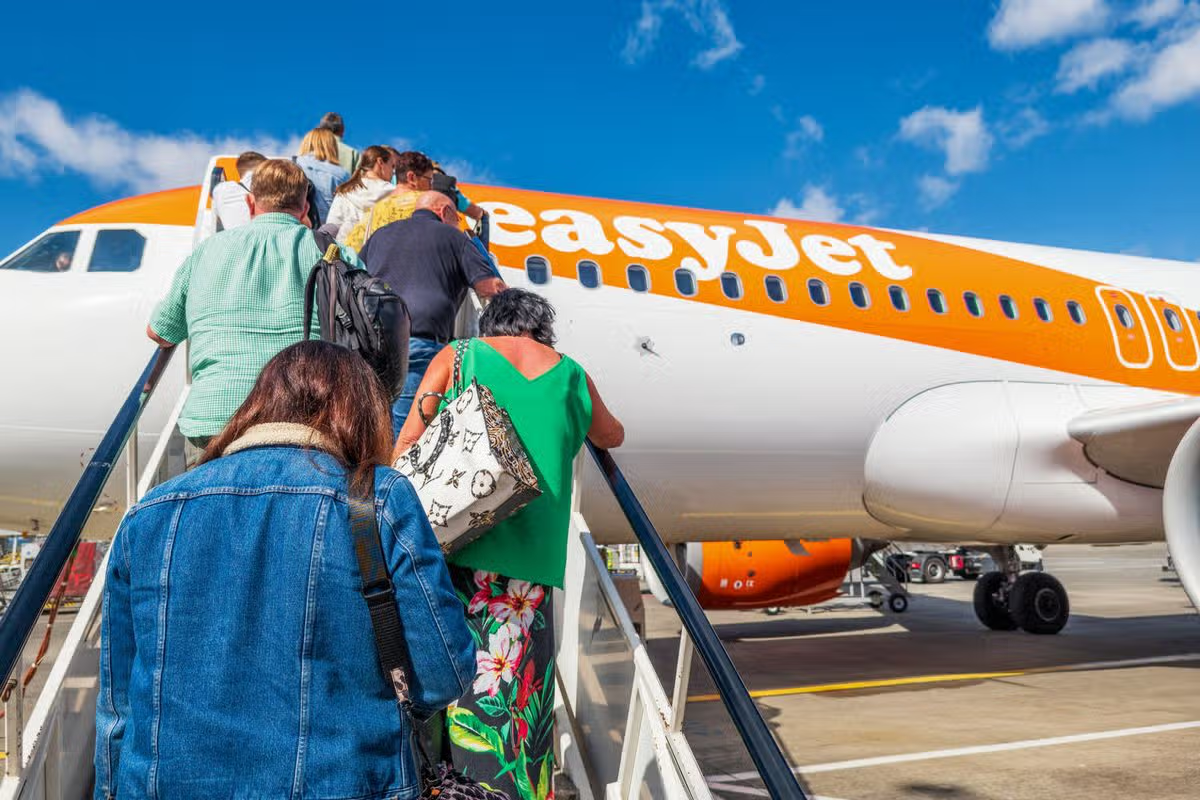
As summer is officially here, many people will be taking the opportunity to travel for the summer holidays, either to soak up the sunshine in a tropical country, or even to visit people in a different part of the world. And if you’re bringing a young infant under the age of two, you’ll be happy to learn that most airlines will offer a cheaper fare if they don’t require their own seat.

But one twin mum named Savannah Gavigan was left baffled as she and her husband boarded their flight recently, as they had been forced to split up their twins on the flight due to a little-known rule they had ‘no idea’ even existed.

“Friendly reminder to all twin parents: two in-lap infants can’t sit in the same row,” Savannah wrote in the overlay text of her TikTok video, which showed her two twins playing with each other despite sitting on separate rows on the plane.

Content cannot be displayed without consent

“But they still find a way to spend time together,” Savannah jokingly added in the caption of her post.

Why can’t babies and young kids be seated next to each other on flights?

The main reason why only one lap infant (an infant sat in an adult’s lap) can be seated on each row of two or three seats of a plane is because of airline safety rules, as there are generally only enough oxygen masks in a row for the main passengers with one extra. So if there are multiple kids under the age of two in one row sitting in an adult’s lap, there would not be enough oxygen masks for them all to use.

Passengers will most likely encounter this on flights across most airlines as they often all follow the same rules and precautions.

But there are ways to get around this, such as if you’re flying with twins or just two infants under the age of 2. Many airlines will offer the opportunity to buy an extra, separate seat for one of the infants. If one infant is in their own seat (often in an approved car seat or with a harness), you can all sit together in the same row. Some airlines will also offer seats with bassinets that babies can lay in throughout the flight.

If both infants that you’re travelling with are lap babies, the closest you can sit together is across the aisle or directly in the row in front/behind each other, as it’s every three rows that will have four oxygen masks.

Keep in mind that some airlines require an additional accompanying adult if one adult is traveling with two infants, and at least one of the babies may need to be secured in a safety-approved car seat.

People soon took to the comment section of Savannah’s video to share their bafflement as many parents shared they’d never heard of the rule before.

“This should be in the disclaimer when you book a flight. How random I would’ve never known!” one person commented. Someone else said: “Will be traveling with the family in October and the grandbabies will be six months so this is a good thing to know now!”

Some flight attendants also appeared in the comments to verify the statement, as one said: “Hey flight attendant here! Thanks for bringing this up!!! It has to do with oxygen masks! Should they deploy we want everyone to have one in reach and easily accessible, reaching may take extra time that could be detrimental!”

Someone else went on to say: “You can though BUT – it depends on the aircraft type and where the bassinets are located. 2 bassinets on D & G on B777, A380 etc on many airlines ( Ex cabin crew )”

Source link

‘Extreme’ health risk warning for popular Brit holiday destination

People visiting these islands could be at risk of high UV levels

People have been urged to take certain precautions as the ultraviolet radiation risk at a popular holiday destination area has been raised to “extreme”. Health officials in the Canary Islands have elevated the UV risk across several of the islands.

According to the Canary Islands Health Department, UV radiation levels are presently classified as “very high” across all islands. And Fuerteventura, Lanzarote and Gran Canaria have reached the highest “extreme” warning category.

Prolonged exposure to ultraviolet radiation can lead to serious health complications, including DNA damage, severe sunburn, allergic skin reactions, eye conditions and a heightened risk of skin cancer, including melanoma. Health experts also caution that UV exposure can suppress the immune system and even trigger the reactivation of viruses such as cold sores.

The alert particularly impacts those who spend lengthy periods outdoors, whether for work or leisure, as well as individuals with fair skin, light eyes or a family history of skin cancer. Children and older adults are also regarded as especially at risk.

As reported by Canarian Weekly on May 21, health authorities are strongly advising people to avoid direct sunlight between 11am and 5pm wherever possible, seek out shaded areas and wear protective clothing, wide-brimmed hats and approved sunglasses with UVA and UVB protection. The application of SPF 50 sunscreen is highly recommended, even on overcast days.

Authorities also issued a reminder to parents that babies under one year old should never be exposed directly to sunlight, as their skin is particularly sensitive and incompatible with most sun creams. The Canary Islands consistently record some of the highest UV radiation levels across Spain throughout the year, owing to their geographical position and climate.

How to apply sunscreen

The NHS warns that most people do not apply enough sunscreen. As a guide, adults should aim to apply around six to eight teaspoons of sunscreen if you’re covering your entire body.

READ MORE: Drivers in England urged to put ‘light coloured’ towel in their car from FridayREAD MORE: 5 UK areas issued with amber heat health alerts as heatwave warning upgraded

If sunscreen is applied “too thinly”, the amount of protection it gives is reduced. If you plan to be out in the sun long enough to risk burning, sunscreen needs to be applied twice:

  • 30 minutes before going out
  • Just before going out

Sunscreen should be applied to all exposed skin, including the face, neck and ears, and head if you have thinning or no hair, but a wide-brimmed hat is better. Sunscreen needs to be reapplied liberally and frequently, and according to the manufacturer’s instructions.

This includes applying it straight after you have been in water, even if it’s “water resistant”, and after towel drying, sweating or when it may have rubbed off. It’s also recommended to reapply sunscreen every two hours, as the sun can dry it off your skin.

Further to this, the NHS recommends you should do the following to stay safe in the sun:

  • Spend time in the shade between 11am and 3pm
  • Never burn
  • Cover up with suitable clothing and sunglasses
  • Take extra care with children
  • Keep babies under six months out of direct sunlight
  • Use at least factor 30 sunscreen – make sure to use enough and re-apply frequently

Source link

Emmerdale fans left terrified for Jacob as Dr Todd enters ‘full psycho mode’

Emmerdale fans have been left even more worried about Jacob Sugden after his latest run-in with Doctor Todd on the ITV soap as his former boss issued another threat

Emmerdale fans have been left even more worried about Jacob Sugden after his latest run-in with Doctor Todd on the ITV soap. The medical student, played by Joe-Warren Plant, has been terrorised by his superior at Hotten General for months now, originally masking her bullying as tough love as he began his journey in the profession.

On Monday’s edition of the Yorkshire-based soap, Jacob called round to see Doctor Todd, also known as Cailtin, on the day of her father’s funeral. He took with him some flowers as a gesture of condolence and explained that he hoped to put the past behind them, especially now that she has decided to retire.

Caitlin (Caroline Harker) thanked him for the flowers and seemingly agreed they could draw a line on it, but as soon as Jacob was out the door, she dismissed his gesture by tossing the flowers onto the sofa.

READ MORE: Emmerdale Dr Todd’s cruel next move ‘seals’ fate – and it’s bad news for JacobREAD MORE: Emmerdale fans ‘work out’ who brings Dr Todd down and it’s not Jacob

Later on, Caitlin bumped into Vanessa Woodfield (Michelle Hardwick) in the shop, where Jacob was working on the till amid his paternity leave, and arranged to go on a date with her. Vanessa then got a phone call and had to leave immediately to deal with a family emergency, with Caitlin swooping in to offer to pay for her shopping so she could leave quickly.

She took the basket to the till and instantly used this as an opportunity to lay out her plans for Jacob. She said: “Thanks again for the flowers. I was a bit blindsided by you showing up, to be honest.

“But you said something about us going our separate ways and moving on. That’s gonna be a bit difficult, that first bit, isn’t it? Because we both live here.

“But I’m gonna have a lot more time on my hands, as you know, what with no job, and no dad to worry about. I wonder what I’m gonna do with it. Hopefully, it won’t involve finding new ways to make your life as hellish as when you worked with me…especially with what I know. Cheery-bye!”

Jacob was left looking confused to say the least as Caitlin walked out of the shop, but the knowledge that she has is that baby Leyla isn’t actually his daughter, nor is she his wife Sarah’s.

The retired doctor has worked out that Charity Dingle (Emma Atkins), who is Sarah’s grandmother and had claimed to be acting as surrogate, is the child’s biological mother, having conceived the baby during a one-night stand with Ross Barton.

Reacting to the shock threat, one fan wrote on Reddit: “Todd is seriously scary now she’s in full psycho mode.” Another said: “Is Todd that sad that she’s retiring to make his life a misery?”

A third wrote: “Jacob – ‘this woman is bullying me and making my life hell every time I see her, so I know what I’ll do, I’ll go round to her house’”

Emmerdale airs weeknights at 8pm on ITV1 and ITVX.

* Follow Mirror Celebs and TV on TikTok , Snapchat , Instagram , Twitter , Facebook , YouTube and Threads .


Source link