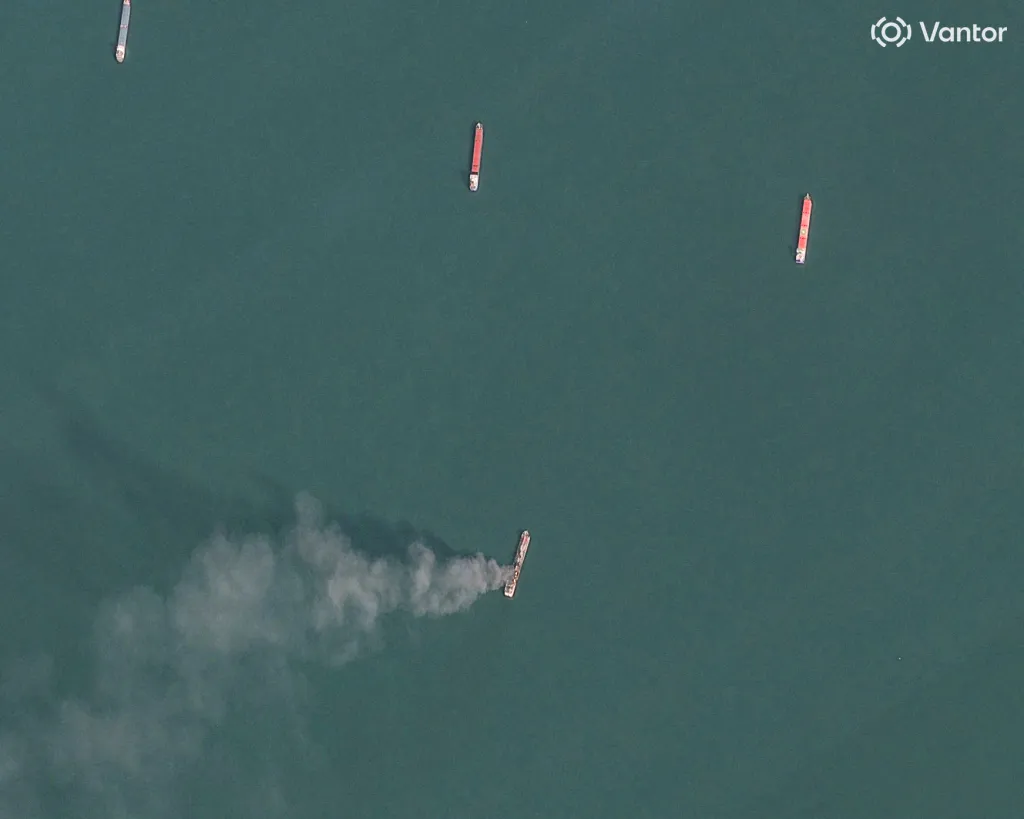
Ukraine says drones hit 11 Russian vessels in the Azov Sea, targeting tankers, dry cargo ships, and a tugboat overnight.
Published On 14 Jul 202614 Jul 2026
Russia says it is working to reroute grain shipments from the Sea of Azov after its vessels came under Ukrainian attacks in the sea, as Kyiv claimed it hit 11 more Russian vessels in overnight strikes.
Russia was preparing to use “alternative shipping routes” and may redirect cargo “to other modes of transport”, Russia’s Ministry of Agriculture said in a statement on Tuesday.
Recommended Stories
list of 3 itemsend of list
The ministry added that “the situation in the Azov Sea will not affect the domestic market’s food supply or our country’s export capabilities.”
Ukrainian military commander Robert Brovdi said on Telegram on Tuesday that drone attacks hit 11 Russian vessels in the Azov Sea overnight. The targets included five tankers, five dry cargo vessels and a tugboat, bringing the total number of vessels struck in the past nine days to 116, he said.
Russia’s Foreign Minister Sergei Lavrov accused Ukraine of carrying out “acts of terrorism”.
“What the Ukrainian regime is doing goes beyond even piracy. Pirates, at least, plunder and keep the spoils for themselves. But here, it benefits neither them nor anyone else – the goal is simply to cause damage and intimidate. It is terrorism, pure and simple,” Lavrov said.
The attacks come as Ukraine steps up long-range strikes on Russian oil refineries and other energy infrastructure, triggering a fuel crisis in Russia.
Russia’s Ministry of Defence said its air defences intercepted 288 Ukrainian drones across the country overnight. Russian authorities said falling debris from a drone attack injured one person and damaged houses in several villages.
One attack sparked a fire at the Afipsky oil refinery, authorities in Russia’s Krasnodar region reported.
Ukraine also struck another oil refinery in the republic of Bashkortostan, which had been hit twice in September 2025. Governor Radiy Khabirov said on Telegram that the attack hit an industrial area in the city of Salavat.
Ukrainian strikes on Russian oil refineries have contributed to a fuel crisis, leading Moscow to ban some fuel exports amid a global surge in energy prices.
Russia’s Defence Ministry also said it hit targets in Kyiv, port infrastructure in Ukraine’s Odesa region, and fuel storage facilities for Ukrainian forces in the port of Yuzhny.
Ukrainian navy spokesman Dmytro Pletenchuk said Russian forces struck a civilian vessel near Ukraine’s Black Sea port of Odesa. Pletenchuk reported no casualties in the attack.
Meanwhile, Ukrainian military officials said their forces shot down seven missiles and 108 drones across the country.
Ukrainian rescuers work to extinguish a fire at a damaged residential building following a Russian drone strike late night in Zaporizhzhia on July 12, 2026, amid the Russian invasion of Ukraine [File: Darya Nazarova/AFP]
Weekly insights and analysis on the latest developments in military technology, strategy, and foreign policy.
Ukraine claims that 28 Russian vessels were hit by aerial drones in the Sea of Azov on Saturday. The strikes are the latest in a campaign that Ukrainian authorities assert has resulted in nearly 80 Russian vessels, mostly so-called shadow fleet oil tankers, being attacked in that body of water on a daily basis since July 6.
As a result of these attacks, “Russia temporarily stopped shipping through the Don-Azov Channel, a navigable waterway linking the Don River with the Sea of Azov,” Reuters reported, citing three grain export industry sources.
The move came after 13 Russian vessels, including 10 tankers, were attacked in this body of water on Friday. Market analysts noted to Reuters that about 25% of wheat exports from Russia, the world’s largest exporter of the grain, pass through the Sea of Azov.
Russia has suspended new applications for vessel transit through the Kerch Strait and halted navigation on the Don-Azov Canal, Reuters reported. The move follows Ukrainian drone attacks on Russian vessels in the Sea of Azov. Euronext wheat futures rose 4%. #Ukrainepic.twitter.com/5pETqKD75K
“Overnight on 11 July, the Birds of the Unmanned Systems Forces hit 21 tankers, 4 tugs, 2 cargo vessels, and 1 special-purpose vessel in the Sea of Azov,” Ukraine’s 414th Separate Unmanned Strike Aviation System Brigade, known as “Magyar’s Birds,” stated on X. The cutting-edge unit is named for Ukraine’s drone force commander Robert Brovdi, also known as Magyar.
In addition to striking the ships, Magyar’s Birds claimed to also have hit “53 legitimate military targets were engaged deep inside the enemy’s rear in Crimea and the southern part of the temporarily occupied territories, including fleet assets and energy infrastructure. Operation ‘Crimean Switch Off’ has no end date.”
The shadow tanker fleet was engaged by drone pilots from a wide array of units, the brigade added.
“The technological humiliation of the empire continues,” Magyar’s Birds proclaimed. “It will fall because of Crimea.”
TWZ cannot independently verify the claims; however, many videos have emerged on social media purporting to show the results of these attacks. Magyar’s Birds has released six compilations of them.
Magyar’s update: Another bad day to be a tanker.
28 shadow de-fleet vessels of the rf hunted down overnight on 11 July in the Sea of Azov by the Birds of the Unmanned Systems Forces.
A total of 76 vessels were struck over six days (06–11.07.26). The Molochka is doing its job.… pic.twitter.com/nhM9Di3DRg
— 414 Magyar’s Birds (@414magyarbirds) July 11, 2026
The brigade began releasing videos of these strikes on July 6. This first one shows two ships being hit in a compilation of videos showing strikes on targets mostly on Crimea. The targets included S-400 air defense systems, radars and an oil depot.
⚡️ Don’t joke about fuel shipments to Crimea. We warned you.
Two fuel tankers carrying gasoline from Taganrog to Crimea were hunted down in the Sea of Azov; on land – two S-400 “Triumf” air defense systems, an oil depot burning in Kerch, and a Nebo-U radar.
— 414 Magyar’s Birds (@414magyarbirds) July 6, 2026
The next day, July 7, Magyar’s Birds released a video that opened with a wide view of almost two dozen tankers lined up in the Sea of Azov. The video then cuts to show several of those vessels being struck and burning. The unit claimed eight tankers, a cargo ship and a ferry were hit.
Holy shit.
Madyar’s Birds took out 8 Russian tankers, 1 cargo ship, and 1 ferry from the shadow fleet in a single night (!).
At this point, Ukraine is effectively seizing control not only of the northern Black Sea, but of the entire Sea of Azov as well. pic.twitter.com/7Hj1DUVbu3
— Illia Ponomarenko 🇺🇦 (@IAPonomarenko) July 7, 2026
On July 8, Magyar’s Birds claimed nine more Russian tankers were attacked.
Magyar’s update: the tanker hunt continues.
🔥 The USF Birds struck 9 more russian shadow fleet tankers during the night of July 8 in the Sea of Azov.
🌶️ 21 vessels were hit over the past 72 hours: 19 shadow fleet tankers, 1 cargo ship, and 1 ferry in Kerch.
— 414 Magyar’s Birds (@414magyarbirds) July 8, 2026
Magyar’s Birds released another video on July 9 claiming 14 Russian ships were hit overnight.
Magyar: Shadow fleet massacre continues.
🔥 14 vessels hit overnight on July 9 in the Sea of Azov by the Birds of the Unmanned Systems Forces.
The worms’ shadow fleet keeps shrinking: 35 tankers, cargo ships, and auxiliary vessels hit within the past 96 hours. (Full timeline… pic.twitter.com/PNwRY7cg0F
— 414 Magyar’s Birds (@414magyarbirds) July 9, 2026
Friday, July 10, Magyar’s Birds claimed strikes on 10 tankers, a cargo vessel, a ferry and a sea tug.
Magyar’s update on new Chornobaivka in Azov Sea:
The Azov branch of Chornobaivka already 48: +13 shadow fleet vessels hunted down on the approaches to Crimea overnight on 10 July.
🔥 Birds of the Unmanned Systems Forces struck 48 vessels within 120 hours – the fleet is becoming… pic.twitter.com/S0wmmi5Y71
— 414 Magyar’s Birds (@414magyarbirds) July 10, 2026
In addition to the videos released by the unit, others emerged on social media showing the aftermath of these attacks.
❗️Consequences of the 🇺🇦Ukrainian drone strike on the 🇷🇺Russian dry cargo ship FAVORI (Volgo-Don type, Project 1565A) in the Sea of Azov pic.twitter.com/MCfwC5fmPa
— 🪖MilitaryNewsUA🇺🇦 (@front_ukrainian) July 10, 2026
Footage shows Ukrainian Armed Forces drones attacking tankers belonging to the Russian shadow fleet in the Sea of Azov. In the last four days alone, the Ukrainians have damaged or destroyed 49 Russian vessels. pic.twitter.com/Ejv7aPv9JS
— Jürgen Nauditt 🇩🇪🇺🇦 (@jurgen_nauditt) July 10, 2026
Magyar’s Birds doesn’t name the types of drones being used, but the video displays show they are from Fire Point, which makes several kamikaze drones as well as the FP-5 Flamingo cruise missile.
Roy Gardiner, a former Canadian military officer who is part of the Defense Tech For Ukraine collective and is an expert on Ukrainian drone warfare, surmised that the attacks are by the FP-2 drone.
FP-1 and FP-2 – Drones that inflict pain on the Russian rear! | Weapons with @StarskyUA
“It’s the only UAV available in large numbers and with the range to carry that much explosive, other than the long-range AN-196 Liutyi, which is a lot more expensive and illogical to use for this mission,” Gardiner, who uses the @GrandpaRoy2 handle on X, told us.
Ukrainian UAVs have struck about 175,000 tons of shipping in the Sea of Azov over the last few days — these are World War II numbers. https://t.co/P4IEJb77M0
Fire Point co-owner Denis Shtilerman recently told the TSN media outlet that the company has increased the warhead of its FP-2 strike drones to 200 kilograms. A change in the wing design enabled the drone to achieve a flight range of up to 370 kilometers with those warheads, he claimed.
УКРАЇНСЬКІ ДРОНИ СТАЛИ НОСІЯМИ РАКЕТ! Деталі від українських розробників / ТСН.Тиждень
That range gives Ukrainian forces fire control over virtually all of the Sea of Azov, a body of water north of the Black Sea. The videos indicate this is made possible by high-speed satellite data links allowing for man-in-the-loop operations at great distances. This has enabled Ukraine’s sea drones since their arrival but the miniaturization of the technology has now allowed for large-scale use on one-way attack munitions.
Sea of Azov (Google Earth)
In addition to the aerial drones striking these tankers, Ukraine’s SBU state security bureau used Sea Baby sea drones to attack a Russian tanker in the Black Sea on June 8. As we have frequently reported, Ukraine’s naval campaign has focused overwhelmingly on the Russian Black Sea Fleet. Many successful attacks have been recorded against Black Sea Fleet vessels and facilities, forcing the general evacuation of Russian naval assets from occupied Crimea and to bases in Russia proper.
The Sea of Azov campaign has some Russian milbloggers chiding Moscow for not doing enough to protect these tankers.
“The ‘Military Informant’ Telegram channel complained that the defenseless manner in which the tankers had travelled had become in effect a shooting gallery for Ukrainian drone operators, with no cover from a Black Sea Fleet, which could nowadays barely defend itself,” the BBC recently noted.
The Kremlin is certainly paying attention to Ukraine’s targeting of refineries, oil depots, ports, ships and other energy infrastructure.
Russian nationalist and Z-blogger Vitaly Voronov is disgusted that Ukrainian drones have reached Omsk, well to the east of the Urals in Siberia.
Russian President Vladimir Putin “is concerned enough to address the fuel shortage publicly on state TV, insisting the Ukrainian attacks are ‘obviously creating problems’ but insisting ‘it’s not critical,’” BBC explained.
There’s good reason for Putin to be concerned.
“Russian gasoline output fell to a level equivalent to only around 65% of the seasonal average consumption after Ukrainian drone attacks led to stoppages at large oil refineries,” Reuters reported on Friday, citing “two industry sources and Reuters calculations.”
As a result of the Ukrainian attacks, Russia – long a major oil exporter – is now turning to imports to cover the gap and meet the demands.
“Supplies of gasoline and diesel from Belarus to Russia hit a monthly record in June, while industry sources said last week that Russia had started seaborne from India,” Reuters added. “Traders said that up to 6,000 tons of gasoline per day are delivered from neighboring Belarus to Russia. Stockpiles are also being tapped.”
Russia is also taking the drastic step of considering bans on exports of diesel, gasoline and jet fuel.
All this comes as both Ukraine and Russia are jockeying for territory and influence amid a slow-churning, on-again, off-again effort by President Donald Trump to end the conflict.
Ukraine’s success in targeting Russia’s energy infrastructure and isolating Crimea has likely had an effect on Trump, who has repeatedly changed his stance on which side he favors.
As we recently reported, Trump and Ukrainian President Volodymyr Zelensky had a remarkably warm bilateral meeting at the NATO Summit in Ankara, Turkey, earlier this week. So much so that the American leader promised his counterpart licenses to manufacture Patriot air defense system interceptors, something Zelensky has sought for years without success.
Ukraine continues to struggle badly to fend off Russian ballistic missile barrages and remains overmatched in terms of troops and equipment on the battlefield, where fighting has ground to a virtual standstill. Despite that, Kyiv is proving that asymmetric efforts like the Sea of Azov campaign are helping to offset Moscow’s advantages.