Ayatollah Ruhollah Khomeini

Jury convicts Salman Rushdie attacker on terrorism charges

July 30 (UPI) — A federal jury has convicted the New Jersey man who attempted to murder writer Salman Rushdie on additional terrorism-related charges, including attempting to provide material support to the Iran-backed militia Hezbollah.

Hadi Matar of Fairview, N.J., was sentenced to 25 years in prison in a state court in May 2025 for trying to kill Rushdie on Aug. 12, 2022.

Matar rushed the stage and stabbed the India-born writer at New York’s Chautauqua Institution in Mayville, N.Y., before being subdued by audience members and taken into police custody. Rushdie lost vision in his right eye and suffered nerve damage as a result of the attack.

A federal jury in the Western District of New York on Wednesday convicted Matar on charges of attempting to provide material support to a designated foreign terrorist organization, engaging in an act of terrorism transcending national boundaries and providing material support to terrorists. Matar faces a maximum penalty of life in prison on the most serious charge when sentenced on Nov. 3.

“Hadi Matar, who was born and raised in the United States, chose to align his values with the terroristic values of the leaders of Iran, which often promote violence, and in this case, the call for murder,” U.S. Attorney for the Western District of New York Michael DiGiacomo said in a statement.

“The defendant spent months planning and preparing to carry out what he hoped would be the execution of Salman Rushdie and possibly follow in the footsteps of martyrs he admired. Instead, his attempted act of terror failed, and Salman Rushdie survived, thanks to courageous members of the public and law enforcement, who saved Rushdie and captured Matar.”

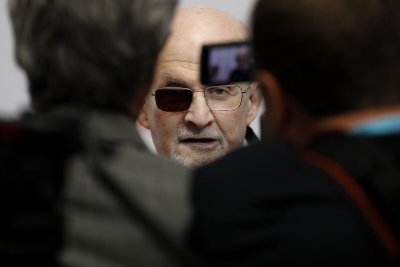
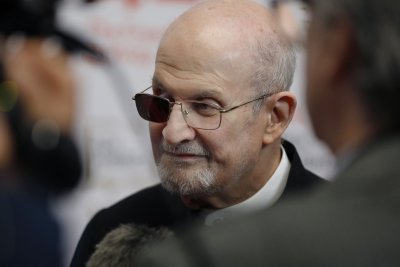
The trial began July 22, and Rushdie, 79, testified.

DiGiacomo said Rushdie answered every question asked of him by the defense and prosecutors.

“It was very powerful,” DiGiacomo said.

“And at the end, at some point, Mr. Rushdie removed his glasses so the jury could see the extent of the injury to his eye that he no longer has vision it.”

Prosecutors said Matar was attempting to carry out the orders of Iran’s late spiritual leader Ayatollah Ruhollah Khomeini, who in 1989 called for Rushdie’s murder after the publication of his award-winning novel The Satanic Verses on the grounds that it was blasphemous to Islam.

The fatwa was reaffirmed in 2017 by Khomeini’s successor, Ali Khamenei, and endorsed by Hezbollah Secretary-General Hassan Nasrallah. Nasrallah was killed Sept. 27, 2024, in Israeli airstrikes on Beirut, while Khamenei was killed Feb. 28 in joint U.S.-Israeli airstrikes on Iran.

Federal prosecutors said during the trial that Matar had spent more than a year researching the fatwa before deciding to try to kill Rushdie and discussed it with people in Iran, Australia and Canada.

According to the Justice Department, Matar had surrounded himself with Hezbollah symbols ahead of the attack and had traveled to the institution that day with a false driver’s license bearing the name Hassan Mughniyeh, with Hassan being Nasrallah’s first name and Mughniyeh being the surname of Hezbollah’s former external security organization head, Imad Mughniyeh.

DiGiacomo told reporters following the conviction that ahead of the attack, Matar traveled by bus from New Jersey to Buffalo, then traveled toward the Chautauqua Institution.

On the morning of the attack, Matar visited a website run by Hezbollah and took screenshots of Hezbollah operatives who had died that month.

“The evidence presented in the trial showed that this attack was not spontaneous. It was deliberate. It was research. It was planned. It was motivated by violent extremist ideology,” Alan Davis, special agent in charge of the FBI’s Buffalo field office, said during the press conference.

“For more than a year, the defendant researched a decades-old fatwa, communicated with individuals overseas about carrying it out and embraced the propaganda and symbols of Hezbollah before traveling to western New York to commit this violent act.”
Source link

Salman Rushdie attacker facing federal terrorism trial in New York

July 22 (UPI) — The man who rushed a stage to attack author Salman Rushdie will face federal terrorism charges in a trial that began Wednesday in New York.

Hadi Matar, 28, was found guilty of murder in state court last year and was sentenced to 25 years in prison for the August 2022 attack that left Rushdie blind in one eye and without use of one hand.

The federal case will determine if the attack was an act of terrorism and if he was carrying out a fatwa against Rushdie, set by the former Ayatollah Ruhollah Khomeini, or if it was for Hezbollah, the Iran-backed militia in Lebanon, or neither.

Khomeini, then the ayatollah of Iran, created the fatwa in 1989 because of Rushdie’s novel, The Satanic Verses, published in 1988. Hardline Muslims considered the book blasphemous because of the way it portrayed the Prophet Muhammad.

The attack on Rushdie happened at the Chautauquah Institution in Chautauquah, N.Y., as he was delivering a speech for more than 1,000 people on writers in political exile. Matar rushed the stage and stabbed Rushdie more than a dozen times.

Matar is a U.S. citizen of Lebanese origin who was raised in New Jersey and California. His friends and relatives said that after some professional and academic frustration, he became religious. His mother told The New York Times that she could not support him.

Rushdie, 79, wrote and published in 2024, Knife: Meditations After an Attempted Murder, a memoir about the attack and his recovery.

Matar had written in his notebook a list of pros and cons to attacking Rushdie. The Times reported that a page provided by prosecutors showed that he wrote one reason not to do it was: “Could make life worse. But I doubt that. It kind of sucks already.”

Source link

Iran’s Ayatollah Mojtaba Khamenei calls U.S. the ‘Great Satan’

Iranian women hold an image of supreme leader Ayatolla Mojtaba Khamenei as Iranian officials, military commanders, families of war victims and their supporters gathered at Imam Khomeini Mosque in Tehran on Sunday. On Saturday, Khamenei called the United States “The Great Satan.” Photo by Behnam Tofighi/UPI | License Photo

July 18 (UPI) — Iran’s supreme leader, Ayatollah Mojtaba Khamenei called the United States the “Great Satan,” ramping up the war of words amid an actual war in the Persian Gulf.

“Today, the Great Satan has once again revealed its true, unmasked face, so that this dark episode of criminality and broken promises serves as yet another indisputable testament to the U.S.’s dishonesty, irrationality, unreliability, and malicious nature,” a post on X from Khamenei’s account said Saturday.

He also said, in another post: “Coercion, totalitarianism, and brutality are inseparable components of the U.S. creed and doctrine.”

On his Telegram channel, Khamenei said, “The Great Satan has once again revealed its malicious nature.

“The repeated breaches of the agreement by the Great Satan [the U.S.] regarding the memorandum of understanding (MOU) signed by the Presidents of Iran and the United States have once again laid bare a fundamental truth: the signature of the U.S. President is utterly worthless and devoid of credibility. It further reaffirms that coercion, totalitarianism, and brutality are inseparable components of the U.S. creed and doctrine,” he said.

“The Great Satan” is an epithet for the United States and was coined by supreme leader Ayatollah Ruhollah Khomeini in November 1979, one day after 66 American diplomats and civilians were taken hostage at the U.S. embassy in Tehran. Most of the hostages were held for 444 days.

Iran and the United States have increased strikes in the region for the past week. Both countries are enforcing blockades in the Strait of Hormuz: Iran is preventing ships from passing, and the United States is blocking Iranian ships and ports. The strait is a vital waterway for oil and gas transport.

As of this writing, President Donald Trump hasn’t responded on his social media channel.

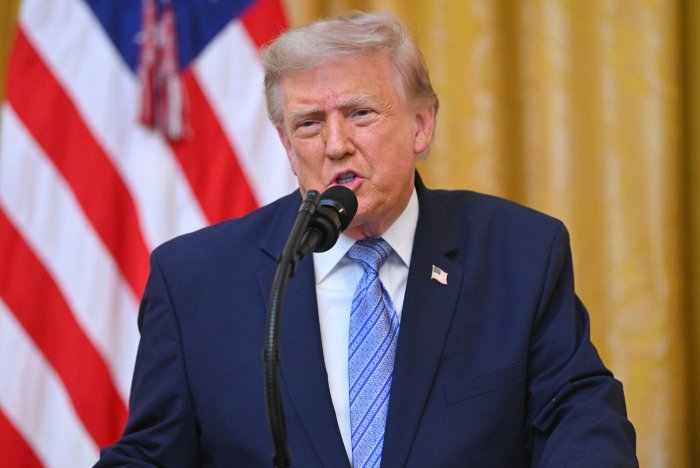
President Donald Trump delivers a prime-time address to the nation from the East Room of the White House on Thursday. Pool photo by Saul Loeb/UPI | License Photo

Source link