More money and awareness sped California’s midterm vote count
Every few years, with abundant disdain, an angry chorus has welled up across this great land.
Why the heck, those wrathful voices demanded, is California taking so long to count its ballots?
The state’s prolonged tabulations became a punchline for late-night comics, a staple of sneering punditry and an irritant for the many impatient souls who believe that election results, like their DoorDash, should be served up quickly and piping hot.
Worse, the laggard count provided an opening for mischief-makers and the conspiracy-minded, foremost among them the nation’s election denier-in-chief, who filled the vacuum with gaseous claims of stolen ballots, illegal voting and other supposed instances of chicanery and deceit.
But not this time.
This time it was Alaska, Mississippi and other states that held the country in their thrall for days and weeks after the Nov. 3 midterm election — not to determine which party would control the House or Senate, but to see just how epic the Democrats’ historic blowout would be.
It was a welcome relief for California.
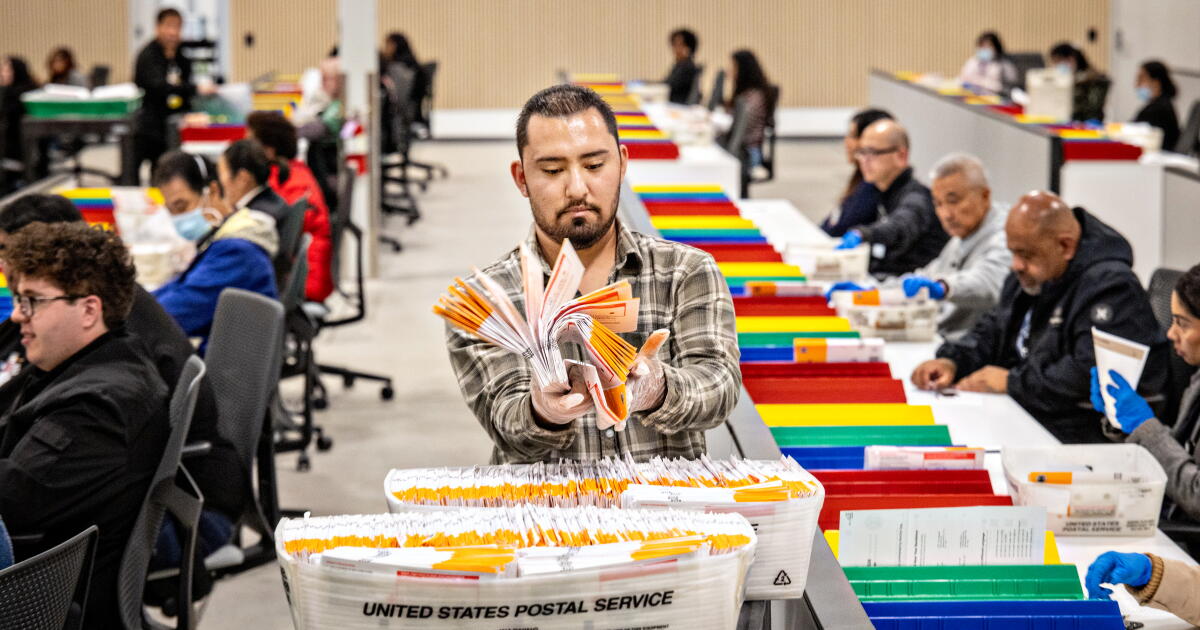
But also a testament to voters, state lawmakers and, not least, reform advocates and the front-line election workers who pushed for changes to speed the count and, so equipped, conducted their work with notable efficiency and dispatch.
“It’s been a great election, despite everything that we had to overcome,” said Kim Alexander, head of the nonpartisan California Voter Foundation, who’s worked for years to make the state’s elections run better.
“It’s easy for people to quickly forget the numerous hurdles California had to get through,” Alexander said, “and so I think that makes the speed and smoothness of the vote count even more remarkable.”
There were court battles, threats to jail local officials, monkeying with the U.S. Postal Service and an attempt to preemptively intervene in California’s vote counting, all in pursuit of President Trump’s phony fraud claims and effort to rig the election for beleaguered Republicans. The U.S. Supreme Court stepped in more than once to thwart Trump’s alarming and undemocratic (that would be small “d”) sabotage attempts.
A long-held grudge
The presidential clash with California had been building for the better part of a decade, ever since the gossamer-skinned Trump sought to explain away his loss of the 2016 popular vote by claiming legions of people had been allowed to vote here illegally.
That assertion was, like so many emissions from the president’s mendacious mouth, utterly false.
But California offered a ripe target, given the duration of its vote count — a function of commendable efforts to make voting as widespread and friction-free as feasible.
A ballot is mailed to every eligible voter and those ballots are counted so long as they are postmarked by election day and received by officials no later than seven days after.
That accounts for part of the delay. Another reason is sheer volume: More than 13.5 million ballots were cast in this midterm election, a number that exceeds the population of all but four states.
Having it all
But, giving credit where due, the duplicity of Trump and political allies such as Speaker Mike Johnson did have one salutary effect. Their falsehoods spurred California lawmakers to prove it was possible to encourage broad voter participation while, at the same time, delivering election results more quickly.
Tucked into the most recent state budget was an extra $40 million aimed at speeding up California’s vote counting. Most of the sum — $29 million — went toward staffing, technology and equipment upgrades. About $10 million was allocated for outreach and voter education and $750,000 was aimed at combating election misinformation.
It wasn’t just officialdom that acted, however. California voters also did their part to thwart Trump’s assault, turning out in significantly higher number than in most recent midterm elections.
“My social media feed was filled with messages from all kinds of people urging people to vote, urging people to vote early,” Alexander said. “I do think that there was a backlash to the numerous attempts being made by the federal government to impede our voting process. That motivated people to become even more outspoken about the importance of voting and motivating other people to vote.”
California has had many close contests. In one of its earliest presidential elections, in 1860, Abraham Lincoln carried the state by fewer than 1,000 votes. (There were about 380,000 residents at the time.) In 2018, it took more than three weeks to settle the country’s final House race.
But the huge Democratic wave this time made for relatively few cliff-hangers. The House went blue not long after the polls closed in California; no waiting for daily vote updates from Kern, Fresno and Kings counties to know which party would prevail.
Alexander believes the improvements to California’s balloting are lasting ones, and this month’s uneventful tally was not just a function of such a clear-cut election. Still, she said, more can be done to speed things along, including upgrades to aging infrastructure and the statewide voter database.
“It’s not just about building a better facility,” Alexander said. “It’s about the workflow and finding the bottlenecks and figuring out how to reduce those.”
But for now, at least, the state has been spared another heaping helping of election-induced indignation, as well as generous side dishes of contempt and nationwide ridicule.
What else you should be reading
Get smart:News Analysis: In Shenzhen, Trump treats deference to adversaries as peace
The deep dive:Buoyed by midterms, Democrats start looking to 2028
The L.A. Times Special: Skelton:Possible stock market crash means California, Becerra need to wise up
Until next time,
mzb
—
Was this newsletter forwarded to you? Sign up here to get it in your inbox.