Avoided

Wembanyama’s concussion puts Spurs in peril the Lakers avoided

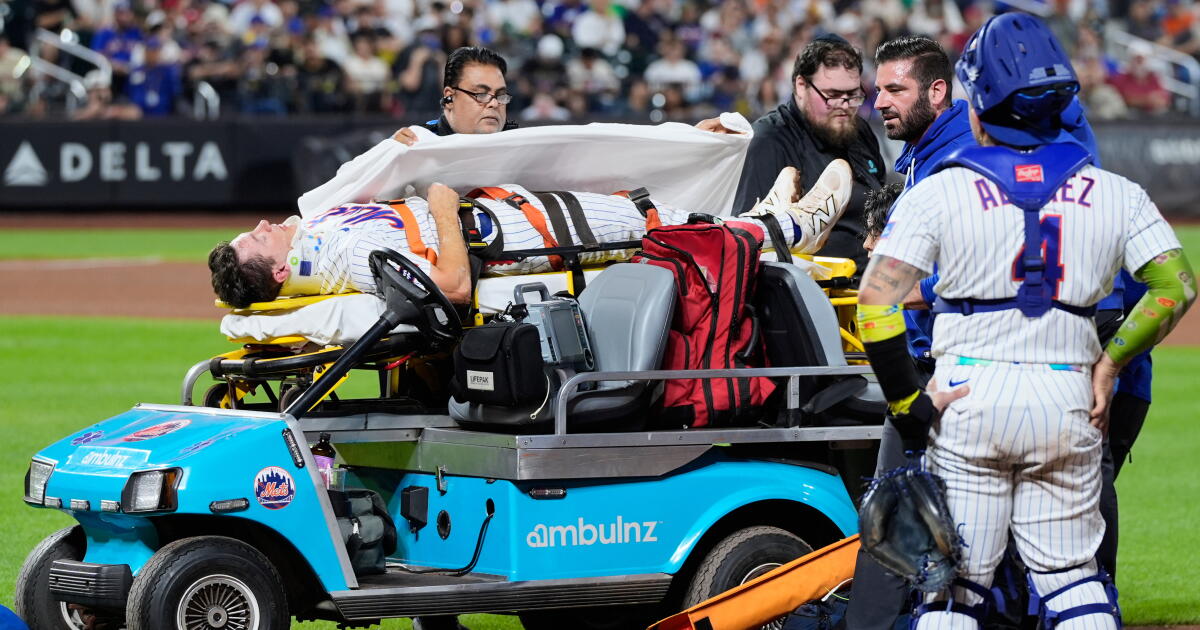
Towering superstar Victor Wembanyama toppled onto his face Tuesday night — timberrr!!! — and the NBA playoff scenario immediately became as scrambled as the San Antonio Spurs’ 7-foot-4 center’s thoughts must have been moments after he suffered a concussion.

Without Wembanyama for nearly three quarters, the Spurs fell to the underdog Portland Trail Blazers, 106-103, with the first-round series tied 1-1 and headed to Portland for Game 3 on Friday.

Meanwhile, without superstar guard Luka Doncic, the Lakers powered past the Houston Rockets, 101-94, to take a 2-0 series lead. Guard tandem Marcus Smart and Luke Kennard combined with the ageless LeBron James to make up for the absence of injuries to Doncic as well as fellow starting guard Austin Reaves.

Peering forward, an extended absence by Wembanyama would seem to place the Spurs in serious jeopardy of a first-round exit. After all, “Wemby” is the league’s defensive player of the year in addition to averaging 25 points and 11.5 rebounds a game. He is a two-way force of unprecedented magnitude.

Meanwhile, the Lakers have responded to the loss of Doncic so well that Times columnist Bill Plaschke declared “believe it, this series is already over” after their Game 2 victory Tuesday night. The absence of Doncic and his 33.3 points, 8.3 assists and 7.7 rebounds a game was masked by the exceptional play of teammates.

Does that make Wembanyana more valuable than Doncic? Does it raise Wembanyana’s NBA Most Valuable Player credentials to the level of fellow finalists Shai Gilgeous-Alexander and Nikola Jokic?

That’s a topic worth debating on another day. For now, the pertinent questions are how severely Wembanyana is injured and how long will he be sidelined. The Spurs and Trail Blazers play Game 3 on Friday night, Game 4 on Sunday and Game 5 on Tuesday night. The median time lost to concussion in the NBA is seven days.

“He has a concussion and he is in the protocol,” Spurs coach Mitch Johnson said afterward. “We’ll obviously take the proper and appropriate steps.”

A player in concussion protocol must have at least 48 hours of inactivity and undergo neurological testing while meeting certain criteria without symptoms before being cleared to play. A decision on clearance will come from the NBA concussion protocol director Dr. Jeffrey Kutcher in consultation with the Spurs’ team doctor.

The injury occurred early in the second quarter. After backing into the paint with the ball, Wembanyama turned to explode toward the basket. Portland defender Jrue Holiday executed a maneuver termed “pulling the chair” — moving completely away from the Spurs center, who clearly was expecting contact.

Wembanyama lurched forward, toppled and slammed the right side of his face on the floor. He stayed down for several seconds before sitting up and putting his hands on his face. Television analyst Reggie Miller exclaimed, “He is dazed.” Wembanyama finally stood and jogged directly to the locker room. He did not return.

Meanwhile at Crypto.com Arena, Doncic and Reaves cheered from the bench throughout the Lakers’ inspired dismantling of the Rockets. Smart scored 25 points and Kennard added 23.

“I know we just kind of flipped the switch,” Kennard said. “We told each other, this is what we got right now. We’ve got to believe in what we have.”

Added Smart: “The word is, ‘elevate’ for us, and that’s all we’ve been trying to do, is elevate our play on both ends.”

Wembanyana’s backup is Luke Kornet, who has played for six teams since going undrafted out of Vanderbilt in 2017. He was effective during a 14-minute stint in the Spurs’ Game 1 victory over Portland and had 10 points and nine rebounds in Game 2 after Wembanyana exited. He’ll need to step up the way Smart and Kennard have for the Lakers.

Injuries are inevitable. How teammates respond when a superstar is sidelined provides insight on multiple levels. So far, the loss of Doncic — and Reaves — has been overcome by the Lakers while the loss of Wembanyama could cripple the Spurs.


Source link

I avoided the dreaded EES airport chaos in Spain

FROM flight cancellations caused by the Iran war to massive airport queues caused by new travel entry rules – going on holiday has never been so stressful.

Even myself – who travels abroad every month – approached the airport with trepidation this week.

I managed to avoid the huge queues on a trip to Spain
There’s been massive queues across Europe in recent weeks Credit: Alamy
With none of the e-gates open, I managed to still get to the front of the queue

My latest trip took me to the city of Bilbao, following the launch of new TUI city breaks to the Spanish city.

But before I could be excited for cheap wine and pinxtos, I was ready to be stuck in the airport for hours on end.

The new European rules – called the Entry/Exit System or EES – have resulted in massive problems especially at busy airports.

More than 80 passengers missed their Ryanair flight because of huge airport queues in Marseille, while over 100 people were left stranded when an easyJet flight to Manchester left without them.

‘APPY DAYS

New travel app to prevent huge airport queues as passengers wait up to 5 HOURS


TRAVEL ADVICE

Holiday warning for Brits as Foreign Office says ‘expect long airport queues’

The Sun’s Travel Reporter Alice Penwill was even stuck in queues for more than three hours at Lanzarote.

This is because of the requirement of biometric checks from all Brits which includes fingerprint scanning, and is a much slower process than passport stamping.

So after arriving late into Bilbao on a Friday, it’s safe to say I was prepared.

My first chaos-avoiding trick? Book a seat as close to the front as possible.

This will mean you can get off the plane as quickly as possible, meaning you can be at the front of the queue.

I was in row 5 out of 36, so was easily one of the first off the plane.

But this doesn’t always work depending on the airline and airport.

This is because many of them don’t have direct access to the airport via jet-bridge and instead offer the dreaded bus service to taxi you to the building.

Thankfully, there is a way to make sure you are still at the front of the queue even if you pile on.

The best way is to go to the very first bus, and go to the front doors.

Then, rather than piling to the back of the bus for a seat, stay in the middle of the doors on either side.

This means that you will be delivered directly to the airport security entrance and, no matter what side the doors open, you will be at the front.

Both of these tricks allowed me to be fewer than 10 people back when trying to get through airport security.

This still saw me waiting around 25 minutes and, frustratingly, unable to use the empty e-gates and instead stuck in the one-man security queue.

Not only that, but each person was taking at least 1-2 minutes due to the slow machines – so you can imagine how many hours that will take if there are more than 100 passengers on a flight.

But, it was reassuring when I saw how long the queue was behind me, and meant I avoided the majority of the queue.

The new EES rules explained

All non-EU nationals – which includes Brits – are required to register their details on their first visit to a Schengen area country.

This will be done by using specific EES machines which will be at airports, ferry terminals and the Eurostar terminals.

The machines will log your fingerprints, facial images and scan your passport as well.

Once you have registered (such as taking fingerprints and a photo), it is valid for three years, or until your passport expires if it is earlier than this.

EES does not cost anything and is free for all travellers.

I would also suggest that if concerned, fly to a smaller airport where there are fewer UK flights.

Bilbao only welcomes 1.6million tourists a year compared to Barcelona‘s 16million or Madrid’s 11million.

This means far fewer passengers travelling through the airport at any one time.

It is also worth avoiding arriving at the same time as other UK flights which you can easily see from airport departure boards.

This is because it is mainly Brits needing to do these checks, not other Europeans, so if there are lots of flights landing at the same time, this will see hundreds more passengers all queueing at the same time.

Airports which have been hit by the chaos recently have included Schipol Airport in Amsterdam, being a major hub, as well as Milan Airport in Italy and Lisbon and Faro Airport in Portugal.

Or – avoid it entirely by travelling to destinations which aren’t following the ne EES rules.

Greece became the first EU country to confirm that Brits are exempt from the rules in a bid to avoid the massive queues.

This means your trip to somewhere like Athens or Crete should be a much easier experience at the airport.

Safe to say I was ready for some Spanish wine…

Source link