avoid

Cornyn went to great lengths to avoid Trump’s wrath. The Texas senator lost his seat anyway

As it turned out, it would never be enough.

U.S. Sen. John Cornyn tried for more than a year to show President Trump and Texas Republicans that he and the president were on the same team.

Cornyn posted a photo of himself reading Trump’s “The Art of the Deal.” He proposed legislation to rename a stretch of interstate in Trump’s honor. Perhaps most glaringly, the Senate institutionalist who long supported the filibuster reversed his position in a failed effort to advance voting restrictions that are a priority for the president.

None of it worked. On Tuesday, Cornyn became the latest in a line of Republicans who lost their primaries after falling out of favor with a president with little tolerance for dissent and a seemingly insatiable appetite for retribution. The four-term senator lost by double digits to Texas Attorney General Ken Paxton, who Trump endorsed last week as “a true MAGA Warrior.”

Cornyn, on the other hand, “was VERY disloyal to me,” Trump wrote on social media.

Trump’s intervention in the Texas runoff came after weeks of successfully backing primary challengers in Indiana, Louisiana and Kentucky as revenge against incumbents who broke with his agenda.

Cornyn’s attempt to avoid the same fate made even some of his supporters wince.

“You look at the positions he took to please the president and the groveling and whatever,” said former Sen. Jeff Flake of Arizona, a Republican and Trump critic who didn’t seek reelection during the president’s first midterm in 2018. “It was rather painful to watch.”

Trump took an uncommonly equanimous approach to Tuesday’s results the following morning.

“Congratulations to Ken Paxton on such a tremendous win, and to John Cornyn for having run a strong and powerful race but, more importantly, having had a truly great career,” he wrote on social media. “John will remain my friend for a long time to come, as we both watch Ken become a fantastic, common sense Senator, one who is respected by all.”

Cornyn started early with ad touting pro-Trump voting record

Cornyn’s loss wasn’t for a lack of political gymnastics and astronomical campaign spending.

His campaign began running an advertisement last summer — part of an astounding nearly-$100-million air war by the senator and allied groups — with Cornyn looking into the camera and saying, “I voted with President Trump 99% of the time.”

On Cornyn’s campaign homepage, Trump and Cornyn stand side-by-side with thumbs pointed upward in an image aimed at projecting solidarity. Deeper in the website, the category titled “The Trump-Cornyn Record” notes the senator’s role securing votes for Trump’s signature 2017 tax cut bill.

Cornyn has also been championing provisions in Trump’s signature tax-and-spending legislation to finance work on the U.S.-Mexico border wall.

The senator had dismissed the project as “naive” during Trump’s 2016 campaign. But in January, he stood along a section of completed wall in Texas’ Rio Grande Valley touting the measure’s $11 billion for Texas contractors’ work at “the direction of the president of the United States, to whom I am very grateful.”

Cornyn’s 2023 dismissal of Trump’s return glares in background

Cornyn’s praise for his party’s leader and president were not unusual, but they clash with a statement Cornyn made in May 2023, when Trump was mounting his presidential comeback campaign.

“Trump’s time has passed him by,” he told reporters. “I don’t think President Trump understands that when you run in a general election, you have to appeal to voters beyond your base.”

Trump would go on to easily win the nomination and carry every battleground state in the general election.

Cornyn would hew closely to the president for the first 16 months of his second administration, hoping at the outside chance of his endorsement or to keeping him from weighing in at all.

But Trump did not forget the past slights.

“John Cornyn is a good man, and I worked well with him, but he was not supportive of me when times were tough,” he wrote on social media while endorsing Paxton.

Smaller gestures, and one big one

Cornyn has playfully worked to promote Trump fandom, last year posting a picture on social media of himself thoughtfully peering into the pages of Trump’s 1987 memoir and business advice book, “The Art of the Deal.”

In a more obvious gesture, he proposed designating a section of a U.S. highway from the Texas Gulf Coast to Montana as “Interstate 47,” to honor a 47th president with a well-documented love of naming things after himself. In a news release about the proposal, filed just over two weeks before Tuesday’s runoff, Cornyn said it would be known as the “Trump Interstate.”

The more tectonic shift occurred in March, after Trump had teased a possible endorsement of either Cornyn or Paxton in the runoff.

Paxton swiftly said he would consider dropping his candidacy if the Republican-controlled Senate lifted the filibuster and passed the SAVE America Act, a series of voting restrictions that Trump has described as an essential part of his agenda.

The following week, Cornyn wrote an op-ed in the New York Post — Trump’s favorite hometown newspaper — backing away from his previous support of the filibuster. He vowed to “support whatever changes to Senate rules that may prove necessary” to get the bill “through the Senate and on the president’s desk for his signature.”

Flake watched with unease.

“I know John and his long-held positions on the filibuster and the Senate’s institutions,” he said. “No office is worth that.”

Beaumont and Bedayn write for the Associated Press. Bedayn reported from San Antonio. AP writer Mary Clare Jalonick in Washington contributed to this report.

Source link

Newspapers have a future, if they can avoid being ‘click whores’

“What’s black and white and read all over?” That is the setup for what used to be the first joke learned by most every American kid. These days, delivering the punch line would leave the kids bewildered. They might just say, “What’s a newspaper?”

In our new media age, that is not a question with an obvious answer. Ask the people in New Orleans who just found out their venerable Times-Picayune will no longer be available in print every day. Based in a city and state with a perennially high level of corruption and dysfunction, the Times-Picayune has been a powerful and admired community watchdog. The question is, will it be as effective with a smaller staff and just three days of print publication a week? And there is a bigger question, one that applies to the newspaper industry as a whole: Can printless watchdogs still have teeth?

Newspapers are different from most other businesses because one of their paramount functions is to provide a public service that may bring no monetary return and may not even interest most of their customers. In a democracy, someone needs to keep an eye on the elected officlals, bureaucrats, business leaders, lobbyists, police and assorted shysters who have the power to mess with people’s lives. Traditional newspapers, from the big city dailies to the small town weeklies, have always had reporters who make it their mission to protect the public interest. Often, they write important stories that few people read — coverage of state legislatures, for instance. But those being watched by the watchdogs read those stories and it tends to keep them honest.

In the past, newspapers were so profitable that, so it was said, any fool could get rich owning one. That made it fairly easy for a publisher to pay for investigative reporters, foreign correspondents and governmental news, the kind of work that is expensive, time-consuming and does not offer any obvious payback, other than a good reputation. But, with so many advertising dollars jumping to the Internet, the newspaper business model has crashed and newsroom cuts have hit everywhere. Often, the newspaper coverage that gets axed first is the stuff that appears to contribute the least to the bottom line. A glaring example is the way reporters in state capitals have become a vanishing breed.

Some think independent bloggers can pick up the slack. Yet, good as they may be, no blogger has the institutional weight of an established newspaper. A newspaper can take on the powers that be because it is one of those powers.

What about online newspapers? After all, it’s the information that matters, not the means of delivering the information. Politico is proving to be a powerful online source of news about national politics. The Huffington Post, though primarily opinion-driven, is a rich source of information. MSNBC.com does a decent job of aggregating and creating news reports.

The best online news is being done by the biggest newspapers — the Los Angeles Times, the Washington Post, the New York Times, the Wall Street Journal. Of course, their online offering is largely a byproduct of reporting done for the print editions. Could the same quality be maintained if they were online only?

One answer to that can be found in the hometown of Microsoft and Amazon.com. Before moving to the L.A. Times, I had a long career at the Post-Intelligencer in Seattle. In 2009, after decades of winning awards and losing money, the Seattle P-I stopped print publication. About 150 talented journalists lost their jobs while 20 were kept on to reinvent the newspaper as a completely online endeavor. By some measures, seattlepi.com has been a success -– low operational costs and plenty of jazzy content — but it is not the comprehensive newspaper it once was. And lacking the institutional weight it once had, this all-electronic publication is no longer a serious player in community affairs.

Still, there is no going back. The future of the news business is online and I suspect it will come out just fine — as long as all involved can resist the ultimate temptation: becoming a “click whore.” For the uninitiated, that is anyone or any entity that will post any darn thing that draws lots of page views, or “clicks.” The problem here is not just the sort of “news” that is put online to chase clicks, it is the important news that is left out.

Sure, any fool can get a lot of page views by running photos of cute kittens, funny dogs, hot cheerleaders and bosomy models in bikinis. It might bring in a lot of money. It might be read all over.

But it would not be a newspaper.

Source link

Travel rule all UK tourists should follow to avoid delays at airport security

When you go abroad, there are all sorts of travel rules people need to follow but a certain guideline is considered crucial. It’s vital to know if you want to avoid delays at airport security

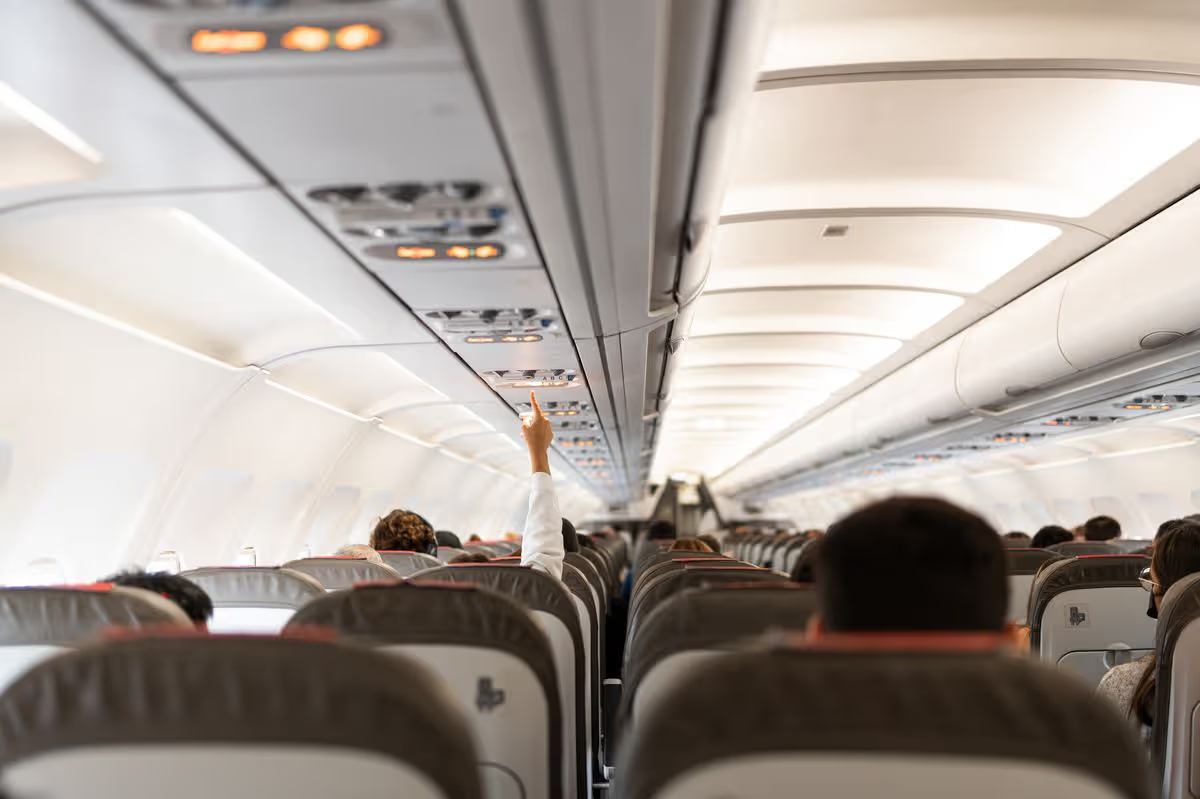
All travellers have been urged to take note of a crucial airport rule, as ignoring it could lead to significant hold-ups at security. It’s well worth bearing in mind as the travel season is already well under way, with scores of Brits eager to head off on their holidays for some hard-earned sunshine and relaxation.

The rule was recently highlighted on TikTok by a travel agent named Jake, who regularly shares straight-talking tips online, and it’s something you may never have previously considered. It’s well worth familiarising yourself with this particular rule, as it could have a real impact on how long you end up waiting in the security queue.

It’s not the first travel tip of this nature to do the rounds recently, either. Previously, holidaymakers were warned to brace themselves for “hell” owing to mounting queues at a popular airport.

Jake said: “This is the number one reason for delays at airport security in the UK right now, and almost everyone has one in their bag. But, there’s one thing that’s catching everybody out.

“It’s these. Reusable, stainless steel water bottles because, while the 100ml rule has been scrapped, and for some airports you can take up to two litres of liquids with you, these still need to be emptied.

“That’s purely because the machines can’t check the liquid that’s in these bottles. So, if you do have one in your bag and it’s got liquid in, then you’re going to have your bag pulled aside.

“You’re going to have that embarrassing moment on the belt where you see your bag go down a different aisle. So, as you’re heading to security, make sure you empty these.

“The good news is though, if you do forget and you have your water bottle in there with liquid in, they’re not going to make you throw your expensive water bottle away. They’re just going to pour out the liquid that’s in there.

“So this is just going to cause further delays for you getting through duty-free and being able to relax before you get on your flight.”

Content cannot be displayed without consent

It might seem like a straightforward tip, but it’s certainly one worth bearing in mind. Sticking to the rule could help you sidestep a major headache that’s easily avoidable.

What you need to know

What you might not realise is that you must fully empty your reusable water bottle before passing through airport security. While the 100ml liquid limit may not apply to the container itself, any liquid left inside is banned and could lead to your bottle being seized.

Even if your local airport permits larger liquid containers or doesn’t require you to remove electronics from your bag, metal or insulated bottles (such as Hydro Flasks or Yetis) typically need to be drained. The sophisticated scanners are unable to “see” through double-wall insulation, so it pays to stay one step ahead.

As Jake highlighted, certain airports now permit passengers to carry containers holding up to two litres of liquid in their hand luggage. However, this is entirely dependent on the specific airport you’re departing from, as it requires state-of-the-art 3D scanning technology.

For this reason, it’s always wise to check the regulations for your particular airport ahead of your journey. At major hubs including London Heathrow, London Gatwick, Birmingham and Edinburgh, you’re allowed to take containers holding up to two litres each.

That said, this rule only applies at select airports. If you’re in any doubt, always confirm with your airport before you travel.

Source link