Rapper Lucki was allegedly involved in a fight at ComplexCon in downtown Los Angeles on Saturday, leaving him with a gash on his neck, according to videos on social media.
Police confirmed to The Times on Sunday evening that four people were wounded in what appeared to be a knife attack but did not name the victims. Officers responded to reports of a fight involving multiple people near Chick Hearn Court and Georgia Street around 4:45 p.m. Saturday, police said. When officers arrived, people were still fighting, according to police.
Footage shared on X appears to show a brawl involving Lucki, 30, outside the L.A. Convention Center.
In one part of the video, as onlookers shout for a paramedic, one unidentified bloodied man shuffles to a car while holding a towel to his neck.
Although police did not confirm whether the rapper or his associates were involved in the fight, police told TMZ that Lucki was surrounded by fans for photos when a suspect “hit him on the side of his face, causing a laceration.”
Additional footage posted to TikTok appears to show a visibly shaken Lucki climbing into the back seat of a black car with a wound near his jaw.
Two people were transported to a local hospital after sustaining injuries “that appeared to be the result of a knife attack,” police told The Times. A third person self-transported to a local hospital for treatment of a severe laceration.
A fourth person approached an officer at the scene and showed a laceration to his elbow, police confirmed. The victim declined medical treatment and left the scene on his own. Authorities did not know if the victim sought medical help afterward.
Before the violence, ComplexCon shared a story to Instagram on Saturday in which the rapper said he was “happy to be here.” In a statement to People Magazine, the venue said officials were aware of the situation, adding that they “take incidents of this nature extremely seriously and remain focused on maintaining a safe and secure environment for everyone.”
Authorities did not provide any further information Sunday.
The Southern Section has no authority to tell a school to get rid of a coach. It has no control over personnel matters. But there’s precedent that when a coach knowingly plays an ineligible player, it expects a school district to take appropriate action.
In the case with Inglewood football coach Mil’von James, he has a history of using ineligible players. James came to Inglewood, which is 4-1 this season, after being fired at Hawkins in 2016 following the discovery of ineligible players, resulting in Hawkins forfeiting all of its games to finish 0-13. Since then, the City Section established a rule that teams must exchange rosters before games to verify that players are eligible, known as the “Hawkins rule.”
Inglewood Unified School District administrator James Morris told the Daily Breeze that James is scheduled to return to coach on Friday after missing last week’s game against Long Beach Poly at SoFi. That means he received a two-game suspension for using two ineligible players in a game last month, since it is believed he also didn’t coach a game against Elk Grove Franklin.
James appears to have knowingly played two players listed on the Southern Section transfer portal that had not been cleared when Inglewood played in Austin, Texas, on Aug. 28. Video obtained by The Times shows the players in the game.
Add to that, both players’ names and numbers were missing from Inglewood’s MaxPreps’ roster, something that was also a tactic when James coached at Hawkins and resulted in the new City Section rule to exchange roster before games.
Shame on the Inglewood Unified School District for failing to hold its coach accountable for a serious violation of CIF rules.
If the two-game suspension stands, shame on the Southern Section, too. The message being sent to other coaches and other schools is that it’s OK to cheat as long as you don’t get caught, and if you get caught and only get suspended for two games, it’s worth it.
The Southern Section, under commissioner Mike West, went out of its way to try to catch those breaking transfer rules last year. It was a sign maybe things were changing and people were paying attention to the games being played with more than 17,000 transfers in California. But if the Southern Section settles for a two-game suspension for James, it will lose credibility among coaches and programs trying to follow CIF rules.
Southern Section spokesman Thom Simmons has declined comment and declined to make West available.
As always, they’re afraid of legal action. And it must be pointed out again the Southern Section has no authority to discipline coaches. But at some point, to save credibility, they will need to address this breaking of rules that goes to the core of what the CIF is supposed to guard against.
The Southern Section Council has a meeting on Thursday. If any of the representatives have concerns, maybe then they’ll get to ask West how this could be acceptable.
In 2014 Long Beach Unified suspended Long Beach Poly basketball coach Sharrief Metoyer for one year for after he was caught using an ineligible player during a state basketball playoff game. He did it on purpose being frustrated at the CIF transfer policies. The CIF could not tell administrators what to do. But if they did nothing or put in only a two-game suspension, there’s no doubt that the Southern Section leadership had the authority to take action.
According to Southern Section’s Blue Book rule 500.5, “Any school knowingly or unknowingly violating the rule may be suspended from membership in the CIF Southern Section.”
Hopefully the Southern Section is keeping its options open, but it’s time for West, the commissioner since 2023, to get his credibility back. If not, it’s up to the Southern Section Executive Committee to launch its own investigation of what the section is supposed to do when schools and districts don’t take their rules seriously.
An unprecedented surge in border crossings over the last decade reshaped America: Millions of people from more than 150 countries arrived, bringing the U.S. immigrant population to its highest levels.
Now, data obtained exclusively by the Associated Press paint a picture of who these migrants are, where they went and what happened after the border.
Some went to cities that have long been magnets for immigrants — New York, Miami — but increasingly, others found their way to smaller cities with less developed immigrant footholds. Blocks, neighborhoods and entire cities were remade in places like Elkhart, Ind., Knoxville, Tenn.,and Dodge City, Kan.
And while the vast majority of migrants traditionally were from Mexico, this surge included people from an astonishing number and diversity of countries: India, Ecuador, Ghana.
Via a Freedom of Information Act request, AP obtained federal records on the self-reported destinations of 4.5 million migrants released in the United States after crossing the Mexican border — both legally and illegally — between October 2018 and July 2025.
Migrants must provide U.S. Customs and Border Protection with a street address. AP obtained their destination ZIP codes, citizenship by country, ages, genders and the dates and border regions where they encountered authorities.
Some probably never arrived at the addresses they gave. Authorities lacked resources to check, though migrants must report truthfully to pursue their cases in court and get work permits. Some have moved elsewhere in the United States or left the country, voluntarily or involuntarily. But many have stayed put.
Data on their initial destinations after the southern border provides both a sweeping and an unusually granular look at how the immigration surge — one that peaked during President Biden’s administration and was a major reason voters returned his predecessor, Donald Trump, to the White House — is playing out today.
Here are some key takeaways from the data.
Cities drew migrants from several continents
The Border Patrol encountered migrants from 174 countries in one year alone, a sharp departure from earlier periods when they were nearly all Mexican and Central American. The growth of social media and new migration routes were key in bringing people from around the world. Cincinnati, for example, experienced a large number of arrivals from West Africa, Uzbekistan and India.
Some cities — ones that for generations have had robust international communities — were further diversified by the range of countries from which people arrived.
New York City’s Queens borough registered at least 25 nationalities with significant arrivals, including five countries that each sent more than 7,000 people: Ecuador, China, Colombia, Venezuela and India.
Philadelphia had 11 nationalities with at least 1,000 new arrivals, led by Brazil, Haiti and the Dominican Republic but also including Russia and Venezuela. The city’s metro area also received more than 1,000 migrants from Georgia.
Florida remained No. 1, but many people looked elsewhere
While Florida was the most popular state, Latin American immigrants increasingly looked elsewhere for more promising job prospects and a better quality of life. Many turned to places with small but established communities of immigrants from their homelands.
For Cubans, nine of the top 10 destination ZIP codes were in Florida, but people of the Caribbean nation also flocked to Louisville, Ky., Grand Island, Neb., and Odessa, Texas. Colombians went to the Denver suburb of Aurora. Paterson, N.J., was the top pick among Peruvians. Some Venezuelans headed to the growing suburbs south of Salt Lake City; others to pockets of Atlanta, Chicago and Denver.
More women and children came than men
Nearly 6 of every 10 migrants released at the border were women and children, a dramatic shift from a few years earlier when migrants were predominantly men.
The change is visible in many places and across nationalities, but some stand out. Tulsa, Okla., attracted Mexican women and children. Ecuadorian women and children went to Spring Valley, N.Y. Guatemalan women were drawn to Chattanooga, Tenn.
Those who came from China headed to L.A. and New York
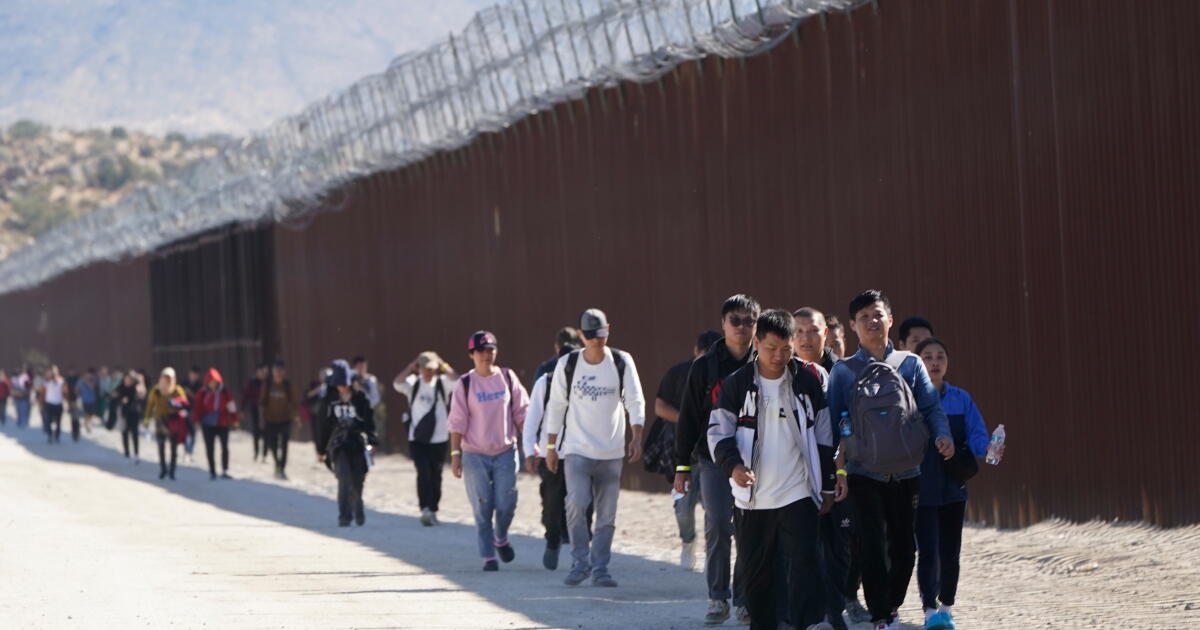
Chinese migrants, who trekked by hundreds nightly in California’s mountainous border with Mexico, largely gravitated to two places: New York City, especially the Queens and Brooklyn boroughs, and a cluster of neighborhoods in the Los Angeles area.
Trump’s deportation machine hit some migrant magnets and overlooked others
Immigration arrests have hit some areas that ranked among the most popular destinations for migrants in recent years, including Miami and New York. Others that experienced a large migrant influx have gotten less attention from authorities, including Silicon Valley, Madison, Wis, and Stamford, Conn.
Jarrett, Kessler, Lodhi and Spagat write for the Associated Press.
MEXICO CITY — When the Trump administration announced this summer that illegal crossings into the U.S. from Mexico had reached historical lows, Homeland Security Secretary Markwayne Mullin declared, “Our border is CLOSED to lawbreakers.”
Even so, the administration continues to pressure both Mexico and U.S. officials serving there — publicly and behind the scenes — to curb illegal immigration further. The crackdown has prompted smugglers to become more creative, turning more often to tunnels once reserved for transporting drugs.
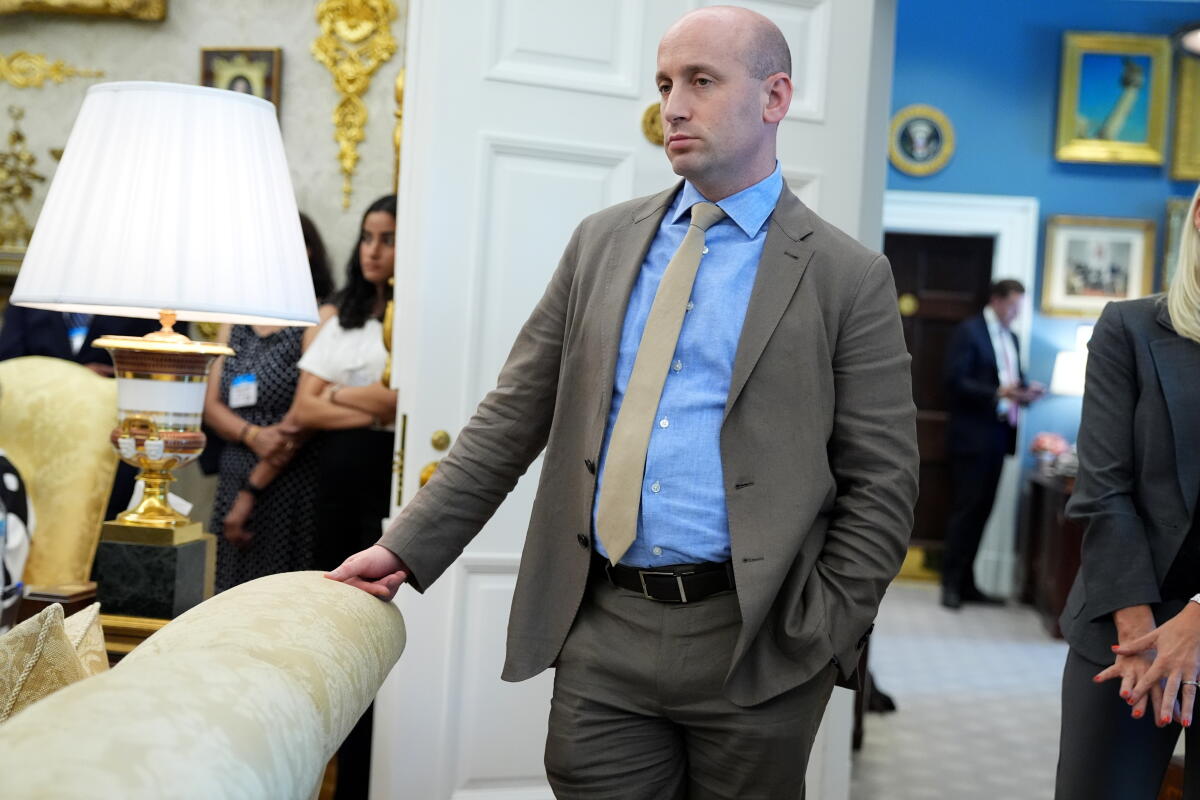
White House Deputy Chief of Staff Stephen Miller, in the White House on Sept. 4, has been the main architect of the Trump administration’s immigration policies.
(Jacquelyn Martin / Associated Press)
Stephen Miller, the main architect of President Trump’s immigration policies, has been in near-daily communication with senior U.S. law enforcement officials, including the U.S. ambassador to Mexico, Ronald Johnson, looking for new ways to stop migrants from entering the United States, according to people familiar with the conversations.
An average of 400 migrants were apprehended while crossing into the U.S. every day in July, according to data by U.S. Customs and Border Patrol. It’s a precipitous drop from the thousands who crossed daily at the peak of a migrant surge in 2022.
Sometimes the number of crossings has dropped to 200 a day. But for Miller, that reduction is still not enough, said sources not authorized to speak publicly about internal matters. Miller’s goal, they said, is to have zero migrants entering the U.S.
Miller has directed officials to increase investigations into migrant smuggling networks, people familiar with his directives said.
Mexican Foreign Minister Roberto Velasco Álvarez, left, and U.S. Secretary of State Marco Rubio in Washington, where they met Aug. 26 to discuss what the minister called “priority issues on the bilateral agenda.”
(Chip Somodevilla / Getty Images)
Since returning to the White House in 2025, Trump has often asked Mexican President Claudia Sheinbaum to crack down on immigration. On Aug. 26, Secretary of State Marco Rubio met with Mexico’s foreign minister, Roberto Velasco Álvarez, and urged him to take “decisive action on illegal immigration,” according to a statement from the State Department.
The Trump administration’s border crackdown has been so effective it’s forced some smugglers literally underground.
Mexican drug cartels are increasingly turning to tunnels built for drug smuggling to ferry migrants into the United States. They are linking into sewer drains, according to people familiar with the trend.
Though the number of migrants apprehended while using tunnels appears to be relatively small — there are no hard statistics — authorities believe it is increasing, given the crackdown on the border and financial incentive for the cartels to smuggle people and not just drugs.
“Enforcement along the border has become more robust and that has increased the demand for alternative methods of passage,” said David Shirk, director of the Justice in Mexico program at the University of San Diego.
The Trump administration has added extra miles of razor wire to border fences, has increased surveillance technology and uses autonomous Predator drones with surveillance and infrared technology to monitor swaths of the border for migrants crossing into the U.S.
1
2
1.A bulldozer sits near Santa Elena Canyon on Aug. 14 in Big Bend National Park, Texas, where contractors have begun construction of a border wall. (Brandon Bell/Getty Images)2.Protesters gather in San Antonio, Texas, on Aug. 28 to demonstrate against construction of a border wall in Big Bend National Park. (Alma E. Hernandez/San Antonio Express-News via Getty Images)
And, picking up on Trump’s “build the wall” pledge from his initial run for president, more border barriers are being built.
Trafficking through cross-border tunnels is not new. In 2023, Ken Salazar, then the U.S. ambassador to Mexico, said there were at least 200 tunnels that spanned the border. Many of them were found linking Tijuana and San Diego.
But in a twist, some tunnels now connect to drainage and sewer systems. This May, authorities captured 19 migrants, including three unaccompanied minors, in the San Diego storm water drainage system. A remote surveillance camera spotted the migrants emerging from the system.
The smugglers were two brothers who had previously been charged with methamphetamine trafficking in the Northern California town of Yreka in 2017.
Smugglers employ tunneling specialists whose work is getting more sophisticated, outfitting the tunnels with lights, ventilation systems and sometimes mini rail lines. Many tunnels are faster, safer and much more expensive for migrants who would otherwise face increasingly dangerous mountain and desert routes, experts said.
Last year, Customs and Border Protection and Homeland Security Investigations agents also found a tunnel that ran under the Rio Grande from Ciudad Juárez, Mexico into El Paso.
The passage tapped into the El Paso sewer system, where, according to U.S. authorities, migrants surfaced from a manhole. They climbed into a box truck outfitted with a trap door that was parked over the manhole.
Cartels charge migrants from Latin America up to $15,000 dollars each to use tunnels to El Paso, an official familiar with the dynamics said. For people from the Middle East or Southeast Asia, the price can be as high as $25,000.
The tunnel traffic continues to vex U.S. officials.
A Homeland Security Task Force drug investigation of a supposed retail store in Otay Mesa, Calif., resulted in the discovery of a sophisticated cross-border tunnel leading to Tijuana.
(U.S. attorney’s office)
In Tijuana, one tunnel discovered last year stretched from Tijuana to what appeared to be a Buy 4 Less store near the Otay Mesa port of entry. The store never had customer traffic, so U.S. law enforcement suspected it hid a tunnel and began monitoring the business.
Authorities raided the building and found the entrance to a tunnel controlled by the ruthless Jalisco New Generation Cartel. It was 55 feet deep and nearly half a mile long. It featured a hydraulic lift, ventilation and a rail and cart system. Authorities stopped a freezer truck after it left the location and seized more than a ton of cocaine, worth roughly $45 million.
In 2024, U.S. law enforcement found a tunnel in the border town of San Luis, Ariz. Authorities said it was used to smuggle migrants and drugs. Its exit was hidden in an abandoned KFC restaurant.
This article was co-published with Puente News Collaborative. Fisher is a special correspondent.
RAFHA: Saudi Arabia’s Imam Turki bin Abdullah (ITBA) Royal Nature Reserve Development Authority has warned that overgrazing is degrading rangelands within its boundaries and called for stricter adherence to sustainable grazing practices.
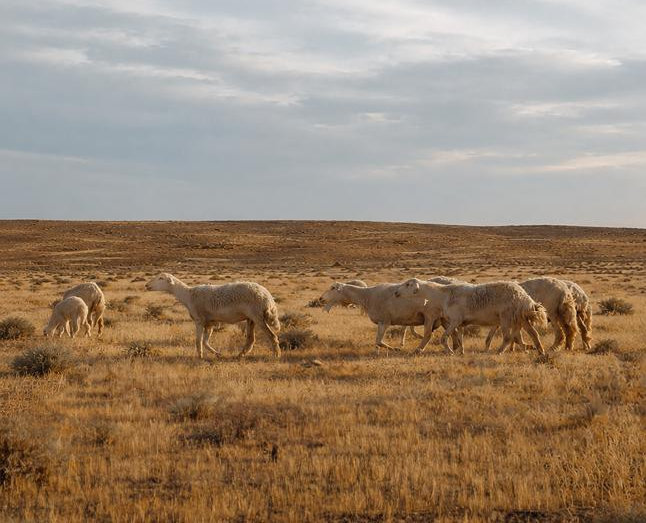
In a report carried by the Saudi Press Agency (SPA), the nature reserve said uncontrolled grazing strips vegetation before plants can mature and produce seed, triggering soil erosion, reduced water retention and rangeland degradation, it said.
Left unchecked, these effects speed up desertification and sand encroachment, reduce food and shelter available to wildlife, and threaten historic sites located within the reserve, the authority said.
Describing rangeland conservation as a shared responsibility, it urged herders and other stakeholders to give vegetation sufficient time to recover to preserve the ecosystem’s long-term balance.
The appeal builds on a broader regulatory push by the authority.
Uncontrolled grazing strips vegetation before plants can mature and produce seed, triggering soil erosion, reduced water retention and rangeland degradation. (ITBA photo)
In March, it introduced an updated, fifth edition of its grazing regulations, first rolled out in January 2022, as part of a wider strategy to protect vegetation cover and biodiversity across the reserve.
Under the rules, grazing is permitted only with official authorization.
It is restricted to designated zones, time periods and livestock quotas calibrated to each pasture’s carrying capacity, the authority has said.
The regulations also expand grazing areas around villages and settlements inside the reserve and establish buffer grazing belts on its periphery, in response to requests from local communities.
They bar tree-cutting, logging and off-road vehicle use.
The authority has said it enforces the rules through patrols and monitoring systems, with legal action taken against violators.
The reserve authority has pointed to improving environmental indicators as evidence its conservation programme is taking effect.
It reported a 76.2% drop in the frequency of dust storms within the reserve during 2026 compared with previous levels.
The Imam Turki bin Abdullah Royal Nature Reserve Development Authority has reported a sharp drop in the frequency of dust storms within the reserve in 2026,]. It attributed the decline to expanded vegetation cover, reduced soil erosion and broader land-restoration efforts. (ITBA photo)
The authority attributed the decline to expanded vegetation cover, reduced soil erosion and broader land-restoration efforts.
Established by royal decree in 2018, the Imam Turki bin Abdullah Royal Reserve spans some 91,500 square kilometers in northeastern Saudi Arabia.
It stretches across parts of the Jawf, Qassim, Hail, Northern Borders and Eastern regions. Prince Turki bin Mohammed bin Fahd bin Abdulaziz chairs the authority’s board of directors.




![The Imam Turki bin Abdullah Royal Nature Reserve Development Authority has reported a sharp drop in the frequency of dust storms within the reserve in 2026,]. It attributed the decline to expanded vegetation cover, reduced soil erosion and broader land-restoration efforts. (ITBA photo)](https://i0.wp.com/occasionaldigest.com/wp-content/uploads/2026/09/1788668012995-72f5491ea405559a.jpg?w=640&ssl=1)