House Speaker Mike Johnson draws on faith as he fights to hold the Republican majority
BANGOR, Maine — Ever the optimist, Speaker Mike Johnson said he believes Republicans will hold on to their U.S. House majority, defying a surge of Democratic momentum in the final stretch of the midterm elections that will determine control of Congress.
It’s the crowds he says he’s seeing as he crosses the country campaigning for GOP candidates. The caliber of recruits and incumbents he calls workhorses, not show horses. And the nearly half a billion he has raised for House Republicans.
He also has faith.
“We run to win, and that’s biblical: You run to win,” he told the Associated Press during a campaign stop in Maine.
“And I believe that we will.”

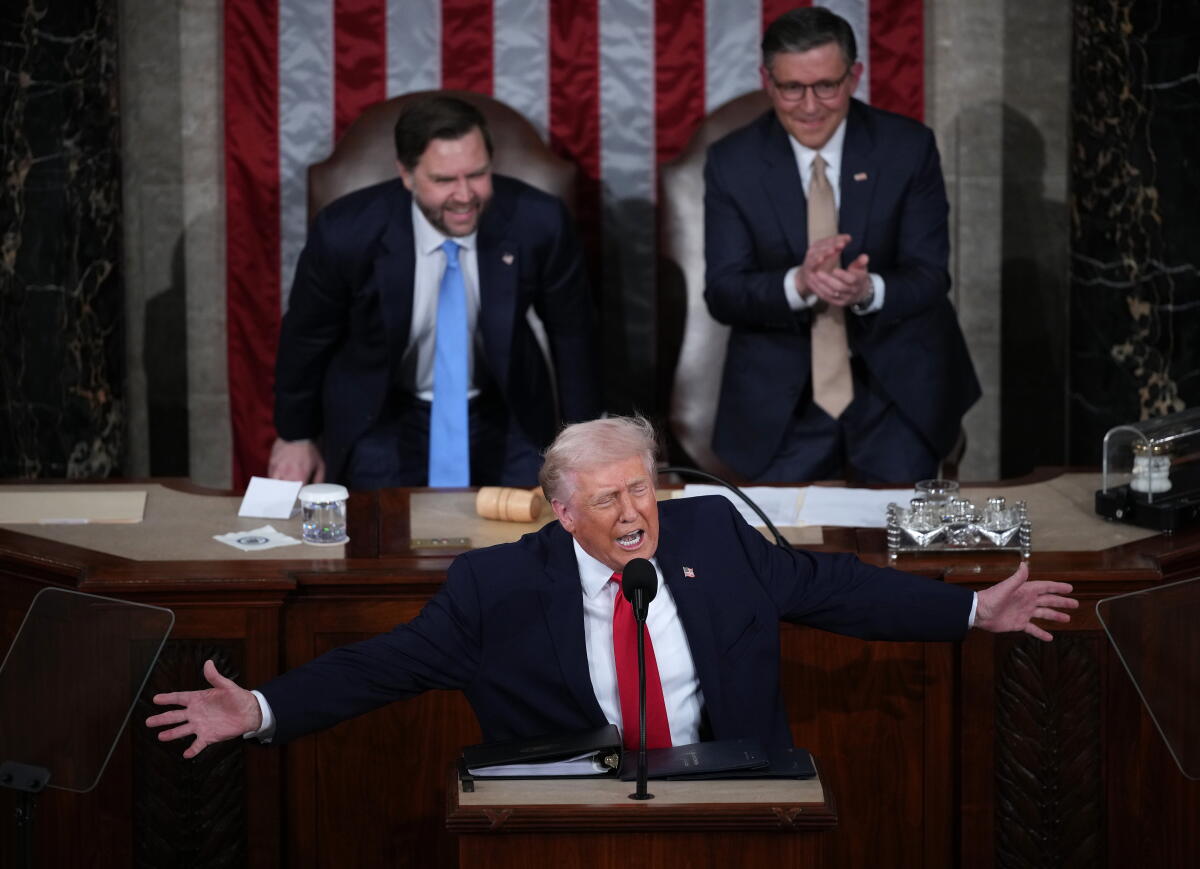
House Speaker Mike Johnson, right, applauds along with President JD Vance as President Trump delivers his State of the Union address during a joint session of Congress in February in Washington.
(Andrew Harnik / Getty Images)
The speaker of the House is one of the most consequential elected officials in the United States, second in line of succession to the president. While Johnson quipped to Fox News recently that he may return to his hometown of Shreveport, La., to start a lawn care business if Republicans lose power on Nov. 3, he fully expects to buck an American midterm tradition that often sees the president’s party dumped in Congress.
It can be said that Johnson, who has drawn so close to President Trump that he routinely fields 1 a.m. calls — they spoke the night before as Trump rallied in Alaska — walks on the sunny side of the street. That’s despite voter frustration over high prices and the Iran war, and his own challenge of leading one of narrowest House majorities in modern times.
In his three years as speaker, Johnson has pushed past the doubters and naysayers, holding his thread-thin GOP majority together to deliver Trump’s agenda. He notably led passage of the big tax breaks and social service cuts bill. Most days he does not have a single vote to spare.
“So many times everybody had written off, there was no way he was going to be able to pull off a particular vote,” said Republican Rep. Mark Harris of North Carolina, who joined the speaker on the campaign swing. “Yet he always seems to pull out the win in the end.”
In the interview, Johnson did not speak brashly about expanding the House majority on election day, as he has in the past. But on track to visit more than 20 states and 40 congressional districts though November, he said the political mood reminds him of the 2024 election that swept Republicans to control of Congress and the White House.
“It’s not going to be a giant majority,” he said. “But I genuinely believe that we will have a working majority.”
Emboldened by Trump
Johnson first fell into the speaker’s job almost by accident, a desperate choice by his GOP colleagues after a contingent of renegade Republicans ousted his predecessor, then-Rep. Kevin McCarthy of California in 2023.
Johnson had been a lower-level member of House leadership, but distinguished himself before the Jan. 6, 2021, attack on the Capitol by organizing support for Trump’s false claims of widespread fraud in the election that he lost to Democrat Joe Biden.
In the time since, Johnson has secured proximity to Trump’s power. He joined Trump at a UFC fight in New York and once gifted the president a speaker’s gavel as Trump signed the “One Big Beautiful Bill” into law. It was a symbolic act, but one that critics saw as giving away the authority of a coequal branch of government.
More recently, Johnson abruptly sent lawmakers home early rather than face a vote forced by Republican Rep. Thomas Massie of Kentucky to impeach Defense Secretary Pete Hegseth as lawmakers tried to halt the Iran war, which has not been authorized by Congress.
Over coffee in Bangor, after rallying for House candidate Paul LePage, a former governor, Johnson brushed back criticism that Congress has eroded under his watch as Trump works to amass executive power.
“Absolute nonsense,” Johnson said.
“We did not yield Article 1 authority to the president,” he said, referring to the powers spelled out in the Constitution. “We used our own,” he said, to muscle GOP priorities past Democratic opposition.
Trump agenda at risk
Johnson has focused the election on Democrats he portrays as “communists.” A handful of far-left liberals, backed by the Democratic Socialists of America, are on the ballot.
Rep. Hakeem Jeffries of New York, the House Democratic leader who is in line for the speaker’s gavel if his party sweeps to power, is preparing a first-100 days agenda for when the new Congress convenes in January, if there is a change in control.
What the Republicans will do if they retain power is less defined.
“Lots of plans,” Johnson said, “along the same course of what we’ve been doing — less taxes, less regulation.”
Trump “wants to go big for his legacy,” he said. “We have big things on the horizon that we can do.”
The president has essentially purged the House GOP ranks of those perceived to be disloyal. Among them are Massie, who lost his primary, and Marjorie Taylor Greene of Georgia, who retired early after breaking with Trump over release of the Jeffrey Epstein files.
Pressed how he would keep Republicans in line, Johnson said he is preparing to change the House rules if he returns as speaker.
“There’s going to be some changes that are going to make the machinery work smoother,” he said.
Praying for the speaker, and the country
Faith has often been strong among House leaders. Two former speakers, Nancy Pelosi and Newt Gingrich are Catholics, as is John Boehner, who invited Pope Francis to address Congress.
Johnson, a former constitutional lawyer who was first elected alongside Trump in 2016, is expected to win his own reelection next month.
“My faith is a huge component of how I think and how I act and what I do,” said Johnson, who led a public prayer on the National Mall as part of the nation’s 250th anniversary.
He is drinking lots of coffee these days, he said, cutting back on the Celsius, and still has 1,413 unread text messages, a slight dip from the frightful number reported a few months ago by the Wall Street Journal.
One text is from someone praying for him.
Johnson said he is grateful for the outpouring of prayers he receives, for him and the country.
“I pray for God’s will. And I believe God’s will is for us — and not the communists — to be in charge of America,” Johnson said.
“And it does say in the New Testament, you run the race to win,” he said, citing 1 Corinthians 9:24. “This is a biblical admonition. So we will.”
Mascaro writes for the Associated Press.