audio

Ethics complaint filed over ads falsely portraying Raman promoting homeless camps

Los Angeles mayoral candidate Nithya Raman’s campaign team has filed a complaint with the city Ethics Commission against an outside group backing Mayor Karen Bass, claiming its social media campaign promotes an interactive AI phone line with a voice falsely identified as that of Nithya Raman.

The ads, paid for by Thrive LA, are styled as real estate advertisements for a fictitious “Nithya Raman Realty.” Some show an image of Raman holding a tent, with the slogan “Keeping Tents on Our Streets.”

The ads are intended to promote the idea that Raman isn’t tough on homeless encampments, which Raman says misrepresents her position. People who call the number get a Raman sound-alike saying “We’re bringing tent communities to your block. Would you prefer them outside your children’s school, the library, or right outside your home?”

Raman’s campaign claims that Thrive LA broke campaign rules by failing to report the AI phone system on required campaign spending forms, and imitating Raman’s voice without stating who paid for it. Not disclosing that it’s an ad could lead voters to believe the AI voice is actually Raman, according to the complaint.

Ana Teresa Dahan, the executive director of Thrive LA, called the complaint “false and absurd” and added that the organization’s ad spending has been properly disclosed. She said the satire ads are protected political speech and abide by campaign finance rules. The advocacy group will continue running ads until Election Day, she said.

“Nithya Raman wants to run the second-largest city in America, and she can’t handle a parody phone number. Imagine how she’d handle a budget crisis, or a wildfire,” Dahan said. “The only real complaint here is the one Angelenos have about her record.”

Thrive LA defines itself as a centrist political advocacy group backed by business and community leaders. The group also received backlash over anti-Raman ads its ran during her 2024 reelection campaign for councilmember.

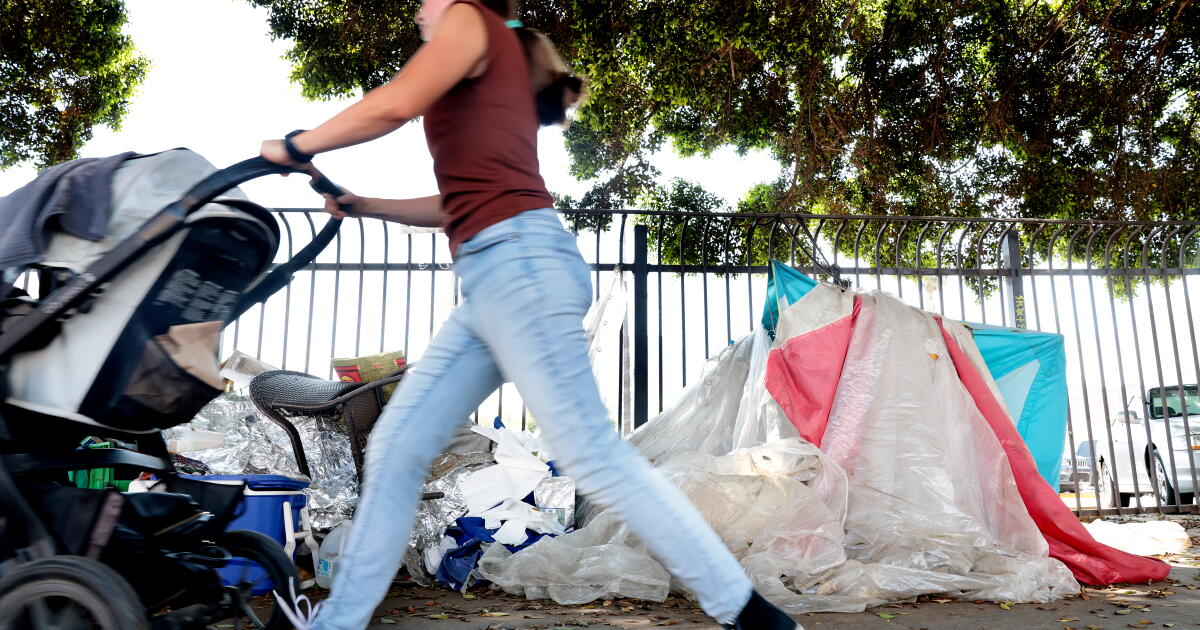
How to address the city’s homelessness crisis has been a central issue in the Nov. 3 election between incumbent Bass and challenger Raman, a City Councilmember. Raman has voted against imposing no-camping zones proposed by other City Councilmembers in their districts, but has said she would not oppose such zones if elected mayor.

Raman says she is committed to ending homelessness, but the city has gone about it the wrong way and that no-camping zones just push the problem from one neighborhood to another.

Bass made homelessness a central focus of her first term as mayor and launched Inside Safe to move people into hotels, motels and other interim housing. Unsheltered homelessness decreased for the first two years, but the latest homeless count showed the numbers are growing once again.

The anti-Raman ads, posted on Instagram, show videos of a recreational vehicle driving around L.A. On the vehicle are posters featuring Raman. One shows her pointing toward a large arrow labeled “Designated Poop Zone” next to the words “Coming to a Neighborhood Near You!” One poster includes a phone number that leads to the AI phone line.

The AI-generated voice carries a live conversation with the caller, and doesn’t clarify it’s not a real person unless prompted. When asked by The Times if the phone is being answered by Raman, the AI bot said, “I’m a fictional AI. I’m as imaginary as my campaign promises.”

The advertisement violates state law that prohibits the distribution of digitally fabricated audio of a candidate within 30 days of an election, according to the complaint.

“It’s both sad and illegal for Karen Bass’ conservative allies to be cloning Nithya’s voice, manufacturing her words, and hiding who is paying for it, all to deceive voters,” Liz Garcia, spokesperson for Raman’s campaign, said in a press release. “These are desperate tactics from corporate interests determined to keep their grip on City Hall.

The city’s Ethics Commission didn’t immediately respond to The Times’ request for comment.

Independent expenditure committee that support political candidates have increasingly come under question. These groups can raised unlimited amounts of campaign donations but cannot coordinate its activities with the candidate.

Any audio communication for an independent expenditure group must clearly state that it’s a political ad at the beginning or end of the audio, according to the city’s campaign rules. When inquired by The Times on Monday morning, the AI bot did state the ad was paid for by Thrive LA, uses artificial intelligence and isn’t coordinated with a city candidate or committee.

In audio recordings included in the complaint, the AI bot said that it couldn’t disclose who paid for the line when asked by callers.

Some small business owners in Raman’s district have said they’ve battled homeless encampments and public safety issues without support from Raman’s office.

Even so, homelessness in Raman’s district dropped by 49% this year, and the candidate says that if elected she aims to deliver those same results citywide.

Source link

A reporter on why the L.A. City Hall audio leak scandal should still matter

Do you remember what you were doing when the infamous L.A. City Hall racist audio leak scandal broke four years ago?

I always will: I was naked.

You’re reading the Essential California newsletter

L.A. Times reporters guide you through the most important news, features and recommendations of the morning.

Sunday morning, Oct. 9, 2022, around 8 a.m., I was about to take a shower when I decided to check my cellphone one more time. Thank God I did: If I hadn’t, I would’ve been half an hour late on assisting in one of the most explosive stories ever to hit L.A. politics.

Via Slack, Times assistant managing editor Steve Clow asked if I could serve as a second set of ears on audio that my colleagues had unearthed involving four of the most powerful L.A. políticos at the time: City Council President Nury Martinez, Councilmembers Gil Cedillo and Kevin de León, and L.A. County Federation of Labor President Ron Herrera. I was still in my birthday suit (sorry for the visual, gentle readers, but I’m sworn to report the facts on this job) when I played the snippet Clow shared: Martinez describing the Black son of then-Councilmember Mike Bonin as “su negrito” — his darky.

I put on my shorts and told my wife I wouldn’t be helping at her restaurant that day.

Clow sent me more clips over the next hour, each crasser than the other — I remember gasping audibly at the part when the four were laughing as Martinez referred to Oaxacans as “ugly.” That morning, my colleagues Benjamin Oreskes, Dakota Smith, Julia Wick and David Zahniser published their first story on the fiasco, which turned out to be a secretly recorded conversation from a year earlier that someone had posted on Reddit just the day before.

The scandal quickly became a national sensation, with even then-President Joe Biden weighing in. L.A. wretched in collective disgust and demanded action, which definitely came: Martinez and Herrera quickly resigned, while Cedillo — who had already lost his reelection bid — would stay on until his bitter end, and De León wouldn’t leave until challenger Ysabel Jurado destroyed him in his 2024 reelection bid. The electoral repercussions of the audio leak can still be felt four years later in this election, as Nithya Raman stages a strong challenge against incumbent Karen Bass — a sentence no one would’ve believed in the fall of 2022, when Bass was on the cusp of winning her first term, and Raman was the lone democratic socialist on the council.

I would’ve figured the anniversary of something as titanic as all of the above would’ve sparked more commemorations than just my columna this week. Nope! L.A. has moved on to the point that Cedillo wasn’t booted from a group photo that included current District 9 council candidate Jose Ugarte, former Assemblymember Wendy Carrillo, former Mayor Antonio Villaraigosa and current Assemblymember Mark Gonzalez — because even Chicanosauruses can survive a political asteroid, I guess?

Having political leaders spew racist, homophobic nonsense now seems like the good ol’ days in an era where infernos destroy or stink up swaths of L.A., immigration agents terrorize immigrants from Westwood to the Eastside, and a spokesperson for a sitting American president denies that the commander in chief suggested Iran bomb the City of Angels, even though he said it during a campaign rally.

I shouldn’t really be surprised, I guess: L.A. infamously loves to forget its own history. But I would urge all you readers to read the great, Pulitzer Prize-winning coverage my colleagues did in the aftermath of the audio leak scandal, because it captured the city at its worst — but also its finest as residents fought back and demanded politicians do better.

Four years later, we can only hope this upcoming election shows more of the same.

The week’s biggest stories

A man looks back as a large wave crashes on the shoreline in Laguna Beach

Domenic Hix looks back as a large wave crashes on the shoreline in Laguna Beach on Friday.

(Allen J. Schaben / Los Angeles Times)

Tropical Storm Rachel in SoCal

California real estate

California crime

In memoriam

More news

Editor’s pick

More picks

Things to do

Photo of a person on a background of colorful illustrations like a book, dog, pizza, TV, shopping bag, and more

(Illustrations by Lindsey Made This; photograph by Charles Phoenix)

Today’s recipe

Apple Butter on a plate and inside a jar

(Rebecca Peloquin / For The Times)

This recipe makes apple butter that is less sweet than most; use more sugar if you like, but don’t use less or there won’t be enough to properly preserve the pureed apples.

Photo of the day

Meals Clothing co-founder Sam Salad stands amid his food-inspired, L.A.-made workwear in his Highland Park store

(Stephanie Breijo / Los Angeles Times)

Games

Mini Crossword Logo

Here’s today’s mini crossword, plus our other free, daily crossword puzzle, sudoku, word search and jigsaw games.

Have a great day, from the Essential California team

Jack Dolan, investigative reporter
Hugo Martín, assistant editor, fast break desk
Kevinisha Walker, multiplatform editor
Andrew Campa, weekend writer
Karim Doumar, head of newsletters

How can we make this newsletter more useful? Send comments to essentialcalifornia@latimes.com. Check our top stories, topics and the latest articles on latimes.com.

Source link

We live in a world the L.A. City Hall audio leak scandal wrought. Thank God

If I ever need to humble myself — if my head inflates with grand visions of becoming the next Steve Lopez or Bill Plaschke — I pull up the transcript of the secret recording that upended Los Angeles politics after The Times broke the story exactly four years ago.

It’s like a modern-day version of “Ozymandias,” except far more vulgar, nowhere near as poetic and a better warning against hubris than anything Shelley could have penned.

“The thing for us is to exercise our power,” said then-City Councilmember Gil Cedillo, about halfway through an hourlong conversation he was having with three of the city’s most powerful political figures.

Oh, did they ever — and nowhere near the way they intended.

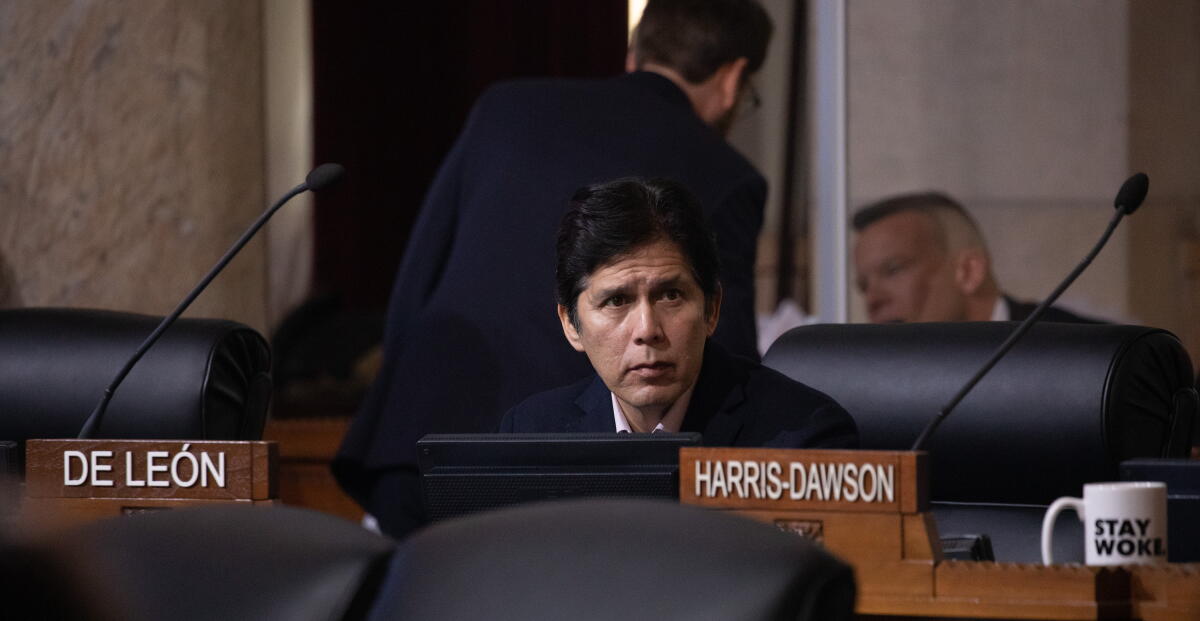
Nury Martinez and Ron Herrera, the president of the City Council and head of the Los Angeles County Federation of Labor, respectively, quickly resigned for their roles in the racist, homophobic drivel on the recording. Cedillo — who was finishing out his term — and Councilmember Kevin de León refused to step down, besmirching their well-earned reputations as progressive lions.

The L.A. they sought to create — where Latinos ascend at the expense of the Black community, and anyone who gets in the way is crushed — never came to be. And the recording that exposed their machinations ultimately destroyed the type of ethnic politicking that made the careers of too many self-serving power grabbers, including this quartet.

The transcript of their back-and-forth now reads as prophecy — and we’re far better for it.

Much of the discussion, which happened in October 2021 at the headquarters of the L.A. County Federation of Labor, was devoted to whining that L.A.’s Latino-majority council districts, and some cities elsewhere in the county, were represented by Black leaders instead of Latinos, even as Latino residents far outnumbered Black ones.

“F—, the way I see it, all of the seats are Latino,” said Herrera, who hailed the rise of a “little Latino caucus of our … own” that he felt should reign permanently.

He and the others predicted a future in which vengeful Black politicians would try to sabotage future Latino leaders on their way out of office, creating “poor Latino districts with nothing,” as Martinez put it.

She was referring to redistricting proposals that would chop off assets like the Coliseum and Exposition Park from South L.A.’s District 9 — the most Latino district in the city, represented by a Black council member, Curren Price.

“So they f— a future Latino for CD 9,” De León whined. “That’s how arrogant, just how arrogant it is.”

That’s not what ended up happening.

 Los Angeles City Councilmember Kevin de León returned to council chambers after a two-month absence.

Los Angeles City Councilmember Kevin de León at a council meeting in December 2022 after a two-month absence following his role in that year’s audio leak scandal.

(Myung J. Chun / Los Angeles Times)

District 9 didn’t lose any assets. Black leaders saw the writing on the wall and didn’t run a serious Black candidate to replace the termed-out Price this year. That created space for two Latinos — Estuardo Mazariegos and Jose Ugarte — to make it to the general election. No matter which candidate wins in November, the City Council will have fewer than three Black members for the first time in 63 years.

Both Mazariegos and Ugarte say that the anti-Black scheming of the audio leak villains inspired them to run campaigns focusing on Black and Latino residents as one constituency, reflecting how life is actually lived in South L.A., not how Latinos from elsewhere in the city imagine it to be.

Mazariegos attended the first City Council meeting after The Times dropped the audio leak bombshell in October 2022. He remembers Cedillo peeking at the angry audience and temporarily returning to the council’s back room.

“No community should have to lose power for another to gain it,” said Mazariegos, who would become the first Central American immigrant to serve on the council if he were to win. “Our power grows when we build it together.”

Ugarte, formerly one of Price’s top aides, agreed. He argued that the best way to lead in South L.A. as a Latino council member is “with respect for those who came before us, the humility to listen to those doing the work today, and the understanding that District 9 is strongest when [Black and Latino residents] move forward together.”

Born in Oaxaca, Ugarte would become L.A.’s first Indigenous council member if he wins. That would be a rich coda to the audio leak, considering that Oaxacans received some of the nastiest insults. Martinez described them as “ little short dark people” who were feos — ugly. Cedillo joked that they were “little ones,” while Herrera cracked that they were “indios.”

Who’s laughing now?

The Feos Four also spent time kvetching about Nithya Raman, who was finishing her first year on the council. In 2020, she had upset an incumbent to become the first democratic socialist council member.

At the time of the recording, rivals were trying to diminish Raman’s power by drawing boundaries that would put her district “in the blender and chop [it] up, left and right,” as De León described it.

“She’s not our ally,” Cedillo said. “She’s not going to help us. Her district is not a district we can count on.”

Give credit to Cedillo and his pendejo pals: They were already seeing Raman and other democratic socialists as an emerging force, even while downplaying the DSA’s chances. De León said that Raman’s politics were “about just her as an individual.” Herrera dismissed Hugo Soto-Martínez, then a no-name union organizer aiming to unseat Councilmember Mitch O’Farrell, as a “kid.” Nury Martinez blithely mispronounced Eunisses Hernandez’s name while cackling about the first-time candidate’s challenge to Cedillo.

If Cedillo and De León weren’t so convinced of their own political immortality, they could have helped check the DSA’s rise that has so vexed L.A.’s liberal leaders. Instead, Hernandez beat Cedillo in a shocking upset in 2022, while Soto-Martínez won in the fall. And fellow democratic socialist Ysabel Jurado took out De León in 2024. Those triumphs paved the path for DSA-LA-backed candidate Marissa Roy to make a strong run for city attorney this year. Mazariegos is also endorsed by DSA-LA, which is backing Raman for mayor against incumbent Karen Bass.

Former L.A. council member Gil Cedillo

Then-Councilmember Gil Cedillo at the Los Angeles City Council meeting on Oct. 11, 2022, two days after the release of explosive audio involving him led to protesters demanding his resignation.

(Gary Coronado / Los Angeles Times)

The group should send Cedillo and De León bouquets of red roses as gracias for assisting their ascendancy. All of us owe the foursome a thanks for hastening the demise of the old Latino political machines that birthed them and kept the city stuck in tribalism for too long.

Now, Latino politicians must run on their bona fides for all Angelenos, instead of just their latinidad. Soto-Martínez and Hernandez won reelection outright in the June primary because their constituents appreciated their sewer socialism approach, focusing on quality of life issues instead of ideological revolution. Meanwhile, Chicanosauruses are wheezing with diminished power as they urge Latinos to back Bass. The message doesn’t seem to be landing: A recent Berkeley IGS/Times poll found that 45% of Latino voters favored Raman to Bass’ 21%, with 34% undecided.

Gone are the days when Latino voters blindly believed Latino leaders. Why bother, after Martinez and her crew proved the folly of ethnic politics?

Near the start of the recording, Martinez complained that voters and the media always seemed to forgive Black politicians caught up in scandal, while Latinos didn’t get the same treatment.

“They’re never done,” she complained. “They never close a chapter on us.”

L.A. did close the chapter. Now, the Feos Four’s only legacy is “that colossal wreck” of their conversation, to quote the finale of “Ozymandias,” left to rot forever.

Source link