audience

‘The Super Mario Galaxy Movie’ post-credits scenes, explained

This story contains spoilers for “The Super Mario Galaxy Movie.”

Everybody’s favorite fearless and super capable princess is back for another adventure — along with the denizens of her kingdom and a pair of New York plumber brothers — in “The Super Mario Galaxy Movie.”

Now in theaters, the follow-up to the 2023 blockbusterThe Super Mario Bros. Movie” sees Princess Peach, Mario, Luigi and Toad joined by some new yet also very familiar faces as they try to thwart yet another evil plan by a member of the Bowser clan. The result is some intergalactic travel and family-friendly action.

Directed by Aaron Horvath and Michael Jelenic, who also helmed the first film, “The Super Mario Galaxy Movie” formally introduces into Nintendo’s movie universe the cosmically powerful Rosalina and her flock of star-shaped Lumas, Bowser’s ambitious mini-me, Bowser Jr., the insatiable dinosaur-like Yoshi, ace pilot Fox McCloud and more video game fan favorites. (That includes Mr. Game & Watch, one of Nintendo’s earliest playable characters.)

These introductions, of course, don’t stop when the film’s main story ends.

Much like the first installment, “The Super Mario Galaxy Movie” features a couple of bonus scenes that are shown after the credits begin to roll. The first is a mid-credits scene that involves a breakout character from “The Super Mario Bros. Movie,” and the second, shown after the credits end, introduces another Nintendo royal.

many colorful star-shaped Lumas

Many Lumas appear in “The Super Mario Galaxy Movie.”

(Nintendo and Illumination)

The mid-credits scene is justice for Lumalee

Lumalee quickly won audiences over in “The Super Mario Bros. Movie” with his cheerfully nihilistic one-liners while imprisoned by Bowser. The blue Luma doesn’t appear during the main story of “The Super Mario Galaxy Movie,” but the star-shaped creature steals the mid-credits scene.

The bonus scene takes place sometime after the movie’s main story ends at the prison where Bowser and Bowser Jr. have been locked up. After Fox teases a possible sequel or “Star Fox” spin-off by mentioning he is finally “heading home” as he approaches his ship, audiences get a glimpse of what’s in store for the Bowser duo’s foreseeable future.

Peace may not be an option, because their prison guard is former Bowser captive Lumalee. And the role reversal — complete with uniform — doesn’t appear to have changed Lumalee’s outlook on life in any way.

The blue Luma said it best in the first “Mario” movie: “Life is sad, prison is sad, life in prison is very, very sad.” Just how sad things might get for the Bowsers will be up to Lumalee.

Peach swinging her parasol at ninja-like creatures

Peach fights off some Ninjis in “The Super Mario Galaxy Movie.”

(Nintendo and Illumination)

The second post-credits scene introduces a new princess

The final bonus scene in “The Super Mario Galaxy Movie” is more of a teaser for what could come in a future “Mario” installment.

This stinger takes place back at the hub known as the Gateway Galaxy. The mischievous thieving monkey Ukiki is once again trying to make off with the belongings of a passerby when he is stopped by another traveler: Princess Daisy.

Daisy is a character that first appeared in the 1989 Game Boy game “Super Mario Land.” Much like Peach in the first “Super Mario Bros.” video game, Daisy was the princess players were trying to rescue. She has since become a Nintendo regular, being featured as a playable character in “Mario”-related titles including in the “Mario Kart,” “Mario Party” and “Super Smash Bros.” series of games as well as the latest main series installment, “Super Mario Wonder.”

Although Daisy does not have any lines in the film, the video game incarnation of her is known to be energetic and feisty.

This brief glimpse of Daisy is another indication that there is more to come in the Mario movie franchise. Audiences will have to wait to see if (or when) a third movie is officially announced.

Source link

Oscars to leave Hollywood’s Dolby Theatre in 2029

• The Academy Awards will move from the Dolby Theatre to L.A. Live in downtown Los Angeles beginning in 2029 under a new agreement with AEG that runs through 2039.

• The shift to L.A. Live will place the ceremony within a larger, campus-style complex, allowing the red carpet, show, press operations and post-show events to be staged in a more centralized footprint with increased capacity.

• The move will coincide with the Oscars’ shift to YouTube, part of a broader reset for the ceremony as it looks to expand its global reach after years of declining television viewership.

The Oscars are leaving Hollywood — or at least Hollywood Boulevard.

Beginning in 2029, the Academy Awards will move from the Dolby Theatre, their home for nearly a quarter century, to L.A. Live in downtown Los Angeles, the Academy of Motion Picture Arts and Sciences and AEG announced on Thursday. The ceremony will be held in the theater currently known as the Peacock Theater, which is expected to be renamed before the Oscars arrive as part of a new naming rights deal.

The new agreement runs through 2039. Discussions about the move have been underway for the last couple of years, according to people familiar with the planning who were not authorized to speak publicly.

The change in venue comes as the Oscars are also moving away from their traditional home on broadcast television. Earlier this year, the Academy announced that the ceremony will begin streaming live worldwide on YouTube in 2029, ending a five-decade run on ABC.

Since 2002, the show has been closely associated with Hollywood Boulevard, where the red carpet runs alongside the Walk of Fame and, for one night a year, the area becomes the symbolic center of the film industry. The Dolby Theatre sits at the corner of Hollywood and Highland, inside a retail and entertainment center near the TCL Chinese Theatre and the El Capitan.

L.A. Live offers a more centralized, campus-style setting, with venues and event spaces clustered together. The complex is adjacent to Crypto.com Arena and the Los Angeles Convention Center and is part of a larger sports and entertainment district developed and operated by AEG that regularly hosts concerts, sporting events and awards shows, including the Emmys and the Grammys. AEG has recently proposed adding a new hotel, residences and additional entertainment space to the complex, part of a longer-term expansion of the site.

In some ways, the move out of the Dolby is less a break than a return: The ceremony was staged for years in downtown L.A. at the Dorothy Chandler Pavilion and at the Shrine Auditorium before settling at the Dolby.

At the Oscars’ new home, the red carpet, ceremony, press operations and post-show events can all be staged within a compact footprint that includes the adjacent JW Marriott hotel and its ballroom. The theater itself is expected to undergo upgrades to its stage, sound and lighting systems, allowing it to be configured more specifically around the show. The move is also expected to increase capacity, a growing consideration as the academy’s ranks have expanded significantly in recent years, now numbering more than 11,000 members.

At the Dolby, space has long been tight. Each year, multiple blocks of Hollywood Boulevard are shut down for days at a time, rerouting traffic and turning the area into a heavily secured zone — conditions that were even more restrictive this year with security tightened further amid the war in Iran, including a one-mile police buffer around the theater.

The Academy had been looking for a venue that offered greater control over how the show is staged, including how the audience is arranged and how the room is used for both the broadcast and the live event. The new venue is expected to provide more room for press areas, green rooms and backstage operations, along with upgraded technical infrastructure for staging the ceremony.

Early design renderings released by the academy suggest that, for viewers at home, the Oscars may not look all that different. The stage retains the sweeping, curved proscenium that has defined the Dolby Theatre era, suggesting a similar visual approach at a larger scale, with expanded screen space and a more immersive ceiling design.

For both the academy and AEG, which owns and operates the complex, the appeal is in keeping everything in one place — arrivals, ceremony, the Governors Ball and afterparties — rather than spreading events across multiple locations. The setup also creates new opportunities for hospitality and sponsorship tied to the broader campus.

“L.A. Live was built to host the moments that define culture and there is no greater global stage than the Oscars,” said Todd Goldstein, AEG’s chief revenue officer. “Together, we will create an environment that celebrates creativity, honors excellence and delivers an unforgettable experience for movie fans everywhere.”

Taken together, the changes amount to a significant reset for the Oscars, which have seen their audience decline from more than 40 million viewers in the late 1990s to 17.9 million this year, down 9% from the previous year. Moving to YouTube offers a way to reach a broader, more global audience at a time when traditional television viewership has declined.

The Oscars will remain at the Dolby through the 100th ceremony in 2028 before making the transition the following year.

“For the 101st Oscars and beyond, the Academy looks forward to closely collaborating with AEG to make L.A. Live the perfect backdrop for our global celebration of cinema,” Academy Chief Executive Bill Kramer and President Lynette Howell Taylor said in a statement.

Source link

In casting Taylor Frankie Paul for ‘Bachelorette,’ ABC was playing with fire

“What were they thinking?”

This is the question on everyone’s mind of “The Bachelorette’s” producers, ABC, Hulu and the Disney legal team.

On Thursday, ABC announced that the heavily promoted new season of “The Bachelorette,” scheduled to premiere Sunday, would not be moving forward “at this time.” Why not? Well, the Bachelorette in question, “The Secret Lives of Mormon Wives” star Taylor Frankie Paul, was the subject of a second domestic assault investigation as a damning video from her first, in which she pleaded guilty to aggravated assault, made the rounds courtesy of TMZ. Filming for Season 5 of “Mormon Wives,” which Paul executive produces, was also abruptly halted.

The disturbing video is hard to watch. Not so much because Paul puts on-again, off-again partner Dakota Mortensen into a headlock and then pelts him with metal bar stools — sadly, this is a scene that would not be out of place on many reality shows — but because a small child is in the room. After one of the stools bounces toward the camera, Paul’s then-5-year-old daughter Indy begins crying and Mortensen later says “help your child.” Even as the child cries “Mommy,” Paul continues on her rampage. When Mortensen belatedly attempts to help Indy, Paul screams at him to “get away from my child.”

And while “Bachelorette” producers and Disney lawyers may not have seen the video, which was introduced in the 2023 court case, the police report makes it clear that Indy was injured during the incident, noting a “goose egg” on the child’s head. Paul was charged with aggravated assault, child abuse and domestic violence in the presence of a child. Paul, who said she had been drinking before the incident, pleaded guilty to one count of aggravated assault, a third-degree felony. The other charges were dismissed and Paul, who was put on probation, submitted a plea of abeyance. In August 2026, a court will review the assault charge and, if Paul complies with the terms of her probation, could lessen it to a misdemeanor.

Should a new criminal charge be made after the current investigation, all bets are off.

So was it the emergence of the video or the possibility of a felony conviction that caused ABC to put this season of “The Bachelorette” on ice? Does the reason matter?

ABC knew that Paul had been charged in a domestic violence incident that led to the injury of her child and somehow thought she would make an excellent Bachelorette anyway.

What were they thinking?

"The Bachelorette" Season 22 billboard starring Taylor Frankie Paul.

“The Bachelorette” Season 22 billboard starring Taylor Frankie Paul is seen on Thursday — the day her season was axed.

(HIGHFIVE / Bauer-Griffin / GC Images via Getty Images)

They were thinking that audiences like messy “authenticity,” and it doesn’t get any more authentically messy than 31-year-old Paul, who climbed to social media fame by founding MomTok, a TikTok community of married Mormon women dancing, joking and pushing against the traditions and restrictions of their faith. Pretty and profane, funny and frank, Paul amassed a large following. After Paul discussed the “soft swinging” she and her husband engaged in with other Mormon couples, the group went viral and led to the creation of “The Secret Lives of Mormon Wives,” the first episode of which was titled “The First Book of Taylor.”

Chronicling the fallout from the “soft-swinging” scandal, the first season built on Paul’s frank discussions of her chaotic life; it was Hulu’s most-watched unscripted season premiere of 2024. The subsequent three seasons, in which the MomTokers deal with the pressures of fame, their romantic relationships and all manner of internal “Mean Girls” drama, have continued to grow the show’s audience even as ratings for “The Bachelor” franchise flagged.

To the algorithm, or a numbers cruncher, the hopes that Paul could bring some of the “Mormon Wives” magic to “The Bachelorette” might make sense.

Except Paul isn’t magic; she waves her red flags high and proud, and the good folks at ABC, Hulu and Disney charged at them with the oblivious desperation of so many trapped, maddened bulls. (It usually does not end well for the bulls either.)

The “soft swinging” led to her divorce from first husband, Tate Paul, with whom she has two children, including Indy. As chronicled on “Mormon Wives,” she began her turbulent relationship with Mortensen, with whom she shares a young son, Ever. Her 2023 arrest was a storyline — she called it one of the rock bottoms of her life, though in a recently resurfaced TikTok video, she brags about throwing things and being arrested — and in Season 4 she was found in bed with Mortensen, with whom she had allegedly broken up, on the morning she was supposed to fly to L.A. to film “The Bachelorette.” (She caught a later flight.) The season finale ended with the possibility that Paul might be pregnant.

Reality cross-pollination has become so increasingly popular — ABC’s “Dancing With the Stars” couldn’t live without it, and Peacock’s hit show “The Traitors” is built on it — that there seems to be little thought given to the apples-versus-oranges fact that not every reality show is the same. “Bachelorette” producers not only ignored the misgivings voiced by their own fans, many of whom did not think Paul would be approaching the show as a truly single woman searching for love, they reportedly extended her many freedoms denied other participants, including unmonitored use of her phone during filming.

They clearly wanted the ratings miracle that Paul’s unvarnished wildness had lent “Mormon Wives.”

Casting for maximum drama is a driving force in many reality shows. Even if one accepts that perfectly reasonable people are happy to live in a bubble with strangers for months in hopes of achieving love, fame or a cash prize, someone inevitably is cast to bring the crazy, er, conversation-sparking personality. And like all of television, reality is facing splintered and waning audiences so the decibel level of that conversation-sparking is often dialed way up.

Hence the ascendancy of Taylor Frankie Paul, queen of MomTok and “Mormon Wives,” a woman known for her lack of filter and habit of putting it all out there. For the purposes of our entertainment.

There is, of course, no point in mentioning the many past, and often show-derailing, scandals of the genre — the suicides, the racism, the sexual assault, homophobia, bullying, pedophilia, infidelity and just general ghastliness that has arisen from the popularity of people sharing their “real” lives. Audiences connect with these shows, the messier the better.

But, as it turns out, some messes are too big to leverage even for forgiving eyeballs of reality fans.

“The Bachelor” franchise should have known better. It’s been around for almost a quarter-century and has suffered its fair share of scandals during those years. But drafting a woman who was convicted of assault in an incident that harmed her own child, well, “The Bachelorette” knew it was playing with fire.

Clearly they hoped she would rekindle the dying embers of the show.

Instead, she burnt it down.

Source link

‘Dune 3’: Trailer, cast, release date and everything you need to know

There’s still nine months to go before audiences can return to Arrakis. Until then, Warner Bros. has released a trailer to hold us over.

“Dune: Part Three,” which takes place nearly two decades after the events of the sequel, promises more political upheaval, introduces a ruthless new villain and teases Paul and Chani’s future child, according to a trailer released Monday.

“Dune” stars Zendaya and Javier Bardem joined Denis Villeneuve to preview the trailer for the conclusion to his famed sci-fi trilogy. New cast members Anya Taylor-Joy and Robert Pattinson were also in attendance at the AMC event while Timothée Chalamet, Florence Pugh and Jason Momoa sent video messages.

“It’s a trailer launch? It looks like a premiere,” Villeneuve said during the event, which included a Q&A with the cast and was met by thunderous applause from the audience.

Zendaya, who stars in the films as Chani, a Fremen warrior, expressed excitement about the upcoming film, saying the “movies have meant so much to me over the years. I’ve literally been able to grow up in my entire 20s doing them, and so they have such a special place in my heart.”

Here’s everything to know about “Dune: Part Three.”

What is ‘Dune 3’ about?

The trilogy’s final installment picks up 17 years after the second movie, though the trailer hints at continued war and political turmoil in Arrakis and beyond.

Paul Atreides, played by Chalamet, is dealing with the consequences of defeating the Harkonnens and becoming emperor, struggling with his role as the Fremen’s messiah.

The trailer hints at a possible future child between Paul and Chani. The pair, who are introduced as potential love interests in the first movie, were split up at the end of the second film, with Paul marrying Princess Irulan, played by Pugh, in a political move to ensure his ascension to the throne.

In the trailer, Chani asks Paul, “If we have a girl, what will we name her?” hinting at a possible reconciliation. In a pre-recorded video played during the event, Pugh addressed the love triangle, and asked Zendaya what her character thinks of Irulan’s marriage to Paul.

“You guys will just have to see for yourself what happens, because it’s quite the journey,” Zendaya said during the event.

At the heart of the third movie, Villenueve said, is a love story, adding that “the heartbeat of the film is still the relationship between Paul and Chani,” according to Deadline.

The trailer also offers a sneak peek at continued battles in the universe, even years after Paul, the “chosen one,” becomes emperor.

Jason Momoa as Hayt in "Dune: Part Three."

Jason Momoa returns as Hayt in “Dune: Part Three,” a clone of Duncan Idaho.

(Warner Bros. Pictures)

When will ‘Dune 3’ be released?

The final installment of the trilogy will hit theaters Dec. 18.

“Dune: Part Three” is inspired by “Dune Messiah,” the second novel in Frank Herbert’s “Dune” series. The first two films were adapted from the first novel.

Villeneuve had planned to temporarily step away from the “Dune” universe, but “felt a responsibility to finish the story” after seeing audience excitement for the second film, which was released in 2024, he said during the trailer launch. The first two movies were box-office hits, collectively grossing more than $1.1 billion worldwide. “Part Two” won two Oscars, and the first film earned six Oscars out of 10 nominations, primarily in the technical categories.

The third film “is a very different movie,” Villeneuve said during Monday’s event.

“It’s a good idea to come back to those worlds, not by nostalgia, but by urgency,” he said. “If the first movie was contemplation — a boy exploring a new world — and the second one is a war movie, this one is a thriller. It is action-packed and tense. More muscular.”

Robert Pattinson, with blonde hair, as Scytale in "Dune: Part Three."

Robert Pattinson plays shape-shifting villain Scytale in “Dune: Part Three.”

(Warner Bros. Pictures)

What have ‘Dune’ stars said about the film?

The trailer’s exclusive screening was introduced via a video message by Chalamet, who said Villeneuve’s third film is “a true act of cinema.”

“This film would not exist without the master of cinema, the great artist that is Denis Villeneuve,” Chalamet said. “I’m not alone in saying thank you to Denis for his dedication in bringing the ‘Dune’ films to life — and now the ‘Dune’ trilogy to life.”

Momoa, who starred in the first film as Duncan Idaho before his character was killed off, will be back in the third installment, he announced in a video at the event. Taylor-Joy, who had a brief cameo in the second movie, will return as Paul’s younger sister Alia.

Pattinson will take on the role of shape-shifting villain Scytale. Pattinson said he got the job just months after he asked Zendaya how he could join the “Dune” cast while on set filming their black comedy “The Drama.” (The A24 movie opens April 3.)

“Everybody wants to work with Denis. He’s a master,” Pattinson said during the event. “When you see the scope and scale and ambition of these movies, like on set, you get why they feel like this on the screen. It’s just extraordinary.”

Anya Taylor-Joy as Alia in "Dune: Part Three."

Anya Taylor-Joy plays Paul’s younger sister Alia.

(Warner Bros. Pictures)


Source link

One of SoCal’s famous vaudeville playhouses is hidden inside Knott’s

The Bird Cage Theatre has stood inside Knott’s Berry Farm for 72 years — albeit not always soundly. Long framed by a tin roof and a tent, the theater had a reputation for discomfort, as it was a source of punishing heat and the occasional mouse sighting.

“It was hot, it stunk and it was dirty,” says Payden Adams, the park’s VP of entertainment.

Still, though it has long felt like an endangered species, the Bird Cage Theatre is one of Southern California’s most historic revival houses, a place for vaudeville-style, fourth-wall-breaking shows that deviate from the expected theme park fare. To quote the theater’s most recent production, its entertainment can be “flirtatious and a little bit saucy.”

A theater facade with a group of people waiting to get in.

Knott’s Berry Farm’s Bird Cage Theatre is modeled after a historic venue in Tombstone, Ariz.

(Kyusung Gong / For The Times)

Historic image of Knott's Berry Farm's Bird Cage Theatre.

Opened in 1954, the Bird Cage Theatre has specialized in vaudeville-style melodramas.

(Knott’s Berry Farm)

And now, against all odds, the Bird Cage is getting a second life. Knott’s Berry Farm recently completed a renovation designed to keep it thriving for another 72 years. Gone is the tarpaulin roof: The Bird Cage is now a fully enclosed, soundstage-like structure. And blessedly, it has modern air conditioning.

The theater reopened this past weekend with “The Great Bank Robbery,” a 30-minute-plus show in which audiences are encouraged to boo, hiss and swoon over the characters, a Bird Cage tradition since 1954. Characters are caricatures, be it a villain that feels plucked from a cartoon western, complete with a purring raccoon for a sidekick, to a greedy wannabe politician of a bank manager. Though set in Ghost Town with period garb, there are modern flourishes, such as tongue-in-cheek nods to the theme park’s attractions and a damsel in distress who ultimately proves to be anything but.

Though it once operated as a daily theater, the Bird Cage is today most active during holidays and seasonal events, such as the park’s annual Boysenberry Festival, which also began this weekend. Popular summer show “Miss Cameo Kate’s Western Burle-Q- Revue” is a 20-minute cabaret-style performance, complete with a torch song and a slightly risqué cancan finale.

When it’s running, the Bird Cage is a must-see attraction. Live theater in theme parks can feel like a moving target, as conventional wisdom often argues that today’s smartphone-addled guests are after thrills and more attention-grabbing, interactive experiences. But when it works, such as during the over-the-top silliness of “The Great Bank Robbery,” or at Universal Studios’ “Waterworld”-themed stunt show, it can offer guests some of the most memorable, personal moments at the parks.

The Bird Cage Theatre reopened this past weekend with the show "The Great Bank Robbery."

The Bird Cage Theatre reopened this past weekend with the show “The Great Bank Robbery.”

(Kyusung Gong / For The Times)

“You’re not wrong, especially when it comes to attention spans. We experience that,” says Adams, who oversaw the theater’s restoration. “The way we’ve pivoted and navigated is just ensuring our shows are tight and clean. It might be a little over 30 minutes, but audiences are engaged. In melodramas, we ask the audience to participate, and we can train them how to participate beforehand. When you see characters, even when they’re heightened or over-the-top, people still connect with them.”

The Bird Cage Theatre first opened in the summer of 1954, its facade a near-replica of the original Bird Cage in Tombstone, Ariz. That the family-focused Knott’s would nod to the Arizona locale is an oddity in and of itself, as the actual theater had a bawdy reputation. Stories today speak of a place that initially opened with grand ambitions but eventually succumbed to gambling and prostitution.

At Knott’s, the theater was built around existing structures, although park founder Walter Knott, according to the book “Knott’s Preserved” by Chrstopher Merritt and J. Eric Lynxwiler, often talked about completing it as a full tribute to the Arizona space. That never really happened.

A close-up of red wallpaper featuring flowers and bird cages.

Knott’s re-created the original wallpaper of the Bird Cage Theatre for its remodeling.

(Kyusung Gong / For The Times)

And yet over the years the Bird Cage won over audiences thanks to programming from Vaudeville veterans. Early on, students from nearby colleges would appear at the space, including Steve Martin, whose signed photograph graces a celebrity wall in the Bird Cage’s introductory hall. Donna Mills and singer Rick Nelson have graced the Bird Cage’s horseshoe-shaped stage, as have Dean Jones and Skip Young.

It was, to say the least, a quirky place to perform. “Knott’s Preserved” tells of a show in which a mouse once sat at the base of the stage, and quotes Martin as reminiscing over performances affected by the weather. “When it rained, no one could hear each other because the rain was beating so hard on that tarp,” Martin said.

None of that should be a problem anymore, although returning guests will likely feel they’re in a familiar space. Though the Bird Cage has been outfitted with modern lighting capable of new theme park tricks and projections, the rig is hidden among curtains designed to re-create the look of the original tent. Lights, in bird cage enclosures, still hang above the audience seating area, which has room for about 250 guests.

The Bird Cage Theatre at Knott's Berry Farm now has a properly enclosed roof and air conditioning.

The Bird Cage Theatre at Knott’s Berry Farm now has a properly enclosed roof and air conditioning.

(Kyusung Gong / For The Times)

And along the way a few discoveries were made. Adams says that when they began stripping away wooden walls added sometime in the 1970s, they found the Bird Cage’s original wallpaper, a scarlet-red strip that surrounds the space with flower-adorned bird cages. Not all of it could be salvaged, so Knott’s meticulously re-created the look. With the new-old wallpaper intact, Adams estimates that guests can count about 11,055 bird cages throughout the theater.

The original pieces will be preserved in the park and gifted to important Bird Cage players. Adams jokes, “If you have a mailing address for Mr. Steve Martin, I have a gift to send him.”

Source link

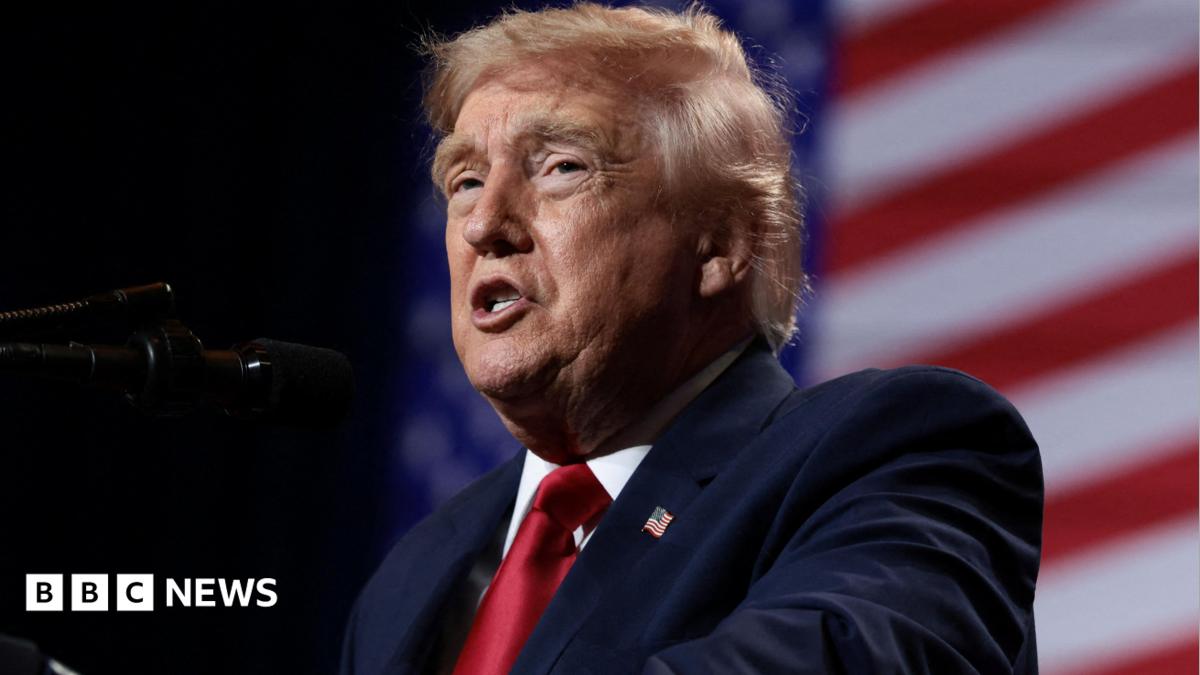
Trump’s war rhetoric is coarse. It’s also heard differently, depending on the audience

In one of his latest missives on social media, President Trump complained that he wasn’t getting enough credit for “totally destroying the terrorist regime of Iran, militarily, economically, and otherwise.”

“We have unparalleled firepower, unlimited ammunition, and plenty of time,” he wrote of a war that has crippled the global supply of oil, sharply increased gas prices, cost U.S. taxpayers billions, left thousands dead and wounded, and so far defied Trump’s own “short term” timetable.

“Watch what happens to these deranged scumbags today,” Trump added. “They’ve been killing innocent people all over the world for 47 years, and now I, as the 47th President of the United States of America, am killing them. What a great honor it is to do so!”

Again and again in recent days, Trump and other top officials in his administration — notably Secretary of Defense Pete Hegseth — have projected confidence and power in Iran in a coarse and triumphant tone that is unprecedented for U.S. wartime presidents and their Cabinet members, according to experts in presidential rhetoric and propaganda.

They have consistently described the war in terms of how hard the U.S. is hitting Iran, rather than why it must do so. They’ve talked of destroying the Iranian navy and air force, wiping out its leadership and making the U.S. “more respected” globally than it has ever been, including by showing no mercy.

“This was never meant to be a fair fight, and it is not a fair fight. We are punching them while they’re down, which is exactly how it should be,” Hegseth said.

Missing is the solemnity of past wartime leaders facing dead U.S. soldiers, a recalcitrant enemy and a precarious tactical position, replaced by a message of U.S. mercilessness — of contempt for Iran rather than concern for its civilians or a focus on the American ideals that U.S. presidents have long tried to rally the world around, especially in times of war.

“At a time when people can see the effects of the war when they fill up their gas tank, and when there have been American casualties, the triumphalist tone is just not something a president normally does,” said Robert C. Rowland, a professor of rhetoric at the University of Kansas and author of the book “The Rhetoric of Donald Trump: Nationalist Populism and American Democracy.”

“Many presidents wouldn’t have that tone for personal moral reasons,” Rowland said, “but they also know that it can backfire when things don’t go well.”

James J. Kimble, a communication professor and propaganda historian at Seton Hall University, said U.S. presidents have “by and large” struck a respectful tone in wartime, though there are some exceptions. President Truman, justifying dropping atomic bombs on Japan, wrote that “when you have to deal with a beast, you have to treat him as a beast,” while the U.S. produced World War II posters designed to “demonize and dehumanize the German enemy,” he noted.

Still, Trump’s messaging — including his “expressing glee at the death of foreign combatants” — has been “much coarser,” Kimble said.

“It’s moving beyond the idea of defeating the enemy on the field of battle, and more into a kind of defeat as humiliation — intentional humiliation,” he said. “It’s schoolyard bullying, along with the physical violence.”

Asked about Trump’s rhetoric, Anna Kelly, a White House spokeswoman, said Trump “will always be proud to recognize the incredible accomplishments of our brave service members.”

“Under the decisive leadership of President Trump, America’s heroic war fighters are meeting or surpassing all of their goals under Operation Epic Fury,” she said. “The legacy media wants us to apologize for highlighting the United States military’s incredible success, but the White House will continue showcasing the many examples of Iran’s ballistic missiles, production facilities, and dreams of owning a nuclear weapon being destroyed in real time.”

Trump has built his political career around blunt rhetoric, and his messaging on Iran has drawn applause from his supporters. Polling has shown the public is heavily divided on the war — drawing far less public support than past wars, but broad support from Republicans.

White House Press Secretary Karoline Leavitt has accused the media of ignoring “clear” objectives that the president and others have set for the war effort, including wiping out Iran’s missile systems, preventing it from developing a nuclear weapon and stopping what Trump had a “feeling” was a coming attack on the U.S.

However, Trump and Hegseth have themselves strayed from that framework with their brash rhetoric, and their focus on the killing of Supreme Leader Ayatollah Ali Khamenei and other Iranian leaders.

Trump has dismissed reports that the U.S. bombed an Iranian school full of children by suggesting that Iran may actually have been responsible, despite reported findings by U.S. intelligence that it was an American attack.

Hegseth has added to concerns about careless U.S. bombing by expressing disdain for wartime rules designed to limit civilian casualties, calling them “stupid rules of engagement.”

“Our war fighters have maximum authorities granted personally by the president and yours truly,” Hegseth said. “Our rules of engagement are bold, precise and designed to unleash American power, not shackle it.”

The White House has also pushed out a wave of wartime propaganda on social media, often striking the same irreverent, bullish tone, experts noted.

One video interspersed movie clips of superheroes and soldiers with real footage of Iranian targets getting blown up, under the words, “JUSTICE THE AMERICAN WAY.” The clip drew condemnation, including from the actor Ben Stiller, who objected to the inclusion of footage from his film “Tropic Thunder,” saying, “War is not a movie.”

Hegseth’s bravado has also been caricatured on “Saturday Night Live,” which opened two weeks in a row with a satirical portrayal of him as angry, dimwitted and hyped up on the violence of war.

All of it has come against a backdrop of Islamophobic remarks from members of Congress on X, with Rep. Andy Ogles (R-Tenn.) writing that “Muslims don’t belong in American society” and Sen. Tommy Tuberville (R-Ala.) posting a picture of the 9/11 terrorist attack next to an image of New York City Mayor Zohran Mamdani, who is Muslim, and writing “the enemy is inside the gates.”

Certainly Iranian leaders have expressed similar contempt for the U.S. for years. Khamenei, killed at the start of the war, was known for stoking anti-American sentiment, speaking to crowds amid chants of “death to America.”

However, U.S. presidents have traditionally spoken with more reserve. They have slammed U.S. enemies, but often by drawing a contrast between them, the U.S. and the values the U.S. purports to defend globally. They have expressed confidence in past U.S. missions, but been wary of taking a celebratory or triumphant tone — especially at the start of a war, amid intense fighting, as American troops are still dying.

Not so with Trump, who on Wednesday said, “You never like to say too early you won. We won. We won … . In the first hour, it was over.”

He also said, “Over the past 11 days, our military has virtually destroyed Iran,” and “they don’t have anything.”

On Thursday, six U.S. service members were killed when a refueling aircraft crashed in Iraq. On Friday, the U.S. military announced it was sending 2,500 Marines and an additional U.S. warship to the conflict.

Kimble said there are several ways to view Trump’s war rhetoric. One is “through the lens of PSYOPS, or psychological operations” — or intentional messaging aimed at discouraging the enemy, akin to the U.S. dropping leaflets in World War II telling foreign combatants that they must surrender or die. In that view, Trump is speaking directly to the Iranians, trying to get them to “perceive victory as impossible.”

Another is to view Trump and Hegseth as projecting a tough image for their MAGA base, their Democratic rivals and any other nations they might be preparing to challenge, such as Cuba.

Rowland said Trump “always has to be the big dog in the room,” and his war messaging should be viewed in that context.

“A lot of the rhetoric is performative cruelty,” Rowland said. “It’s more about him coming across as dominant than it is about making a case that the war has been good for the U.S. and the region and the West and the world.”

Source link

Universal to keep its movies in theaters for at least five weekends

Universal Pictures will now keep its new films in theaters for at least five weekends, a reversal from the studio’s previous policy of at least 17 days that was set during the pandemic.

The change takes place immediately, the studio said Thursday. That means it will apply to its newest film, the Colleen Hoover romance “Reminders of Him,” which is out in theaters this weekend. Other upcoming films include Christopher Nolan’s “The Odyssey,” which will be released in July.

“Our windowing strategy has always been designed to evolve with the marketplace, but we firmly believe in the primacy of theatrical exclusivity and working closely with our exhibition partners to support a healthy, sustainable theatrical ecosystem,” Donna Langley, chair of NBCUniversal Entertainment, said in an email to the New York Times, which first reported the news.

Focus Features, Universal Pictures’ specialty film arm, will keep its existing theatrical exclusivity policies, which vary on a case-by-case basis. Chloé Zhao’s “Hamnet,” for instance, was in theaters for 99 days, while 2024’s “Nosferatu” played for 58 days. The minimum is 17 days.

The amount of time films are available exclusively in theaters — known as “windowing” in industry jargon — has become a contentious topic of conversation in Hollywood.

That debate ramped up during the pandemic, when some studios shortened theatrical exclusivity periods in order to move films to release for video on demand or streaming.

Prior to the pandemic, those windows could be as long as 90 days. Now, the average is around 30 days.

Theater owners have argued that shorter windows cut into box office profits and train audiences to wait to watch a movie at home. Distributors have countered that a one-size-fits-all approach doesn’t necessarily work for smaller or mid-budget films, which may find a bigger audience via at-home viewing.

At last year’s CinemaCon trade conference, top theater lobbyist Michael O’Leary called on distributors to establish a minimum 45-day window, arguing there needed to be a “clear, consistent starting point” to set moviegoers’ expectations and affirm commitment to theatrical exclusivity.

The debate has become even more fierce as box office profits still have not recovered from the pandemic. Last year, theatrical revenue in the U.S. and Canada totaled about $8.87 billion, just 1.5% above 2024’s disappointing $8.74-billion tally.

Source link

‘undertone’ review: This podcast is sponsored by evil

Everyone’s getting into podcasts — even demons.

“undertone,” a muted, personal and static microbudget horror debut by Ian Tuason, takes place in the writer-director’s actual childhood home where he tended to both of his parents before they died. Both hospice and inspiration, it’s a stifling place decorated with floral wallpaper and crucifixes. The pain and exhaustion and grief are so real and oppressive, the camera never dares set a foot outside.

Upstairs, Evy (Nina Kiri), watches over her own terminally ill mother (Michèle Duquet). Tuason funneled his emotional gloom into this movie; Evy co-hosts a horror podcast with her overseas best friend Justin (voiced by Adam DiMarco). “This is the only thing keeping me sane right now,” she says. They’re words she’ll regret within the week.

Kiri and DiMarco have the comfortable, convincing chemistry of two old pals who have done a show for a while. One snippet seems to be an episode on Elisa Lam, the real-life tourist found dead in the rooftop water tank of Los Angeles’ Cecil Hotel. There’s also a reference to a website with a red-faced ghoul who hypnotizes victims into cutting off their ears. The latter may be Tuason seeding his idea for a sequel.

Here the central story is that Justin, who lives in London, has received an email with 10 audio files recorded by a couple named Mike and Jessa (Jeff Yung and Keana Lyn Bastidas) who are trying to understand what she’s saying in her sleep. The sender is unknown. (Possibly an evil spirit hoping for the exposure of a mattress ad?) Justin, the believer, is instantly alarmed by how these eerie tapes escalate from cute banter to ghostly crying babies and backward incantations. Evy is the skeptic who dismisses the noises as either an online hoax or bad plumbing.

Due to the time zone differential, Evy and Justin record their show just before he heads out to work in the morning, which for her is 3 a.m. Most of the movie takes place in that witching-hour window, an airlessly silent time where an at-home podcaster doesn’t worry about being interrupted by a leaf blower, an ice cream truck or a dog. Sound-designed by David Gertsman, “undertone” is so quiet that a tea kettle sounds like a fire alarm. Story-wise, it’s equally inert. One of the biggest action shots in the first hour comes when — eek! — a sink turns on.

I’d love to understand why horror films that I find excruciatingly dull give others the heebie-jeebies. My working theory is that they tap into audiences with a preexisting suspicion that the world is wicked — they prove paranoia to be well-founded. My mental default is that the world is neutral-good, and that may be why I prefer movies with active villains scaring me out of my complacency. I spent “Paranormal Activity” and “Skinamarink” restlessly admiring the production design; here, my main thrill came from the soundscape, like when a vibrating cellphone made my chair rattle like it was a tractor, or a noise that can only be described as death-rattle ASMR.

When Evy slips her on headphones, she’s so focused making sense of the latest scary tape, playing it forward, reversed and slowed-down, that she’s oblivious to the bumps in the night in her own house, upstairs near her comatose mother’s bedroom. I suspect Tuason deeply relates to Evy, to the disassociation of living with death every day, and uses her resistance to explore denial. She refuses to admit that the supernatural is real, even as she repeatedly takes a break to steady herself and, as she puts it, “get back into character.” Her stifled panic makes it obvious that fear is taking over.

The screenplay also has a passing reference to Evy’s useless, off-screen boyfriend Darren (voiced by Ryan Turner). Their miserable dynamic is compelling but overall comes off like a plot point Tuason stuffed in his pocket and never got around to using. Our one peek into it comes when Darren phones Evy to pressure her to ditch her mom and come to a party. He claims he’s throwing a kegger to cheer her up. (A frozen lasagna on the doorstep would be better, dude.)

Evy does reluctantly leave the house — we don’t follow her there — and that one moment says as much about crossed-signals communication as anything else in the movie. It’s bullseye-accurate about how isolating it is to lose a parent earlier than your peers.

The film is so committed to its rigors — the two-person cast, the glacial camera pivots, the moody lighting — that it teeters on the line of becoming monotonous. When Tuason eases up a bit, say in a scene in which Evy pops on a sleep podcast that begins by describing a babbling brook and rapidly becomes a nightmare tale of bobbing corpses, he finally shows you that he has the potential for range.

But “undertone” is rooted in that slow-and-still horror discipline that holds its breath waiting for something to happen. It requires the audience to bring their own bad vibes to shots of religious icons on the wall and long takes of Evy clacking on her laptop, unaware of a flickering light behind her. (Rumor is Tuason has already signed on to shoot the next “Paranormal Activity” sequel.)

Mostly it puts the audience in the position of watching a protagonist so passive that chunks of the running time are watching her sit at a table waiting for Justin to look up things for her on Wikipedia. Like amateur detectives, we learn alongside them as they click around pages about Sumerian devils, Catholic saints and the origin of the nursery rhymes “London Bridge” and “Baa, Baa, Black Sheep.”

As visuals go, “undertone” is so far removed from anything resembling the cinematic experience that I left with a fresh appreciation for campfire storytelling. At least then the listener gets to use their own imagination. But production designer Mercedes Coyle does dig up two satisfyingly creepy props: one, an antique speaking doll, the other, a small white statue that appears to be the Virgin Mary until we get a better look at her mouth, deformed by a hungry scream.

Despite my quibbles with how her character reacts when things really go awry, Kiri’s Evy has a clarity of purpose that holds our attention despite not having that much to do. In her strongest sequence, she and Justin take a few live callers on their podcast, some of whom bear bad news about Mike and Jessa, and another who phones up in the middle of a crisis that’s too big for these self-positioned experts to handle. Real violence is coming and these armchair ghosthunters are totally out of their depth. Yes, everyone is into podcasts. Maybe they shouldn’t be.

‘undertone’

Rated: Rated R, for language

Running time: 1 hour, 34 minutes

Playing: Opens Friday, Mar. 13 in wide release

Source link

Ryan Gosling tricks Eva Mendes into a public display of affection

The birthday surprise was not subtle.

Eva Mendes and Ryan Gosling showed up together in public Thursday evening for the first time in more than a decade, with Gosling enlisting “The Tonight Show Starring Jimmy Fallon” host for help in surprising his longtime partner for her 52nd birthday.

Gosling was on the show to promote his upcoming film, “Project Hail Mary,” in which he plays a high school teacher tasked with saving the world. So he asked Fallon to arrange for an audience full of — you guessed it — high school teachers. Because Mendes absolutely loves teachers, he said.

And then there was the request that they surprise Mendes by singing “Happy Birthday” when she came out on stage. It was unclear whether Gosling also ordered up the marching band that played backup, but Fallon wound up crediting him for the whole deal, which we assume included the, um, confetti cannon.

So back to Gosling, who along with Mendes is very private about their relationship and hasn’t been seen at a public event with her (His partner? His wife? Who knows, who cares) since they promoted their 2013 movie “The Place Beyond the Pines.”

He talked about the movie, of course, sharing some funny video from a promotional spot he recorded.

“This was crazy,” the “Crazy, Stupid, Love” actor told Fallon and the “Tonight Show” audience. “I swear, this is not a paid ad. I swear this happened. This was not planned. I had to do a little thing with Alexa, where I just was supposed to ask her facts about the movie. … And this is what happened. This is what she said, I swear.”

In the video, Gosling quizzed Alexa about why people should see the movie in theaters instead of waiting for it to stream at home.

“Because the Imax visuals are absolutely stunning,” Alexa said. But it was what she said next that warmed Gosling’s heart.

“Plus, Eva Mendes herself called it a masterpiece that brings back the magic of the big screen experience that you just can’t get the full impact of on your couch at home,” Alexa said.

“That Eva Mendes is great, isn’t she?” Gosling said in his trademark slight-smirk delivery.

“Absolutely. She’s got this incredible range that people don’t always give her credit for” — at this point Gosling blurted an enthusiastic “Thank you!” — “from her breakthrough in ‘Training Day’ to that beautiful performance in ‘The Place Beyond the Pines’ with Ryan Gosling, she brings this authentic vulnerability to every role.”

At this point, Gosling kissed Alexa, who was made out of red plastic and had a “Project Hail Mary” image emblazoned on her speaker.

“Plus, she’s been smart about stepping back from acting to focus on family,” Alexa continued, “which shows she’s got her priorities straight.”

“I couldn’t agree more,” said Gosling, who’s been with Mendes since 2011 and welcomed two daughters with her. Whether they are officially married is, of course, a mystery. And he did kiss Alexa, which could complicate things. That Alexa, she’s a hustler.

But married or not, Gosling was 100% committed to surprising Mendes on her 52nd trip around the sun. Turns out she was backstage at the show, thinking she was going to get the opportunity to tell the audience full of teachers how much she appreciated what they do every day. So someone brought her to the set, where Gosling greeted her with a “Hi, sweetheart” and held her hand as he pulled her to center stage.

Mendes, apparently thinking her appearance wouldn’t be part of the show, immediately burst into a paean to teaching, telling the educators who were assembled, “I love teachers so much, you guys. We owe so much to you guys. You’re so underpaid and you’re so — I just — thank you so much. I had so many amazing teachers.”

Then she turned to Fallon and said, “You’ll cut all this, right?” Seems she hadn’t put two and two together when Gosling pointed her toward the mark on the floor where she was supposed to stand for the cameras.

Nope, the host said. We love this.

So Mendes went on. “I had so many amazing teachers mentor me,” she said, speaking rapidly and enthusiastically, “and I just want to say thank you to you guys.”

But Fallon reminded her that this was her day — her birthday. And Gosling pointed out that among the educators there were some band directors.

“Yes, we have band directors from North Bergen High School,” Fallon announced. “Ladies and gentlemen, here to play ‘Happy Birthday’ to Eva Mendes, we have the North Bergen High School marching band.”

And there they were, a dozen or two members of that marching band, in full regalia, with two people holding a “Happy Birthday Eva!” banner and the rest blasting out the familiar tune. The entire audience joined in serenading the woman of the hour as they clapped along. Mendes clapped along as well.

As a finale, yup, confetti blasted out over those onstage. And Fallon gave credit where it was due.

“That’s all him,” he said, indicating Gosling, which prompted Mendes to grab her beau’s face and start whispering into his ear. And that’s the most fans are likely to see the twosome behaving like a twosome in public, at least until maybe 2039 or so. Maybe for her 65th birthday. Or her 70th. Or perhaps their AI holograms will one day reveal whether they said “I do.”

By the way, all those teachers were the ones who got the birthday gift last night. Fallon announced they would be going to a special screening of “Project Hail Mary” after the taping, and the teachers’ delight was palpable.

Very nice, “Tonight Show.” You and Ryan Gosling made some people very happy Thursday. Including one Eva Mendes.

“Project Hail Mary” hits theaters March 20.

Source link

Kennedy Center’s NSO executive director leaves for the Wallis in L.A.

The tumult continues at the John F. Kennedy Center for the Performing Arts as the National Symphony Orchestra’s executive director, Jean Davidson, steps down from her role to become executive director and chief executive of the Wallis Annenberg Center for the Performing Arts. Davidson will assume her new position May 4, the Wallis announced Friday.

Davidson is not new to L.A., having served as the president and CEO of the Los Angeles Master Chorale at the Music Center from 2015 to 2023. She left the Master Chorale for the NSO in Washington, D.C., where she worked for two years until President Trump began his controversial takeover of the Kennedy Center, firing its board and installing himself as chairman. Major artist defections ensued, culminating with a board vote to rename the center the Trump Kennedy Center in December and February’s surprise announcement that the center would close for two years for renovations, beginning July 4.

“I’ve learned a lot in the last three years, and I think it’s no secret that it’s been a hard year,” Davidson told The Times, adding that the politicization of the Kennedy Center was a factor in her decision-making. “I had intended to stay through the [orchestra’s] 100th anniversary in 2031, but found it more and more difficult to achieve the goals that we had set out to achieve given the external forces that are at work that are just so far beyond my control.”

It seemed like “I had reached a natural ending point,” she said.

With the imminent closure of the Kennedy Center, speculation has swirled around the NSO’s future, especially in light of the Washington National Opera’s decision in January to cut ties with the storied venue, which has been its home since 1971. The Kennedy Center’s Trump-appointed leadership, however, made it clear that it intended to support the NSO in the long term, and the orchestra’s board chair assured musicians that the orchestra and its staff would remain intact.

Davidson said the NSO is in the process of identifying venues for the next two years, and that the orchestra has been told by the Kennedy Center that its financial support is not in question.

“Many venue operators in the D.C. area have been very generously reaching out to us, asking how they can help,” she said. “Of course, we plan our seasons years in advance, and so next season was already planned. We already have conductors and soloists and all of that, and so it’s a bit of a jigsaw puzzle aligning our existing programming and obligations to those artists with venues that are appropriate for those programs.”

It will take several more weeks to come up with a cohesive plan and it will probably include several venues, “but we will have a season,” Davidson said. “And we hope that everybody will come.”

In many ways, Davidson said, the NSO is stronger than it has been in quite some time. During her tenure, Davidson helped reboot the orchestra’s international and domestic touring, which includes upcoming shows at New York’s Carnegie Hall in May and at the Hollywood Bowl in August. The orchestra also extended acclaimed music director Gianandrea Noseda’s contract through 2031.

“The orchestra is just playing at such a high level and they really have never sounded so good,” said Davidson, echoing what notable critics have also been saying. “We’re still welcoming many new players after our audition process, and I think that’s all very positive for the NSO.”

Davidson knows that leaving her role will be difficult for the orchestra, but she believes it will emerge stronger.

“I care deeply about the NSO and I am so proud of everything that we’ve accomplished together. I think the world of Gianandrea, of [principal conductor] Steven Reineke, our musicians, our staff and board — it’s a great community of people,” said Davidson.

Davidson also believes that the upcoming renovations to the Kennedy Center will ultimately result in a better experience for audiences and artists. She just wishes there had been much more advance notice.

“Usually orchestras will plan for being out of their hall years in advance, and we only have months to do that, so it is causing a bit of strain,” she said. “I think the most important thing is that our audiences and donors continue to support the NSO during this transition period.”

Davidson will now embark on her own transition as she moves from D.C. to L.A., rejoining her husband who has stayed in the area as a music professor at UC Irvine.

“This is an opportunity that’s been on my bucket list of things that I want to do in my life and it seems like the right time,” said Davidson of her new role at the Wallis in Beverly Hills.

Compared with the NSO, the Wallis is practically brand new, having opened in 2013.

Davidson is excited that there is lots of room for growth, and that the Wallis has evolved into one of the region’s most exciting multidisciplinary performing arts presenters and home base to a variety of local arts groups.

“I think anytime you’re starting a new role, there’s a lot of learning that needs to occur,” Davidson said. “And I’m not somebody that is prone to walking in with a big vision that’s going to suddenly change course. I think they’ve been doing a lot of great work and so I’m looking forward to collaborating with the team that’s there — to learn and to create a shared vision for the future.”

It’s an exciting time to be in Los Angeles, Davidson said.

“The last decade or so has seen a lot of growth in the art sector, and there are so many talented artists and organizations in L.A. that need a place to perform.”

Source link

Commentary: Iran, Israel, pet otters and hair gel. Gavin Newsom’s book tour stops in L.A.

Israel, Iran, ICE, dyslexia, single moms and a pet otter named Potter were among the subjects discussed Tuesday evening at California Gov. Gavin Newsom’s tour stop in Los Angeles to promote his new book, “Young Man in a Hurry: A Memoir of Discovery.”

Speaking to a sold-out crowd of around 1,300 at L.A.’s historic Wilshire Ebell Theatre, the hourlong Q&A hosted by Writers Bloc and moderated by “Pod Save America” hosts John Favreau and Tommy Vietor was equal parts a get-to-know-the-man-behind-the-mask chat and a timely discussion about challenges facing the country.

The engaging discussion was clearly geared toward dispelling the image of Newsom as “that slick guy” (his own words), by covering his journey from an insecure, cocky young man trying to impress those around him to an adult who, through his successes and follies, has become comfortable in his own skin.

Gavin Newsom, Jon Favreau and Tommy Vietor sitting on stage

Gov. Gavin Newsom and moderators Jon Favreau and Tommy Vietor promoting Newsom’s new book, “Young Man in a Hurry.”

(Ronaldo Bolanos / Los Angeles Times)

He described his young, pre-politician self as posing in a suit: “I was thinking I was Pierce Brosnan in ‘Remington Steele.’ I just discovered hair gel,” Newsom joked. He said in those early years he was often overcompensating for his own feelings of inadequacy as the son of a single mom who struggled to pay the rent. As a kid with learning differences, whose undiagnosed dyslexia put him behind in school. Whose “broke and broken” father neglected his family while hobnobbing with wealthy San Francisco families, including the heirs of the Getty oil fortune.

A chatty, relaxed and sometimes free-associating Newsom rarely needed prompting from the moderators when speaking about his childhood, his family’s strange choice of pet (the aforementioned otter) or far more serious matters. He said that Democrats need to “fight fire with fire” and be more “ruthless” in their fight to win back the country.

Newsom’s politician-speak was evident in some of his more rehearsed efforts to convince the crowd that he’s a regular guy (he may not have changed many diapers with his first daughter, but he got better at his dad duties with his next three kids). But those instances were matched by unvarnished comments that appeared genuine, and risked alienating some of his base.

One such instance came early in the conversation, when Newsom was asked about where he stood on President Trump’s new Iran war, and the administration’s changing rationales on why it launched the military operation without consulting Congress.

“[The Trump administration’s] first rationale was we’ve got to make sure that they’re not armed with nuclear [weapons]. But I thought that was resolved, that we had completely ‘obliterated’ it,” Newsom said, using Trump’s claims against him. “Then maybe that wasn’t the case, so now it’s about their missiles, and they can perhaps hit the United States, and then it’s wait, that’s a decade plus away. So that’s BS. Then it’s about their militias, it’s about their proxy. Then it’s no, it’s about their navy. And then no, it’s a response to the likelihood that Israel was going to [go in] so we had to go in ourselves. God help us … this is Keystone Cops.”

Newsom was then asked if the United States should perhaps consider rethinking its military support for Israel, and he said that would be reasonable.

“The issue of Bibi [Israeli Prime Minister Benjamin Netanyahu] is interesting because he’s got his own domestic issues,” Newsom said. “He’s trying to stay out of jail. He’s got an election coming up. I mean, to say this is in America’s interest, at a time when affordability is at crisis levels, where you had an administration who literally got elected saying this is exactly the opposite of what they would ever consider doing. The fact that we are in this now, regional war.…”

He also said Netanyahu was “potentially on the ropes. He’s got folks, the hard line, that want to annex the West Bank.” Newsom suggested that some critics have “appropriately” described Israel as sort of an “apartheid state.” His comments caused a stir Wednesday from pro-Israel advocates who felt Newsom was turning on their interests.

But most of the conversation was about the book, and domestic issues. Newsom has been a fierce critic of Trump and his policies, positioning himself as part of the resistance, one of the few high-profile leaders to hit back with policy (Proposition 50) and a strong media presence with his podcast, “This is Gavin Newsom,” and his Trump-trolling social media accounts.

“Nothing goes to the heart of who [Donald Trump] is than his press conference yesterday, where he was lamenting [that] four Americans had died,” Newsom said. “He mentioned them in passing. And then went on, in great detail, about the drapes and the Imperial Palace in the East Wing [of the White House] that he’s building. He talked about [it] with real passion and conviction. It says everything about Donald Trump, the uncertainty in the world, to the fact that we have allies under threat, UAE, we’ve got proxy war with, once again, with Hezbollah and Lebanon. We’ve got all the anxiety as relates to 20% of the world’s oil flow, issues related to oil prices and stocks.”

Though Newsom was speaking to an auditorium of blue state supporters, his tour kicked off last week in the South, with stops in Georgia, Tennessee and South Carolina. His efforts to relate to his audience were seized upon when, during a conversation with Atlanta Mayor Andre Dickens, he addressed the audience, saying, “I’m like you,” before bringing up his low SAT scores. He was called out for his comment, which was labeled as racist by critics, particularly those from right leaning media outlets.

In Los Angeles on Tuesday, he was asked how he felt about the California Democratic Party chair’s recent suggestion that some party candidates drop out of the governor’s race, to avoid a Republican potentially winning. “I confess. I agree. With all the promise and peril that marks this moment in California, the most un-Trump state in America,” we can’t risk a Republican winning, he said.

The California Highway Patrol and a private security firm deployed officers and agents around the venue for a tight security presence (no bags or purses allowed). On at least three occasions, one or more protesters interrupted the discussion with shouts from the balcony and floor seats, demanding Newsom do something about privatized prisons and the ICE sweeps of immigrants.

After they were removed by security, Newsom said he understood the “escalation of stress” over the last ten years or so, and defended his record, mentioning he signed the first bill banning private prisons and was a “fierce opponent” of what’s happening on American streets.

Attendees of the event applauded Newsom’s record, and just about everything else he said. They were, after all, folks who had paid up to $80 a seat to hear the conversation and receive a copy of his book. He walked into the crowd afterward and spent nearly a half hour chatting with audience members, posing for selfies and signing copies of his memoir. Newsom was not in a hurry.

Source link

With ‘Hoppers,’ Pixar looks for a boost to its original animated films

In 2020, “We Bare Bears” creator Daniel Chong came to Pixar leaders with an idea.

He had seen documentaries in which robotic animals with eyeball cameras captured footage of natural habitats. But what if that technology was so good that no one could tell the difference? And to make it even more zany — what if someone went undercover in that animal body?

That idea became the basis of Walt Disney Co. and Pixar’s new animated movie, “Hoppers,” which debuts this week. The film is Pixar’s latest attempt to break through at the box office with an original story, something that has been a struggle for the storied animation studio since the pandemic.

The pressure of Pixar’s legacy can be a little overwhelming and coming up with an original idea is difficult, said Chong, who directed “Hoppers” and also serves as a writer on the film.

“For a Pixar movie, it’s very high stakes,” he said. “But I just felt like I had a really funny idea, and I thought as long as we made it really funny and had characters you loved, to me that’s the key to every Pixar movie — really awesome characters that really connect emotionally with people.”

Recent theatrical success for Pixar as well as other animation studios has come from sequels, such as 2024’s “Inside Out 2,” which grossed $1.7 billion globally. But the reputation of Emeryville-based Pixar is built on its string of blockbuster originals, including 1995’s “Toy Story,” 2001’s “Monsters, Inc.” and 2004’s “The Incredibles,” making new stories crucial to the studio’s future.

People like coming back to familiar characters like Woody and Buzz from “Toy Story,” but the studio can do only so many sequels, said Pete Docter, Pixar’s chief creative officer. And some films don’t lend themselves to new chapters, he said, noting the studio’s efforts to look at “Monsters, Inc.”

“We’ve been trying, struggling for a long time to get somewhere with that, and we’ll see in the future how things go, but it’s been an uphill battle,” he said. “For whatever reason, that movie seems to be self contained and doesn’t want to go forward without repeating some of the same themes, which I think would be disappointing.”

Opening weekend expectations for “Hoppers” are wide-ranging, from $25 million to $40 million, on a production budget of $150 million. So far, the reviews have been strong, with a 96% approval rating on aggregator Rotten Tomatoes.

“If we don’t continue to do originals, we’re going to run out of stuff,” Docter said. “If ‘Hoppers’ can really catch on, it could show that audiences still want original movies. They’re still excited to see things that surprise them, that are not just following through on characters and worlds that they’ve seen before.”

It’s been a tough time for original animated movies — and new films in general. As the theatrical market continues to find its footing after the pandemic, audiences still largely have gravitated toward familiar fare, including sequels and reboots, even as they profess to want new stories.

Pixar’s previous original film, 2025’s “Elio” cratered at the box office, partially beset by the tough climate for new animated stories as well as strong competition from other kids’ movies such as live-action adaptations of Universal Pictures’ “How to Train Your Dragon” and Disney’s “Lilo and Stitch.”

The pandemic played a major role in Pixar’s recent track record with originals. When COVID-19 hit, original films like 2020’s “Soul,” 2021’s “Luca” and 2022’s “Turning Red” all were sent straight to the Disney+ streaming service to give families something to watch during the stay-at-home orders. But that also got audiences accustomed to waiting to watch Pixar films at home, and as theaters started opening up again, families were some of the last groups to return because of concerns about health and safety.

“There had been a conditioning process,” said Heather Holian, a professor of art history at the University of North Carolina at Greensboro. “It was challenging to turn the ship around a little bit, or getting people to rethink how they engage with Pixar films and getting them back to theaters.”

To connect with audiences, Pixar films need to feel familiar in some way, but with a surprising twist — something that is incredibly difficult to do, Docter said. “Hoppers” also involved extensive, early stage collaboration with the studio’s story artists. Chong would give them a rough idea of his thoughts, which the artists would then use to develop dialogue and other details that expanded on his vision. That’s a bit of a departure from Pixar’s typical process, which involves writing pages and giving them to the artists, who then go to work..

Chong worked as a story artist at Pixar before he went on to create Cartoon Network’s “We Bare Bears” and then returned to the studio in 2019.

“Hoppers” could get strong tailwinds from the success of Sony Pictures Animation’s “Goat,” which was produced by Golden State Warriors star Stephen Curry and tells an original story set in an all-animal world about an undersized “roarball” player who pushes to make it in the big leagues.
That film has netted nearly $75 million in the U.S. and Canada, with a global total of more than $131 million..

The two movies are the beginning of a potentially big year for animated films. After “Hoppers,” Nintendo and Universal Pictures’ sequel “The Super Mario Galaxy Movie” is out in April, followed by Pixar’s “Toy Story 5” in June and Universal Pictures and Illumination Entertainment’s “Minions & Monsters” in July. In the fall, Warner Bros. Pictures Animation plans to release “The Cat in the Hat.”

High-performing years at the box office traditionally are anchored by strong family movies, said Shawn Robbins, director of movie analytics at Fandango and founder of the site Box Office Theory.

“A lot of us are so optimistic about what the box office can do overall this year because of the animated releases,” he said. “When there is appealing content out there, families are a big driver for this industry.”

Source link