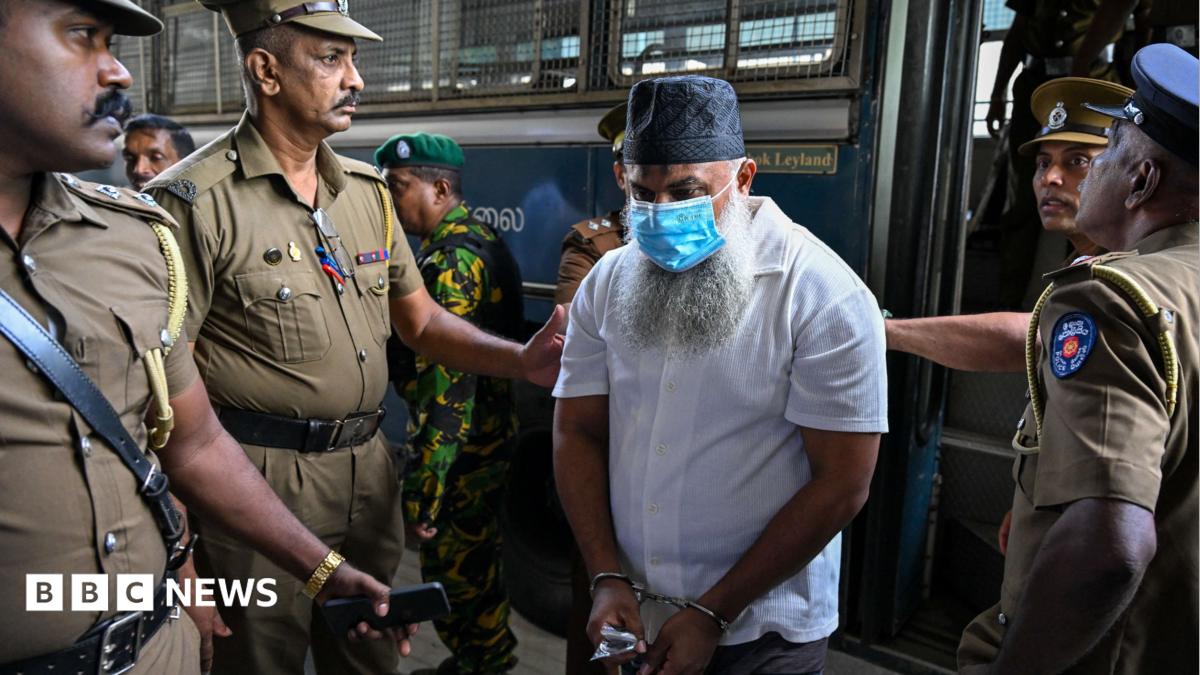
Sri Lanka’s High Court has convicted 15 men who had been charged with plotting the 2019 Easter Sunday bomb attacks that killed 270 people and injured more than 500.
Those found guilty include Naufer Moulavi, who prosecutors said masterminded the suicide bombings. Nine other men were acquitted.
The co-ordinated blasts at three churches and three luxury hotels were the deadliest in Sri Lanka since the end of its civil war in 2009. Forty-five foreigners were among the dead.
All the bombers who carried out the attacks died in the blasts. Investigators have previously blamed the bombings on Islamist extremists, and the 25 men indicted were from Sri Lanka’s Muslim minority. One died in custody.
The accused had been charged with more than 23,000 offences, including murder, conspiracy to commit terrorism and possessing firearms.
More than 2,300 people gave evidence for the prosecution.
There were also 2,076 pieces of evidence, including explosives, swords and firearms.
In the wake of the attacks, Sri Lankan authorities pointed to a “major intelligence lapse”. Its parliament heard that a tip-off from India about the attacks was not properly shared with the authorities.
In 2023, the Supreme Court ordered former president Maithripala Sirisena to pay millions in compensation to the victims of the bombings, after finding him responsible for national security failures that led to the attacks.
Last month, two former senior officials were sentenced to death for criminal negligence that led to the bombings. Death sentences are usually commuted to life in prison in Sri Lanka due to a decades-old moratorium on executions.
For years, Sri Lankans have held regular demonstrations demanding justice for the victims of the Easter attacks.
The verdict comes as a separate investigation on former intelligence chief Suresh Sallay is under way. Sallay is accused of orchestrating the bombings with Islamist extremists.
The allegations echo those aired in a 2023 documentary by British broadcaster Channel 4, which heard whistleblower testimony claiming the attacks were allowed to happen to boost the popularity of the Rajapaksa family, which long dominated Sri Lankan politics.
Sallay, who was arrested in February, denies the allegations. Former president Gotabaya Rajapaksa, who was elected months after the 2019 attacks, with a campaign of tackling Islamist extremism has also denied the allegations.
Rajapaksa, who has been banned from leaving the country, has asked the court to prevent his potential arrest in connection with the ongoing investigations.
Fidan highlights Turkiye’s readiness to assist Saudi Arabia militarily, as Houthi attacks escalate in Yemen.
Published On 19 Sep 202619 Sep 2026
Turkish Foreign Minister Hakan Fidan has said that Saudi Arabia may have unmet military needs from the attacks by Yemen’s Houthi rebels and that Turkiye would consider how to support the kingdom as part of a trilateral defence pact.
Speaking to Turkish broadcaster NTV on Friday, Fidan said it was unacceptable for Saudi Arabia to be dragged into the US-Iran war, adding that Riyadh had no desire to join the conflict.
Recommended Stories
list of 3 itemsend of list
He added that proposals had been conveyed to all sides in an effort to end the fighting, without further elaborating.
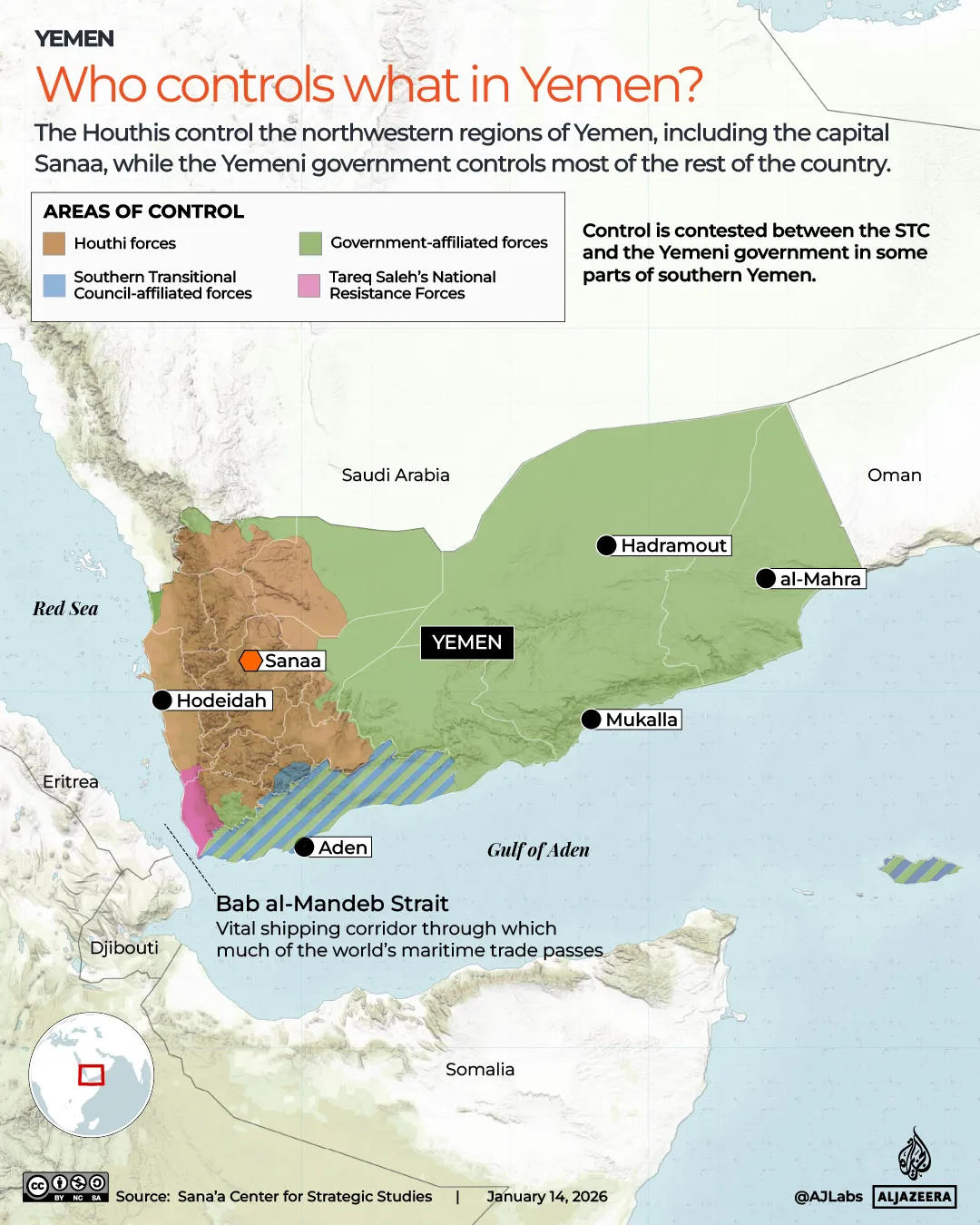
The Iran-backed Houthi rebels and Saudi Arabia continue trading attacks in an escalating war in Yemen, as the Houthis press gains that have brought large stretches of the Red Sea coast, including the strategic Bab al-Mandeb Strait, under their control.
Pakistan has made a similar pledge to defend Saudi Arabia under the defence pact.
Lieutenant-General Ahmed Sharif Chaudhry, a spokesperson for Pakistan’s military, told Arab News on Thursday that Islamabad would defend Saudi Arabia “to any extent”, including “physically”, though he did not say whether Riyadh had asked for more Pakistani troops.
Pakistan’s Foreign Office has said no military response is currently under discussion under the pact, adding that Islamabad would act “when time comes”.
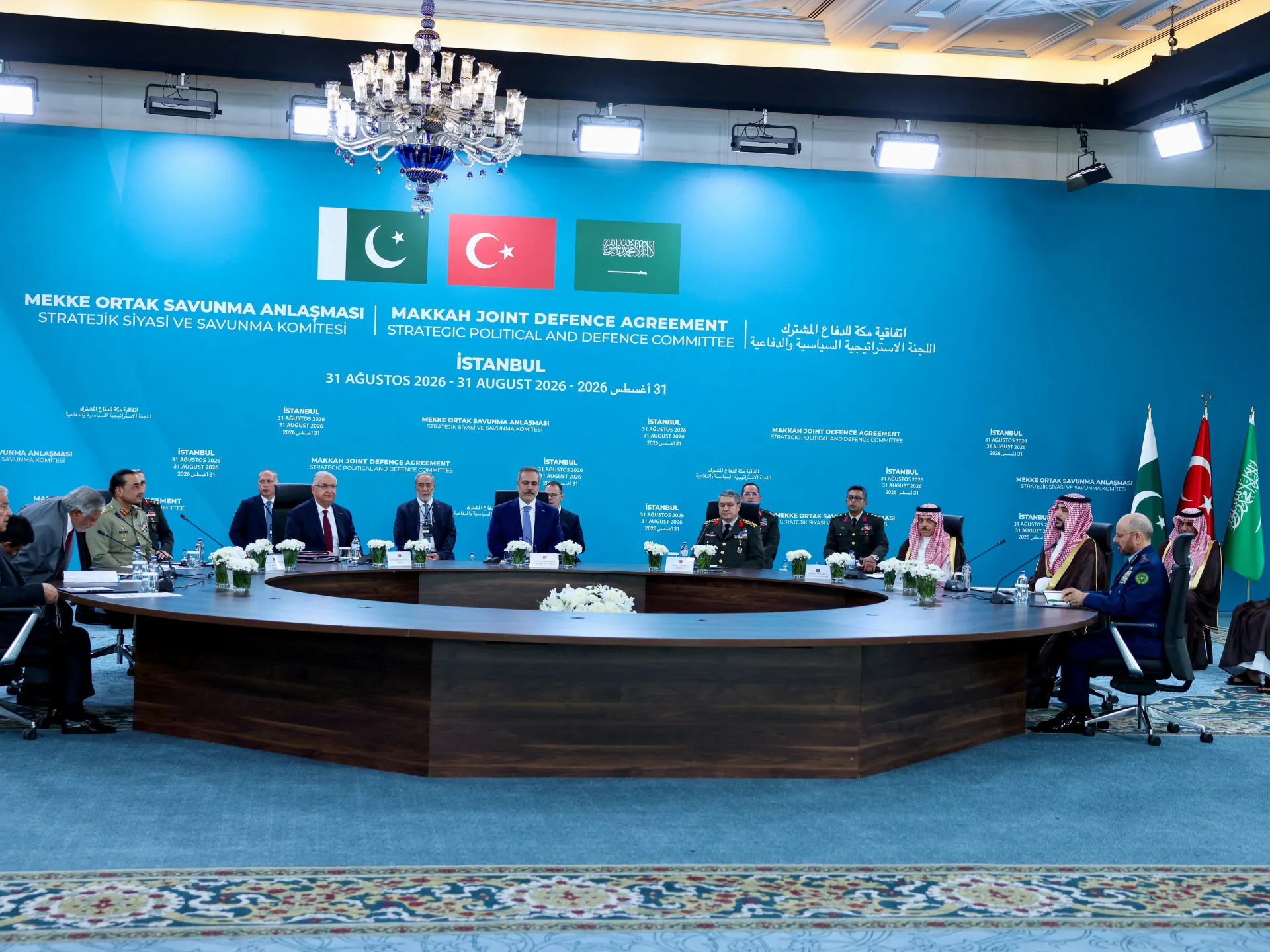
The trilateral agreement, known as the Mecca Joint Defence Agreement, was signed on August 7 in Mecca by Saudi Crown Prince Mohammed bin Salman, Turkish President Recep Tayyip Erdogan and Pakistani Prime Minister Shehbaz Sharif.
The three countries formally named the arrangement the Mecca Defence Alliance on August 31, after officials meeting in Istanbul agreed to set up a secretariat in Riyadh, to be headed initially by a Pakistani secretary-general.
Its founding principle is that an armed attack against any one of the three states will be treated as an attack against all three.
Fidan said at the time the alliance was built on “respecting the sovereignty of other states, territorial integrity and not intervening in internal affairs”, and remained open to other countries joining.
Analysts have questioned how much substance lies behind the pact so far, noting it lacks the integrated command structure and standing forces that underpin NATO.
Its institutional shape, including how the mutual defence clause would actually be triggered, remains unclear.
The trilateral pact was struck as Gulf states grow increasingly concerned about being pulled into the wider US-Iran war, which has continued for more than six months since Washington and Israel first struck Iran in February.
Intensifying attacks between Saudi Arabia and Yemen’s Houthis have reportedly killed at least five people in total, including three children.
At least one person – a Yemeni resident in Saudi Arabia – was killed, and two others were injured after a Houthi drone was intercepted in Saudi Arabia’s southwestern governorate of Taif on Thursday, according to the kingdom’s civil defence agency.
It is the first death announced in Saudi Arabia this month since Yemen’s Iran-allied Houthis intensified their attacks.
In Yemen on Thursday, the Houthis said “Saudi enemy warplanes targeted three telecommunications towers” in Taiz province.
One civilian was killed in Taiz and another injured in strikes on the town of Abs, Yemen, said Houthi-linked Almasirah television.
Houthi-backed media later reported that “three children were killed and several Yemeni nationals were injured in strikes by the Saudi-backed mercenaries”, a reference to the country’s internationally recognised government forces.
Houthis reject claim they attacked Mecca
The escalation comes as Saudi Arabia said a drone was launched by the Houthis towards Mecca before being intercepted and destroyed.
“It’s a heinous lie,” Houthi leader Abdel-Malik al-Houthi said in a live televised address on Thursday, calling Saudi claims that his group would target Islam’s holiest city “a great propaganda”.
“The sanctity of Mecca is particularly important to the people of Yemen,” he said while accusing Saudi Arabia of “weaponising lies” to serve its war objectives against the Houthis.
Reporting from the Yemeni capital Sanaa, Al Jazeera’s Yousef Mawry said: “Al-Houthi’s speech is not just directed towards the Yemeni people; it is directed to the world to set the record straight that the Houthis did not target the holy city of Mecca, as the Saudis claim.”
In his address, al-Houthi also said Saudi Arabia had initiated the latest round of conflict in Yemen and that Houthi forces are acting defensively.
Meanwhile, Rashad al-Alimi, the head of Yemen’s Saudi-backed Presidential Leadership Council, said that Houthi forces are suffering heavy blows on the fronts in Taiz, Marib, Lahj, al-Jawf, Hajjah, al-Bayda al-Dhale.
In a meeting with the French ambassador to Yemen, al-Alimi said that gains made by the Houthis along the Red Sea coast are temporary, the state-run Saba news agency reported.
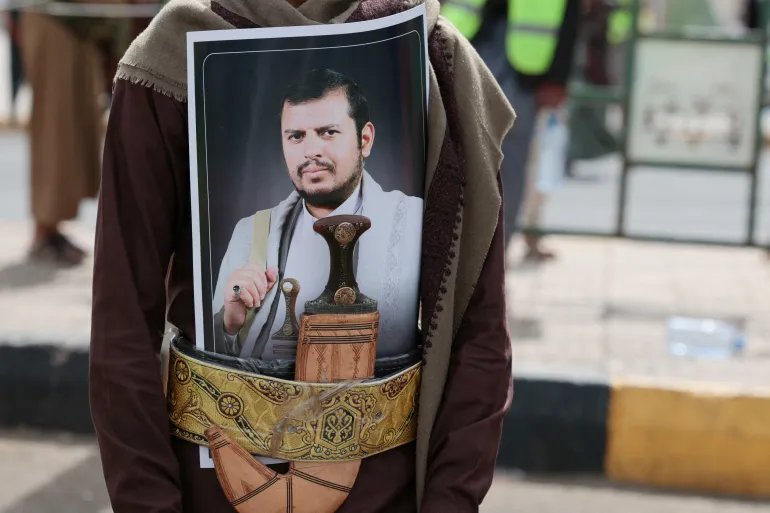
A Houthi supporter sports a poster of the group’s leader, Abdel-Malik al-Houthi, in his dagger’s belt, during a rally against the Saudi-led coalition [File: Khaled Abdullah/Reuters]
Aggression against Mecca ‘a condemned act’
Esmaeil Baghaei, Iran’s Ministry of Foreign Affairs spokesperson, said in a statement on X on Thursday that any aggression against Islamic holy sites, particularly Mecca, “is a condemned act”.
But he added that “a mere claim” of intercepting a drone “en route to Mecca” is not enough to accuse the Houthis of the act.
“Nor should we forget that our region has witnessed numerous instances of ‘false flag’ operations, particularly in recent months,” Baghaei said while pointing at Israel.
Meanwhile, China has privately asked Iranian officials to help rein in the Houthis after Saudi Arabia appealed to Beijing following recent Houthi attacks, anonymous sources in Iran told the Reuters news agency.
Beijing publicly called for restraint, dialogue and the restoration of safe navigation, but its private message went further than that, Reuters reported.
The escalation is also threatening to draw in other regional actors – specifically Saudi defence partners Pakistan and Turkiye, which signed a joint defence agreement with the kingdom last month.
Pakistan’s Defence Minister Khawaja Asif said the time has come to implement the Mecca agreement with Saudi Arabia and Turkiye due to recent Houthi attacks.
Asif’s comments to Pakistani media on Thursday were made as Iran’s Foreign Minister Abbas Araghchi said he’d held a phone conversation with Pakistan’s army chief Asim Munir to discuss “regional developments”.
RIYADH: Thirteen civilians were injured after attacks on several Saudi cities by Yemen’s Houthi militia, authorities said early on Tuesday.
The Iran-backed group targeted civilian areas in
Khamis Mushait, Abha and Taif with ballistic missiles and drones on Monday.
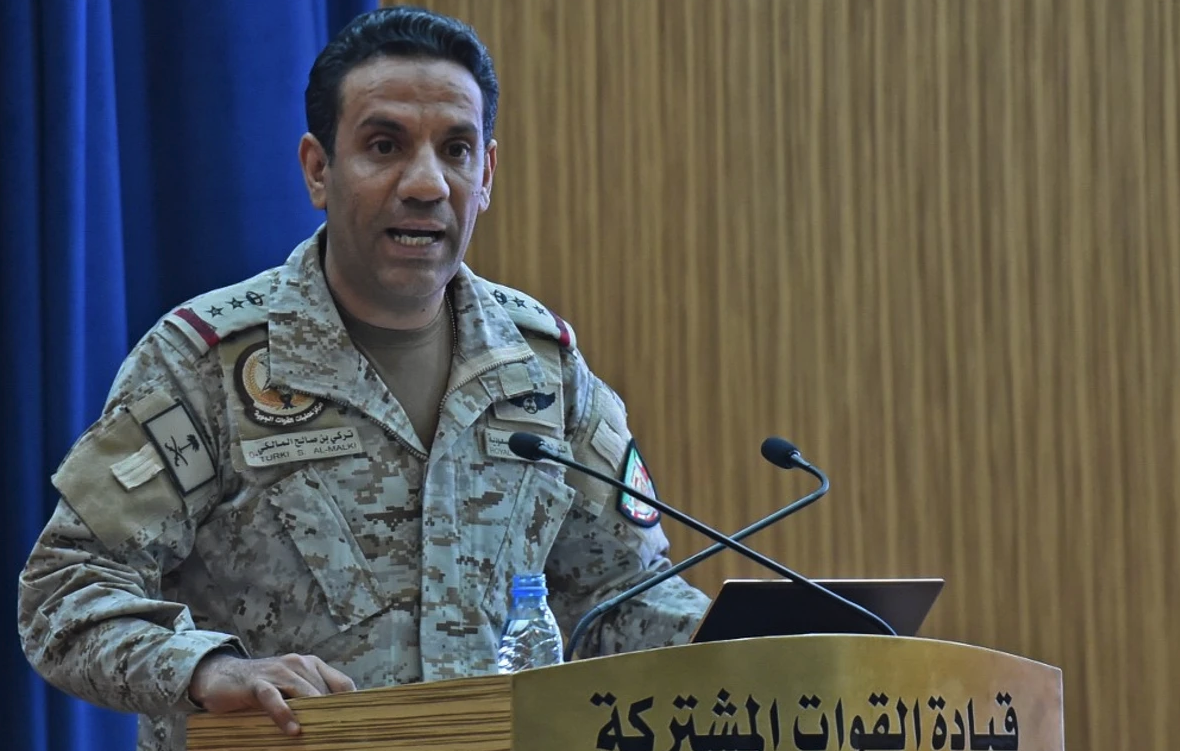
The strikes resulted in “minor to moderate injuries to 13 civilians and damage to 7 houses and two vehicles,” said Major General Turki Al-Malki, spokesperson for the Coalition to Restore Legitimacy in Yemen, in a statement issued on social media early on Tuesday.
“The Terrorist Houthi Militia continues its heinous and deliberate attacks on civilian objects and civilians in the Kingdom,” the statement read.
“The continuation of these deliberate and repeated attacks proves the Terrorist Houthi Militia’s approach and extremist ideology of escalation and targeting civilian objects and civilians.”
The Coalition said its joint forces will deal with the attacks
“responsibly and firmly to protect the sovereignty of the Kingdom, civilian objects, and civilians.”
Last week an attack by the militia left more than 70 people injured, including women and children, in various towns and cities across Saudi Arabia.
The Kingdom on Friday temporarily shut down its East-West Pipeline after it was targeted in several drone attacks in the Riyadh and Madinah regions.
Gulf and Muslim organizations condemned the attack on the pipeline, expressing solidarity with the Kingdom.
Tetiana Bubynets collapsed on the asphalt after a Russian drone exploded at a gas station in the southern Ukrainian city of Zaporizhzhia.
Despite the violent shockwave and blast of drone shrapnel produced by the attack on July 6, the 18-year-old accounting student had no visible wounds except for a nosebleed.
Recommended Stories
list of 3 itemsend of list
She was rushed to hospital and pronounced dead shortly after, alongside two other civilians, aged 41 and 48.
One of her lecturers, Tetiana Melikhova of Zaporizhzhia National University, said Bubynets was an only child and that her mother “lost the meaning of life” after she died.
“She couldn’t speak. At the funeral, she just lay on the coffin; she couldn’t let her child go,” Melikhova told Al Jazeera.
The strike that killed Bubynets was the first recorded case of Russia’s use of a fully autonomous attack drone powered by artificial intelligence (AI), according to a New York Times analysis.
While drone strikes have hammered Ukraine since Russia launched its full-scale invasion in February 2022, Ukrainian officials who examined the wreckage found the unmanned vehicle to be unlike others.
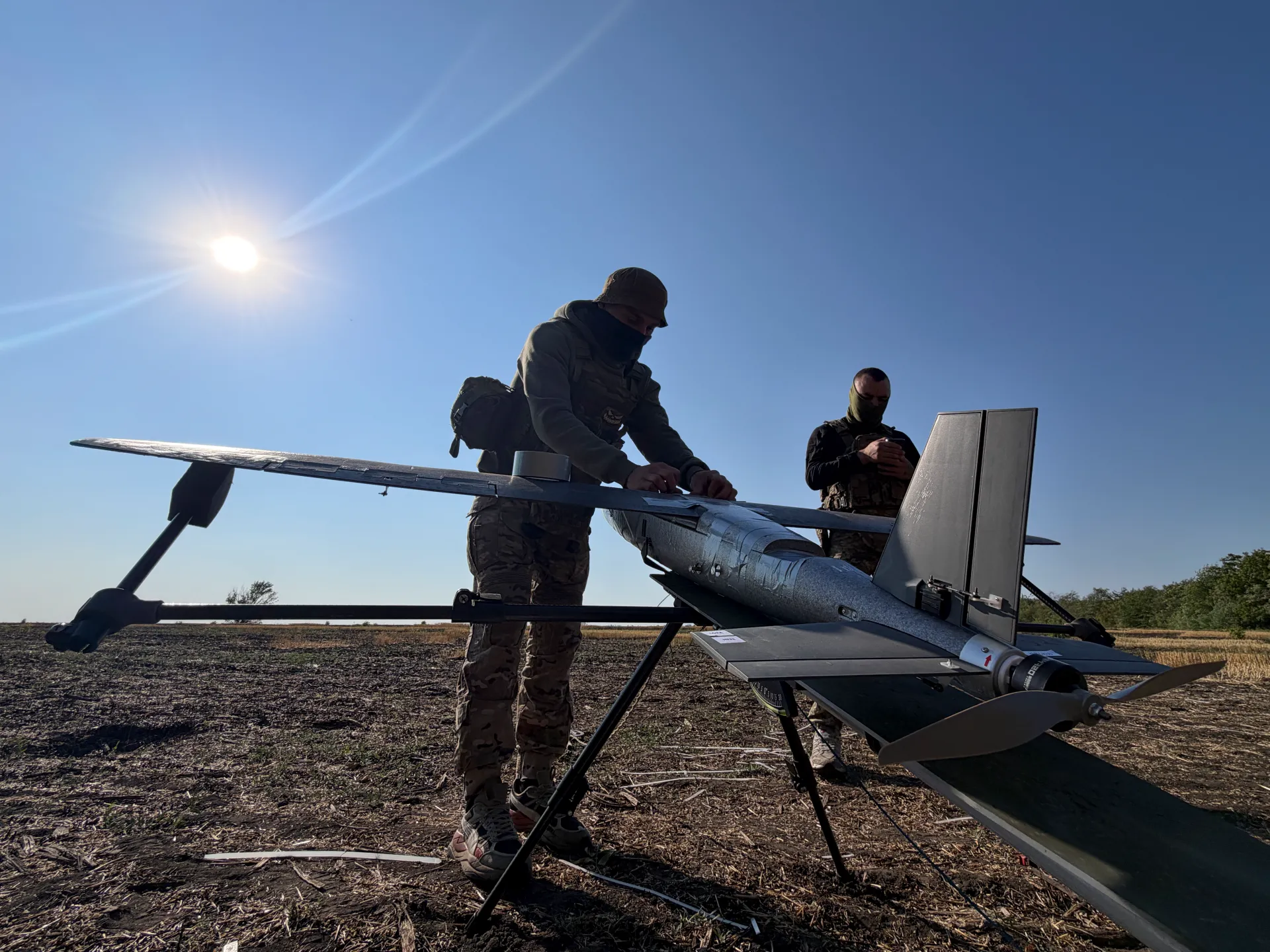
In place of an antenna, it featured an AI-powered minicomputer sold commercially by US technology company Nvidia, which rendered it capable of directing itself to the type of target it was programmed to spot – likely propane tanks in this case – lock on to it and proceed to strike.
AI-powered drones are the tip of the iceberg as Russia and Ukraine race towards boosting tech infrastructure aimed at coordinating reconnaissance and attack, according to analysts.
“It’s not about a drone having AI in it, and then seeing something and striking,” Marina Miron, researcher at the defence studies department at King’s College London, said. “Rather, it’s the drone seeing something, communicating to a software complex which knows how to map the GPS coordinates on a live battlefield map, and notifying the closest artillery unit.”
Referred to as reconnaissance-strike architecture, these unified battlefield management systems act like a central command. They track the location of friendly forces and identify enemy positions.
AI acts as the accelerator, instantly processing massive amounts of data collected through sensors in drones or any other military products, including interceptor missiles or artillery units.
The tactical advantage on the battlefield is given by the system’s ability to compress the kill chain – meaning coordinating and distributing the intelligence to military assets on the ground to find, track and destroy targets in a matter of minutes.
In such an ecosystem, AI-powered automated drones are just pieces of a broader puzzle.
Ukraine is known to be developing its system, which it named DELTA. Following operational trials in late 2025, Russia has been rolling out its version, the Svod Tactical Situational Awareness Complex, to front-line units.
Both sides claim that once the battlefield data is processed, a decision support system (DSS) presents a military commander with options to choose from, keeping a human in the decision-making loop, said Miron.
“In how far that is true is, of course, impossible to find out,” she added.
Acknowledging full AI autonomy would provoke ethical and legal questions.
Even if humans were to retain final decision-making authority, research has shown AI systems subtly shape choices, predetermining outcomes.
“Under time and pressure, commanders often do as AI suggests,” said Miron, whose research focuses on military AI and remotely piloted and autonomous systems.
Towards full automation
Coordinated AI-powered military systems are the next frontier of modern warfare, said Serhiy Beskrestnov, a Ukrainian Ministry of Defence adviser on loitering munitions, known by his callsign Flash.
“That’s what it will all come to,” he posted on his Telegram channel on July 1. “Navigation, search for a target, and attacks will be fully autonomous.”
Drones with some autonomous capabilities are already being deployed at scale.
Heorhii Volkov, commander of Ukraine’s Yasni Ochi drone strike unit, said this is currently mostly used in the final phase of long-distance strikes, where first-person view (FPV) drones are likely to lose radio connection due to electronic warfare or the curvature of the Earth.
The use of AI in so-called last-mile operations solves this battlefield hitch. If the signal is lost, an integrated AI-enabled onboard module takes full control of the unmanned vehicle, autonomously locks on the target and carries the strike to completion.
Yaroslav Azhnyuk, founder of Ukrainian technology company The Fourth Law, which develops AI-powered autonomy software for unmanned vehicles, said Russia and Ukraine were working to deploy a wider range of autonomous systems.
“This is not simply a race to demonstrate a fully autonomous drone. It is a race to make autonomy reliable, affordable and deployable at scale,” Azhnyuk told Al Jazeera. “Electronic warfare, increasingly long engagement distances and the growing number of drones are making human-controlled systems less sufficient. Autonomy solves exactly these constraints.”
Azhnyuk believes autonomy will become a game-changer over the next six to 12 months.
“The decisive advantage will belong to the side that can deploy reliable autonomy across tens or hundreds of thousands of systems, not just demonstrate it in prototypes,” he said.
Kateryna Bondar, senior fellow at the Center for Strategic and International Studies (CSIS), noted the dangers of AI’s reliance on algorithms.
“The system doesn’t understand what it’s doing; it’s just following the algorithm and the rules which people created,” said Bondar, who works at the CSIS’s Wadhwani AI Center. “AI has to be trained to recognise targets and engage these targets,” but writing code that distinguishes between a bus and a tank is easier than between a Russian and a Ukrainian soldier.
Additionally, cost-effective FPV drones have low-quality cameras and their resolution can be lowered further by adverse atmospheric conditions.
Military units using autonomous systems therefore “delegate the decision to a very imperfect technology that cannot distinguish between a civilian and a military person, combatant or non-combatant”, Bondar said.
“This is why there is a conversation around who makes a decision and who has responsibility for mistakes and errors.”
Yemen’s Houthi rebels have captured Mocha port and now threaten to control the main waterway of the Bab al-Mandeb strait. They have also attacked several cities in Saudi Arabia, wounding about 70 people, including women and children.
The repeated attacks against Saudi energy, civil, and defence facilities, combined with the maritime blockage by Iran and its Yemeni partner the Houthis, directly raise the question of the Mecca Pact’s operationalisation between Saudi Arabia, Turkiye, and Pakistan.
The Houthi attacks on Saudi Arabia can activate the mutual defence agreement. If that happens, what could a Pakistani and Turkish intervention look like?
The answer to this question necessitates some crucial background first.
The US – the main security partner of the Gulf states – has signalled for a while now that it expects regional countries to take primary responsibility for their own defence and deterrence, with US help remaining critical but limited.
That posture is already visible on the ground. Since the start of the US-Israel war on Iran, the US has not been able to provide comprehensive defence for its regional partners. On several occasions, it has even failed to stop attacks on its own bases in the Gulf.
With US presence receding and Washington emphasising regional burden-sharing, Gulf states have had to look into a new defence architecture. In September 2025, Saudi Arabia and Pakistan signed their first mutual defence agreement, which expanded in August this year to include Turkiye and became the Mecca Joint Defence Agreement.
The three countries have since established a joint secretariat, with its headquarters in Riyadh, with Pakistan taking the chairmanship for an initial three-year term.
The pact remains in a gestation period. It does not publicly identify the thresholds or scenarios under which a member would move to direct military intervention. Its organisational and institutional structure, including rules of engagement, mechanisms of consultation, and collective defence and deterrence, are yet to be formally developed.
Now, back to the question of how the pact will be operational if a member state is attacked.
Earlier this week, Pakistan’s Defence Minister Khawaja Asif said that an unprovoked aggression against Saudi Arabia, or a spillover of the Yemen conflict into the kingdom, would make the Mecca Joint Defence Agreement operational, adding that “there should be no doubt in this.”
Asif, however, did not share specific details on what shape that operationalisation would take. Last month, Turkiye’s Foreign Minister Hakan Fidan clarified that the Mecca Pact would work the same way as NATO: If a member state is attacked, it must actively request and define the specific type of help it needs.
NATO’s Article 4 allows for a member to call alliance consultations and exchange of information. Article 5 requires mutual assistance from allies, but it leaves each state to decide the nature of that assistance.
In 2012, after Syria shot down a Turkish warplane, Ankara invoked Article 4 for consultation and requested specific defence assistance. Instead of demanding direct military intervention, the Turkish government explicitly asked for Patriot missile defence batteries. NATO approved the request and deployed the systems to protect Turkish airspace.
In this context, if the Mecca Pact is to be operationalised, it would have to be Saudi Arabia that defines the type of military assistance and involvement that it needs. If, for example, Riyadh makes an actual request for Pakistani direct military intervention, beyond materiel and intelligence support, Islamabad would be obliged to comply. But the request, and the scale of the response, would still likely need to be defined and agreed in a consultation meeting.
For now, none of this has been tested as Riyadh has not invoked the pact with either Pakistan or Turkiye.
In the meantime, diplomatic efforts have intensified, with Pakistani Field Marshal Asim Munir and Saudi Foreign Minister Prince Faisal bin Farhan Al Saud talking to Iranian Foreign Minister Abbas Araghchi.
Islamabad has also publicly urged Iran to rein in the Houthis from attacking Saudi Arabia and threatening the Bab al-Mandeb, and has reminded Tehran of Pakistan’s commitment to Riyadh’s defence through the pact. Ankara would likely play its own part in diplomatically restraining the Houthis and Iran.
If diplomacy fails and Houthi attacks on Saudi Arabia or the Bab al-Mandeb continue, Turkiye and Pakistan would likely expand the air and technological support they already provide. Islamabad already has an air squadron of about 16 JF-17 Thunder multirole aircraft, defence systems, and thousands of troops deployed in Saudi Arabia.
But a direct military operation by Pakistani forces inside Yemen remains unlikely at the moment. Given the disastrous and lasting impacts of its participation in the Afghan war against the Soviet Union on behalf of the US, Pakistan would be far more wary of joining a war against Iran and its allies, for fear of spillover into its western border provinces’ economy, domestic security, sectarian balance, and societal harmony. Pakistani leaders would find it hard to build domestic consensus for direct attacks on the Houthis or a fight with Iran.
The likely scenario is that Pakistan would increase joint diplomatic pressure on Iran to restrain the Houthis, further augment its support for Saudi defence, and push for a multinational naval coalition to secure the Bab al-Mandeb. Adopting this restraint would still keep the essence of the Mecca Pact intact, while putting more weight behind regional de-escalation.
The new security architecture that agreements like the Mecca Pact are setting up will take years to mature. Until the mechanisms and rules of collective response develop, Pakistan’s existing bilateral defence relationships with Saudi Arabia and other Arab partners will continue to focus on defence needs.
The views expressed in this article are the author’s own and do not necessarily reflect Al Jazeera’s editorial stance.
TOKYO: Japan strongly condemned the attacks by the Houthis on Saudi Arabia and reiterated its call on them to refrain from escalating the situation both inside and outside Yemen.
“The Houthis’ continued military attacks have resulted in numerous casualties, including among civilians. Japan renews its strong denunciation of the recent series of attacks by the Houthis. Attacks on civilians and civilian facilities, as well as any actions that impede the free and safe navigation of vessels, cannot be tolerated,” Japan’s Foreign Ministry said in a statement on Friday night.
The ministry stressed that stability in Yemen is directly linked to the stability of the entire Middle East, and Japan reiterates the importance of achieving peace in Yemen. It also noted that peace and stability in the Middle East, including ensuring free and safe navigation through the Bab Al-Mandab Strait, are of the utmost importance to the entire international community, including Japan, from the perspective of energy security.
“Japan will continue to make every diplomatic effort, in cooperation with the international community, including Yemen and Saudi Arabia, toward an early de-escalation of the situation,” the statement said.
WASHINGTON — President Trump observed Friday’s 25th anniversary of the Sept. 11 attacks at a ceremony at the Pentagon by commemorating the lives lost when Al Qaeda militants hijacked planes and killed nearly 3,000 people in three locations and upended American foreign policy and national security.
Trump and First Lady Melania Trump listened as the names of the 184 people killed at the Pentagon that day were read aloud, a bell tolling between each. In his remarks, Trump recounted the stories of several of the victims and insisted that the moment has led to a fortification of American resolve.
“We will never, ever forget,” Trump said. “That’s why we fight today. We don’t have a choice.”
Earlier, in a downpour at daybreak, Defense Secretary Pete Hegseth and top military officials stood outside and watched as a giant American flag was unfurled on the building struck by one of those planes a quarter-century ago.
It was the second year in a row that Trump observed the day at the Pentagon. The president, who is originally from New York, last attended the ground zero ceremony there in 2024.
Vice President JD Vance attended the New York observance alongside former presidents, while other administration officials took part in the ceremony in Shanksville, Pa. Vance had planned to be in New York for the anniversary last year but instead flew to Salt Lake City to be with the family of Charlie Kirk after the conservative activist was fatally shot.
Widow calls on Trump to reconsider relations with Saudis
At one point during the solemn remembrance in New York City, a woman whose husband died in the attacks criticized Saudi Arabia and called on the Trump administration to rethink the United States’ tight relationship with the kingdom.
Terry Strada, who lost her husband Tom Strada on 9/11, called on Trump to “tell the Saudis to stop lying” and accused U.S. presidents of choosing “to protect the Saudis instead of standing with the 9/11 families.”
Strada, who was one of the 9/11 family members who read aloud the names of victims at this year’s remembrance, added that the current administration should “stand with the families, stand with the survivors.”
“It has been one betrayal after another. President Trump can still change that,” she said before calling on Vance to “carry that message back” to Washington.
Strada is part of a group of family members of 9/11 victims embroiled in a long-running lawsuit against the Saudis. They allege a group of extremist religious leaders in Saudi Arabia gained influence in the Saudi government and aided the hijackers. Fifteen of the 19 hijackers were Saudis, but the Saudi government has long denied any involvement in the attacks.
Trump and Hegseth try to bridge 9/11 and Iran war
Trump began his remarks by recalling the sense of American unity following the attacks. “In those harrowing days after the attacks, we saw the authentic spirit of our nation,” Trump said. “We were all New Yorkers that day. Every one of us. We were all New Yorkers. We were all family.”
The president and his Defense secretary sought to connect the events of 9/11 to the war with Iran. Trump saluted the service members “working right now to ensure the world’s No. 1 sponsor of terror — the Islamic Republic of Iran — will never, ever have a nuclear weapon.”
Hegseth used the moment to make the case that the U.S. military had “laid waste to the world’s most prolific state sponsor of terrorism” with the war against Iran.
“Our warriors have fought an Islamic theocracy that has wished us death for nearly half a century, that cheered on 9/11, a regime that has sponsored terrorist attacks against Americans for decades, killing thousands, including our comrades in Iraq, in Afghanistan,” Hegseth added.
Officials wonder if 9/11 could have been thwarted
At Friday’s commemorations, there was also a measure of reflection about whether 9/11, the deadliest attack on the U.S., could have been prevented.
Homeland Security Secretary Markwayne Mullin at a ceremony at his agency’s headquarters said it was a moment to consider the success of his department, which was established following the attacks and has “prevented it from happening again.”
Still, Mullin noted that Osama bin Laden, architect of the attacks, had fired “warning shots” in the years prior to 9/11 about his intent to carry out a major strike on the U.S. The U.S. national security apparatus certainly had “failures along the way,” Mullin said.
Condoleezza Rice, who was serving as White House national security advisor on 9/11, participated in Friday’s commemoration at the Pentagon. In her remarks, she acknowledged that she still feels deep pain that “those of us in authority on that day did not see the nature of the danger in time to prevent the attack of 9/11.”
“I will always carry deep personal remorse for the pain that you, the families of the fallen, still feel, and for the trauma that our country endured,” Rice said.
Binkley, Madhani and Kinnard write for the Associated Press. AP writers Anthony Izaguirre and Sagar Meghani contributed to this report.
CAIRO: An Iraqi military commander was dismissed early on Saturday after investigations confirmed the latest drone attacks targeting Saudi Arabia originated from Iraq, according to a statement by Iraq’s prime minister’s office.
The commander led operations in Maysan province in southern Iraq, according to the statement.
A quarter-century after the attacks on September 11, 2001, officials across the United States have taken part in tributes and memorials to honour the 2,977 victims and those who risked their lives as part of the rescue efforts.
The incident is considered the deadliest “terrorist” attack in US history.
Recommended Stories
list of 3 itemsend of list
Four planes were hijacked. Two crashed into the World Trade Center, causing its Twin Towers to collapse. A third struck the Pentagon outside Washington, DC. And the fourth plummeted into a field in Shanksville, Pennsylvania, after passengers and crew rose against their attackers.
Through social media messages, public speeches and appearances at ceremonies, US leaders on Friday took different approaches to remembering the lives of the thousands who perished on the fateful day.
Here’s what they said:
US President Donald Trump
US President Donald Trump speaks at the Pentagon in Arlington, Virginia, on Friday [Saul Loeb/AFP]
US President Donald Trump chose to stay in Washington, DC, to observe the 25th anniversary.
During the attacks, 184 people died near the capital when American Airlines Flight 77 struck the Pentagon, the headquarters of the US military.
Trump opted not to attend a Friday ceremony at the World Trade Center site in New York, where all his living presidential predecessors were in attendance.
His vice president, JD Vance, travelled to New York instead. The ceremony at the World Trade Center has a policy of not allowing political speeches.
In his remarks at the Pentagon, Trump described what happened as “true evil”. He also paid tribute to those who died in the attacks.
“We will honour their lives, we will cherish their beautiful memories, and we will protect this country and its freedoms for every future generation,” Trump said.
The president also praised US troops as he appeared to link the 9/11 attacks with his administration’s war against Iran.
“We will never, ever forget. That’s why we fight today. We don’t have a choice. There can only be victory,” Trump said.
“We salute the service members working right now to ensure the world’s number one sponsor of terror – the Islamic Republic of Iran – will never, ever have a nuclear weapon,” he later added.
US Secretary of Defense Pete Hegseth
US Secretary of Defense Pete Hegseth speaks at the Pentagon in Arlington, Virginia, on Friday [Saul Loeb/AFP]
US Defense Secretary Pete Hegseth also spoke at the Pentagon, delivering his remarks shortly before Trump’s.
He warned the audience to practice “eternal vigilance” against what he called continued threats.
“There are still enemies who hate us. Every day, enemies plot to curb our power and kill our citizens, including from Islamic terrorists abroad and at home,” he said.
He proceeded to seemingly use the 9/11 attacks as justification for the US-Israeli war against Iran, which started on February 28.
“Over the past six months, we have laid waste to the world’s most prolific state sponsor of terrorism,” Hegseth said, referring to Iran. “Our warriors have fought an Islamic theocracy that has wished us death for nearly half a century, that cheered on 9/11.”
He went on to claim that the US military has destroyed Iran’s defences and that the US controls the Strait of Hormuz, a vital waterway for international trade.
Iran has stopped commercial traffic through the strait since the start of the war.
“We’re still sending terrorists where they belong, to hell, and tankers to the bottom of the ocean where they belong,” Hegseth said. “And we’re ensuring that Iran will never have a nuclear weapon. The economic pressure tightens every day. We control the strait. We will finish this fight.”
New York City Mayor Zohran Mamdani
Former New York City Mayor Rudy Giuliani and New York City Mayor Zohran Mamdani attend the 25th anniversary commemoration of the attacks on September 11, 2001, on Friday [Barry Williams/AFP]
New York City Mayor Zohran Mamdani attended the New York memorial service, alongside the city’s former mayor, Rudy Giuliani, who led the city through the attacks.
Before the event started, Giuliani shook hands with the mayor, despite previously calling on Mamdani not to attend the event.
Mamdani, the city’s first Muslim mayor, had recently come under fire from some conservative politicians and victims’ family members who said his presence at the memorial would offend them.
A Change.org petition garnered more than 100,000 signatures from those who wished to express concern about Mamdani’s participation.
Like all politicians attending the service at the National September 11 Memorial, Mamdani was not permitted to speak.
Instead, the mayor released a video on social media remembering those who were killed and challenging the public to honour their memory by doing good works.
“Twenty-five years later, we have a sacred obligation to those who were stolen from us. To care for one another as they cared for strangers. To live lives worthy of the sacrifices they made. And to build a city worthy of their courage. A city where we run toward one another,” Mamdani said.
“That is how we’ll remember.”
On Tuesday, Mamdani also released a trove of previously undisclosed documents suggesting city officials tried to downplay – or even mislead – first residents about the dangerous air quality following the attacks.
US Senate candidate Abdul El-Sayed
Democratic candidate for US Senate Abdul El-Sayed participates in a town hall event in Waterford, Michigan [File: Emily Elconin/Getty Images via AFP]
Democratic Senate candidate Abdul El-Sayed took to the social media platform X to honour the lives lost during what he described as a “cruel act of terror”.
El-Sayed is locked in a tight midterm race in Michigan against his Republican opponent, former US Representative Mike Rogers.
Michigan’s open Senate seat is considered a must-win seat for Democrats, if they hope to take back control of the US Senate.
Rogers has sought to create controversy over El-Sayed’s past comments about the September 11 attacks. He has pointed to audio of El-Sayed reportedly saying, “9/11 scarred our country in profound ways, but what we did after 9/11 scarred millions of other people.”
During the Republican Party’s first-ever midterm convention in Dallas, Texas, on Thursday, Rogers blasted El-Sayed, who is Muslim, for being sympathetic to terrorists. He also sought to highlight El-Sayed’s links to left-wing internet commentator Hasan Piker.
“I never imagined that, 25 years after 9/11, I would be running against somebody who campaigns with Hasan Piker, who thinks America deserved it,” Rogers said. “Yep, but here we are.”
On Friday, however, El-Sayed used his social media post to push back against Rogers’s attacks.
“Nothing can justify the murder of innocent civilians. Nothing,” El-Sayed wrote.
He also called on Americans to help build a country that was “more inclusive, more empowering, more just” in tribute to the lives lost.
“They didn’t just attack America that day. They attacked the idea of America,” El-Sayed said of the 19 al-Qaeda hijackers who participated in the attacks.
“The notion of a nation brought together by ideals where it doesn’t matter how you pray or if you pray at all. A place where freedom and commitment to justice bind us, even if at times we struggle to fully realise it.”
RIYADH: Saudi Arabia temporarily shut down its East-West Pipeline after it was targeted in several attacks in the Riyadh and Madinah regions, the Ministry of Energy said on Friday.
Several people were injured in the attacks, which took place on Thursday morning, and medical treatment, the ministry said in a statement.
Emergency and specialized technical teams were deployed immediately following the attacks to secure the pipeline and assess its safety in coordination with the relevant authorities, the ministry added.
The shutdown was carried out as a precaution and any further developments would be announced as they arise, according to the statement.
The Iran-backed Houthis earlier this week targeted civilian and energy infrastructure targets in Saudi Arabia’s Abha, Khamis Mushait, Jazan and Najran. The attacks caused several fires at oil facilities in the southern region that led to a temporary halt in some operations, the Energy Ministry said.
The Coalition to Support Legitimacy in Yemen condemned the attacks on Saudi Arabia, which wounded 73 civilians, including women and children, vowing to take measures to neutralize the threat.
NEW YORK — Americans commemorated the 25th anniversary of 9/11 on Friday, remembering the shock, the dead and the sweeping consequences of the al Qaeda attacks on symbols of U.S. might and prosperity.
The milestone anniversary brought memorial rituals — wreath-laying, flag-flying, moments of silence, vigils and readings of victims’ names — and volunteer projects in tribute to a day that about half of U.S. adults remember as the most historic event of their lifetime, according to a new poll. On Sept. 11, 2001, al Qaeda extremists hijacked four commercial jets and crashed them into New York’s World Trade Center, the Pentagon and a field near Shanksville, Pennsylvania, killing nearly 3,000 people.
Elsie Caldwell carried a photograph of her son Kenny Caldwell to the trade center to hear his name and all the others read aloud Friday morning. She last spoke to him that morning a quarter-century ago.
“Mom, I just want to let you know that I love you,” Caldwell said he told her in a final phone call. His remains, like those of many other victims, have never been recovered.
Trump attends Pentagon observance
The attacks brought down the World Trade Center’s twin towers — icons of U.S. economic power, and among the tallest buildings on Earth — and blew a hole in the Pentagon, the U.S. military’s fortress-like headquarters near Washington. The fourth plane was headed for Washington, officials concluded, but the aircraft went down in Pennsylvania after passengers and crew members stormed the cockpit and fought the hijackers.
“Sept. 11 reminded us of the terrible power of hate,” President Trump said Friday at the Pentagon’s anniversary ceremony Friday.
“The 25 years since have shown us the even greater power of the American spirit to endure and prevail, and to win,” added the Republican, who was in his native New York on 9/11.
Former President George W. Bush, who was in office on 9/11, and ex-Presidents Clinton, Obama and Biden and current Vice President JD Vance convened for the observance at the National Sept. 11 Memorial in New York. Other administration officials went to the Flight 93 National Memorial in Pennsylvania.
At ground zero, a new tribute to those who fell ill
For Angilic Casalduc, attending the New York commemoration “helps to show you’re not alone.” She lost her mother, Vivian Casalduc.
“There’s no timeline for grief, and unfortunately, no one can say how can you can grieve, but coming here once a year makes it feel just a little bit better,” she said.
Traditionally, there are no political speeches at the ground zero commemoration, where victims’ relatives read aloud the long list of names and added personal messages. They thanked first responders and the military, invoked religious faith, appealed for national unity and touched on the U.S. relationship with Saudi Arabia. The kingdom was the homeland of most of the hijackers but denied any involvement in the attacks.
Mostly, relatives spoke of, and to, loved ones — who some were too young to remember.
“You dreamed my whole life for me, and you only got eight months of it,” said Trisha Pakka, who lost her mother, Deepa Pakkala.
The ceremony has long been punctuated with moments of silence at key points in the attack timeline and this year organizers added another moment to honor people who were exposed to the clouds of toxic dust released by the twin towers’ fiery collapse and have since died of cancer and other illnesses. Questions remain about how many people developed health problems linked to the dust.
The impact of 9/11 endures
It’s a reminder of how the attacks’ long shadow has reached into many corners of life in the U.S. and beyond.
The U.S.-led global war on terrorism included invasions of Iraq and Afghanistan — the latter Washington’s longest war — and detentions and harsh interrogation of terror suspects in an international network of secret CIA prisons. The U.S. found and killed al-Qaida leader Osama bin Laden in Pakistan in 2011, but accused 9/11 mastermind Khalid Sheikh Mohammed still awaits a trial 23 years after his capture.
The attacks changed U.S. air travel, led to the creation of the Department of Homeland Security, prompted new federal surveillance and intelligence-gathering powers and banking regulations and generated ongoing debate over the balance between security and freedom.
Sept. 11 engendered a culture of individual vigilance summed up by the slogan “ if you see something, say something,” while a wave of patriotism propelled some Americans to join the military, fire departments, police forces or other public agencies.
Casey Kloepfer became a New York police officer this June. He was 4 when his father, Officer Ronald Kloepfer, was killed at the trade center.
“It’s big footsteps to fill, but it’s definitely something that I take very seriously and want to continue to honor him and be the best police officer I can,” the 29-year-old, who wears his father’s badge number, said by phone this week.
New York’s mayor comes under scrutiny
Amid the post-9/11 calls to service and appeals for national unity, the attacks also fanned mistrust, prejudice and hate crimes directed at Muslims.
In the quarter-century since, Muslim Americans have played a growing role in public life from statehouses to Congress to New York City Hall, where Zohran Mamdani is the city’s first Muslim mayor. Yet he faced some criticism for attending the anniversary ceremony at ground zero.
Republican ex-Gov. George Pataki and 9/11 victims’ relatives cited, among other things, past remarks that some of Mamdani’s political associates have made about the attacks. Former Mayor Rudy Giuliani, a Republican, also inveighed against Mamdani attending the remembrance, though the two shook hands there Friday.
Mamdani, a Democrat, said this week he loves the city and country and that he wanted the anniversary to focus on victims’ families, first responders and New Yorkers who helped one another after the attacks, which he called a “horrific act of terror.” The 34-year-old mayor was an elementary school student in New York on 9/11.
Times Square billboards pause advertisements
Remembrances extended far from the attack sites, including beams of light projecting from New Hampshire’s Mount Washington, a stair climb at Mississippi State University’s football stadium and a ceremony at Honolulu’s 9/11 memorial.
Sept. 11 isn’t a federal holiday, but Congress has designated it both Patriot Day and a National Day of Service and Remembrance.
“One appropriate way to remember is by serving,” says Jay Winuk, who lost his brother Glenn Winuk and then co-founded the volunteer organization 9/11 Day with friend David Paine. The group helps people find volunteer opportunities and this year arranged for dozens of Times Square billboards to pause their advertising at 9:11 a.m. Friday.
Instead, they simply displayed the time.
Peltz and Shaffrey write for the Associated Press. AP journalists Michael R. Sisak, Anthony Izaguirre, and Julie Walker contributed to this report.
Israeli attacks come a week after it said to have established operational control over the strategic ridge.
Published On 10 Sep 202610 Sep 2026
The Israeli military says it has destroyed Hezbollah’s underground infrastructure at a key site in southern Lebanon, with Israeli government officials adding that the operation consolidated its so-called security zone in the area.
In a joint statement, Prime Minister Benjamin Netanyahu and Defence Minister Israel Katz said on Thursday that Israeli forces would remain in the area to prevent the Iran-aligned Hezbollah militant group from re-establishing its presence and rebuilding its capabilities.
Recommended Stories
list of 4 itemsend of list
The Ali al-Taher ridge, about 15 km (10 miles) from the Israeli border, has become one of the most contested areas of the war between Israel and Hezbollah. Katz claimed last Friday that Israeli forces had driven Hezbollah fighters out of what he said was a network of tunnels under the disputed highland.
Reuters reported that Hezbollah is believed to have built an underground command centre and weapons stores there in July, quoting unnamed Lebanese security sources.
Lebanon’s National News Agency said that the Israeli military carried out a powerful blast at the ridge, with tremors and the sound of the explosion felt across Nabatieh and surrounding areas in southern Lebanon.
Hezbollah has yet to respond to the recent Israeli attack.
The Israeli military said its forces had established “operational control” over the ridge, both above and below ground, before dismantling the infrastructure. The network extended for more than 2 km (just over 1 mile) and contained dozens of rockets, missiles and drones, as well as anti-tank missiles, mines and explosive devices, it said.
The military said a central command complex belonging to Hezbollah’s Badr unit was located within the underground infrastructure. The complex contained command centres, weapons storage rooms and living quarters that allowed fighters to remain underground for extended periods, it said.
Iran reportedly warned the United States last month that it would respond forcefully if Israeli attacks on the ridge continued.
Over the last weeks, Israeli strikes and ground operations around the Ali al-Taher ridge continued despite a ceasefire agreed in June, after Israel gained control of nearby Beaufort Castle and part of the higher ground overlooking much of southern Lebanon and northern Israel.
A US-brokered framework agreed after a June ceasefire — between Lebanon and Israel, without negotiating with Hezbollah — called for Israeli forces to gradually withdraw from southern Lebanon while Lebanese troops disarm Hezbollah.
The process has stalled, however, with Hezbollah refusing to give up its weapons and Israel saying it will not withdraw until the group disarms.
Since 2023, Israel has pushed into southern Lebanon and seized several strategic positions, occupying swathes of land, which it now increasingly says it needs to maintain a so-called buffer zone between Israel and Hezbollah positions in Lebanon.
Ukraine launches one of its deepest strikes to date, targeting gas plants in Russia’s Arctic region.
Published On 10 Sep 202610 Sep 2026
Russian forces have launched attacks across Ukraine, killing at least seven people, according to Ukrainian officials, as Kyiv claimed responsibility for a drone attack that set off a fire at a natural gas plant deep in Russia’s Arctic region.
Four people were killed in a Russian attack in Mykolaiv in southern Ukraine overnight on Thursday, while three were killed in a drone attack on a shopping centre in the northeastern city of Sumy, according to Ukrainian authorities.
Recommended Stories
list of 3 itemsend of list
Heorhii Reshetilov, the acting governor of the Mykolaiv region, said the Russian strikes there hit both civilian and industrial infrastructure, killing two men and two women. At least 19 others were wounded, he said on Telegram.
The attack in Sumy left at least 14 people wounded, according to Oleh Hryhorov, head of the Sumy Regional Military Administration. Three of the victims were children, he said on Telegram.
The Russian Ministry of Defence confirmed the attack in Mykolaiv, but said it targeted a drone warehouse. The ministry said it also hit the Ukrainian port of Chornomorsk and two vessels near Odesa on the Black Sea.
The targets of the strikes were being used for military purposes, the ministry claimed.
The attacks came after Russian authorities said Ukrainian forces had launched a drone attack on the country’s Yamal-Nenets region, which is located some 2,800 kilometres (1,700 miles) from the Ukrainian border.
Dmitry Artyukhov, the region’s governor, said the attack targeted an industrial facility in Novy Urengoy. The attack was repelled, but falling debris from the drone caused a fire, he said on Telegram.
“The main thing is that there were no deaths or injuries. The extent and nature of the damage are being determined,” he added.
Artem Zhoga, the Kremlin’s envoy to the Urals, said Wednesday’s strike was the first ever to hit the Arctic part of the region.
Ukraine’s Special Operations Forces (SOF) confirmed the attack in a series of posts on X.
“For the first time! Deepest strike of the war: Ukrainian SOF hit critical russian plants more than 3,000 km away,” it said. “Ukraine’s Special Operations Forces carried out the deepest strike inside russia since the beginning of the full-scale war.”
In the posts, the Ukrainian force claimed it “successfully struck” two gas plants, Novy Urengoy and Purovsky.
“Until today, the area was considered a safe rear zone for the aggressor,” it added.
The Ukrainian force said the facilities play a key role in Russia’s gas industry, processing large volumes of condensate from gas fields across the Yamal region, processing millions of tonnes of condensate per year.
Gazprom used to export gas from Yamal as far as Western Europe until relations broke down following the start of Russia’s war in Ukraine in 2022.
It estimated the region’s gas resources at 26.5 trillion cubic metres as of 2020, enough to cover global demand for more than six years.
Ukraine has escalated its long-range strikes on Russia in recent months, in retaliation for daily Russian bombardment of Ukrainian towns and cities.
Earlier this month, Ukrainian President Volodymyr Zelenskyy said his country’s drones would make Russian airspace “completely unsafe” for the duration of the war.
RIYADH: Qatar on Wednesday condemned Houthi attacks on civilian and economic sites in southern Saudi Arabia during a phone call between the two countries’ foreign ministers.
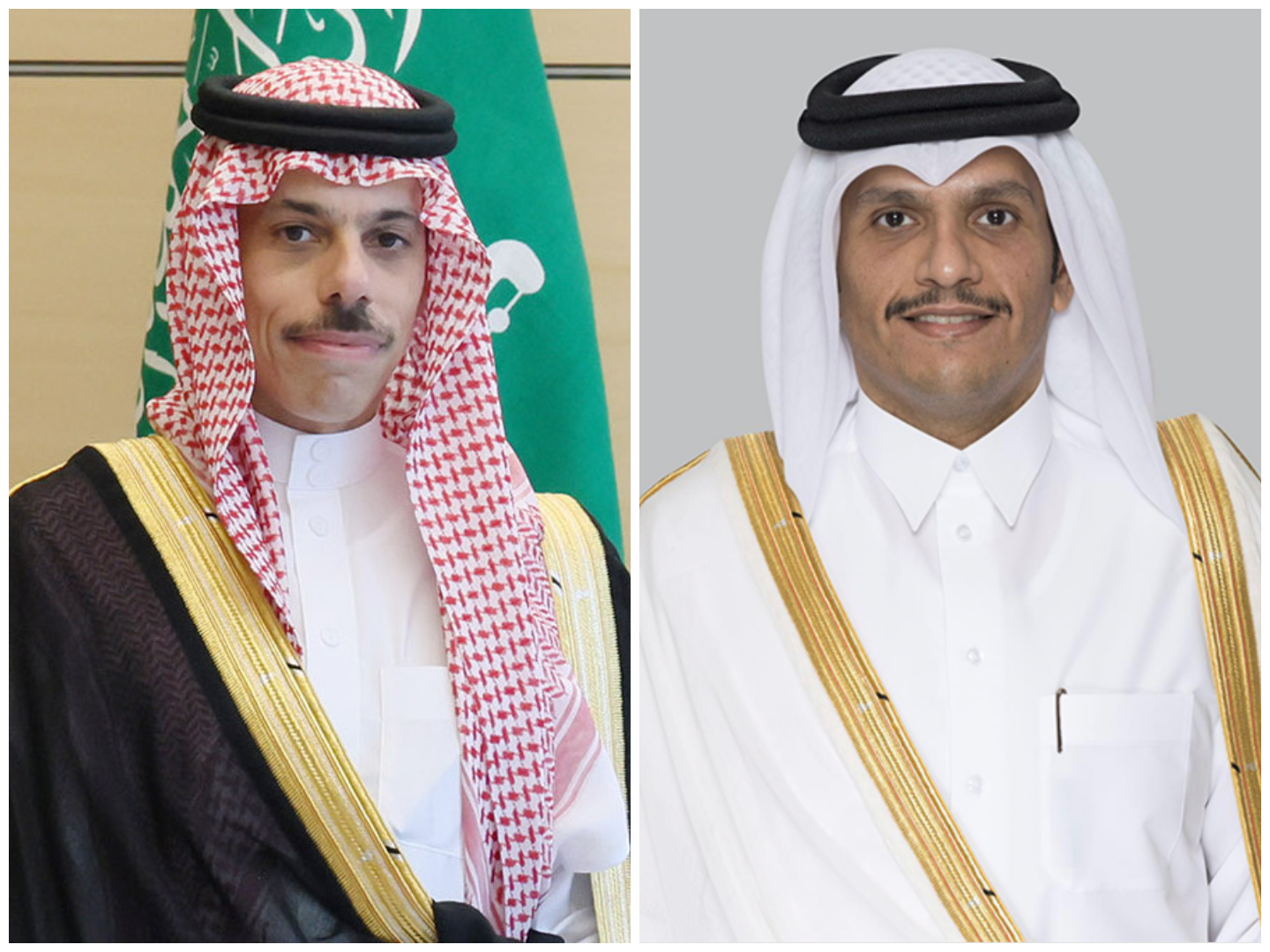
Qatari Prime Minister and Foreign Minister Sheikh Mohammed bin Abdulrahman Al-Thani expressed his country’s condemnation of the attacks during a call with Saudi Foreign Minister Prince Faisal bin Farhan, the Saudi Press Agency reported.
The two officials also discussed the latest regional developments and diplomatic efforts by Saudi Arabia and Qatar to de-escalate tensions and preserve regional security and stability, SPA said.
The call came as the Iran-backed Houthis targeted civilian and economic sites in the southern cities of Abha, Khamis Mushait, Jazan and Najran, injuring 73 civilians, including women and children.
Operations at some energy facilities were temporarily halted.
The Saudi-led coalition described the attacks as a “dangerous escalation” and said it would take measures to protect the Kingdom’s sovereignty, civilians and national assets.
Qatar’s Foreign Ministry separately condemned the attacks on Tuesday as a “dangerous escalation” and a violation of Saudi sovereignty and international law.
Doha reaffirmed its “full solidarity” with the Kingdom and its support for measures taken to protect its sovereignty, security and territorial integrity, adding that Saudi security was an integral part of the collective security of Gulf Cooperation Council states.
It also called on the international community to take a firm position against the attacks and ensure the implementation of relevant UN Security Council resolutions concerning Yemen and the security of navigation in the Red Sea.
Fighting between the Houthis and forces aligned with Yemen’s internationally recognized government has intensified in recent weeks, raising fears of a return to wider conflict after a UN-brokered truce in 2022 largely halted years of fighting between the Houthis and the Saudi-led coalition.
The Houthis, who control Sanaa and much of northern Yemen, declared a naval blockade against Saudi Arabia in July and have since stepped up attacks on the Kingdom and vessels in the Red Sea. Saudi-backed Yemeni government forces have meanwhile launched an offensive on several fronts against Houthi-held areas.
US military says it struck the five Iranian tankers after IRGC targeted a US warship twice in two days.
The United States has claimed attacks on five Iranian oil tankers in the Gulf of Oman and near Kharg Island after accusing Iran of launching ballistic missiles at a US warship twice in two days.
Iran responded to the attacks on Tuesday by firing missiles at US forces stationed at the Al Azraq base in Jordan. Amman said its air defences intercepted and destroyed 18 of 20 Iranian missiles, while the rest fell in open areas.
Recommended Stories
list of 3 itemsend of list
The exchange of fire comes amid escalating tensions in the Gulf, six months into the US and Israel’s war on Iran, with Tehran maintaining the closure of the Strait of Hormuz and Washington imposing a naval blockade on Iranian ports.
The hostilities briefly drove oil prices to $99.46 earlier on Tuesday.
In a statement, the US Central Command said Iran’s Islamic Revolutionary Guard Corps (IRGC) had targeted a US warship twice over the past two days. The warship “successfully evaded the attempted Iranian attacks” and “no American personnel were harmed”, it said.
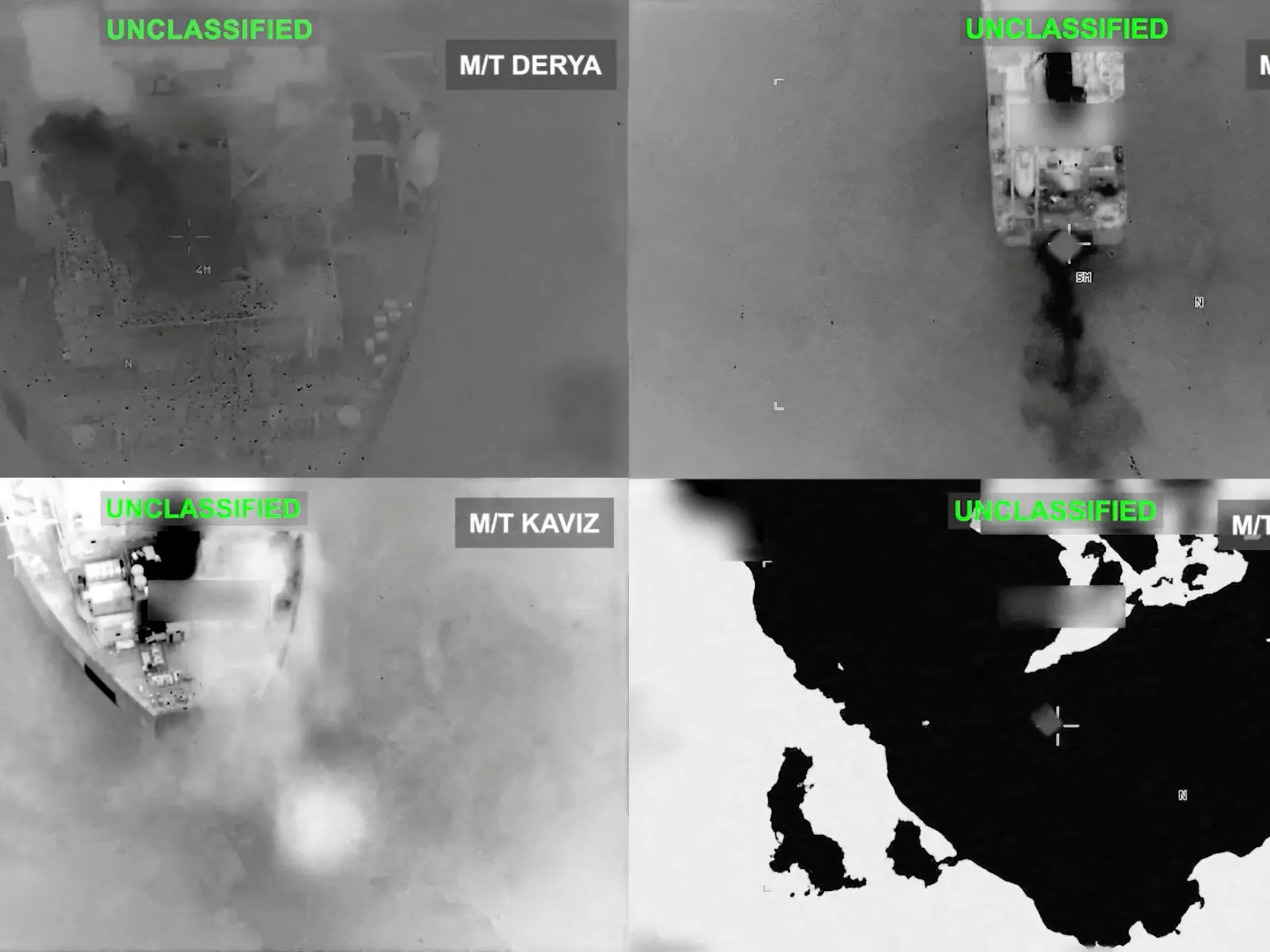
The Central Command said it retaliated by destroying the Iranian oil carriers, M/T Kaviz, M/T Charminar, M/T Horizon 1, and M/T Riesco in the Gulf of Oman as well as M/T Derya near Kharg Island.
“American forces directed the crews to abandon ship before the vessels were struck and rendered inoperable,” the Central Command added.
Iran’s IRIB state broadcaster confirmed the attack near Kharg Island in the Gulf, which handled some 90 percent of Iran’s oil exports before the war. It reported that the crew was evacuated and said a second tanker was hit near the southern port of Jask on the Gulf of Oman.
The IRGC also said “several” Iranian commercial ships were hit, and said it retaliated by subjecting Al Azraq base in Jordan to “fierce missile strikes”. It claimed hangars used by US fighter jets were destroyed in the ballistic missile attacks.
It went on to claim ballistic missile attacks on the US Navy DDG-119 and DDG-53 destroyers, saying “significant damage was caused to these vessels”.
The IRGC also threatened to target oil tankers in Kuwaiti and Bahraini ports, warning crews there to evacuate immediately.
“We warn all the crews of oil tankers in the Kuwaiti and Bahraini ports… to immediately abandon their vessels, whether at anchor or at the ports, because they will be targeted,” it said.
Jordan’s Armed Forces, meanwhile, said its air defences engaged 20 ballistic missiles, “successfully intercepting and destroying 18 of them”. Two missiles “fell in unpopulated areas,” it said in a statement.
The attacks did not cause any casualties and specialised teams “have begun securing the locations where debris and shrapnel fell,” it added.
Earlier, the chief of staff of Iran’s Armed Forces, Ali Abdollahi, had warned that Tehran would strike US military installations across the region if Iranian tankers were targeted.
“The US aggressor army has given Iranian oil tankers an evacuation warning to hit them, so I announce that any attack on Iranian oil tankers will result in the targeting of US bases in the region by the armed forces of the Islamic Republic of Iran,” Abdollahi said on state TV.
US Secretary of State Marco Rubio, however, said Washington would continue to strike Iranian ships.
“Iran continues to try to hit US naval ships, and for every time they do that or try to do that, they’re going to lose tankers,” Rubio told reporters on a visit to Colombia.
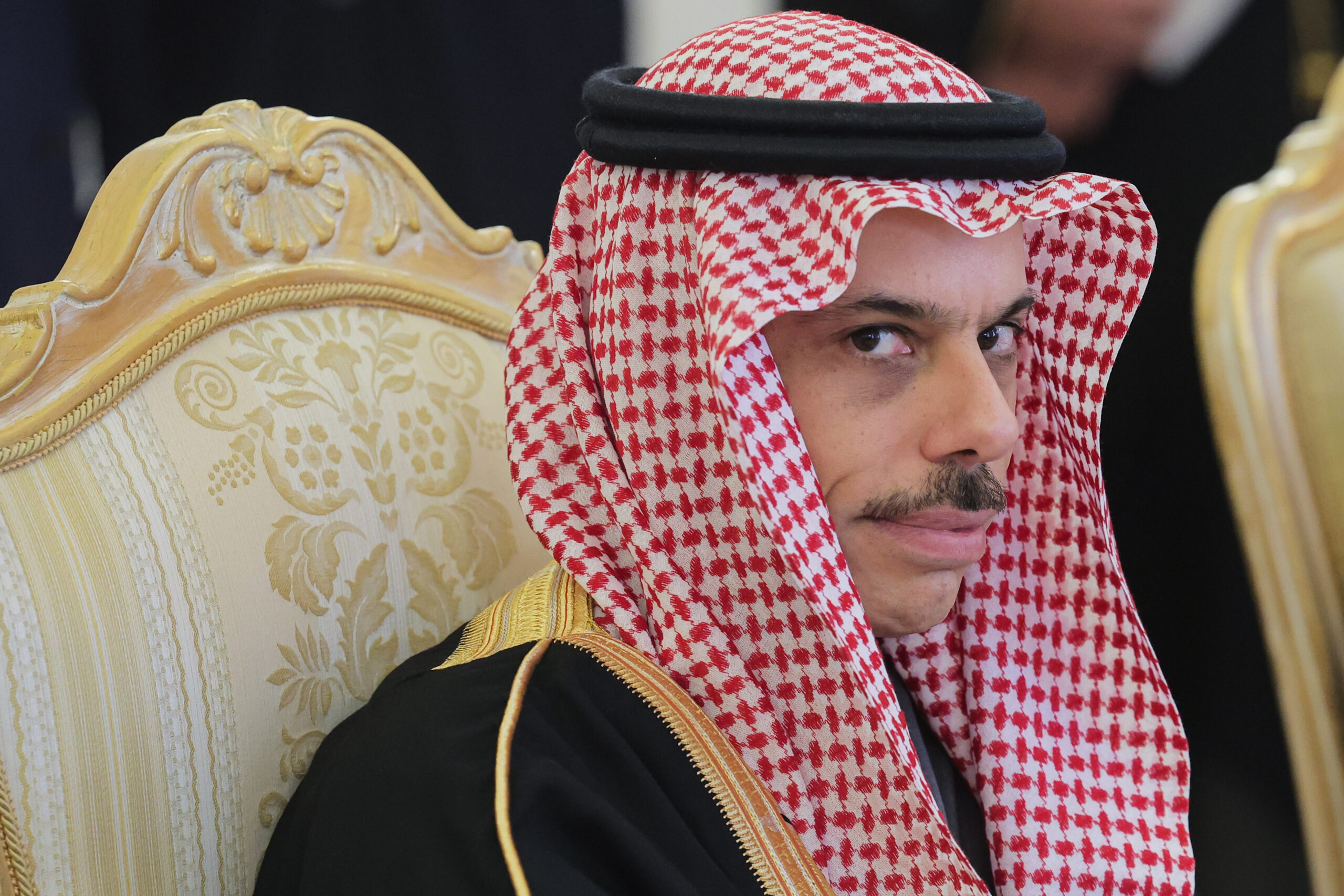
DUBAI: Saudi Arabia’s foreign minister, Faisal bin Farhan, said on Tuesday the Kingdom will not hesitate to defend itself against Houthi attacks.
Speaking from Russia’s capital, the minister said the Kingdom would use all available means to protect its interests.
“Houthi militia resorts to violence whenever it finds itself in a difficult situation. The Houthis are trying to export their domestic problems inside Yemen to Saudi Arabia,” he added.
The minister said the door for diplomacy was open for the Houthis but that they resorted to violence whenever they found themselves in a difficult situation.
Russian FM Sergey Lavrov said Houthi attacks on civilian targets in Saudi Arabia were unacceptable.
“Security and freedom of navigation in the Bab el-Mandeb Strait must be ensured,” he added.
Saudi Arabia says a wave of Houthi attacks on the country’s south have injured 73 people, including women and children. The strikes reportedly hit civilian and economic sites, as fighting intensifies in Yemen.
An Israeli air attack on Kfar Reman in southern Lebanon has killed at least 10 people, including an infant, with at least two others missing.
The attack early on Monday on the town in the Nabatieh district comes a day after at least seven people were killed and 20 others were wounded in Israeli air raids on the nearby town of Arab Salim.
Recommended Stories
list of 4 itemsend of list
The Israeli military also struck a residential area in the town of Deir al-Zahrani in southern Lebanon overnight after it issued a forced evacuation order. The army says it targeted a building near a Hezbollah facility, which it claims was used to launch an explosive drone.
Attacks continued despite a United States-brokered ceasefire agreement between Israel and Lebanon in June.
Reporting from Kfar Reman on Monday after overnight strikes, Al Jazeera’s Zeina Khodr said “uncertainty and fear” are the prevailing feelings in southern Lebanon. “Among the dead are children, including a two-month-old infant,” she said.
“People just do not know what is next. There’s been a wave of Israeli attacks over the past 48 hours. Civilians are being killed. Residential homes are being destroyed,” she said, adding, “Recovery efforts by civil defence workers are continuing. They’ve been here throughout the night.”
TEHRAN: Iran said Sunday that its forces attacked a US naval drone trying to enter the Strait of Hormuz, hours after targeting ships in retaliation for American strikes on three oil tankers.
The latest round of clashes, which began with US raids last week, comes amid a deadlock in their six-month war.
Iran has maintained its stranglehold on the strategic Strait of Hormuz while Washington continues a counter-blockade of Iranian ports.
Washington is also seeking to choke Iran’s economy, rolling out sanctions on entities with financial links to the Islamic republic in a bid to force it into submission.
The Islamic Revolutionary Guard Corps, the ideological arm of Iran’s military, said Sunday it “attacked an American military unmanned surface vessel” attempting to enter the strait, according to a statement carried by state television.
Hours earlier, the IRGC said its naval forces “targeted three oil tankers on the unauthorised route of the Strait of Hormuz and three vessels affiliated with the child-killing America in other areas”.
Iran’s top negotiator Mohammad Bagher Ghalibaf threatened on Sunday to launch swifter and more forceful responses to US attacks.
“The Americans must have understood that the era of proportionate responses has come to an end,” said Ghalibaf in a speech carried by state media, adding that “any aggression against Iran’s interests and security will receive a faster, more intense and more painful response”.
It warned ships not to attempt to transit by unapproved routes.
On Saturday, US Central Command (CENTCOM), which oversees American military operations in the region, said it struck tankers linked to the Iranian Guards, accusing the most powerful arm of the Iranian military of unsuccessfully firing at American warships.
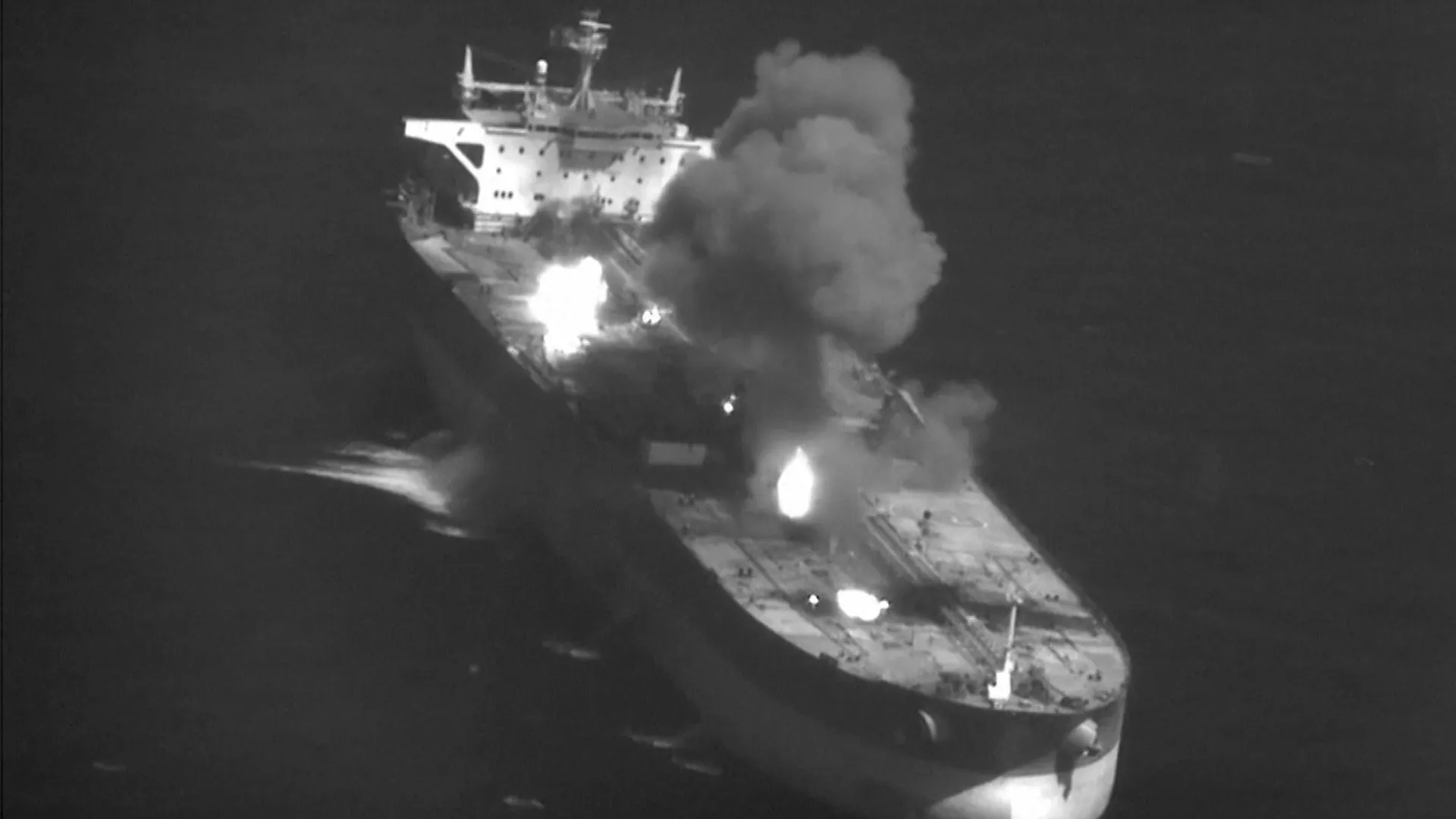
“Following Iran’s failed attacks, CENTCOM permanently disabled the IRGC crude oil carriers M/T Downy off the coast of Kharg Island and M/T Stark 1 near Jask,” it said.
“American forces also completely destroyed the unladen crude oil carrier M/T Kylo… in the Gulf of Oman, striking the vessel in multiple critical locations to render it inoperable after the crew was directed to abandon ship.”
Video posted by CENTCOM showed large fireballs and billowing flames after projectiles slammed into the ships.
The three vessels were “part of a multibillion-dollar shadow network that funds the IRGC and its regional proxies”, it said.
‘Higher economic cost’
The Guards meanwhile claimed the two American warships they targeted had been “forced to retreat” after “suffering damage”, but CENTCOM said those ships successfully evaded Iranian attacks.
CENTCOM commander Admiral Brad Cooper said after the operation: “If you shoot at two of our ships, we will impose an even higher economic cost — taking out three of yours.”
The Iranian foreign ministry hit out at Washington over the strikes on oil tankers, calling them “illegal and aggressive actions”.
A correspondent for Iranian state TV in Jask in the southern province of Hormozgan said one of the tankers was empty and the second was carrying oil. The crews were transported to shore on lifeboats, they said.
Another state TV correspondent on Kharg Island said the attack there caused no casualties.
Iran’s Khatam-al Anbiya central military command warned that if the US continued its attacks, then Tehran’s retaliation against US warships would be “more severe than before, and there is a possibility of their expansion”.
The administration of US President Donald Trump has tried to downplay the significance of the six-month conflict, which has proven increasingly unpopular at home as midterm elections near.
US Vice President JD Vance went so far as to say that he “wouldn’t call it a war”.
Trump reiterated that view on Friday, calling the war “small potatoes” for Washington.
Iran’s Security Chief Mohsen Rezaei warned this week that the Islamic republic had adopted a “new strategy” against Washington that “will shatter your foundations”.
The US has been trying to step up pressure on Tehran in a bid to wrestle control of the Hormuz strait, through which one-fifth of world oil supplies previously flowed.
A fragile ceasefire between the two sides collapsed in July after attacks on commercial ships in the strategic waterway.
Trump has in recent weeks repeatedly threatened to claim sovereignty over the strait, even posting a map showing it as “new US territory”.
Vance has insisted the US will not reopen talks with Iran until it ends attacks on commercial shipping in Hormuz.
US Central Command says its forces struck three Iranian crude oil carriers on Saturday, in retaliation for Iranian forces firing ballistic missiles towards two US warships ‘patrolling regional waters’.
Yemen’s internationally recognised government has launched a series of air attacks against Houthi positions in the country, marking a significant escalation in the conflict, with some of the country’s heaviest fighting since a fragile truce in 2022.
Government warplanes carried out at least 15 strikes on Friday against Houthi positions, gatherings and vehicles in the western provinces of Taiz and Hodeidah, according to the Yemeni military.
Recommended Stories
list of 4 itemsend of list
The air assault against Houthi positions provided support to government forces fighting a major Houthi offensive towards the Red Sea coast and the strategic Bab al-Mandeb Strait, one of the world’s most important shipping routes.
These are not the first air attacks by government aircraft since Yemen’s fragile truce began to unravel in July. On July 25, government aircraft struck Houthi missile and drone launch sites and weapons depots in Marib and al-Jawf, according to Yemeni military officials cited by the Reuters news agency.
And less than two weeks earlier, on July 13, Yemen’s internationally recognised government said its forces had struck the runway at the Houthi-held Sanaa International Airport to prevent an Iranian aircraft from landing.
However, the latest attacks mark a significant step up in the government’s use of its own air power against the Houthis, after Saudi-led coalition aircraft provided much of the aerial firepower supporting anti-Houthi forces during the most intense years of Yemen’s war.
Friday’s air campaign comes as the Iran-backed Houthis, who have been vying for control of Yemen for years, attempt to advance through western Taiz and southern Hodeidah towards al-Makha (Mocha), and territory overlooking the critical Bab al-Mandeb Strait at the opening to the Red Sea.
Control of the area could strengthen the Houthis’ position along the Red Sea, where the group has previously attacked commercial and military vessels, while threatening a key government supply route.
The fighting unfolds against a backdrop of the wider regional conflict, with the Houthis recently declaring a Red Sea maritime blockade against Saudi Arabia, while disruption to shipping through the Strait of Hormuz during the US-Israel war with Iran has raised the strategic importance of alternative routes through the Red Sea. This means any expansion of Houthi influence around Bab al-Mandeb could have consequences for shipping far beyond Yemen.
Here’s what we know.
What has happened?
Fighting erupted on Thursday as Houthi forces launched a major offensive along front lines in western Taiz and southern Hodeidah, using ballistic missiles, drones and artillery as ground forces attempted to advance towards government-held territory along the Red Sea coast.
The fighting has centred on areas west of Taiz and around al-Makha, a government-held port near the Bab al-Mandeb Strait.
A Yemeni official in Aden told the AFP news agency that the Houthis were seeking to capture hills overlooking Bab al-Mandeb and al-Makha before pushing towards the coast.
Al Jazeera’s Yousef Mawry, reporting from Sanaa, said Houthi forces had made gains in western Taiz.
“According to military officials from the internationally recognised government, the Houthis have been able to take some of those territories,” Mawry said. “In western Taiz, they’ve managed to take over a strategic military base, which is settled on top of a strategic mountain and gives the Houthis an overview of the entire area.”
Mawry said there had been particularly heavy fighting around al-Barah and Maqbanah, where a main road is used to resupply government forces stationed in Taiz and al-Makha.
More than 120 fighters have been killed since the Houthi offensive began, according to an AFP tally, making the clashes among Yemen’s deadliest in years.
Several civilians were also reported killed and others injured after a ballistic missile hit a restaurant in the al-Makha area, according to government-run Saba TV.
On Saturday, at least four civilians were killed and nine others injured in a Houthi missile strike on a crowded road in southwestern Yemen, according to Saba news agency.
The attack by the Iran-backed group on Saturday targeted a gathering of civilians along the strategic Heijah al-Abd Road, south of Taiz city, Saba said, citing local and medical sources.
What is behind the latest tensions?
The Houthis seized Yemen’s capital, Sanaa, in September 2014 and subsequently took control of much of northern and western Yemen, prompting a Saudi-led coalition of Arab countries to intervene in support of the internationally recognised government in March 2015.
A United Nations-brokered truce in April 2022 sharply reduced fighting. Although the agreement formally expired six months later, large-scale hostilities between the Houthis and Saudi-backed government forces remained relatively limited and Saudi Arabia pursued negotiations with the group.
No comprehensive peace agreement followed, however, leaving front lines largely frozen rather than ending the conflict.
That fragile status quo came under increasing pressure after the United States and Israel launched their war against Iran on February 28, but tensions escalated further in July with the government air force strike on the Houthi-held Sanaa International Airport, preventing an Iranian aircraft from landing.
(Al Jazeera)
What do we know about Yemen’s air force?
The modern Yemeni Air Force was created after North and South Yemen unified in 1990, bringing together two militaries equipped with both Soviet and Western aircraft.
Its fleet subsequently included MiG-21 and MiG-29 fighters, Su-22 fighter-bombers, US-made F-5 fighters and a range of helicopters and transport aircraft.
But Yemen’s armed forces fractured when the Houthis seized Sanaa and the political crisis descended into war in 2014 and 2015.
When Saudi Arabia intervened soon after, its coalition targeted airbases, air-defence systems and combat aircraft in a bid to prevent the Houthis from making use of Yemen’s air force.
That left the Saudi-led coalition – rather than the Yemeni government’s own depleted air force – providing much of the air power supporting government forces during the subsequent war.
Saudi-led coalition aircraft conducted tens of thousands of air raids between March 2015 and the 2022 truce, striking Houthi military positions and providing air support during major government ground offensives. The campaign also caused extensive civilian casualties and became one of the most controversial aspects of the war.
Between 2014 and 2022, Human Rights Watch documented dozens of apparently unlawful coalition air attacks on homes, markets, hospitals, schools, detention centres and other civilian sites.
In 2024, the US and the United Kingdom launched a new round of air attacks against Houthi positions in Yemen following strikes on Israel-linked shipping in the Red Sea. Earlier this year, the US Pentagon disclosed that US military attacks against Yemen’s Houthis killed 153 civilians in 2025 and wounded another 243. The US had previously denied its attacks had caused civilian deaths.
The conflict in Yemen has caused a huge humanitarian crisis. In 2021, the UN estimated that 377,000 people had died in Yemen since 2014, with 60 percent the result of food shortages and lack of accessible health services.
Why is the Yemeni government using its own air power now?
Previously relying on Saudi-led coalition air force power, the government’s decision to deploy its own warplanes now comes as it tries to blunt a Houthi offensive that initially made gains across several fronts in western Taiz and threatened the main road linking Taiz with the Red Sea port of al-Makha.
Mohammed al-Basha, a Yemeni American analyst and former spokesperson for Yemen’s embassy in Washington, told Al Jazeera that the Houthis had achieved “some initial gains during a surprise, multi-axis offensive across western Taiz” this week, temporarily capturing positions and threatening areas overlooking the Taiz-al-Makha corridor.
But those advances did not produce the wider breakthrough the group appears to have sought, he said.
“The front did not collapse, the Taiz-al-Makha corridor was not severed, and attempts to expand the offensive towards other strategically important positions were stopped,” al-Basha added.
Government and allied forces recovered much of the territory lost during the first day of fighting, according to al-Basha, while Houthi advances on several other axes were contained or repelled.
The government has since sent reinforcements, and the use of aircraft gives those forces another means of attacking Houthi positions and concentrations as they try to retake high ground and prevent the group from cutting the Taiz-al-Makha road.
Why have the Houthis launched this offensive now – and what happens next?
Al-Basha said Jabal Numan, overlooking the Taiz-al-Makha road, is one of the most important remaining contested areas, while a Houthi attempt to capture Jabal Dhu Ba’s, north of Hays, was repelled by National Resistance forces.
Taking such high ground could allow the Houthis to observe and threaten government supply routes, while losing it could make further advances towards al-Makha substantially more difficult.
“The first day therefore ended with a mixed battlefield picture,” he said. “The Houthis gained ground through the initial surprise and speed of their multi-axis assault, but much of that ground was subsequently recovered.”
The arrival of new government-aligned forces, coupled with air support, could make it harder for the Houthis to repeat their initial breakthrough.
“The next phase is likely to be more difficult,” al-Basha said. “Both sides are reinforcing, several positions remain contested, and control of Jabal Numan remains a key immediate objective.
“The coming hours will likely centre on attempts by anti-Houthi forces to recover the mountain, consolidate their lines and prevent another Houthi push towards the Taiz-al-Macha corridor.”