

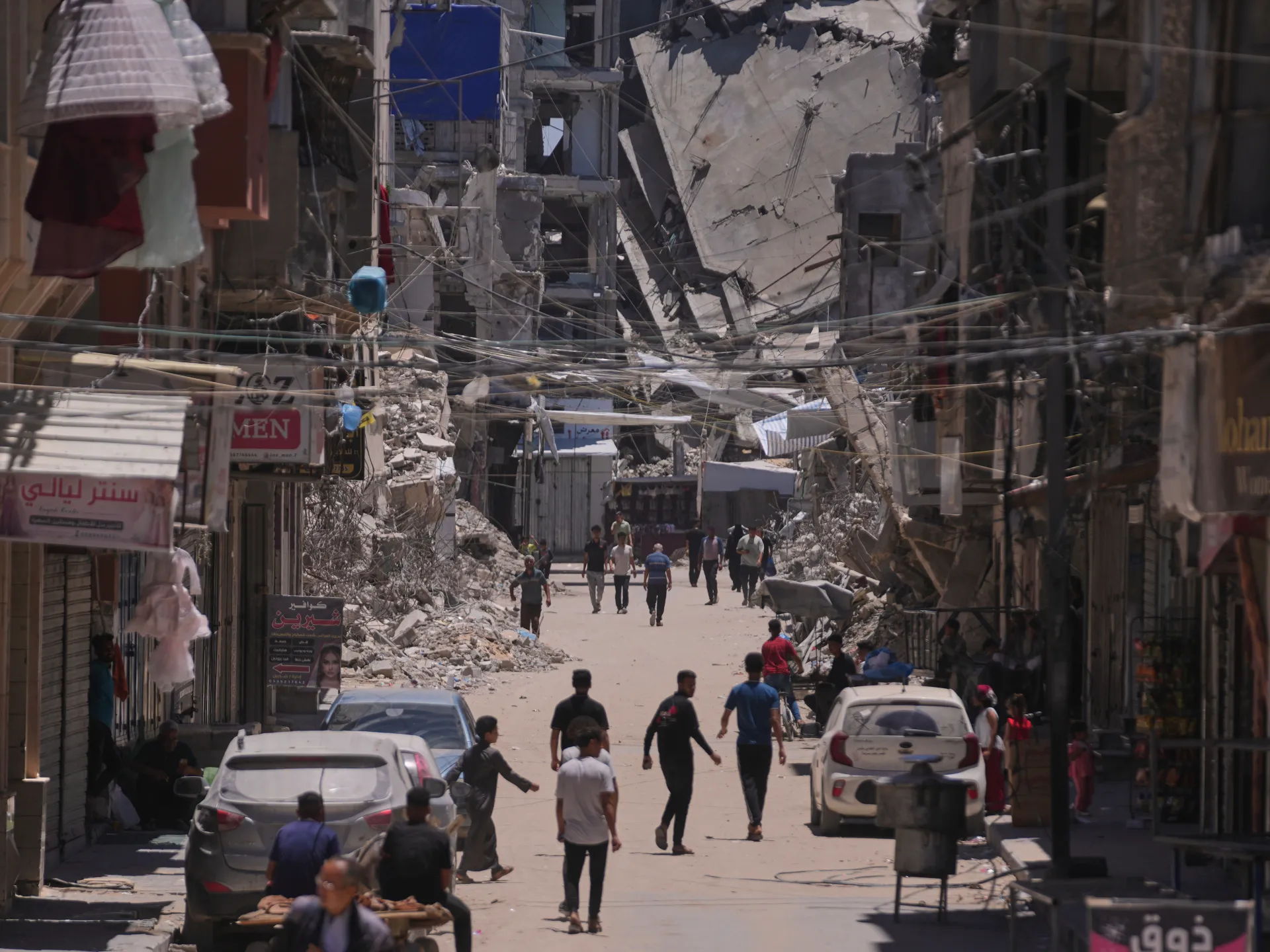
“The Voice of Hind Rajab,” a heartbreaking retelling of the efforts to save a 6-year-old Palestinian girl amid Israel’s attacks on Gaza, will be honored at the 98th Academy Awards on Sunday — without one of its star players.
Actor Motaz Malhees, who stars in the film as Red Crescent dispatcher Omar, confirmed Thursday that he will be absent from the festivities because of President Trump’s travel ban against Palestinians. “I had the honor of playing one of the lead roles in a story the world needed to hear,” Malhees said on Instagram, “but I will not be there.”
“I am not allowed to enter the United States because of my Palestinian citizenship,” he added.
Trump announced his widened travel ban in December, noting his decision to “fully restrict and limit the entry of individuals using travel documents issued or endorsed by the Palestinian Authority,” along with people from countries including South Sudan and Syria. The president issued the order months after he presented his 20-point peace plan for the Gaza strip — efforts that some Palestinians feel have been now brushed aside amid U.S. and Israeli attacks against Iran.
Malhees said in his post that the restriction “hurts” but offered his followers and supporters a kernel of truth: “You can block a passport. You cannot block a voice.”
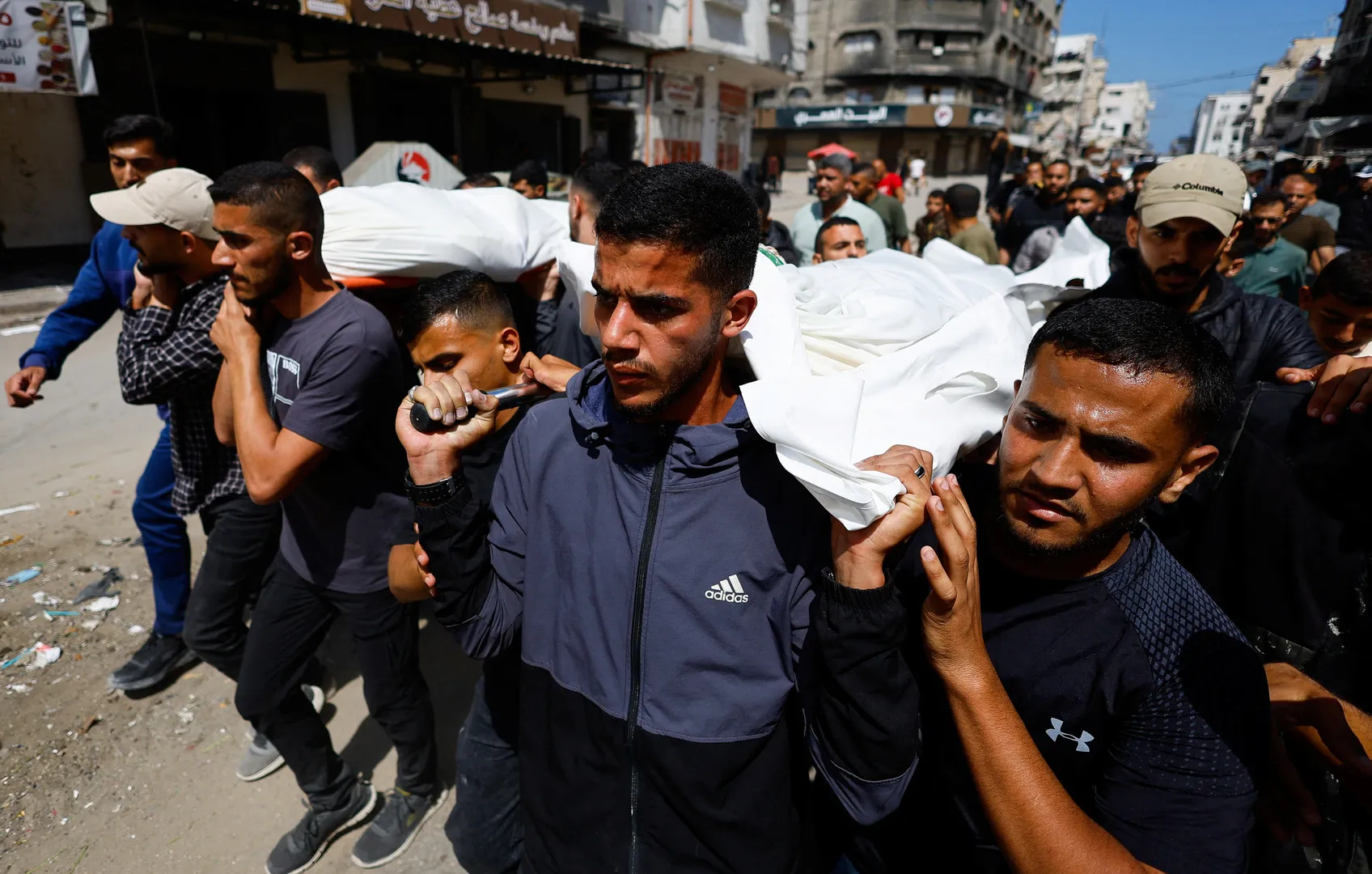
“The Voice of Hind Rajab,” directed by Tunisian filmmaker Kaouther Ben Hania, is nominated in the international feature category. The film is set in a Red Crescent call center in Ramallah and centers the 70-minute phone recording of Hind’s pleas for help as she waits with her family in a trapped car for emergency responders. She and two medics dispatched to her location were killed in February 2024 in Israeli attacks in Gaza.
The film earned the grand jury prize at the Venice Film Festival.
Though unable to celebrate the film at the Oscars on Sunday, Malhees said he stands “with pride and dignity” and that his “spirit will be with the Voice of Hind Rajab that night.”
“Our story is bigger than any barrier, and it will be heard,” he said.
A representative for the Academy of Motion Picture Arts and Sciences did not immediately respond to a request for comment.
As Malhees publicized his absence, fellow stars including Oscar winner Riz Ahmed and Emmy-nominated “Succession” star Arian Moayed rallied in support.
“Your work in the film and the film itself are both incredible and will live on forever,” Ahmed commented.
“You are brilliant, azizam,” Moayed replied to Malhees. “And this is heartbreaking and unjust.”
WASHINGTON — Anti-Muslim rhetoric from some Republicans in Congress intensified this week against the backdrop of the Iran war, with several lawmakers — including one who said that “Muslims don’t belong in American society” — drawing condemnation from Democrats but little response from GOP leaders.
The derogatory language has been percolating among Republican officials for months, often prominent when criticizing New York Mayor Zohran Mamdani, who is Muslim. But against the backdrop of the Iran war, a country with an overwhelmingly Muslim population, and attacks at a synagogue in Michigan and a college in Virginia, the tone sharpened this week.
“The enemy is inside our gates,” Sen. Tommy Tuberville of Alabama wrote Thursday in response to a photo of Mamdani sitting on the ground during an iftar dinner at New York City Hall. The photo was juxtaposed with a picture of the Sept. 11 attacks.
Hours later, Tuberville added: “To be clear, I didn’t ‘suggest’ Islamists are the enemy. I said it plainly.”
The rhetoric intensified Friday as GOP lawmakers responded to the attacks in Michigan and Virginia by urging a halt to all immigration into the United States. Some singled out Muslims specifically.
For many Muslims, it’s a political moment that carries echoes from the early 2000s, when the Sept. 11 attacks and the Afghanistan and Iraq wars generated hostility toward Muslim communities in the United States, often accompanied by discrimination and racist violence.
“When members of Congress speak, it’s not just words,” said Iman Awad, the national director for policy and advocacy for the Muslim American advocacy group Emgage Action. “It shapes public perception. It legitimizes prejudice.”
GOP rhetoric targeting Muslims spreads online
Rep. Andy Ogles (R-Tenn.) in his social media post stated flatly that Muslims don’t belong in the United States. He stood behind it after criticism mounted, later writing that “paperwork doesn’t magically make you American” and that “Muslims are unable to assimilate; they all have to go back.”
Asked about Ogles’ post Tuesday, House Speaker Mike Johnson (R-La.) said he had spoken to members “about our tone and our message and what we say.” He said Ogles used “different language than I would use,” but added that he believes the issue raised by the comments is “serious.”
“There’s a lot of energy in the country, and a lot of popular sentiment that the demand to impose sharia law in America is a serious problem,” Johnson said. “That’s what animates this.”
Sharia is a religious framework that guides many Muslims’ moral and spiritual conduct. References to “sharia law” have often been invoked by officials to suggest Muslims are attempting to impose religious practices on communities in the United States.
Many Republicans point to a Muslim-centered planned community near Dallas as proof of “sharia law” — though the developers have denied the allegations and said they are being targeted only because they are Muslim.
With Johnson not condemning Ogles’ remarks — or recent comments from Rep. Randy Fine (R-Fla.) that “the choice between dogs and Muslims is not a difficult one” — the anti-Muslim rhetoric grew louder. After the photo circulated of Mamdani at the iftar dinner, several Republicans responded with critical posts.
Democrats broadly condemned the Republican messages. Sen. Chuck Schumer of New York, the leader of Senate Democrats, called Tuberville’s post “mindless hate.”
“Islamophobic hate like this is fundamentally un-American and we must confront and overcome it whenever it rears its ugly head,” Schumer said.
Mamdani — in response to Tuberville’s post that “the enemy is inside our gates” — said: “Let there be as much outrage from politicians in Washington when kids go hungry as there is when I break bread with New Yorkers.”
Attacks in Michigan and Virginia spark more rhetoric
Federal officials identified a man who rammed his vehicle into a hallway at Temple Israel in West Bloomfield Township, Mich., this week as a naturalized citizen born in Lebanon. Officials have said that the man — who was killed by security guards at the temple — had lost four family members in an Israeli airstrike in Lebanon during the ongoing war in the Middle East, just after sunset as they were having their fast-breaking meal during the Muslim holy month of Ramadan.
In Virginia, Mohamed Bailor Jalloh opened fire in a classroom at Old Dominion University before ROTC students subdued and killed him. Court documents showed that he had served time for attempting to aid the militant group Islamic State and was released less than two years ago.
Some Republican lawmakers claimed vindication for their views. Others pushed for legislation. Rep. Tom Emmer of Minnesota, the House Republican whip, said that “the security of our nation hinges on our ability to denaturalize and deport terrorists.”
Rep. Riley M. Moore (R-W.Va.) said he would introduce a bill to denaturalize and deport any naturalized citizen who “commits an act of terrorism, plots to commit an act of terrorism, joins a terrorist organization or otherwise aids and abets terrorism against the American people.”
Similar rhetoric and policy efforts have surfaced before and stoked controversy. Protesters connected to demonstrations in recent years over the Israel-Hamas war were arrested and targeted by authorities, including former Columbia University graduate student Mahmoud Khalil, a Palestinian activist the government has sought to detain and deport.
Mamdani responds
Middle East conflicts bringing domestic tensions is nothing new. With the war in Gaza, both Muslim and Jewish communities have faced faith-based discrimination and attacks.
Mamdani said the posts invoking the 9/11 attacks are problematic not just because of the words, but because of “the actions that often accompany them.”
“I think too of the smaller indignities, the indignities that many New Yorkers face, but that Muslims are expected to face in silence,” the mayor said. “Of the exhaustion of having to explain yourself to those who are not interested in understanding. Of the men who introduce themselves by their given name only to be called Muhammad for years on end.”
The stark silence from Republican leaders, including President Trump, reflects a broader change in the party. After the Sept. 11 attacks in 2001, Republican President George W. Bush visited the Islamic Center of Washington to explicitly warn against Muslim discrimination.
“America counts millions of Muslims amongst our citizens, and Muslims make an incredibly valuable contribution to our country,” Bush said during the visit, adding: “They need to be treated with respect. In our anger and emotion, our fellow Americans must treat each other with respect.
“Those who feel like they can intimidate our fellow citizens to take out their anger don’t represent the best of America, they represent the worst of humankind, and they should be ashamed of that kind of behavior,” Bush said.
Police investigate the scene following an overnight explosion at a Jewish school in the Buitenveldert district of Amsterdam, the Netherlands, on Saturday. Photo by Michel Van Bergen/EPA
March 14 (UPI) — An explosion early Saturday at a Jewish school in Amsterdam was a “targeted attack” fueled by anti-Semitism, the city’s mayor said.
It was the second attack on Jewish institutions in the Netherlands in as many days.
A statement from Amsterdam Mayor Femke Halsema said a suspect detonated an explosive device along the outer wall of a school in the neighborhood of Buitenveldert. She said there was limited damage to the facility and no injuries reported.
“This is a cowardly act of aggression towards the Jewish community,” she said. “I understand the fear and anger of Jewish Amsterdammers. They are increasingly confronted with anti-Semitism, and that is unacceptable.
“A school must be a place where children can receive lessons safely. Amsterdam must be a place where Jews can live safely.”
Halsema said police were investigating the explosion using camera images of the suspect who detonated the device.
The attack in Amsterdam came one day after an explosion and fire at a synagogue early Friday in Rotterdam. Police said the fire went out on its own and no one was injured.
A statement from the police department said officers later arrested four teenage men outside another synagogue in the city believing them t be involved in the earlier attack. The driver of the vehicle allegedly had been driving erratically and matched the description of one of the perpetrators at the first synagogue.
The arrested suspects were from Tilburg and aged between 17 and 19.
Video shows a large fire engulfing an apartment building in the Sidon area of southern Lebanon, following reports of an Israeli attack that killed four people.
Israel’s attack, echoing similar carnage it wrought in Gaza, kills doctors, paramedics and nurses who were on duty.
An Israeli strike on a health centre in southern Lebanon has killed 12 medical workers, the Lebanese Ministry of Public Health said, as its devastating assault continued amid a wider regional war launched by the United States and Israel on Iran 15 days ago.
The attack late on Friday occurred in the village of Burj Qalaouiyah in the Bint Jbeil District, and killed doctors, paramedics and nurses who were on duty, Lebanon’s health ministry said.
Recommended Stories
list of 4 itemsend of list
The carnage echoed Israel’s constant targeting of medics and hospitals that decimated Gaza’s healthcare system during its genocidal war on the Palestinian enclave and which contravenes international humanitarian law.
Israeli strikes have so far killed 18 paramedics among 773 people reported killed in Lebanon since fighting between Hezbollah and Israel reignited March 2, after a US-Israeli assault on Iran began on February 28, with the conflict now embroiling much of the region.
According to Al Jazeera’s Heidi Pett, reporting from Beirut, the toll of medics was preliminary as rescue teams continued searching for missing people.
“You can see how deadly some of these individual air strikes have been, not just across the south, but of course, we are seeing air strikes hitting across the capital, Beirut,” said Pett.
Lebanon’s Ministry of Health said it was the second attack on the health sector within hours, after another Israeli strike on the southern village of Souaneh killed two paramedics and wounded five others when it hit a paramedic centre.
The ministry condemned the attack and denounced what it called as continued violence against health workers.
At least four people were also killed in an Israeli air raid on Taamir Haret Saida in the country’s south, the Lebanese News Agency (NNA) said.
Meanwhile, Hezbollah overnight claimed it fired suicide drones against Israeli troops in the northern town of Ya’ara inside Israel.
It was the 24th military operation announced by the group on Friday.
The Lebanese armed group also said it launched rocket attacks targeting Israeli soldiers in southern Lebanon, one in the town of Kfar Kila, and the other in the city of Khiam.
Late on Friday, Hezbollah leader Naim Qassem said his group is ready for a “long confrontation” with Israel as the war continues.
“This is an existential battle, not a limited or simple battle,” he said.
Damage in Israel from Iranian ‘cluster missiles’
Meanwhile, Iran’s retaliatory attacks against Israel continued.
Rocket and missile strikes early on Saturday targeted the Upper Galilee region of northern Israel, Channel 12 reported.
The news outlet said that a “limited number of launches” were either “intercepted” or exploded in open areas.
A post on X from Israel’s public broadcaster KAN featured several vehicles damaged in the strikes.
Alarms were raised for suspected rocket and missile fire in Manara, Margaliot, Kfar Giladi, Misgav Am, Tel Hai, Metula, Kfar Giladi and Kfar Yuval throughout the early morning on Saturday.
“A lot of the damage that we are being told about at the moment seems to be coming from these cluster missiles that Iran has been launching pretty much consistently for the last week at least and they scatter over a large area,” said Al Jazeera’s Rory Challands, reporting from Amman, Jordan.
“They disperse these submunitions bomblets. Each of those has about 2.5 kilogrammes (5.5 pounds) of explosives in them. You can see why that does quite some damage when it scatters and hasn’t been intercepted by the Israeli air defence.”
March 13 (UPI) — Michigan Gov. Gretchen Whitmer on Friday thanked security personnel for risking their lives to thwart a potentially deadly attack on a temple this week.
Whitmer spoke at a news conference one day after a person drove a vehicle into Temple Israel in West Bloomfield, Mich., calling the attack “anti-Semitism at its absolute worst.”
Her comments followed the attack at the temple on Thursday, where more than 100 children were attending school at the time.
“I want to thank Temple Israel’s security personnel — they were selfless in their courage and they saved lives,” Whitmer said. “Let’s be very clear: Yes, this is a place of worship, but at the time that this attack occurred, it was a school. One hundred and four children aged 5 and younger.”
The attacker, according to police, drove through the doors of the temple and down a hallway “with purpose” when a fire started inside the vehicle.
A security guard was hit by the vehicle, but security guards also responded to the driver with gunfire and the driver died.
Temple Israel is one of the largest reform Jewish congregations in the country, Whitmer noted, attracting more than 1,000 people for Friday night Shabbat services.
“Parents bring their children to daycare and school, and it’s a place of peace, unity, light and life,” Whitmer said. “Yesterday’s attack was anti-Semitism. It was hate, plain and simple.”
“We will fight this ancient and rampant evil,” she said.
There has been an uptick in anti-Semitic incidents in recent years and, according to the American Jewish Committee, roughly 70% of all religiously motivated hate crimes in the United States are committed against Jewish people.
President Donald Trump speaks during an event celebrating Women’s History Month in the East Room of the White House on Thursday. Photo by Bonnie Cash/UPI | License Photo
Iranian state TV video shows the Chief Justice Gholam-Hossein Mohseni-Eje’i speaking to a reporter when a blast, described by officials as an Israeli strike, hit near the al-Quds Day rally in Tehran. Despite the explosion, he continued marching with crowds taking part in the annual pro-Palestinian demonstration.
A drone attack on a joint French-Kurdish base in northern Iraq has killed one French soldier and wounded several others. Iran-aligned armed groups have been carrying out attacks against US and coalition forces in the region.
WASHINGTON — Iran’s new supreme leader, Mojtaba Khamenei, vowed retaliation Thursday against the United States and Israel and signaled that Tehran will continue to choke off the world’s most critical oil route, as the war strained global energy markets and raised new security concerns in the United States.
In his first public remarks since U.S.–Israeli strikes killed his father, former Supreme Leader Ayatollah Ali Khamenei, Mojtaba Khamenei swore revenge. The new leader, notably, did not appear in person for the televised statement. Instead, his written words were read aloud on Iranian state media.
“We will never retreat and vow to avenge the blood of our martyrs,” he said. “Our revenge will be never ending, not only for the late supreme leader, but also for the blood of all of our martyrs. … Those who killed our children will pay the price.”
The new leader expressed condolences to families who lost children in a strike on a girls school in Minab that killed more than 165 people, many of them children. He also warned that the war could expand, declaring that the continuation of the conflict “depends on the interests of the parties.”
The Associated Press, citing two sources, reported that outdated intelligence likely led to the United States carrying out the deadly missile strike on the elementary school. U.S. Central Command relied on target coordinates for the strike using outdated data provided by the Defense Intelligence Agency, according to a person familiar with the preliminary finding.
Khamenei indicated that Tehran would maintain its blockade in the Strait of Hormuz, a key choke point through which 20% of the world’s oil supply is shipped. He also said he believes in friendship with his country’s neighbors, but that attacks on U.S. military installations in the region will continue. He described maintaining pressure on the passage as a necessary part of Iran’s war strategy.
His remarks came as attacks continued to disrupt shipping and energy infrastructure across the Persian Gulf. The war sent oil up 10% Thursday as hostilities in Iran drag on.
Reports from the region said Iranian forces have intensified strikes on vessels attempting to pass through the Strait of Hormuz, leaving hundreds of ships stranded at its entrances and rattling global oil markets.
Two oil tankers were struck by explosives in Iraqi waters near the port of Basra. The Islamic Revolutionary Guard Corps claimed responsibility for the attacks, which killed at least one crew member and set both vessels ablaze, according to the Associated Press. A third unnamed vessel was reported to have been struck by an “unknown projectile” near Dubai and Jebel Ali, causing a small fire, the United Kingdom Maritime Trade Operations reported.
The latest incidents come after drone strikes targeted fuel storage facilities across the Gulf, including at energy sites in Bahrain and at the port of Salalah in Oman, an important hub for tankers seeking to bypass the Strait.
“They will pay the price. We will destroy their facilities,” Khamenei said. “It is necessary to continue our defensive activity, including continuing to close the Strait of Hormuz.”
KATIE Price has warned that her son Harvey “will die of a heart attack” as she begs the NHS to put him of fat jabs.
The former glamour model, 47, revealed her worst fears for her 23-year-old son, who has a rare genetic disorder called Prader-Willi syndrome, which causes insatiable hunger, alongside autism, septo-optic dysplasia.
Sign up for the Showbiz newsletter
Thank you!
Katie Price has shared a heartbreaking health update on son HarveyCredit: Paul EdwardsThe former glamour model said the 23-year-old ‘will die of a heart attack’ unless he has fat jabsCredit: Paul Edwards
And now the TV personality has shared another serious health update on the latest episode of her podcast.
A worried Katie said: “I’ve been on the case to doctors about putting him on the Monjaro.
“I’m actually going to put some up on Instagram to say, is there any private doctors out there because the NHS are so – I’m not slagging the NHS off, but they know he’s in the obese category.
Katie confessed: “Things are definitely going to change for Harvey when we move because although he’s moving to adult residential, he’s also going to be starting Mounjaro.”
She explained she would be keeping an eye on him while he takes the medication, adding: “So, he’ll be losing weight.”
Last April Katie told fans that she was worried for her son’s life as he weighed nearly 30 stoneCredit: Paul Edwards
Harvey has several complex medical conditions, including Prader-Willi Syndrome, which causes an excessive appetite and weight gain, and autism.
Back in November, Katie spoke out in one of her podcast episodes, saying: “He’s not started fat jabs,” after speculation he had already started the weight loss injections.
She went on to say: “There are talks of fat jabs – of Mounjaro – for him.
“But when he was there, they’ve actually got a new weight loss drug coming out, and it’s new.
“They’ve clinically tested it on people and they’ve got a few people they’re putting it on first.”
Katie then said: “And if it works, then Harvey can go on it in the new year.
“But they want him to start the Mounjaro.
“Because if he goes on Mounjaro first and then goes onto this new one, it will work a lot quicker.
“The reason he hasn’t started Mounjaro yet is because they were trying to get him to lose weight through his diet, to try all avenues,” she explained.
Despite not being on fat jabs yet, Harvey has still lost a substantial amount of weight
Back in October, Katie opened up about how much weight he had lost.
“Last I heard, he lost 22lbs, is he still going?” Katie’s sister asked on their podcast last month.
Katie then revealed: “He’s lost a stone and a half. I can notice it on his chest, but not the belly yet.”
Katie says she’s terrified when she hears her son wheezing in the middle of the nightCredit: Getty
The Bahraini interior ministry released footage of a massive blaze at a fuel storage facility following an Iranian attack. Bahrain hosts the US Navy’s Fifth Fleet and has been consistently targeted amid the US-Israeli initiated war.
Two foreign tankers were seen ablaze in Iraqi territorial waters after a strike near the al-Faw port. Authorities say they evacuated 25 crew members but have confirmed at least one death and are battling to control the flames.
Attacks on multiple commercial ships in the waters around Iran on Wednesday increased global energy concerns, pushed nations to unleash strategic oil reserves and sparked fresh critiques of the Trump administration’s readiness for a war it started.
As Trump administration and U.S. military officials continued to claim increasing success and advantage in the conflict — and authorities downplayed a reported threat of drone attacks on California — leaders around the world scrambled to respond to the latest attacks and the International Energy Agency’s call for the largest ever release of strategic oil reserves by its members to help stem energy price spikes.
President Trump also faced renewed questions about a deadly strike on an Iranian elementary school at the start of the war, after the New York Times reported Wednesday that a military investigation had determined the U.S. was responsible.
“I don’t know about it,” Trump said when asked about the report.
In an address Wednesday morning, IEA Executive Director Fatih Birol said energy shipments through the Strait of Hormuz had “all but stopped” amid the conflict, driving massive global competition for oil and gas in wealthier countries and fuel rationing in poorer nations.
He said the IEA’s 32 member nations have brought a “sense of urgency and solidarity” to recent discussions on the matter, and had unanimously agreed to “launch the largest ever release of emergency oil stocks in our agency’s history,” making 400 million barrels of oil available.
However, he said the most needed change is the “resumption of traffic through the Strait of Hormuz.”
A vendor pumps petrol from Iranian fuel oil tankers for resale near the Bashmakh border crossing between Iraq and Iran.
(Ozan Kose / AFP/Getty Images)
Several countries, including Germany, Austria and Japan, had already confirmed their plans to release reserves.
The White House did not immediately respond to a request for comment on any U.S. plans to release its strategic reserves, or how much would be released. The U.S. is an IEA member.
Trump told reporters Wednesday that the U.S. has hit Iran “harder than virtually any country in history has been hit,” including by wiping out its naval fleet and eliminating other vessels capable of laying mines, and that he believes oil companies should resume shipments through the strait despite the recent attacks.
U.S. Interior Secretary Doug Burgum backed the idea of releasing oil reserves in a Fox News interview.
“Certainly these are the kinds of moments that these reserves are used for, because what we have here is not a shortage of energy in the world; we’ve got a transit problem, which is temporary,” Burgum said. “When you have a temporary transit problem that we’re resolving militarily and diplomatically — which we can resolve and will resolve — this is the perfect time to think about releasing some of those, to take some pressure off of the global price.”
Burgum said that while Iran is “holding the entire world hostage economically by threatening to close the strait,” Trump has made the consequences of such actions “very clear,” and “there’s a lot of options between ourselves and our allies in the region, including our Arab friends in the region, to make sure that those straits keep open and that energy keeps flowing for the global economy.”
The IEA did not provide details as to the release of the 400 million barrels, part of a broader reserve of some 1.2 billion barrels held by its members. It said the reserves “will be made available to the market over a time frame that is appropriate to the national circumstances of each Member country and will be supplemented by additional emergency measures by some countries.”
The agency said an average of 20 million barrels of crude oil and oil products transited the strait per day in 2025, and that options for bypassing the strait are “limited.”
While some tankers believed linked to Iran were still getting through the Strait of Hormuz, which under normal circumstances carries about 20% of the world’s oil and natural gas, Iranian officials threatened attacks on other vessels — saying they would not allow “even a single liter of oil” tied to the U.S., Israel or their allies through the channel, which connects to the Persian Gulf.
Trump has repeatedly claimed that the U.S. and its powerful Navy would support commercial vessels and ensure the strait remains open to oil shipments, but that has not been the case.
Tankers wait off the Mediterranean coast of southern France on Wednesday.
(Thibaud Moritz / AFP/Getty Images)
The United Kingdom Maritime Trade Operations center, run by the British military, reported at least three ships struck in the region Wednesday — including ships off the United Arab Emirates and a cargo ship that was struck by a projectile in the strait just north of Oman, setting it ablaze.
The Trump administration and the U.S. military, meanwhile, have been pushing out messaging about wiping out Iran’s ability to plant mines in the strait — posting dramatic videos of major strikes on tiny boats on small docks.
Adm. Brad Cooper, the leader of U.S. Central Command, said in a video posted to X on Wednesday morning that “in short, U.S. forces continue delivering devastating combat power against the Iranian regime.”
“I’ve said this before, but it bears repeating: U.S. combat power is building, Iranian combat power is declining,” he said.
The U.S. has struck more than 60 Iranian ships, and just “took out the last of four Soleimani-class warships,” he said. “That’s an entire class of Iranian ships now out of the fight.”
Cooper said Iranian ballistic missile and drone attacks have “dropped drastically” since the start of the war, though “it’s worth pointing out that Iranian forces continue to target innocent civilians in gulf countries, while hiding behind their own people as they launch attacks from highly populated cities in Iran.”
He also addressed the attacks on commercial shipping in the region directly, saying that “for years, the Iranian regime has threatened commercial shipping and U.S. forces in international waters,” and that the U.S. military’s “mission is to end their ability to project power and harass shipping in the Strait of Hormuz.”
Other U.S. leaders called the U.S. war plan — and specifically its approach to protecting the Strait of Hormuz — into question.
In a series of posts to X late Tuesday, which he said followed a two-hour classified briefing on the war, Sen. Chris Murphy (D-Conn.) slammed the administration’s plans as “incoherent and incomplete.”
Murphy wrote that the administration’s goals for the war seemed to be focused primarily on “destroying lots of missiles and boats and drone factories,” and without a clear plan for what to do when Iran — still led by “a hardline regime” — begins rebuilding that infrastructure, other than to continue bombing them. “Which is, of course, endless war,” he wrote.
Murphy also specifically criticized the administration’s plan for the Strait of Hormuz — which he said simply doesn’t exist.
“And on the Strait of Hormuz, they had NO PLAN,” he wrote. “I can’t go into more detail about how Iran gums up the Strait, but suffice it [to] say, right now, they don’t know how to get it safely back open. Which is unforgiveable, because this part of the disaster was 100% foreseeable.”
Ships in the strait remained under threat of various forms of attack Wednesday, as did much of the region as the war raged on.
There was an attack on a U.S. Embassy operations center at Baghdad’s airport, which officials attributed to a drone launched by Iranian proxies based in Iraq. No casualties were reported.
Lebanon’s Health Ministry reported the death toll there — from fighting between Israel and Iranian-backed Hezbollah fighters — had risen to 634 since last week, including 91 children. Another 1,500 people had been wounded, the ministry said.
Iranian authorities have said U.S. and Israeli attacks have killed 1,255 people since Feb. 28. That includes many Iranian leaders, including then-Supreme Leader Ayatollah Ali Khamenei. U.S. officials have said Iranian attacks in the region have killed seven U.S. service members, with another 140 wounded.
CBS News reported Wednesday that dozens of those injuries were sustained by service members in the March 1 Iranian drone attack on a tactical operations center in Kuwait — which is also where six of the seven deaths occurred.
The outlet reported that the attack was more severe than the Trump administration has revealed, with more than 30 military members still in hospitals Tuesday with a range of battle injuries including “brain trauma, shrapnel wounds and burns.”
Threats extended beyond the Middle East, too — including to California, where law enforcement agencies were warned by federal authorities that Iran “allegedly aspired to conduct a surprise attack” on California using drones launched from a vessel off the U.S. coast.
However, sources told The Times that advisory was cautionary and not backed by credible intelligence.
Times staff writer Gavin J. Quinton, in Washington, D.C., contributed to this report.