WASHINGTON — Lawmakers from both parties said Sunday that they support congressional reviews of U.S. military strikes against vessels in the Caribbean Sea and eastern Pacific Ocean, citing a published report that Defense Secretary Pete Hegseth issued a verbal order for all crew members to be killed as part of a Sept. 2 attack.
The lawmakers said they did not know whether last week’s Washington Post report was true, and some Republicans were skeptical, but they said attacking survivors of an initial missile strike poses serious legal concerns.
“This rises to the level of a war crime if it’s true,” said Sen. Tim Kaine (D-Va.).
Rep. Michael R. Turner (R-Ohio), when asked about a follow-up strike aimed at people no longer able to fight, said Congress does not have information that that happened. He noted that leaders of the Armed Services Committee in both the House and Senate have opened investigations.
“Obviously, if that occurred, that would be very serious and I agree that that would be an illegal act,” Turner said.
Turner said there are concerns in Congress about the attacks on vessels that the Trump administration says are transporting drugs, but the allegation regarding the Sept. 2 attack “is completely outside anything that has been discussed with Congress, and there is an ongoing investigation.”
The comments from lawmakers during news show appearances come as the administration escalates a lethal maritime campaign that it says is needed to combat drug trafficking into the United States.
On Saturday, President Trump said the airspace “above and surrounding” Venezuela should be considered “closed in its entirety,” an assertion that raised more questions about the U.S. pressure on Venezuelan leader Nicolás Maduro. Maduro’s government accused Trump of making a ”colonial threat” and seeking to undermine the South American country’s sovereignty.
After the Post’s report, Hegseth said Friday on X that “fake news is delivering more fabricated, inflammatory, and derogatory reporting to discredit our incredible warriors fighting to protect the homeland.”
“Our current operations in the Caribbean are lawful under both U.S. and international law, with all actions in compliance with the law of armed conflict — and approved by the best military and civilian lawyers, up and down the chain of command,” Hegseth wrote.
Republican Sen. Roger Wicker of Mississippi, chairman of the Senate Armed Services Committee, and its top Democrat, Rhode Island Sen. Jack Reed, said in a joint statement late Friday that the committee “will be conducting vigorous oversight to determine the facts related to these circumstances.”
That was followed Saturday by the chairman of the House Armed Services Committee, Republican Rep. Mike Rogers of Alabama, and ranking Democratic member, Washington Rep. Adam Smith, issuing a joint statement saying the panel was committed to “providing rigorous oversight of the Department of Defense’s military operations in the Caribbean.”
“We take seriously the reports of follow-on strikes on boats alleged to be ferrying narcotics in the SOUTHCOM region and are taking bipartisan action to gather a full accounting of the operation in question,” Rogers and Smith said, referring to U.S. Southern Command.
Rep. Don Bacon (R-Neb.), asked about the Sept. 2 attack, said Hegseth deserves a chance to present his side.
“We should get to the truth. I don’t think he would be foolish enough to make this decision to say, ‘Kill everybody, kill the survivors,’ because that’s a clear violation of the law of war,” Bacon said. “So, I’m very suspicious that he would’ve done something like that because it would go against common sense.”
Kaine and Turner appeared on CBS’ “Face the Nation,” and Bacon was on ABC’s “This Week.”
From deadly floods in Indonesia and Sri Lanka, to antigovernment protests in the Philippines and demonstrations in Italy to show solidarity with Gaza, here is a look at the week in photos.
Kurdish authorities say one killed, several wounded in riots in Erbil’s Gwer, as authorities try to restore power after attack on Khor Mor.
Published On 30 Nov 202530 Nov 2025
Share
A group of “rioters” have opened fire at fuel tanker trucks in the northern Iraqi governorate of Erbil, killing at least one person and wounding several others, Kurdish authorities said, days after a rocket attack on the region’s Khor Mor gas field.
In a statement carried by the Iraqi News Agency late on Saturday, the Ministry of Interior of the Kurdistan Regional Government (KRG) linked the shooting to the Khor Mor attack.
Recommended Stories
list of 3 itemsend of list
The rocket attack hit a storage tank at the gas field, which is one of the region’s largest facilities, late on Wednesday, leading to production shutdown and extensive power cuts.
The ministry said the KRG sent liquid fuel to supply power plants following the Khor Mor attack, but that “a group of rioters blocked the road used by fuel tankers and civilians in Gwer, opening fire on passersby and travellers”.
The shooting “resulted in the death of one citizen and injuries to several others”, it said.
The ministry pledged action against the “riots”, saying “we will put an end to these acts of sabotage”.
The ministry statement followed an earlier report by the Iraqi News Agency in which it said there had been armed clashes between the Harkiya tribe and security forces in Erbil, near the village of Lajan on the Erbil-Gwer road.
The agency cited security forces as saying that the clashes, adjacent to the Lanaz Company refinery, had “resulted in fatalities and injuries”.
Meanwhile, Iraqi Kurdish Prime Minister Masrour Barzani has announced that the KRG has agreed with the company operating the Khor Mor gas field to restart production within hours to restore electricity.
The attack on Thursday on Khor Mor was the most significant violence since a series of drone attacks in July that cut production by about 150,000 barrels per day.
“I have spoken with the company’s [Dana Gas] leadership to thank them and their workforce for their extraordinary resilience and determination amid eleven attacks on the Khor Mor field,” Barzani said in a statement posted in English.
“I have urged [Iraqi] Prime Minister Mohammed Shia al-Sudani to hold the perpetrators of this attack accountable to the full extent of the law, whoever they may be and wherever they are,” Barzani added.
There has been no claim of responsibility for the attack on Khor Mor, and authorities have not said who was behind the attack.
Abdulkhaliq Talaat, a military expert and former official from the Kurdish region of northern Iraq, however, told the Rudaw news channel that the drone attack on the Khor Mor gas field was launched from an area under the control of Iraqi forces.
The storage tank at Khor Mor is part of new facilities partially financed by the US and built by a US contractor, an industry source told the Reuters news agency earlier this week.
WASHINGTON — The U.S. Capitol Police on Tuesday announced that the agency was opening regional field offices in California and Florida to investigate threats to members of Congress in the wake of the Jan. 6 attack on the Capitol.
Threats against members of Congress have increased in recent years. As of Tuesday, total threats so far in 2021 were double what they were at this point a year ago, according to Capitol Police.
Home to House Speaker Nancy Pelosi (D-San Francisco), House Minority Leader Kevin McCarthy (R-Bakersfield) and other prominent members of Congress, California gives the law enforcement agency a Western base to investigate claims of threats made against members. The state is also home to the nation’s largest congressional delegation.
Yogananda Pittman, the department’s acting chief, told lawmakers in March that the vast majority of the increased threats were from people who didn’t live near Washington..
The field offices will be in the Tampa and San Francisco areas, according to Capitol Police.
“At this time, Florida and California are where the majority of our potential threats are,” a department spokesperson said in a statement. “The field offices will be the first for the Department. A regional approach to investigating and prosecuting threats against Members is important, so we will be working closely with the U.S. Attorney’s Offices in those locations.”
The new field offices are among the changes made since the attack six months ago in which Capitol Police were quickly overwhelmed by thousands of pro-Trump supporters, hundreds of whom were able to break into the Capitol building, forcing members to temporarily halt certification of the 2020 election results and flee for safety. Capitol Police leaders told congressional committees investigating the incident that they had no information that the crowd would become violent.
Five people died in the melee or the days after. Two officers died by suicide, and more than 140 were injured — some permanently. More than 500 people have been charged for participating in the attack.
Other changes, spurred in part by congressional investigations and reports by the department’s internal watchdog, include increased training for officers alongside the National Guard, improved intelligence-gathering efforts and protocols for reporting sensitive information, and new equipment and technology for officers.
The police agency rarely provides information to the public on how it operates, citing security concerns and member safety. For example, unlike other government agencies, the internal watchdog’s reports are not publicly available.
A spokesperson did not answer questions Tuesday about how many staff would be hired or what the cost to taxpayers would be.
The spokesperson said other regional offices were expected.
Very few members of Congress are accompanied by security outside of the Capitol building, and it is unclear if the new offices will primarily investigate threats against members or also will help when security is needed in the state. The Capitol Police have jurisdiction to investigate all threats made against a member of Congress.
GOFFSTOWN, N.H. — In their last joint appearance before Tuesday’s high-stakes New Hampshire primary, the five major Democratic presidential candidates Sunday coasted through a generally desultory debate enlivened only by attacks on former Massachusetts Sen. Paul E. Tsongas for his support of nuclear power.
Tsongas, who leads in state polls, repeatedly came under attack for his staunch backing of nuclear power–a controversial position in a state where many Democratic activists have long opposed the Seabrook nuclear power plant. Each of Tsongas’ four rivals said they would decrease the nation’s reliance on nuclear energy.
“We’re not all trying to gang up on you, we’re not trying to say you’re wrong all the time,” Nebraska Sen. Bob Kerrey said to Tsongas at one point. “But on this particular issue I think you are. . . . Nuclear power, it seems to me, is fatally flawed.”
The focus on nuclear power–an issue that until recently has played virtually no role in the campaign–underlined the shift in Tsongas’ position from a long-shot who had been gently patronized to a front-runner worthy of pummeling. But other than the criticism of his energy policy–an issue that has not been high on the list of voter concerns here in recent years–Tsongas ran this last gantlet before the vote virtually unscathed.
Early in the debate, former California Gov. Edmund G. (Jerry) Brown Jr.–who later grilled Tsongas most aggressively on his support for nuclear power–even embraced him as a fellow outsider committed to “the politics of the future” as compared to the three current officeholders in the race.
Brown then mildly distanced himself from Tsongas, saying the former senator “represents a more conservative, business-oriented view of the future.”
In fact, the tone of the debate was strikingly low-key, with all of the candidates focusing more of their fire on President Bush than their rivals. Tsongas took the lead, employing the front-runner strategy used earlier by Arkansas Gov. Bill Clinton. At every opportunity Tsongas stressed his agreements with his rivals and his differences with Bush.
In the debate, sponsored by Cable News Network and the League of Women Voters, the candidates were hampered by a format so disjointed and at times unstructured that twice Clinton felt compelled to suggest questions to moderator Bernard Shaw.
After weeks of focusing on the bread-and-butter concerns of voters in this economically ravaged state, the candidates Sunday found themselves exploring international population control, the destruction of the rain forests, utility pricing reform and whether the nation needs a better class of light bulb.
In this alternately esoteric and disengaged atmosphere, the only energy was generated by the issue of nuclear power.
One by one, each of Tsongas’ rivals insisted they would reduce reliance on nuclear power. Harkin declared that a program “of developing solar . . . for the future” would allow the nation to avoid “going to the nuclear option that Paul Tsongas wants to move to.”
Brown said he would move to phase out all nuclear power plants over the next decade.
Clinton said: “I do not favor anything that will accelerate the building of nuclear power plants. If you have major incentives to the utilities to engage in conservation, if you have a major attempt to convert to natural gas wherever you can. . . . I do not think you are going to see a need for new nuclear power plants.”
Tsongas–after characterizing nuclear power as part of “the third tier” of his preferred energy options for the country–argued in response to the persistent jabs that a reduction in reliance on nuclear power would require greater use of fossil fuels, raising the threat of global warming through the greenhouse effect.
“If you take out all of your nuclear power plants by definition, you are going to have more fossil fuel burning and add to the greenhouse effect,” Tsongas said. “I take the position that the threat long term is global warming.”
Though Tsongas forcefully held his ground, he bristled under the attacks–which were among the most pointed he has endured. “If I could, I would like . . . to characterize my positions myself and not have others do it,” he said.
After the debate, aides to the other candidates maintained that Tsongas had been weakened by the focus on an issue. “I don’t think his position has been laid out before as it was here tonight, so I think it will hurt him,” said Frank Greer, Clinton’s media adviser.
Thaleia Schlesinger, Tsongas’ sister, countered: “People understand his position was based on his fear of global warming.”
When not arguing over whether to split atoms for energy, the candidates managed to make some points about the economy. To a greater degree than usual, Tsongas declared that his approach–which relies heavily on increasing capital incentives for business and rejects a tax cut for the middle class–offered struggle as well as reward.
“There are two roads,” he said in closing remarks. “One is easy, one is comfortable, but it is downhill. The other is the road to economic prosperity. . . . That road is steeper and it’s harder, but it’s more noble and it’s more worthy.”
Harkin reiterated his support for cutting the defense budget in half over 10 years to support infrastructure investments and other programs at home. And he took a harsh line on trade issues, promising to stand up to Japan and prevent former government trade negotiators from lobbying for foreign governments. “I’m saying trade has to be a two-way street, not a one-way bridge,” he said.
As he has in recent days, Clinton sought to differentiate himself from Tsongas by emphasizing his experience as chief executive in Arkansas and his plans to reform government. “I think we have to have a more activist government,” he said, “but it also has to be more community-based, less bureaucratic and provide more citizen choice.”
Like Harkin, Kerrey insisted that America needed to get tougher with Japan on trade. But he called for the establishment of “new trading structures so that we can expand trade into the rest of the world, trying to convert . . . old enemies into new customers.”
Tsongas, who has taken the strongest free-trade position, urged voluntary protectionism, saying that as President he would ask Americans to shun Japanese imports if Japan doesn’t open its markets. “If the Japanese are not willing to be reasonable,” he said, “you have to play hardball.”
For most of this encounter, though, hardball was apparently the last thing on the minds of the five Democrats chasing the White House. With Tuesday’s pivotal vote in sight, they seemed less like contenders stepping into the ring than weary fighters embracing at the end of a bruising match.
Times political writer Robert Shogan contributed to this story.
President Vladimir Putin has said he is ready to guarantee in writing that Russia will not attack another European nation, as he dismissed claims that Moscow intends to invade another country as a “lie” and “complete nonsense”.
Speaking on Thursday in Kyrgyzstan’s capital, Bishkek – where he attended a summit of the Collective Security Treaty Organisation (CSTO), a Russia-led military alliance that includes some former Soviet republics – Putin branded claims Moscow is planning to attack Europe as “ridiculous”.
Recommended Stories
list of 3 itemsend of list
“The truth is, we never intended to do that. But if they want to hear it from us, well, then we’ll document it. No question,” the Russian president told reporters.
Putin’s denials that Moscow is planning another invasion have been met with scepticism from European leaders, who point to the fact that he repeatedly denied Russia would invade Ukraine before doing so in February 2022.
Responding to questions about efforts to end the war in Ukraine, Putin expressed optimism about a draft United States-backed peace plan, saying it could serve as the “basis for future agreements”.
While Putin said Russia is ready for a “serious” discussion to end the war, he also warned that Moscow was prepared to fight on if necessary and take over more of Ukraine.
A basic prerequisite to end the fighting, he reiterated, was that Ukrainian troops withdraw from Donetsk and Luhansk in eastern Ukraine’s Donbas region, including leaving areas that Russian troops do not currently control.
“Ukrainian troops must withdraw from the territories they currently hold – then the fighting will stop. If they do not pull back, we will achieve this by military means,” he said.
Ukraine has said that such a withdrawal would leave the way open for a Russian assault on its capital, Kyiv.
‘The president has lost his legitimate status’
Putin also suggested that he was open to a negotiated settlement with Kyiv, but once again branded Ukrainian President Volodymyr Zelenskyy’s government illegitimate, adding that it was “legally impossible” to sign any agreements with them.
“Broadly speaking, of course, we ultimately want to reach an agreement with Ukraine. But right now, this is practically impossible,” Putin said, repeating previous unfounded claims that Kyiv had lost the right to govern after failing to hold elections when Zelenskyy’s presidential term expired in May 2024.
“The Ukrainian leadership made a fundamental strategic mistake when it feared presidential elections, because since then, the president has lost his legitimate status,” Putin added.
Kyiv has maintained it could not hold elections while under martial law and defending its territory against Russian attacks. In February, lawmakers in Ukraine’s parliament overwhelmingly approved a resolution affirming Zelenskyy’s legitimacy to stay in office.
Putin also claimed that, due to the Zelenskyy government’s purported illegitimacy, any peace deal must be recognised by the international community, and that the international community must also recognise Russian gains in Ukraine.
The Ukrainian president’s chief of staff, Andriy Yermak, reiterated on Thursday that Zelenskyy “will not sign away territory”.
“As long as Zelenskyy is president, no one should count on us giving up territory,” Yermak told US magazine The Atlantic.
Last week, the US revealed a 28-point peace plan for Ukraine that was widely viewed as extremely favourable to Russia. It called for Kyiv to make major concessions, including ceding territory and abandoning its NATO ambitions.
The plan has since been altered with Ukrainian input, Ukrainian First Deputy Foreign Minister Sergiy Kyslytsya said, nixing a 600,000-member cap on Ukraine’s army and a general war crimes amnesty.
On Thursday, Zelenskyy said Ukrainian delegations are set to meet with Washington officials to work out a formula discussed at previous talks in Geneva to bring peace and provide security guarantees for Kyiv.
He added, without providing details, that there would be further talks next week.
US representatives, including Trump’s special envoy, Steve Witkoff, are also set to travel to Moscow next week to continue discussions on key issues, including security guarantees for Ukraine and Europe.
Putin said his delegation intends to raise its own “key issue” with the US delegation, specifically a passage in the peace plan stating that Washington only intends to recognise Russia’s de facto control over Crimea and other Ukrainian territory, which Moscow claims as its own.
“That is precisely what our talks with the American side will be about,” Putin said.
Jamie Taylor hurled three molotov cocktails outside Livingston police station
A former solider has admitted endangering a police officer’s life in a petrol bomb attack at a police station.
Jamie Taylor, 34, hurled three molotov cocktails at police vans parked outside the building in Livingston, West Lothian, on 30 May 2025.
The High Court in Edinburgh heard that Taylor, from Bo’ness, had told his mother “he was going to blow up Livingston Police station”.
CCTV footage showed the bombs burst on the ground, with one narrowly missing PC Kirsty Forsyth who ran outside to tackle the flames with a fire extinguisher.
The court heard that Taylor had eight previous convictions and was staying temporarily with his mother at the time of the incident.
Prosecutor Wojciech Jajdelski said that on the day of the attack, Taylor had phoned her to say he had a “bag full of vodka bottles filled with petrol”.
Police Scotland
Jamie Taylor claimed he was going to “blow up” the police station
CCTV cameras near the police station captured the moment a hooded Taylor started throwing the petrol bombs.
The court saw footage of PC Forsyth come out of the station with a fire extinguisher. Taylor’s third petrol bomb burst at her feet before she ran from the scene.
PC Forsyth’s colleagues chased Taylor who was caught a short while later nearby.
The court heard he was found lying on the ground next to a bush smelling strongly of fuel.
Defence solicitor advocate Iain McSporran KC said his client had serious mental health issues which were partly associated with his former army career.
Mr McSporran also praised PC Forsyth’s actions.
He added: “She seemed to remain extremely cool in the circumstances.”
‘Clearly dangerous’
Taylor pleaded guilty to breaching the 1883 Explosives Act and of “culpably and recklessly” throwing a petrol bomb at PC Kirsty Forsyth.
Judge Lady Ross said: “This was clearly a dangerous thing to do.”
Police Scotland inspector Lindsey McIntyre said it was a “totally reckless act” that endangered the lives of all officers and staff in the station.
She said: “Thankfully, no one was injured, but the outcome of the incident could have been far worse.
“Every officer has the fundamental right to come home from each shift unharmed, and no one should be targeted in this way.”
Taylor will be sentenced at the High Court in Stirling in January.
Nov. 26 (UPI) — Federal authorities on Wednesday announced the arrest of a Virginia high school principal and his brother on charges of plotting to attack immigration agents.
John and Mark Bennett were arrested Nov. 19 — John Bennett in Virginia Beach, where he worked as an assistant principal at Kempsville High School, and Mark Bennett at Norfolk International Airport, the Department of Homeland Security said in a statement.
According to authorities, an investigation was launched into the brothers on Nov. 17 after an off-duty Norfolk police officer heard the pair allegedly discussing plans to kill police officers and Immigration and Customs Enforcement agents.
“Mark Bennett was also overheard saying he was planning to meet with like-minded individuals in Las Vegas, Nev., to purchase firearms with explosive rounds to carry out the attacks,” the Department of Homeland Security said in a statement.
Mark Bennett was arrested as he was to board a flight to Charlotte, N.C., from where authorities allege he planned to travel to Las Vegas.
DHS Assistant Secretary Tricia McLaughlin accused the brothers of discussing plans to secure a high-caliber rifle capable of piercing bullet-resistant vests.
“It’s chilling that a human being, much less a child educator, would plot to ambush and kill ICE law enforcement officers,” McLaughlin said.
The arrests come amid an increase in U.S. immigration enforcement operations in many Democratic-led cities as the Trump administration carries out a broader immigration crackdown, which has been met with protests, criticism and legal challenges.
According to Department of Homeland Security statistics, there have been 238 reported assaults on ICE agents so far this year, an increase of 19 from the same period last year.
The Trump administration has criticized Democrats for rhetoric it says is fueling the violence.
“Our law enforcement officers have had Molotov cocktails and rocks thrown at them, been shot at, had cars used as weapons against them and been physically assaulted,” McLaughlin said in a statement on Monday.
“Sanctuary politicians need to tone the rhetoric down before a law enforcement officer is killed.”
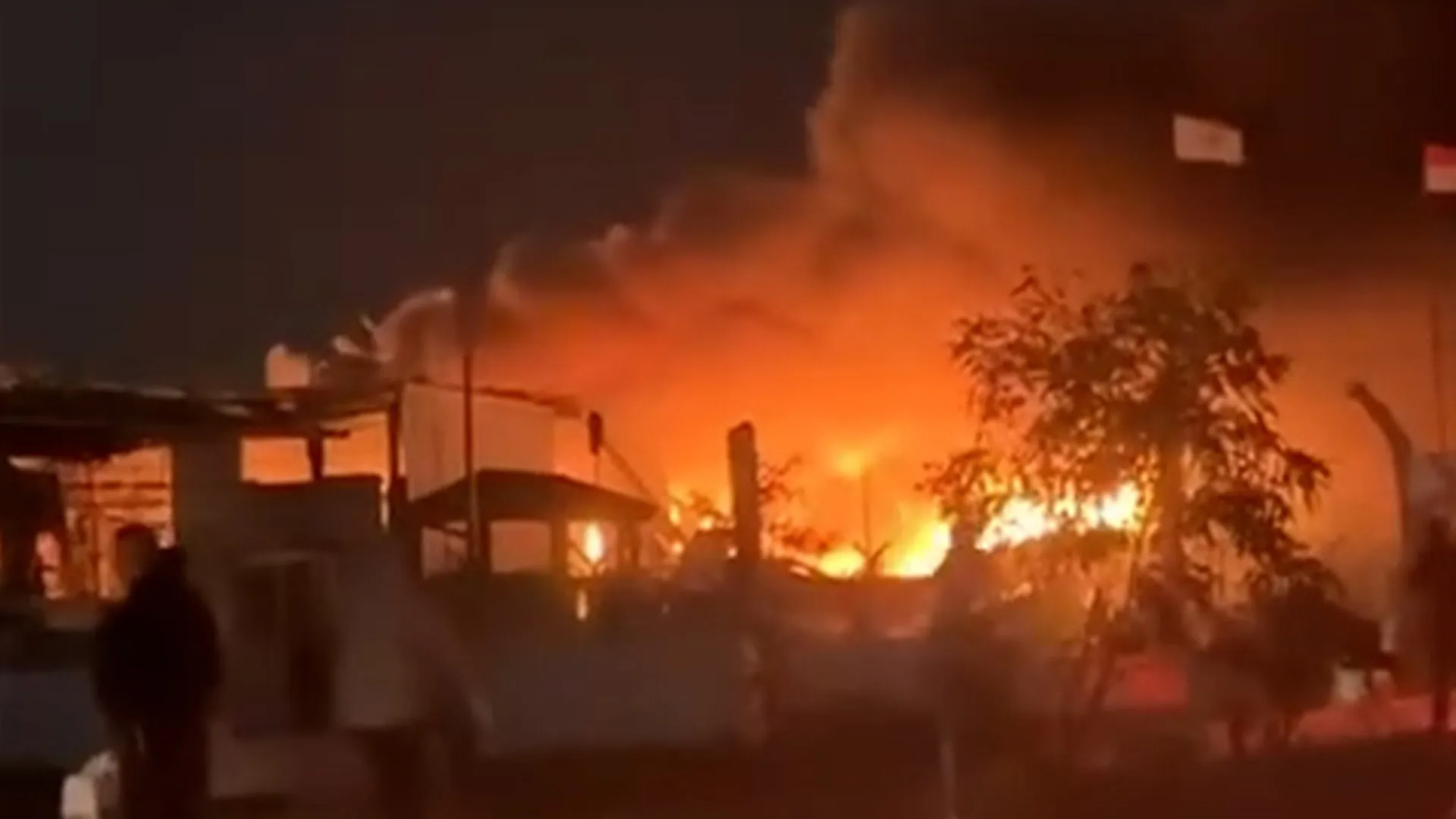
Production at Iraq’s Khor Mor gas field, one of the largest in the Kurdistan region, was halted after a rocket struck a storage facility late on Wednesday. The facility, part of a recent expansion under the KM250 project, had increased the field’s production capacity by 50% and included new installations partially financed by the U.S. government and built by a U.S. contractor. The attack comes amid a series of drone strikes and assaults on the region’s oilfields, which have previously disrupted production and raised concerns over energy security in northern Iraq.
Why It Matters
The shutdown of Khor Mor has caused significant power cuts in the Kurdistan region, with electricity generation dropping by an estimated 3,000 megawatts. The gas field supplies fuel for regional power generation, meaning interruptions directly impact homes, businesses, and local infrastructure. The attack also underscores the vulnerability of energy assets in Iraqi Kurdistan, a region of strategic importance with major U.S. and international investments in the energy sector.
Key stakeholders include Dana Gas and Crescent Petroleum, operators of the Khor Mor field under the Pearl Consortium, local Kurdish authorities responsible for regional security, and U.S. interests, given their financial and operational involvement in the field. Residents and businesses in the northern region are directly affected by the power cuts, while regional security forces and international observers monitor the recurring attacks, which are often attributed to Iran-backed militias targeting U.S. and allied interests.
What’s Next
Authorities are assessing the damage and working to restore production and electricity supply. Firefighting teams successfully extinguished the blaze early on Thursday, but gas output remains suspended, prolonging power shortages. The incident follows previous attacks in July and recent drone strikes, highlighting ongoing security risks to critical infrastructure. Local officials, including Kurdish leaders, have called for improved anti-drone and defense measures to protect energy facilities, while the investigation into the perpetrators continues.
Binance founder Changpeng Zhao (pictured in 2022) is among defendants named in a federal lawsuit filed on Monday and accusing them of providing financial services that helped Hamas carry out the Oct. 7, 2023, attack that killed or injured 306 U.S. citizens in Israel. File Photo by Miguel A. Lopes/EPA
Nov. 25 (UPI) — The families of hundreds of U.S. citizens killed or injured by Hamas on Oct. 7, 2023, accuse cryptocurrency exchange Binance of supporting terrorism.
The families of 306 U.S. citizens harmed or killed during the attack filed a 272-page federal lawsuit in the U.S. District Court of North Dakota on Monday.
They say Malta-based Binance marketed its services to “terrorist organizations, narcotics traffickers and tax evaders” by emphasizing that Binance is “beyond the reach of any single country’s laws or regulations,” the lawsuit says, as reported by The New York Times.
The plaintiff families accused Binance of conducting transactions that totaled more than $1 billion on behalf of Hamas and other terrorist organizations.
Binance officials handled the transactions despite being warned of potential illegality by its compliance vendors and did not use common security checks, according to the lawsuit.
The plaintiffs also claim Binance willfully handled at least $50 million in transactions for Hamas, Hezbollah, the Islamic Revolutionary Guard Corps of Iran, the Palestinian Islamic Jihad and other terrorist organizations after the Oct. 7, 2023, attack on Israeli civilians that killed 1,200 and kidnapped 254 others.
Zhao is named as a defendant in the lawsuit, along with Guangying Chen and Binance Holdings Ltd., who are accused of intentionally creating Binance to serve as a “criminal enterprise to facilitate money laundering on a global scale.”
The plaintiffs say the Binance officials knew Hamas and other designated foreign terrorist organizations regularly used the cryptoexchange and actively assisted them “at a time when Hamas, in particular, was publicly directing its donors to send funds” to its Binance cryptowallets.
Binance officials also disregarded filing required suspicious activity reports and manipulated how qualifying transactions were reported to prevent any scrutiny by U.S. banking regulators, the plaintiffs argue.
Binance “actively tried to shield its Hamas customers and their funds from scrutiny by U.S. regulators or law enforcement — a practice that continues to this day,” the plaintiff families say.
The plaintiffs seek compensatory damages in amounts to be determined at trial, treble damages due to alleged international terrorism-related activities, legal costs and other damages.
Binance officials told UPI they are aware of the federal complaint but cannot comment on active litigation.
The crypto exchange said it fully complies with internationally recognized sanctions laws and in 2025 had a direct exposure to illicit flows of less than 0.02% of platform volume, which it said is significantly below the industry average.
“We have invested hundreds of millions of dollars, expanded our global compliance-related workforce to over 1,280 specialists (22% of our entire workforce), and built real-time intelligence-sharing partnerships with law enforcement worldwide,” Binance said.
“We remain steadfast in our commitment to working with regulators, law enforcement and our users to protect the integrity of the global digital-asset ecosystem.”
Playing Venture, he makes a desperate attempt at going out with Rhoda.
He appeared in 11 episodes during seasons three and four in 1976-78.
The star also played Lou Atkins regularly in Supertrain – which aired for nine episodes in 1979.
DeLano was born in Virginia on November 26 1940.
His dad was a pilot in the service, but tragically passed away before DeLano was born.
DeLano, whose real name is Michael Ace Del Fatti, was raised in Philadelphia, and even received fan-mail while he was a regular dancer on Dick Clark’s American Bandstand.
He also served as a paratrooper in the US army.
The rising star then signed with Swan Records as Key Larson in 1960, before recording tunes such as “A Web of Lies” and “A Little Lovin’ Goes a Long, Long Way”.
He later adopted the stage surname DeLano after seeing a blinking neon sign on a hotel with the name, according to his wife.
DeLano burst onto the Hollywood scene after landing an on-stage role in Hair.
He went on to appear in films such as showed up in the films Catlow, and The New Centurions.
The actor then starred in episodes of Adam-12, Kojak, Banacek and Barnaby Jones – before landing on Firehouse.
DeLano is survived by his wife, his daughter Bree, grandsons Michael and Lincoln, and granddaughter Jaxon.
Weekly insights and analysis on the latest developments in military technology, strategy, and foreign policy.
A Ukrainian attack on the aircraft manufacturer Beriev’s facility in Taganrog in southwestern Russia overnight appears to have knocked out a unique laser testbed aircraft, the A-60, and at least one more. While the most recent status of the A-60 program remains unclear, the attack once again underscores Ukraine’s ability to strike high-value Russian military aircraft on their airfields, a capability that has been bolstered through the addition of long-range cruise missiles, as well as an expanding inventory of attack drones, both large and small.
Videos posted to social media reveal the immediate aftermath of the attack, with a significant blaze illuminating the night sky. At least one video shows a burning aircraft, which appears to be the unique A-60, an aircraft based on a converted Il-76MD Candid transport. Its identity was subsequently confirmed by satellite imagery, which also revealed the destruction of another airframe, apparently a testbed associated with Russia’s new airborne early warning and control (AEW&C) platform.
🇺🇦Ukrainian Armed Forces struck an experimental Russian A-60 aircraft — a laser weapon carrier — at the airfield in Taganrog during the night
During the project, only two prototypes of this experimental system were built in the USSR.
There are differing accounts of whether Ukraine used drones or cruise missiles to attack the factory airfield at Taganrog/Tsentralnyy in the Rostov region, a facility that has also been struck in the past. According to the Ukrainian Ministry of Defense, both Bars jet-powered long-range one-way attack drones and Neptune cruise missiles were employed. As you can read about here, Ukraine has been steadily increasing the range of the land-attack versions of the Neptune missile, which is derived from an anti-ship cruise missile. Meanwhile, the Bars is one of a growing series of Ukrainian munitions that blur the line between drones and traditional cruise missiles, and which also includes the Peklo ‘missile drone’.
Confirmed by Ukraine’s General Staff: the rare Russian A-60 airborne laser aircraft was likely destroyed in a strike on the Beriev plant in Taganrog. Also hit: drone factory “Molniya,” oil terminals in Novorossiysk, Tuapse refinery, and an S-400 launcher. pic.twitter.com/yaz74Y592k
The second A-60 test aircraft, the 1A2, appears to have been destroyed in the overnight attack on Taganrog. Beriev
The Russian Telegram news channel Astra confirmed that drone strikes had caused a fire at Taganrog/Tsentralnyy, while eyewitness accounts from the area also point to at least one aircraft left burning on the flight line. The Fighterbomber account on Telegram, which is closely connected to the Russian military, also reported the destruction of the A-60.
Russian aviation-linked channel Fighterbomber confirms the A-60 laser lab aircraft was destroyed in the Taganrog strike. The plane reportedly hadn’t flown since 2016 and was claimed abandoned. About 50 drones and three missiles hit the airfield. While they claim no losses to… pic.twitter.com/NuZ9mzPFvl
Subsequent satellite imagery of the airfield confirms that, as well as the A-60, clearly identified by its signature tail-section hump, another aircraft was also destroyed. This may have been an A-100 AEW&C platform, or more likely, the A-100LL test aircraft related to the same program, evidenced by the rear-fuselage supports for the main radome, which is not fitted. Meanwhile, damage is also visible to buildings associated with the Beriev facility.
In addition to the A-60 flying laboratory, a regular Ilysuhin Il-76 transport plane was also destroyed as a result of Ukrainian strikes on the Taganrog Yuzhny Air Base last night.
— Status-6 (Military & Conflict News) (@Archer83Able) November 25, 2025
FIRMS data confirms two separate fires in Taganrog after yesterday’s Ukrainian drone/missile attacks, one at the Beriev Aircraft Company and one, likely, at industrial interprise Natek-Neftekhimmash, manufacturing heating equipment. https://t.co/JPgO7NIdUZpic.twitter.com/gYf4QOvE15
The strike on Taganrog/Tsentralnyy was part of a wider series of Ukrainian attacks on Russian targets in Krasnodar Krai and the Rostov region overnight. Local officials and Telegram news channels reported that key military infrastructure was among the targets.
The governor of the Rostov region, Yury Slyusar, also confirmed an attack on Taganrog, but did not mention the specific target. According to Slyusar, Ukrainian attacks in the region damaged several homes, a warehouse, and an external gas pipeline. He also said three people were killed and eight people were injured in the attack.
Taganrog/Tsentralnyy, which is co-located with the Taganrog-Yuzhny military airfield, is the main facility of the Beriev Aircraft Company. While best known for its amphibious aircraft designs, Beriev is also responsible for converting special-purpose aircraft, among them the A-50 and A-100 AEW&C platforms and the A-60. Beriev also uses this facility to conduct deep maintenance of Tu-95MS Bear-H strategic missile carriers as well as Tu-142 Bear-F/J long-range maritime patrol aircraft. This also makes it a prime target for Ukraine.
The prototype A-100 airborne early warning and control aircraft. Rostec
As we have discussed in the past, the A-60 was originally developed by the Soviet Union starting in the mid-1970s as a way of combating high-altitude balloons. It was fitted with the carbon dioxide (CO2) laser gun, thus creating the Dreyf (Drift) system for combating aerostats.
The first experimental A-60 took to the air in 1981. The aircraft’s laser was housed in the cargo hold. On the fuselage spine, there was a large fairing covering a mirror system, which directed the laser ray onto the target. The laser had a range of 25 miles and was able to ‘shoot’ for a total of 50 seconds, at least according to the design specification; reportedly, the actual firing time was only 11 seconds.
An early study for the Dreyf airborne combat laser system. NPO Almaz
The targeting system consisted of a Ladoga radar with an upward-directed five-foot-diameter Cassegrain antenna fitted under a large bulbous fairing in the aircraft’s nose and a laser locator. A balloon could be detected and tracked from 31 to 44 miles.
The Ladoga radar for the A-60 aircraft in the museum of the Phazotron-NIIR company in Moscow. Piotr Butowski
During one test in 1984, the A-60 flying at an altitude of 32,800 feet damaged a balloon over the Volsk aerostat research center, 430 miles southeast of Moscow.
In 1988, the first A-60 was destroyed in an accidental fire at the Chkalovsky test airfield near Moscow. In 1991, tests commenced with the second experimental aircraft. After two years, however, the trials were suspended due to a lack of funding. By now, the threat from high-altitude balloons had also evaporated.
According to Piotr Butowski, a long-time Russian aerospace observer and TWZcontributor, Russia revived the A-60 project in late 2002, now with the plan to use the laser gun to ‘blind’ the infrared sensors of reconnaissance satellites.
The A-60 at Beriev’s Taganrog airfield in May 2021. Other aircraft in this photo are an Il-80 airborne command post, a Be-12 amphibian, and a Yak-40K business jet. Google Earth
Flight trials of the reworked second A-60 then resumed around 2006, with the official goal of the program being “to counteract infrared surveillance sensors on the ground, the sea, in the air, and in space.”
In late 2019, Russia’s deputy defense minister Alexsei Krivoruchko said that “work is underway on high-power lasers of various types. It is planned to put it on an airplane in the coming years.”
Dep def minister Alexei Krivoruchko said Krasnaya Zvezda on 28 Dec 2019, “work is underway on high-power lasers of various types. It is planned to put it on an airplane in the coming years”. It is not known whether the A-60 destroyed today was already fitted with a laser gun.
Since then, it’s unclear what, if any, progress the program made, and whether the A-60 that was hit during the attack overnight was actually equipped with a laser weapon.
It is likely that Ukraine was primarily attempting to target Russia’s prized A-50 and A-100 AEW&C aircraft.
These vital assets have already taken a beating during the war in Ukraine, with two examples shot down and another damaged by a drone strike. Russia’s radar plane problems have been exacerbated by difficulties in fielding the new-generation A-100 AEW&C platform, a situation that has led to a proposal to restart production of the A-50. As we have discussed in the past, the viability of relaunching production of these high-value aircraft is questionable, to say the least.
Again? Again! The Ukrainian Air Force destroyed another enemy A-50 long-range radar detection and control aircraft, worth $330 million.
“These aircraft can provide a unique ‘look-down’ air ‘picture’ that can extend deep into Ukrainian-controlled territory, depending on their patrol zone. From the outset, the A-50 was designed to detect low-level cruise missile attacks, and the same capability means it can potentially spot Ukrainian drone attacks, too, as well as low-flying fighter sorties. They also provide command and control and situational awareness for Russian fighters and air defense batteries. Ukrainian authorities also assess that Russia uses A-50s to help plan and execute its own cruise missile attacks.”
Prior to the full-scale invasion of Ukraine, Russia was estimated to have nine A-50s, including a number of modernized A-50Us, in active service. As it stands, the best-case scenario puts seven of these aircraft in active service as of today.
Provided the other aircraft destroyed overnight was the A-100LL (or even an A-100), then the damage inflicted on the Russian radar plane fleet will have been even more significant. The A-100 program has already been hampered by sanctions and has yielded just one operational-standard aircraft so far. Losing the A-100LL, which has been used to prove the new systems for this aircraft, will likely have a significant effect on the progress of the program.
Aside from Taganrog/Tsentralnyy, overnight Ukrainian drone strikes also occurred in Novorossiysk, in Krasnodar Krai, according to reports from Russian officials and media.
Officials tell me Ukraine’s SBU and GUR and military special forces units attacked the port of Novorossiysk, the second largest oil export center in Russia and the main base of the Russian Black Sea Fleet with drones overnight. They claim strikes on an oil terminal and Russian… pic.twitter.com/J0s4PMI7Ap
The governor of Krasnodar Krai, Veniamin Kondratyev, said that the region “was subjected to one of the longest and most massive attacks” since the full-scale invasion of Ukraine. He claimed that six people were injured and at least 20 homes were damaged in the attack.
The Russian news channel Astra reported that a drone struck a high-rise building close to a Russian military unit operating S-400 air defense systems. This was presumably the Kuban Red Banner Regiment military base, which came under a previous Ukrainian drone attack earlier this month.
A video posted to social media by a resident of Novorossiysk showed what appears to be a Russian air defense missile hitting a high-rise building in the city, after failing to intercept an incoming drone.
A video of the moment when a Ukrainian long-range OWA-UAV imapcted a multi-storey residential building in the city of Novorossiysk, southern Russia, tonight.
The drone likely fell off its course due to the work of Russian electronic warfare systems. pic.twitter.com/ZHoUSorV6E
— Status-6 (Military & Conflict News) (@Archer83Able) November 24, 2025
Novorossiysk has repeatedly found itself in Ukraine’s sights, its value as a target being derived from its military status, as well as its use as a major transshipment point for oil. The port handles over two million barrels of oil per day, meaning that it’s responsible for roughly five percent of global maritime oil supplies. Meanwhile, the port is also now home to much of the Russian Black Sea Fleet, providing it with something of a safe haven, after its warships were essentially forced out of waters closer to Crimea following a concerted Ukrainian campaign waged against them.
In total, the Russian Ministry of Defense claimed that Russian forces shot down 116 drones over the Black Sea and 76 over Krasnodar Krai overnight. These claims have not been independently verified.
Ukrainian strikes have repeatedly targeted Russian aircraft at their home bases deep inside the country, as well as in occupied Crimea. Most dramatically, Operation Spiderweb, the large-scale Ukrainian drone strike against airbases across Russia in June of this year, targeted Moscow’s fleet of strategic bombers. On that occasion, a reported 117 drones were launched against at least four airfields.
While the full results of the overnight attack on the airfield at Taganrog/Tsentralnyy remain unclear, it seems that, at the very least, Russia’s sole A-60 and another aircraft were put out of action. Since the status of the A-60 program remains mysterious, its long-term effect is hard to determine. The damage to the A-100 program will likely be a harder blow, especially in the short term. Regardless, the A-60 and the A-100LL were both unique assets, and their losses will be hard, if not impossible, for Russia to replace anytime soon.
Nov. 24 (UPI) — A federal agency wants to exhume unknown servicemembers who died in the Pearl Harbor attack in Honolulu, Hawai, including on the battleship Arizona, 84 years ago.
The Defense Department’s Prisoner of War/Missing in Action Accounting Agency announced it “will seek exhumation of dozens of unknowns from the Pearl Harbor attack once an advocacy group is confirmed to have reached the required mark in its genealogy work,” Stars & Stripes reported last week. The agency has a searchable list of missing military personnel dating to World War II.
They want to remove 86 sets of commingled remains buried as unknowns from the Arizona in the National Memorial Cemetery of the Pacific and 55 sets of remains with no known ship affiliation, DPAA director Kelly McKeague told Stars & Stripes.
Since the surprise attack on Dec. 7, 1941, the Arizona has been underwater as a gravesite for more than 900 entombed.
The Pearl Harbor National Memorial straddles the sunken battleship with an oil sheen. The names of all 1,177 casualties are engraved on a marble wall in the Shrine Room of the memorial.
The U.S. Navy considers the site a final resting place.
In all, 2,403 were killed at Pearl Harbor, including on the USS Oklahoma with 429 fatalities.
Of the ship’s dead, 277 of the sailors and marines are buried in Honolulu’s National Memorial of the Pacific with the 86 unknown remains.
The Pentagon requires a general threshold of family reference samples from 60% of the “potentially associated service members” before removal.
With the Arizona, that means 643 families. Once the threshold had been reached, final approval from the Defense Department can be sought.
The Armed Forces DNA Identification Laboratory had DNA from 613 families and is awaiting additional test kits, DPAA director Kelly McKeague said.
Rear Adm. Darius Banaji, the agency’s deputy director, said in 2021 the Navy had no plans to exhume the remains and try to identify them because there is insufficient documentation, the Military Times reported.
It would cost approximately $2.7 million and take 10 years to track down enough families.
In 2023, Virginia-based real estate agent Kevin Kline formed Operation 85 with a “mission to identify 85 or more crew members removed from the ship in 1942, or found near the U.S.S. Arizona after the attack, never identified, and left buried in commingled graves ten miles away from Pearl Harbor, marked only as “UNKNOWN USS ARIZONA.”
His great-uncle, Robert Edwin Kline, a gunner’s mate second class petty officer, was among those killed on the Arizona, and his remains were never recovered or identified.
Kline brought in research analysts and a forensic genealogist to track down the appropriate family member DNA donors and worked with the Navy and Marine Corps casualty offices to send DNA kits to the families.
They have tracked down 1,415 family members from 672 families
“What DPAA is preparing to do now is exactly the mission we built the foundation for,” Kline said. “When the system said ‘no,’ families stepped forward and made ‘yes’ possible.”
James Silverstein is a California attorney and maternal grandnephew of Pearl Harbor casualty Petty Officer 2nd Class Harry Smith.
“So much hard work and dedication has gone into something that should have been so uncontroversial, yet has been so difficult to receive approval for,” he told Stars & Stripes. “It will be such a glorious homecoming and well-deserved sendoff when they are identified.”
Haytham Ali Tabatabai is Hezbollah’s most senior figure to be killed since a ceasefire began in November 2024.
An Israeli air strike on Beirut has killed Haytham Ali Tabatabai, Hezbollah’s chief of staff.
Tabatabai was the highest-level Hezbollah official targeted by Israel since a ceasefire came into force a year ago between the armed group and Israel’s military.
Recommended Stories
list of 3 itemsend of list
There have been frequent Israeli breaches of the agreement, but observers say the latest attack is a major escalation.
So why is this strike coming now – and what are the implications?
Presenter:
Imran Khan
Guests:
Joe Macaron – Geopolitical analyst specialising in US strategy in the Middle East
Nadim Houry – Executive director of the Arab Reform Initiative
Alon Pinkas – Former Israeli ambassador and consul general of Israel in New York
Security camera video shows the moment suicide bombers attacked a security complex in Pakistan. Six people were killed in total, including two attackers who were shot dead.
Nov. 24 (UPI) — Canadian conservation officials continue their search for three grizzly bears that attacked a group of elementary students injuring four people, including a teacher, last week in rural British Columbia.
Since the Thursday attack in Bella Coola Valley, located about 620 miles north of Vancouver, B.C. conservation officers have been searching the region for the mother grizzly bear and two cubs.
On Sunday, the B.C. Conservation Officer Service has been rotating teams to search for the bears, including during the night.
Royal Canadian Mounted Police air assets with thermal imaging cameras have been deployed to assist, the BCCOS said in a statement, while urging members of the public to not aid in their search efforts.
Additional officers arrived a day prior, and trapping efforts were ongoing.
Residents are being urged to avoid the 4 Miles subdivision of Bella Coola Valley where the attack occurred and to remain indoors.
Any bears captured amid the search will be assessed by wildlife biologists as well as federal veterinarians “to determine next steps,” the BCCOS said.
On Thursday, local authorities were notified of a bear attack involving a school group. Three students and an adult were injured, BCCOS Insp. Kevin Van Damme said in a recorded statement posted on Facebook.
The group had stopped along a trail when the bear, emerging from the woods, attacked. A teacher, armed with pepper spray and a bear banger, successfully repelled the animal, he said.
The four injured were transported to a hospital in Vancouver for further treatment.
The bear may have been previously injured, Van Damme said.
B.C. Premier David Eby thanked the teachers for their “heroism.”
“The conservation officers, I’m assured, are working hard to identify and find the bear, and I know for all of us in the province [this is] just a terrible story and terrible outcome and we wish a quick recovery and the best for everyone who was injured,” he said during a press conference following the attack.
So Clarin, Argentina’s biggest newspaper, steered straight into it instead.
In the first two lines of their preview of Sunday’s match, “history, politics, the Falklands War and England’s persistent imperialist views” were all referenced., external
The story of a teenage Federico Mendez ironing out England second row Paul Ackford with a blindside haymaker 35 years ago was retold.
On Thursday, Franco Molina threw in another piece of the Anglo-Argentine back story.
“It was a goal, the referee gave it, it was a goal!,” the Argentina second row said, recalling Diego Maradona’s contentious ‘Hand of God’ goal in the 1986 quarter-final meeting at the football World Cup.
But it was all with a smile.
If all that history is being brewed up as pep-talk kerosene, Molina, who spent last season playing for Exeter, hid it well.
For him there was too much to get excited about in the 80 minutes to come, without dredging up the past.
“It is a big game, just because of the context of the international game,” he said.
“It is really special playing at Twickenham.
“It is going to be a really physical game and every English team is tidy in what they do, all the kicks from the field, all the play with the ball in hand.
“We will need to be really connected and precise across the whole 80 minutes to beat them.”
Boko Haram attacked Civilian Joint Task Force (CJTF) members in the Warabe community in Gwoza Local Government Area, Borno State, North East Nigeria, on Thursday, Nov. 20, at about 10:00 am, killing eight people and leaving three others missing, according to a CJTF member in Warabe.
“All the members killed are part of the CJTF, except for one,” a local told HumAngle..
Warabe has no permanent military presence, and the CJTF serve as the community’s frontline defence as the Boko Haram crisis continues to endure almost a decade after it started. They had gone out earlier in the day to collect firewood when Boko Haram attacked them.
According to locals, the group arrived on five motorcycles, with about 20 fighters armed with machine guns, while several others advanced on foot. The hunters engaged them in a gunfight, but the militants overpowered them after their ammunition ran out.
After killing the CJTF members, they took their weapons and used the victims’ mobile phones to lure other hunters, pretending to request help. By the time reinforcements arrived, Boko Haram had already withdrawn with the stolen weapons.
Three hunters remain missing and are believed to have been taken. The nearest military base is located in Pulka, approximately 7 kilometres from Warabe, while Gwoza town is situated roughly 15 kilometres away. Residents say the absence of soldiers in Warabe leaves them exposed during such attacks.
HumAngle reported in 2024 how youths in Warabe, with only seven pump-action rifles among them, defended their community when the first attack came, showing a history of resilience despite being under-armed.
The terrain around the town plays a huge role in why attacks persist. The Mandara Mountains stretch across Gwoza and serve as a natural hideout for fighters who move in and out of Nigeria through rugged footpaths that link the area to Cameroon. These mountain corridors give Boko Haram a strategic advantage, allowing them to launch quick raids on villages and vanish before security forces arrive.
Boko Haram attacked members of the Civilian Joint Task Force (CJTF) in Warabe, Gwoza Local Government Area, Borno State, Nigeria, killing eight people and leaving three hunters missing.
The CJTF is Warabe’s main defense due to the absence of a permanent military presence, as the Boko Haram crisis continues.
The attackers, arriving on motorcycles with machine guns, engaged CJTF members who ran out of ammunition. Boko Haram took weapons, used the victims’ phones to deceive reinforcements, and withdrew before help arrived.
The terrain’s mountainous geography facilitates such attacks, as it provides Boko Haram with a strategic advantage for quick raids and retreats. Residents remain vulnerable without nearby military protection.
Nov. 20 (UPI) — A former congressional staff member has been accused of faking a violent attack against her at a New Jersey park, according to the criminal complaint.
Natalie Greene, 26, allegedly paid a body modification artist to etch wounds onto her skin and then claimed she had been assaulted in a politically motivated attack in July, according to the complaint announced Wednesday.
Greene, of Ocean City, N.J., has been charged with one count of conspiracy to convey false statements and hoaxes, and one count of making false statements to federal law enforcement, according to the U.S. Attorney’s Office for the District of New Jersey.
Greene previously worked for Rep. Jeff Van Drew, R-N.J., his office told NBC News.
“We are deeply saddened by today’s news, and while Natalie is no longer associated with the Congressman’s government office, our thoughts and prayers are with her,” said Aaron Paxton, a spokesperson for Van Dew’s office. “We hope she’s getting the care she needs.”
Prosecutors allege that Greene and an accomplice called 911 on July 23, claiming that they had been attacked by three armed men at Egg Harbor Township state park.
Police located Greene in a wooded area bound with zip ties, with lacerations on her head and chest, according to the criminal complaint. A sexual slur referencing President Donald Trump and a statement calling her former employer a “racist” were written on her stomach, according to photos from the alleged crime scene included in the complaint.
“The investigation revealed that Greene had not, in fact, been attacked by three men at gunpoint on July 23,” the U.S. attorney’s statement said. “Instead, Green had paid a modification and scarification artist to deliberately cut the lacerations on her face, neck, upper chest and shoulder, based on a pattern that she had provided beforehand.”
Law enforcement agents who investigated the incident said they found zip ties in Greene’s car similar to the ones used in the alleged attack. Investigators also found a “zip ties near me” search on her co-conspirator’s phone, prosecutors said.
A search of Greene’s phone found messages with a body modification artist in Pennsylvania, who gave police $500 in receipts for the scarring and apparent injuries he did for Greene. Her phone also allegedly showed a Reddit profile that followed posts for “bodymods” and “scarification,” the court documents state.
Greene told an FBI agent after she was discovered following the attack that she had been receiving threatening messages at work. The alleged co-conspirator who called 911 relayed details of the incident to the dispatcher.
“They were attacking her,” they told the 911 operator. “They were like talking about politics and stuff. They were like calling her names. They were like calling her racist, calling her a whore,” the co-conspirator added.
Greene’s attorney, Louis Barbone, told ABC News that Greene is innocent until proven guilty.
“At the age of 26, my client served her community working full time to assist the constituents of the Congressman with loyalty and fidelity,” a statement from Barbone said. “She did that while being a full time student. Under the law, she is presumed innocent and reserves all of her defenses for presentation in court of law.
Following her arraignment Wednesday, Greene was released on a $200,000 bond, the U.S. attorney’s office said. She faces up to 10 years in prison and a $500,000 fine if convicted.
Last month, in the span of a single half, USC’s top two running backs were lost to serious injuries. For Eli Sanders, the knee injury he suffered against Michigan prematurely ended his season. For Waymond Jordan, ankle surgery meant missing most of the Trojans’ critical stretch run.
It made for a particularly cruel one-two punch. Through the first six games, the Trojans duo had been a top-10 rushing attack in the nation, trending toward the best rushing season USC had seen in two decades. Then, in less than an hour’s time, a promising start had been derailed by injury.
“That could almost be a death sentence,” coach Lincoln Riley said Wednesday.
But with just two games left in the season, the Trojans’ rushing attack still is very much alive. And USC still is clinging to College Football Playoff hopes because of it.
“It’s gone remarkably well,” Riley said of USC’s rushing attack since. “I don’t know that anyone could have predicted that to be completely honest.”
No one anticipated the arrival of redshirt freshman walk-on King Miller, who has been a season-saving revelation since being thrust into the role of the Trojans’ lead back. Miller is averaging 113 yards per game since Jordan and Sanders went down, which, extrapolated over the course of a full season, would tie Nebraska’s Emmett Johnson for best in the Big Ten. Miller also is one of just two Power Four running backs with more than 90 carries to average better than seven yards per rush.
His unexpected coronation, coming at the most critical point of USC’s season, is part of why the Trojans could be just two wins away from their first playoff bid. And if they have any hope of continuing that run, Miller will have to lead the rushing attack into its toughest battle yet Saturday at Autzen Stadium, where No. 7 Oregon has held opposing offenses to 90 yards rushing per game.
There was a brief glimmer of hope leading into this week that Jordan, who underwent tightrope surgery on his ankle five weeks ago, might be able to return for USC’s trip to Eugene. Jordan was listed as questionable on the injury report last Saturday and dressed for practice this week, both signs of progress. But Riley acknowledged Tuesday it was unlikely Jordan would be ready for the game, as he’s still getting comfortable cutting on his surgically repaired ankle.
“He’s getting closer,” Riley said. “But for a back, that’s not a great injury.”
There were a number of other injuries too that presumably should have led to USC’s undoing on the ground. In addition to their battered backfield, the Trojans have been without left tackle Elijah Paige for several games because of a knee injury and could be without him again Saturday. Center Kilian O’Connor missed three games because of his own knee issue, and guard Alani Noa was sidelined for most of the Nebraska win.
But the Trojans have yet to take a step back. The offensive line has shuffled positions with surprising success, and Miller has exceeded all expectations, earning a place in USC’s future plans.
“Just trying to learn to be confident in whatever I’m doing,” Miller said this week. “You’ve got to be confident no matter what it is.”
Miller may, however, have met his match this week with Oregon. While USC has remained near the top of the Big Ten, even after losing its top two backs, the Ducks have boasted arguably the best rushing attack in the nation. Only Navy averages more yards per carry than Oregon (6.33) or has more 20-plus-yard carries (28).
Two of Oregon’s trio of backs, senior Noah Whittington and freshman Dierre Hill Jr., are averaging better than eight yards per carry. The other, Mater Dei product Jordon Davison, is averaging seven yards as a freshman and has 12 touchdown runs.
The numbers aren’t exactly encouraging for the Trojans, who have been distressingly vulnerable against the run for long stretches of this season. USC is giving up more than 200 yards on the ground on average over its last four games, none of which came against offenses that rank among the top 25 nationally in rushing.
The best backfield USC faced during that stretch, Notre Dame, rolled over the Trojans for 306 yards. And the Irish are averaging 41 fewer yards per game on the ground than Oregon.
But in each of its three games since that Notre Dame nadir, the Trojans have come out looking like a totally different defense in the second half. None of their last three opponents — Iowa, Northwestern or Nebraska — managed more than a field goal after halftime.
USC won’t have the luxury of waiting that long this week, up against one of the few offenses in college football scoring at a more efficient clip. For the Trojans to keep their playoff hopes alive, it starts with dictating how things go on the ground.
So far that’s gone better than expected.
“We’ve had some big challenges,” Riley said. “We’ve been able to respond. It’ll obviously be important in games like this. Being able to run the football, being able to stop the run is always key, no matter who you’re playing, where you’re playing, what year it is.
“We’ve been clutch there. We’ve been able to do it. Hopefully we can get it done this time.”