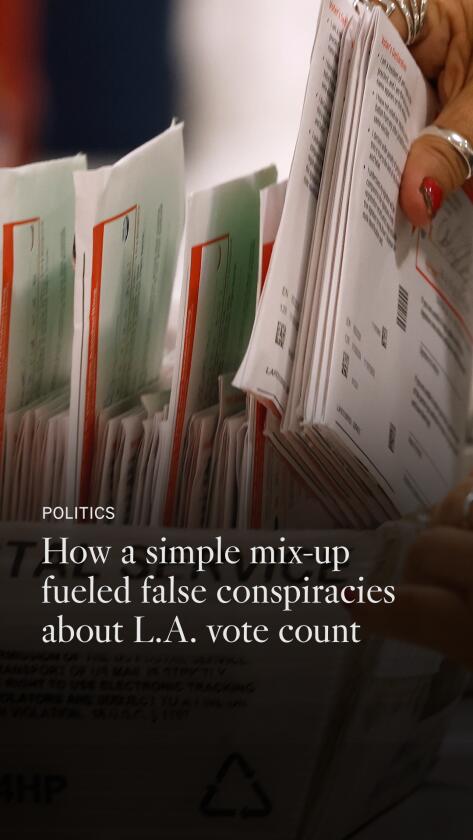
How a simple mix-up fueled false conspiracies about L.A. vote count
Since election night in California, a single theory of election fraud has taken root like no other — not just among online conspiracy theorists or bot accounts, but among major conservative influencers and people close to President Trump.
Late on election night, an update of vote counts in the Los Angeles mayor’s race appeared on election results pages of various media outlets including the Los Angeles Times.
It showed leading Democrats Mayor Karen Bass and Councilmember Nithya Raman receiving tens of thousands of new votes, and leading Republican former reality TV star Spencer Pratt receiving no new votes.
Close observers of the vote tally immediately took screenshots, with some shouting fraud. Others ran statistical analyses that showed it would be impossible for a candidate such as Pratt — running second in the race — to receive zero votes in such a large batch of ballots.

-
Share via
“They’re not even trying to hide the fraud anymore,” wrote Elon Musk, the world’s richest man and one-time member of Trump’s inner circle.
The claim fit into the broader narrative being pushed relentlessly by Trump and other Republicans in recent days, that California Democrats were cheating.
But the discrepancy in the Tuesday vote count in the mayor’s race was not fraud.
What attracted far less attention than the update with zero Pratt votes was another update one minute later that showed tens of thousands of votes for Pratt, and none for Bass or Raman.
There was no batch of votes that included zero votes for any candidate, as Los Angeles County’s own data show plainly.
But voting data pushed out by the Associated Press came as two separate updates one minute apart, with Bass’ and Raman’s votes in the first and Pratt’s in the second.
“The AP vote count receives updates as provided by election officials and adds them to our vote count. What happened in this case is that there was a lag in an automated update such that some candidates’ votes were added in one update and the other candidates followed about a minute later,” the Associated Press said in a statement to The Times.
“Specifically, an electronic update from the Los Angeles County website pulled in votes for only one group of candidates, including Karen Bass and Nithya Raman. Exactly one minute later, the electronic update picked up the votes for another group of candidates including Spencer Pratt. Taken together, the updates included 21,870 votes for Pratt, 12,850 votes for Bass and 9,521 votes for Raman, along with votes for other candidates.”
The Times’ election results page relies on the AP’s data feed, and checks for updates once a minute.
According to a Times review of election night results data, The Times pulled data from the AP’s feed at approximately 8:35 p.m. that included 0 new votes for Pratt and eight other candidates. When The Times’ system next checked for new numbers a minute later, there was an update with votes for Pratt but no new votes for Raman, Bass and others.
Michael Sanchez, a spokesperson for Dean Logan, head of the L.A. County registrar-recorder/county clerk’s office, said he could not speak for how news outlets report county data, but that he could confirm there were no batches of votes that included zero votes for Pratt.
“It is false,” he said of that narrative. “In every single result update that we released on election night and since election night, he has received votes,” Sanchez said.
Justin Grimmer, a political science professor at Stanford University and senior fellow at the Hoover Institution who researches and evaluates claims of election fraud, conducted his own data analysis of the vote updates, and came to the same conclusion.
He said there was an initial update with no Pratt votes, but a second one 41 seconds later with no votes for Bass or Raman — leading him to believe the single batch of ballots was just reported in two back-to-back updates rather than one.
“Because they came so close together, it looks like it was just a sequence of updates,” he said.
Grimmer said news outlets are “thinking about speed” and the best way to get people the most accurate information as quickly as possible, but “haven’t quite adjusted to being in this world where there’s this group of people who monitor these data feeds as if they are official government reports.”
“It leads to these horrible tweets about there being evidence of fraud,” he said.
Grimmer said he operates under the “mantra” that such fraud claims can’t be dismissed “by mere assertion” that the fraud didn’t happen, but must be looked into — which is why he dived into the data in the first place. This claim, he said, was similar to claims about odd-seeming vote tallies that were made during and after the 2020 election of Joe Biden over Trump, so he was familiar with how to look into the data.
“You can just go to the source code for the page, and then you can find where the sort of feed is, and that’s all I did — just found the feed, downloaded it, and then just saw what the updates were,” he said.
Grimmer said it was not surprising to him that people were watching the data feeds come in closely enough to notice an apparent discrepancy in the data that lasted less than a minute.
“There is a group of individuals who are convinced that there’s lots of fraud going on in U.S. elections, and for whatever reason, this group is convinced that they’re gonna uncover this by careful monitoring of these data feeds and the data that is being reported,” he said.
Grimmer said he would not presume to tell news outlets how to do their job of delivering election results quickly in the future, but does hope they balance the need to move quickly with “this reality that their feeds are now being monitored by individuals who think that they’re able to discover instances of fraud from what’s happening in the feeds.”
Sanchez reiterated that the county’s own official results of votes have been accurate — saying that “at no point” did the county office “report an official results update in which Pratt received zero votes.”

