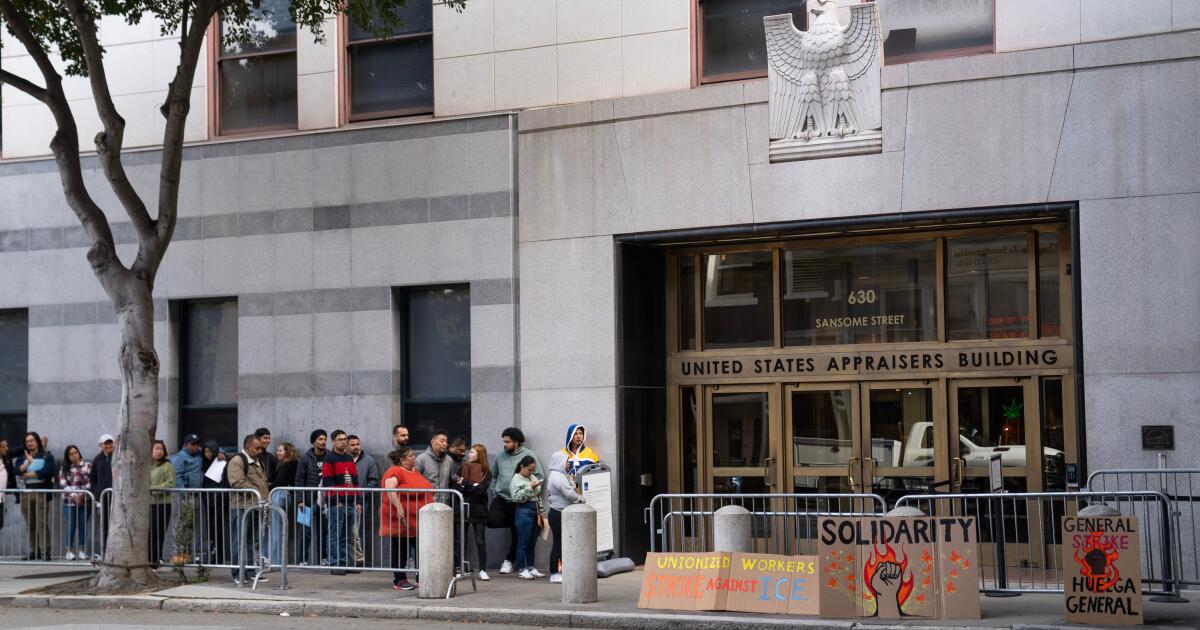
SAN FRANCISCO — There are no immigrants waiting for rulings anymore at San Francisco’s main immigration court, no lawyers making arguments.
The court, which had 21 judges when President Trump was sworn in last year, had only two left when it closed May 1. The rest had been fired, retired or resigned amid a White House purge of federal immigration judges.
The closing is one more reflection of the turmoil that has upended the immigration court system as the administration looks for ways to churn through its massive backlog of 3.8 million asylum cases and deport as many people as possible.
Asylum denial rates have soared as the administration has fired almost 100 judges deemed to be too liberal, and approved using hundreds of military lawyers to replace them. Immigrants have been arrested when they arrive at courthouses or government offices for scheduled appearances.
But amid the nationwide upheaval, San Francisco is the first major city to be left without a primary immigration court, leaving chaos and dysfunction in a region long known for its friendliness to asylum seekers. The two remaining judges will work from another federal building in the city but will be part of an immigration court across the bay.
That reputation, court insiders say, might have led to its downfall.
“It was a vibrant legal scene and so I think if you were looking to target a court you would have to look at what San Francisco stands for,” said Jeremiah Johnson, an immigration judge in the city until he was fired in November. He is now executive vice president of the National Assn. of Immigration Judges.
Most of the court’s 117,000 immigration cases have been moved to a courthouse in Concord, a city about 30 miles away that opened two years ago to help with San Francisco’s backlog of cases. But turmoil has also reached that city. A courthouse that had 11 judges at the start of 2025 is down to five after a series of firings. It had a caseload of 60,000 cases even before the San Francisco cases were shifted over.
San Francisco’s immigration court, which had the third-highest number of asylum cases in the nation, was long considered one of the most favorable to people seeking asylum. From 2019 to 2024, almost 75% of petitioners received some form of relief, compared with 43% nationwide, according to data compiled by the Transactional Records Access Clearinghouse, a nonprofit data research center based at Syracuse University.
That’s partly because San Francisco, with its vast network of pro-immigrant organizations and pro bono or low-cost legal services, had one of the country’s highest rates of legal representation for immigrants.
The Executive Office of Immigration Review, the Department of Justice branch that oversees immigration courts, announced in March that it would close the San Francisco courthouse in 2027 as a cost-saving measure and move its cases to Concord. But the end came early after nearly all the San Francisco judges left or were fired. The Executive Office provided no detailed explanation for the changes, saying in a statement only that it had decided not to renew its lease for the court, and doesn’t comment on personnel matters.
Tight security in Concord courts
Security is tight at the Concord courthouse, perhaps because of the new influx of cases. Armed security guards ask every person if they are carrying weapons or explosives, and they watch as each person turns off their cellphone. Even coffee is not allowed in. Only water is acceptable, and then only if it’s in a transparent bottle.
Judah Lakin, an immigration attorney based in Oakland who also teaches at UC Berkeley School of Law, said the closure of the San Francisco court has made cases more time-consuming since it’s harder for his clients, who often travel from hours away, to reach Concord on public transportation.
One recent 10-minute hearing in Concord took him more than two hours of travel, he said.
But beyond logistics, Lakin said the chaos in immigration courts under the Trump administration has created a fraught court atmosphere. Mass firings have led to last-minute hearing cancellations, cases have been reset with little notice, and clients are often left in prolonged legal limbo, leaving them vulnerable to deportation.
One of his clients, he said, was provisionally granted asylum by a judge, who was then fired before signing the decision. The case was transferred to a second judge, who was also fired. Now on their third judge, his client is still waiting.
“The ground is constantly shifting underneath your feet, whether it’s judges being fired and hearings getting canceled, whether it’s your clients getting arrested, whether it’s getting denials on things that used to be standard and routine,” Lakin said.
“I think that’s on purpose. That’s by design. It’s part of the strategy,” he added.
‘Heartbreaking’
San Francisco’s immigration court was one of the first in the nation to hire judges with non-prosecutorial backgrounds, with many having previous experience working with immigrants at nonprofits or defending them in court.
To see the court close is “heartbreaking,” said Dana Leigh Marks, a former San Francisco immigration judge who retired in 2021 after 35 years on the bench and who was among the first judges in the nation to be hired from private practice.
She sees the Trump administration’s decision to close the largest immigration court in Northern California as part of an effort to undermine due process and eventually dismantle the path to asylum.
“It’s all a part of big ways and little ways that the Trump administration is trying to get noncitizens out of the country,” she said.
Johnson, the fired San Francisco judge, was appointed during the first Trump administration. He believes he was targeted because he granted asylum in 89% of the cases he heard.
“You don’t fire judges if you disagree with the way they’re handling a case; that’s not how courts work. If you disagree, you appeal that decision,” he said.
Johnson, who is the executive vice president of the National Assn. of Immigration Judges, defended his judicial record, pointing out that over eight years, only about 10 of his cases were appealed by the Department of Homeland Security, and very few were sent back for further hearings by the Board of Immigration Appeals.
Unlike federal courts, where there are strict rules of procedure and judges have lifetime tenure, the Justice Department runs immigration courts, and the attorney general can fire the judges with fewer constraints.
There were 754 immigration judges across the country at the start of Trump’s second term. Now, there are about 600, including some temporary judges, according to data collected by the judges’ union. Widespread courthouse arrests of immigrants have caused hundreds of people not to even show up for hearings, leading to deportation orders in absentia.
Nidaa Pervaiz came to the Concord court on a recent day to represent a client from Nepal. She prefers the new courthouse in some ways, since it’s closer to her home.
But, she said, she and her clients are already feeling the impact of the changes. Fewer judges leads to fewer hearings. That means more delays for her clients, whose paperwork can expire even before they can appear before a judge.
“Their whole lives are at stake, and they are coming to make a plea for their future” she said.
Rodriguez writes for the Associated Press.