Former two-time champion loses his fourth straight bout after being stopped by Pyfer in the second round.
Published On 29 Mar 202629 Mar 2026
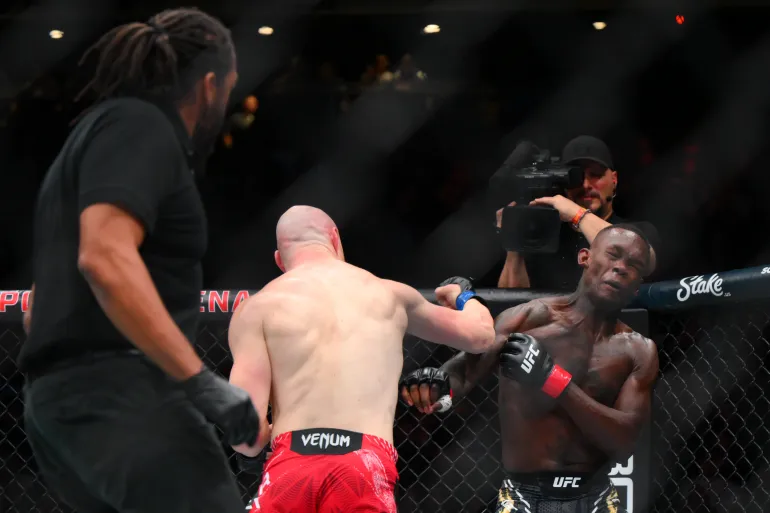
Joe Pyfer sent former Ultimate Fighting Championship middleweight champion Israel Adesanya back to the drawing board in Saturday’s UFC Fight Night headliner in Seattle, stopping Adesanya at 4:18 of the second round to cap the night.
Before the technical knockout (TKO) finish, both fighters exchanged their best punches in a stand-up battle until a Pyfer (16-3 MMA) takedown signalled the beginning of the end.
Recommended Stories
list of 3 itemsend of list
“I just have this mentality where I don’t care; I’m going to search and destroy,” Pyfer said, following the stoppage, securing the finish in top control.
Adesanya (24-6 MMA), fighting out of New Zealand, has not won a bout since regaining middleweight gold in April 2023 at UFC 287, and confirmed he has no plans to retire.
“I’m just going to keep going and going and going,” Adesanya said.
Pyfer, left, delivers a right-hand punch to Adesanya [Steven Bisig/Imagn Images via Reuters]
Grasso dominates Barber in rematch
A rematch five years in the making commenced at flyweight as former champion Alexa Grasso made short work of Maycee Barber with a TKO stoppage at 2:42 of the opening round. The Mexican used a left hook to down Barber before jumping on top of her immediately as the referee stepped in.
The two first met in February 2021, with Grasso earning a decision. Grasso (17-5-1 MMA) snapped a two-fight losing skid, whereas Barber (15-3 MMA) had not lost since the first meeting with Grasso, having won her previous seven fights.
In his final MMA fight, welterweight Michael Chiesa (20-7 MMA) had a hometown send-off as he submitted Niko Price (16-11 MMA) with a first-round rear-naked choke. Chiesa needed just 63 seconds to put a bow on his UFC career, one that spanned a decade-plus and included winning the 15th season of The Ultimate Fighter in June 2012.
Chiesa ended his UFC career at 15-7, while Price, who has been in the promotion for over a decade himself, now sits at 8-11, with two no contests in the Octagon and has dropped four straight fights.
The finishes were a theme on the night, as featherweight Lerryan Douglas (14-5 MMA) of Brazil needed 3:33 of the opening round to deliver a devastating TKO against Julian Erosa (31-13 MMA). Douglas has now won his last six in a row while Erosa continues to struggle at 9-9 in the UFC.
At middleweight, Yousri Belgaroui of the Netherlands scored a third-round TKO stoppage against Mansur Abdul-Malik by landing a perfectly timed knee to end the fight in a back-and-forth battle. Belgaroui (10-3 MMA) has won five straight and remains undefeated in the UFC. Conversely, it was Abdul-Malik’s (9-1-1 MMA) first professional loss, as he had won seven of his 11 outings by KO/TKO.
The main card got under way in emphatic fashion in the opener, with lightweight Terrance McKinney needing just 24 seconds to dispatch Canadian Kyle Nelson with a series of punches following a head kick. McKinney (18-8 MMA) has won three of his last four, while Nelson (17-7-1 MMA) has lost two of his last three.
Movsar Evloev rallies after a point deduction against the unbeaten Lerone Murphy to win the contest in London.
Published On 22 Mar 202622 Mar 2026
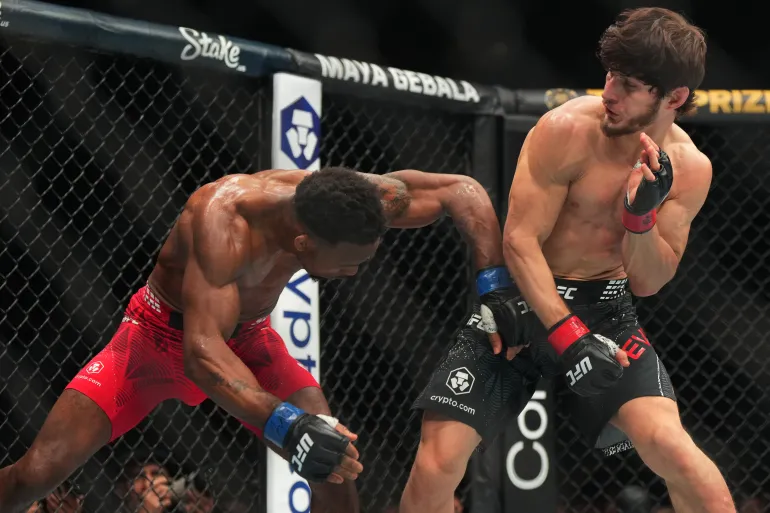
Russia’s Movsar Evloev overcame a point deduction for a foul to edge a majority decision win over Lerone Murphy at Saturday’s UFC Fight Night 270 at the O2 Arena, likely punching his ticket to a title fight against featherweight champion Alexander Volkanovski in his next bout.
With the two fighters putting their undefeated records on the line to decide who will face the 37-year-old Australian Volkanovski for the belt, the bout turned into an intriguing clash of styles.
Recommended Stories
list of 3 itemsend of list
Evloev, who is known for his wrestling, tried to showcase his striking, while Murphy displayed some superb defensive work on the ground.
Murphy evaded the fearsome grappling attack of his Russian opponent for the first two rounds of the five-round bout, using a selection of stiff right hands to keep him at bay. Evloev took the chance to exhibit some of the dangerous spinning strikes he has added to his repertoire since his last fight in December 2024.
Evloev finally managed to take the fight to the mat early in the third round, but Murphy was quickly back to his feet, uncorking a spinning back kick of his own shortly afterwards.
However, it was his opponent who finished the frame strongest with a big overhand right, followed up by a flurry of strikes.
Evloev, right, lands a punch against Murphy during the UFC Fight Night 270 main event at the O2 Arena [Peter van den Berg/Imagn Images via Reuters]
His momentum was derailed somewhat when he landed a second kick to Murphy’s groin early in the fourth round, and referee Marc Goddard deducted a point from Evloev for the foul.
Knowing that the deduction could be decisive if the fight went to the judges’ scorecards, Evloev turned up his energy-sapping grappling attack in the fifth and final frame as he chased a finish, but again Murphy was able to get back to his feet with relative ease.
Despite not really threatening to submit his opponent on the ground, it proved to be enough for the 32-year-old Evloev, with two of the judges scoring the fight 48-46 in his favour and the third scoring it a draw 47-47 after the point deduction was taken into account.
Murphy reacts following his first career defeat in UFC [Jasper Wax/Getty Images]
Chuck Norris, a former martial arts champion and 1980s action-film hero, has died at the age of 86, according to his family.
In a statement posted to Instagram on Friday, his family described Norris’s death as sudden.
Recommended Stories
list of 3 itemsend of list
“It is with heavy hearts that our family shares the sudden passing of our beloved Chuck Norris yesterday morning,” the Norris family wrote.
“While we would like to keep the circumstances private, please know that he was surrounded by his family and was at peace.”
According to the publication Variety, Norris had been hospitalised in Hawaii since Thursday, though details were not disclosed.
Norris was the six-time undefeated World Professional Middleweight Karate Champion from 1968 to 1974. But he rose to wider fame in a series of action films, including 1985’s Code of Silence, 1984’s Missing in Action and 1986’s The Delta Force.
He further cemented his status as a household name when he starred from 1993 to 2001 in the popular TV series Walker, Texas Ranger, playing a principled lawman.
Norris’s tough-guy image made him an internet meme in his later years, though he received pushback for his far-right political views and embrace of conspiracy theories.
His family expressed gratitude to fans for their prayers during his hospitalisation.
“He lived his life with faith, purpose, and an unwavering commitment to the people he loved,” the post read. “Through his work, discipline, and kindness, he inspired millions around the world and left a lasting impact on so many lives.”
‘The ultimate tough guy’
Norris starred in more than two dozen films, often portraying stoic loners, soldiers, lawmen and all-American heroes who captured criminals and rescued hostages.
He made his film debut in 1973’s The Way of the Dragon, where he famously faced martial arts icon Bruce Lee in Rome’s Colosseum.
In 1985, Time magazine dubbed him “the ultimate tough guy” and “the undisputed superstar” of the B-movie action genre.
On screen, Norris was known for his signature roundhouse kicks, shrugging off gunfire and dispatching opponents with ease. His tough-guy persona made him a box-office draw and a television staple.
Decades later, he joined fellow action stars Sylvester Stallone, Arnold Schwarzenegger and Bruce Willis in 2012’s The Expendables 2, helping defeat a villain played by Belgian fighter Jean-Claude Van Damme.
He also became an unlikely internet phenomenon. In 2005, “Chuck Norris Facts”, a series of satirical jokes about his strength and masculinity, went viral and inspired several books.
The “Facts” included jokes like “Chuck Norris has a mug of nails instead of coffee in the morning” and “Chuck Norris doesn’t do push-ups; he pushes the Earth down.”
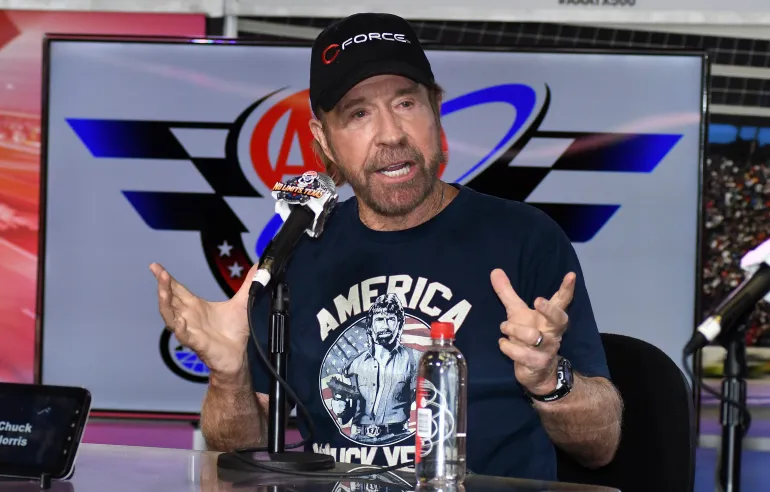
Chuck Norris speaks to reporters before the NASCAR Sprint Cup Series auto race at Texas Motor Speedway in Fort Worth, Texas, on November 6, 2026 [File: Larry Papke/AP Photo]
‘Texas has lost a legend’
Carlos Ray Norris was born on March 10, 1940, in Ryan, Oklahoma, the oldest of three brothers. The family moved to California after his parents divorced.
He described himself as extremely quiet and introverted as a young man, which he attributed to his father’s alcoholism and the family’s poverty.
“In school I was shy and inhibited,” Norris wrote in his 2004 memoir, Against All Odds: My Story. “If the teacher asked me to recite something aloud in front of the class, I would just shake my head no.”
According to Norris, he was also not a natural athlete growing up, and he credited his martial arts career to intense training.
After graduating from school, he enlisted in the US Air Force in 1958. While stationed in South Korea, he learned Tang Soo Do, a form of karate, and other martial arts.
The future film star started teaching martial arts in California after his discharge. Actor Steve McQueen, who was one of Norris’s students, eventually encouraged him to try acting.
Tributes poured in following news of his death, including from political figures who shared Norris’s far-right leanings.
“Texas has lost a legend,” Texas Governor Greg Abbott wrote on X, referencing Norris’s work on Walker, Texas Ranger.
“He electrified generations of conservatives. Giving them a passion and voice to fight for the principles that make America the greatest nation on earth.”
Israel’s Prime Minister Benjamin Netanyahu also paid tribute, calling Norris “a great friend of Israel and a close personal friend”.
High-profile stars and artists also mourned Norris’s passing, including several of Norris’s colleagues.
Stallone, for instance, wrote in a statement, “I had a great time working with Chuck. He was All American in every way. Great man and my condolences to his wonderful family.”
Author Stephen King, meanwhile, shared a memory of being thrilled — and scared — by Norris’s performance in the action-horror film Silent Rage.
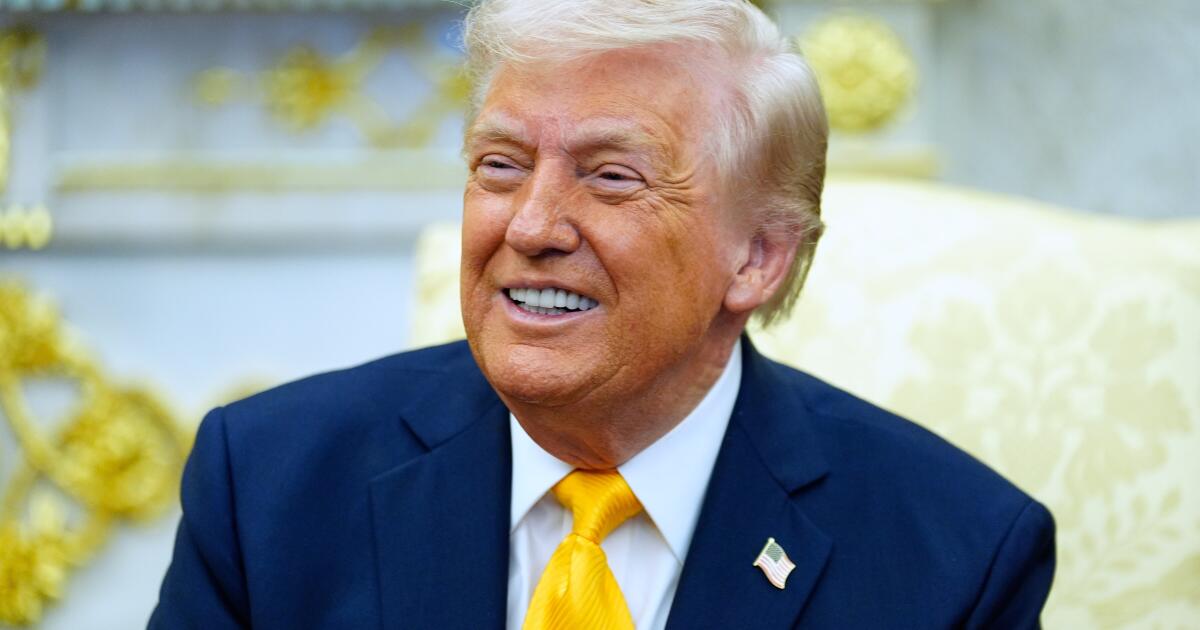
WASHINGTON — A federal arts commission on Thursday approved the final design for a 24-karat gold commemorative coin bearing President Trump’s image to help celebrate America’s 250th birthday on July 4.
The vote by the U.S. Commission of Fine Arts, whose members are supporters of the Republican president and were appointed by him earlier this year, was without objection. It clears the way for the U.S. Mint to begin production on the coin, whose size and denomination are still under discussion.
“As we approach our 250th birthday, we are thrilled to prepare coins that represent the enduring spirit of our country and democracy, and there is no profile more emblematic for the front of such coins than that of our serving President, Donald J. Trump,” U.S. Treasurer Brandon Beach said in a statement.
The unprecedented move marks yet another example of Trump and his allies circumventing conventional past presidential practices — and even the law — to get what he wants. It’s the latest instance of Trump putting his name and likeness in the historical archive, following his renaming of the U.S. Institute of Peace, the Kennedy Center performing arts venue and a new class of battleships, among other tributes.
Federal law says no living president can appear on U.S. currency. But Megan Sullivan, the acting chief of the Office of Design Management at the Mint, said the Treasury secretary has authority to authorize the minting and issuance of new 24-karat gold coins, which Scott Bessent has used to get around that prohibition and put Trump on a coin.
She presented the coin’s final design at the commission’s March meeting on Thursday and said Trump had approved it.
“It is my understanding that the secretary of the Treasury presented this design, as well as others, to the president and these were his selection,” Sullivan said.
The White House and the Mint did not immediately respond to electronic and telephone requests for comment.
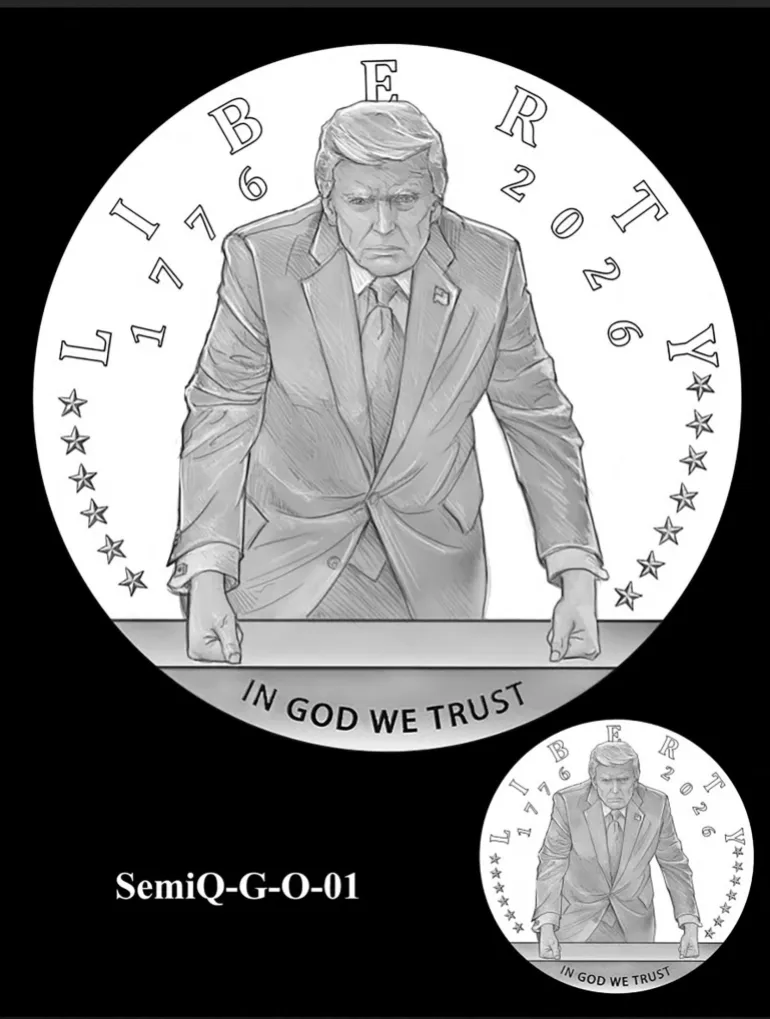
The front of the coin features an image of Trump in a suit and tie and with a stern look on his face. His fists rest on top of what is supposed to be a desk as he leans forward. Lettering on the top half of the coin spells “LIBERTY” in a slight arc. Directly underneath that are the dates 1776-2026. The words “IN GOD WE TRUST” are at the bottom, with seven stars on one side of the coin and six stars on the other side.
The reverse side depicts a bald eagle midflight with “UNITED STATES OF AMERICA” on the right side and “E PLURIBUS UNUM” on the left side.
“I know it’s a very strong and a very tough image of him, and I think it’s fitting to have a current sitting president who’s presiding over the country over the 250th year on a commemorative coin for said year,” said Commissioner Chamberlain Harris, a top White House aide to Trump.
The coin will be part of a “very limited production run,” Sullivan said, but the number has not been determined. The size and denomination of the coin also have not yet been decided, she said. Some commissioners noted Trump’s fondness for big things as they advocated for the largest size coin.
The Mint, which is part of the Treasury Department, has looked at a size for the Trump coin that is larger than its 1-ounce gold coin, which is about 1.3 inches in diameter, Sullivan said.
Its largest coin is 3 inches, “so we’re looking somewhere in there,” she said.
“I think the president likes big things,” said Commissioner James McCrery II, who was the architect on Trump’s design proposal for a 90,000-square-foot ballroom addition to the White House. The fine arts commission approved that proposal at its February meeting.
Harris told McCrery she agreed with him. She works in the White House as a special assistant to the president and deputy director of the Oval Office.
“I think the larger the better. The largest of that circulation, I think, would be his preference,” Harris said, speaking of Trump.
The United States Commission of Fine Arts, a federal agency, has approved plans for a commemorative gold coin that features one of Donald Trump’s recent presidential portraits.
The commission, made up of Trump appointees, voted unanimously in favour of minting the coin on Thursday. But the legality of such efforts has been repeatedly questioned.
Recommended Stories
list of 3 itemsend of list
Federal law prohibits the depiction of living presidents on US currency. Thursday’s coin, however, may sidestep the rule, as it is intended as a commemorative item, not for circulation as currency.
Still, the Trump administration has advanced other plans to put the president’s face on a $1 coin, in addition to the commemorative gold coin.
Critics denounced both initiatives as unlawful and inappropriate for a sitting leader.
“Monarchs and dictators put their faces on coins, not leaders of a democracy,” Senator Jeff Merkley told the news agency Reuters.
The Citizens Coinage Advisory Committee, a bipartisan federal panel, has previously pushed back against efforts to mint Trump-themed coins.
One of its members, Donald Scarinci, said that the panel and the Commission of Fine Arts are both supposed to approve such designs.
“But we still fully expect them to plough ahead and mint both coins,” Scarinci said of the commission.
The gold coin is set to feature a bald eagle on one side, and Trump on the other, leaning with both fists on the table and staring straight ahead.
The image is a facsimile of a black-and-white image of Trump taken by photographer Daniel Torok and featured in the National Portrait Gallery in Washington, DC.
“I know it’s a very strong and a very tough image of him,” said Chamberlain Harris, a Trump aide who was appointed to arts commission earlier this year.
The US Mint’s commemorative gold coin for the 250th anniversary of the US is set to feature Donald Trump on one side [US Mint/Reuters]
Harris indicated that the Trump gold coin would be as large as possible. The US Mint currently produces coins as large as 7.6 centimetres, or three inches, which is what Harris said the Trump administration would aim for.
“I think the larger the better. The largest of that circulation, I think, would be his preference,” Harris said, referencing her discussions with the president.
Megan Sullivan, the acting chief at the Office of Design Management at the US Mint, also indicated that Trump had given the design his approval.
“It is my understanding that the secretary of the Treasury presented this design, as well as others, to the president, and these were his selection,” Sullivan said.
Since taking office for a second term, Trump has pushed to leave his mark on the federal government.
In addition to the gold coin and $1 coin that are slated to bear his image, he has placed his name on the US Institute of Peace and the Kennedy Center for the Performing Arts.
Both efforts are the subject of ongoing lawsuits. An act of Congress gave the Kennedy Center its name, designating it as a living memorial to the late John F Kennedy, a president who was assassinated in office in 1963.
Likewise, the US Institute of Peace was established by Congress as an independent think tank dedicated to conflict resolution.
It was the subject of a standoff between its leadership and members of Trump’s Department of Government Efficiency (DOGE) last March, culminating in its employees being forcibly evicted.
Trump has also placed his face on government buildings around Washington, DC, in the form of long banners.
Even the architecture of the city is changing to reflect his tastes: Last October, he tore down the White House’s East Wing in order to build a massive ballroom, and he has plans to build a triumphal arch in the capital, similar to the one in Paris, France.
Trump has pitched many of the changes as part of the country’s 250th anniversary celebrations, which culminate this July.
At Thursday’s meeting to discuss the gold coin, his officials repeated the argument that celebrating Trump was a good way to mark the anniversary.
“I think it’s fitting to have a current sitting president who’s presiding over the country over the 250th year on a commemorative coin for said year,” said Harris.
One Battle After Another was the big winner of the 98th Academy Awards, taking home six Oscars.
Paul Thomas Anderson’s black comedy about a has-been revolutionary won Best Picture, Best Director, Best Adapted Screenplay, Best Supporting Actor, Best Film Editing, and Best Casting.
Recommended Stories
list of 1 itemend of list
Sinners, which entered the ceremony with a record 16 nominations, was the second-biggest winner of the night, with four awards.
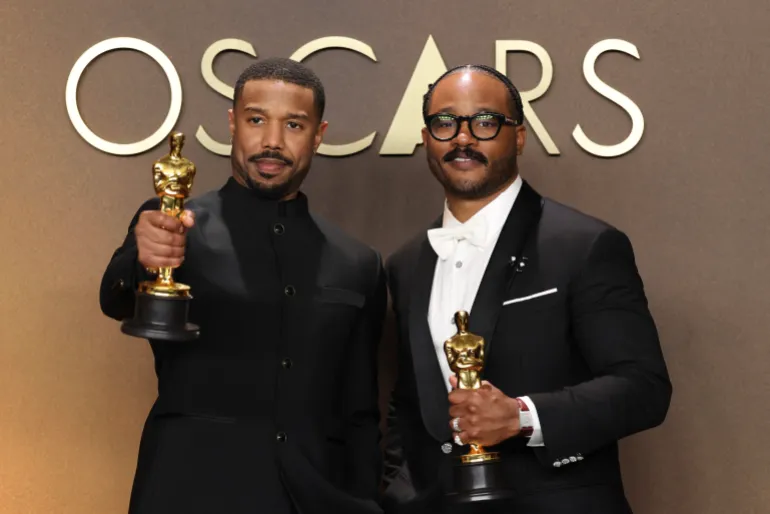
Michael B Jordan earned Best Actor for his leading role, while director Ryan Coogler picked up his first Oscar for Original Screenplay.
In the acting categories, Jessie Buckley won Best Actress for Hamnet, marking her first Academy Award, while Amy Madigan was recognised as Best Supporting Actress for Weapons.
Elsewhere, the South Korean musical fantasy KPop Demon Hunters won two Oscars, while Frankenstein also secured two awards.
Here is the full list of winners:
Best Picture One Battle After Another
Best Actress Jessie Buckley, Hamnet
Best Actor Michael B Jordan, Sinners
Best Supporting Actress Amy Madigan, Weapons
Best Supporting Actor Sean Penn, One Battle After Another
Best director Paul Thomas Anderson, One Battle After Another
Best Original Score Ludwig Göransson, Sinners
Best Animated Film KPop Demon Hunters
Best International Feature Sentimental Value
Best Documentary Feature Mr Nobody Against Putin
Best Casting Cassandra Kulukundis, One Battle After Another
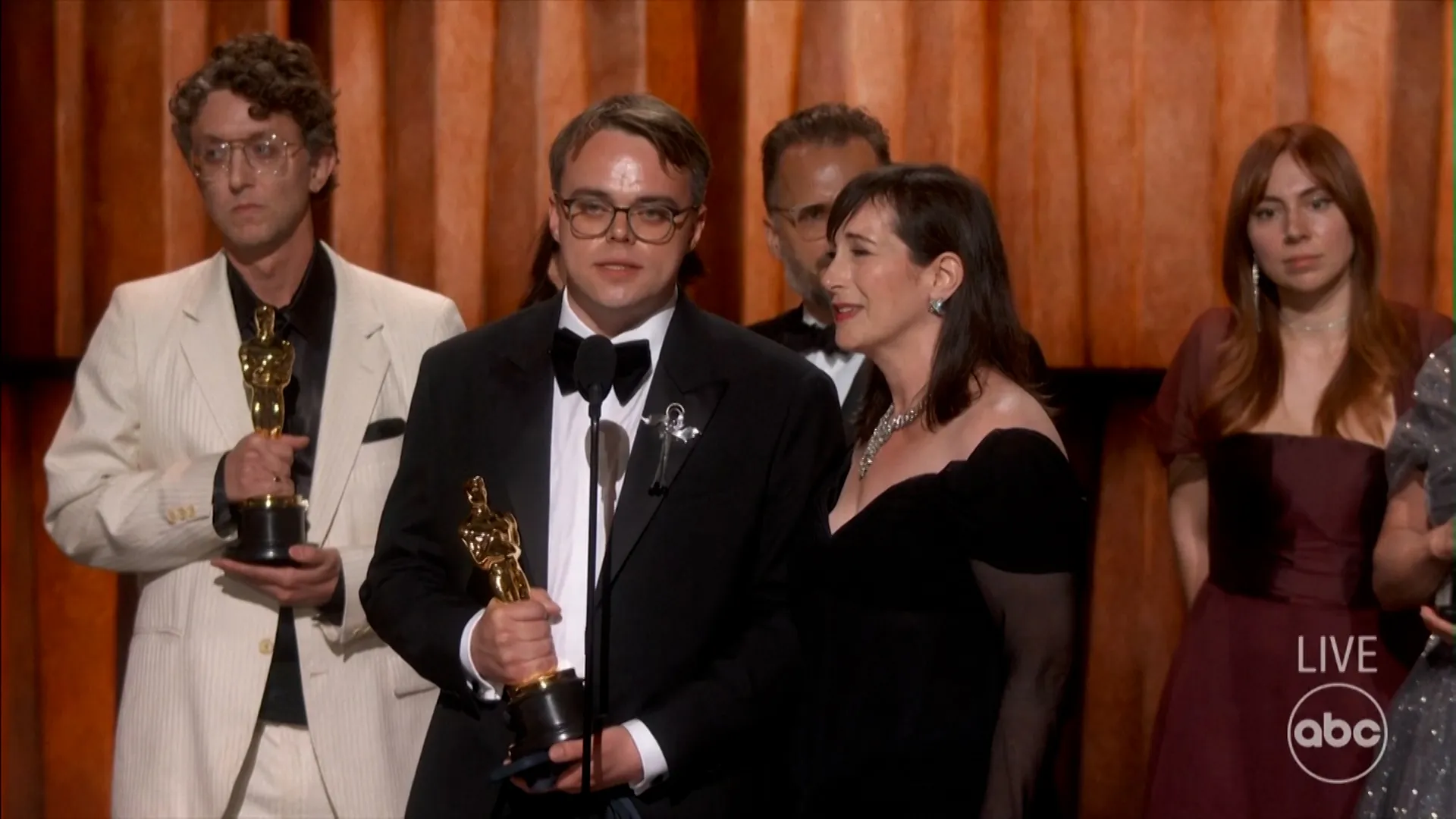
Best Sound Gareth John, Al Nelson, Gwendolyn Yates Whittle, Gary A Rizzo and Juan Peralta, F1
Best Original Screenplay Ryan Coogler, Sinners
Best Adapted Screenplay Paul Thomas Anderson, One Battle After Another
Best Documentary Short All the Empty Rooms
Best Live Action Short Film The Singers and Two People Exchanging Saliva (tie)
Best animated short film The Girl Who Cried Pearls
Best Music (Original Song): EJAE, Mark Sonnenblick, Joong Gyu Kwak, Yu Han Lee, Hee Dong Nam, Jeong Hoon Seo and Teddy Park for Golden, KPop Demon Hunters
Best Film Editing: Andy Jurgensen, One Battle After Another
Best Cinematography: Autumn Durald Arkapaw, Sinners
Best Production Design: Tamara Deverell and Shane Vieau, Frankenstein
Best Costume Design Kate Hawley, Frankenstein
Best Makeup and Hairstyling Mike Hill, Jordan Samuel and Cliona Furey, Frankenstein
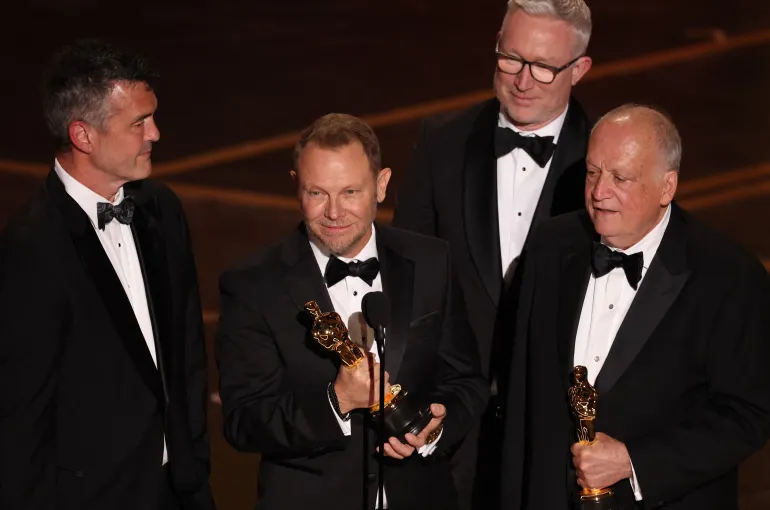
Best Visual Effects Joe Letteri, Richard Baneham, Eric Saindon and Daniel Barrett, Avatar: Fire and Ash
Visual effects supervisor Eric Saindon, visual effects artist Richard Baneham, Daniel Barrett and visual effects supervisor Joe Letteri accept the award for Best Visual Effects for Avatar: Fire and Ash [Patrick T. Fallon/AFP]
As anticipated, it ended up being One Battle After Another’s night at the 98th annual Academy Awards, with the political thriller carting away six Oscars out of a total of 13 nominations.
But while Paul Thomas Anderson’s magnum opus continued its march towards award-season domination, there were moments of genuine surprise and subversion in Sunday’s ceremony.
Recommended Stories
list of 3 itemsend of list
Some of those moments had to do with the current political climate in the United States.
Host Conan O’Brien and his fellow presenters deftly avoided mentioning President Donald Trump by name, but their barbs took direct aim at his policies since returning to office.
Other surprises came from within the filmmaking community itself. For only the seventh time in Oscar history, a tie was announced: Two films had gotten an equal number of votes for Best Live Action Short.
As a result, both the surrealist thriller Two People Exchanging Saliva and the moody bar-room drama The Singers shared the Academy Award.
Here are six key takeaways from the night.
Actor Michael B Jordan holds the Oscar for Best Actor next to director Ryan Coogler, who earned an Oscar for Best Original Screenplay [Valerie Macon/AFP]
A two-horse race between Sinners and One Battle
The vampire film Sinners came into Sunday night’s ceremony with a record 16 Oscar nominations. But the big question of the night was: How many nods could it actually convert into wins?
Its biggest competition was, of course, Anderson’s One Battle After Another, which had the second highest tally of nominations.
Sinners director Ryan Coogler and Anderson were in direct competition in several top categories, including Best Picture and Best Director.
In both cases, Anderson came out ahead, though he acknowledged how fickle such awards can be.
“ I just want to say that, in 1975, the Oscar nominees for Best Picture were Dog Day Afternoon, One Flew Over the Cuckoo’s Nest, Jaws, Nashville and Barry Lyndon,” the four-time Best Director nominee said, listing films now considered to be Hollywood classics.
“There is no best among them. There is just what the mood might be that day.”
In the categories for Best Supporting Actor and Best Film Editing, One Battle After Another also triumphed, as well as for the inaugural award for Best Casting.
But in a sign of how well matched their two films were, both Coogler and Anderson emerged from the night with writing Oscars.
Anderson picked up Best Adapted Screenplay award for his use of the Thomas Pynchon novel Vineland, while Coogler made off with the Best Original Screenplay Oscar for Sinners, a work inspired by his uncle’s love of the blues.
US cinematographer Autumn Durald Arkapaw poses in the press room with her Oscar for Best Cinematography [Valerie Macon/AFP]
Jordan dunks on Chalamet in Best Actor race
Sinners, which won four Academy Awards overall, earned some of the most emotional, nail-biting victories of the night.
In the Best Cinematography category, for instance, Autumn Durald Arkapaw became the first woman to top the field.
It was her first nomination and first win, with Arkapaw besting veteran cinematographers like Marty Supreme’s Darius Khondji and Frankenstein’s Dan Laustsen, both multiple nominees.
Another big win for Sinners came in the form of Michael B Jordan, the actor whom Coogler has cast in every film since his directorial breakout in 2013’s Fruitvale Station.
Jordan, 39, was in a tight race for Best Actor with another young performer, 30-year-old Timothee Chalamet of the 1950s ping-pong drama Marty Supreme.
But Chalamet’s aggressive campaigning may have ultimately sabotaged his prospects. Multiple cracks were taken throughout the night at Chalamet’s recent comments disparaging opera and ballet.
“Nobody cares anymore” about either art form, Chalamet said in an interview last month.
“We can change society through art, through creativity, through theatre and ballet and also cinema,” director Alexandre Singh said pointedly during his acceptance speech for Best Live Action Short.
O’Brien, meanwhile, acknowledged the backlash with a joke about heightened security at the night’s Oscar ceremony.
“I’m told there are concerns about attacks from both the opera and ballet communities,” O’Brien said, before turning to Chalamet. “They’re just mad you left out jazz.”
Irish actress Jessie Buckley celebrates her win during the 98th Annual Academy Awards [AFP]
A conga line of snubs
Given the dominant performances from Sinners and One Battle After Another, plenty of critically acclaimed films left empty-handed, or nearly so.
Guillermo del Toro’s Frankenstein, as expected, earned three wins in technical categories, including Best Production Design, Best Costumes and Best Hairstyling and Makeup.
Netflix’s smash hit KPop Demon Hunters, meanwhile, also fulfilled expectations that it would dominate in its categories, Best Animated Feature and Best Original Song.
But then there were former frontrunners like Hamnet that failed to generate much traction, including for director Chloe Zhao, a past Oscar winner. Out of eight nominations total, it only came away with one win: a Best Actress trophy for Irish performer Jessie Buckley.
Marty Supreme and the Brazilian film The Secret Agent fared worse, however. Despite having nine nominations and being considered an early shoo-in for Best Actor, Marty Supreme scored no wins.
The Secret Agent, which swept the Best Actor and Best Director categories at the 2025 Cannes Film Festival, also earned nothing at this year’s Oscars.
Same was true for the quirky kidnapping drama Bugonia, from Oscar darling Yorgos Lanthimos.
South Korean-US singer Ejae poses with the Oscar for Best Original Song for the film KPop Demon Hunters[Angela Weiss/AFP]
Fears about artificial intelligence
The ceremony, however, did occasionally veer away from the competition between the films to discuss issues facing the film industry and the country as a whole.
Among those was the creeping growth of artificial intelligence (AI) in the creative sector.
In the weeks leading up to the 98th Oscars, an AI-generated video clip had gone viral, appearing to show Hollywood icons Brad Pitt and Tom Cruise in a rooftop brawl worthy of a James Bond movie.
The clip had been generated through AI software developed by the Chinese firm ByteDance, and Hollywood leaders quickly denounced it as a threat to their livelihood, not to mention a copyright infringement.
Those concerns reverberated on the Oscar stage on Sunday, with O’Brien and others addressing the growing use of AI.
“Tonight we are celebrating people, not AI, because animation – it’s more than a prompt,” actor Will Arnett said emphatically as he introduced the animation awards.
O’Brien, meanwhile, joked that, by next year, his hosting gig would be taken by “a Waymo in a tux”.
Host Conan O’Brien performs onstage during the 98th Annual Academy Awards [Patrick T Fallon/AFP]
Trump skewered for threatening free speech
Another concern looming over the night’s Oscar ceremony came in the form of President Donald Trump, who has courted controversy by launching deadly military attacks in Venezuela and Iran, as well as leading a violent immigration crackdown in the US.
At no point was Trump mentioned by name. But his leadership was alluded to throughout the night.
O’Brien, the host, set the tone early on with his oblique jabs at the Republican president in his opening monologue.
“When I hosted last year, Los Angeles was on fire,” the two-time Oscar emcee said in remarks dripping with sarcasm. “But this year, everything’s going great.”
Fellow comedian Jimmy Kimmel was even more direct. Last September, his show was briefly suspended after Trump criticised the comedian.
The head of the Federal Communications Commission, a Trump appointee, subsequently threatened the broadcasting license of the TV channel Kimmel performs on.
“There are some countries whose leaders don’t support free speech. I’m not at liberty to say which. Let’s just leave it at North Korea and CBS,” Kimmel quipped, referring to another channel that cancelled a fellow late-night comedy show.
Several filmmakers honoured at the Oscars likewise waded into the controversies surrounding Trump.
Best Documentary Feature winner David Borenstein, for instance, implied a parallel between his film — an exploration of authoritarianism in Russia — and what is currently happening in the US.
“Mr Nobody against Putin is about how you lose your country,” Borenstein explained.
“What we saw when working with this footage is that you lose it through countless small little acts of complicity: when we act complicit, when a government murders people on the streets of our major cities, when we don’t say anything, when oligarchs take over the media.”
Indian actress Priyanka Chopra and Spanish actor Javier Bardem present the award for Best International Feature Film [Patrick T Fallon/AFP]
Political speeches avoid mention of Iran war
The Oscars come roughly seven months ahead of the pivotal midterm elections in the US, which could see Trump’s Republican Party lose its majorities in Congress.
But while several filmmakers did hint at their anti-Trump stances, few explicitly denounced his policies.
For example, Norway’s Joaquim Trier, the winner of the Best International Feature category, veiled his criticism in a James Baldwin quote about the duty to protect children.
“Let’s not vote for politicians who don’t take this seriously into account,” Trier said.
No artist during the night referenced the US and Israeli war against Iran either, though its effects were felt among the participants of this year’s Oscar crop.
Writer-director Jafar Panahi, whose work was up for two Oscars on Sunday, has already said he plans to return to his native Iran after the awards season concludes.
Meanwhile, Iranian politician Sara Shahverdi — the subject of a nominee in the Best Documentary Short category — was prevented from attending the Oscars at all due to Trump’s ban on visas for 39 countries.
Palestinian actor Motaz Malhees, star of the Oscar nominee The Voice of Hind Rajab, likewise told media outlets he could not be present at the ceremony due to the travel ban.
The most pointed acknowledgements of the US-led and US-backed conflicts in the world were brief. When Spanish actor Javier Barden took the Oscar stage to present an award, he offered up six words, “No to war, and free Palestine!”
Russian filmmaker Pavel Talankin, meanwhile, made a similar appeal to the audience. “In the name of our future, in the name of all of our children, stop all of these wars now,” he said.
But by and large, the Oscar winners and presenters kept their remarks vague, emphasising global unity over political criticism.
“If I can be serious for just a moment, everyone watching right now around the world is all too aware that these are very chaotic, frightening times,” O’Brien told the audience at the outset of the night.
“It is at moments like these that I believe that the Oscars are particularly resonant. Check it out. Thirty-one countries across six continents are represented this evening, and every film we salute is the product of thousands of people speaking different languages.”
Cinema, he and others argued, transcended borders. The talent on stage was not the US’s alone.