Artemis

Artemis II crew splashes down in the Pacific Ocean after moon mission

1 of 3 | A Navy MH-60 Seahawk from Helicopter Sea Combat Squadron (HSC) 23 is seen as it lifts CSA (Canadian Space Agency) astronaut Jeremy Hansen, Artemis II mission specialist as teams work to bring the crewmembers aboard USS John P. Murtha, on Friday, in the Pacific Ocean off the coast of California. NASA Photo by Joel Kowsky/UPI | License Photo

April 10 (UPI) — The crew of the Artemis II crew returned to Earth after a splashdown in the Pacific Ocean after travelling farther from Earth than any humans in history.

The Orion capsule carrying the four-person crew is expected to make a water landing just after 8:07 p.m. EDT on Friday evening, capping their 10-day mission to test NASA’s new spacecraft while taking the next steps to returning humans to the surface of the moon.

Thus far, the mission has been successful in most ways, but NASA engineers have noted that the most important part is the return to Earth.

“Every system we’ve demonstrated over the past nine days — life support, navigation, propulsion, communications — all of it depends on the final minutes of flight,” Amit Kshatriya, NASA’s associate administrator, told reporters on Thursday.

“We have confidence in the system, in the heat shield, and the parachutes and the recovery system that we’ve put together,” he said.

One of the main concerns after the Artemis I uncrewed launch was unexpected charring on the heat shield of the Orion capsule, which protects astronauts from the heat created as the spacecraft reenters Earth’s atmosphere at 40 times the speed of sound.

A combination of adjustments to the heat shield and late mission burns to adjust the angle that the capsule reenters the atmosphere is expected to resolve NASA’s concerns after the first flight of the Artemis Space Launch System and Orion crew capsule.

This is a developing story. Please check back for updates.

NASA’s Space Launch System rocket carrying the Artemis II crew is launched from Complex 39B at Kennedy Space Center in Florida on April 1, 2026. Photo by Joe Marino/UPI | License Photo

Source link

Title: Artemis II astronauts journey back to Earth after Moon mission | Space

NewsFeed

NASA’s Artemis II astronauts have returned to Earth after completing the first crewed lunar mission in more than 50 years, reaching the greatest distance ever travelled by humans. The crew successfully completed a parachute landing in the Pacific Ocean, after a high-speed re-entry through Earth’s atmosphere.

Source link

Artemis II splashdown: Astronauts return to Earth after lunar mission | Science and Technology News

The Artemis II crew landed in the Pacific Ocean under parachutes after a high-speed re-entry that tested its heat shield.

NASA’s Artemis II astronauts have safely splashed down on Earth, completing a landmark mission that carried humans around the Moon and back for the first time in more than 50 years.

The crew successfully completed a parachute landing on Friday in the Pacific Ocean, after a high-speed re-entry through Earth’s atmosphere. Recovery teams were off the coast of California, waiting to retrieve them after their arrival at 5:07pm Pacific time (00:07 GMT).

Recommended Stories

list of 3 itemsend of list

The four astronauts will now undergo medical checks before returning to NASA’s Johnson Space Center in Houston.

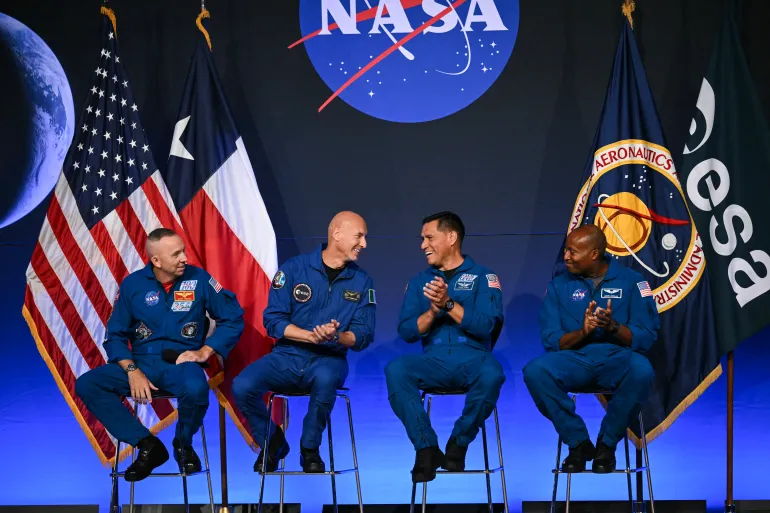
NASA crew members Reid Wiseman, Victor Glover and Christina Koch, together with Canadian astronaut Jeremy Hansen, began a 10-day voyage from Florida’s Kennedy Space Center last week, travelling farther into space than any human ever has.

They looped around the far side of the moon, testing equipment in deep space, before propelling back to Earth on Friday.

Their mission was the first to the moon since the 1972 Apollo 17 mission, and their return caps a mission packed with technical milestones.

A new perspective on Earth

Artemis II is widely seen as a critical test flight for future Moon missions, particularly Artemis IV, which aims to land astronauts on the lunar surface for the first time since the Apollo era.

Engineers will now analyse key data from the mission, including the performance of the Orion capsule’s heat shield as well as navigation systems and life-support technology, all essential for safely carrying humans deeper into space.

The return also included one of the most challenging phases of the journey: a brief communication blackout during re-entry, caused by intense heat building up around the spacecraft.

But on top of its record-setting distance, the mission also marked other historic firsts. Glover became the first person of colour to travel around the moon, Koch the first woman, and Hansen the first non-American.

During their journey, the crew reported in vivid detail features of the lunar surface and later witnessed a solar eclipse as well as meteorite impacts.

Mission commander Wiseman reflected that “what we really hoped in our soul is that we could, for just a moment, have the world pause — and remember that this is a beautiful planet in a very special place in our universe”.

“We should all cherish what we have been gifted.”

Every morning since the astronauts’ departure, NASA has sent a song to Artemis II to start the day. On Friday, the astronauts awoke to the tune of Live’s song Run to the Water and the country hit Free, by Zac Brown Band.

A handout picture made available by the National Aeronautics and Space Administration (NASA)
Artemis II Commander Reid Wiseman shares a picture of Earth taken from the Orion spacecraft’s window on April 2, 2026 [EPA/NASA]

Source link

Artemis II crew prepares for return to Earth, splashdown in Pacific Ocean

April 10 (UPI) — The Artemis II crew on Friday reached the last part of their mission to travel past the moon, farther than any human has traveled from Earth before circling back home — splashdown day.

The Orion capsule carrying the four-person crew is expected to make a water landing just after 8:07 p.m. EDT on Friday evening, capping their 10-day mission to test NASA’s new spacecraft while taking the next steps to returning humans to the surface of the moon.

Thus far, the mission has been successful in most ways, but NASA engineers have noted that the most important part is the return to Earth.

“Every system we’ve demonstrated over the past nine days — life support, navigation, propulsion, communications — all of it depends on the final minutes of flight,” Amit Kshatriya, NASA’s associate administrator, told reporters on Thursday.

“We have confidence in the system, in the heat shield, and the parachutes and the recovery system that we’ve put together,” he said.

One of the main concerns after the Artemis I uncrewed launch was unexpected charring on the heat shield of the Orion capsule, which protects astronauts from the heat created as the spacecraft reenters Earth’s atmosphere at 40 times the speed of sound.

A combination of adjustments to the heat shield and late mission burns to adjust the angle that the capsule reenters the atmosphere is expected to resolve NASA’s concerns after the first flight of the Artemis Space Launch System and Orion crew capsule.

NASA’s Space Launch System rocket carrying the Artemis II crew is launched from Complex 39B at Kennedy Space Center in Florida on April 1, 2026. Photo by Joe Marino/UPI | License Photo

Source link

Artemis II enters moon’s sphere of influence ahead of lunar flyby

April 6 (UPI) — The four crew members of the Artemis II mission entered the moon’s sphere of influence early Monday, marking the start of their lunar flyby.

The Orion spacecraft reached what is called the lunar sphere of influence at about 12:41 a.m. ET Monday, meaning the moon’s gravitational forces on the capsule were greater than those of Earth.

The mission launched Wednesday from Florida, and it took the spacecraft four days, six hours, two minutes and 54 seconds to cross the important gravitational milestone, the first crewed mission to enter the moon’s sphere of influence since Apollo 17 in 1972.

About 13 hours later, at 1:56 p.m., the four-person crew of NASA astronauts Reid Wiseman, Victor Glover and Cristina Koch, and Canadian Space Agency astronaut Jeremy Hansen will have surpassed the record for the farthest humans have traveled from Earth, which was previously set by Apollo 13 in 1970.

The spacecraft is expected to start its flyby of the moon at about 2:45 p.m. Monday, when a seven-hour lunar observation period will begin.

NASA said the crew will see both the near and far sides of the moon during this period. As window space is limited, the crew will be divided into pairs that will conduct between 55- and 85-minute observation shifts, it said.

Mission control sent the crew the final list of lunar surface features to be observed and photographed during the flyby early Sunday, according to NASA.

The astronauts will be tasked with observing about 30 targets, including the Orientale basin, a nearly 600-mile-wide crater that spans the boundary between the moon’s near and far sides, NASA said.

“The crew will study Orientale’s features up close and from multiple angles as they pass by,” the space agency said in a Sunday evening blog post.

Orion is expected to reach its closest approach to the moon at 4,070 miles at 7:02 p.m. only to reach its maximum distance from Earth during the mission minutes later.

The lunar observation period is expected to come to an end at 9:20 p.m.

At about 1:25 p.m. Tuesday, Orion will have exited the lunar sphere of influence en route home.

The 10-day moon flyby mission is to conclude with a splashdown off the coast of San Diego at about 8:07 p.m. Friday.

Source link

Artemis II crew set eyes on parts of the moon humans have never seen before

1 of 3 | A photo of the moon, taken by the crew on day 4 of the Artemis II mission, shows the South Pole at the top and parts of the lunar far side, as well as the Orientale basin on the right edge of the lunar disk. The mission will mark the first time that humans have seen the entire basin. Photo by NASA/UPI

April 5 (UPI) — The four astronauts of the Artemis II mission were woken on Sunday by the sounds “Working Class Heroes (Work)” by CeeLo Green, and they will go to sleep as their spacecraft enters its sphere of gravitational influence.

Day 5 of NASA’s first journey to the moon in more than 50 years remained on course Sunday morning after maneuvering the Orion space capsule in its precise course to ricochet around the far side of the moon before heading back to Earth.

The crew is roughly half-way through its ten-day mission to test the abilities of the Orion space capsule and make direct observations of the far side of the moon, all of which will take them farther from Earth than any human has previously traveled.

The crew’s work for Sunday includes a full sequence of space suit operations and preparations for their approach to the moon, as well as their responsibilities during the five-hour trip around its back side, NASA said.

“We’re going to work!” NASA said in a post on X around 12:30 p.m. EDT on Sunday that the astronauts were hearing the day’s wake-up song, which the agency has been announcing each day of the mission.

In addition to the wake-up song, the astronauts were greeted this “morning” with an audio message from Apollo 16 astronaut Charlie Duke, who in 1972 became the 10th person to walk on the moon at age 36.

“Below you, on the moon, is a photo of my family,” Duke said in the 46-second recording, which the crew posted to X. “I pray it reminds you that we, in America, and all of the world, are cheering you on. Thanks for building on our Apollo legacy with Artemis.”

The suits are designed to protect astronauts during “dynamic” phases of space flight, can keep them alive should the Orion’s cabin depressurize and are designed to provide life support after splashing down in the ocean when they return to Earth.

The demonstration, like many of the other tasks the Artemis II crew is conducting, are meant to inform later Artemis missions to land on the moon and eventually build a human base there.

Although the crew was able to skip two other planned correctional burns on the way to entering the moon’s gravitational influence, an outbound trajectory correction burn is still planned for later today.

The final lunar science targets that the astronauts will be inspecting, photographing and analyzing will be sent from mission control and the crew will prepare to actually enter the moon’s gravity.

NASA’s Space Launch System rocket carrying the Artemis II crew is launched from Complex 39B at Kennedy Space Center in Florida on April 1, 2026. Photo by Joe Marino/UPI | License Photo

Source link

World’s Most Secretive 737 Is Supporting NASA’s Historic Artemis II Launch

The U.S. Air Force Materiel Command’s secretive NT-43A has been spotted in Florida, taking part in the preparations for the launch of NASA’s long-delayed Artemis II lunar space mission. This highly unique and notoriously shy plane, a converted militarized Boeing 737-200 variant (T-43) also commonly known by the callsign RAT55, has long been used as an airborne signature measurement platform to support work related to stealthy military aircraft. However, during a high-stakes space launch, its two huge radar arrays, modular electro-optical and infrared sensors, and other capabilities would likely be well-suited to gathering telemetry and other valuable data, as you can read more about here.

RAT55 was spotted yesterday flying over Melbourne, on Florida’s eastern coastline, which was already highly unusual. The jet is very easy to identify, even in the distance, due to its heavily modified nose and massive aft radome protruding from the rear of the fuselage. The NT-43A seems to live at the Tonopah Test Range Airport (TTR), a high-security facility in Nevada long associated with shadowy aircraft programs. It is often spotted flying around Area 51 in Nevada and Edwards Air Force Base in neighboring California, both of which are major U.S. military flight test hubs. It is rare to see it anywhere else.

The sighting of RAT55 in the skies above Melbourne aligned with online tracking data for a flight using the callsign NASA522. That track showed the aircraft – apparently miscoded as a C-130 Hercules transport plane – taking off from MacDill Air Force Base, situated to the southwest, and then flying an oval-shaped orbit in restricted airspace around the Kennedy Space Center’s Launch Complex 39B. The aircraft then returned to MacDill.

ADS-B Exchange

The Artemis II mission is currently scheduled to launch from Launch Complex 39B today at 6:24 PM EDT. A Space Launch System (SLS) rocket will take four astronauts in an Orion capsule into space on what is expected to be a nine-and-a-half-day-long trip. This will be the first crewed lunar mission of any kind since Apollo 17 in 1972, but the Artemis II crew will not actually set foot on the Moon. They will instead pass by, hopefully setting a new record for the longest distance that people have traveled away from Earth. The target distance is 252,000 miles, some 4,000 miles beyond the current record, set by the crew of the ill-fated Apollo 13 lunar mission in 1970. The Artemis II mission’s main goal is to help lay the groundwork for future missions to the lunar surface, the first of which is now expected to come in 2028.

The fueling process for the Artemis II rocket has picked up speed. The rocket is now more quickly filling with liquid oxygen and liquid hydrogen.

When the core stage is completely full, it will contain 196,000 gallons of liquid oxygen and 537,000 gallons of liquid hydrogen. pic.twitter.com/wejiCveeNb

— NASA Artemis (@NASAArtemis) April 1, 2026

NASA regularly uses fixed-wing aircraft to gather imagery and other important data during space launches. One of its high-flying WB-57F research planes, which are routinely used to provide optical tracking, was also flying around Launch Complex 39B yesterday at the same time as the NASA522 flight. The WB-57F conducted that flight from the Kennedy Space Center’s Shuttle Landing Facility (SLF).

This is correct, there are two separate NOTAMs for support aircraft that match both flight tracks. This was an obvious rehearsal. pic.twitter.com/X3i5RbP4T2

— Dillon Shropshire (@Dillonshrop06) April 1, 2026

A stock image of one of NASA’s WB-57Fs. NASA One of NASA’s WB-57Fs, which carries the U.S. civil registration number N926NA. NASA

It is unclear why RAT55 has been called in to help, especially given that the U.S. military, and the U.S. Navy in particular, has an array of dedicated range support aircraft specially configured to support missile test activities, and a history of using them to support NASA launches in the past. TWZ has reached out to the Air Force and NASA for more information.

Still, as already noted, the NT-43A does have a sensor suite that would likely be very relevant to the space launch support mission. Beyond helping to collect more general telemetry information, the unique capabilities the aircraft has to offer might be used to gain more detailed insights into various aspects of the SLS rocket and the Orion capsule at launch. One of the tasks RAT55 is more typically understood to perform is helping to verify surface coatings on low-observable (stealthy) aircraft. Specialized coatings and other materials, especially to provide critical thermal protection, are a key aspect of space launch rocket and spacecraft design.

Though the WB-57F has numerous modular payload bays, as well as space for sensor and other equipment in underwing pods, the NT-43A offers a more capacious airframe, overall, along with optional dorsal fairings. NASA could fill this space with additional systems to meet other mission requirements.

In addition, it is worth mentioning here that NASA only has three WB-57Fs, and one made a fiery belly landing in Houston, Texas, back in January. The current status of that aircraft is unclear. Whether or not this was a factor in the decision to utilize the NT-43A is unknown.

The Air Force does have its own previous history of supporting NASA Moon missions, specifically, with specialized fixed-wing aircraft, which The Aviationist has noted. During the 1960s and 1970s, the U.S Air Force supported the Apollo program with a fleet of EC-135N Apollo/Range Instrumentation Aircraft (ARIA) planes, which were also used to track missile tests. The ARIA jets carried very large radars in their bulbous noses. Those aircraft were later redesignated as EC-135Es and continued to be used for various flight test activities until the last example was retired in 2000.

An EC-135N/E ARIA aircraft. USAF

Choosing the NT-43A for this task at all is still somewhat curious, given the U.S. military’s array of other missile tracking and range support telemetry aircraft, especially within the U.S. Navy. Those fleets continue to evolve, including with the Navy’s addition of its Gulfstream G550 business jet-based NC-37B. Repurposed RQ-4 Global Hawk drones are even now in the mix. There is a history of similar U.S. military planes supporting NASA launches in the past. It isn’t clear if additional roles for the NT-43A are going to be a common thing, but it certainly appears that its mission set is expanding. This is a very interesting development for an aging aircraft that has lived in the shadows for so long.

Regardless, the Artemis II launch is especially important for NASA, in general. There has only been one all-up launch of an SLS before now, in 2022, and no astronauts were on board at that time. The Artemis program has been dogged by setbacks and delays, with the hope originally that the Artemis III mission would bring Americans back to the lunar surface in 2024.

The video below shows the first SLS launch as part of the uncrewed Artemis I mission in 2022.

NASA’s Artemis I Launches on Nov. 16, 2022


NASA is now in line to finally reach the next Artemis milestone with today’s planned launch, and is doing so with help from the Air Force’s unique and rarely seen RAT55.

UPDATE: 7:42 PM EDT –

We have now received additional information from the U.S. Air Force about RAT55, which you can find in a follow-up story here.

Contact the author: thomas@thewarzone.com

Thomas is a defense writer and editor with over 20 years of experience covering military aerospace topics and conflicts. He’s written a number of books, edited many more, and has contributed to many of the world’s leading aviation publications. Before joining The War Zone in 2020, he was the editor of AirForces Monthly.


Joseph has been a member of The War Zone team since early 2017. Prior to that, he was an Associate Editor at War Is Boring, and his byline has appeared in other publications, including Small Arms Review, Small Arms Defense Journal, Reuters, We Are the Mighty, and Task & Purpose.


Source link

Artemis II now closer to moon than Earth

Artemis II astronauts are inside the Orion capsule as they make their way to the moon. Photo courtesy NASA

April 4 (UPI) — NASA announced Saturday that the four astronauts of the Artemis II mission were closer to moon than to the Earth.

NASA shared photos from the mission on X, declaring that the astronauts were officially “moonbound.”

“Artemis II astronauts are more than halfway to their destination, and preparations for lunar flyby are underway,” NASA said. “During the trip around the far side of the moon, they will capture imagery to share with scientists (and you, too!).

The photos included two images of the moon and one of the interior of the Orion capsule as the astronauts worked and looked out at space.

“We can see the moon out of the docking hatch right now. It’s a beautiful sight,” an earlier NASA post quoting the astronauts said.

On Sunday, Artemis II is expected to reach the lunar sphere of influence, meaning the moon’s gravity will be stronger than Earth’s on the spacecraft.

The astronauts are expected to make their flyby of the moon on Monday, coming to within 6,000 miles of the lunar surface. They’ll fly around the far side of the moon for about 6 hours, taking photos and making observations. During this time, the astronauts will lose communication with Earth for about 30 to 50 minutes.

Tuesday marks the start of Artemis II’s four-day return to Earth, and splashdown is scheduled for Friday.

NASA’s Space Launch System rocket carrying the Artemis II crew is launched from Complex 39B at Kennedy Space Center in Florida on April 1, 2026. Photo by Joe Marino/UPI | License Photo


Source link

Artemis II leaves Earth orbit for first time in 50 yeas en route to moon

April 3 (UPI) — NASA’s Artemis II crew left Earth orbit Thursday evening en route for the moon, marking a milestone not reached in more than 50 years.

The Orion spacecraft began a scheduled 5-minute, 50-second burn at 7:49 p.m. EDT, successfully propelling it and its four-person crew out of Earth orbit.

“Nominal translunar injection burn complete. The Artemis II crew is officially on the way to the moon,” NASA Administrator Jared Isaacman announced on social media.

“America is back in the business of sending astronauts to the moon. This time, farther than ever before.”

The crew of NASA astronauts Reid Wiseman, Victor Glover, Christina Koch and Canadian Space Agency astronaut Jeremy Hansen launched Wednesday evening from Florida’s Kennedy Space Center.

It is the first crewed mission to travel farther than low-Earth orbit since Apollo 17 in 1972.

The long-awaited exit from Earth orbit signaled that humankind is now on a trajectory to its closest celestial body, the moon at an average of 238,855 miles away.

“I got to tell you, there is nothing normal about this: sending four humans 250,000 miles away is a Herculean effort, and we are just realizing the gravity of that,” Reid said in a press conference after exiting orbit.

Asked what they are most excited about when they near the moon, Koch simply said it was views.

“Having just experienced incredible views of planet Earth and seeing the entire planet out the window in one pane, knowing that we’re about to have some similar views of the moon in that same way is definitely getting me more excited for it,” she said.

“I knew that that is what we would see, but there is nothing that prepares you for the breathtaking aspect of seeing your home planet both lit up bright as day and also the moon glow on it at night with the beautiful beam of the sunset and knowing we are going to get similar views of the moon, I’m just really excited for that.”

The Orion spacecraft is now on its way to the moon where the crew will perform a flyby, during which they will take high-resolution photographs and provide personal observations of the lunar surface, including the far side of the moon, NASA said.

After the flyby is completed, the four-person crew will begin their return to Earth, completing their 10-day deep-space journey with a splashdown in the Pacific Ocean on April 10.

The mission, in essence, is a crewed rehearsal for a future lunar landing, targeted for early 2028.


Source link

Artemis II astronauts complete first burn, head back to sleep

April 2 (UPI) — The Artemis II astronauts have completed their perigee raise burn as part of a planned orbital adjustment and are headed back into a four-hour rest period, NASA said.

After an earlier rest period, the astronauts were awakened at 7:06 a.m. EDT for the perigee burn. NASA played the song “Sleepyhead” by Young and Sick to wake them up.

In the perigee burn, the spacecraft lit its main engine for 43 seconds, which raised the lowest point of its orbit. This helps prevent the craft from re-entering the Earth’s atmosphere. It also refines the trajectory of the craft as it circles Earth. It put Orion into a stable high-Earth orbit, which aligns with its path to the moon.

The crew will now have another four-and-a-half-hour rest period, then they will be awakened to start their first full day in space.

Later today, the mission management team will have its first meeting of the mission to assess the spacecraft’s systems and will give its approval for the upcoming translunar injection burn. That burn will send astronauts out of Earth’s orbit and toward the Moon for the first time in 50 years. It will last just over six minutes and will speed the craft to escape Earth’s gravitational pull.

The launch on Wednesday evening began at 6:35 p.m. EDT from the Kennedy Space Center in Florida.

Soon after launch, Wiseman told operators on the ground, “We have a beautiful moonrise, we’re headed right at it.”

There was a small glitch in the craft’s space toilet, Space.com reported.

“The toilet fan is reported to be jammed,” NASA spokesperson Gary Jordan said during live mission commentary. “Now the ground teams are coming up with instructions on how to get into the fan and clear that area to revive the toilet for the mission.”

NASA Director of Flight Operations Norm Knight told reporters that the problem was a controller issue on the toilet in urine collection. The astronauts were able to use a backup system until the engineers fixed the problem before their first rest period.

About 9 minutes after the launch, the crew entered Earth’s orbit, traveling about 15,000 mph. They are expected to enter the moon’s orbit in about six days, travel around it and then return to Earth.

The four-person crew are: NASA’s Commander Reid Wiseman, Victor Glover and Christina Koch, and Canadian Space Agency’s Jeremy Hansen.

NASA’s Space Launch System rocket carrying the Artemis II crew is launched from Complex 39B at Kennedy Space Center in Florida on April 1, 2026. Photo by Joe Marino/UPI | License Photo

Source link

How long will Artemis II take to reach the moon, and what happens next? | Science and Technology News

NASA has successfully launched the Artemis II mission, marking the first crewed mission to the moon’s vicinity since the Apollo programme ended in 1972.

The 322-foot Space Launch System (SLS) rocket lifted off at 6:35pm ET (22:35 GMT) on Wednesday from Cape Canaveral, Florida, sending the Orion crew capsule on a 10-day journey.

Recommended Stories

list of 3 itemsend of list

While Artemis II will not land on the moon, it will fly a “free-return” trajectory that swings around it to prove the spacecraft can sustain a crew on future missions.

The idea is to descend to the surface of the Earth’s only natural satellite again on Artemis IV in 2028.

“We have a beautiful moonrise,” said Reid Wiseman, the NASA astronaut serving as mission commander, about five minutes after the launch. “We’re heading right at it.”

Here is what we know:

What happened?

The Artemis II mission launched successfully from the Kennedy Space Center in Florida, sending four astronauts on a historic journey around the moon, the first crewed mission beyond low-Earth orbit in more than 50 years.

The launch followed a tense countdown, as engineers worked through several technical issues. Teams closely monitored the rocket during fuelling due to hydrogen leaks that had delayed the mission in the past, but no major leaks were detected on launch day.

Engineers also resolved last-minute problems involving battery sensors and the rocket’s flight termination system, a critical safety system used to destroy the rocket if it goes off course, before clearing the mission for liftoff.

The 32-storey rocket lifted off in the early evening in front of large crowds gathered near the launch site. The crew are now on a mission that will take them around the moon and back to Earth.

The launch had been planned for as early as February 6, and then March 6, until a hydrogen leak prompted NASA to ‌roll the ⁠rocket back to its vehicle assembly building for scrutiny.

It had earlier been scheduled for November 2024, but NASA announced a delay due to technical investigations, particularly into the Orion’s heat shield.

Who is part of the Artemis II mission?

All three NASA astronauts are veterans of Earth-orbit science expeditions to the International Space Station, while the lone Canadian joining them on a voyage around the moon and back is a spaceflight rookie.

  • Reid Wiseman, 50, commander: The NASA veteran and former International Space Station commander is leading the Artemis II mission. A test pilot-turned-astronaut, he has leadership and deep spaceflight experience.
  • Victor Glover, 49, pilot: The US Navy aviator is the first Black astronaut assigned to a lunar mission and flew on SpaceX Crew-1.
  • Christina Koch, 47, mission specialist: The record holder for the longest single spaceflight by a woman at 328 days is a veteran of multiple spacewalks and has scientific and deep-space mission expertise.
  • Jeremy Hansen, 50, mission specialist: The first Canadian set to travel to the moon is a former fighter pilot. His presence represents international collaboration in deep space exploration.
INTERACTIVE - Who is on board Artemis II-1774960222
(Al Jazeera)

When will the mission reach the moon?

If the mission goes as planned, the capsule is expected to reach the moon on about April 6, the sixth day of the mission.

The crewed Orion capsule will then fly around the moon, reaching its closest point before beginning the journey back to Earth, with splashdown expected on April 10, 2026.

Interactive_Artemis2_March30_2026-MISSION_MOON

What is the mission plan for the next 10 days?

The Artemis II mission is expected to last about 10 days and follows this general outline:

Days 1-2 high Earth orbit : The crew will spend their first one to two days in high Earth orbit conducting extensive checks on the spacecraft’s systems.

Once those checks are complete, Orion’s propulsion system will perform a “translunar injection”.

A translunar injection is a critical manoeuvre performed by the Orion spacecraft’s propulsion system. Occurring after the crew completes their initial systems checks in high Earth orbit, this manoeuvre propels the spacecraft out of Earth orbit and sets it onto a direct trajectory towards the moon.

Days 3-4 translunar transit: As they transit to the moon over the next several days, the astronauts will continue monitoring Orion’s systems.

The spacecraft will then pass behind the moon on a “free-return” trajectory, a strategic path that naturally swings the capsule back towards Earth without requiring any additional propulsion.

Day 5 lunar sphere of influence: Orion enters the moon’s gravitational pull, which becomes stronger than Earth’s.

The astronauts will spend the first several hours of the day testing their spacesuits, including practising how quickly they can put them on, pressurising them and strapping into their seats.

Day 6 lunar flyby: This is the day the crew fly by the moon.

The spacecraft reaches its closest approach, approximately 4,000-6,000 miles (6,450-9,650km) above the lunar surface.

Day 7-9 Return journey: Following the flyby, Orion remains on its free-return trajectory. The crew conducts deep-space science, including medical monitoring through programmes like ARCHER.

Day 10 Re-entry and splashdown: Orion separates from the service module and re-enters Earth’s atmosphere at roughly 25,000mph (40,230km/h). The mission concludes with a splashdown in the Pacific Ocean.

What’s NASA’s next mission?

Artemis III is the next mission and is currently planned for 2027.

It will involve the Orion spacecraft docking in Earth orbit with at least one of NASA’s lunar landers, either Blue Origin’s Blue Moon system or SpaceX’s Starship.

The docking manoeuvre is intended to demonstrate how the landers will collect astronauts in orbit before transporting them to the moon’s surface.

Source link

Artemis II lifts off for first crewed journey to moon in more than 50 years

April 1 (UPI) — NASA launched its most powerful rocket yet, the Space Launch System, on Wednesday to send the crewed Artemis II mission to the moon, the first in more than five decades.

The mission had liftoff around 6:35 p.m. EDT from the Kennedy Space Center in Florida.

Within minutes of liftoff, Artemis II commander Reid Wiseman told operators on the ground, “we have a beautiful moonrise, we’re headed right at it.”

The four-person crew — which also includes NASA’s Victor Glover and Christina Koch, and Canadian Space Agency’s Jeremy Hansen — is expected to enter the moon’s orbit in about six days. The spacecraft won’t land on the moon, but will orbit around it before returning to Earth.

The 2-hour launch window for Artemis II began around 6:24 p.m., and most of the pre-flight checks were successfully.

Shortly after the crew members boarded the craft, though, NASA officials had to address a pair of issues.

Derrol Nail, of NASA, said officials fixed a problem with the Space Launch System rocket’s flight termination system.

Later, there was a problem with the battery on the launch abort system on Orion. This system ejects the capsule away from the rocket in case there’s a problem with the rocket during flight. NASA detected issues with temperature readings on the battery but had resolved the issue before schedule launch.

The 10-day trip will be the first crewed flight to the moon in more than 50 years and the farthest distance from Earth traveled by humans.

About 9 minutes after the launch, the Artemis crew entered orbit, traveling about 15,000 mph. During Earth orbit, the crew has a series of tasks to complete before they’re able to make their way to the moon.

The Artemis I mission in 2022 flew around the moon but didn’t have a crew aboard.

Children race to push colored eggs across the grass during the annual Easter Egg Roll event on the South Lawn of the White House in Washington on April 21, 2025. Easter this year takes place on April 5. Photo by Samuel Corum/UPI | License Photo

Source link

NASA’s Artemis II lifts off to the moon | Science and Technology News

DEVELOPING STORY,

The mission is a major step in NASA’s plan to return humans to the moon and eventually send astronauts to Mars.

The Artemis II space mission has blasted off from the US state of Florida, sending four astronauts on a historic journey around the moon and marking the first time humans have travelled beyond low-Earth orbit in more than 50 years.

The mission, which launched on Wednesday, is a major step in the US space agency NASA’s plan to return humans to the moon and eventually send astronauts to Mars.

Recommended Stories

list of 1 itemend of list

The 32-story rocket rose from NASA’s Kennedy Space Center where tens of thousands gathered to witness the lift-off.

The Artemis II crew – NASA astronauts Reid Wiseman, Victor Glover and Christina Koch, and Canadian Space Agency astronaut Jeremy Hansen – are set for a nearly 10-day journey around the moon and back, taking them farther into space than humans have travelled in decades.

“On this historic mission, you take with you the heart of this Artemis team, the daring spirit of the American people and our partners across the globe, and the hopes and dreams of a new generation,” said Charlie Blackwell-Thompson, the launch director. “Good luck, Godspeed Artemis II. Let’s go.”

Five minutes into the flight, Wiseman, the commander, saw the team’s target: “We have a beautiful moonrise, we’re headed right at it,” he said from the capsule.

Source link