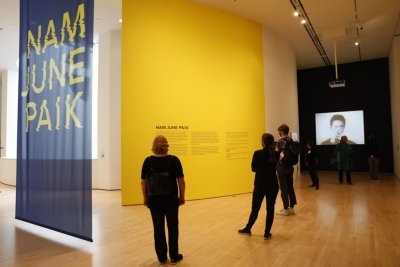
The San Francisco Museum of Modern Art (SFMOMA) presents the work of the late Nam June Paik, Korean American artist, who is considered to be the founder of video art, during a press preview of his first-ever retrospective exhibition in San Francisco, California. Photo by JOHN G. MABANGLO / EPA
June 12 (Asia Today) — Nam June Paik connected Seoul, Tokyo and New York by satellite in 1986.
His project, “Bye Bye Kipling,” brought Korean traditional dance, American popular music and Japanese avant-garde art together on one screen in real time. The work directly challenged British writer Rudyard Kipling’s famous line that East and West could never meet, presenting instead the possibility of communication across borders and cultures.
That history of encounter and exchange is at the center of “Road movie: Art between Korea and Japan since 1945,” now on view at the National Museum of Modern and Contemporary Art, Korea, in Gwacheon. The exhibition marks the 60th anniversary of normalized diplomatic relations between South Korea and Japan and traces 80 years of artistic exchange since Korea’s liberation in 1945.
The exhibition features about 200 works by 43 artists and artist teams from both countries. It was jointly organized by the Korean museum and the Yokohama Museum of Art. The show first opened in Yokohama late last year and drew about 37,000 visitors before coming to South Korea.
Featured artists include Nam June Paik, Lee Ufan, Lee Bul, Jung Yeondoo, Koki Tanaka, Jiro Takamatsu and Takashi Murakami, along with other major figures in contemporary Korean and Japanese art.
Paik is one of the central figures in the exhibition. He studied aesthetics and art history in Japan in the 1950s and later built close ties with Japan’s avant-garde art scene. It was there that he met Shigeko Kubota, his lifelong partner and artistic collaborator.
Alongside “Bye Bye Kipling,” the exhibition presents Kubota’s video work “Broken Diary: Korean Trip,” which documents Paik’s return to South Korea after 34 years abroad.
The exhibition, however, does not focus only on well-known artists. Its first section, “In Between: Zainichi Koreans’ Gaze,” examines the lives of Korean artists who remained in Japan after liberation. Cho Yanggyu’s “Sealed Warehouse” depicts a dark, enclosed labor site and reflects both the reality faced by Zainichi Koreans and the wounds left by national division.
The exhibition also explores the growth of artistic exchange after South Korea and Japan normalized diplomatic relations in 1965. Works by Lee Ufan, Park Seo-bo, Yun Hyong-keun, Jiro Takamatsu and Kishio Suga show how artists in the two countries influenced one another as modern art movements developed across borders.
Later works by Masato Nakamura, Takashi Murakami and Lee Bul show how artistic exchange expanded in the 1990s from official institutions to personal networks and collaborative relationships.
Lee Bul’s “Cyborg W5” presents a futuristic but incomplete body, questioning boundaries between humans and machines and between male and female identities. The work reflects the shared concerns about technology and identity that shaped Korean and Japanese contemporary art after the 1990s.
The exhibition’s final section shifts from past exchange to present-day solidarity. Koki Tanaka’s “Vulnerable Histories: A Road Movie” links the massacre of Koreans after the 1923 Great Kanto Earthquake to more recent anti-Korean demonstrations in Japan, asking viewers to consider histories of discrimination and exclusion.
Jung Yeondoo’s “Magician’s Walk” reflects on landscapes after the 2011 Great East Japan Earthquake and explores the possibility of empathy and solidarity with the suffering of others.
The exhibition also extends to the museum’s outdoor sculpture park in Gwacheon. Six sculptures by Korean artists based in Japan and Japanese artists, including Duckjun Kwak, Quac Insik and Lee Ufan, highlight the museum’s role as an important site of Korean-Japanese artistic exchange.
Kim Sung-hee, director of the National Museum of Modern and Contemporary Art, Korea, said the exhibition revisits “historical moments experienced by the two countries and the traces of artistic exchange formed within them.”
Kim said she hopes the exhibition will offer visitors a chance to rediscover “the status and possibilities of Korean and Japanese contemporary art.”
In “Rheology,” Shayok Misha Chowdhury, an experimental theater artist, and his mother, Bulbul Chakraborty, a theoretical physicist, bridge the language of their different disciplines to explore a subject dear to both of them: loss.
Chowdhury, author of the play “Public Obscenities,” a 2024 finalist for the Pulitzer Prize, and the director of the sensational off-Broadway production of Jordan Tannahill’s “Prince Faggot,” is as tenderly devoted to his mother as the young Marcel was to his own in Proust’s “In Search of Lost Time.” The idea of his mother dying is insupportable to Chowdhury, but given that she’s in her 70s and he’s in his 40s, certain terrifying realities must be faced.
“Rheology,” which is receiving its West Coast premiere at REDCAT (in a brief run ending Saturday), is the piece they’ve created to prepare Chowdhury for that fateful day. This strikingly staged Bushwick Starr, HERE Arts Center and Ma-Yi Theater Company production is an interdisciplinary experiment that is as playful in its methodology as it is serious in its research aims.
Chakraborty, a professor at Brandeis University, starts off with a physics lesson. Her subject is sand, and she poses a simple question: Is the sand pouring through the hourglass sitting on the counter before her a liquid or a solid?
A charismatic teacher, she knows how to Socratically engage a room. Her welcoming manner draws out from the audience the different ways sand behaves both like a solid and like a liquid.
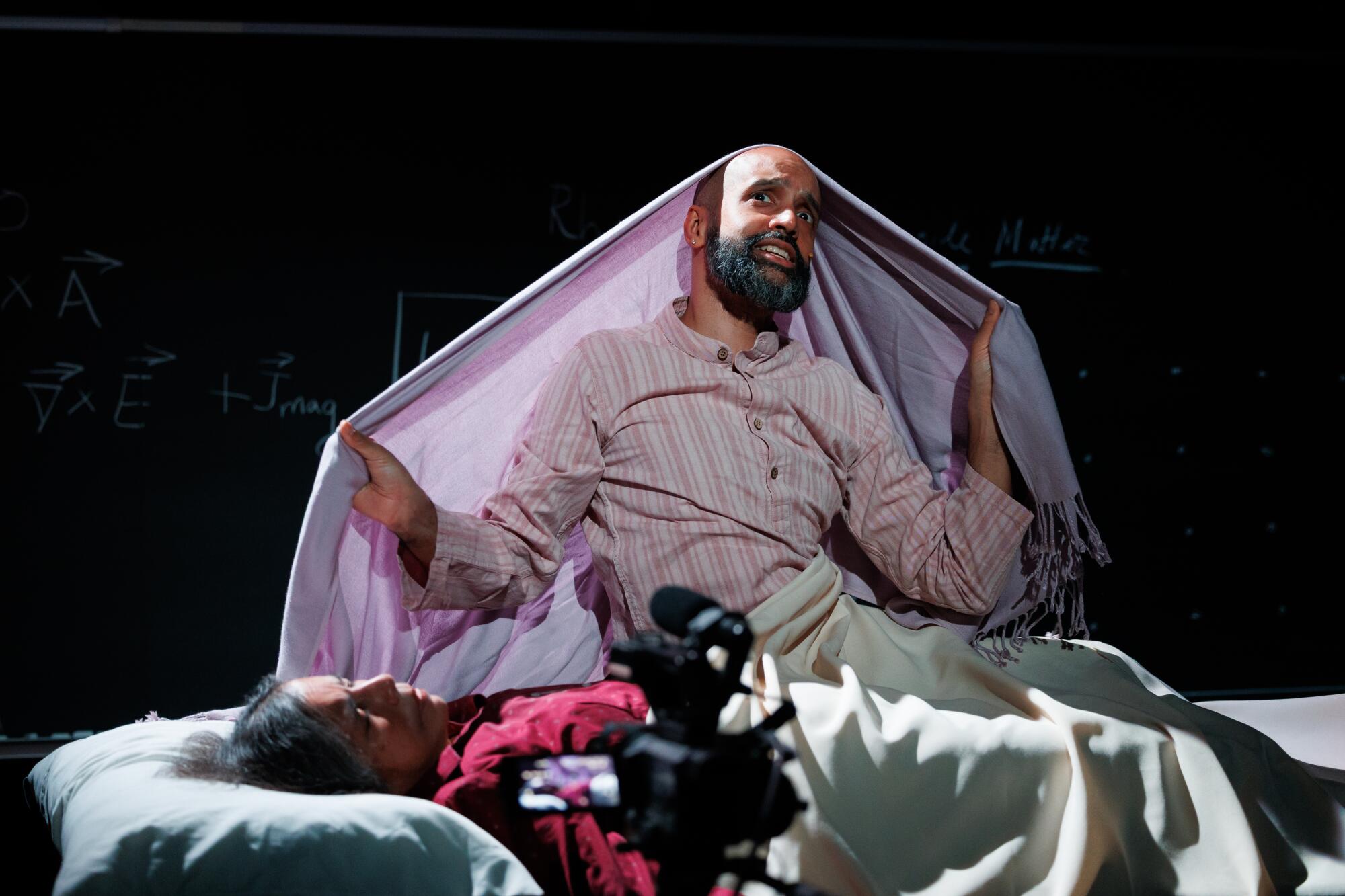
Shayok Misha Chowdhury, in rear, and Bulbul Chakraborty in “Rheology” at REDCAT.
(Roy and Edna Disney CalArts Theater [REDCAT])
Rheology, or the science of how a substance responds to external stress, is her chief interest. Her research, focused on soft condensed matter, has been seeking a comprehensive theory to explain the curious elasticity of such material. A photo of a sand dune, in which she’s seated alongside Chowdhury as a toddler, helps illustrate her point that sand can flow like a liquid yet retain its shape like a solid.
An onstage sandbox is more than just another visual accompaniment to her talk. It’s a source of both elemental mystery and childlike wonder. But elucidation is her motive. She enters the box with her bare feet, noting the way the sand flows around her toes yet supports her weight in observation of the rule that “every grain has to be in force balance.”
She writes equations on the board to explain these findings, equations that begin to glow as the production moves from the realm of pure science to the more slippery domain of art. The transition, like all aspects of this piece, is frolicsomely conducted.
While pouring sand from one container to another, Chakraborty appears to be overcome with dust. For a moment, it’s not clear if this is part of the show or a medical incident until Chowdhury, discreetly occupying a seat in the audience, asserts himself as the director. He asks his mother to run through the death scene with a different sequence of movements and introduces the accompaniment of George Crotty on cello to liberate her performance.
They are rehearsing not so much Chakraborty’s end but Chowdhury’s reaction. He assumes he will fall apart and vows to die himself out of heartbreak. Chakraborty wants him to carry on his work, just as she carried on her research as a mother with a young son who would wail uncontrollably when she would drop him off at daycare.
She recounts that his emotional outbursts were so extreme that it was painful leaving him behind. But she was assured that he was handling the separation. For proof, she was taken into a private teacher’s room, where through a one-way mirror she saw him compose himself shortly after her departure and start to play with the other children.
Mother and son enact a similar situation where, after a more permanent leave-taking, she can catch a glimpse of her son recovering himself sufficiently to survive her loss. Chowdhury, a queer artist who enjoys sampling performance modes, adopts the figure of the grieving Bollywood widow. The effect isn’t to lampoon but to confront his raw emotion and to test his capacity for resilience.
The experiment might sound sentimental, but Chakraborty, the production’s secret weapon, maintains a scientific restraint, albeit one suffused with maternal anguish. The way she listens to her son, takes in his feelings, gently suggests other possibilities of response and treats his experimental theater piece with the same dignity as her own research is incredibly moving to witness. Her performance won an Obie Award, and though she insists that she’s not an actor she demonstrates a sincerity and collaborative grace that many veteran performers would envy.
As it unfolds, “Rheology” can seem piecemeal, even haphazard. There’s an informality built into the production, but it’s somewhat deceptive because the mercurial staging is extremely precise. Chowdhury’s direction has visual panache. Kameron Neal’s video design transforms Krit Robinson’s part lab, part lecture hall set into something kaleidoscopic.
When mother and son sing songs from the famous cycle by Bengali writer-composer and Nobel laureate Rabindranath Tagore or hold a deathbed conversation in Bangla, the piece spins further across time and space. Empiricism gives way to surrealism. But the world, as any scientist probing into the atomic level can attest, contains more secrets than meets the eye.
Fragile matter is Chakraborty’s specialty, and her expertise is put to novel use in shoring up her son’s tender heart.
More than any other artist in the 20th century, David Hockney defined Los Angeles in the public imagination. When he first arrived in January 1964, age 26, his mental image of the city had been forged not by art but by Hollywood movies, which he had watched as a young boy in Yorkshire, England. In later life, he often recollected the sharp-edged shadows cast by the Californian sunlight in movies such as Laurel and Hardy’s “Big Business.
Before he ever went to L.A., Hockney — who died Thursday at 88 — knew that he would love it. Writing about his first descent into the city, he recalled how “as I flew over San Bernardino and looked down — and saw the swimming pools and the houses and everything and the sun, I was more thrilled than I’ve ever been arriving at any other city, including New York.” By this time, the glamour of Hollywood had been compounded by other influences, including the homoerotic magazines that an American friend had given him at the Royal College of Art in London. Titles such as Physique Pictorial, published in L.A. by the pioneering “beefcake” photographer Bob Mizer, held out a promise of California as a paradise of rippling men and permanent sunshine. A darker, no less thrilling image of the city had arisen from Hockney’s reading of “City of Night,” the 1963 novel by John Rechy that tells the story of a hustler in the gay underworld of downtown L.A.
Los Angeles itself felt young to Hockney. He loved the light, the architecture, the sense of space and the sense of possibility — not least the possibility of greater sexual freedom. West Hollywood boasted a large gay bar, the Red Raven on Melrose Avenue, that was unlike anything he had found in London or New York. There was also the lure of the beach, with its pageant of sculpted physiques. Venice Beach struck him as a more body-beautiful version of London’s Portobello Road.
Before long, his work shifted from generic fantasies of the city (a young man showering in Beverly Hills, for instance) to vivid portrayals of its real-life pools, palm trees, architecture and people. American artists such as Edward Ruscha and Edward Kienholz were producing their own canonical images of L.A. in these years, but for Hockney, there were no artistic precedents — “no ghosts,” as he later put it — to live up to. “People then didn’t even know what it looked like,” he once said. “And when I was there, they were still finishing up some of the big freeways.… I suddenly thought: ‘My God, this place needs its Piranesi, Los Angeles could have a Piranesi, so here I am!’ ”
He was true to his word, even if his luminous, serene images of the city were a far cry from Giovanni Battista Piranesi’s feverish visions of Baroque Rome. “Beverly Hills Housewife” (1966), a portrait of a pink-dressed collector in her modernist home, marked the onset of a realist style that would define Hockney’s work for the next decade. This era gave rise to paintings that became icons of their time and place. Among them were “A Bigger Splash” (1967), which was based on a magazine cover that he came across on a newsstand, and “Christopher Isherwood and Don Bachardy” (1968, sold last year at Christie’s New York for $44.3 million). Inspired by Hans Holbein, this portrait of the English novelist and his artist partner was one of the first celebratory portrayals of a gay couple. Hockney would later recount how Isherwood proclaimed: “Oh David, we’ve so much in common; we love California, we love American boys, and we’re both from the north of England.” Hockney’s beloved American boy at this time was Peter Schlesinger, a young artist he had met while teaching at UCLA in the summer 1966 — and a recurring presence in the early L.A. pictures.
According to Norman Rosenthal, who curated a major survey of Hockney’s art at the Fondation Louis Vuitton in Paris last year: “It is astonishing that a boy from a poor family in Bradford became the person — partly because of his gayness, but also his talent — who defined what everybody now thinks of as California. L.A. had no real image in the world before then, unlike New York.”
Despite his enchantment with Los Angeles, Hockney didn’t settle there until 1978, after a decade of bouncing between America and Europe. In the summer of 1979 he moved into a house in the Hollywood Hills, and soon adorned its pool with swishing strokes of blue paint. In the early 1980s, he converted the paddle tennis court into a studio. The meandering routes and Mediterranean scenery of the Hills were a fresh source of amazement, giving rise to monumental depictions of Mulholland Drive and Nichols Canyon in a newly abstract style.
By this time, the city was deeply familiar — a second home — and he had a close circle of friends around him who included the patron Betty Freeman (subject of “Beverly Hills Housewife”), the designer Gregory Evans, the gallery owner Nicholas Wilder and the film producer Joe Simon. “L.A. had represented a whole new world for him,” says Simon, who remained in regular contact with the artist until his final days. “He just loved the light. He was like a kid in a candy store when he first came. But David was all about the work. Everything came back to that.”
In recent decades, Hockney’s name had become synonymous with the landscapes of his native Yorkshire, which he began painting prolifically in the early 2000s. But Los Angeles never lost its newness and promise. His house in the Hills remained a sanctuary until his final years, when he was too frail to travel. L.A. was where he had come of age, and it remained an indelible part of his life and psyche — not least in terms of its egalitarian spirit and its tendency toward the horizontal. “The great thing about Hockney was that he spoke to everybody,” says Rosenthal. “Few artists of his world and his generation could do that.”
James Cahill, a novelist and an art critic, is the author of, among other books, “David Hockney” and the forthcoming “The Beverly Hills Housewife: Hockney’s Californian Muse and the World Beyond the Pool.”
David Hockney, the innovative and prolific British artist who arrived in Los Angeles in 1964, soon celebrating its sun-drenched life and landscapes in colorful, wildly popular paintings, has died.
He was 88.
Calling himself “an English Los Angeleno,” Hockney immortalized the city’s sparkling swimming pools, palm trees and beautiful young men, then went on to experiment with intricate photo collages, portrait suites, painted and filmed images of Yorkshire landscapes, iPad drawings and more.
Since his Pop Art paintings in the early ‘60s at London’s Royal College of Art, Hockney was rarely out of the limelight and, more important, rarely out of fresh ideas for how to draw, paint, film, print, photograph or otherwise express his creativity. The David Hockney Foundation owns more than 8,000 of his works, including about 200 sketchbooks, more than 230 self-portraits, opera designs and portraits of family and friends.
Hockney loved Hollywood — the people and the place — and liked to say he was brought up in England and Hollywood because of the time he spent at the movies. His peroxide blonde hair reportedly was inspired when he was a student and saw Clairol TV ads claiming “blondes have more fun.” But it was his interest in everything from Elvis Presley to the Hubble Space Telescope and his sense of humor that set him apart. Time Magazine art critic Robert Hughes once called him “the Cole Porter of modern art.”
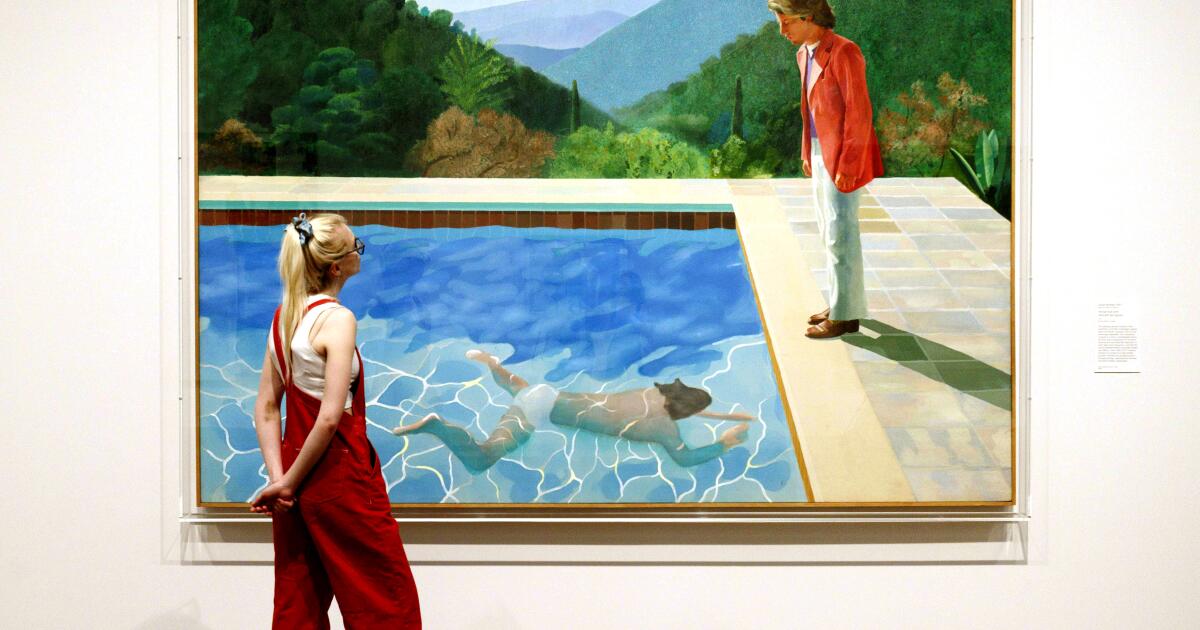
He was open about being gay, even when homosexuality was outlawed in Britain. His early love affair with artist Peter Schlesinger, a younger man he met when teaching a summer drawing class at UCLA in 1966, inspired Hockney’s monumental 1972 painting “Portrait of an Artist (Pool with Two Figures),” a centerpiece of Jack Hazan’s 1974 film “A Bigger Splash.” The painting’s 2018 auction at Christie’s drew a record $90 million for a living artist.
He was a dedicated reader and student of art, paying homage in his work to Picasso and Cubism as well as to Monet, Matisse, Van Gogh and Cezanne. A lover of opera, he often had it playing loudly in the studio and enjoyed taking visitors on curated car trips through the Hollywood Hills or Malibu while listening to Wagner. He designed sets for major companies in Los Angeles, Chicago, New York, London and elsewhere over the years, and some of his set models were later shown in museums.
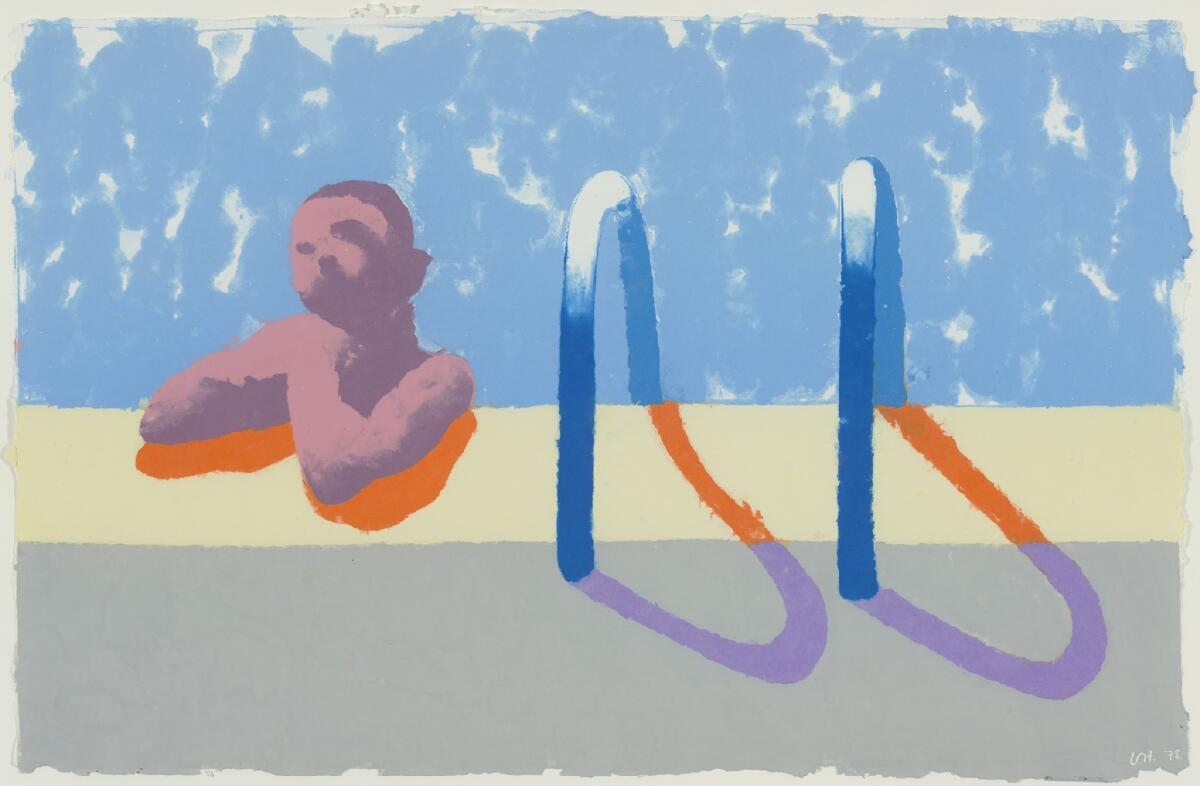
David Hockney’s work “Gregory in the Pool (Paper Pool 4)” is part of his solo exhibition “David Hockney: Perspective Should Be Reversed” at the Palm Springs Art Museum in Palm Springs. (Courtesy of the Palm Springs Art Museum)
(Courtesy of the Palm Springs Art Museum)
His solo shows drew enormous crowds to the Los Angeles County Museum of Art as early as 1988. In 2017 a major retrospective of his work, keyed to his 80th birthday, was presented at New York’s Metropolitan Museum of Art, Paris’ Centre Pompidou and London’s Tate Modern. Chronicling Hockney’s arrival as an important artist in the “ravishing” Met retrospective, the New Yorker writer Andrea K. Scott called it “a revelation.” It was, she wrote, “a retort to all the eye-rollers,” including herself, who dismissed his work “as, at best, a guilty pleasure.”
In 2012 he received the coveted Order of Merit, which Queen Elizabeth II presented to him at Buckingham Palace.
David Hockney was born the fourth of five children to a working-class family in Bradford, Yorkshire, on July 9, 1937. He has said he started “making marks on paper” at 8 and received private painting lessons before moving on to Bradford School of Art in 1953. The first painting he sold was a portrait of his father in 1955. He attended the Royal College of Art in London from 1959 until his graduation in 1962 and received the school’s Gold Medal.
After college he did not slack off, noted his biographer Christopher Simon Sykes. In his 2014 book, “Hockney: The Biography,” Sykes pointed out that the artist’s first flat had a chest of drawers near the bed on which he had painted, in large capital letters, the words “get up and work immediately.”
David Hockney in 2017.
(Catherine Opie, Courtesy of Regen Projects, Los Angeles and Lehmann Maupin, New York, Hong Kong and Seoul.)
Hockney lived by that command for the rest of his life, turning out canvas after canvas, photo after photo. In the ‘80s came his extraordinary multi-image photographic collages of friends including writer Christopher Isherwood and artist Don Bachardy and such landmarks as the Brooklyn Bridge, Grand Canyon and Pearblossom Highway.
“The Polaroids started oddly enough when I’d just finished a long period of work in the theater, which is of course playing with perspective and illusion,” he once told The Times. “People say, ‘You are a painter, and photography is a sideline.’ But nothing is a sideline for me.”
That included his continuing fascination with technology. The artist’s long career swept in artworks made not only on cameras and canvases, but on such things as fax machines and photocopiers. Hockney liked to experiment, whether it was with state-of-the-art printing devices or centuries old painting techniques. He went several times to a show of portraits by Jean Auguste Dominique Ingres at London’s National Gallery in 1999 and was greatly taken with the photographic’ quality of Ingres’ 19th century drawings. Certain that Ingres had used something optical to achieve that quality, Hockney bought himself a camera lucida, a small device that works like a prism. He then applied Ingres’ methods–as Hockney imagined them–to his own portraits of friends and family, and in 2001, he published “Secret Knowledge,” exploring his theories on early artistic uses of optical devices.
His death was confirmed by the Associated Press and New York Times.
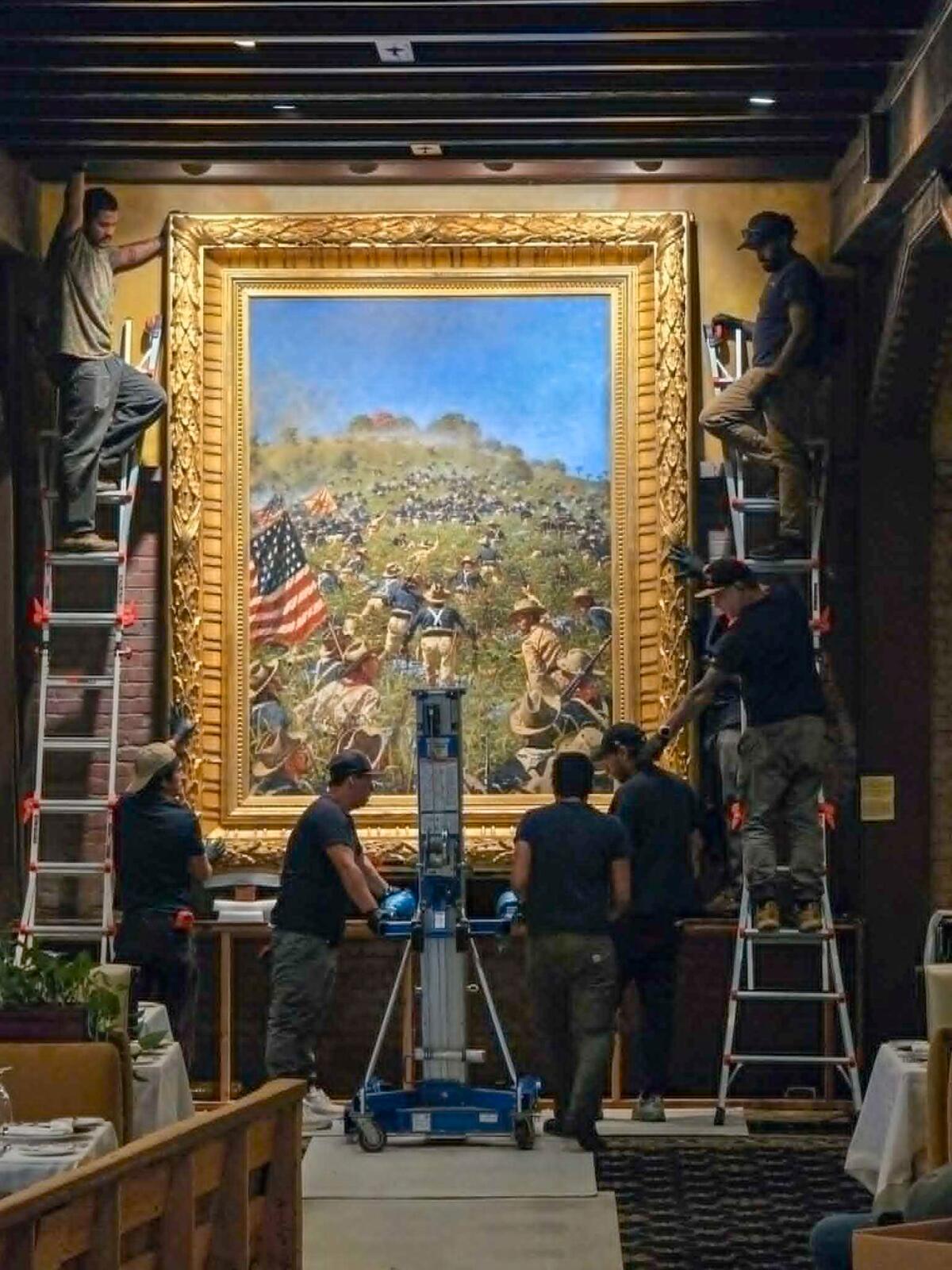
In less than a month, Riverside’s Mission Inn has gained a new owner, lost two prized pieces of art and sparked a heated debate over the line between private property and community history.
The stage for this controversy was set in early May, when hotel owner Kelly Roberts decided to sell the Mission Inn to the Yuhaaviatam of San Manuel Nation, the tribe that owns the Yaamava’ Resort & Casino in Highland and the Palms Casino Resort in Las Vegas.
But it wasn’t the sale (for an undisclosed amount) that started arguments. It was Roberts’ removal of two beloved paintings from the hotel before the sale closed.
A painting at the Mission Inn in Riverside titled “Charge Up San Juan Hill” is taken down on March 20, shortly before the hotel’s change in ownership.
(James Ranger)
One is an alpine landscape called “California Alps” (1874) by William Keith, which measures roughly 6 feet by 8 feet and was displayed in the lobby near the front desk. The other painting, “Charge Up San Juan Hill” (about 1900) by Vasily Vereshchagin, was displayed on a wall of the steakhouse near the lobby. Both paintings had been a part of the hotel for more than a century.
“It was like a slow-motion version of the Louvre Museum heist, pulled off on a sunny day in Riverside in view of guests, staff and visitors,” wrote David Allen of the Riverside Press-Enterprise.
“There’s an outrage among members of this community,” said Mike Marlatt, a Riverside attorney and former board member of the Mission Inn Foundation.
The issue appears to be what agreements Roberts’ late husband made when he bought the building more than 30 years ago.
Former Riverside redevelopment official Ralph Megna, who facilitated the 1992 sale to Duane Roberts’ Historic Mission Inn Corp., wrote on Facebook that “What Kelly is apparently doing at this point is just pillaging the place in violation of those agreements.” But on a phone call, he was less absolute. He said the original pact included an agreement intended to protect about 180 movable pieces of art and artifacts from removal, but that “there’s shades of gray here.” Megna added, “We trusted people. Good faith turned out to be not so good.”
Duane and Kelly Roberts, photographed in 1998 at their home in Laguna Beach. Duane, who reopened the Mission Inn in the early 1990s, died in 2025.
(Glenn Koenig / Los Angeles Times)
Roberts’ family attorney Alan Jackson, however, said “Kelly is not pillaging anything.” He maintained that when Duane Roberts bought the hotel, “he bought every single item. Every single item was the Roberts family’s personal property.” When Kelly Roberts sold the hotel last month, Jackson said, she was free to keep or sell any of its contents.
In that deal, Jackson said, “the buyers would not close” until the paintings and a sculpture of Duane and Kelly Roberts were removed, because “they’re expensive.” Also, Jackson said that Duane Roberts, “before his passing, made it very clear to Kelly and the family that those are two of his favorite paintings ever.”
Jackson declined to say where the artworks are but said “they are in her possession” and “she has no intention of ever getting rid of those ever.”
The iconic spiral staircase in the rotunda of the historic Mission Inn.
(Gina Ferazzi / Los Angeles Times)
The hotel’s new owner, the San Manuel Investment Authority, declined to address questions about the sale agreement. But in a statement, it said it is “committed to collaborating with the Mission Inn Foundation and the City to respectfully steward and preserve this historic landmark, recognizing its deep history and significance to the Riverside community.”
Despite accolades from groups including Historic Hotels of America, tensions between the Roberts family and Riverside preservationists have risen in recent years. In late 2024, after more than 30 years renting space within the hotel, the nonprofit Mission Inn Foundation and Museum was unable to agree on a lease extension with hotel management and moved to a building on Main Street. Foundation leaders did not respond to messages seeking comment.
“The Mission Inn is so foundational to Riverside that any significant change brings real concern to me and makes me uneasy,” said City Council member Philip Falcone, 28, who has been leading tours of the inn since he was in high school.
The Keith painting is “quintessential California, a romanticized view of the Sierra Nevada range. William Keith, the painter, was friends with John Muir,” Falcone said. As for the San Juan Hill painting, it connects neatly with the history of Theodore Roosevelt, one of nine presidents who have visited the inn.
A guest takes in the view from the Spanish patio at the Mission Inn.
(Gina Ferazzi/Los Angeles Times)
The hotel is largely the creation of Frank Miller, who bought Glenwood Cottage, a modest boarding house, from his father in 1880. Then Miller enlisted investment help from his friend, railroad magnate Henry Huntington, transformed the boarding house into a hotel and renamed it. Over time, Miller built it into an architectural wonderland filled with art and antiques gathered in the U.S. and Europe. By 1931, the enterprise filled a city block.
“It’s a unique property,” said David Stolte, president of the Old Riverside Foundation. “It’s a National Historic Landmark. It kind of sits at the intersection of private commerce and public benefit. The original owner, Frank Miller, intended it as a public space, essentially a cultural museum, in addition to his business of running a hotel.”
After Miller’s death in 1935, the hotel’s reputation spread even further, attracting dignitaries of the day — and the future. It served as the site of Richard and Pat Nixon’s wedding in 1940 and Ronald and Nancy Reagan’s honeymoon in 1952. But by the 1960s, it was much diminished, and a later owner, Benjamin Swig, had sold close to 1,000 antiques and artworks to help pay bills.
By the mid-1980s, the hotel had passed through a period of city ownership and was closed. By 1992, more than $50 million had been spent in restoration and renovation, but the project was scuttled by a bankruptcy. That’s when Duane Roberts, who grew up in Riverside and made his fortune selling flash-frozen burritos, bought the property and reopened it.
Duane and Kelly Roberts, residents of Laguna Beach, also established the hotel’s annual Festival of Lights, an Inland Empire holiday tradition. The hotel today includes 238 guest rooms, four restaurants, two lounges, two chapels, a spa, pool and candy shop.
Besides their stewardship of the hotel, Duane and Kelly Roberts became known as major donors to the Republican party. In 2017, Politico reported that Kelly Roberts was in line to be named the Trump administration’s ambassador to Slovenia, but turned down the post.
After Duane Roberts died at 88 in November, Riverside buzzed with questions over the fate of the hotel, prompting another Roberts family lawyer to offer public assurances.
“Nobody’s buying this hotel. Mrs. Roberts is keeping this hotel,” attorney Patrick O’Brien told a TV news crew in late November. But on May 4, Kelly Roberts and the San Manuel Investment Authority announced the pending sale.
Festival of Lights, Mission Inn’s popular holiday tradition, was created by Kelly and Duane Roberts after they reopened the hotel.
(Allen J. Schaben/Los Angeles Times)
Then on May 20, guests spotted workers removing the two paintings from the lobby area. Longtime hotel-watchers said other items had disappeared in recent years, including an 1876 Steinway piano; a statue of the goddess Pomona; William Wendt’s painting “Houses at Arch Beach”; Ilya Repin’s 1884 painting “Portrait of Madame K.”; and the hotel’s Taft Chair, a sturdy oak armchair commissioned by Frank Miller in 1909 to hold 335-pound President Taft. But the midday, presale removal of the Keith and Vereshchagin paintings prompted immediate outcry.
It was “traumatizing, seeing that stuff on display for so long and then seeing it come down,” said James Ranger, a veteran hotel tour guide and Mission Inn Foundation docent. After all the time and money the Roberts family invested in the property, “leaving on this note puts a sour taste out there,” he said.
The sale closed May 29. Though the Roberts family’s attorneys have insisted that the buyers and sellers are in accord, preservation advocates in Riverside have called for a review of documents associated with Roberts’ purchase of the property.
Meanwhile, the hotel’s new era as a tribal holding begins. Besides the two casino-hotels, the Yuhaaviatam of San Manuel Nation owns several other hotels, including the Waldorf Astoria Monarch Beach Resort & Club in Dana Point. As for the Mission Inn, the tribe has signed on Boston-based Pyramid Global Hospitality to take over management, and several changes are already evident.
Notably, the Roberts’ names have been dropped from the signage. Kelly’s Spa has become simply the spa, Duane’s Steakhouse is now just the steakhouse, and Casey’s Cupcakes, a hotel shop founded by Kelly’s daughter Casey Beau Brown, has closed. The Festival of Lights will continue, a spokesperson said.
Stolte said the Old Riverside Foundation believes the tribe will be “great stewards” for the Mission Inn.
“I wish that their welcome to Riverside was a little smoother,” he said.
Staff writer Alex Wigglesworth also contributed to this story.
A model suing Kanye West is speaking out about the alleged assault that lawyers for the rapper argue was his 1st Amendment right.
Jennifer An, an actor and model who competed on the 13th season of “America’s Next Top Model” in 2009, detailed the alleged assault — that she says happened in 2010 — in a new interview with the BBC’s “Fame Under Fire” podcast that was released Wednesday. In 2024, An filed a lawsuit against the “Heartless” rapper alleging he choked her and used his fingers to simulate oral sex during a music video shoot for La Roux’s “In for the Kill.”
“He had me sit in the chair in front of the camera, and I didn’t know what was going to happen. I was given no direction,” An told the BBC. “I was just told to sit in this chair, and then playback started, and then all of a sudden he just reaches a hand out and starts choking me, and I’m just not sure what’s happening, and then he pulled his other hand out and starts choking me with both hands and then starts smearing my makeup all over my face and sticking his hands inside of my mouth, which simulated oral sex.
“I remember feeling so suffocated, unsure, scared,” she said. An said she was 24 years old at the time of the alleged incident, her first foray into the industry. She told the outlet that, as it was happening, she hoped someone on the production side would call a halt to it.
“I remember him looking at me, like really intensely, and licking his lips a lot, my face was like so close to his,” she continued. “He reached a point that — I assume — he was very happy with himself, and he yelled something like, ‘This is art! I’m Picasso.’”
La Roux said she insisted the alleged assault be left on the cutting room floor, and in a 2024 Instagram exchange with An, the artist said, “I could never forget that, it was horrific,” according to court documents.
During the podcast episode, the BBC correspondent Anoushka Mutanda Dougherty asks if she can see the direct-message exchange between An and La Roux. She then reads aloud a message in which La Roux said, “I was in the room behind the monitor, begging the directors and everyone else to do something, but everyone was scared of him and did nothing.”
La Roux told An that West whispered to her, “I bet you think I just put women back about 10 years.” She said that she responded, “You just put women back about 500 years.”
Representatives for La Roux did not immediately respond to The Times’ request for comment.
The case has not yet gone to trial. In a motion to dismiss the civil suit — which was filed under New York City’s Gender-Motivated Violence Act and remains pending — attorneys for West didn’t deny the incident took place but, rather, argued that it was an artistic performance and therefore protected by the 1st Amendment.
Attorneys representing An in the case, Melissa Berouty and Christine Hintze, told The Times in an emailed statement: “While we respect the importance of artistic expression and the protections afforded by the First Amendment, dismissing this case on that basis would set a dangerous precedent. It would effectively grant immunity to perpetrators of unlawful abuse so long as their conduct occurred under the guise of artistic expression or within an artistic setting.”
They further said that An’s claims are supported by affidavits and written communications from multiple eyewitnesses, including La Roux.
What was the moment from the season finale of “The Pitt” that finally broke you?
Was it the shot of the day-shift staff watching the Fourth of July fireworks from the hospital roof, the sound of “America the Beautiful” playing in the distance? Maybe it was Dr. Al-Hashimi (Sepideh Moafi) crying in her car, realizing she can’t work around the seizure disorder that makes her a liability in the ER. Or perhaps it came when Noah Wyle’s Dr. Robinavitch (a.k.a. Dr. Robby) swaddled Baby Jane Doe, telling her that “everything’s gonna be just fine,” because she has “so many wonderful things to see and so many people to love.”
But what opened the floodgates for me, after the last half-hour of the episode left me completely dazed and dumbfounded, was Drs. Santos (Isa Briones) and King (Taylor Dearden) exorcising the day’s demons by belting out Alanis Morissette’s “You Oughta Know” at a karaoke bar and demonstrating that primal scream therapy is alive and well three decades into the 21st century.
Sign up for The Envelope
Get exclusive awards season news, in-depth interviews and columnist Glenn Whipp’s must-read analysis straight to your inbox.
By continuing, you agree to our Terms of Service, which include arbitration and a class action waiver. You agree that we and our third-party vendors may collect and use your information, including through cookies, pixels and similar technologies, for the purposes set forth in our Privacy Policy such as personalizing your experience and ads.
Which is all to say: “The Pitt” is the only television show I’ve watched that gives me the same feeling I have when I read a great, immersive novel. When the end is near, I’m bereft. I’m Al-Hashimi in her car, wanting to pound the dashboard. I do not want to let these characters go. They’ve given me 15 hours and I still crave more. I would devour a series of short films about odd couple Santos and Whitaker (Gerran Howell) sharing an apartment or a summer spinoff showing Dr. Abbot (Shawn Hatosy) working off-hours as a SWAT medic. Anything to fill the long, “Pitt”-less weeks between seasons.
“The Pitt” won five Emmys from 13 nominations, including best drama series, for its celebrated first season, a 15-episode run that began with Dr. Robby up on the hospital roof talking down Dr. Abbot after an intense shift. The season ended with Dr. Abbot returning the favor after Robby and his staff ground their way through a day that included a mass shooting, a child drowning and a patient assaulting LaNasa’s no-nonsense charge nurse.
How do you follow that?
For a few episodes this new season, it looked like “The Pitt” wasn’t up to the task. We watched the ER staff dealing with a series of bloody, messy (the disimpaction!) medical maladies, an avert-your-eyes spectacle that felt like the writers were trying to one-up themselves and find the worst possible affliction to make viewers double over. Worse, the thrill of discovery that kept us invested throughout the first season, the slow drip of information about the characters, wasn’t quite there. Something was missing, and it wasn’t just Dr. Robby’s motorcycle helmet.
But the luxury of having 15 episodes is that the writers can take their time laying the groundwork for the story they want to tell.
And what a story it was.
Over the course of the season, we watched Dr. Robby disintegrate, his mental health more precarious than ever because he has done nothing to address his apparent PTSD. “You need help,” Dr. Langdon (Patrick Ball) tells Robby, confronting him in the finale. “Be honest with yourself.”
Robby isn’t the only one struggling, as Dr. Abbot puts it, to “dance through the darkness.” Langdon is back, managing his sobriety. Dr. Mohan (Supriya Ganesh) is having panic attacks. Santos is still dealing with self-harm. Dana remains haunted by that Season 1 patient assault and now carries a syringe containing a heavy sedative just in case somebody emerging from that overcrowded waiting room crosses the line again.
“I’ve seen so many people die that I feel like it’s leaching something from my soul,” Robby says. “I’m tired of feeling like I’m drowning every day.”
And there you have it, the subject of Season 2 of “The Pitt.” Medical professionals are gasping for air, and the American healthcare system, with its focus on profit above all else, is failing them and the patients they treat.
Remember Orlando, the patient with severe diabetic ketoacidosis who arrives at the ER after fainting? Orlando had to ration his insulin because he lacked insurance and felt he had to cut corners. He ends up leaving the hospital early, fearing the cost of treatment. Later he returns, having fallen (jumped) from a catwalk at his construction job, fracturing his skull. But good news: He now qualifies for Medicare and Medicaid due to long-term disability.
It’s a tragedy, one of many reasons the season finale shot of the ER staff holding back tears as they watched the Fourth of July fireworks felt like a body blow. “America the Beautiful”? How can that be true when the current administration is seeking $1.5 trillion for defense spending — nearly 50% more than this year — while cutting healthcare and social safety nets? How can that be true when an act known as the “Big, Beautiful Bill” removed funding from an already frayed healthcare system and exacerbated the shortage of care in rural areas of the country?
That one scene, the culmination of hours of careful, patient storytelling, said more about the disconnect between American ideals and America’s reality than anything else I’ve read or watched this year.
Give “The Pitt” all the Emmys. It has more than earned them.
This is San Diego’s backyard, a condensed, flatter version of Griffith Park, but with more historic buildings, more museums and a zoo with a global following. If you’re a Balboa Park rookie, start with the San Diego Zoo, which may take your entire day. (Admission: $68-$74 per adult, $58-$64 per child age 3-11.) If you’ve already done that, well, it’s lucky for you that the zoo is less than 10% of Balboa Park’s 1,200 acres, and the park’s other institutions have been growing and changing.
The park’s emblematic 1914 Botanical Building is open again after major reconstruction that ended in late 2024. The Mingei International Museum, which focuses on global folk art, won Michelin praise in 2023 for its eclectic restaurant, Artifact at Mingei (which serves lunch Tuesday through Sunday, dinner Thursday and Friday).
The park’s museums and other institutions cover art (fine, folk, contemporary and photographic), natural history, anthropology, flight, model railroading and all the imagined worlds that come with Comic-Con (which opened its museum here in 2021).
The Old Globe theater complex includes three stages. The big lily pond between the promenade and the Botanical Building may be the most wholesome over-the-counter tranquilizer in town. The Centro Cultural de la Raza, housed in an enormous former water tank, covers Chicano, Latin and Indigenous culture. The park’s Japanese Friendship Garden & Museum fills 12 acres with greenery, koi ponds and bonsai displays.
If you’re planning to hit several museums over a couple of days, look into a park Explorer Pass, which might save you money.
About parking: In January, after years of free parking, the city imposed a fee system charging non-residents $10-$16 per day and residents slightly less. San Diegans rose in outrage, and in late May city officials announced a plan to end the parking fees by Jan. 1, 2027.
In early 2026, it was announced that lido would not be reopening and would be closed indefinitely.
Since its closure, locals have been campaigning to save the lido with over 100 written requests from residents to see what the future of the pool would be.
In a huge U-turn, Stroud District Council has now approved the funding needed to repair the pool.
Work is set to start immediately, so the lido could open as soon as July 29 – failing that, it’s scheduled to reopen on August 14.
Initial funding to upgrade the lido was estimated at £5.1million, but has been brought down to £476,000.
The pool may need to undergo more repairs at a later date.
On its Facebook page, Save Stroud Lido said: “We are absolutely delighted by last night’s decision and can’t wait to see families, swimmers and young people enjoying the Lido again this summer.
It has been closed since September 2025 and needs to undergo repairsCredit: AlamyThe lido could undergo more repairs at a later dateCredit: Unknown
“And now the focus turns to getting the works completed and the gates reopened as quickly as possible. Because this is more than a pool.
“It’s part of Stroud’s identity. A place for fun, friendships, exercise, memories and safe outdoor swimming for generations to come.’
The Stratford-based lido first opened to swimmers in 1937 at a cost of just £20,000.
It’s a 50-metre long cold water pool with six swimming lanes and has a 10-metre high diving board.
Usually the pool is only open for the summer season and is open for around 100 days starting in May.
Maybe you can use a laugh this morning. Maybe you’re still deep in your feelings, thinking about the “Hacks” series finale and that shot of Hannah Einbinder looking at Jean Smart on the dance floor, grief seeping into her eyes. Maybe you’re lamenting the chaos at our treasured national parks. Hell … maybe you took out a loan to buy a tomato over the weekend.
If you’re feeling down, Gary Oldman would like a word. And that word is: Hufflepuff.
I’m Glenn Whipp, columnist for the Los Angeles Times and host of The Envelope newsletter, back in your inbox for the next few weeks as we navigate our way through Emmy season.
Sign up for The Envelope
Get exclusive awards season news, in-depth interviews and columnist Glenn Whipp’s must-read analysis straight to your inbox.
By continuing, you agree to our Terms of Service, which include arbitration and a class action waiver. You agree that we and our third-party vendors may collect and use your information, including through cookies, pixels and similar technologies, for the purposes set forth in our Privacy Policy such as personalizing your experience and ads.
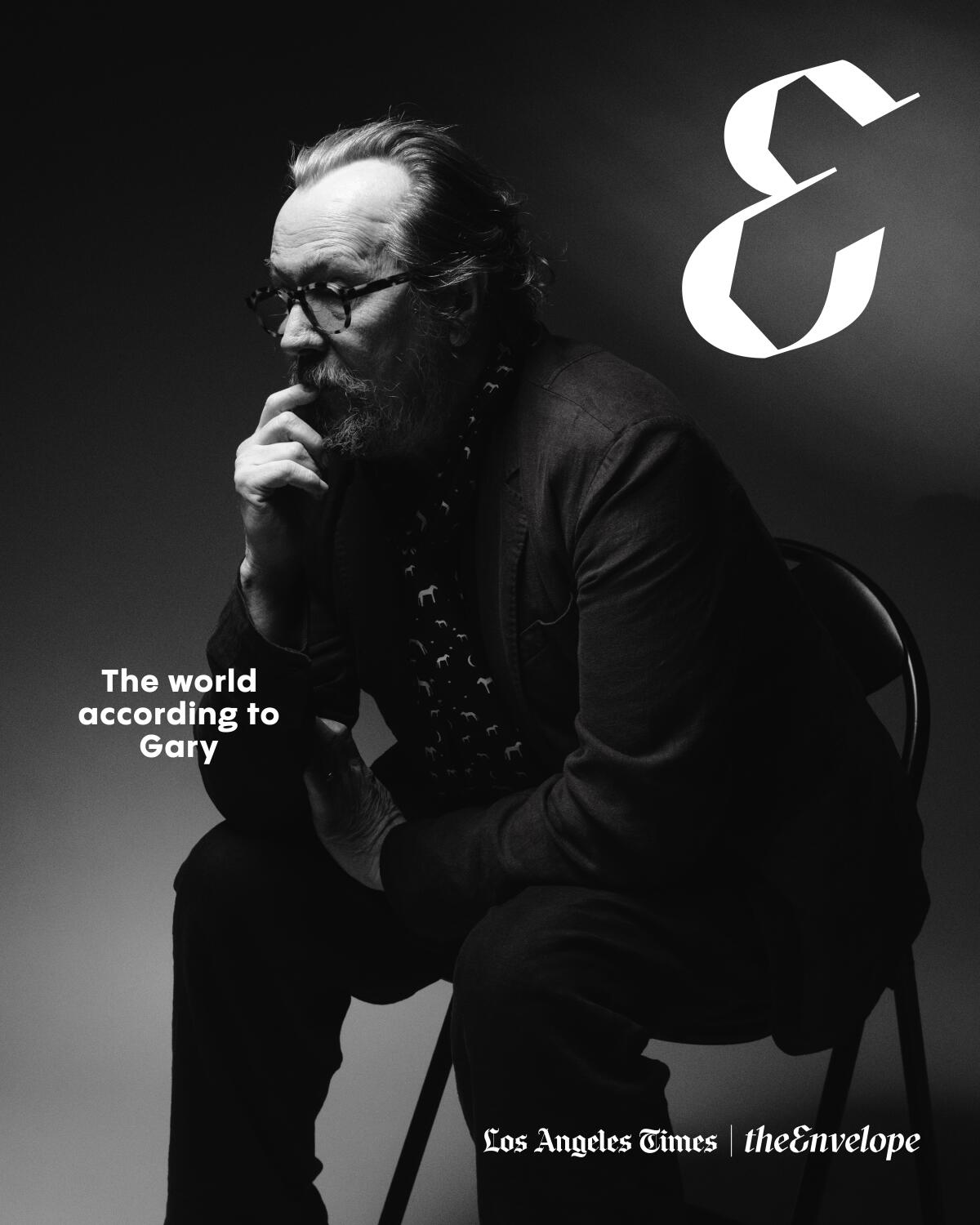
Digital cover story: The world according to Gary
(Jennifer McCord / For The Times)
Gary Oldman is a Hufflepuff.
Never mind that the 68-year-old actor, who played the rebellious, impulsive wizard Sirius Black in the Harry Potter film franchise, couldn’t tell you the difference between a Hufflepuff and, say, a Gryffindor.
When journalist Josh Horowitz reads a list of core personality qualities — loyalty, hard work, patience, fairness, dedication — and asks Oldman if that describes him, he nods his head.
You’re a Hufflepuff.
“I’m a Hufflepuff?” Oldman says, trying the word on for size. He likes it. “I’m a Hufflepuff!”
This video clip is a favorite of mine, one I could watch on a loop for the sheer delight Oldman takes in pronouncing the word Hufflepuff.
It’s easy to see why Oldman takes such pleasure in being a granddad these days, one of the things we talked about at length not long ago for an Envelope digital cover story. He can access his silly side with ease.
I asked Oldman about the upcoming HBO “Harry Potter” television series, a decade-spanning endeavor that will spend a season adapting each of J.K. Rowling’s seven fantasy books.
“I’ve seen a trailer for it, and I think it’s a great idea,” Oldman says. “They’re doing the whole book, which I love, because there were a lot of wonderful things, fabric and character detail, we had to lose for the sake of telling the story in two hours.”
Would Oldman be keen to don a distressed velvet overcoat again and participate in the reboot?
“I don’t think they want any of us from the movies contaminating or muddying the waters,” Oldman says, pleasantly. “Besides, I’m too old.”
But with AI, is anyone too old now? Oldman could drop into “Harry Potter and the Prisoner of Azkaban” and look like he hasn’t aged a day since the movie was released 22 years ago.
“I don’t know where we’re going with it because it seems to advance every week,” Oldman says. He ponders the advances made since Martin Scorsese used digital deaging in his 2019 film “The Irishman.”
“I think that was the least successful thing about it,” Oldman says of the technology, “and I’ve been a huge Martin Scorsese fan forever. Ultimately, I don’t know why they wanted to make [Robert] De Niro’s eyes blue.” He pauses, considering the change and why it bothered him. “I guess it’s a blue-eyed Irishman. If I had one negative takeaway, it would be that.”
Oldman prefers directors like Christopher Nolan, whom he worked with on the “Dark Knight” movies and “Oppenheimer,” who think technology should be used sparingly to enhance the storytelling.
“Otherwise it leaves me a bit cold,” he says. “You’re just looking at ones and zeroes.”
“I don’t want to be replaced entirely,” Oldman continues, shaking his head. “I don’t think anyone does.”
There she stands, in that iconic hot pink gown, arms thrown open wide as if to both offer herself to the world and embrace what the world offers — love, applause, admiration and diamonds, which are, as she sang from the body-hugging confines of that pink silk in “Gentlemen Prefer Blondes,” a girl’s best friend.
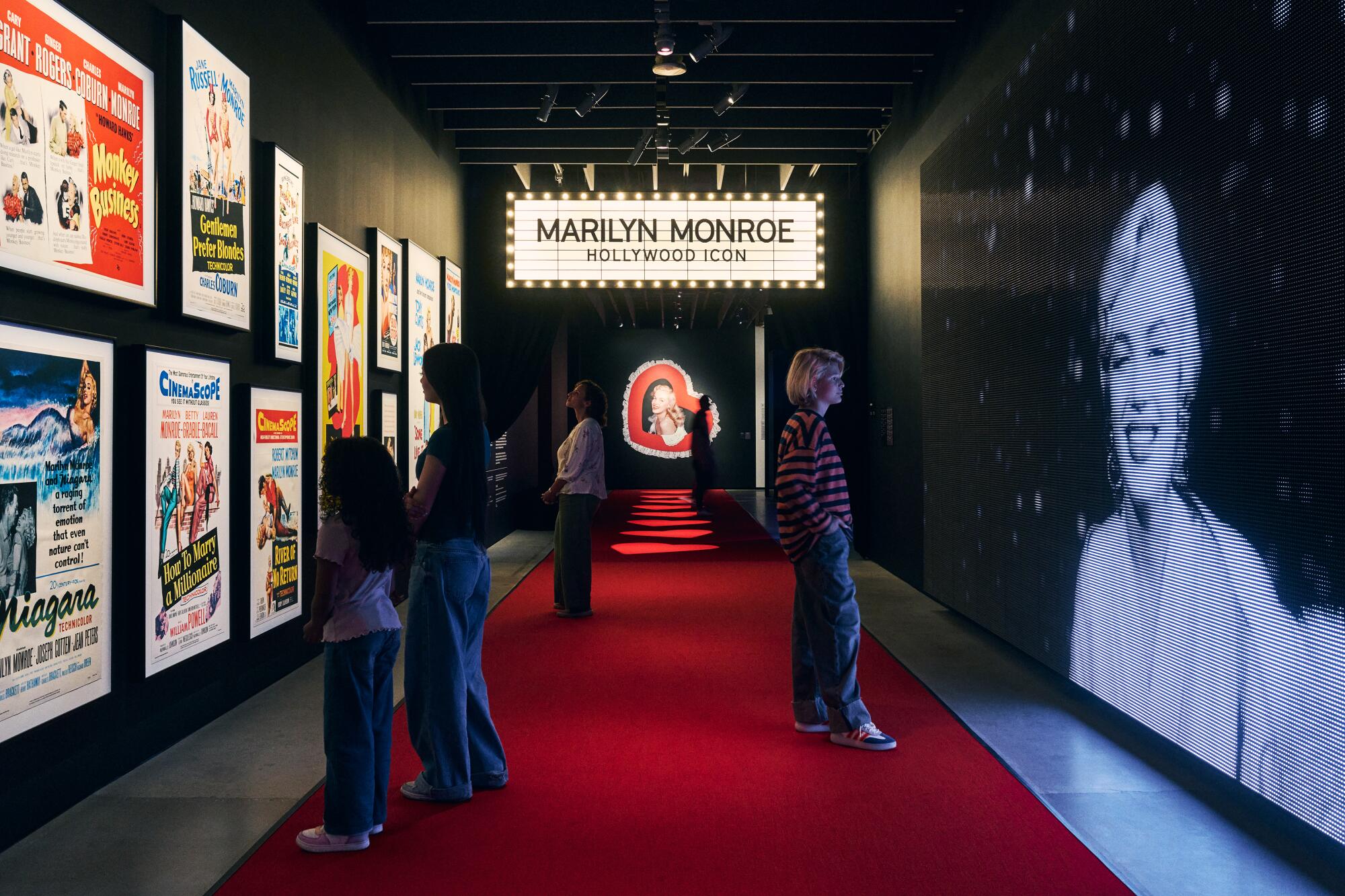
It isn’t her, of course, though it is the dress, designed by William Travilla and now a part of the new “Marilyn Monroe: Hollywood Icon” installation at the Academy Museum of Motion Pictures. Opening Sunday, it is just one of many exhibitions and events timed to celebrate the 100th anniversary of Monroe’s birth.
More than 60 years after her death, Monroe still glows brightly in the Hollywood firmament. Her career only lasted 17 years, but during that time she dazzled so brightly that her image, and all that has been projected onto it, remains burned into our collective line of vision, an unfading afterimage of a bursting star.
As the Academy Museum’s exhibit underlines, Marilyn Monroe was a pioneer in many ways.
(Emily Shur / Academy Museum Foundation)
Her death — at 36 by way of overdose — did much to cement her legacy, generating international headlines and then a multitude of conspiracy theories, many of them involving powerful men, including members of the equally mythic Kennedy family.
Tragedy and mystery are powerful binding agents, but they do not quite explain the tower of books that have been, and continue to be, written about her (including several out this year) or the many films made about her life or the art she has inspired, from Andy Warhol’s iconic silkscreen “Marilyn Diptych” (done a year after her death) to Seward Johnson’s massive statue “Forever Marilyn,” which, after some controversy, made its forever home in Palm Springs five years ago.
Marilyn Monroe’s personal items on display include parts of her makeup regimen.
(Emily Shur / Academy Museum Foundation)
As the Academy Museum’s exhibit underlines, Monroe was a pioneer in many ways. In the repressive ‘50s, she was sex positive and spoke openly about psychotherapy and the vagaries of fame. She often defied studio heads, was one of the first actresses to start her own production company and demanded approval of her many photo sessions.
She had multiple marriages, problems with drugs and alcohol and a reputation for being difficult on set, but she was unafraid to both call out the press and banter with them.
Still, she is not seen by the masses as a pioneer, a term that brings to mind scientists and suffragettes. No, Monroe remains a mesmerizing, radiant symbol — of beauty, glamour, sensuality, a life force so rare that it could not be expected to survive long in a world full of envy and petty demands.
In putting together “Marilyn Monroe: Hollywood Icon,” associate curator Sophia Serrano spoke with many devoted fans, including those whose collections helped build the exhibit, and they all said the same thing.
More than 60 years after her death, Marilyn Monroe still glows brightly in the Hollywood firmament.
(Emily Shur / Academy Museum Foundation)
“Even though she had a tragic ending,” Serrano said, “people would say she is a symbol of resilience. Her story is like a movie — an orphan who makes it big, then loses it all. They see her as battling the studio, wanting to get more nuanced roles and not getting the roles she wanted. … A lot of people latch onto her because she gives them hope.”
In many ways, Monroe is, and was, a piece of art herself, onto which we could project our own longings and adulation. But that art, Serrano says, was created by Monroe, with equal parts natural magnetism and a canny, rigorous sense of her own strengths.
In 1952, when she was a rising star, a journalist realized a nude pin-up being used in calendars and posters was Monroe; she had posed for what is now known as the “Golden Dream” series five years before. Monroe was filming 20th Century Fox’s “Gentlemen Prefer Blondes” at the time and studio head Darryl Zanuck pressured her to deny that the photos were of her.
Monroe did the exact opposite, shrugging it off in an interview, in which she said, “I was broke and I needed the money. … I’m not ashamed of it; I’ve done nothing wrong.”
“Marilyn Monroe: Hollywood Icon” opens Sunday at the Academy Museum.
(Emily Shur / Academy Museum Foundation)
Monroe’s unique, and, to a certain extent, self-constructed combination of vulnerability — the wide eyes, the half-open mouth, the child-like voice — and essential grit is what fuels her continued cultural resonance and what forms the guiding principal for the Academy Museum’s exhibit.
An exhibit on the life and legacy of Marilyn Monroe could fill an entire museum so for purposes of this exhibit, Serrano and her team chose objects that were relevant to her life. This being the Academy Museum, much of it focuses on her career in film. Costumes from her various movies (including the original exhibition copy of the famous white dress from “The Seven Year Itch”) occupy a big portion, in part, Serrano says, because Monroe was so often involved in their design.
“She was so smart, looking at these costumes,” Serrano says. “She was obviously Fox’s star for Cinemascope — she’s how they marketed the new technology and she didn’t like how certain silhouettes looked so she would not wear A-lines in Cinemascope because she thought the effect was unflattering. She really paid attention to how things worked and then knew how to control and edit and manage.”
Costumes from Marilyn Monroe’s various movies.
(Emily Shur / Academy Museum Foundation)
The pink gown from “Gentlemen Prefer Blondes” has its own story. Monroe’s character was originally to appear in bejeweled hot pants (also on display), but when the Golden Dream “scandal” broke, Zanuck demanded that she wear something less revealing.
Many personal items are on display as well, including the shoes she wore to her wedding to Joe DiMaggio, a rare apology from gossip columnist Hedda Hopper, marked-up scripts and parts of her makeup regimen (including a face-slimming mask she wore after being told she had a double chin). The love-hate relationship she had with the press is well represented by newspaper clippings and newsreels.
Marilyn Monroe’s famous white dress from “The Seven Year Itch.”
(Emily Shur / Academy Museum Foundation)
A whole room is devoted to scenes from her more famous films and an entire long wall to countless photographs. “She understood the camera better than anyone,” Serrano says, echoing observations made by photographers and actors who worked with her, including Laurence Olivier, who famously did not get along with Monroe during the filming of “The Prince and the Showgirl.”
Her reputation as being difficult on certain sets is also documented in a rather infuriating series of telegrams between director Billy Wilder complaining to her then-husband, playwright Arthur Miller, and Miller responding in defense of his wife.
It is a well-crafted glimpse at Monroe as a totality, including pieces from her Brentwood home and some of her own clothing, which Serrano says was far simpler than the gowns and suits she was photographed in. “Her persona was carefully constructed. She knew how to give just enough, to create the illusion of something.”
A whole room is devoted to scenes from her more famous films and an entire long wall to countless photographs.
(Emily Shur / Academy Museum Foundation)
And maybe that is the reason why Monroe continues to fascinate. Yes, she owned her beauty and sexuality with a boldness that stands out even now. Her relationship with the camera remains unparalleled — when she is in frame, it is almost impossible to look away. Her hip-swaying walk remains iconic and also, perhaps, revealing. It was achieved by putting one foot directly in front of the other, much like a tight-rope walker.
Which in many ways Monroe was, treading the line, invisible to the rest of us, between innocence and worldliness, between vulnerability and power.
The tension between the human need for both love and self-determination powers both art and madness, but never was it so tangibly brought to life than by Marilyn Monroe. Art and artist, creation and creator, she left behind a now-century-old mystery we’re still trying to unravel.