Burbank airport’s new $1.3-billion terminal opens — bigger and sleeker than ever
After 33 months of construction and $1.3 billion in spending, the Hollywood Burbank Airport’s new terminal opened on Tuesday morning, with a medley of arrivals and departures in the minutes after 7 a.m.
Instead of the snug, historic facility whose Spanish Colonial Revival style dated to 1930, travelers found themselves in a sleek terminal at Winona Avenue and Hollywood Way, distinguished by high ceilings, contemporary art, twinkling terrazzo floors, abundant charging stations and landscaping full of cactus and succulents, along with a few “wet paint” signs. Passengers gawked at mirrored grid artwork by Glenn Kaino overhead.

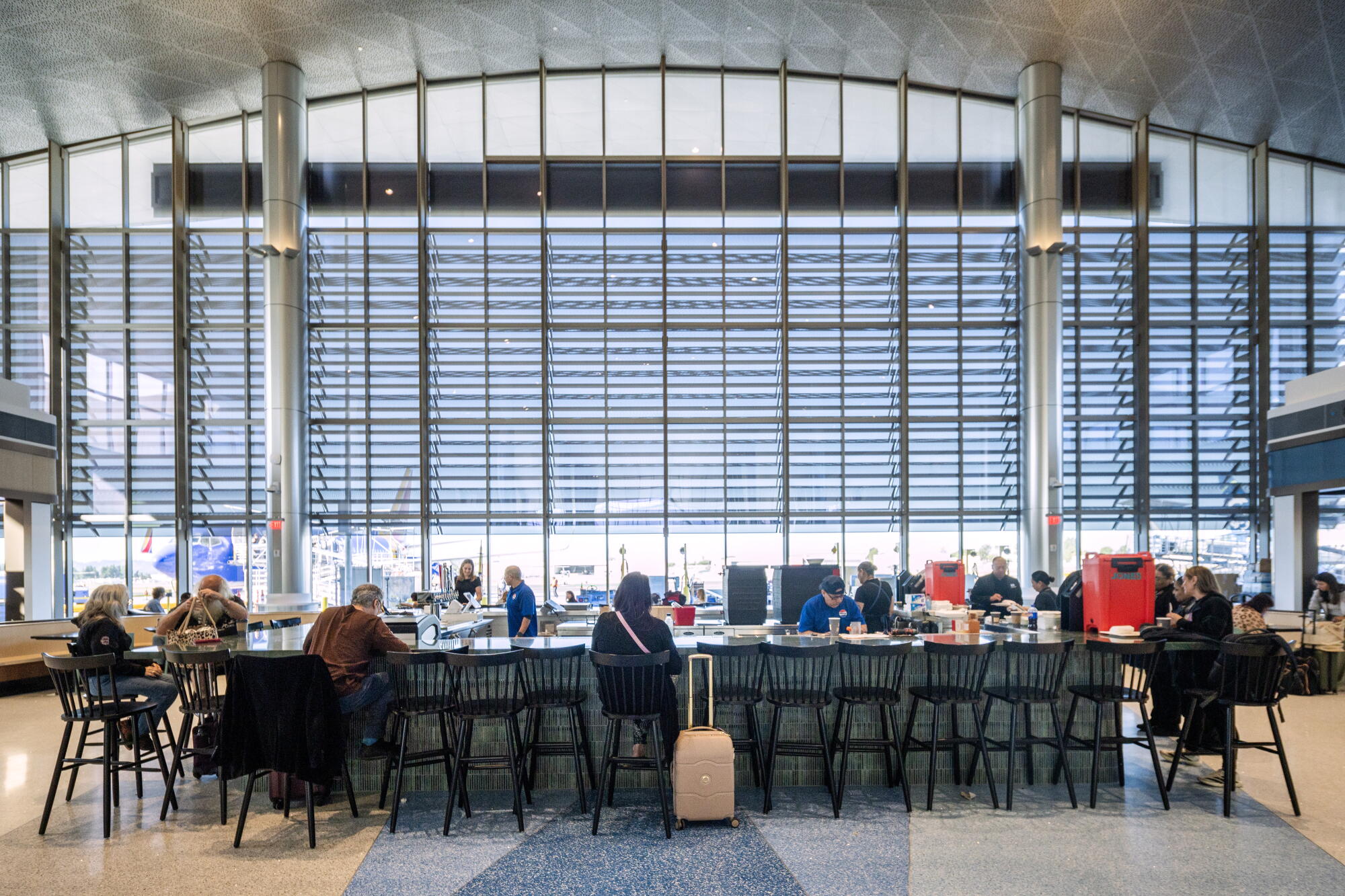
Passengers at Pete’s Pub inside the new Hollywood Burbank Airport terminal. None of the 13 food concessions are fully open.
(Myung J. Chun/Los Angeles Times)
“It was weird,” said Tanya Radke, 25, of Van Nuys, who was headed to Kansas City and caught off-guard by the terminal switch. “It was not what I thought was going to happen today for me.”
But looking around, the passenger called the new space a big upgrade. “It reminds me a lot of the Kansas City airport,” Radke said. “It was well overdue.”
The day’s schedule called for about 90 departures and arrivals by eight airlines, roughly the same schedule as in the previous buildings. The new terminal also has the same two runways and same number of gates — 14 — as the airport’s previous two-terminal alignment. And passengers still often board planes from the front and back, using outdoor steps from the tarmac, rather than enclosed tunnels. That practice is something travelers have long praised for its informality and efficiency.
But the new building does bring many changes. It measures about 50% larger than the two old terminals combined — about 355,000 square feet — with higher ceilings and a pair of illuminated steel sculptures by Cliff Garten flanking the main entrance.
The first departure was Alaska Flight 3401 to Santa Rosa at 7:03 a.m. with 33 passengers aboard. The first arrival: Southwest Flight 189 from Las Vegas, which landed at 7:16 a.m. with 30 passengers aboard.

The new terminal opened after 33 months of construction and $1.3 billion in spending.
(Myung J. Chun/Los Angeles Times)
“The taxi off was a little different. Instead of turning right, you turn left,” said Southwest Airlines pilot Mike Petros, who arrived at 7:31 a.m. with a planeload of passengers from Sacramento. At the start of the flight, Petros said, “We told them that we would be flying to a new terminal, so if they had anybody picking them up, let them know.”
Still, many were surprised. Airport management deployed several staffers to redirect confused travelers from the old terminals (now idle) to the new one. Anthony Bailey, 29, said he learned of the switch from an Uber driver on his way to the airport.
“So far, I’m liking it,” Bailey said of the new terminal, standing near gate 13 before catching a flight to Las Vegas. “Nice and clean. The TSA line was pretty smooth.”
While most of the six retail stores were open on Tuesday, none of the terminal’s 13 food concessions were fully operating. Two eateries were offering grab-and-go options, and airport spokesperson Mike Christensen said more options would arrive later in the day and week.

Katelyn Bailey and travel companion Pigeon check in for a flight to the Bay Area.
(Myung J. Chun / Los Angeles Times)
When the new terminal concessions open, dining options will include Guy Fieri’s Flavor Town, Spring Chicken, Diane’s Farm Table and Italian Market, Jones Coffee, Perry’s Joint, Poquito Mas, West Coast Smash Burgers, Massis Kabob, Starbucks, Border Grill, Jet Tila’s Asian Table, Santa Canela bakery and a bar, Pete’s Pub, with picture-window views of the runways and Verdugo Mountains.
Many travelers, including William Langlois and Annie Cerillo of Tampa, noted the shortage of eating options on Tuesday. “It’s horrible, there’s no restaurants and not enough security stations,” said Langlois, who had gone to the old terminal first and was redirected. Before this change, “this was the easiest airport,” said Cerillo.
In the new terminal, airport officials say, the walk from the entrance to the farthest gate is 1,285 feet, down from 1,600 feet now, with wider corridors and sidewalks and access to power plugs for devices from every seat. (Its many charging stations are now mostly USB-C ports, not USB.) The new terminal includes eight TSA lines, versus five in the old set-up. Baggage claim carousels have moved from outdoors to indoors.
The airport’s new parking structure includes about 2,000 spots and 310 charging ports for electric vehicles. (The airport’s total number of parking spaces is 6,637, the same as before.)

Alaska Airlines Flight 3401 to Santa Rosa was the first flight to depart from the new terminal at Hollywood Burbank Airport on Tuesday.
(Myung J. Chun/Los Angeles Times)
As it did before, the airport supplies shuttle bus service between the new terminal and Burbank Airport-South Train Station (which connects with Amtrak’s Pacific Surfliner) and the Burbank Airport-North Station at San Fernando Road and Hollywood Way.
Among many preparations for the day, Burbank airport officials staged a “passenger simulation trial” on Sept. 19, inviting 1,500 volunteers to behave like passengers in the new building, giving dozens of airport workers staffers, including TSA staffers and airline gate agents, a chance to prepare for Tuesday.
The airport, second busiest in L.A. County, was built in 1930 and is run by the Burbank-Glendale-Pasadena Airport Authority. For decades it has been favored by many local travelers as a simpler, faster, quainter alternative to Los Angeles International Airport. The Burbank airport’s site in the San Fernando Valley, however, has often put its leaders at odds with residents of surrounding suburban neighborhoods. Unlike LAX, which has no flight curfew, the Burbank airport has limited operating hours — 7 a.m. to 10 p.m.

Passengers disembark Southwest Flight 189 from Las Vegas just before 7:30 a.m. This was the first arrival into the new terminal at Hollywood Burbank Airport.
(Myung J. Chun / Los Angeles Times)
Before this week’s move, the aged Burbank facility didn’t meet current state seismic standards or Federal Aviation Administration design standards, which prompted repeated safety warnings. Airport officials said the new design also increases the distance between the terminal and the nearest runway, formerly as little as 257 feet, to about 880 feet — a change that brings the airport into compliance with FAA standards.
Voters approved the Burbank airport terminal replacement project in 2016. Construction began in 2024. The airport reported about 6.2 million arriving and departing passengers in 2025, flying to and from about 30 nonstop destinations.
“It’s a beautiful building, but buildings aren’t anything without people who fill them with dedication and service,” said Tyron Hampton, president of the Burbank-Glendale Airport Authority and City Councilmember in Pasadena. He predicted that the new facility would attract not only new passengers but new businesses to the commercial corridor along Burbank’s Winona Avenue.
As Burbank unveils its new terminal, the opening of LAX’s most high-profile project — the SkyLink automated people mover (a 2.25-mile electric train route linking terminals to rail service and rental cars) has been delayed by technical and legal issues until Jan. 6 at the earliest.
“I don’t like to compare,” said Hampton when asked about LAX. “We have 14 gates. LAX has 161.”
