Ukraine Situation Report: Kyiv Is Turning Soviet-Era Armor Into Robotic Combat Vehicles
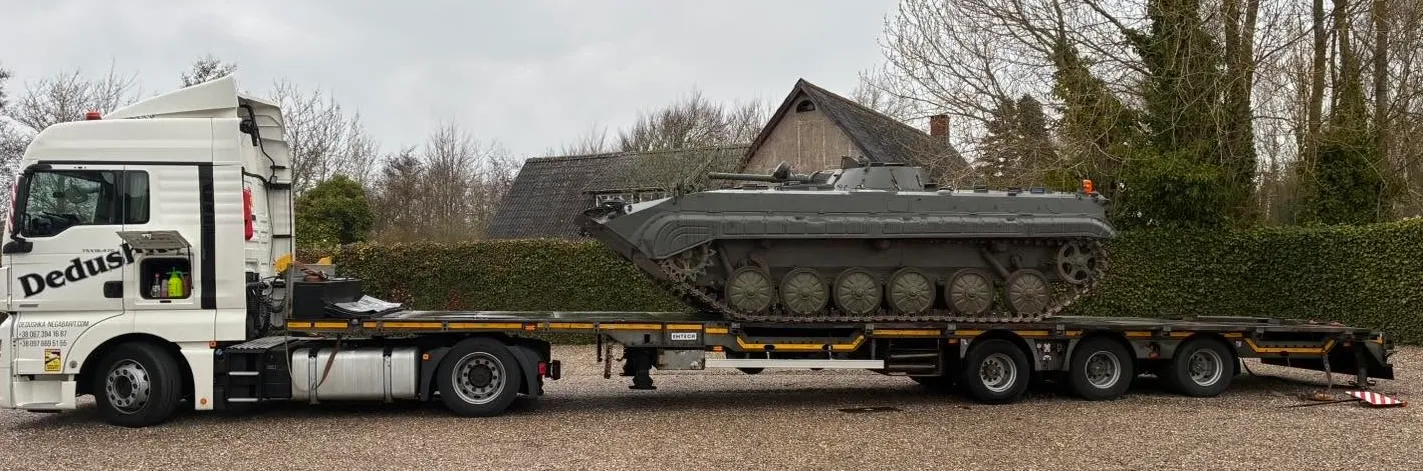
In another effort to advance robotic warfare, Ukraine is working to turn Soviet-era BRDM-2 armored reconnaissance vehicles into remotely controlled systems. The move comes as uncrewed ground vehicles (UGVs) are playing an increasing role on both sides of the conflict as movement along the front lines has been highly contested by the ubiquity of aerial drones.
This is one of the latest efforts by the Central Innovation Activities Directorate of the Ukrainian Armed Forces to help provide weaponry that will keep troops out of harm’s way, the head of that unit told the Ukrainian Ukrinform news outlet on Friday. Ukraine is using UGVs mainly for logistics and casualty evacuation, but they are also increasingly engaging in ground combat as well air defense.
Col. Vladyslav Voloshyn said work is currently underway “to enable remote control of the vehicle from a distance of up to 1,000 km. In addition, the BRDM-2 is planned to be fitted with a powerful foreign-made diesel engine, with General Motors and Mercedes engines among those being considered, replacing the Soviet-made GAZ gasoline engine. An automatic transmission is also planned.”
“The platform will have expanded capabilities for integrating a remotely controlled combat module equipped with an automatic weapon of at least 12.7 mm caliber,” Voloshyn explained. “This is expected to enhance the capabilities of Ukrainian units and their effectiveness in carrying out combat missions while helping preserve the lives of service members.”
The directorate is also installing additional mine protection for the vehicle’s hull bottom, tubeless high-mobility tires, a backup remote-control system inside the hull, and anti-fragmentation protection, the colonel added. Equipped this way, the vehicles would likely be used to assault front line Russian positions where troops can’t go on foot or as a remote option to provide fire control and support Ukraine’s often porous front line defenses. Uncrewed ground vehicles have also been used heavily in medical evacuations and general logistics to the front lines.
Unlike having to build a totally new vehicle, this project aims to take advantage of the large supply of BRDM-2s Ukraine has in storage, Voloshyn added.

Ukrainian BRDM-2 Armored Vehicle Conducts Indirect Fire #warinukraine
The vehicles will be equipped with day/night cameras to assist with guidance and will be remotely controlled from beyond line-of-sight. A vehicle this size would be able to more easily accommodate robust satellite links for that kind of operation. Beyond these features, the colonel provided few details about how the vehicles would be operated.
The head of Ukraine’s Brave1 defense technology hub previously provided some insights about how this works for purpose-built UGVs.
“I can tell you that combat UGVs without artificial intelligence do not work at appropriate effectiveness,” Brave1 CEO Andrii Hrytseniuk told us in May in a discussion about Ukraine’s burgeoning UGV industry. “All combat turrets that we are using have elements of artificial intelligence, and it allows them to be as effective as they are.”
The UGVs use machine vision for “object recognition, identification, classification, tracking and providing recommendations for the operator on what to do,” he added.
These systems communicate through Ukraine’s Delta command and control system, the Brave1 CEO noted.
Without the Delta system, “all these advanced technologies on the battlefield will not be working,” Hrytseniuk suggested. “The Delta command and control system, which is number one in the world, is absolutely crucial. And this is for all our drones, multi-domain operations, everything.”

War in Ukraine: An advanced digital map. The Delta system #shorts #warinukraine #united24media
The Ukrainian company ArmSpetsTekhnolohiya unveiled the BRDM-2M in June during the Defense Builder Accelerator Demo Day. Now the directorate is preparing this system for deployment to the front lines, Voloshyn stated without providing timelines. If it does turn out to be a viable option, it will join tens of thousands of other Ukrainian UGVs on the battlefield.
The Latest
On the battlefield, both sides are making small advances, however, the front lines are largely static. Here are some key takeaways from the latest Institute for the Study of War analysis.
- Sumy: Russian forces recently advanced in northern Sumy Oblast.
- Kharkiv: Russian forces continued offensive operations in northern Kharkiv Oblast on August 19 and 20 but did not advance as Ukrainian forces counterattacked. However, Russian forces are reportedly intensifying strikes in the Kupyansk direction, likely in preparation for future ground attacks.
- Donetsk: Russian forces continued offensive operations in the Kostyantynivka-Druzhkivka tactical area on August 19 and 20 but did not make confirmed advances. Ukrainian forces recently advanced south of Dobropillya while Russian forces recently advanced southwest of Pokrovsk.
- Zaporizhzhia: Russian forces continued offensive operations in the Hulyaipole direction and western Zaporizhzhia Oblast on August 19 and 20 but did not advance.
- Kherson: Neither Russian nor Ukrainian sources reported ground activity in the Kherson direction on August 20.
In an update to a story we reported earlier this month, North Korea is reportedly sending KN-30 missiles, also known as the Hwasong-11C, to Russia.
“Ukraine’s Main Military Intelligence Directorate (GUR) confirmed on August 20 that North Korea transferred around 50 KN-23, KN-24, and KN-30 (Hwasong-11C) ballistic missiles to Russia as of July 2026,” the Institute for the Study of War reported on Thursday, citing Ukrainian media.
The KN-30 is an enlarged derivative of the original Hwasong-11 and designed to carry larger warheads. North Korea has previously said it has tested subvariants of the Da/C type with 2.5-ton and 4.5-ton conventional high-explosive warheads, and that it can also be fitted with a nuclear warhead.
North Korea has also sent a new wave of about 8,500 North Korean troops to Russia, CNN reported. This includes “a drone unit that could attack targets inside Ukraine,” the network stated, citing Major General Vadym Skibitskyi, Deputy Head of Defence Intelligence of Ukraine (GUR).
Thousands of North Korean engineers and bomb disposal experts are mostly dispersed across Kursk Oblast, Skibitskyi stated. The North Korean forces deployed in Russia also include 400 drone operators. Many gained previous experience fighting against Ukraine. Their drones are likely to be used both for reconnaissance and attacks on Ukraine, CNN noted.
Around 25,000 North Koreans have so far either been part of the forces deployed in Russia or passed through the Russian armed forces, the GUR leader added. He said that Russia could request up to 50,000 more troops during a meeting between Kremlin leader Vladimir Putin and North Korean leader Kim Jong Un in September.
Ukrainian officials have made it clear that they cannot defend against Russian ballistic missiles because they are out of Patriot missile interceptors. In the latest bid to offset that and hit missiles before they can be launched, Ukraine is seeking help from Elon Musk, the Financial Times reported.
“Ukraine is seeking approval to use Starlink-equipped drones against ballistic missile launchers up to 200km inside Russia,” the publication reported on Friday, citing people familiar with the matter.
Such a move, if approved, would provide Ukrainian drones with beyond line-of-sight connectivity and resistance to jamming, increasing their ability to strike deeper into Russia against dynamic targets, giving them the ability to hunt for missiles deep inside Russia and strike them when they are found. This use of Starlink helped Ukraine with its mid-range strikes against Russian logistics.
The introduction of Starlink to the battlefield in Ukraine has revolutionized how war is waged, giving users high bandwidth, relatively secure communications basically anywhere, all in a small, off-the-shelf package. This has impacted everything from high-level command and control, to basic communications and data exchange between troops across the entire battlespace. The antennas have also been reduced in size enough so that they can now fit onto relatively small one way-attack drones.
There is a major catch, however, in any bid to use Starlink in offensive weapons beyond how it is currently employed. While he wouldn’t sign off on similar requests in the past, Musk is now allowing Ukraine to use Starlink to hit targets deep behind enemy lines and, apparently, ships in the the Sea of Azov as well, though we don’t know for sure.
Musk would need to sign off on the kinds of strikes deep into Russia that Ukraine is currently seeking. While his Starlink service is helping Ukraine now, he also shut it off earlier in the war during Ukrainian attacks on Crimea, fearing there could be a nuclear response from Moscow.
Complicating matters, Ukrainian President Volodymyr Zelensky recently fired defense minister Mykhailo Fedorov, who was Ukraine’s most direct connection to Musk.
TWZ cannot independently confirm FT’s reporting. We’ve reached out to SpaceX, Musk’s company providing Starlink service, for clarification.
Russia attacked a shopping mall in Ukrainian President Volodymyr Zelensky’s hometown of Kryvyi Rih. The attack killed at least 14 and wounded more than 100 others, the Ukrainian president stated on X.
“The attack drones struck in two waves – half an hour after the first hit and the fire, there was a second strike targeting the emergency responders,” Zelensky stated on earlier on X. “Attacks like these are nothing less than terrorist acts. And the world must respond to them accordingly – with real pressure on the aggressor. For peace to be possible, Russia must face real accountability.”

Russia also struck the Tabaky crossing at the Ukraine-Moldova border.
“The attack damaged buildings and structures at the crossing, and fires broke out at the site,” according to Ukrainian border guards. “Traffic through the Tabaky crossing is currently suspended. Vehicles are being redirected to other border crossing points.”
For its part, Ukraine is continuing its long-range strike campaign against Russian energy and military targets. This campaign has severely crippled Russia’s oil infrastructure in particular, causing widespread domestic gasoline shortages and a drastic reduction in oil exports.
“Last night, our deep strikes hit an oil refinery in Perm, more than 1,600 kilometers from the border, and the Marinovka military air base in the Volgograd region,” Zelensky claimed. “There are also results in the Black Sea.”
“We also have confirmed results from previous strikes: a Russian Su-34 aircraft was damaged at the Akhtubinsk air base, about 600 kilometers from the front line,” the Ukrainian leader added. “And in Primorsko-Akhtarsk, nearly 180 kilometers away, a facility used for storing, preparing, and launching attack drones that the Russians use to strike our people was hit.”
TWZ cannot independently verify these claims.
Ukraine’s campaign against Russian air defenses continues as well.
A Russian S-300 surface-to-air missile system (SAM) was located and destroyed, Ukraine’s Defense Ministry (MoD) claimed on X.
Video emerged on social media showing a Ukrainian MiG-29 chasing a Russian Shahed drone, which eventually crashed apparently without being fired on. Based on the quality of the video and the distance from which it was shot, it is hard to say exactly what caused the drone to crash.
Russia has introduced a new method of attack. It involves using a drone that lies in wait until a microphone picks up the sound of a passing vehicle and activates the weapon.
Ukraine’s mid-range strike drone campaign against Russian logistics, especially fuel trucks, has relied heavily on AI for terminal guidance and target recognition. Now Russia is supposedly testing a new method of trying to defend against those strikes.
Russian forces have reportedly fitted a UAZ-452 “Bukhanka” vehicle with mirrored panels as a potential countermeasure against drones using optical or AI-assisted guidance.
The improvised modification, which makes the van look like a rolling disco, appears intended to interfere with the drone’s ability to visually identify and track the vehicle by altering its appearance and creating reflections. However, whether this works is not known.
Earlier in this piece, we touched on Ukraine’s Delta battle management system. It turns out the country’s SBU state security service arrested a commander of a National Guard special purpose group for giving Russia access to his Delta account in return for $1,000 in cryptocurrency, a serious security breach.
That’s it for now. We’ll update this again at a later date.
Contact the author: howard@twz.com