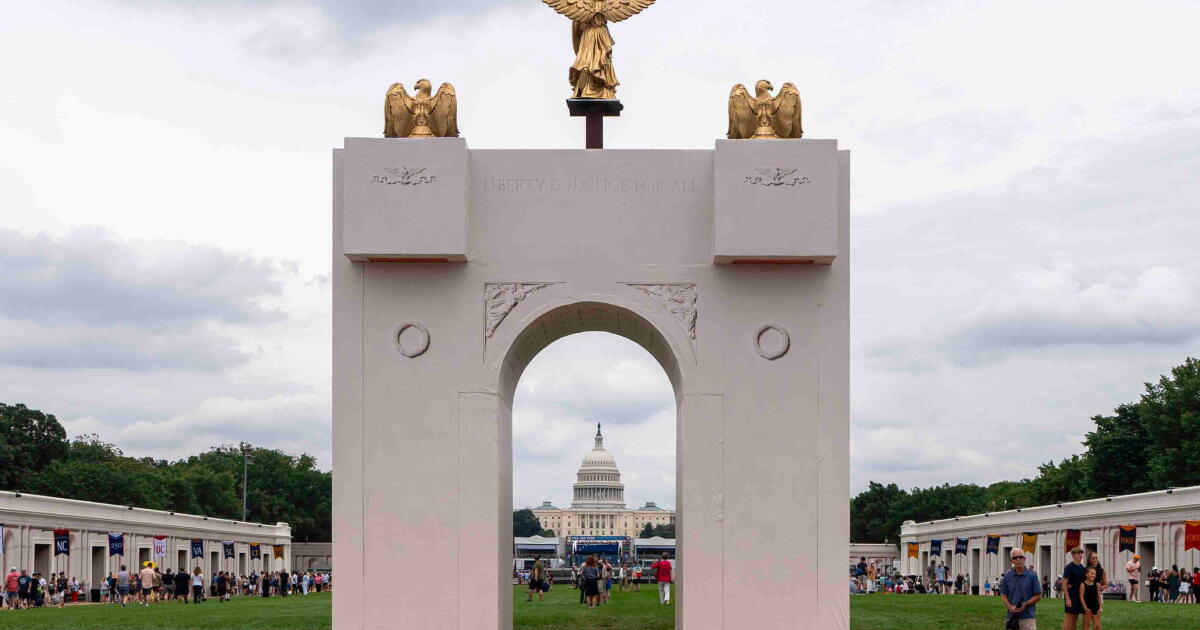
arch

D.C. planning panel advances plans for Trump’s triumphal arch

July 9 (UPI) — A federal Washington, D.C., planning agency advanced plans Thursday night for President Donald Trump‘s 250-foot triumphal arch, clearing a key procedural hurdle toward construction despite staunch opposition from historic preservation groups.

The National Capital Planning Commission approved preliminary site and building plans in an 8-1 vote, with three members voting present, during a meeting at its Washington headquarters.

The sole objector, Evan Cash, representing D.C. Council Chair Phil Mendelson on the panel, said he would not vote in its favor. He said the plans would “have the effect of upending decades of NCPC practice and thee century-old height framework.”

According to the proposed plans, the arch would be constructed across the Potomac River in Virginia. At 250 feet tall and 166 feet wide, it would be twice the height of the Lincoln Memorial.

Rob Nieweg, senior vice president of the National Trust for Historic Preservation, also objected to the project.

Nieweg told the commission that the arch would “overwhelm” nearby historic landmarks, including the Lincoln Memorial, Arlington House and Memorial Bridge, while being inconsistent with “the solemn character of Arlington National Cemetery.”

“Each new rendering submitted for this proposal is totally inappropriate in its scale and location,” he said.

“The new images clearly show that the arch blocks the view of the Lincoln Memorial from vantage points on the Virginia side. It looms larger on the skyline than everything other than the Washington Monument. From the District side, placing the arch in the foreground completely overpowers the sacred rolling wooded hills and rows of white grave markers at Arlington National Cemetery.”

The vote comes after the U.S. Commission of Fine Arts approved a modified design of the arch in May. A final vote on the plan will take place at the September commission meeting, NCPC Chair Will Scharf said.

“It’s disappointing that the NCPC approved the preliminary site and building plans for the Monumental Arch today, and we remain strongly opposed to its scale and locations,” the National Trust for Historic Preservation told UPI in an emailed statement.

Trump proposed the arch as he has sought to remake the capital in his own image, including plans for a new White House ballroom and renaming the John F. Kennedy Center for the Performing Arts to include his name, among others. Several of those efforts have been met with lawsuits.

Olympic canoeist David Hearn departs the Moultrie Courthouse after pleading not guilty to damaging the Lincoln Memorial Reflecting Pool on Thursday. Hearn was indicted on July 2 on one count of destruction of property of more than $1,000 for allegedly damaging the Reflecting Pool, carrying a maximum penalty of 10 years in prison if convicted. Photo by Bonnie Cash/UPI | License Photo

Source link

L.A.’s Sparkletts bottling plant is now a historic landmark

For nearly a century, Sparkletts bottled its water in a vast building on Lincoln Avenue designed to look like a Moorish palace, or maybe an industrial oasis.

Now Sparkletts has moved out, the owners aren’t talking and L.A. city officials, hoping to save the building, have named the site a historic-cultural monument.

“We’ve always had an eye on the building because it’s such an icon in the community,” said Frank Parrello, Landmarks and Advocacy chair for the Eagle Rock Valley Historical Society. “We want to make sure that whatever happens in the future, the building is considered.”

The plant, which drew water from subterranean springs and bottled it for distribution through Southern California, went up in 1929 on E. Lincoln Avenue along the Eagle Rock-Highland Park border, filling the block between N. Avenue 45 and N. Avenue 46. Designed by architect Richard D. King, its main building features arches, towers and domes, a white-washed brick exterior and wrought-iron lanterns.

The L.A. Conservancy calls it a bold example of Moorish Revival industrial style and a prime illustration of “the industrialization of drinking water in Los Angeles.”

Neighbors call it “the Taj Mahal,” resident Anthony Carmona says.

This 1929 Sparkletts building on the Eagle Rock-Highland Park border was designed in a Moorish Revival style.

The Sparkletts building, built in 1929, was designed in a Moorish Revival style. The building, idle since 2025, has been added to the L.A. City Historical-Cultural Monument list.

(Christopher Reynolds / Los Angeles Times)

Questions about the building’s future began to multiply in 2025, when Sparkletts ceased operations on the site. A 4.4-acre portion of the property was listed for sale, then for lease. The L.A. Conservancy warned that the building was “at risk of redevelopment.”

The Instagram site Save Iconic Architecture also sounded an alarm, saying the Sparkletts building “tells the story of Los Angeles’ innovation, design, and relationship with its most precious resource: water.”

Meanwhile, the Eagle Rock Valley Historical Society nominated the building as a historic-cultural monument, which led to a site visit and votes by the city of Los Angeles Cultural Affairs Commission and City Council.

On June 24, the council voted to protect the building as a monument. The designation “does not guarantee that the building cannot be demolished,” but it does allow city officials to delay demolition for up to 360 days “to allow for time to preserve the monument.”

The city Planning Department staff report on the historic monument nomination lists the owners as Sparkletts Drinking Water Corporation and Foremost Water Corporation. Neither commented to the city on the monument nomination and Primo Brands (Sparkletts’ parent company) did not respond to requests for information Monday.

The city’s staff report on the site says the architect may have been influenced by a Moorish design trend in the 1920s that included the film “The Thief of Bagdad” (1924). The El Capitan Theater on Hollywood Boulevard and Shrine Auditorium near USC, both completed in 1926, are also known for their Moorish features.

Architectural historians David Gebhard and Robert Winter included the Sparkletts building in their “Architectural Guidebook to Los Angeles,” noting its mosque-like presence and saying “the best remaining element” is the tiled mosaic oasis scene over the entrance.

The building has seen some changes. As the Eagle Rock Valley Historical Society nomination notes, the building’s largest Sparkletts sign was removed in July 2025. City records show that decades ago, in the course of repairs after the 1971 San Fernando earthquake, at least one minaret was removed.

The entrance, however, remains largely intact, featuring three arches and a set of steps framed by a pair of tall palm trees. Just above the front door and beneath a surviving Sparkletts sign hangs the tilework that Gebhard and Winter enjoyed.

Moreover, “it’s very impressive inside,” Parrello said. “It’s a big open industrial floor plan, which could be used for a lot of things.”

The Sparkletts building, idle since 2025, has been added to the L.A. City Historical-Cultural Monument list.

The Sparkletts building, idle since 2025, has been added to the L.A. City Historical-Cultural Monument list.

(Christopher Reynolds / Los Angeles Times)

If public agency or nonprofit is able to play a role in the property’s future, Parrello added, “it could become a housing complex, or a community center for a housing complex.”

A similar answer came from Carmona, 51, a restaurant worker who lives in an RV about a block away from the Sparkletts building. Carmona said he’d love to see it become a gathering place where neighbors can trade products, services, ideas, “lemons, oranges, whatever.” In a perfect world, Carmona said, “there should be free water for everyone, but of course that’s not going to happen.”

The city of L.A. began designated historic-cultural landmarks in 1962 and has given that status to more than 1,000 buildings and other structures.

The closure of the Eagle Rock Sparkletts operation followed a 2024 merger between Sparkletts’ parent company, Primo Water, and another bottled water company, BlueTriton, to from Primo Brands.


Source link

Design plan for Trump’s proposed Washington arch is approved by key federal agency

The U.S. Commission of Fine Arts on Thursday approved the design for the triumphal arch that President Trump wants built at an entrance to the nation’s capital.

Commissioners, all of whom were appointed by Trump, approved the design despite overwhelming opposition from the public. Approval is a key step in the project’s process.

The proposed arch is one of several projects the Republican president is pursuing alongside a White House ballroom to leave his imprint on Washington.

He has said some of his other projects, such as adding a blue coating to the interior of the Lincoln Memorial Reflecting Pool, will beautify the city in time for July 4 celebrations of America’s 250th birthday.

The U.S. Commission of Fine Arts approved the concept for the arch at its monthly meeting in April.

As presented to the federal agency, the arch itself would stand 250 feet tall from its base to a torch held aloft by a Lady Liberty-like figure on top of the structure. The statue would be flanked on top by two eagles and guarded at the base by four lions — all gilded. The phrases “One Nation Under God” and “Liberty and Justice for All” would be inscribed in gold lettering atop either side of the monument.

A public observation deck on top would provide 360-degree views of the surroundings.

The commission’s vice chairman, architect James McCrery II, said in April that he preferred the arch without the figures on top. Removing them would significantly reduce the arch’s height by about 80 feet. Critics of the project, including an overwhelming number of people who submitted public comment in April, said the arch would be taller than any other monument in the capital city and dominate the skyline.

At a height of 250 feet, the arch would dwarf the Lincoln Memorial, which is 99 feet tall, and be close to half the height of the Washington Monument, an obelisk that is about 555 feet tall.

McCrery also recommended that the lions on the base be removed because that animal is “not a beast natural to the North American continent.” And he objected to plans for an underground tunnel for pedestrians to get to the arch, which would be built on a traffic circle between the Lincoln Memorial and Arlington National Cemetery in Virginia.

Preliminary surveys and testing of the site began last week.

A group of veterans and a historian have sued the Trump administration in federal court to block construction on grounds that the arch would disrupt the sightline between the Lincoln Memorial and Arlington House at Arlington National Cemetery, among other reasons.

Trump and Interior Secretary Doug Burgum have argued that Washington is the only major Western world capital without such an arch. Burgum’s department includes the National Park Service, which manages the plot where Trump wants to put the arch.

Trump’s rehab of the Lincoln Memorial Reflecting Pool is also the subject of a court challenge brought by the Cultural Landscape Foundation, which said the administration’s moves to repaint the bottom of the Reflecting Pool blue without first undergoing relevant reviews ran afoul of federal preservation laws governing historic sites.

The nonprofit group argued in a lawsuit filed last week that the changes at the Reflecting Pool are part of Trump’s broader effort to push through dramatic renovations in Washington without proper reviews and undermine the tone of the area.

A hearing in the case was scheduled for Thursday afternoon in federal court in Washington.

Superville writes for the Associated Press.

Source link