TALLAHASSEE, Fla. — The Florida Legislature approved a new congressional map intended to maximize Republicans’ advantage in the state as part of the national redistricting battle that President Trump launched ahead of this year’s midterms.
The vote came just two days after Gov. Ron DeSantis unveiled his proposal and the same day that the U.S. Supreme Court rolled back a key provision of the Voting Rights Act. The decision could make it harder for Democrats to challenge Republican efforts to redraw congressional districts in ways that limit the influence of nonwhite voters.
DeSantis’ map could increase Republicans’ advantage in Florida’s House delegation to 24 to 4, up from the current split of 20 to 8. The potential four-seat gain is the same as what Virginia Democrats expect from a recent redistricting referendum, which is being challenged in state court there.
Florida’s new districts are certain to face lawsuits as well, especially because the state constitution prohibits redistricting for explicitly partisan purposes. DeSantis and his aides believe those provisions will not be a legal barrier because they have been weakened previously by the Florida Supreme Court and again by Wednesday’s U.S. Supreme Court ruling.
Florida Republicans, comfortable in their supermajority in both legislative chambers, said little about the new districts during the whirlwind special session. The measure’s sponsor, Rep. Jenna Persons-Mulicka (R-Fort Myers), limited her remarks to careful answers about an “evolving legal landscape” as Democrats’ asked her about the redistricting effort.
“I believe that there is a likelihood that that map will be upheld against legal challenge,” Persons-Mulicka said.
Opposition was vocal but futile
Democrats, activists and some citizens to decried the process as a partisan power play to satisfy Trump, boost DeSantis’ future ambitions and hurt the majority of registered Florida voters who are not Republicans.
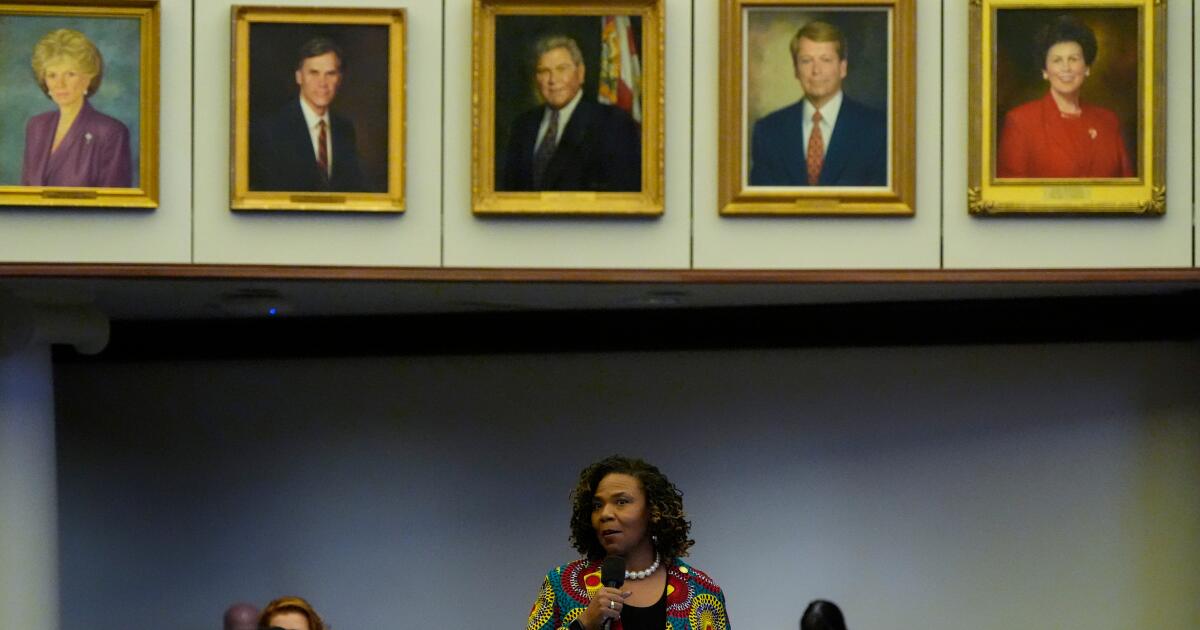
“Y’all are doing this because y’all’s daddy in the White House is injecting national political objectives into what should be a state-driven process,” Rep. Michele Rayner (D-St. Petersburg) told her Republican colleagues before an 83-28 vote in favor of the measure.
The Florida Senate later approved the plan in a 21-17 vote.
Rep. Angie Nixon, a Jacksonville Democrat, chided Republicans for yielding the redistricting process to DeSantis, whose second term expires in January.
“Last time I checked, we’re the ones who were supposed to be drawing the map,” she said, “and yet we are allowing y’all to continue to hold the water of the governor, who is a lame duck and just trying to figure out what his next job is going to be.”
Democrats diminished in metro areas
The new map reshapes districts in Democratic areas around Orlando, the Tampa-St. Petersburg area and in south Florida around Palm Beach, Fort Lauderdale and Miami. The changes could cost Reps. Jared Moskowitz and Debbie Wasserman Schultz, among others, their seats.
DeSantis and his aides said before and during the session that new map is necessary to account for population growth in suburban and exurban areas since the 2020 census and to ensure Florida has a “race-neutral” congressional plan.
The proposal presumed the outcome of the U.S. Supreme Court’s Wednesday decision, which specifically struck down a Louisiana congressional district drawn for the electorate to be majority-Black. Historically, Black voters have aligned more with Democrats, while a majority of white voters lean toward Republicans.
The changes in Florida include the effective elimination of one nearly majority Black south Florida district that was represented by Rep. Sheila Cherfilus-McCormick, a Black Democrat, until her resignation earlier this month.
Lawmakers fast-tracked the measures
From the session’s opening bell Tuesday morning, Republican leaders moved swiftly.
In one of just two committee hearings, Senate Rules Chair Kathleen Passidomo (R-Naples) said she wanted “everybody who has taken the time and effort to come to Capitol to have an opportunity to speak.” Then she declared each speaker would have 30 seconds.
“I know that doesn’t seem like a lot but it actually is, uh, if you’re concise,” she said.
Deborah Courtney drove more than two hours from from Jacksonville and noted that all citizen speakers expressed opposition.
“Why are you doing this redistricting now?” she asked senators. “I doubt that your phone have been ringing off the hook from your constituents going, hey, we need some new maps.”
Rob Woods came from the Tampa area, which under the new map could have no Democratic representation in the U.S. House. A Black man, Wood told senators he was a veteran who said he “bought in from elementary school” on notions of the U.S. as an equal-opportunity democracy.
Now, he said, “it seems as if we are back in that period of Reconstruction, moving back to Jim Crow.”
On the House floor, Persons-Mulicka sidestepped specifics about what factors went into the map. She repeatedly called it “race-neutral,” citing testimony from DeSantis aide Jason Poreda, who took sole credit for the map during the session and did not disclose the names of any architects. But asked about Poreda’s admission that he examined party affiliation and voting patterns, Persons-Mulicka balked.
“I cannot speak to the intent of the map drawer,” she said.
DeSantis unveiled the map on Fox News
Persons-Mulicka and Sen. Don Gaetz, who sponsored the map in the Senate, deflected questions about why DeSantis unveiled the plan on Fox News.
Gaetz, a Crestview Republican, confirmed he had no part in drafting the map and forwarded the governor’s proposal to other senators as soon as he received it late Monday morning.
There’s no guarantee that new maps across the country will play out the way two parties hope. For example, Texas based its revised lines largely on Trump’s performance in 2024, redistributing the president’s voters across more districts to pull them into the Republican column. But Trump’s popularity has waned since his reelection, including among Latino voters who figure prominently in the state.
Florida could face a similar conundrum. Creating more majority-Republican districts could leave margins thin enough to allow for Democratic victories, especially if there’s an anti-Trump backlash at the polls this year.
Some Republicans have expressed worry about that possibility, and a handful voted against the measure in the Florida Legislature.
The governor already took a hit because of the session. He had wanted lawmakers to adopt state regulations on artificial intelligence, ostensibly protecting minors from harmful material, while rolling back vaccine mandates for students in Florida’s public schools. House Speaker Daniel Perez, a Republican but not a DeSantis ally, spiked both ideas.
DeSantis called it “political shenanigans.”
House Minority Leader Fentrice Driskell (D-Tampa) lamented that Republicans still delivered DeSantis the big-ticket item that he wanted.
“On destroying our democracy, they’ve been aligned,” she said, “and that’s what we did here today.”
Barrow writes for the Associated Press.