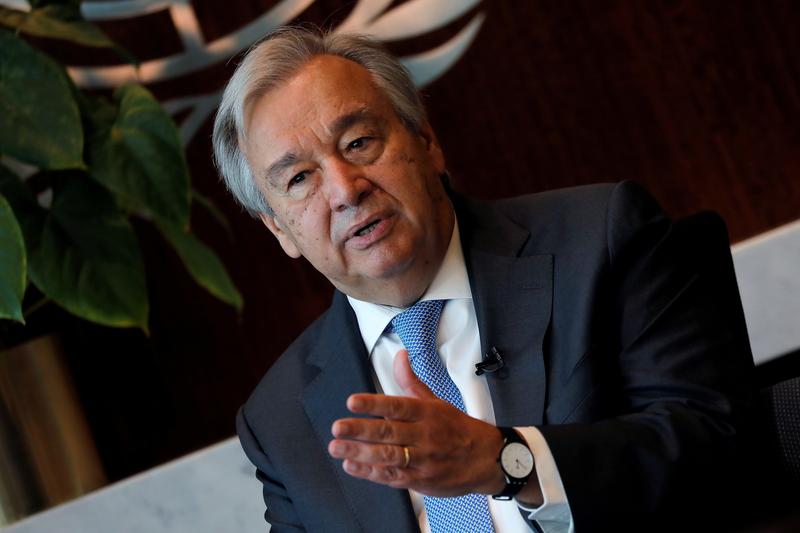
Antonio Guterres

Who is Khalilur Rahman, Bangladesh FM who beat Cyprus to UNGA presidency? | Antonio Guterres News

Bangladeshi Foreign Minister Khalilur Rahman has been elected as the 81st president of the 193-member United Nations General Assembly (UNGA). He will assume office when the UNGA session opens in September.

Rahman, who earlier held several portfolios at the UN, won the presidency after defeating Cyprus’s Ambassador Andreas Kakouris in a closely contested vote, taking the helm of the world’s most representative diplomatic body during a time of global geopolitical turmoil.

Recommended Stories

list of 4 itemsend of list

Who is Khalilur Rahman?

A career diplomat, Rahman joined Bangladesh’s foreign service in 1979. He also held senior UN positions in New York and Geneva, including as the spokesperson for the Least Developed Countries (LDCs) and as special adviser to the UN Conference on Trade and Development (UNCTAD).

Between 1986 and 1991, he served as the first secretary at the Permanent Mission of Bangladesh to the UN.

Rahman became foreign minister in February, when the Bangladesh Nationalist Party (BNP) won the country’s first election since a student-led uprising ousted Prime Minister Sheikh Hasina in 2024.

He previously served as national security adviser and the high representative on the Rohingya issue in the interim government led by Nobel laureate Muhammad Yunus.

Rahman’s presidency will coincide with one of the most consequential processes on the UN calendar – the selection of Secretary-General Antonio Guterres’s successor – as his term expires at the end of this year.

“The UN will commence its ninth decade at a time when trust in our organisation is being tested on multiple fronts,” he told diplomats assembled at the UNGA as he accepted the new role. “Taken together, these challenges tend to undermine the public trust and confidence in the ability of our organisation to deliver its promises.”

Guterres congratulated Rahman, saying, “Your remarkable political and diplomatic experience are a guarantee of success not only to the General Assembly but to the United Nations as a whole.”

How is the UNGA president selected?

While the presidency of the UNGA is largely ceremonial, it is also prestigious. It is the UN organ where countries large and small can speak, and it is the scene of the world’s largest annual diplomatic gathering.

The UNGA president is normally chosen by acclamation, meaning member states agree on a candidate by broad consensus. If no consensus can be reached, a secret ballot is held; in that rare case, the candidate who wins a simple majority of votes becomes president.

Before this year, the last contested UNGA presidential election was in 2016, when Fijian diplomat Peter Thomson won the presidency of the 71st session in a secret ballot, defeating Cyprus’s candidate by four votes. In 2012, Serbia’s Vuk Jeremic narrowly beat Lithuania’s candidate in another secret ballot. In 1991, Saudi Arabia’s candidate, Samir Shihabi, won the presidency in a contested vote against candidates from Yemen and Papua New Guinea.

In the secret ballot, Rahman secured 99 votes, eight more than his competitor Kakouris. A total of 190 ballots were cast, with no invalid votes or abstentions.

The presidency rotates among the UN’s five regional groups, and the 81st session falls to the Asia Pacific group. Rahman will serve a one-year term starting on September 8, the UN said.

Outgoing UNGA President Annalena Baerbock, Germany’s foreign minister, highlighted how trust towards multilateralism is under growing strain.

The UN is facing “not only headwinds, but immense pressure”, with consensus increasingly difficult to achieve and defence of the UN Charter becoming “a daily necessity”.

“The role of the president of the General Assembly is no longer simply procedural,” she said.

The US administration under President Donald Trump has tried to undermine the UN system, resorting to unilateral actions to tackle complex global geopolitical issues. Washington has withdrawn from several UN organisations, such as the World Health Organization and the Human Rights Council, and cut funding to the global body.

The US president has called the UN a “talking shop”, questioning its purpose during his speech at the annual UNGA meeting last September. “The UN has such tremendous potential … but it’s not even coming close to living up to that potential,” he said.

What is the UNGA?

The General Assembly is the UN’s most representative body, bringing together all 193 member states, each with one vote. Its annual gathering in September in New York is the only UN forum where world leaders from all countries can speak.

The UNGA controls the UN budget, adopts treaties, addresses global issues from poverty to corruption and passes numerous resolutions that, while not legally binding, almost always reflect global opinion.

The UNGA also makes key decisions for the UN, including appointing the secretary-general on the recommendation of the UN Security Council (UNSC) and electing the nonpermanent members of the council.

The coming UNGA session will open on September 8.

On Wednesday, the UNGA elected Austria, Kyrgyzstan, Portugal, Trinidad and Tobago and Zimbabwe to the 15-member UNSC for two-year terms starting on January 1, 2027.

Germany, which had lobbied hard for a seat, failed to win the UNSC seat in a major setback for Chancellor Friedrich Merz.

The council is the only UN body that can make legally binding decisions, such as imposing sanctions and authorising the use of force. It has five permanent veto-wielding members: China, France, Russia, the United Kingdom, and the United States.

Source link

NATO states slam Russia after drone crashes in Romania | Antonio Guterres News

Romania and its NATO allies have reacted angrily after a Russian drone crashed into an apartment building in eastern Romania, injuring two people.

The foreign ministry in Bucharest on Friday labelled the crash of the drone, part of an overnight attack aimed at Ukraine, a serious violation of international law and called on NATO to accelerate the transfer of anti-drone capabilities. The incident is just the latest incursion along the alliance’s eastern flank, raising concern that the risk of an open confrontation between Russia and NATO states is rising.

Romania said the overnight drone was tracked by radar in its airspace before crashing onto the roof of a residential building in the city of Galati.

Two F-16 fighter jets and a helicopter were scrambled, as authorities issued emergency alerts to residents. Two people suffered minor injuries and several residents were evacuated after a fire was triggered by the crash.

‘Consequences’

The incident is just the latest of several, as the war in Ukraine has spilled over into neighbouring NATO countries, raising fears of potential escalation.

Estonia, Lithuania and Latvia, as well as Finland have all reported repeated incursions into their airspace in recent months. Drone incursions sparked a government collapse in Latvia earlier this month.

Shortly after the crash, Bucharest called for NATO to speed up the transfer of anti-drone capabilities. Outgoing Prime Minister Ilie Bolojan also said that Romania would, within hours, sign ⁠a contract which ⁠will give it anti-drone defences ‌under the EU’S SAFE programme.

On Friday morning, Romania summoned the Russia ambassador.

“We will officially communicate the consequences that this lack of responsibility on the part of the Russian Federation will have for the diplomatic relations between our countries, as well as the next steps at the European level regarding sanctions packages,” Foreign Minister Oana Toiu wrote on social media.

President Nicusor Dan stated that Romania ⁠will ⁠not accept that the war of aggression ⁠waged by Russia against ⁠Ukraine be transferred to its citizens, and added that he had asked the foreign ministry ⁠to present without delay ⁠a series ⁠of measures regarding the country’s relationship with Russia, “proportionate to ‌this very serious situation”.

NATO allies and others joined the chorus of anger.

French Minister for European Affairs Benjamin Haddad said the incident highlighted the threat Russia poses to European security, noting that French troops are stationed in Romania.

“Regardless of ⁠whether it was on purpose ⁠or the ⁠result ⁠of ineptitude, Russia is still dangerous and ‌we must defend ourselves against ‌it,” ‌Polish ⁠Foreign Minister Radoslaw Sikorski told ⁠the Reuters news agency.

European Commission President Ursula von der Leyen said the incident showed that “Russia’s war of aggression has crossed yet another line”.

A NATO spokesperson also condemned “Russia’s recklessness” on social media.

Ukraine’s Foreign Minister Andrii Sybiha, whose country is pressing the United States to help boost its air defences, pledged “Ukraine stands firmly by Romania” as he branded Russia a threat to the Black Sea region and the wider ‌European continent.

“We are ready ⁠to work closely together ⁠to strengthen protection from such threats,” he wrote on social media, adding that the bid to ⁠strengthen Ukraine’s ⁠air defence is a “strategic task” to protect not only ‌Ukraine but also to reduce risks for ‌neighbouring ‌countries.

United Nations Secretary-General Antonio Guterres warned that the escalating attacks risk spiralling “out of control”, with “unknown and unintended consequences”.

He said more civilians had been killed in the first four months of this year than during the same period in the previous three years, and called for diplomacy, immediate de-escalation and “a full and unconditional ceasefire”.

Rising risk

Concern that the war is threatening to spillover is building as Russia escalates hostilities in a bid to ward off rising political and economic pressure at home.

Ukrainian forces reported that they shot down 217 drones overnight on Friday. Russia attacked with 232 drones and one ballistic missile. Hits were recorded in 14 areas, the air force said.

Moscow has said it plans “systematic strikes” on Kyiv and has issued a barrage of threats at Ukraine’s European allies, listing facilities in Europe that it said are involved in manufacturing drones and components for Ukraine.

Moscow’s Foreign Intelligence Service recently warned the Baltic nations that their NATO membership won’t protect them from retaliation should they allow Ukraine to launch attacks from their territory, with analysts warning that the risk of an open confrontation between Russia and NATO states is rising.

That heightens concern regarding NATO’s Article 5 collective defence clause, which President Donald Trump has hinted the United States may not honour in some cases.

However, the alliance’s Secretary General Mark Rutte insisted on Friday that NATO will defend all of its territory.

“Russia’s reckless behaviour is a danger to us all,” he wrote on social media. “Last ⁠night showed yet again ⁠that the implications of their illegal war of aggression don’t ⁠stop at the border.”

“We will ⁠continue to strengthen ⁠our deterrence and defence at home and continue our support for ‌Ukraine as they defend against Russia’s aggression,” he ‌added.

Source link

U.S. blames other nations for U.N. nuclear treaty conference failure

May 24 (UPI) — The United States on Sunday blamed the collapse of a U.N. nuclear nonproliferation conference on what it called some countries’ inability to take Iran’s threat to global nonproliferation seriously.

The nearly monthlong Review Conference of the Parties to the Treaty on the Nonproliferation of Nuclear Weapons ended Friday without consensus on an outcome document, which reviews implementation of the Cold War-era pact and sets recommendations and commitments for its 191 state parities.

Conference President Do Hung Viet of Vietnam said Friday, following weeks of work and four versions of an outcome document, that he would not put it forward for adoption as “the conference is not in a position to achieve agreement on its substantive work.”

The failure came amid mounting global insecurity, including the war in Iran, the modernization and expansion of nuclear arsenals and other geopolitical tensions, which complicated efforts to reach consensus.

The U.S. State Department on Sunday faulted on other NPT member states.

“The inability of some NPT States Parties to take Iran’s threat to global nonproliferation seriously will be addressed by the United States in our continuing engagements,” State Department spokesperson Thomas Pigott said in a statement.

He said the failure to adopt a document was made worse by what he described as Iran’s continued noncompliance with NPT-required safeguards and “its escalating nuclear activities.”

Pigott did not specify in the statement which activities he was referring to. The United States attacked Iran’s nuclear facilities in June, with President Donald Trump repeatedly claiming they were “obliterated.”

“For the NPT Review Conference to uphold its founding mandate, States Parties cannot turn a blind eye to Iran’s noncompliance, nor can violators be allowed to undermine the enforcement and accountability mechanisms at the core of the NPT,” he said.

Iran was quick to blame the United States, saying Washington’s “excessive demands” were at fault.

The United States was seeking to include language in the document concerning Iran, which accused the United States during the meeting of violating the treaty by attacking its nuclear facilities.

“The NPT Review Conference failed for the third consecutive time due to obstructionism by the United States and its allies,” Iran’s mission to the U.N. said in a social media statement.

Following the collapse of the conference, U.N. Secretary-General Antonio Guterres expressed his “disappointment.”

“The current international environment, marked by deep tensions and an elevated risk posed by nuclear weapons, demands urgent action,” his spokesperson, Stephane Dujarric, said in a statement.

“The secretary-general appeals to all states to make full use of all available avenues of dialogue, diplomacy and negotiation to reduce tensions, lower nuclear risks and, ultimately, eliminate the nuclear threat.”

It is the 11th meeting of the treaty states parties and the third in consecutive review conference to end without an agreement.

Daryl Kimball, executive director of the Arms Control Association, said the failure of the conference to call for “urgently needed” concrete actions to avert a new nuclear arms race was due to the five nuclear-armed states’ use of “aggressive diplomatic intimidation tactics against non-nuclear weapons states.”

He also said U.S. leadership as “sorely lacking.”

“The foundations of the NPT, the cornerstone of global efforts to reduce and eliminate the world’s greatest danger, are cracking due to inattention, intransigence and ineptitude,” Kimball said in a statement.

Source link