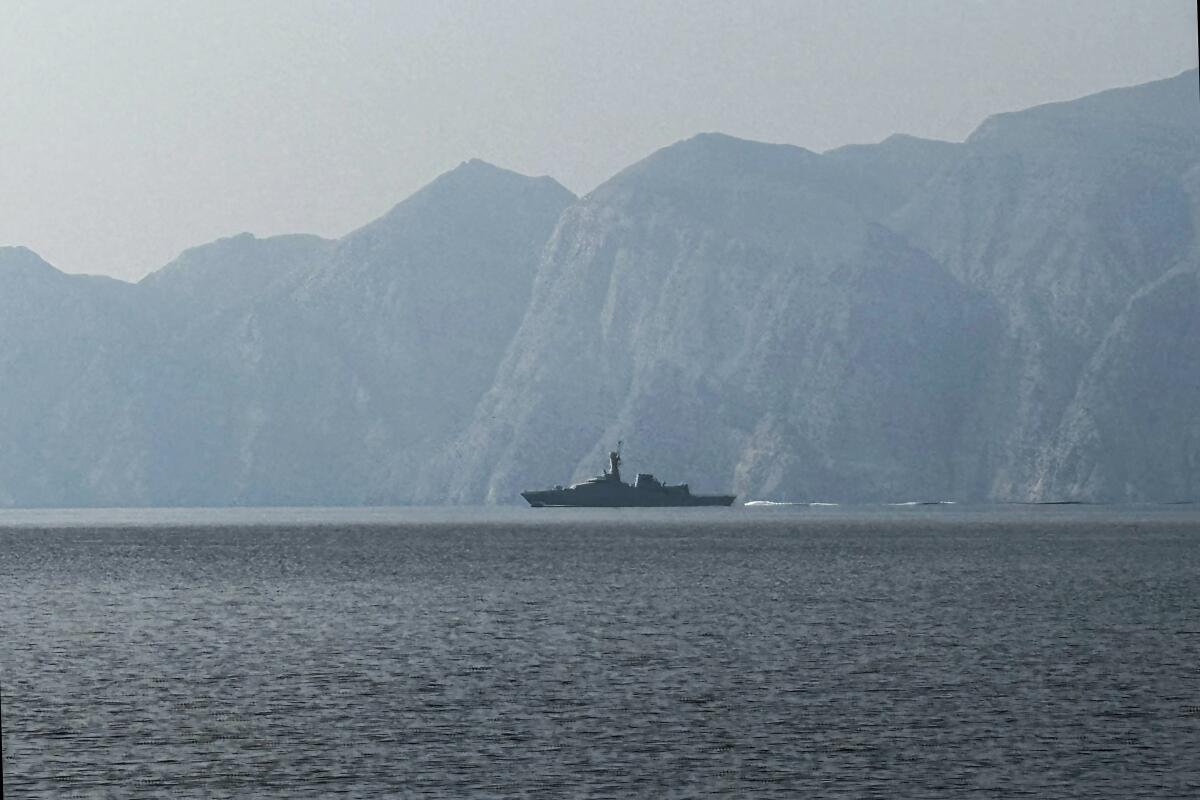
analysis

Analysis: Could the Venezuela model be applied to Iran?

The capture of Venezuelan President Nicolas Maduro was a blow for Iran and its main proxy, Lebanon’s Hezbollah, potentially depriving the group of an ally and a foothold, or safe haven, in Latin America. File Photo by Wael Hamzeh/EPA

BEIRUT, Lebanon, Jan. 8 (UPI) — The capture of Venezuelan President Nicolas Maduro in a dramatic military operation ordered by U.S. President Donald Trump represents another blow — a new red flag — for Iran and its main proxy, Lebanon’s Hezbollah, potentially depriving the group of an ally and a foothold, or safe haven, in Latin America.

The predawn raid in Caracas not only sparked renewed U.S. accusations that both entities were involved in drug and arms trafficking, money laundering and evading sanctions, but also raised questions about whether the Venezuela model could be applied to Iran.

“No more drug trafficking, no more Iran‑Hezbollah presence there and no more using the oil industry to enrich all our adversaries around the world,” U.S. Secretary of State Marco Rubio said in summarizing his country’s. goals for Venezuela and its allies.

Venezuela and Iran, which developed deep political, diplomatic, economic and military cooperation under Maduro and his predecessor, Hugo Chavez, as part of an “Axis of Unity” against U.S. influence, have suffered from U.S.-imposed crippling sanctions that have intensified their economic crises.

In June 2022, Iran and Venezuela signed a 20‑year cooperation agreement intended to strengthen their alliance and circumvent U.S. sanctions by expanding collaboration in areas such as energy, oil, petrochemicals, science and technology, and other sectors.

The accord envisaged Iranian assistance with Venezuela’s oil industry and broader technical cooperation, and since then, the two countries have also deepened military cooperation, including links involving drone technology.

Long-standing ties between Iran and Venezuela created conditions in which Hezbollah — through networks embedded in Venezuela and parts of the diaspora — was reportedly able to establish financial and logistical operations in the country.

According to U.S. congressional testimony in October, these activities included fundraising, money transfers, smuggling and using Venezuelan‑issued travel documents.

The Maduro government denied these allegations, but Washington sanctioned Venezuelan officials and businessmen accused of assisting Hezbollah operatives.

Such accusations against Hezbollah, whose military capabilities were significantly degraded during the war with Israel, have been described by analysts in Lebanon as exaggerated and unsupported by clear evidence.

Mohanad Hage Ali, an analyst and fellow at the Beirut-based Carnegie Middle East Center, said Venezuela offered “a window of opportunity” for Hezbollah to be active in a state where the regime is friendly to the group and sympathetic to its ideology. But many claims describing a vital Hezbollah-Venezuela relationship exceeded what publicly available evidence supports.

“This is because what we have seen are instances of involvement by individuals who have relationships with Hezbollah, whether relatives or others, and these relationships and the roles they play seem small compared to Hezbollah’s budgetary needs in Lebanon,” Hage Ali told UPI.

Undoubtedly, he said, Hezbollah has some form of presence, representation, financial and economic activities, or plays a role in drug trafficking, but these are “limited,” as is its ability to expand abroad.

With the militant group relying more on direct funding from Iran, Hage Ali said Hezbollah would be affected in the event of a regime change in Caracas, but added, “I fail to see Venezuela as a crucial part of the overall puzzle of Hezbollah financing.”

It remains to be seen whether Trump can translate or invest the success in capturing Maduro into political gains.

It would not be easy to contain a country such as Venezuela simply by abducting its president, retired Lebanese Brig. Gen. Hassan Jouni argued.

“Would Trump be able to control and subjugate the Venezuelan regime? Would that require boots on the ground– a land invasion?” Jouni asked, warning that such a move would entail significant attrition and deep involvement for the United States, making the operation highly risky.

Snatching Maduro from his home in Caracas and charging him with drug trafficking and terrorism sent a clear message from Trump to countries around the world — especially those opposing his policies, chief among them Iran: Cooperate or face the use of force.

Jouni said the message capped the Dec, 29 meeting between Trump and Israeli Prime Minister Benjamin Netanyahu, with threats that Iran would not be allowed to restart its nuclear program or rebuild its ballistic missile industry.

Could the Venezuela scenario be used for Iran? Could Trump do in Tehran what he did in Caracas — even going so far as to reach and capture Iran’s Supreme leader, Ayatollah Ali Khamenei?

Jouni ruled out such a possibility, explaining that Iran differs from Venezuela because of the nature of its regime, its geographical location and the vast size of the country. Moreover, Khamenei would be protected by an “exceptional protection system.”

“Would Russia and China accept the overthrow of the Iranian regime and its replacement with a pro-U.S. one?” Jouni asked during an interview with UPI, suggesting “under-the-table” coordination with Russia on Ukraine and with China on Taiwan for possible exchanges.

Moreover, Iran would not stand idle and would strike back at Israel — as it did during the 12-day war last June, causing considerable damage — and would likely target U.S. bases across the region.

Kassem Kassir, a political analyst who specializes in Islamic movements and is close to Hezbollah, said Iran is being targeted, whether through economic pressures and sanctions affecting the internal situation, or militarily.

“Today, Tehran is ready for all possibilities, working to contain popular movements and street protests by addressing economic problems,” Kassir told UPI.

With Hezbollah no longer constituting a threat to Israel, a war against Iran, which would require Trump’s approval and his green light for Israel, might not change much, given the fighting round in June, according to Jouni.

A possible way out could be a deal — modeled on the recently forced arrangement with Venezuela regarding its oil, under which Caracas agreed to export up to $2 billion worth of crude to the United States — through which Trump could secure substantial investments in Iran in exchange for eased tensions or dropping threats of regime change.

Whether all these new U.S. interventions could bring stability remains uncertain and doubtful, especially given the chaos unleashed after the 2003 Iraq invasion, when disbanding the army and rebuilding the state from scratch backfired both in the country and across the region, Hage Ali noted.

Source link

Snoop Dogg hilarious in on-air analysis of Steve Kerr’s sideline rant

In a warm-up for his role in the upcoming Winter Olympics, Snoop Dogg was given a microphone during the second half of the NBA game between the Golden State Warriors and the Clippers on Monday night at the Intuit Dome.

Can’t wait for those Olympics! Snoop hilariously sizzled when Warriors coach Steve Kerr stormed the court in the fourth quarter of the Clippers’ 103-102 victory.

“The Arizona Wildcat done came out of him. Look at him!” Snoop said, alluding to Kerr’s college team. “Aw, Rawwwr, rawwwr, rawwwr!”

Kerr was hit with two technical fouls in less than a minute. He nearly got one with 8:44 to play when Warriors guard Stephen Curry made a shot that appeared to be a continuation after a foul, but the officials nullified the basket.

Less than a minute later, Kerr found a new level of vehemence after the Clippers’ John Collins wasn’t called for goaltending on a shot by Gary Payton II. The four-time NBA championship coach flew into a rage, aggressively gesturing at officials and screaming.

Kerr picked up the two technicals — his first in nearly four seasons — and was held back by Payton and assistant coaches before exiting to the locker room.

Snoop Dogg, who had joined regular Peacock/NBC announcers Reggie Miller and Terry Gannon for the second half, rose to the occasion, his commentary keeping pace with Kerr’s antics.

“Oh, Steve gonna get thrown out! Get him out of there. Get him out of there! Back him up!” Snoop barked.

All Miller and Gannon could do was laugh as Snoop continued, referencing the location of the Intuit Dome and Kerr’s Southern California ties: “Steve back in Inglewood right now. Inglewooood!!! Get him, Steve! You in Inglewood, Steve!”

Snoop will join NBC Olympics host Mike Tirico in Italy in February, riffing on stories that unfold at the Winter Games the way he did at the 2024 Paris Summer Olympics. The NBA game was an indication he’ll again be up to the task.

“We are excited to have Snoop bring his unique energy and passion to our NBA coverage,” NBC Sports executive producer Sam Flood said in a statement. “It will be a once in a lifetime opportunity to watch Snoop, Reggie and Terry talk hoops with a side order of fun.”

Snoop said in the release that his debut as an NBA game broadcaster “is a dream come true for me. I can’t wait to bring a fresh vibe to the analysis.”

For the record, official Brian Forte acknowledged after the game that goaltending should have been called against Collins. Curry told reporters that he appreciated his coach’s passion.

“Two crazy calls in a row that you feel like can dictate the momentum of the game, it doesn’t mean a win or a loss, it just dictates the momentum,” Curry said. “I love that fired up Steve, for sure. Somebody had to do it.”

Visiting Los Angeles has been emotional for Kerr since the Pacific Palisades wildfire a year ago destroyed his childhood home, which his family bought in 1969. His mother, 90-year-old Ann Kerr, still lived in the house, located near Rivas Canyon, and was evacuated safely.

Source link

Analysis: ISIL attacks could undermine US-Syria security collaboration | Syria’s War News

On December 13, a joint US-Syrian patrol was ambushed by a member of Syria’s own security forces near Palmyra, a city in central Syria once controlled by the ISIL (ISIS) group.

Two US soldiers and an interpreter were shot dead, and four people were wounded, before Syrian forces killed the gunman.

Recommended Stories

list of 3 itemsend of list

In the aftermath of the attack, US and Syrian officials linked the attacker to ISIL, which once controlled vast swaths of Syria and Iraq, and promised to retaliate.

The incident highlights the growing cooperation between the United States and Syria against ISIL, particularly after Damascus joined the US-backed coalition against the group in November.

While it is still unclear if the attacker was a member of ISIL or another group opposed to US-Syrian relations, analysts say that cooperation between the two countries is strong and growing stronger.

“The Syrian government is responding very robustly to fighting ISIL following US requests to do so, and it is worth noting that HTS [Hayat Tahrir al-Sham], before it was in government, had a long-term policy of fighting ISIL,” Rob Geist Pinfold, a scholar of international security at King’s College London, told Al Jazeera, referring to Syrian President Ahmed al-Sharaa’s former group.

“It [HTS] did it in Idlib, and cracked down on insurgents and cells, and this is more a continuation of that policy.”

Syria’s Minister of Interior spokesman, Noureddine al-Baba, told Syria’s Al-Ikhbariah TV that there was no direct chain of command to the gunman within Syria’s internal security forces, and that he was not part of the force tasked with escorting the US forces. Investigations are under way, he added, to determine whether he had direct ties to ISIL or adopted violent ideology.

ISIL attacks down

In May 2015, ISIL took over the city of Palmyra from the former Syrian government.

Famous for its Greco-Roman ruins, the city bounced back and forth between regime forces and ISIL until the group was expelled in 2017.

In May 2017, the US-led coalition also forced the group out of Raqqa, which ISIL had declared the capital of its so-called caliphate three years earlier.

Many surviving ISIL fighters were imprisoned in the al-Hol and Roj camps in northeast Syria, controlled by the US-backed Syrian Democratic Forces (SDF). Others escaped into the Syrian desert around Palmyra, from where they have occasionally launched attacks.

When the regime of former Syrian President Bashar al-Assad fell on December 8, 2024, analysts said ISIL fighters used the ensuing chaos to go into various cities across the country. In June, the group launched an attack on a church in Damascus that killed at least 25 people.

Samy Akil, a fellow at the Tahrir Institute, said recent estimates put ISIL’s manpower in Iraq and Syria at between 3,000 and 5,000 fighters.

But experts told Al Jazeera that the coordination between Damascus and Washington has improved over the last year, and pointed to the fact that Syria’s security forces have thwarted several ISIL attacks due to US-provided intelligence.

“Ahmed al-Sharaa’s new government is committed to fighting the group and, in contrast to the Assad era, al-Sharaa’s government gets regular tip-offs from US intelligence, and probably other forms of US support as well. That’s a pretty powerful combination,” Aron Lund, a research fellow at Century International, focusing on Syria, told Al Jazeera.

This collaboration has seen a decrease in ISIL attacks in Syria, according to a report by consulting firm Karam Shaar Advisory. ISIL launched an average of 63 attacks a month in 2024, while in 2025, that number dropped to 10, according to the report.

“Since HTS arrived in Damascus, collaboration [with the US] has become much easier,” Jerome Drevon, a senior analyst with the International Crisis Group, told Al Jazeera.

Structural flaws

After the fall of the Assad regime, there were questions over how security would be enforced. The few thousand HTS members who had previously only controlled Idlib in northwest Syria would not be enough to enforce security across the country.

Syria’s security forces undertook a serious recruitment drive, bringing in tens of thousands of new recruits to add to many of the existing former opposition battalions that were incorporated under the state’s new security apparatus.

With such a huge recruitment campaign, analysts said, vetting was a difficult task.

“The Palmyra attack points to structural flaws rather than a mere one-off event. Integration of former faction fighters and rapid new recruitment have produced uneven vetting and oversight, compounded by a permissive environment for radical views, allowing infiltration to persist,” Nanar Hawash, International Crisis Group’s senior Syria analyst, told Al Jazeera.

“Together, these factors blur early warning signs and create space for hidden threats, raising the risk of repeat attacks.”

Analysts said they expect Syrian security forces to improve the vetting process with time. Meanwhile, another attack like December 13’s was possible and could dent the US’s faith that al-Sharaa’s government can provide security in Syria.

“It could happen again due to the sheer numbers [of new recruits], but over time, the government will improve its game and be more thorough to prevent that from happening again, because it will have consequences,” Drevon said.

“We should be careful over generalising based on one attack, which can be a one-off. But if it happens again, it might change the perception of the Syrian government.”

What does ISIL want?

As for ISIL, analysts said the group’s priorities have changed since the fall of al-Assad.

“What we’re seeing now is ISIL is trying to test boundaries and conduct attacks knowing it cannot gain territorial control,” Akil said.

“It aims at destabilising and staying relevant.”

“ISIS cannot hold cities or topple governments. But it doesn’t need to. Its strength lies in destabilisation,” Hawach said. “The Palmyra attack showed that one operative with the right access can kill three US personnel and shake a bilateral relationship.”

Analysts said ISIL could destabilise Syria by targeting state security forces, religious minorities – like it did in the Damascus church attack in June – or any foreigner on Syrian soil, from US soldiers to humanitarian or United Nations workers. The group could also look to capitalise on tensions between the SDF and Damascus over disagreements on how to integrate the former into the state’s security apparatus.

The SDF also manages the al-Hol and Roj prison camps in northeast Syria, where many of ISIL’s most battle-hardened fighters and commanders are held. This could prove to be a key target for ISIL in Syria.

“ISIL thrives in those vacuums,” Hawach said.

“It’s a guerrilla insurgency, not a caliphate, but in a fragile state, that’s enough to cause serious damage.”

Source link

Analysis: Is Lebanon controlled by ‘mini deep states’?

Bank customers and Depositors Association members hold placards during a protest organized by the ‘Depositors’ Outcry’, a group campaigning for the rights of depositors, in Beirut, Lebanon, on Thursday Customers are angry over the continued restrictions that local banks have imposed on withdrawals and transfers since 2019. Photo by Wael Hamzeh/EPA

BEIRUT, Lebanon, Dec. 24 (UPI) — Once hailed as the “Switzerland of the Middle East,” Lebanon has undergone an infernal descent into deeply rooted corruption, financial collapse and state failure, suggesting that the country is governed by a unique model of “mini deep states” that have flourished under its sectarian and clientelist system, political and financial analysts said.

Endemic corruption, misgovernance, sectarianism, wars and political disputes have long fueled Lebanon’s multiple crises.

The 2019 financial collapse — described by the World Bank as a “deliberate depression” and the worst globally since 1850 — was the tipping point that revealed the country’s situation to be far worse than anyone had realized.

Six years later, the situation remains almost unchanged. No one has been charged or put on trial and no official has acknowledged responsibility for the crisis or the estimated $110 billion in bank deposits squandered under state mismanagement.

The first serious attempt to address the financial crisis came Friday, when Prime Minister Nawaf Salam’s government presented a draft law aimed at tackling the financial system’s huge funding gap and enable depositors to gradually regain access to their frozen savings — though probably not in full.

The draft law, yet to be debated and expected to be amended, was quickly met with opposition from the banks and depositors, arguing that its provisions are insufficient or unfair. Crucially, it fails to address corruption as the root cause of the crisis and provides no mechanism for accountability.

However, Lebanon’s problems extend far beyond the recent financial crisis, stemming from a corrupt and inept political elite whose sectarian and clientelist networks consistently put personal gain above the nation’s survival, analysts say.

One of the most striking examples of deliberate systemic failure is the chronic power shortages, which have forced most citizens to rely on private or neighborhood generators — run by what many describe as a “mafia” protected by influential political leaders — since the end of the 15-year civil war in 1990. This has created cumulative deficits of about $43 billion.

The same pattern applies to nearly every other sector and extends to the country’s political system, reflecting the reality that all major political forces have blocked meaningful change and prevented reforms for decades.

Despite their political divisions, these forces share common interests, effectively acting as a deep state rather than merely an elite sectarian cartel.

To Mohammad Fheili, a risk strategist and monetary economist, Lebanon is better understood as a system of “multiple, competing and at times cooperating mini-deep states operating within a consociational (power-sharing) confessional framework.”

Rather than a single hidden chain of command, power, Fheili notes, is distributed across overlapping circuits involving security services, the banking and financial sector, senior judges and prosecutors, and top public officials. These networks outlast governments and are bound together by mutual protection.

“Sectarianism is the main channel of organization and veto, but it is not the only engine,” he told UPI. “It provides quotas, patronage pipelines and narratives of legitimacy. However, the driving incentives are often clientelism, rent extraction, protection from prosecution and control of state resources.”

As a result, the same political establishment came to dominate legislation, government and the economy, with decisive influence over appointments, contracts and financial regulation.

Such a “deep state” is not a new phenomenon. Its roots can be traced back to Lebanon’s founding in 1943, when it developed alongside a “rentier economic model,” according to Makram Rabah, a political activist and history professor at the American University of Beirut.

While the civil war saw the rise of militia leaders who later became powerful political figures in peacetime, Rabah said that Syria’s military presence in Lebanon after 1990 introduced “a kind of dual system, in which local actors were allowed to benefit economically as long as Syria controlled foreign policy and security.”

“This is what gave the system its longevity,” he told UPI.

The civil war also normalized militia power, wartime political economy and impunity, Fheili noted, adding that the post-war order “recycled many wartime actors into peacetime governance through a spoils-and-veto arrangement rather than institutional reconstruction.”

A sectarian cartel, he said, then emerged, dividing ministries, contracts and regulatory favors –and transforming political competition into a struggle over access to the state.

The withdrawal of Syrian troops from Lebanon in 2005 — just a few months after the assassination of Prime Minister Rafik Hariri in Beirut — paved the way for Iran-backed Hezbollah to consolidate its control over the country.

Although the militant group has consistently denied involvement in Lebanon’s entrenched corruption — arguing that its funding from Iran is sufficient — experts contend that it nonetheless benefits from the country’s clientelist system, even operating a shadow parallel economy.

Lebanon’s financial collapse, Rabah argued, revealed Hezbollah as both a beneficiary of and a participant in the system, as many of its institutions faltered during the meltdown. Moreover, the perception that it relied solely on Iranian funding and was free from corruption has proven to be “a fallacy.”

With each sect — Muslims and Christians alike — protecting its own corrupt members, it became impossible to hold anyone accountable or bring them to justice. A few exceptions were recorded, but only because those arrested had lost the political protection of their patrons.

“There are many ministers and officials who are extremely corrupt, but no one dares to act against them, as they are protected by their sect and political leaders,” said Mohammad Chamseddine, policy research specialist at the Information International research and consultancy firm.

Although the Lebanese government adopted a new, anti-corruption law in 2020 and began work on a national anti-corruption strategy, he said these efforts failed to yield any results due to the prevailing sectarianism.

“Such an interaction of religion, politics and money is everywhere and consolidates corruption,” Chamseddine told UPI. “Only a real revolution — when people storm the houses and palaces of the corrupt and put them in jail — can change this.”

Lebanon’s losses from corruption and the deep state, accumulating since the 1990s, are difficult to estimate, exceeding tens of billions of U.S. dollars, according to Chamseddine.

However, dismantling the country’s “mini deep states” and eliminating corruption is possible –even if only partially — but it would require a long process of gradual, progressive steps, starting with an independent judiciary, the analysts said.

Would the disarming of Hezbollah, which was significantly weakened by Israel during last year’s war, be the starting point?

“It may open tactical space, but only if reforms target the entire ecosystem, not just Hezbollah or the banks,” Fheili said.

Source link

NEWS ANALYSIS : U.S. SENATE : Trailing Badly, Seymour Unable to Forge Image

When he was plucked by fate and his friend Pete Wilson from the political minor leagues to be a U.S. senator in January, 1991, John Seymour vowed to go back to Washington, shake up the congressional Establishment, make his mark for California and win election on his own.

After 22 months, the 54-year-old former Anaheim mayor is still struggling to forge a senatorial image of himself and his vision for California in the minds of voters.

His 59-year-old Democratic opponent, Dianne Feinstein, has coasted into the final week of the campaign with a commanding 54%-to-40% lead among likely voters surveyed by the Los Angeles Times Poll. Political experts credit her with building on her strong image from the 1990 contest for governor and conducting an error-free campaign that more often resembled that of a secure incumbent than the challenger.

The race for the U.S. Senate seat vacated by Wilson had shaped up as a classic California contest featuring a scrappy appointed incumbent and a strong challenger known to many voters as the tough officeholder “forged from tragedy” when she was thrust into the leadership of San Francisco by the shooting death of Mayor George Moscone in 1978.

Some experts thought it would be a close rerun of Feinstein’s 1990 battle with Wilson, which she lost by only 3.5%.

But so far the race hasn’t gotten that close.

Feinstein has demonstrated the immense benefits of having run an earlier campaign for major statewide office: Building an image among voters in a state of 30 million residents and the financial base needed to field such a campaign.

In analyzing the contest Tuesday, political experts credited Feinstein with running a consummate professional effort, if not a spectacular one. But even more emphatically, they characterized the Republican campaign as a missed opportunity that failed to follow a basic rule of politics: A candidate must define himself or herself to the voters before waging a negative campaign on the opponent.

Going into the last week of the campaign, one-fourth of California’s voters still did not know who John Seymour was, according to statewide opinion polls. Even more didn’t know much about him or why they should vote for him.

What’s more, Feinstein has demonstrated a Teflon resistance to attack. When Seymour attacked her, he often appeared strident or petty as Feinstein reacted indignantly and emerged all the stronger.

For 22 months, Seymour has been dogged and tireless, commuting regularly to Washington and campaigning throughout California with the tough can-do talk of a former Marine and a successful Orange County Realtor–the sort of man who’s not worried about the threat of Mexican competition under a free trade agreement because “we’ll kick their butts.”

He hounded Feinstein to hold more debates and pounded her with tough, largely negative television commercials.

His ads attacked her on all the perceived weaknesses of the tough 1990 campaign for governor: Her 1990 campaign’s legal problems, the potential conflict of interest of her banker-husband’s investments and her former position against the death penalty, which changed nearly 20 years ago.

Seymour added the hidden bomb of his opposition research: the fact that the five-member state women’s parole board on which Feinstein served from 1960 to 1966 paroled 21 convicted murderers out of more than 5,000 cases considered. By last week, Seymour even tried to link those 30-year-old decisions to the prospect that a convicted murderer like Robert Alton Harris, who was executed at San Quentin in April, might be set loose.

Essentially, Seymour duplicated the 1990 Wilson campaign playbook, Feinstein media adviser Bill Carrick said.

“But it’s 1992 not 1990,” Carrick said. “And in 1990, we never saw that crime as an issue made much difference. It’s less important in a Senate race.”

While Seymour tried to portray himself as an outsider, Feinstein attacked him as just another incumbent and, going to the heart of his failure to define himself to voters, asked: “How much do you know about Sen. John Seymour?”

Seymour, the ad said, was “a Washington big spender” who also had voted to raise his own pay four times. In fact, he had voted to raise his pay as a state senator, but not in the U.S. Senate, where he denounced the congressional pay raise and refused to accept it.

While Feinstein seemed relatively impervious to his ads, hers seemed to be finding the mark. The Times Poll found that in the last month, the number of respondents who had an unfavorable impression of Seymour had soared to 39%, an increase of 18 points.

“One has to infer they haven’t run a very good campaign,” Times Poll Director John Brennan said.

Veteran California pollster and analyst Mervin Field said: “He was unknown. He got appointed. He is unelected. He hasn’t distinguished himself in the Senate.”

UC Berkeley political science professor Bruce Cain said Seymour has been “invisible” as a senator and suffers “grayness” as a candidate.

Seymour insists he’s closing the gap. And on Tuesday, campaign manager Richard McBride said: “We’re fine, right where we are. Our tracking shows a lot of volatility among voters out there.”

But other polls point to a Feinstein victory Tuesday that would gain her some measure of revenge for her narrow loss of the governorship to Republican Wilson two years ago.

It was that loss that provided Feinstein her Senate opportunity. Before Wilson could take office as governor in January, 1991, he had to resign the Senate seat to which he was reelected for a six-year term in 1988. As governor, Wilson appointed a successor until the next general election. The winner Tuesday will serve the final two years of Wilson’s term and the seat will come up again in 1994 for a regular six-year stint.

Wilson angered GOP conservatives and puzzled nearly everyone else when he turned to Seymour, who had served eight years as a state senator but was not well known statewide. He had lost the Republican nomination for lieutenant governor in 1990 to a fellow Orange County senator.

Seymour bounded off to Washington, saying that to win the 1992 election, “John Seymour has got to perform and he’s got to make his mark very quickly.”

Seymour’s best opportunity to make a name for himself was to resolve two major California issues that had long simmered in Congress: the California desert wilderness bill and legislation to reform the federal Central Valley water project.

But Seymour presided over the death of the desert bill in 1991 because, Democratic critics contend, of his loyalty to ranching and mining interests.

In 1992, Seymour seized on Central Valley Project reform as his key issue. He bragged about muscling a water bill favorable to California agribusiness through the Senate over the objections of Senate giants like Bill Bradley (D-N.J.) and Bennett Johnston (D-La.). But Seymour’s measure was ignored in the House and Seymour was shut out of Senate-House conference sessions where the final version of the bill was drafted by others.

Seymour denounced the deal as being unfair to California farmers while he repeatedly misstated the dire effect it would have on California water supplies. With Wilson’s backing, Seymour implored President Bush to veto the measure. A final ignominy for Seymour would be Bush’s signature on the bill just a few days before the election.

Feinstein used her primary to reinforce the positive image and message of change she carried over from the 1990 race. She went after Seymour in the fall as an insider incumbent and capitalized on the “year of the woman,” but also was careful to avoid damaging mistakes.

Cain summed it up: “Dianne Feinstein has a formula which is well suited to California, which is a moderate to conservative Democrat who is pro-choice and pro-environment but also pro-business, for fiscal responsibility and the death penalty.”

“That formula has served her well,” Cain added. “She consolidated that image in 1990 and carried it into this campaign.”

Source link

Analysis: Yemen’s future after the separatist STC’s expansion eastwards | Conflict News

Yemen’s separatist Southern Transitional Council (STC) is trying to create facts on the ground with its recent advances in the country’s eastern governorates of Hadramout and al-Mahra.

Its military push this month highlights that Yemen’s conflict – ongoing for more than a decade – cannot be reduced to one simply between the internationally recognised government and the Houthis. Instead, an overlapping map of influence is evident on the ground with de facto authorities competing over security, resources and representation.

Recommended Stories

list of 3 itemsend of list

At the heart of these changes is the STC, backed by a regional power, which now stands as the most powerful actor in Yemen’s south and parts of its east at a time when the government’s ability to impose unified administration over the whole country is distant and the economy is suffering.

In this context comes what the Yemeni government has said is the International Monetary Fund’s (IMF’s) decision to suspend activities in the country. While the IMF has not publicly commented on the topic, President Rashad al-Alimi, the head of Yemen’s Presidential Leadership Council, warned on Sunday that the decision was a “wake-up call” and an early signal of the cost of the STC’s security and military escalation in Hadramout and al-Mahra.

Al-Alimi stressed that Yemen’s economic circumstances – the country is the poorest in the region and has suffered immensely during the war – cannot withstand any new tensions. He added that the security instability in eastern Yemen would immediately affect the distribution of salaries, fuel and services and international donor confidence.

The solution, according to al-Alimi, is for the withdrawal of forces who have arrived in Hadramout and al-Mahra from outside the two governorates, calling it a necessary step to contain tensions and restore a path of trust with the international community.

But that economic warning cannot be understood in isolation from the shift in power in eastern Yemen, where competition for influence has become a direct factor in generating tension that leaves donors wary.

A new balance of power

The STC is clear that its goal is ultimately the secession of the territories in Yemen – its south and east – that formerly made up the country of South Yemen before unification in 1990.

It is opposed to the Houthis, who control Yemen’s capital, Sanaa, and much of Yemen’s populous northwest, and the STC’s leader, Aidarous al-Zubaidi, has a seat on the government’s Presidential Leadership Council, officially as one of its vice chairmen.

The STC and government forces have previously fought, most notably in 2018 and 2019, in Aden and its surrounding governorates.

Its current expansion eastwards, focused on government forces and those affiliated with them, is part of that ongoing division in the anti-Houthi camp but one that redraws the balance of power within it, turning resource-rich Hadramout and al-Mahra into a multiparty arena of competition.

There are three concurrent trends that are emerging as a result: the expansion of STC forces with regional support, a desire by local and tribal forces – independent of the STC – to solidify their presence and the clearly limited tools the government has to confront its rivals.

The result is the further fragmentation of the state on three interconnected levels.

Politically, there is fragmentation within the same anti-Houthi camp with multiple decision-making centres. The government and regional actors are finding it more difficult to unify security and administrative policies, and the idea of a single “chain of command” controlling territory under anti-Houthi control has been eroded.

Geographically, new lines of contact have now been formed. Whereas lines of control were previously between the Houthis and government forces, they are now between Houthi and STC forces as well as grey areas contested by local and tribal forces and multiple military groups.

And then there is fragmentation on the representative level with mounting disputes over who actually speaks for the south and Hadramout and the practical decline of the concept of a single state as a sovereign framework for managing resources and institutions.

In Hadramout and al-Mahra, the fragmentation is particularly sensitive as both governorates include important border crossings with Saudi Arabia and Oman and also have a long coastline with routes tied to trade, smuggling and irregular migration.

Any imbalance here does not remain local; it quickly spills over into the region.

Economy hostage to security

The IMF’s suspension of activities carries not only financial implications but also a political reading that the security and institutional environments no longer provide sufficient conditions for sustaining support programmes.

The Yemeni state relies heavily on its own limited resources and fragile external support, so any disruption in resource areas, ports or supply routes translates into immediate pressure on livelihoods.

The latest military developments increase pressure on the exchange rate and the government’s ability to meet its financial obligations and widen the trust gap between society and the state, prompting non-institutional alternatives based on levies and loyalties.

And it will shrink the room for the government to manoeuvre, meaning the government has to take into account the cost of any escalation because any military move increases an economic bill that it cannot pay and drains what remains of the government’s ability to manage services.

Now that the impression has taken root that Yemen has turned into “islands of influence”, some external actors may be inclined to deal directly with de facto local authorities at the expense of the government, weakening the political centre rather than helping it to strengthen.

That is why the latest developments are so important if not existential to the government and al-Alimi. His call for the withdrawal of outside forces from Hadramout and al-Mahra is part of an attempt to stop the deterioration of trust in Yemen and to present the government once again as capable of controlling the other parties in the anti-Houthi camp if reasonable political and economic conditions are provided.

Houthis gain while rivals stay divided

The Houthis, who overthrew the government in Sanaa in a coup in 2014, have benefitted from the developments in Hadramout and al-Mahra even without being directly involved.

Every struggle for influence in areas outside the group’s control gives it clear gains, including the disintegration of the front opposing it and its rivals being preoccupied by internal conflicts rather than by the Houthis themselves.

In the anti-Houthi camp, the notion of a united front recedes every time a military confrontation between its components takes place, and the discussion shifts from confronting the Houthis to disputes over power and resources within the same camp.

The divisions within the anti-Houthi camp and the regional dimension to them also allow the Houthis to reinforce their narrative that their rivals are working within competing foreign agendas, as opposed to the Houthis, who portray themselves as independent actors able to carry out their own decisions.

Moreover, the recent conflict and its consequences ultimately improve the Houthis’ negotiating position now that the other side is even more fragmented and weak. The Houthis will enter any upcoming settlement from a more cohesive organisational and administrative position, raising the ceiling of their conditions.

The Houthis may have their own economic and social tensions, but divisions among their enemies give them extra time to sustain the war economy and their instruments of control over it and over the people they rule.

Rising risks, domestic and regional

The current course of events in Yemen elevates a number of overlapping risks.

Domestically, there is the possibility of front lines turning into actual borders between adjacent entities, the expansion of security vacuums and declining prospects for producing a unifying social contract.

Regionally, there could be an expansion of the areas considered lawless along the borders with Saudi Arabia and Oman, increasing the risks of smuggling and leading to higher costs for managing border security.

Internationally, the growing need for global powers to communicate with multiple parties in Yemen prolongs the crisis and increases the chances that the conflict is internationalised through competition over ports, resources and shipping routes.

However, the picture painted does not mean there will be a decisive victory for any side and instead makes a mosaic of authorities, all needing external sponsorship, more likely. Inevitably, that will weaken the prospect of establishing a stable state.

A way out?

Lowering tensions by making partial deals on redeployments of forces is not enough. Instead, the path forward needs a broader approach based on three interlinked pillars.

First, the national project needs to be redefined by drafting a vision of the state that guarantees fair partnership for all the regions of Yemen within a viable federal framework and redefines the political centre as a guarantor of rights and services.

Second, security must be based on a model of local forces under a national umbrella. In Hadramout and al-Mahra, this should be done by building professional local forces within a clear national and legal framework with practical arrangements for withdrawing outside forces and ensuring that security decision-making in state institutions is uniform.

Third, an economic deal is necessary to restore trust by concluding a transparent agreement on managing resources in the governorates that produce them, the fair distribution of revenues and the linking of international support to an implementable reform plan with a clear commitment to protecting sovereign facilities under central management.

In the absence of these steps, Yemen will continue towards a gradual model of disintegration from the peripheries in which the most cohesive armed entities advance and contested margins expand.

If that continues, the economy will be the first victim of fragmentation, making conditions even more difficult for millions of Yemenis.

And the governance crisis will eventually turn into a prolonged stability crisis, the repercussions of which will be difficult to contain locally and perhaps even regionally.

Saeed Thabit is the Al Jazeera Media Network’s bureau chief for Yemen

Source link

Israel demolishes more buildings in military-controlled Gaza: Analysis | Gaza News

Satellite images show ongoing demolitions behind the ‘yellow line’; experts warn actions likely violate Geneva Convention.

Satellite images reviewed by Al Jazeera’s Sanad fact-checking agency show that the Israeli military has continued to demolish buildings in areas of Gaza it has occupied since a ceasefire with Hamas went into effect.

The Palestinian group has decried such demolitions as a violation of the ceasefire deal, which went into force on October 10. Legal experts and United Nations officials have said throughout the war that the destruction of civilian infrastructure could constitute a war crime.

Recommended Stories

list of 3 itemsend of list

The Israeli military did not immediately respond to a request for comment from Al Jazeera, but officials have previously said such actions have been done within the ceasefire’s framework and were in response to active threats.

Israel has remained in control of about 58 percent of Gaza since the ceasefire began, withdrawing behind the so-called “yellow line” that divides coastal Gaza from its border regions.

Satellite images showed the latest demolitions took place between November 5 and December 13, with most concentrated in the Shujayea and the Tuffah neighbourhood in Gaza City.

INTERACTIVE - Gaza map Israel’s withdrawal in Trump’s 20-point plan yellow line map-1760017243

The images also appeared to show demolitions in the southern city of Rafah as well as the apparent destruction of agricultural facilities east of Deir el-Balah in central Gaza.

In an email to Al Jazeera, Adil Haque, a professor of law and armed conflict at Rutgers Law School, explained that under the Fourth Geneva Convention, “any destruction by an Occupying Power of private property is prohibited, except where such destruction is rendered absolutely necessary by military operations”.

“The exception is extremely narrow. The destruction must be absolutely necessary, not merely convenient or advantageous,” Haque said. “And the absolute necessity must arise from military operations, that is, from combat or direct preparations for combat.”

“With a general ceasefire in place, and only a few sporadic exchanges of fire, it is not plausible that such significant destruction of civilian property has been rendered absolutely necessary by military operations,” he added.

Violations continue

The Sanad analysis further found that Israel appears to have created a new advanced military outpost in Tal al-Za’atar in northern Gaza, with new tents and equipment added between November 5 and December 13.

Before its creation, there were 39 active Israeli military points inside the enclave, according to Sanad.

Israeli military operations have devastated Gaza throughout the war, with the UN Relief and Works Agency for Palestine Refugees (UNRWA) reporting last month that 282,000 housing units have been destroyed in the enclave, where about 1.5 million Palestinians remain displaced.

About 93 percent of schools have been destroyed or damaged throughout the war, with 63 percent of hospitals remaining out of commission as of December 9.

A UN Human Rights Council independent commission in September repeatedly cited attacks on civilian infrastructure, particularly medical facilities, in finding that Israel has committed genocide in Gaza.

INTERACTIVE - Where Israeli forces are positioned yellow line gaza map-1761200950

Meanwhile, Gaza’s Health Ministry has said that 391 Palestinians have been killed in Israeli attacks in the enclave since the ceasefire went into effect.

All told, at least 70,663 Palestinians have been killed in Gaza since the Hamas-led attack on southern Israel on October 7, 2023, which killed at least 1,139 people.

Last week, Hamas political bureau member Hossam Badram decried a reported statement by Israeli army chief Eyal Zamir in which the military official described the “yellow line” as the “new borderline” with Gaza.

At the time, Badran said that Hamas viewed Israeli demolitions in the area as a continuation of military operations.

Source link