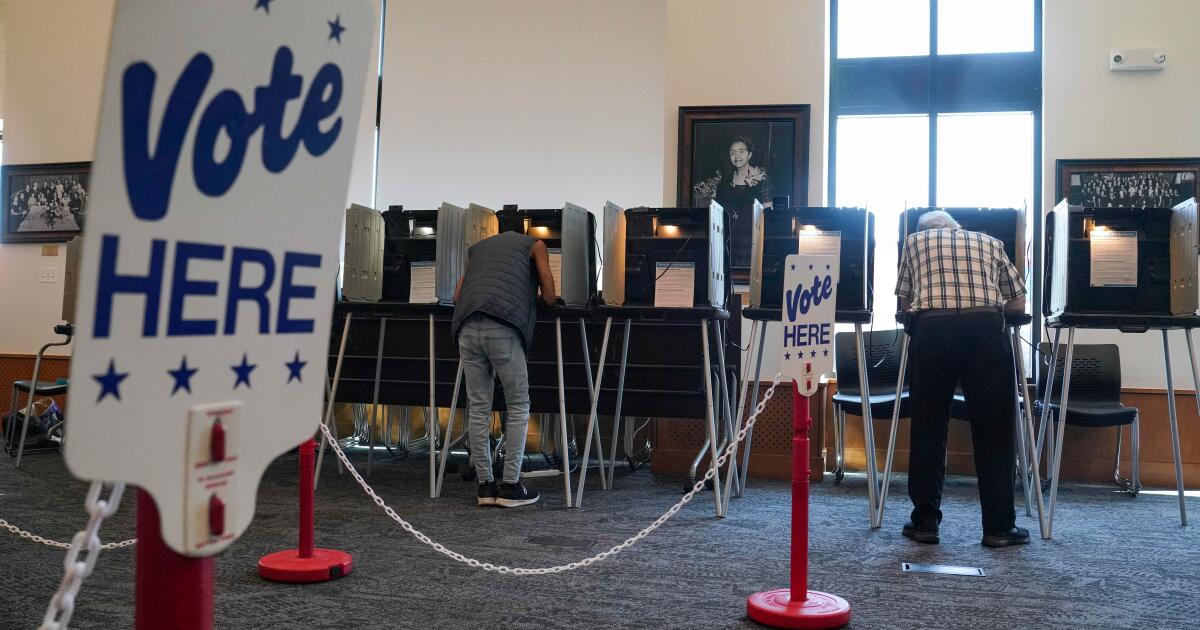
american election

Why American elections are so complicated — and secure

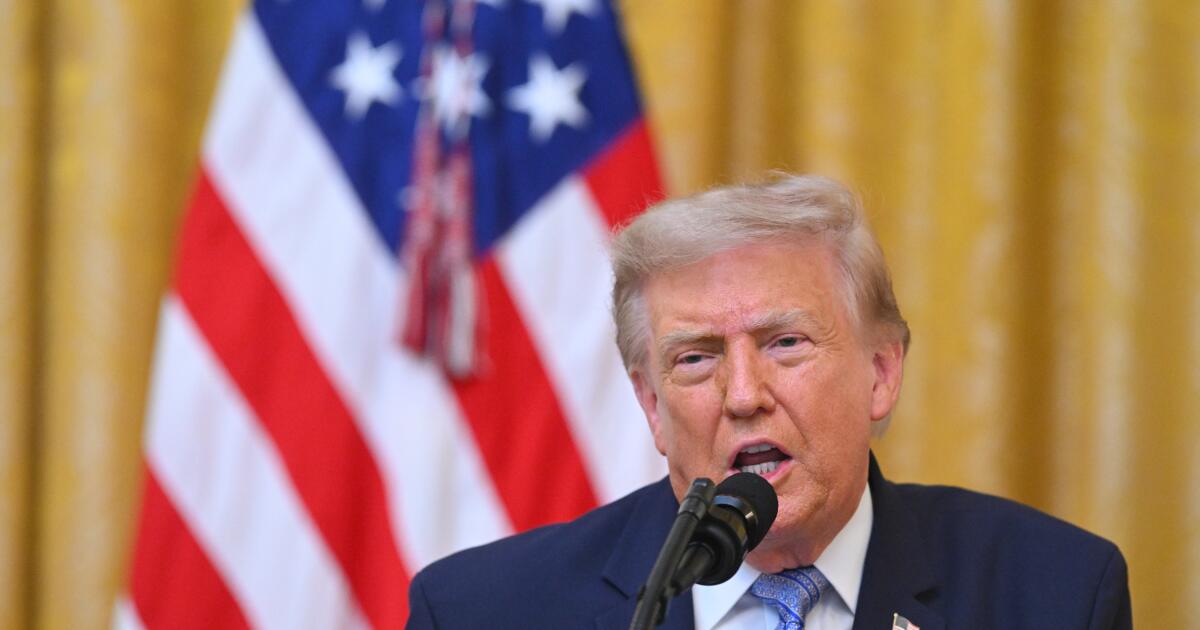
In a speech to the nation Thursday evening, President Trump said Americans deserve secure elections, and he claimed to be using federal authority to prevent them from being “stolen.”

In fact, one of the strongest security features of U.S. elections is the fact that they aren’t conducted at the federal level. America votes in more than 10,000 different election jurisdictions, each with different rules set by state and sometimes local governments.

That structure makes the nation’s elections extraordinarily complicated — and also safe from widespread fraud. And when misconduct does happen — rarely — security protocols frequently catch it.

Decentralized elections date back to the nation’s founding

America’s highly decentralized system of voting exists because the nation’s Founding Fathers gave authority over elections to the states, rather than the federal government. While Congress has the power to regulate elections — and has used that authority to pass such laws as the Voting Rights Act — the Constitution makes clear that states have primary authority to set the “times, places and manner” for elections.

There also is no national election agency that administers the presidential contest, something that’s different from many other countries. And when it comes to doing the day-to-day work of running an election, the responsibility falls to officials at the local level — usually a clerk or election supervisor — with help from staff and volunteers.

While differences in election laws can get confusing, election security experts say this structure is a strength. That’s because to pull off stealing a presidential election — as Trump falsely claims was done to him in 2020 — it would require large numbers of election workers in the most competitive counties across the country who are willing to risk prosecution, prison time and fines while working with officials from both parties willing to look the other way. And everyone somehow would have to keep quiet — a highly unlikely scenario.

There are also shared practices and security measures in place across the country that together work to ensure that only eligible voters can cast a ballot and only one ballot is counted for each.

Voter fraud can happen, but it’s rare and there are safeguards to catch it

Most Americans by now have probably heard stories about someone casting multiple ballots, or voting in the name of dead relatives, or stealing mail ballots from mailboxes.

When these incidents happen, they are often caught and prosecuted.

Voting more than once, tampering with ballots, lying about your residence to vote somewhere else or casting someone else’s ballot are crimes that can be punished with hefty fines and prison time. Non-U.S. citizens who break election laws can be deported.

For anyone still motivated to cheat, election systems in the United States are designed with multiple layers of protection and transparency intended to stand in the way.

For example, for in-person voting, most states either require or request voters provide some sort of identification at the polls. Others require voters to verify who they are in another way, such as stating their name and address, signing a poll book or signing an affidavit.

For absentee voting, all states require a voter’s signature, and many states have further precautions, such as having bipartisan teams compare the signature with other signatures on file, requiring the signature to be notarized or requiring a witness to sign.

That means even if a ballot is erroneously sent to someone’s past address and the current resident mails it in, there are checks to alert election workers to the foul play.

AP review found there was too little voter fraud to tip the 2020 election

Trump has spent six years insisting he won the 2020 election, a campaign he lost to former President Joe Biden.

An Associated Press review in 2021 dug into every potential case of voter fraud in the six battleground states that Trump disputed. It found fewer than 475 cases — a number that would have made no difference in that race.

Allegations from Trump of massive voting fraud have been refuted by a variety of judges, state election officials and an arm of his own administration’s Homeland Security Department. In 2020, then-Attorney General William Barr, a Trump appointee, told the AP that no proof of widespread voter fraud had been uncovered. “To date, we have not seen fraud on a scale that could have effected a different outcome in the election,” he said at the time.

Swenson writes for the Associated Press.
Source link

Trump repeats debunked claims about voting vulnerabilities

President Trump used a rare prime-time address Thursday night to renew his attacks on the security of U.S. elections, telling Americans that the nation’s voting system is “so broken” that “no one can possibly defend it,” an unprecedented effort by a sitting president to undermine public confidence in domestic elections.

Many of the claims he made, which echo those he made after he lost the 2020 election, have been debunked by investigations, audits and court proceedings. Trump did not claim that vote counts were changed or election systems were hacked, and his warnings that the nation’s elections could be vulnerable to foreign influence have long been made by members of both parties.

But the president amplified those claims and others in an effort to cast fresh doubt over what he said was a “stolen” and “rigged” election and renew calls to pass a federal voting law ahead of the November election.

“Addressing this crisis of elections security demands that Congress will pass the SAVE America Act,” Trump said. “How easy is that to do? Unless you want to cheat.”

Trump said he directed the White House to release a tranche of heavily redacted documents that purport to show “vulnerabilities” in the nation’s voting system, with the goal of “correcting them very, very quickly.”

The 26-minute address to the nation — a platform traditionally reserved for rare moments of national importance — was the latest effort by Trump to attempt to assert more federal control over state elections.

Major broadcast networks declined to air Trump’s speech in full, instead reporting on it. Trump complained about NBC and ABC as he spoke, saying they should lose their broadcasting licenses. He falsely claimed that “they and others in the media are part of a plot” to “continue this fraud.”

In his remarks, Trump alleged China carried out what is believed to be the “largest compromise of election data history” starting during the 2020 election cycle and claimed that “members of the deep state” in the American intelligence community covered it up.

He directed the FBI, the director of national intelligence and other agencies led by some of his loyalists to investigate and prosecute the people responsible for the cover up.

Democrats swiftly condemned Trump’s claims as baseless and rehashed ideas that have little to do with actual election administration.

“Donald Trump is releasing unverified, meaningless documents to appease his own delusions about an election he lost resoundingly, all while continuing to withhold 3 million pages of the Epstein files,” Senate Minority Leader Chuck Schumer said on X.

Multiple reviews of the 2020 election have concluded that Democrat Joe Biden won legitimately, and election experts say there is no evidence that widespread fraud affected the outcome of the election.

“It’s been more than half a decade, with numerous audits, recounts, and more than 60 court cases, each finding no evidence of widespread voter fraud,” Sen. Alex Padilla (D-Calif.) said in a statement. “Clearly, this is no longer about an election Donald Trump lost six years ago. It’s about him laying the groundwork to try to ‘take over the voting’ in the upcoming midterm elections.”

Ahead of the speech, elections and democracy experts had cautioned that the president may attempt to sow doubt in the security of the nation’s election system or bolster debunked fraud claims.

Trump has taken a series of steps since retaking office aimed at exerting control over elections. Some experts said Thursday’s address could be interpreted as a sign that Trump is running out of moves in the lead up to the midterm elections, where Republican control of the House is at stake.

“The fact that they’re throwing everything up on the walls at this point demonstrates panic,” said David Becker, executive director of the nonpartisan Center for Election Innovation and Research. “They are not operating from strength right now. They are operating from weakness.”

Trump delivered the address with his approval rating stagnating at 37%, according to a Washington Post-Ipsos poll released Thursday, with weakening enthusiasm among Republicans.

This is a breaking news story and will be updated.

Source link

Democratic voters confident California election is secure, Republicans less so, poll finds

California voters are deeply divided over the trustworthiness of state elections heading into Tuesday’s primary, with most Democrats but less than half of Republicans expressing confidence in the electoral process, according to a new poll.

The polarized view follows a years-long campaign by President Trump and his Republican allies to question the legitimacy of American elections, especially in California and other blue states. It also follows robust efforts from liberal leaders, elections officials and voting rights experts to denounce Trump’s claims as baseless.

Overall, registered voters in the state — which skews heavily Democratic — expressed confidence in local election officials by a 2-to-1 margin, with 65% expressing confidence and 31% expressing a lack of confidence, according to the poll released Tuesday by the UC Berkeley Institute of Governmental Studies and co-sponsored by The Times.

However, those figures shift dramatically when sorted by political party, and even more when parsed by partisan leaning.

For example, 79% of Democratic voters expressed confidence in local officials running a secure and fair election, compared to 62% of independent voters and 42% of Republican voters, the poll found.

While 82% of voters who identified as strongly liberal expressed confidence, just 38% of voters who identified as strongly conservative did so.

A volunteer assists a voter at a polling site.

A volunteer assists Melani Hurwitz at a polling location Monday at the Cal State Long Beach Walter Pyramid.

(Eric Thayer / Los Angeles Times)

“It’s clearly a partisan issue, and it is being promoted by the president and others who are his followers,” said Mark DiCamillo, the director of Berkeley IGS polls. “Strong conservatives and the Republicans are the least confident, and a lot of them are saying [they are] not at all confident. That’s a pretty extreme statement.”

Rick Hasen, an election law expert and director of the Safeguarding Democracy Project at UCLA Law, said he expected Republican confidence to be even lower given Trump’s decade of undermining trust in elections, especially in liberal, diverse states such as California. But he said neither Trump’s narrative nor public sentiment about election security — which generally shows voters are more confident “when their side wins” — reflects reality, which is that “our elections are administered well.”

“There’s very little evidence of manipulation or of fraud or even of incompetence,” Hasen said. “Anyone who looks objectively would see that there are numerous safeguards to ensure we have free and fair elections in California.”

Trump has long contended without evidence that voter fraud is pervasive among undocumented immigrants and in states, such as California, that use mail ballots, and blamed his 2020 loss to Joe Biden on such fraud despite experts rejecting the claim and Trump’s own allies and lawyers being unable to prove it.

A voter's feet in a poll booth.

A voter casts their vote inside the Westchester Family YMCA Annex on Monday.

(Kayla Bartkowski / Los Angeles Times)

Since returning to the White House last year, Trump has tried to implement strict new requirements for voter ID and proof of citizenship and to limit or bar mail-in voting, and called for greater federal or Republican Party control over state-run elections. In February, he said that “Republicans ought to nationalize the voting” in “at least 15 places” where they lose.

On Saturday, Trump falsely claimed that California doesn’t have any voting booths and only accepts mail ballots.

Democratic leaders, elections experts and voting rights advocates have all pushed back. They’ve backed their assurances that the state’s elections are safe with lawsuits to block Trump’s efforts to assert federal control. They also warn that his administration may try to intervene anyway, including by sending federal immigration agents to polling locations or intercepting or invalidating mailed ballots.

When Trump issued an executive order in March 2025 purporting to require voters to provide proof of citizenship, California sued, with a court blocking the policy while the litigation continues. When the Justice Department sued California Secretary of State Shirley Weber in September for refusing to hand over the state’s voter rolls, California won a dismissal in court. When Trump issued another executive order this March directing the U.S. Postal Service to take control of mail balloting, California sued again. That litigation is ongoing.

Last week Gov. Gavin Newsom signed a bill barring federal agents and other law enforcement from interfering with local and state elections officials or confiscating ballots, voter rolls or voting machines without a warrant. Newsom said California voters were experiencing “legitimate anxiety” over election integrity given the threats from the Trump administration and the recent actions of Riverside County Sheriff Chad Bianco — a MAGA-backed Republican candidate for governor who recently seized hundreds of thousands of ballots as part of what he said was an investigation into potential fraud in last year’s election.

An election worker carries a bin of ballots.

An election worker collects extracted vote by mail ballots to be tallied at the Los Angeles County Registrar-Recorder/County Clerk Ballot Processing Center in City of Industry.

(Gary Coronado / For The Times)

Newsom said he expects Trump to interfere with the upcoming election as well because “every single thing that Donald Trump is saying only suggests that he will do more, not less, to intimidate and to impact the outcome of this election,” but that the state stands ready to respond.

California Atty. Gen. Rob Bonta last week said that his office is preparing for “all different types of scenarios” involving federal interference, from ballots being seized to immigration agents showing up at polling locations.

“We are currently monitoring any potential risks or threats, and we’re ready for any possibility,” he said.

Sen. Alex Padilla (D-Calif.) last week blasted the U.S. Postal Service for issuing a proposed rule to implement Trump’s mail ballot changes, despite the ongoing litigation. In April, Rep. Nancy Pelosi (D-San Francisco) helped convene a pair of “shadow hearings” in California where fellow House Democrats and a panel of experts shot down Trump’s claims about widespread fraud and expressed confidence in state elections.

A Berkeley IGS Poll from a year ago found that California voters support requiring first-time voters to show ID to prove citizenship in order to register, and that most supported requiring a government ID every time a voter casts a ballot. However, another Berkeley IGS Poll from last month found that strong majorities of California voters believe American democracy is under attack or being “tested.”

Dean Logan, head of the L.A. County registrar-recorder/county clerk’s office, said that overall confidence, “despite a sometimes volatile state and national narrative,” was “gratifying.”

“Election officials take connection to their community seriously. We recognize that our job is to facilitate their voting experience, and that voter participation is key to election security,” Logan said. “Regardless of party affiliation, our role as election officials focuses on the function and process of ensuring the voice of the electorate is heard and that compliance with the election laws adopted in our state is achieved.”

Jesse Salinas, president of the California Assn. of Clerks and Elections Officials and the registrar of voters in Yolo County, said local elections officials are “proud to be a steady source of trust at a consequential moment,” and stand ready to “open our doors to any voter who wants to see firsthand how our elections work and to answer any questions they may have.”

Times staff writer Iris Kwok contributed to this report.

Source link