America250

Chris Stapleton and Chaka Khan celebrate America’s 250th at the L.A. Coliseum

In New York, the Brooklyn Bridge went up in flames briefly during a fireworks display. In Washington D.C., stormy weather delayed a grievance-filled speech by President Trump.

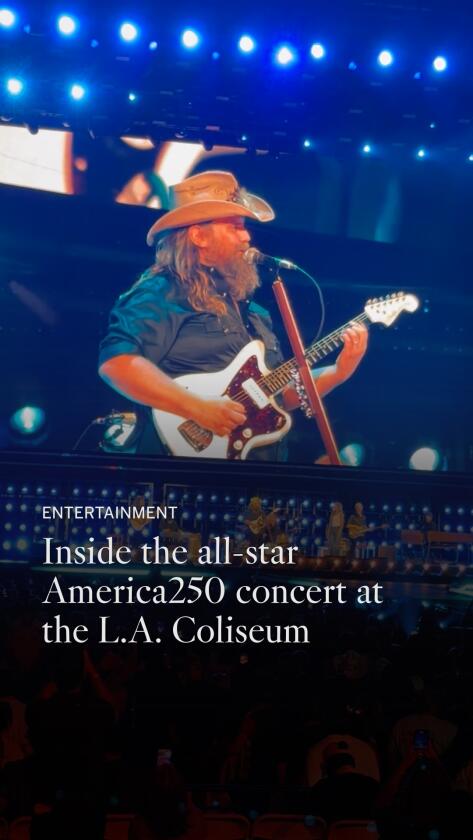
And here in Los Angeles? On Saturday night, tens of thousands of Angelenos joined voices peacefully at the L.A. Memorial Coliseum to sing along with Chris Stapleton as the country star compared a lover to Tennessee whiskey.

A unifying cultural figure beloved by both liberals and conservatives, Stapleton was the headlining act at a Fourth of July benefit concert that also featured Smashing Pumpkins, Chaka Khan, Maren Morris and Queen Latifah. (I’d be surprised if those five names had previously appeared together in the same sentence.) The show, with tickets priced at $17.76, was presented by America250, a bipartisan commission that Congress created in 2016 to plan celebrations for the country’s 250th birthday; proceeds went to Feeding America, which calls itself the largest domestic hunger-relief organization in the United States.

  • Share via

“No politics — just purpose” is how America250 Chair Rosie Rios described the night in remarks from the stage, and it wasn’t hard to interpret the distinction she was seeking to draw between her group and Freedom 250, Trump’s rival semiquincentennial initiative that organized Saturday’s windblown event on the National Mall (not to mention an earlier concert by Vanilla Ice that was called off due to the threat of rain).

But here’s the thing: Compared with the president’s celebration, where he complained about his treatment by the justice system and suggested we should refer to his current term as his third, the show at the Coliseum really did feel like a politics-free zone — the somewhat rare occasion these days when folks from different walks of life come together just to listen to music and drink overpriced micheladas.

Said Stapleton not long into his set: “I won’t waste time talking.”

America250’s success was hardly a sure thing. Despite the relatively low price, tickets moved slowly in the weeks before the concert; one guy I talked to Saturday told me he’d paid six bucks for a discounted pass. Yet to my eyes the Coliseum was close to full by the time Stapleton came on.

The country singer was as solid and soulful as always, snarling gently through “Bad as I Used to Be,” then trading loving harmonies with his wife, Morgane, in “Millionaire.” He closed with “Tennessee Whiskey,” of course — a trusty yet somehow un-shopworn piece of Americana that’s earned a place on the shelf next to Ray Charles’ “Georgia on My Mind” and Willie Nelson’s “Angel Flying Too Close to the Ground.”

Smashing Pumpkins was perhaps a stranger fit for an explicitly patriotic event — “The world is a vampire,” frontman Billy Corgan sneered in “Bullet With Butterfly Wings” — yet the band sounded sharp and punchy in the ’90s alt-rock hits that have brought zoomers and even Gen Alpha kids into its audience.

Billed not inaccurately on the concert’s poster as “the legendary Chaka Khan,” the 73-year-old funk doyenne flexed her vocal chops in jammy renditions of “Ain’t Nobody” and “Tell Me Something Good” and got people hoisting their drinks for “I’m Every Woman.” Morris, who’d flown in from New York after attending her pal Taylor Swift’s wedding on Friday night, made an improbably smooth segue between her and Zedd’s synthed-up “The Middle” and the rustic “My Church.”

As the show’s host, Queen Latifah dispensed uplifting thoughts about American idealism throughout the evening but also got a slot of her own to do her classic “U.N.I.T.Y.” with help from a rambunctious drum line. It’s an unapologetic message song about demanding respect, and what was moving about hearing it here is that nobody seemed put off by that idea.

I’ll wave a flag for that.

Here are more photos from Saturday’s concert:

Chaka Khan performs.

Chaka Khan performs.

(Myung J. Chun / Los Angeles Times)

Queen Latifah hosted the show.

Queen Latifah hosted the show.

(Myung J. Chun / Los Angeles Times)

A couple in patriotic garb share a kiss.

A couple in patriotic garb share a kiss.

(Myung J. Chun / Los Angeles Times)

Smashing Pumpkins performs.

Smashing Pumpkins performs.

(Myung J. Chun / Los Angeles Times)

A concertgoer enjoys confetti.

A concertgoer enjoys confetti.

(Myung J. Chun / Los Angeles Times)

Maren Morris performs.

Maren Morris performs.

(Myung J. Chun / Los Angeles Times)
Source link

America250: How the US heatwave will affect Fourth of July celebrations | Climate News

The United States is about to celebrate its 250th birthday, but as millions across the country prepare to gather this weekend for parades, concerts and festivals, an intense heat wave has settled over much of the eastern US.

Officials across the region are warning that the extreme heat could pose serious health risks over the Fourth of July weekend.

Recommended Stories

list of 3 itemsend of list

Here’s what you need to know about how the weather will affect the celebrations.

What is America’s 250th anniversary?

It has been 250 years since the United States adopted the Declaration of Independence on July 4, 1776. Unlike a typical Independence Day, this year’s celebrations are unfolding on a much bigger scale, capping years of preparation and planning.

Landing in the midst of a highly polarised moment in American politics, planning for the anniversary has also been contentious.

A decade ago, Congress tasked a bipartisan commission known as America250 with organising the celebrations.

But last year, US President Donald Trump issued an executive order to put his own “Freedom 250” planning committee in charge of many of the anniversary’s marquee events, including the Great American State Fair on the National Mall.

Initially, a variety of musicians were announced as performers for the fair, including country singer Martina McBride, the soul group The Commodores and the pop duo Milli Vanilli. But many withdrew in late May and early June over concerns over the fair’s affiliation with Trump.

Last week, in lieu of the performers, the US president delivered a speech to open the fair, billing himself as the “Number One Attraction anywhere in the World”.

He has also promised to mark the July 4 holiday in Washington, DC, with “the most spectacular TRUMP RALLY of them all”.

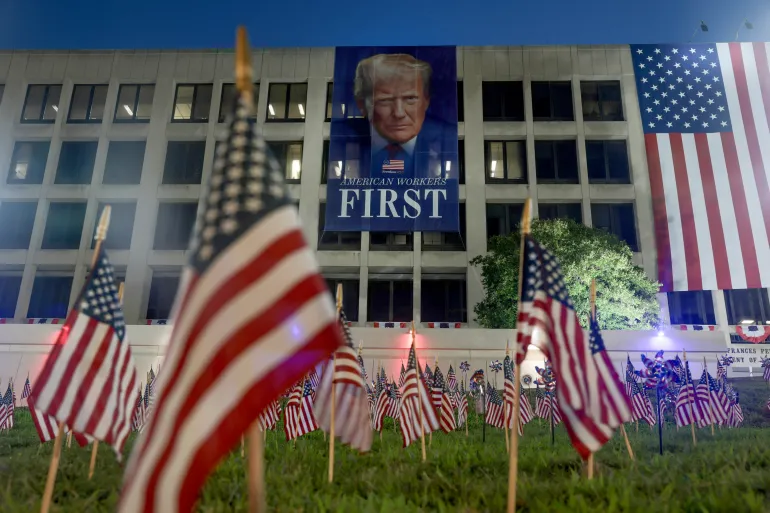
WASHINGTON, DC - JULY 03: American flags are planted in the ground in front of a banner of U.S. President Donald Trump, hanging from the U.S. Department of Labor building, ahead of July 4th festivities on July 03, 2026, in Washington, DC. A fireworks show will begin around 10:30 p.m on July 4th as the city deals with extreme heat warnings. Joe Raedle/Getty Images/AFP (Photo by JOE RAEDLE / GETTY IMAGES NORTH AMERICA / Getty Images via AFP)
The Department of Labor building in Washington, DC, displays US flags on the eve of July 4th festivities [Joe Raedle/Getty Images/AFP]

What will celebrations look like across the country?

Among thousands of smaller, locally organised celebrations nationwide — including historical reenactments, picnics, concerts and fireworks displays — some of the highest-profile events include:

  • Washington, DC: Hundreds of thousands are expected to arrive in the city, where the Great American State Fair will be held along the National Mall, the 2.5 km (1.5 mile) promenade linking the US Capitol to the Washington Monument. It will feature state pavilions, food, live music and a Ferris wheel. Trump has also promised “the largest fireworks show in history.” Around one million people attended the fireworks display for the US’s bicentennial anniversary in 1976.
  • Los Angeles: As part of its America’s Block Party event, America250 will hold a benefit concert hosted by Queen Latifah, featuring artists such as Chris Stapleton, Maren Morris and the Smashing Pumpkins.
  • Philadelphia: The city where the Declaration of Independence was signed is hosting one of the country’s biggest commemorations, including the burial of a 400kg (900 pounds) time capsule, containing artefacts from across the country, meant to be opened at the next semiquincentennial in 250 years.
  • New York: More than 40 tall ships are expected to sail into New York Harbour with almost 20,000 sailors aboard, while more than 200 aircraft fly overhead.
  • Boston: Celebrations will include the annual Boston Pops Fireworks Spectacular — a free concert followed by a fireworks display — and a public reading of the Declaration of Independence from the balcony where it was first read aloud to Bostonians in 1776.

How will the heat affect celebrations?

Some celebrations are already being disrupted, with organisers forced to adapt to extreme heat.

On Friday, the Great American State Fair temporarily closed as temperatures reached over 39 degrees Celsius (102 degrees Fahrenheit) in parts of Washington, DC.

But the capital was not the only area affected by the extreme heat.

In Philadelphia, for example, officials announced that the Salute to Independence Semiquincentennial Parade was cancelled, after initially planning to shorten the route to mitigate heat-related risks.

A celebration in Pennsylvania’s Lower Windsor Township was also rescheduled for July 8, while in nearby Norristown, officials cancelled another parade, citing safety concerns.

The heat is also affecting transportation. Amtrak announced several train cancellations in the northeast region and warned that other trains could face delays due to high temperatures, which can affect railway infrastructure.

“Extreme heat can cause rail, bridge and overhead wires to expand,” it said in a statement on Thursday. “As a precaution, Amtrak may enact heat restrictions, which can require locomotive engineers to operate trains at lower speeds, resulting in potential delays.”

What will it actually feel like outside?

While air temperatures in cities such as Philadelphia and Boston are expected to reach around 38 degrees Celsius (100 degrees Fahrenheit), high humidity can make it feel significantly hotter.

That’s because humidity makes it harder for sweat to evaporate and cool the body. Weather agencies use the heat index, often called the “feels like” temperature, to estimate what people will actually be experiencing.

Experts also warn that cities can become even hotter than forecasts suggest as concrete, asphalt and steel absorb heat.

“The number on your phone may actually not reflect the true temperature profile that you’re going out into,” Vijay Limaye, a climate scientist at the Natural Resources Defense Council, told The Associated Press.

What precautions are officials taking?

Aside from changing or cancelling some Fourth of July events, cities across the eastern United States are rolling out broader measures to help people cope with the heat.

In New York City, for example, more than 200 teams of government workers and volunteers are checking on homeless residents and directing people to hundreds of cooling centres, including public buildings, mobile cooling vans and outdoor sites equipped with misting fans.

Mayor Zohran Mamdani urged people to stay inside and avoid “extraordinary temperatures”. He also asked residents to set their air conditioners to 26 degrees Celsius (78 Fahrenheit) to avoid straining the power grid.

Boston is offering residents free admission to several air-conditioned museums, while Providence, Rhode Island, has extended hours at public pools and water parks.

How can people stay safe?

The National Weather Service (NWS) recommends drinking a lot of water, even if you don’t feel thirsty, especially if you’re spending an extended amount of time outside and taking hourly breaks in shade or air conditioning.

Health authorities also urge people to occasionally check in on seniors and other vulnerable populations.

Alcohol can make dehydration worse, so experts also recommend limiting drinking during long outdoor events.

Signs of heat illness include cramping, rapid pulse, heavy sweating, hot red skin, dizziness, confusion, nausea and vomiting, according to the NWS. If you see any of those warning signs, seek medical attention immediately.

Source link