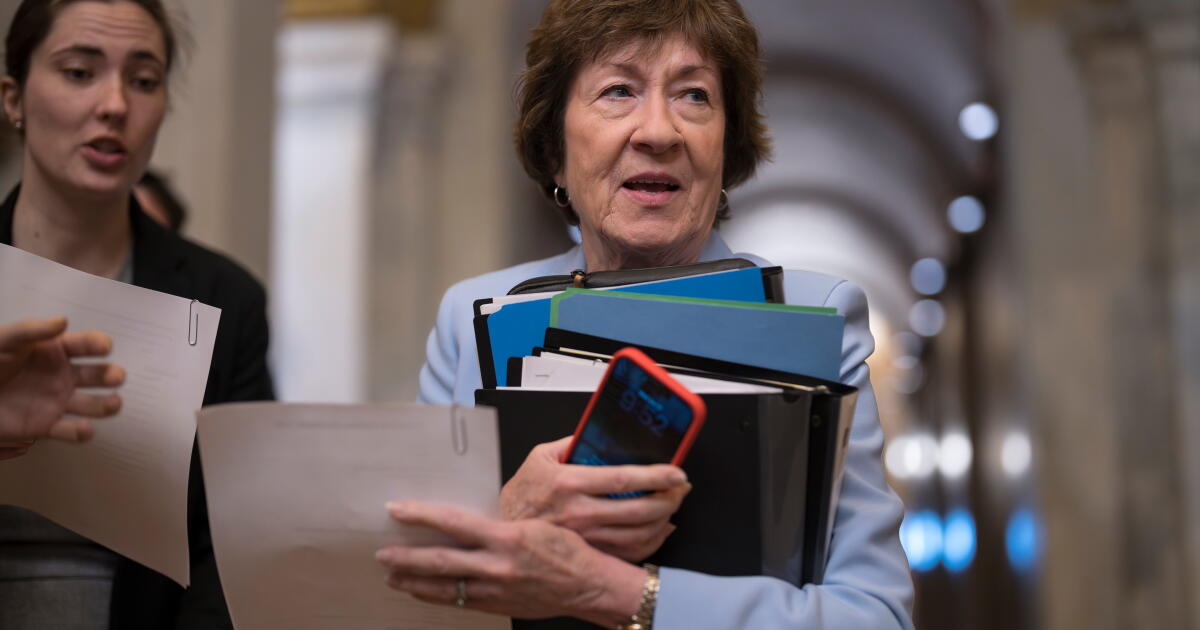
WASHINGTON — Vice President JD Vance on Friday held the inaugural meeting of a new anti-fraud task force he’s leading as the Trump administration seeks to show it’s cracking down on potential misuse of social programs.
Vance, speaking Friday before the task force held a closed-door meeting, said that the federal government for decades had not taken the issue of fraud seriously and that it needed to be tackled with “a whole-government approach.”
“This is not just the theft of the American people’s money,” Vance said. “It is also the theft of critical services that the American people rely on.”
President Trump, a Republican, has made a crackdown on fraud part of his chief domestic focus as voters have said they’re concerned about affordability ahead of November’s midterm elections. That effort comes after allegations of fraud involving day-care centers run by Somali residents in Minneapolis prompted a massive immigration crackdown in the Midwestern city, resulting in widespread protests.
Vance cited some of the Minnesota allegations on Friday. Last month, he held a news conference to announce a temporary halt of some Medicaid funding until the state took actions that federal officials said would address their concerns.
Minnesota Gov. Tim Walz, a Democrat who faced Vance as a vice presidential candidate in 2024, has called it a “campaign of retribution” and said the Trump administration was “weaponizing the entirety of the federal government to punish blue states like Minnesota.”
The task force is also the most visible assignment to date that Trump has given to Vance, who is seen as a potential 2028 presidential candidate.
Vance and the task force, which includes about half the president’s Cabinet, the leader of a new Justice Department division focused on prosecuting fraud and Federal Trade Commission Chair Andrew Ferguson, are set to meet regularly to look at rooting out potential fraud and waste in federal benefit programs.
Ferguson, who is vice chair of the task force, cast the issue of fraud as a dire crisis facing the country and said it “shreds the social trust on which these programs and our entire nation depend.”
“This fraud crisis is thus existential,” he said. “If we fail to address it, the fabric of our nation will swiftly unravel.”
Joining the task force was Colin McDonald, a top aide to the Justice Department’s second in command. He was recently confirmed as the assistant attorney general overseeing the new division at the department focused on prosecuting fraud.
The Justice Department has long prosecuted fraud nationally through its Criminal Division, but the Trump administration says the new division is needed to crack down on rampant fraud.
The U.S. Department of Justice announced Thursday that it has launched an investigation into two California women’s prisons to determine if they unconstitutionally provided housing and preferential treatment to “biological male prisoners.”
In a letter to Gov. Gavin Newsom, Assistant Atty. Gen. Harmeet Dhillon — who heads the Justice Department’s Civil Rights Division — said investigators will look into “widely reported allegations of deprivation of female prisoners’ rights” at the Central California Women’s Facility in Madera County and the California Institution for Women in San Bernardino County.
The Justice Department said in a news release that there have been allegations “of sexual assaults, rape, voyeurism and a pervasive climate of sexual intimidation due to the presence of males in the women’s prison.”
Newsom’s office referred The Times to the California Department of Corrections and Rehabilitation. A spokesperson for the agency said it is “committed to providing a safe, humane, respectful and rehabilitative environment for all incarcerated people.”
The Department of Justice also notified Maine Gov. Janet Mills of an investigation into allegations that the state “has allowed a biological male inmate to remain housed with women despite complaints that the male inmate has assaulted or harassed several female inmates.”
Dhillon said in a video posted on X that the investigations are part of a new project called the “single-sex prisons initiative” to look for potential civil rights violations in which female inmates are forced “to be in the same rooms with men who are posing as women to get access to the female prisons.”
“In California there are reports of many dozen such men housed in women’s prisons which of course is exposing these women to sexual assault and other forms of violence and harassment that, if true, are extremely troubling and could violate the civil rights of these women,” Dhillon said.
In 2020, Newsom signed into law Senate Bill 132, which gives transgender, nonbinary and intersex inmates at state prisons the right to be housed at either men’s or women’s facilities. Opponents of the law sued the following year, alleging that it was unconstitutional and created an unsafe environment for women in female facilities, with some plaintiffs claiming they were assaulted.
At the time, LGBTQ+ advocates slammed the suit as baseless and damaging.
“The way they wrote [the complaint] is saying that trans women are men and they are putting men in women’s prisons, which is completely false,” Bamby Salcedo, president and chief executive of the TransLatin@ Coalition, which cosponsored SB 132, previously told The Times. “They’re making a claim that is not accurate and not respectful towards trans women specifically.”
In an interview with the Times Thursday, Salcedo said that while there may be instances in which people have abused the law, she stressed “it is the responsibility of the CDCR to protect people who are incarcerated.”
“They should be able to not just follow the law, but also to be able to screen people appropriately,” Salcedo said.
Salcedo said she was not surprised to hear about the new Justice Department investigation, calling it “an effort for this administration to continue to deny opportunities and access to trans people in our society.”
The Women’s Liberation Front, which brought the lawsuit, announced this week that a federal court had dismissed the case but that they planned to appeal. In an emailed statement, Elspeth Cypher, Women’s Liberation Front board president, called the Justice Department investigation “welcome and long overdue.”
“I hope that this investigation provides the women in prison with some hope that finally someone is listening,” Cypher said.
Under the bill enacted in 2021, 1,028 inmates housed at male prisons have requested to be moved to female facilities, according to data as of March 4. The department had granted 47 requests and denied 132. Another 140 applicants “changed their minds,” according to the department.
State officials said that 84 inmates sought to be transferred into men’s facilities from women’s prisons. Of those, seven were approved.
According to the corrections department, 2,405 inmates identify as nonbinary, intersex or transgender. Those populations are said to experience excessive violence in prison. A 2007 UC Irvine study that included interviews with 39 transgender inmates found that the rate of sexual assault is 13 times higher for transgender people, with 59% of those surveyed reporting experiencing such encounters.
The Justice Department said Thursday that its investigation was just getting underway and that it “has not reached any conclusions regarding allegations in these matters.”
“I’m very determined to ensure that no woman who’s incarcerated in the United States is subject to potential rape, sexual assault or other violations of her civil rights as a condition of incarceration to satisfy some woke ideology by the state,” Dhillon said. “If these states are violating these rights and they don’t stop, we will make them through litigation.”
Jessi Draper of “The Secret Lives of Mormon Wives” is accusing her estranged second husband, Jordan Ngatikaura, of being involved in pretty much all of the above.
Ngatikaura filed for divorce Thursday in Utah after five years of marriage to Draper. Though that was far from the start of their marital problems, she told Alex Cooper during Wednesday’s episode of “Call Her Daddy” — which was taped Friday — that the dissolution filing was something they had agreed to do together. Then he changed his mind, she said, and she got the news via TMZ.
“I’m the one who ended it. I told him on Friday the 13th, so not that long ago, and I just said I want a divorce. He definitely didn’t want it. And now he’s the one rushing to do it, which is a little strange,” Draper told Cooper.
Also strange, in her view, was his choice to state on the documents that she had had an affair, though they had agreed previously that the reason would be the tried-and-true and totally non-gossipy “irreconcilable differences.” Plus Draper had only kissed another man twice, she said. She never had a physical affair with Marciano Brunette of “Vanderpump Villa,” though their emotional affair was a big part of the third season of “Mormon Wives.” Also, Utah is a no-fault state when it comes to divorce.
The Times was unable to contact Ngatikaura on Wednesday for comment on Draper’s allegations.
During the chat, Draper called her estranged husband “calculated” and “emotionally abusive” and said he told her he had been advised by someone to file on his own. She also admitted to Cooper that their marriage most likely was what it was because she went too quickly from divorcing her first husband to starting a relationship with her second.
That said, Draper said that right before Season 1 of “Mormon Wives” dropped on Hulu in September 2024, she was given “proof” that Ngatikaura had been using an escort service in Texas. At the time, she presented her evidence to him, she said, only to have him say it had probably been generated by AI.
Draper also said she had heard rumors of “sex parties” that he allegedly attended, though her sourcing on that allegation was definitely of the friend-of-a-friend-who-was-there variety. She further claimed that Ngatikaura had listened in on her personal conversations via cameras in her house — cameras she said he unplugged when he moved back into the house and she moved to a hotel — and had blackmailed her, threatening to post texts between her and Brunette online.
“Any time he was mad at me, he’s like, ‘I’m going to post them. I’m going to ruin your life,’” Draper told Cooper.
One day, she said, Ngatikaura told her he believed in traditional gender roles and that he should be in his masculine and she in her feminine, and therefore she should do Pilates every day. That led to a fight, during which he threatened to post the texts he had been keeping in a draft in his phone. Nobody knew yet what had happened between her and Brunette, and she worried that exposing everything would hurt her business, where she employs dozens of people.
“I went to go grab his phone. I was like, ‘Jordan, no … This could ruin everything.’ And he goes, ‘OK.’ And I’m freaking out. So, I’m trying to get his phone. I’m kind of chasing him, trying to get it. He pulls out his phone, starts recording me, and he’s like, ‘What are you going to do? What are you going to do? Are you going to be like, “Taylor, should I call the cops?”’ (referring to her embattled co-star and best friend, Taylor Frankie Paul, whose season of “The Bachelorette” was nixed before it aired).
“I was like, ‘Whoa,’ ‘cause he’s friends with Dakota [Mortenson, Paul’s on-and-off boyfriend], so he’s like hearing things like that, obviously, and he’s baiting me and he’s trying to be like, ‘Oh, oh, what are you doing?’ And that was the moment where, for me, I was like, ‘What am I doing? I am chasing around my husband trying to get his phone so he doesn’t blackmail me. This is not healthy.’ And I literally left him the next day,” she said.
Puka Nacua has denied a woman’s claim that he made an antisemitic comment, says the Rams wide receiver’s attorney.
Madison Atiabi made the claim this week in an application for a temporary restraining order obtained by The Times.
Atiabi asserted in the court filing that during a group New Year’s Eve dinner, Nacua said “f— all the Jews … in a manner audible to [her] and others at the table.” Atiabi added that Nacua’s “vulgar, threatening, violent and harassing conduct” escalated as the evening progressed.
After dinner, Atiabi said she was in a car with Nacua and others when the Rams star bit her on the left shoulder, leaving a substantial bite mark that was photographed. Nacua also is alleged to have bitten the thumb of Atiabi’s friend “so forcefully that she screamed in pain,” according to the filing.
Nacua’s attorney, Levi McCathern, said he has spoken to witnesses — including other Rams players who were present — who didn’t hear Nacua make the antisemitic statement. He also said the bite was innocent “horseplay.”
“Puka denies these allegations in the strongest possible terms,” McCathern said. “We will pursue all available legal remedies in response to these false and damaging statements.”
The request for a temporary restraining order was denied by a Los Angeles Superior Court judicial officer and a hearing is scheduled for April 14.
“Our office was contacted with demands of millions of dollars in exchange for not publicizing these allegations,” McCathern told TMZ. “This is not a legitimate claim — it is blackmail.”
The livestreamers, with Nacua out of earshot, discussed whether Nacua would get in trouble if he performed a move that references an offensive stereotype about Jewish people. Ross is Jewish, but he often performs the move in his livestreams.
They suggested Nacua, who led the NFL with 129 receptions and was named an All-Pro in 2025, perform the gesture the next time he scored a touchdown.
“At the time, I had no idea this act was antisemitic in nature and perpetuated hateful stereotypes against Jewish people,” Nacua wrote in his post. “I deeply apologize to anyone who was offended by my actions as I do not stand for any form of racism, bigotry or hate of another group of people.”
The Rams distanced themselves from Nacua’s gesture in a statement.
“There is no place in this world for antisemitism as well as other forms of prejudice or hostility towards the Jewish people and people of any religion, ethnicity, or race,” the team said.
Bill Cosby drugged and sexually assaulted a former waitress in 1972 after escorting her to one of his shows, a civil jury in California concluded Monday, awarding the woman $19.25 million in damages.
The verdict was the latest turn in a series of legal battles the disgraced entertainer, now 88, has faced since allegations that he repeatedly drugged and raped women exploded publicly about a decade ago. Since then, he served about three years in a Pennsylvania prison on sexual assault charges before the case was overturned in 2021.
Donna Motsinger, now 84, said in her lawsuit filed in Los Angeles County Superior Court that Cosby had given her wine and a pill that left her unable to move, and that she woke up in her house wearing nothing but her underwear, according to court records, and that “she knew she had been drugged and raped by Bill Cosby.”
Cosby has denied the allegations, as well as those brought by dozens of other women who claimed they had been drugged and raped. Coming in the early years of the #MeToo movement, a broad social media-inspired campaign to name and prosecute men accused of sexual misconduct, Cosby’s attorneys painted him as an unfair target of mass vigilantism gone awry.
Motsinger sued Cosby in 2023, alleging that, at the time, she was working at a Sausalito restaurant called The Trident that was popular with celebrities, including Cosby, according to the complaint her attorneys filed Sept. 27 of that year. One night, Motsinger accepted Cosby’s invitation to go with him to his show at the Circle Star Theater in San Carlos. Cosby picked her up at her home in a limousine, according to her complaint, and, on the way to the venue, gave her the wine and a pill that she thought was aspirin.
“Next thing she knew, she was going in and out of consciousness while two men attending to Mr. Cosby were putting her in the limousine,” the complaint said. “The last thing Ms. Motsinger recalls were flashes of light,” before waking up in her house in nothing but underwear.
Motsinger didn’t consent to Cosby’s sexual contact and, having been rendered unconscious by drugging, she couldn’t consent to it to begin with, according to the complaint. As a consequence of her ordeal, her complaint says she suffered lost wages, medical bills, pain and suffering and emotional distress.
Chad Bianco, the Riverside County sheriff and a leading Republican candidate for governor, has seized more than 650,000 ballots from last November’s election as part of an investigation that he called a “fact-finding mission” to determine if they were fraudulently counted.
Atty. Gen. Rob Bonta, the state’s top law enforcement official, has sharply criticized the probe, which he called “unprecedented in both scope and scale.”
In a March 4 letter to the sheriff, Bonta said the seizure of the ballots “sets a dangerous precedent and will only sow distrust in our elections.” He threatened to seek legal recourse if Bianco does not halt his investigation.
Bianco said Friday that his investigators are looking into allegations by a local citizens group that “did their own audit” and found that the county’s tally was falsely inflated by more than 45,000 votes — a claim that local election officials have emphatically rejected.
Here is what we know.
Why were ballots taken?
According to Bonta’s office, Bianco’s department on Feb. 26 took about 1,000 boxes of ballot materials in Riverside County related to the November election for Proposition 50, which temporarily redrew the state’s congressional districts to favor Democrats in response to partisan redistricting in Republican states, including Texas.
Bianco said that it’s his “constitutional duty” to investigate a potential crime and that he is not trying to change the election results.
The investigation includes all of the ballots cast in the county, where Proposition 50 passed with 56% of the vote, a margin of more than 82,000 ballots. Statewide, it passed with 64% of the vote, a margin of more than 3.3 million ballots.
Bianco said he had been contacted by “a group of citizen volunteers” that said it performed an audit finding that 45,896 more ballots were counted than were cast. He did not name the group, but the allegations match those made by a group called the Riverside Election Integrity Team.
In a February presentation to the Riverside County Board of Supervisors, Registrar of Voters Art Tinoco disputed the group’s allegations and said they were based on a misunderstanding of raw data that had not been fully processed.
The actual discrepancy, Tinoco said, was 103 votes — a variance of 0.016%.
How did the sheriff get the ballots?
Bianco said his department served the registrar with a warrant “approved and signed by a judge” on Feb. 9.
According to Bonta’s office, an additional warrant was issued on Feb. 23. Bianco said the warrants are now sealed.
In the March 4 letter to Bianco, the attorney general said he had “serious concerns” about whether the sheriff had probable cause to seize the election materials.
Bonta questioned whether Bianco had concealed information from the magistrate judge who approved the warrants, including details from the registrar’s analysis of the citizen group’s allegations.
An official from Bonta’s office told The Times that the attorney general “found out in the middle of the week that [Bianco] was going to execute the warrants on a Friday.” Bonta’s office asked the sheriff to slow down and share information about the investigation, but “instead of waiting, he actually moved it up” and seized the ballots sooner than planned, said the official, who would only speak on background.
Bianco said a Riverside County Superior Court judge ordered the appointment of a special master to oversee the ballot count. His investigators had already begun counting, but the tally would start over under the court’s guidance, Bianco said.
The ballots would have soon been destroyed
California law requires county officials to keep election materials — including ballots and voter identification envelopes — for 22 months for elections involving a federal office and for six months for all other contests.
The materials must be sealed and then destroyed at the end of the retention period.
The Proposition 50 election took place on Nov. 4, so the ballots are scheduled to be destroyed in May.
Why investigate now?
Political observers say that Bianco — a leading gubernatorial candidate — appears to be vying for attention from President Trump and his supporters.
Kim Nalder, a political science professor and director of the Project for an Informed Electorate at Sacramento State, said the investigation appears to be “an electoral ploy.”
“At this stage in the election, most voters haven’t really tuned into the gubernatorial race, and there are a ton of candidates,” she said. “People who don’t know his background will know now. This is clear signaling.”
Trump has repeatedly called on the federal government to “nationalize” state-run elections. He remains fixated on his 2020 election loss and has falsely claimed widespread fraud.
In January, the FBI raided the elections office in Fulton County, Ga., seizing 2020 presidential election records. And this month, the Republican leader of Arizona’s state Senate said he had handed over 2020 election records to the FBI, complying with a federal grand jury subpoena for records related to a controversial audit of the election in Maricopa County.
Bianco is an outspoken Trump supporter.
A poll released last week by UC Berkeley’s Institute of Governmental Studies and co-sponsored by The Times showed Bianco and conservative commentator Steve Hilton leading the crowded field of gubernatorial candidates by slim margins, with the Democratic vote split among multiple candidates in a left-leaning state.
The top two vote getters, regardless of party, will advance to the November election.
Bianco said the investigation was “not a recount” for Proposition 50 and had nothing to do with his campaign for governor.
Riverside County Sheriff Chad Bianco, who is a leading Republican candidate for governor, has seized more than 650,000 ballots from last November’s election and is investigating whether they were fraudulently counted.
“This investigation is simple: Physically count the ballots and compare that result with the total votes recorded,” Bianco said at a news conference Friday.
The unusual probe drew a sharp rebuke from California Atty. Gen. Rob Bonta, who said in a statement Friday that it is “unprecedented in both scope and scale” and appears “not to be based on facts or evidence.”
“There is no indication, anywhere in the United States, of widespread voter fraud,” Bonta said. “Counts, recounts, hand counts, audits, and court cases all support this.”
According to Bonta’s office, Bianco’s department on Feb. 26 seized about 1,000 boxes of ballot materials in Riverside County related to the November election for Proposition 50, which temporarily redrew the state’s congressional districts to favor Democrats in response to partisan redistricting in Republican states, including Texas.
The sheriff said his investigators are looking into allegations by a local citizens group that “did their own audit” and found that the county’s tally was falsely inflated by more than 45,000 votes — a claim that local election officials have rejected.
President Trump, who remains fixated on his 2020 election loss, continues to amplify election conspiracy theories and has repeatedly called for the federal government to “nationalize” state-run elections to counter what he says is widespread fraud.
Bonta and California Secretary of State Shirley Weber, both Democrats, have vowed to fight federal interference that could affect voting in California, including efforts to seize election records, as the FBI recently did in Georgia.
Bianco is an outspoken Trump supporter who said in an endorsement video in 2024 that, after 30 years of putting criminals in jail, he figured it was “time to put a felon in the White House — Trump 2024, baby” — referencing Trump’s conviction by a New York jury for falsifying business records while paying hush money to a porn actor.
Bianco’s investigation, which includes all the ballots cast in Riverside County in November, raises questions about how he would handle the election denialism movement if elected governor.
A poll released last week by UC Berkeley’s Institute of Governmental Studies and co-sponsored by The Times showed Bianco and conservative commentator Steve Hilton leading the crowded field of gubernatorial candidates by slim margins, in a left-leaning state.
Last fall, Proposition 50 passed in Riverside County with 56% of the vote — a margin of more than 82,000 ballots.
A citizens group called the Riverside Election Integrity Team has said it performed an audit finding that 45,896 more ballots were counted than were cast.
In a lengthy February presentation to the Riverside County Board of Supervisors, Registrar of Voters Art Tinoco disputed that figure, saying it was based on a misunderstanding of raw data that had not been fully processed.
The actual discrepancy, Tinoco said, was 103 votes, a variance of 0.016% that was far below what he said was the state’s preferred 2% margin of error for certifying results.
Bianco on Friday said that there “is no acceptable error, small or large, in our elections.”
The sheriff did not name the Riverside Election Integrity Team, but his description of the allegations brought to him by “a group of citizen volunteers” matched theirs.
Bianco said the investigation was “not a recount” for the Proposition 50 contest and was “just as much to prove the election is accurate as it is to show otherwise — we will not know until the count is complete.”
Bonta said his office has “attempted to work cooperatively” with the Sheriff’s Department to understand the basis for the probe. The sheriff, Bonta said, “has delayed, stonewalled, and otherwise refused to work with us in good faith” and failed to provide most of the requested documents.
“We’re concerned that there is not sufficient justification for seizing every ballot that was cast in this very largely populated county,” an official in Bonta’s office said in an interview Friday night.
In a March 4 letter to Bianco, the attorney general cited Bianco’s plan to use Sheriff’s Department staffers, “who are not trained and have no experience,” to count the ballots.
“Let me be clear: this is unacceptable,” Bonta wrote. “Your decision to seize ballots and begin counting them based on vague, unsubstantiated allegations about irregularities in the November special election results sets a dangerous precedent and will only sow distrust in our elections. You are also flagrantly violating my directives.”
At his news conference Friday, Bianco fired back by calling Bonta “an embarrassment to law enforcement.”
A Riverside County Superior Court judge, Bianco said, has ordered the appointment of a special master to oversee the ballot count.
In a statement Friday, Secretary of State Weber said “the Sheriff’s assertion that his deputies know how to count is admirable. The fact remains that he and his deputies are not elections officials and they do not have expertise in election administration.”
The United Farm Workers said it would not participate in celebrations of its founder Cesar Chavez amid what the labor union described as “troubling allegations” against the iconic Chicano figure.
The union, in a statement released Tuesday, did not detail the accusations against Chavez but said they were concerning enough for the organization to take action. But several events around the country honoring Chavez including events in Tucson, Houston, Corpus Christi, San Antonio and San Bernardino have been canceled in recent weeks, with little explanation given by organizers.
The claims against Chavez “are incompatible with our organization’s values. Some of the reports are family issues, and not our story to tell or our place to comment on. Far more troubling are allegations involving abuse of young women or minors. Allegations that very young women or girls may have been victimized are crushing. We have not received any direct reports, and we do not have any firsthand knowledge of these allegations,” the union said.
Canceling events, the union said, would “provide space for people who may have been victimized to find support and to share their stories if that is what they choose.”
Chavez is a towering national figure credited with organizing and raising the lives of migrant farmworkers in California and beyond and giving voice to the struggles of Mexican Americans.
Bursting into national prominence in the mid-1960s in the San Joaquin Valley, Chavez galvanized public support on behalf of them after organizing community groups across Central and Southern California. For decades, agricultural laborers had lived in substandard housing and were paid terrible wages. Efforts to organize migrant laborers were usually crushed violently by farmers and local law enforcement.
Chavez and his associates joined a grape pickers’ strike in 1965 launched by Filipino organizers centered around Delano, the heart of California’s table grape crop. Those early years were marked by bitter and sometimes brutal incidents involving picketing farmworkers who screamed “Huelga!” — “Strike!”—and growers who vowed never to give in to Chavez and his movement.
Sen. Robert Kennedy and Cesar Chavez as Chavez ended a 25-day fast.
(Bettmann Archive)
That eventually transformed into a boycott that earned international attention. Chavez, drawing on his Catholic faith, fasted for 25 days in 1968 to draw attention to the violence swirling around the effort, ending it by sharing bread with then-presidential candidate Robert F. Kennedy. Two years later, the UFW was able to secure contracts for more than 10,000 grape pickers.
Those successes made Chavez an almost mythic figure. The UFW flag — a stylized black Aztec eagle against a red background — became synonymous with the Chicano movement that was emerging at the same time. Posters and murals featuring Chavez’s beatific face sprouted in the Southwest and beyond. He traveled across the United States espousing his philosophy of nonviolence, union and dignity for farmworkers.
But Chavez’s legacy became increasingly tarnished as the years went on. Labor victories became fewer and fewer. His fierce criticism of illegal immigration — Chavez argued that they undercut his unionization efforts — put him at odds with immigration activists. A 2006 Times investigation detailed how dozens of former associates and workers left the UFW because of what they described as Chavez’s increasingly autocratic ways.
Cesar Chavez talks to striking Salinas Valley farmworkers.
(Sakuma / Associated Press )
When the Los Angeles County Board of Supervisors decided to change the name of Brooklyn Avenue in East Los Angeles and Boyle Heights to Cesar Chavez Avenue after the labor leader’s death in 1993, many in the community opposed it, citing the economic burden businesses would undergo to update their addresses and the erasure of the community’s history on the street.
Yet his standing among Latinos nationwide was such that schools, streets and parks were renamed in his honor in the years after his death. In 2012, President Obama went to tiny Keene, Calif. — where Chavez had set up both his home and the operational headquarters of the United Farm Workers — to dedicate the César E. Chávez National Monument.
It’s unclear the source of the new allegations or when they might become public. But there has been rumbling for weeks among activists that something about Chavez was coming.
Huerta is not commenting on the issue at this time, said Eric Olvera, spokesperson for Huerta.
The news comes two weeks before Cesar Chavez Day, observed March 31.
Local organizers in Los Angeles haven’t announced whether they will cancel their events.
The UFW was vague about the claims but suggested they were serious enough for extreme action.
“These allegations have been profoundly shocking. We need some time to get this right, including to ensure robust, trauma-informed services are available to those who may need it.
“We understand this will be tremendously painful for many and we encourage our community to seek mental health support if they experience distress.”
Tuesday morning, the Cesar Chavez Foundation said in a statement that it had “become aware of disturbing allegations that Cesar Chavez engaged in inappropriate sexual behavior with women and minors during his time as President of the United Farm Workers of America.”
The foundation said it was working with leaders in the farmworker movement to be responsive to these allegations and support the people who might have been harmed.
“In partnership with the UFW, we are establishing a safe and confidential process for those who wish to share their experiences of historic harm, and, if they choose to, participate in efforts toward repair and reconciliation,” the statement said. “In addition, we are investing time and resources to ensure the Foundation promotes and strengthens a workplace culture that is safe and welcoming for all.”
In the 48 hours before the UFW and Cesar Chavez Foundation made their statements, La Unión del Pueblo Entero, a community-based union and nonprofit in the Rio Grande Valley of Texas, which was founded by Huerta and Chavez, erased the names and affiliation with the leaders from its website.
The new allegations could have implications beyond Chavez’s place in history. If he has been accused of sexual abuse, a legal expert said it could spark legal claims against the union he ran for so long.
In California, Assembly Bill 250 opened a two-year window to file sex assault claims beyond a previous statute of limitations. The Catholic Church, Scouting and public school districts, as a result, have been hit hard with lawsuits.
“It is [a] matter [of] who knew what and when,” said John Manly, a sexual abuse attorney, adding that Chavez’s leadership role could create liability for the UFW.