Algeria

Algerian parliament’s upper house approves troop deployment to Niger | Military News

Vote to send forces comes after a recent defence pact between two neighbouring countries.
The upper house of Algeria’s parliament has unanimously approved the deployment of troops to neighbouring Niger.

The Algerian constitution empowers the president to send military units abroad, provided that both chambers of parliament approve it by a two-thirds majority.

Recommended Stories

list of 3 itemsend of list

The Council of the Nation held an emergency session on Sunday to vote on troop deployment, while the People’s National Assembly, or the lower house, is expected to hold a separate session later in the evening, Algeria’s popular newspaper El Khabar reported. If the deployment is approved, it would be the first mission outside Algeria’s borders since the 1973 War between Israel and several Arab countries, known to Arabs as the October War and Israelis as the Yom Kippur War.

The military units to be deployed by Algeria are expected to be tasked with securing oil facilities in Niger.

The vote came after a visit by Niger’s Defence Minister General Salifou Modi to Algeria last week, where he held talks with Algerian President Abdelmadjid Tebboune and Chief of Staff of the People’s National Army General Said Chanegriha.

During that visit, the two sides signed a military cooperation protocol, the details of which were not made public.

Earlier this month, Tebboune confirmed that Algeria sent fighter jets to Niger in late August to help thwart a “coup attempt” that shook the capital, Niamey.

The Algerian Ministry of Defence previously said it had sent four jets to Niger following the unrest. It said two patrols of four Sukhoi Su-30 aircraft had landed at Niamey airport, accompanied by an air-to-air refuelling plane.

The warplanes were deployed at the request of Nigerien authorities on “a mission to support the Nigerien army in confronting an attempt to destabilise the brotherly state of Niger”, the ministry said on August 30.

Relations between Algeria and Niger have witnessed a significant rapprochement over the past few months on political, diplomatic, military and economic levels, following a period of tension between the two countries.
Source link

Gulf Investors Look to Libya and Algeria

Energy market disruptions and regional uncertainty are pushing GCC countries to boost North Africa investments.

This article appears in the October issue of Global Finance Magazine.

In July, Qatar’s UCC Holding signed a $1 billion deal with Libya’s National Oil Corp. and the Libyan Investment Authority to increase output at the Ghadames Basin from 33,000 to 80,000 barrels a day.

A few weeks earlier, Oman’s OQEP signed a similar contract to explore investment opportunities in Libya, “so our production will not rely only on exports from the Strait [of Hormuz],” OQEP Board Chairman Ashraf Al Mamari told Arabian Gulf Business Insight in July. That same month, Libyan Prime Minister Abdul Hamid Dbeibah visited the United Arab Emirates and Qatar to encourage new partnerships.

Disruptions in energy markets at home are pushing Gulf countries to scale overseas investments and increase involvement in riskier destinations. With its large oil reserves, Libya is an attractive opportunity; but for years, it has been a headache for foreign investors. After Muammar Gaddafi’s fall in 2011, the country split between rival governments and became a playground for militias. Yet, despite instability, Gulf states—led by the UAE, and to a lesser extent Qatar—developed relationships with both capitals: Tripoli and Benghazi.

“Gulf states have been navigating this landscape for some time,” said Mohamed Dorda, head of business intelligence at Libya Desk, a consulting firm that advises businesses looking to enter Libya. “It’s really a matter of, first, having a foot in the door; and then, knowing where to put your feet. In Libya, they’ve been investing in the necessary political capital for quite some time now.”

Signs of Improvement

Today, the situation is showing signs of improvement. Both sides have taken steps toward greater stability, including the reunification of the central bank in 2023 and the approval of a common state budget in April of this year. Libyan authorities are now looking to reopen the energy sector to foreign investors. In February, the country resumed licensing for the first time since 2007, attracting oil majors like Italy’s Eni SpA, France’s TotalEnergies SE, Spain’s Repsol SA, and U.S.-based Chevron Corp.

The renewed interest extends beyond Libya. In recent months, the U.S. administration has stepped up engagement with North Africa, with Middle East adviser Massad Boulos visiting several countries. European nations, including Turkey, as well as China, are also moving to secure market shares.

“North Africa is becoming increasingly important in global trade because of its proximity to Europe and its capacity to help fill supply gaps created by the wars in Ukraine and the Middle East,” Dorda said. “People see that Libya and Algeria are among the strongest candidates to help meet global energy needs, and that creates opportunities.”

Algeria has drawn around $9 billion in Gulf-backed projects over the past 18 months, led by Saudi Arabia’s Midad Energy’s $5.4 billion oil and gas deal in October 2025 and by Qatar’s $3.5 billion Baladna dairy venture, now in its second phase.

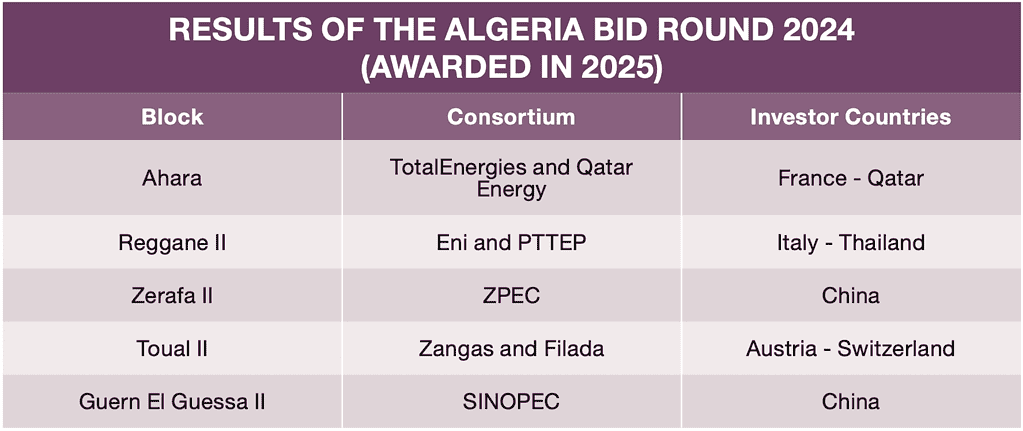
Algerian state-owned hydrocarbon company Sonatrach plans to increase production and drill 1,450 wells by 2030, but it needs foreign know-how and capital to modernize infrastructure. In April, Algiers opened a new licensing round for seven oil and gas blocks. Bids are underway, and contracts are expected to be signed in January.

Chloe Domat is a contributing writer based in France.

Source link

Paris court finds Swiftair guilty over 2014 Mali crash that killed 116 | Aviation News

Spain’s Swiftair was fined 225,000 euros ($256,000) in France for corporate manslaughter over the 2014 Air Algerie disaster in Mali.

A Paris court has found Swiftair guilty of corporate manslaughter over the 2014 Air Algerie crash that killed 116 people in northern Mali.

On Monday, a French judge ordered the Spanish airline to pay the maximum fine in France of 225,000 euros ($256,000) for corporate manslaughter after a three-week trial earlier this year.

Recommended Stories

list of 3 itemsend of list

Air Algerie Flight AH5017 was flying from Ouagadougou, the capital of Burkina Faso, to Algiers, Algeria when it crashed less than an hour after takeoff in July 2014, killing everyone on board.

The Swiftair-owned McDonnell Douglas MD-83 was operated by the Spanish airline on behalf of the Algerian carrier.

Investigators said the aircraft went into a stall when it was hit ‌by ⁠ice as an anti-icing system remained switched off.

On Monday, the court ⁠said “negligence” in Swiftair’s training with icy conditions had played a role.

The captain had failed to complete an adequate proficiency check, while the crew lacked the required refresher flights following a period of inactivity.

“This ruling comes as a relief to families who have been fighting for more than 12 years for justice to be done,” said Sebastien Busy, a lawyer representing a group of relatives.

The airline has 10 days to appeal the ruling.

Swiftair attempted to have the trial dropped on the grounds that a Spanish court previously dismissed the case without any charges.

In a statement to AFP, Swiftair reiterated that the trial should not have gone ahead and that safety regulations had been followed.

The ruling marks the second time an airline has been found guilty of corporate manslaughter in France after Air France and Airbus were both ⁠found guilty earlier this year over the 2009 crash of a jetliner flying from Rio de Janeiro to Paris. The crash killed all 228 people on board, marking the worst aviation disaster in French history.

Source link