L.A. officials raise alarms over crippling Olympic costs
Los Angeles officials are expressing growing fears that taxpayers and the city treasury could be hit with a round of crippling costs to support the 2028 Olympic Games if the city doesn’t ink a rigorous deal to assure a “zero–cost” Games.
Some city officials have long been concerned that taxpayers could be left with massive bills if the Olympics don’t generate the income organizers have promised. Delays in finalizing a deal between City Hall and the Olympics committee have heightened those tensions.
The exact costs to L.A. and other local governments remain unknown, as officials wait to hear from LA28 and federal security agencies about exactly what services they will need. Recent controversy over the ties between Casey Wasserman, the head of the L.A. Olympics, and Jeffrey Epstein have added to the uncertainty over the finances in the minds of some city leaders.
City Atty. Hydee Feldstein Soto and Councilmember Monica Rodriguez both issued letters demanding a contract pledging that LA28 cover any of the city’s future costs that arise as the city plays host to hundreds of thousands of athletes and fans.
The contract, more than six months overdue, is needed “to foreclose any scenario in which funds might go back to the wealthy backers and investors of the LA 28 organization without reimbursing taxpayer funded extraordinary costs,” the city attorney wrote to council members.
Rodriguez agreed in a separate letter this week that the city needs a contract that assures that the Olympics organization will pay any excess costs for policing, transportation, trash pickup and more, so that taxpayers are not burdened or “core city services” slashed.
That should take priority over the private nonprofit LA28 building a “Legacy Fund” to bankroll future youth sports programs, public sports facilities and the like, argued the city officials, who are both up for reelection this year.
“Bankruptcy cannot be the legacy of these Games,” Rodriguez wrote, without elaborating on what she meant, though L.A.’s top budget official recently projected a deficit, unconnected to the Olympics, of “several hundred million” dollars.
LA28 officials responded with a statement they issued previously, saying, in part, that “LA28 remains committed to delivering the safest, most secure, and fiscally responsible Games that will benefit Angelenos for decades to come,” adding, “We remain engaged in good faith negotiations and look forward to our continued partnership with the City of Los Angeles.”
LA28 Chief Executive Reynold Hoover said at a press event Wednesday that ticket sales were one vehicle for the host committee to assure that taxpayers didn’t get stuck with a big bill down the road.
The stakes remain high for both sides. The private LA28 group needs the city’s police, fire, sanitation, streets and transportation services to deliver a successful event. The city wants the sports extravaganza to succeed, not only to burnish its image on an international stage, but also to assure there is enough money to pay for all the extra tasks city workers will perform.
The LA28 leaders project the Games will cost more than $7.1 billion. They say that money will come from a variety of sources: nearly $1 billion from the International Olympic Committee, $437 million from international marketing rights, $2.5 billion from corporate sponsors in the U.S., $2.5 billion from ticket sales and hospitality packages, $344 million from licensing and merchandise and $405 million in other revenue.
LA28 reports being ahead of schedule on the revenue front. But city officials worry that unforeseen events — including an economic downturn or natural disaster — could blow up the income model, with one of many wild cards being the willingness of President Trump and the Republican-controlled Congress to follow through with a funding pledge to the Democratic-controlled city.
L.A. officials have long expressed concern that Trump and Congress might belatedly yank away $1 billion already set aside to reimburse state and local governments for security, planning and other Olympics-related costs.
While the two elected officials and some others, including an attorney representing city employees, raised alarms, an individual with knowledge of the talks between the city and LA28 said that a tentative agreement would likely be before the City Council “within two or three weeks.”
The knowledgeable individual, who asked not to be named because of the sensitive nature of the discussion, said negotiators on both sides must bear in mind how a third party, the federal government under Trump, is integral to the financing model.
The source tracking the negotiations said that both sides needed to make sure the pact creates a path to “maximize federal resources, which were dedicated by Congress for the Games,” adding: “The contract needs to avoid saying that LA28 is going to pay, for example, for all of the LAPD’s extra costs in such a way that the federal government says, ‘Fine, then you don’t get any of the federal money.’ We can’t afford to leave a billion dollars on the table.“
City Administrative Officer Matt Szabo, one of those bargaining for the city, struck a positive note.
“We are invested in a successful Olympics. The organizing committee knows that it needs the city and city services to have a successful Games,” said Szabo. “It’s in both the city’s and the organizing committee’s best interest to have a successful Games. We’re joined at the hip and we’ll succeed together, or not.”
The 2028 Games have been designated a National Special Security Event, placing it in the same category as major party political conventions and Super Bowls. The U.S. Secret Service sets the security plan for those events.
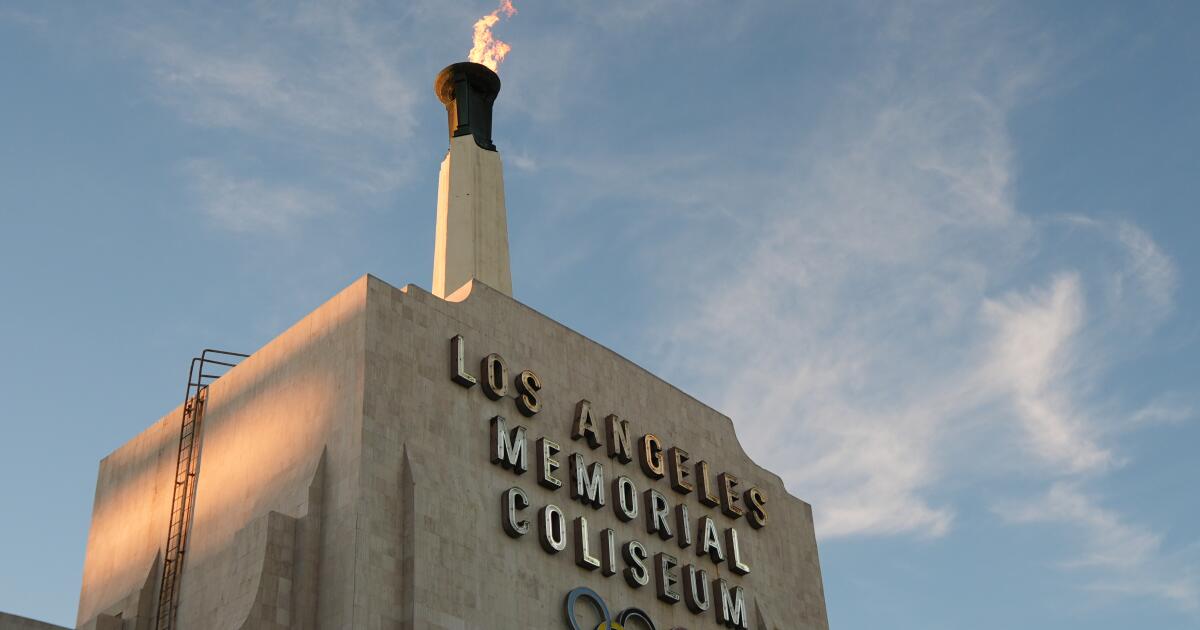
Officials in L.A. have said they are still waiting to learn from the Secret Service how broad the security “blast area” should be around each athletic venue. The federal agency will then dictate how many police and federal agents will flood those zones, which include the Los Angeles Memorial Coliseum, Exposition Park and Crypto.com Arena.
Attorney Connie Rice, who represents L.A. city employees concerned about how the city will pay for the Games, said that her clients still had questions. Rice, whose past litigation helped force LAPD reforms, said that employees helping to plan for security said they had estimated that the Los Angeles Police Department and the Los Angeles County Sheriff’s Department, alone, would need at least $1 billion to pay for extra security during the Games.
The current federal allocation would not get the city and county of Los Angeles $1 billion since many other jurisdictions, including Long Beach, Oklahoma City and the state of California also will be competing for U.S. funding. And the federal government has not yet released its “notice of funding opportunity” — laying out the parameters for claiming a part of the $1 billion.
Rice argued that the city gave up its best leverage when it signed an earlier agreement to host the Games. “Who is going to pay the bill, or who are they even going to send the invoices to, when the Games are over and LA28 is dissolved?” Rice asked. “LA28 has no obligation to raise money once the event is over.”
Los Angeles city officials expect to have requests by October from LA28 for the services the Games organization needs at each venue. The Games organizing group has agreed to pay any costs that exceed the city’s typical expenditures. But there is not a clear understanding of what constitutes a customary level of service. The massive event is expected to require an array of services, including trash pickup, bus service, street closures, park maintenance, drinking water stations and building inspections of temporary Olympic structures.
In her letter late last month to City Council members, the city attorney raised a slew of questions about the fiscal contract with LA28. Feldstein Soto contended the Games had a “heightened risk exposure … given the recent claims against LA 28 Chairman Casey Wasserman.”
Wasserman’s name appeared in the files about convicted sexual predator Epstein, with records showing the then-28-year-old sports marketer had gone on a two-week tour of Africa sponsored by Epstein and later exchanged risque emails with Epstein accomplice Ghislaine Maxwell. Though some activists demanded Wasserman leave his post as LA28 chair and called for a Games boycott, there has been no apparent reduction in sponsorships or ticket sales because of the furor.
As city attorney, Feldstein Soto is advising the city officials negotiating the Olympic contract. Her letter says she will insist that “transparent audit rights and procedures” be put into place to assure the city treasury does not take a hit in supporting the Games.
The letter raises the possibility that natural disasters or other emergencies could cut into LA28’s bottom line. It also asks: “What happens if the federal government does not pay the assume $1 billion [or] … [w]hat happens if the city’s actual expenses exceed $1 billion?” Feldstein Soto’s answer: “In either situation, this office believes that all surplus funds must reimburse the city and its taxpayers first, as promised, before any surplus funds are available for a [LA28] legacy or tribute fund.”