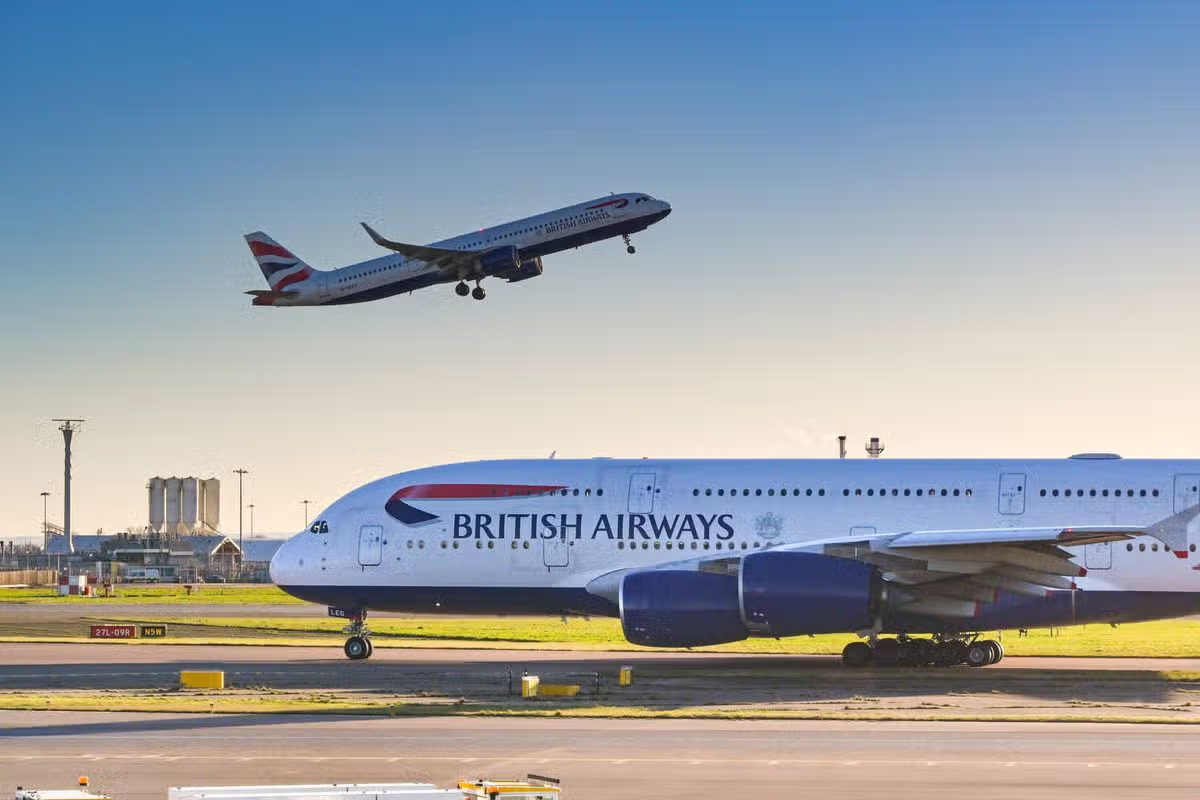
British Airways has said it will cut flights to six destinations and permanently end its route to a seventh, citing the war in the Middle East
British Airways said the cuts are due to the war with Iran (file)(Image: NurPhoto via Getty Images)
British Airways is cutting flights to seven major international airports in response to the ongoing conflict in the Middle East.
The airline said it has updated its schedule of flights for the Summer 2026 season, which ends on October 24. Customers have been told the changes were made to destinations in the Middle East due to the ongoing conflict between Iran and US-Israeli forces in the region.
As a part of the new schedule, British Airways has reduced the number of flights to seven cities in the Middle East. Services to Dubai are being reduced from three flights a day to one, with the daily service due to return on August 1 (meanwhile, a second daily flight is planned to start on October 16).
Flights to Doha in Qatar, Riyadh in Saudi Arabia and Tel Aviv in Israel are also being cut from twice‑daily to once‑daily. All three routes are expected to resume normal frequency on August 1.
Following a wider review of the programme, the airline has also made the decision to permanently end its route to Jeddah in Saudi Arabia from April 24, The Express reports.
The airlines said in a statement: “Due to the ongoing situation in the Middle East, we have made further changes to our flying schedule to provide greater clarity for our customers.
“We are keeping the situation under constant review and are directly in touch with affected customers to offer them a range of options.
“Since the disruption began, we have helped thousands of customers return home, operated relief flights, and added additional capacity on key long‑haul routes. We will continue to assess and introduce further flying where possible.”
Destinations impacted by reduced British Airways flights
Hundreds of passengers were left stuck at major UK airports as airlines included British Airways cancelled departing flights alongside hundreds of other delays
British Airways cancelled further flights on Friday (Image: Jaroslaw Kilian via Getty Images)
Hundreds of passengers have been left stranded at major UK airports after several flights have been cancelled.
British Airways were one of many airlines who cancelled flights on Friday, May 15, leaving travelers stuck at several airports across the nation.
The significant wave of disruption saw a total of 465 flight delays and 25 cancellations on the one day.
Flights from British Airways, American Airlines, Norse Atlantic Airways, Delta Air Lines and United Airlines were among those impacted.
London Heathrow was the most significantly impacted, with 233 flights delayed.
A total of 22 flights were also cancelled from the busy travel hub, with 17 of these being British Airways flights.
At Gatwick, cancellations were kept to a minimum with only one British Airways journey called off.
Despite this, 142 flights from the London airport departed later than scheduled.
In Scotland another British Airways flight did not go ahead, with a further 58 delays logged from Edinburgh airport.
Glasgow also saw a cancellation from British Airways.
The disturbance comes as the travel industry is suffering at the hands of the Middle East conflict due to hiking fuel costs as the Strait of Hormuz remains blocked.
Data shows that airlines have dramatically ramped up flight cancellations for May as jet fuel costs continue to soar.
In total, Cirium recorded 296 departures from UK airports scrapped this month as of Tuesday; a sharp rise from 120 cancellations just six days earlier.
Last week, British Airways’ parent company IAG warned its profits will be hit as it expects to spend about two billion euro (£1.72 billion) more than planned on fuel this year.
Chief executive Luis Gallego said IAG does not believe there will be “any interruption for the summer” in terms of jet fuel supplies.
Airlines have been forced to cancel and amend flight schedules due to the ongoing Middle East conflict and soaring jet fuel prices, with Qatar Airways also hit with suspended routes
16:38, 14 May 2026Updated 16:39, 14 May 2026
Qatar Airways has suspended routes to 22 cities(Image: Getty Images)
Qatar Airways has become the latest airline to cancel flights this May.
Since the Middle East conflict erupted in late February, airlines have been forced to axe routes and amend flight schedules due to restricted airspace across the Gulf region. The situation was heightened by Iran’s blockade of the Strait of Hormuz, through which roughly 20 percent of the world’s oil and gas passes, triggering a worldwide shortage and skyrocketing jet fuel prices.
With growing concerns over the long-term supply of jet fuel, a whopping 18 airlines have announced cancellations, and 13,000 flights worldwide have been taken from May schedules, according to figures from aviation analytics firm Cirium. Now, Qatar Airways is the latest airline to have routes axed, with flights to 22 cities suspended during May and beyond.
Qatar Airways has suspended flights from its Doha Hamad International Airport (DOH) to four European countries, Malta, Sarajevo, Sofia, and Venice, according to Simple Flying. As airlines prioritise their routes amid the jet fuel crisis, it is thought Qatar Airways will resume routes to Malta, Sofia and Venice in September.
Additionally, the Doha-based airline is not currently offering flights from its hub to Canberra, Cebu, Djibouti, Kano, Kigali, Mogadishu, Nagpur, or Zanzibar. Around half of these routes are expected to return in September, after one of the busiest travel periods, the summer holidays.
As a result of the Middle East conflict, drone and missile strikes caused major airspace closures, which severely impacted the Doha-based airline. Further routes suspended by Qatar Airways include flights to Aleppo, Gassim, Istanbul Sabiha Gökçen, Mashhad, Neom Bay, Shiraz, Tabuk, Taif, Tehran, and Yanbu. In addition to three cities in Iran, where the airspace remains closed.
Some of the suspended routes, excluding Aleppo and Iran, are expected to resume in September. In total, 22 routes have been suspended.
However, it’s not all bad news in the world of aviation this week. Qatar Airways announced that it is resuming some of its routes and that its Airbus A380s will return next month. The plane has been grounded. In a statement released on 13 May, the airline said: “Qatar Airways continues to restore its network across the Middle East, with the resumption of double-daily passenger flights to Abu Dhabi (AUH), the capital of the United Arab Emirates.”
This comes after the airline announced plans to expand its network further in time for the summer holidays. “Qatar Airways is expanding its international flight network, with services to over 150 destinations from 16 June 2026, connecting more passengers to more of the world this summer,” the statement read.
Airlines with cancelledflights in May
Air Asia X
Air Canada
Air China
Air Transat
Air New Zealand
Asiana Airlines
Cathay Pacific
Delta
KLM
Lufthansa
Norse Atlantic
Qantas
Qatar Airways
SAS
Thai Airways
Turkish Airlines
United Airlines
Vietjet
Vietnam Airlines
Do you have a travel story to share? Email webtravel@reachplc.com
British Airways is understood to be looking at raising fares following a hit caused by a spike in jet fuel costs
15:43, 10 May 2026Updated 15:44, 10 May 2026
Costs are up for airlines across the world
British Airways (BA) has released a statement to passengers concerning possible price rises. The UK’s flag carrier airline shared the announcement across its social media platforms.
In a post titled ‘The British Airways Holidays Promise’, it emphasised that existing customers would not face an increase in their holiday costs if they had already made a booking, even if the airline’s operating expenses rose.
The price of aviation fuel has roughly doubled since the commencement of US-Israeli strikes on Iran in late February. It continues to remain elevated, despite a lull in hostilities and speculation about an end to the conflict.
It confirmed that the ‘cost of your holiday won’t change once you’ve booked your trip’. The full statement declared: “Book with confidence, whatever’s happening in the world.
“The price you book is the price you pay. Once you’ve booked your flight or holiday package, the price you’ve paid is locked in and won’t change, even if our costs increase later.
Content cannot be displayed without consent
“You can secure your holiday with a low deposit now and spread the agreed cost over time. The cost of your holiday won’t change once you’ve secured your trip.
“When you book a package with British Airways Holidays, we offer you a dedicated helpline, 24/7, in case you need assistance during your trip. All packages booked in the UK with British Airways Holidays are ATOL protected, giving you peace of mind from the moment you book and while you’re away.
“If your flight is cancelled, as part of a British Airways Holidays package or flight only booking, we’ll always offer you the option to rebook onto another flight or to accept a full refund under UK and EU Regulations. Your holiday is protected, so you can focus on looking forward to it.”
This follows confirmation that BA’s charges are set to increase as the airline attempts to recoup some of its financial losses. The Guardian reports the carrier has taken a €2bn (£1.7bn) hit to its finances due to soaring jet fuel costs.
The International Airlines Group (IAG) revealed its annual fuel bill is now projected to reach around €9bn, up sharply from the previously forecast €7.1bn. The group anticipates recovering roughly 60 per cent of the €2bn shortfall through ‘revenue and cost management actions’, with BA expected to shoulder the majority of the fare hikes.
epa11846878 British Airways aircraft at Gatwick Airport in London, Britain, 23 January 2025. The British government is considering airport expansions in London. Plans for a third runway at Heathrow and a second runway at Gatwick are under review by the Treasury in an effort to boost growth. Transport Secretary Heidi Alexander has a deadline of 27 February to decide whether to permit Gatwick to bring its existing emergency northern runway into routine use. EPA/ANDY RAINCredit: EPA
BRITISH Airways passengers face higher fares after its parent company warned rising oil prices will add about £1.72billion to its fuel bill this year.
International Airlines Group (IAG), which also owns Iberia and Aer Lingus, said it expects to pass on part of the extra cost through ticket prices, with business class and other premium long-haul passengers among those most likely to be affected.
Sign up for the Travel newsletter
Thank you!
IAG warned the crisis could deepen if the strait remains blocked, with global jet fuel supplies potentially restrictedCredit: Getty
Chief executive Luis Gallego said airlines need to increase fares to help offset fuel costs, which make up about a quarter of their spending.
The rise follows disruption linked to the Middle East conflict and the closure of the Strait of Hormuz, which normally carries about a fifth of the world’s oil and gas shipments.
IAG warned the crisis could deepen if the strait remains blocked, with global jet fuel supplies potentially restricted.
However, the group said it does not expect any disruption to summer fuel supplies.
Mr Gallego said there is less jet fuel coming from the Middle East, but there are “other places with record supply” such as the US.
He said IAG has been “planning for situations like this for many years”, and has invested in its own jet fuel supply at its “main hubs”.
The company recorded a pre-tax profit of £365million during the three months to the end of March.
That was a 76.6% increase from £207million a year earlier.
The group now expects its annual fuel bill to reach £7.78billion.
Mr Gallego attributed the firm’s “strong first quarter” to “continued strong demand for our networks and airline brands”.
He added: “IAG is uniquely positioned to navigate the current headwinds created by the Middle East conflict thanks to our leading positions across diverse markets, strong brands, structurally high margins and strong balance sheet, as well as a strong track record of execution.”
IAG said about 3% of its capacity was “exposed to the Gulf region” at the start of the war on February 28, mostly with British Airways flights.
A large part of this has been redeployed, including boosting capacity at destinations where there are now fewer flights by Middle East carriers such as Bangkok, Singapore and the Maldives.
British Airways has also announced additional flights this summer on routes with higher demand for direct flights, such as India and Nairobi.
This European carrier serves regionally inspired dishes at 35,000ft
Andrea Blazquez Editor of Spare Time
14:56, 03 May 2026Updated 14:56, 03 May 2026
Airline with the best food named – not British Airways, Virgin or Emirates
A Greek airline boasting a fleet of 83 aircraft has been named the top carrier for in-flight dining, beating major rivals including Emirates, Virgin Atlantic, Qatar Airways, and British Airways. A study by Canstar Travel Insurance analysed passenger reviews and meals from the world’s top 100 airlines, concluding that Greek carrier AEGEAN serves up the finest food, earning an impressive score of 7.82 out of 10.
AEGEAN treats passengers to authentic Greek cuisine and regionally inspired dishes, while in business class, meals are lovingly prepared by acclaimed Greek chefs and sommeliers. The airline’s culinary philosophy is rooted in the concept of filema, which champions “love and kindness through food”. Other carriers delivering exceptional onboard dining include Qatar, Asiana Airlines and EVA Air.
On Tripadvisor, one traveller who recently flew with Aegean wrote: “Aegean Airlines is simply amazing! The level of service is very high, and it is incredibly easy to reach their call centre whenever you need help or extra information. On board, they offer food and drinks, and everything was delicious.”
A second passenger added: “I have used British, Virgin, easyJet, Ryanair… but no one is better, always on time and sometimes even earlier at the destination than Aegean Airlines.
“Although I’m Italian, I use it instead of Alitalia when I’m travelling to my country. Warm and delicious food and choices of wines and a particular menu for any kind of dietary or religious needs.”
In a world of smartphones and content creators, airlines have strict rules on taking photos or videos while on board, with British Airways tightening its passenger regulations
16:41, 01 May 2026Updated 16:42, 01 May 2026
Holidaymakers need to be aware of the regulations for taking photos or videos during a flight (Image: Getty Images/Stock Image)
Every airline has passenger regulations, but holidaymakers may not be aware of the restrictions on taking photos during a flight, as British Airways tightens its rules.
Heading off on holiday is always an exciting time, and it’s natural to want to document the journey, from arriving at the airport and boarding the plane to landing at that sun-drenched destination. But for those eager to take photos or videos during their flight, there are stringent guidelines to follow.
A vast number of airlines that fly thousands of Brits to holiday hotspots every year have specific policies on using a camera on board. While they affirm that it’s not a blanket ban and passengers are still allowed to take photos or videos during the flight, they can’t capture everything on board.
Just recently, British Airways introduced tougher guidelines on taking photos and videos while on board and revised its passenger terms. In an update under section 11a on its ‘behaviour on the aircraft’ conditions, the airline noted that none of its crew should be filmed without their consent.
The update stated: “If, while you are on board the aircraft, we reasonably believe that you have filmed, live-streamed or photographed our crew or other colleagues without their consent, we may take any measures we think reasonable to prevent you continuing your behaviour.”
The airline went on to warn that passengers who fail to comply with these rules could be asked to disembark upon landing or be refused passage on the remaining legs of their journey, as shown on their ticket. That’s not all; the incident could be reported to the relevant authorities “with a view to them prosecuting” the passenger for any criminal offences that may have been committed.
BA also pointed out that if diversion expenses arise due to unacceptable conduct, and they redirect the aircraft to an “unscheduled place of destination” and remove a passenger from the plane, that traveller will be liable for the “reasonable and proper costs of the diversion”.
They’re not the only airline to have a policy of this nature in place. Outlining their own policies on the common habit, a Virgin Atlantic spokesperson told the Mirror: “We know our customers enjoy capturing moments during their journey, and photography and filming are permitted onboard. However, we ask that customers always seek permission before including other people, including our crew, in any photos or videos. The comfort and well-being of our customers and crew is always our priority, and our crew may ask customers to stop filming or photographing to protect the privacy of those onboard.”
Meanwhile a spokesperson for Wizz Air told us: “Wizz Air is proud of its cabin crew, who play a vital role in maintaining the safety and security of everyone on board. Filming or taking pictures of cabin crew without their consent is not tolerated on board. Passengers are required to follow crew instructions at all times, and where behaviour is considered disruptive, unsafe, or causes concern to crew or other passengers, appropriate action may be taken in line with our Conditions of Carriage. Our priority is always to help ensure a safe and respectful onboard environment for both passengers and crew.”
As for easyJet, a spokesperson told us: “Customers are welcome to take personal photos and videos as long as it doesn’t disturb the privacy of other customers or include the crew without their consent, so everyone can have a pleasant flight.”
Meanwhile, Ryanair states in its terms and conditions: “Recording or photographing our personnel, whether at the airport or onboard the plane, without their consent is strictly prohibited. Only recordings or photographs personal to you may be permitted.”
While airlines have these regulations in place, it doesn’t mean holidaymakers can’t document their flights. They’re still free to capture images of their seat, the view through the window, cabin features, meals, drinks and any other personal moments – provided they don’t film a crew member directly without their permission.
The same rule applies to photographing or filming fellow passengers on board without their consent. So as long as travellers remain mindful of their surroundings and what they’re recording, it shouldn’t be an issue.
Do you have a travel story to share? Email webtravel@reachplc.com
British Airways has enforced stricter rules for passengers, including a habit that is now banned, and if failed to comply, the airline may take ‘any measures’ necessary to stop it
This article contains affiliate links, we will receive a commission on any sales we generate from it. Learn more
British Airways has updated its policies for passengers on board, enforcing a strict ban(Image: Getty Images)
British Airways has enforced stricter rules for passengers about a behaviour that could see them removed from the aircraft.
In a world of influencers and content creators, using smartphones on planes has become increasingly popular, with many opting to capture every moment of their journey in photos or videos. Even holidaymakers without a mega social media following often snap their experience on board.
While it might seem like a relatively harmless act, it can actually land travellers in serious trouble, whether they’re a content creator or not. British Airways has updated its terms for passengers on board, introducing stricter guidelines on taking photos and videos.
In an update under section 11a on its ‘behaviour on the aircraft’ conditions, the airline stated: “If, while you are on board the aircraft, we reasonably believe that you have filmed, live-streamed or photographed our crew or other colleagues without their consent, we may take any measures we think reasonable to prevent you continuing your behaviour.”
They further outlined that if passengers fail to comply with these rules, they could be asked to leave the aircraft, upon landing, or be refused carriage on the remaining sectors of the journey shown on their ticket. Additionally, it could also result in the incident on board being reported to relevant authorities “with a view to them prosecuting” the passenger for any criminal offences that might have been committed.
BA also noted that if diversion costs are a result of unacceptable behaviour, and they divert the plane to an “unscheduled place of destination” and make a passenger leave the aircraft, the traveller will have to pay the “reasonable and proper costs of the diversion”.
However, this doesn’t mean that passengers are completely banned from taking photos while on board. They can still grab a snap of their seat, view out of the window, cabin features, meals, drinks and any other personal highlights – as long as they don’t directly film a member of cabin crew without their consent.
This is the same rule for taking photos or videos of other passengers while on board without their consent. So as long as holidaymakers are wary of their surroundings and what they’re capturing, they can still document their journey, be it for social media or a personal travel album.
BA isn’t the only airline to enforce these rules, banning photos of cabin crew without consent. Ryanair states in its terms and conditions: “Recording or photographing our personnel, whether at the airport or onboard the plane, without their consent is strictly prohibited. Only recordings or photographs personal to you may be permitted.”
Do you have a travel story to share? Email webtravel@reachplc.com
AS THE fuel crisis continues to put pressure on airlines, it can be hard to know what it means for your upcoming flight.
For some airlines, rising fuel costs are being offset by raising the price of flight fares such as Virgin Atlantic, with British Airways also recently warning of flight fare increases.
Sign up for the Travel newsletter
Thank you!
Follow The Sun’s award-winning travel team on Instagram and Tiktok for top holiday tips and inspiration @thesuntravel.
Yet there are also a number of airlines that have vowed not to increase costs for their passengers. Here’s a full rundown of the UK airlines that have not changed their prices:
Jet2
Currently, Jet2 has not increased the prices of its flights and holidays due to rising jet fuel costs, and both holidays and flights with the company remain unaffected.
A Jet2 spokesperson told Sun Travel: “We remain in continual dialogue with our fuel suppliers, as is standard practice.
“Based on the conversations we have been having, we see no reason not to look forward to operating our scheduled programme of flights and holidays as normal.”
Jet2 boss Steve Heapy added: “Holidaymakers should have every right to book their hard-earned break in the sun, without worrying about being hit with additional costs, and they can have that complete assurance when they book a flight or holiday with Jet2.
“As a result of today’s announcement, customers booking with Jet2 know that they are locking in their price without additional cost surprises later and we strongly believe that is the right thing to do by them.”
EasyJet
EasyJet is not increasing flight prices, nor is the airline currently impacted by the fuel crisis.
A spokesperson told Sun Travel that passengers would not “suddenly face unexpected fees added to their bookings to cover fluctuating commodity costs”.
They added that there were “no plans to make any changes to our flying schedule”.
EasyJet has said that its passengers do not need to fear sudden unexpected feesCredit: Alamy
TUI
TUI holidays are not be increasing prices to cover fuel costs and are currently not impacted by the fuel crisis.
A TUI spokesperson told Sun Travel: “We’re closely monitoring the developing situation in the Middle East and its potential impact on global aviation fuel supplies.
“At present, we’re not anticipating disruption to our flight schedules or holiday programmes from fuel shortages.”
Ryanair
Europe‘s biggest airline has not increased costs for passengers and has not cancelled any flights due to the fuel crisis yet.
This week, the airline’s CEO Michael O’Leary said that he was committed to not implementing price increases or adding fuel surcharges to flight fares.
However, O’Leary has previously warned that it could cancel flights in the future, saying: “We don’t expect any disruption until early May, but if the war continues, we do run the risk of supply disruptions in Europe in May and June, and we hope the war will finish sooner than that and the risk to supply will be eliminated.”
Ryanair is another budget airline that has not yet increased prices for travellersCredit: Splash
Kuoni
When it comes to holiday package firm Kuoni – which specialises in tailor-made packages – they confirmed to MoneySavingExpert that no ‘holiday surcharge’ will be added to bookings.
Loveholidays
Similarly, Loveholidays – which offers packages to sunshine destinations and city breaks – also confirmed to MoneySavingExpert that there would be no additional charges on bookings.
The comment from the owner of BA comes after Jet2 said it would not introduce surcharges on any booked flights or holidays to cover cost increases
08:33, 25 Apr 2026Updated 08:37, 25 Apr 2026
British Airways’ fully-funded programme has been running for the last three years(Image: GETTY)
The parent company of British Airways has cautioned that airfares are set to climb as the closure of the Strait of Hormuz, triggered by the Iran conflict, has caused oil prices to surge dramatically.
International Airlines Group (IAG) announced on Friday that the ongoing Middle East crisis will push up the cost of flights to account for soaring jet fuel prices.
Airlines routinely purchase a portion of their fuel in advance at fixed rates to shield themselves from price fluctuations, a strategy commonly referred to as “hedging”.
Despite this, IAG warned that it remained “not immune” to the wider consequences of the Middle East conflict. The group insisted it had yet to experience any disruption to its jet fuel supply, amid growing concerns over potential future shortages as a result of the ongoing hostilities.
The government is “closely monitoring” fuel stocks as airlines brace themselves for possible shortages, with oil tankers still unable to navigate the Strait of Hormuz. It has also emerged that airports are set to make it simpler for airlines to cancel flights without jeopardising their allocated take-off and landing slots, should fuel shortages prevent them from operating. The Department for Transport (DfT) announced that airlines will no longer be obliged to adhere to the “use it or lose it” rule at UK airports, whereby carriers must utilise at least 80% of their allocated slots during a season in order to retain them for the following year. “Airport Coordination Limited, the independent body that manages slot allocation at UK airports, has updated its guidance so that airlines will not lose their slots if fuel shortages prevent them from flying,” the DfT statement confirmed.
“Airlines can now apply for an exemption from the ‘use it or lose it’ rule in these circumstances.”
Meanwhile, Jet2 has revealed it will not be imposing surcharges on any previously booked flights or holidays to offset rising costs, reassuring customers that the price they book is the price they will pay.
The policy covers all flights and holidays booked through any channel, whether online, via the mobile app, contact centre or through an independent travel agent. Steve Heapy, CEO of Jet2 said: “Holidaymakers should have every right to book their hard-earned break in the sun, without worrying about being hit with additional costs, and they can have that complete assurance when they book a flight or holiday with Jet2. As a result of today’s announcement, customers booking with Jet2 know that they are locking in their price without additional cost surprises later and we strongly believe that is the right thing to do by them. Ahead of a busy summer this is yet more evidence of why, on top of our incredible holidays and award-winning customer service, nothing beats a Jet2holiday.”
FOR many of us, the idea of being a pilot is about as glamorous as it gets – but what is it actually like? Is all that globe-hopping as magical as it seems?
We spoke to two of BA’s most experienced pilots, to find out what really goes on behind the closed cockpit door when the planes are in the sky.
Sign up for the Travel newsletter
Thank you!
British Airways pilots reveal what the job is really likeCredit: British AirwaysBritish Airways’ Training Standard Captain Andy Godwin has shared fascinating behind the scenes secretsCredit: British AirwaysSenior Flight Training Manager Mark Dorman recalled one of his most memorable flights, in an empty BA plane over the Northern LightsCredit: British Airways
It is no easy feat becoming a pilot but for British Airways‘ Training Standard Captain Andy Godwin and Senior Flight Training Manager Mark Dorman, flying feels like second nature.
The duo – who are training up wannabe pilots in the British Airways’ Speedbird Pilot Academy (applications currently open) – have answered some of the most common questions people have about flying a British Airways plane…
What’s something people always get wrong about BA planes?
“Everyone things you’d start a plane just like you would a car,” Mark told us. “But in reality, it doesn’t even have a set of keys – either to start it or even get inside.”
“We walk down the jetty, there’s a procedure to open the door, and you just knock – there’s no ignition either.”
What do the pilots eat during a flight?
Mark told us: “We eat very similar food as passengers but we have our own crew meals loaded.
“They’re cooked in the same way, they’ll quite often look quite similar but because of what we’ve potentially done before or what we’re potentially doing after [the flight] – the amount and the timings of food can vary.”
How do you stay alert with such antisocial schedules?
Andy said: “It’s all about planning ahead. You might have a run of early trips, where you don’t even necessarily have a risk of jet lag, but you’re always thinking about your nextsleep to keep your energy up.
“Because short haul can be tough on the body too – you’re working really hard with short sectors, bouncing around doing lots of briefings and lots of talking to the crew as well as passengers, so it’s important to care of little things like staying hydrated.”
“Because there were no passengers on board we were able to switch all of the lights off.
“It meant for the flight crew and the cabin crew, the aircraft was only lit by the Northern Lights for about 20 minutes – there was a really cool, weird green glow in the plane. It was a quite surreal experience.”
And of course, as BA pilots they get discounts on flightsCredit: Getty
He added: “One of my other favourite moments is when I realised I was flying an aeroplane – I was still a co-pilot at the time – and my friend was the captain.”
“We sort of looked at each other like we couldn’t quite believe that we’d been allowed to go flying an aeroplane together, with 140 passengers behind us.
“You’re coming home, you get incredible views, there’s a familiarity to it, it’s busy, it’s quite challenging at times but it’s nice.”
But for overseas, both pilots agreed on one particularly special destination – if a little scary at times – is Innsbruck in Austria.
Innsbruck Airport is in a valley, with such steep mountains either side that it’s a ‘Category C’ airport, which means it requires special training.
Both pilots commented on how special but tricky Innsbruck Airport is to fly intoCredit: Getty
Despite it perhaps being a more technical airport to land at, the mountains either side lend themselves to a spectacular landing and taking off experience with amazing views.
Mark said: “I feel very lucky to have been able to go and fly there.
“I guess the other places that I like, again it sounds a bit silly but places with nice views, I really like flying into Nice because it’s a really interesting approach and you get the most amazing view of the Cap d’Antibes coast around to Cannes.
“Again it’s one of those moments where you’re like, we’re actually doing this.”
What is one of the biggest misconceptions about being a BA pilot?
Andy said: “A question that we’ll quite often get is about what aeroplane we fly and why don’t we just switch to another, almost as if you’re switching between car manufacturers.
“Pilots are only licensed to fly one aircraft at a time so we couldn’t just go and fly another aircraft even though it’s broadly similar.”
“Most pilots are proud of the plane they fly and love being asked about it, the routes it does or anything that allows them to show off their knowledge.”
With 160 places available, the scheme is in its fourth year and covers the entire £100,000 cost of pilot training, over two years.
Trainees start on the ground for six months before taking the controls of a tiny four-seater plane and eventually moving up to a two-engine aircraft.
Andy said: “In a matter of months, you’re flying something lighter than a family car.
“Within a year, you’re in something 100 times heavier…”
One of the final hurdles after training on a simulator and in smaller planes, is taking off and landing a plane with zero passengers on board.
“It’s a once-in-a-career moment,” Andy said. “You do about six take-offs and landings to get your eye in before we let you fly the real thing with passengers.
“[This is] a very significant milestone in a pilot’s career.”
All trainees who complete the scheme are guaranteed a flying role with BA upon completion.
To apply to the Speedbird Academy you need to be 18-years-old or over at the start of training, have six GCSEs grade A-C or 4-9, including Maths, English Language and a Science, be fluent in English, have a valid passport and be between 1.52metres and 1.9metres tall.