Air Space & Cyber 2026

Anduril’s YFQ-44A Fury CCA Has Flown Alongside F-35s

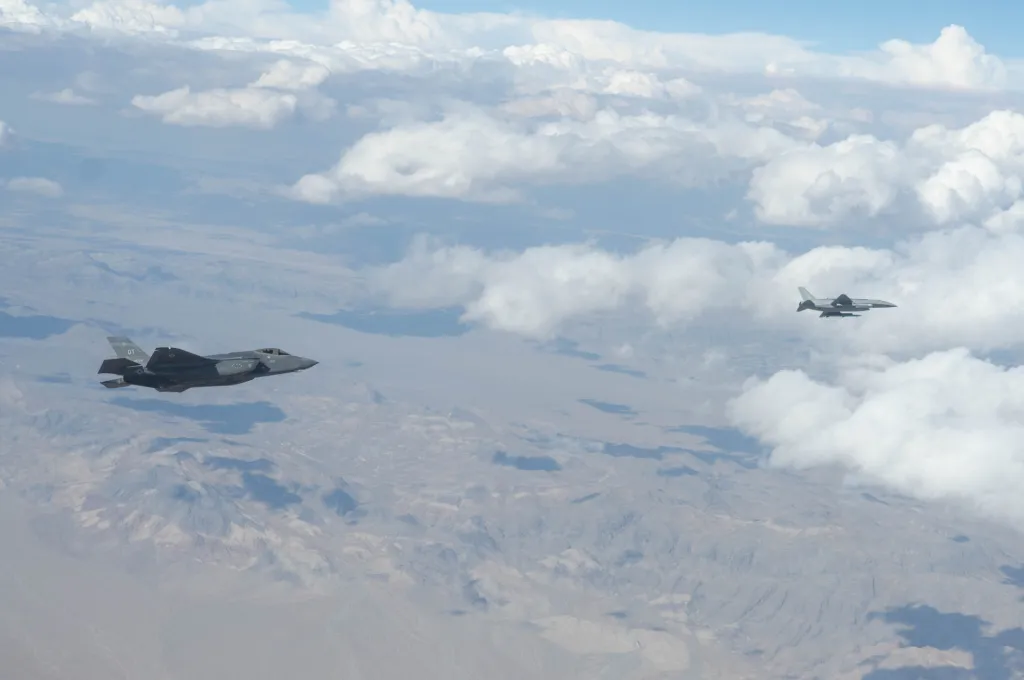
Anduril’s YFQ-44A Fury Collaborative Combat Aircraft (CCA) has already flown in formation alongside F-35 fighters during U.S. Air Force testing, company executives have revealed, offering the clearest indication yet that live manned-unmanned teaming work with the fifth-generation fighter is underway.

The disclosure came during a briefing by Anduril executives Jason Levin, senior vice president for Air Dominance and Strike, and Erin Simpson, vice president for Strategy for Air Dominance and Strike, at the Air & Space Forces Air, Space and Cyber Symposium that TWZ is attending. The executives said the Fury flew alongside F-35s during a July exercise conducted with the Air Force’s Experimental Operations Unit (EOU) at Creech Air Force Base, Nevada. You can read more about that event in our past reporting here.

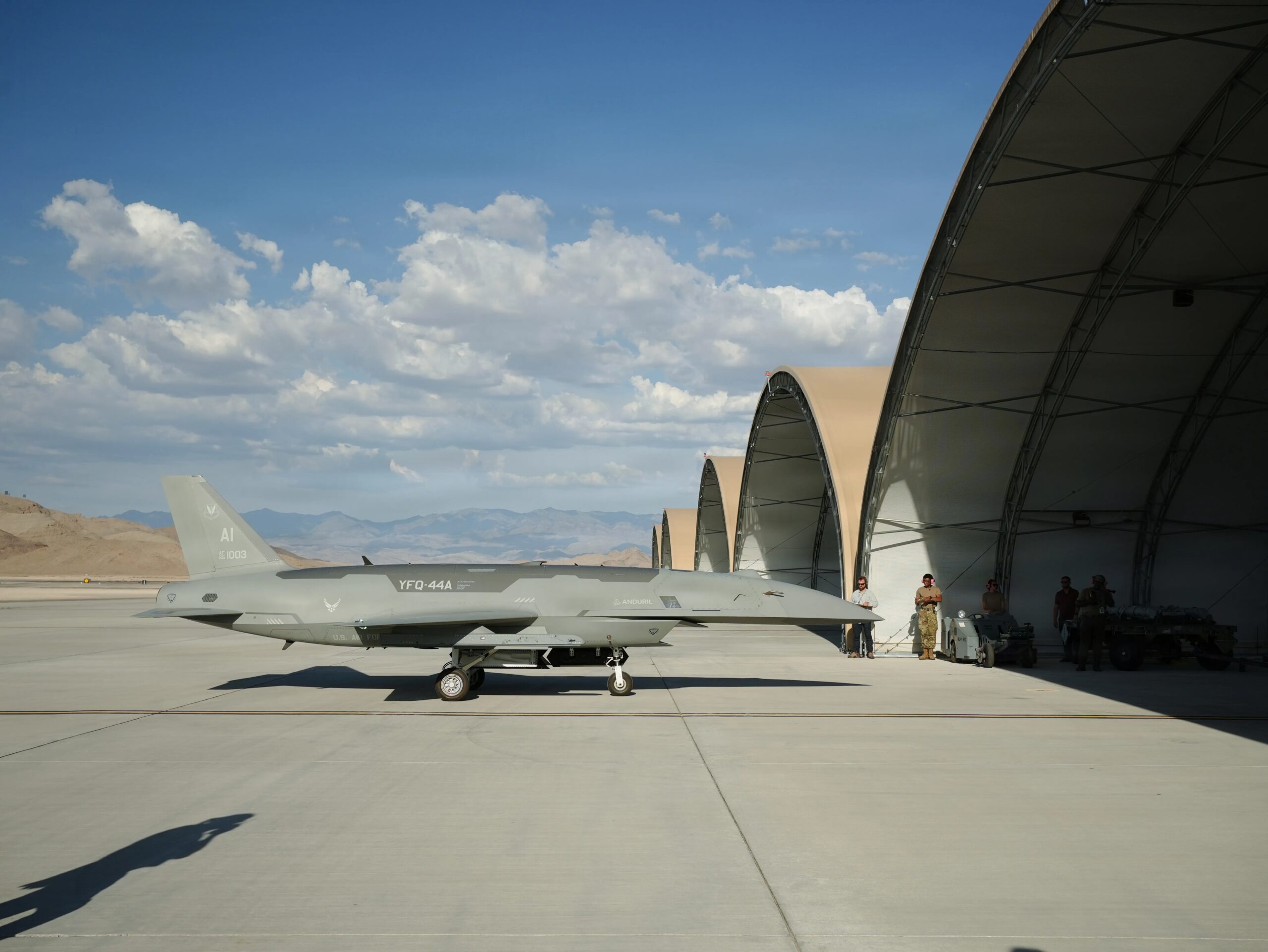
A YFQ-44A Fury aircraft assigned to the Collaborative Combat Aircraft Experimental Operations Unit taxis toward a sunshade at Creech Air Force Base, Nevada, July 20, 2026. The CCA took part in an Agile Combat Employment exercise that provided information necessary to validate the reduced logistical footprint required to operate in remote, forward-deployed locations. (U.S. Air Force photo by Senior Airman Renee Blundon)
A YFQ-44A Fury assigned to the Collaborative Combat Aircraft Experimental Operations Unit taxis toward a sunshade at Creech Air Force Base, Nevada, July 20, 2026. U.S. Air Force photo by Senior Airman Renee Blundon Senior Airman Renee Blundon

“We’ve already started flying in formation alongside crewed. I can even say fifth-gen fighters. F-35,” Levin said.

The testing is an important step toward the Air Force’s broader vision for its Collaborative Combat Aircraft program, in which relatively inexpensive autonomous aircraft are intended to operate alongside and support crewed fighters in contested airspace.

The executives stressed, however, that the F-35 was not yet controlling the Fury during those flights.

“But they’re not controlling it from the crewed fighter yet,” Levin said. “Not yet.”

Instead, the July testing involved Fury operating under its Mission Autonomy system while sharing airspace with crewed fighters, other CCAs, and other aircraft. Anduril says Air Force personnel were able to operate the autonomy system without Anduril personnel directly running the aircraft, although company personnel remained on site in a supporting role.

Lattice for Mission Autonomy: An Unfair Advantage for Unrivaled Deterrence thumbnail

Lattice for Mission Autonomy: An Unfair Advantage for Unrivaled Deterrence

The company described the progression toward direct manned-unmanned teaming as a “crawl, run, build-up” process.

Anduril says it has already begun work on what it calls “quarterback integration,” referring to the ability for a crewed aircraft to direct or task autonomous aircraft. That work has been conducted in hardware-in-the-loop and software-in-the-loop environments as well as on the Fury itself.

“Most of those events will be coming up here in a matter of weeks or months,” Levin said when asked about the timeline for the first quarterback integration with Fury.

Asked whether those events would involve live flying, the answer was unequivocal: “Yes.”

A YFQ-44A, part of the Air Force’s Collaborative Combat Aircraft (CCA) program, undergoes an undated captive carry test at a California test location. This test phase uses inert munitions to methodically validate weapons integration, structural performance and safety, ensuring the platform can safely carry external stores. The CCA program is a critical part of a larger, integrated system-of-systems designed to extend the reach and effectiveness of crewed aircraft, giving U.S. warfighters an overwhelming advantage in future conflicts. (Courtesy photo)
A YFQ-44A undergoes an undated captive carry test at a California test location. This test phase uses inert munitions to methodically validate weapons integration, structural performance and safety, ensuring the platform can safely carry external stores. Courtesy photo via U.S. Air Force Secretary of the Air Force Publi

Exactly how an F-35 would control Fury remains part of that ongoing development effort. The executives pointed to work involving integration of the appropriate human-machine interfaces, primarily including tablet-based control from the crewed fighter, at least at first.

The distinction between flying alongside an F-35 and being controlled by an F-35 is important. The former demonstrates that Fury’s aircraft and autonomy systems can operate safely in the same battlespace as a fifth-generation fighter. The latter would represent a much more significant demonstration of the operational concept behind CCAs: allowing a single crewed fighter to employ and manage additional autonomous aircraft as part of a larger force.

Anduril’s July testing went beyond simple formation flying. The company said Fury was conducting Mission Autonomy flights using live sensor data and was operating in airspace shared with crewed fighters and other CCAs. Air Force operators reportedly conducted both relatively basic route and pattern work and more representative tactical scenarios.

The Fury’s work with the Air Force’s Experimental Operations Unit has progressed through two increasingly ambitious phases. During the first exercise in April at Edwards Air Force Base, Air Force personnel were trained to operate the aircraft and were able to launch and recover it using Anduril’s compact Menace-T setup, essentially a pair of ruggedized cases and a laptop rather than a conventional ground-control station.

By the second exercise, conducted at Creech in July, the Air Force had reduced the manpower and infrastructure required further. A single EOU operator could launch and recover the aircraft after only hours of training, while Air Force personnel independently operated Fury’s Mission Autonomy. The aircraft also flew in airspace shared with other CCAs, while the exercise demonstrated disaggregated operations and a rapid “hot reload” in which two operators replaced an AIM-120 AMRAAM with the engine running, reducing the turnaround between sorties to single-digit minutes.

A U.S. Airman assigned to the Collaborative Combat Aircraft Experimental Operations Unit loads an inert missile onto a YFQ-44A Fury aircraft at Creech Air Force Base, Nevada, July 20, 2026. The data from the exercise will be used to develop and refine new tactics, techniques, and procedures for semi-autonomous air operations when deployed from main operating bases. (U.S. Air Force photo by Senior Airman Renee Blundon)
A U.S. airman assigned to the Collaborative Combat Aircraft Experimental Operations Unit loads an inert missile onto a YFQ-44A Fury aircraft at Creech Air Force Base, Nevada, July 20, 2026. U.S. Air Force photo by Senior Airman Renee Blundon Senior Airman Renee Blundon

The July exercise also included a live weapons demonstration that Anduril characterized as a complete end-to-end kill chain rather than simply a captive-carry or basic weapons-release test. The Fury launched from Edwards with a single operator and received a track generated by an external source over a beyond-line-of-sight connection. That track was ingested by Anduril’s Lattice AI-infused autonomy software system, after which the operator tasked the aircraft to engage. Fury then launched an AIM-120 AMRAAM and guided the weapon to the target. Anduril described the test as demonstrating the complete kill chain from offboard targeting information, through the aircraft’s mission systems and operator tasking, to an actual air-to-air weapons engagement.

On the weapons side, the production FQ-44 is being designed around four external hardpoints, allowing it to carry four AIM-120 AMRAAMs for the Air Force’s primary air-to-air mission set. Currently, the demonstration aircraft can carry two. Regardless, the company is also pursuing a much broader weapons portfolio for Fury. Executives said they have already begun integration and fit checks for 500-pound guided bombs, Small Diameter Bombs, low-cost cruise missiles — including Anduril’s Barracuda 500 offering — other air-to-air weapons, rocket pods and targeting pods. Those integrations are intended to give Fury options beyond air-to-air combat, including counter-drone, counter-cruise-missile and air-to-ground/air-surface strike missions. Anduril stressed that these are currently integration and engineering efforts rather than claims that all of those weapons have been flight-tested from Fury. The company also said additional sensors, such as a targeting pod, could be added for some of those missions.

The executives acknowledged that some of the more advanced tactical capabilities remain under development and are being explored extensively in simulation. Those efforts include areas such as sensor fusion, track discrimination and tactical engagements.

A U.S. Air Force YFQ-44A Fury aircraft, assigned to the Collaborative Combat Aircraft Experimental Operation Unit, takes off for a mission flight during an Agile Combat Employment exercise at Creech Air Force Base, Nevada, July 21, 2026. The flight was part of a broader ACE exercise designed to test the resilience, adaptability, and combat effectiveness of the semi-autonomous fleet. (U.S. Air Force photo by Staff Sgt. Kristal Munguia)
A U.S. Air Force YFQ-44A Fury takes off for a mission flight during an Agile Combat Employment exercise at Creech Air Force Base, Nevada, July 21, 2026. U.S. Air Force photo by Staff Sgt. Kristal Munguia Staff Sgt. Kristal Munguia

The ultimate objective is an aircraft that does not require a large ground-control infrastructure or a dedicated operator for every individual sortie. As previously noted, during the July exercise, Anduril says a single Air Force operator was able to launch and recover a Fury after only hours of training, while other Air Force personnel operated the aircraft’s Mission Autonomy functions.

That same exercise also demonstrated what Anduril described as “disaggregated operations,” with personnel at multiple locations able to operate the same aircraft. The concept is intended to support an Agile Combat Employment-style approach in which CCAs can be dispersed across multiple operating locations rather than relying on a single large ground footprint.

The company has since delivered a Fury aircraft to the Air Force’s EOU at Creech, making it the first CCA to be permanently delivered to the unit, according to Anduril. The service is now flying the aircraft multiple times a day with what the company said is a very limited Anduril presence.

A YFQ-44A production representative test vehicle is staged in a testing chamber at Costa Mesa, Calif. The Department of the Air Force’s has begun ground testing for the Collaborative Combat Aircraft program to validate performance and readiness for future flight testing. (Courtesy photo)
A YFQ-44A production-representative test vehicle is staged in a testing chamber at Costa Mesa, California. Courtesy photo via U.S. Air Force Master Sgt. Gustavo Castillo

Meanwhile, Anduril says assembly of Fury airframes has already begun at its Arsenal facility, with production aircraft expected to begin coming off the line early next year. The company says it has built the facility and supply chain around a potential production rate of 150 aircraft per year, although that figure is a planned capacity rather than an existing Air Force order. Anduril executives said the company has already advanced procurement of long-lead items and worked with its Tier 1, 2 and 3 suppliers to support that rate, while also examining additional production lines. They emphasized that the current Air Force pricing is based on a substantially lower annual buy than 150 aircraft, but said the Fury’s unit cost is well below $20 million at the quantities currently contemplated. The company also says the production line is designed for relatively rapid reconfiguration, allowing capacity to be shifted between products in weeks rather than the months or years associated with more traditional aircraft production facilities.

Earlier this year, the Air Force awarded contracts for the production of FQ-44A Fury and General Atomics FQ-42A Dark Merlin drones — the latter has now been formally named Vengeance. This sets the service up to operate a split initial fleet of CCAs. As you can read about here, the Air Force is now aiming to have at least 500 CCA in service by 2032, a substantial step up from earlier plans, with the USAF having previously talked about acquiring “over” 150 of these drones by the end of the decade. The 500 target will likely include upcoming increment two CCAs, as well, the requirements of which the Air Force is still working on.

For Anduril, the next major milestone should go far beyond simply putting a Fury and an F-35 in the same formation, demonstrating that a crewed fifth-generation fighter can actually command and employ the autonomous aircraft as part of a live mission.

If Anduril’s timeline holds, that testing could begin relatively soon.

Contact the author: thomas@thewarzone.com

Thomas Newdick is a staff writer at TWZ, where he covers military aviation, defense technology, weapons systems, and international security. Based in Berlin, Germany, he reports on conflicts, military modernization efforts, and emerging aerospace technologies around the world, with a particular interest in airpower and its role in contemporary warfare. His reporting is informed by deep expertise in modern and historical airpower, particularly in Europe, with a focus on military aviation, air campaigns, and aerospace developments across the continent and beyond.


Source link

U.S. Admits It Has Weapons In Orbit

Secretary of the Air Force Troy Meink made a bombshell admission this morning, disclosing that there are on-orbit weapons deployed right now to protect America’s interests in space. Those weapons support a Space Control mission set, and the U.S. Space Force has now also shared additional details about that directly with TWZ.

Meink first made mention of what he described as “on-orbit space control weapons” during his keynote speech earlier today at the Air & Space Forces Association’s (AFA) 2026 Air, Space & Cyber Conference, at which TWZ is in attendance. As head of the Department of the Air Force, Meink serves as the top civilian overseeing both the Air Force and the Space Force. Space-based weapons have historically been a very sensitive topic for the U.S. military, with much discussion over the decades about whether such capabilities could already exist to varying degrees in the American arsenal. There has already been a dramatic shift in this regard in recent years, with the head of U.S. Space Command (SPACECOM) openly declaring the acquisition of new anti-satellite weapons to be a top priority just last month.

The first official painting commissioned by the Space Force, seen here, explicitly depicts a duel between a reusable spaceplane and a hostile ‘killer satellite.’ USSF

“Today, we continue to ensure we remain ready to meet the challenges of evolving threats, wherever they exist,” Meink said during his keynote address. “This is why the United States now has on-orbit space control weapons capable of defending the joint force against hostile adversary action.”

“That phrase was very well thought out. So whatever I said before is what I say again,” he said when asked if he could elaborate in any way on those capabilities at a question-and-answer session immediately following his speech. “It is critically important that we maintain our dominance not only in the air, but in space, and so we’ve had to take steps to make sure that when we’re threatened, we can take care of that.”

“Not going to go into specifics on the type of weapon,” Meink said when asked again if he could elaborate at a press roundtable with TWZ and other outlets on the sidelines of the Air, Space & Cyber Conference today. “Just like in air dominance, we need to maintain dominance in space as it becomes more and more important to how we function, how we operate militarily, and economically [and] civilian-wise.”

“There’s a lot of factors that go into how we talk about these things. We spend a lot of time talking about how we’re going to talk about these things,” Meink added at the roundtable when asked about why this disclosure was being made now and its implications for deterring adversaries.

“It is important from a deterrence perspective, but on the other hand, me talking about the details of what we’re doing would actually not benefit that deterrence,” he continued. “So I’m not going to talk about the specifics of what we’re doing, whether we’ve tested or not tested, or anything else.”

Secretary of the Air Force Troy Meink speaks during the change of responsibility ceremony for Chief of Space Operations Gen. Douglas Schiess on Sept. 3, 2026. USAF/Eric Dietrich

TWZ had separately reached out for more information after Meink made his initial remarks this morning.

“It is longstanding policy that the U.S. will protect and defend the Joint Force through all domains,” a Space Force spokesperson subsequently told us. “We are increasing readiness against existing threats, and the U.S. has on-orbit space control weapons capable of defending the Joint Force against hostile adversary action.”

“Space control encapsulates the mission areas required to contest and control the space domain – employing kinetic and non-kinetic means to affect adversary capabilities through disruption, degradation and even destruction, if necessary,” they continued. “These capabilities can be employed for offensive and defensive purposes at the direction of combatant commands. U.S. military operations are conducted in compliance with international law, including the Outer Space Treaty and LOAC [the Law of Armed Conflict].”

The Outer Space Treaty, which came into force in 1967, prohibits the United States and other signatories from placing nuclear weapons and other weapons of mass destruction (WMD) in orbit. It does not impose limits on the deployment of conventional weaponry. After receiving this initial statement from Space Force, TWZ followed up to ask whether the service was confirming that it has kinetic (e.g. physical interceptors) and non-kinetic space control weapons (e.g. electronic warfare jammers) now, and that any such weapons could be employed both offensively and defensively.

“We are confirming that the United States has on-orbit space control weapons capable of defending the Joint Force against hostile adversary actions,” the Space Force spokesperson said in response. “Beyond that, we will not discuss specific operational methods, payloads, technical characteristics, or employment concepts.”

A look inside a U.S. space command center. US Space Command

“As the Space Force continues to mature, our public discussion is intended to clarify doctrine and mission sets, not disclose sensitive operational details,” they added. “What is important is that the U.S. Space Force is committed to the long-term safety, security, and sustainability of the space domain, and our operations are guided by longstanding principles of professional military behavior and international law. That commitment remains central as space operations continue to mature and normalize.”

There are a wide range of means by which a platform on-orbit can attack another or otherwise defend against incoming threats. Not all of those options involve effects that are destructive or even irreversible, either. For instance, a laser could be used to blind optics on a target temporarily without damaging them. Electronic warfare suites could similarly disrupt a threat without causing any kind of permanent harm. Doing so could help provide extra time for a friendly asset to maneuver out of danger. There are, of course, also capabilities that do seek to damage and/or destroy a target, such as physical interceptors, grappling arms, aerosols that can be sprayed on optics and solar panels, or even just using one satellite as a kinetic weapon to smash into something else.

A U.S. Defense Intelligence Agency graphic highlighting some of the ways on-orbit attack can be carried out. DIA

So-called counter-space weapons, as a broad category, are also not limited to space-based capabilities. There are also direct-ascent anti-satellite (ASAT) interceptors launched from the surface and other capabilities deployed from within the Earth’s atmosphere. Prior to today, the only acknowledged anti-satellite weapons the U.S. military had in inventory were ground-based electronic warfare systems. In 2022, under President Joe Biden, the U.S. government had announced a self-imposed moratorium on destructive direct ascent anti-satellite weapons testing. Still, this would not have precluded development of those capabilities using other means, and it’s not even clear if that policy is still in place.

It is important to further note here that plans for new space-based anti-missile interceptors are at the core of the Trump administration’s Golden Dome missile defense initiative.

There is certainly no debate about the absolutely vital role that space-based capabilities – including early warning, general intelligence gathering, weapons guidance, near-real-time communications, and more – play in U.S. military operations today. Similarly, it is well-established at this point that America’s principal global competitors and potential adversaries, especially China and Russia, have been actively developing and fielding increasingly more threatening anti-satellite capabilities. China’s People’s Liberation Army (PLA) has also been dramatically expanding its own space-based capabilities, steadily eroding the U.S. military’s historic dominance in this domain and presenting new threats to U.S. forces.

“From the broadest perspective, maybe the most critical characteristic of the responsive and adaptive national security space architecture called for in the President’s Ensuring American Space Superiority executive order is that survivability matters at least as much as performance,” U.S. Space Force Gen. Stephen Whiting, head of SPACECOM, said in August at the annual Space & Missile Defense (SMD) Symposium. “In space, there is no safe harbor. You can’t dig a trench or build a shield. Our satellites are consistently or predictably in an opponent’s weapons engagement zone. And we can build the most high-performing, exquisite satellites in human history, but if they depend on fragile, targetable supporting infrastructure, their performance will drop to zero on the first day of the next war.”

U.S. Space Force Gen. Stephen Whiting, head of US Space Command, seen speaking at the 2026 DoDIIS Worldwide Conference on August 10, 2026. DIA

Whiting publicly declared at that time that having “credible, acknowledged” options for countering enemy capabilities in space, to include damaging or even destroying them, was a key priority for deterring hostile action and surviving if a major fight in orbit were to break out.

“Protective measures on satellites is just like thinking about protective measures on aircraft, okay? And we’re working through that,” Lt. Gen. Gregory Gagnon, head of the Space Force’s Combat Forces Command (CFC), also told TWZ and others more recently at a roundtable at AFA’s Warfare Symposium back in February. “I won’t provide specifics, because I want those protective measures to work, right? I don’t want to tell Beijing and Moscow what I’ve done.”

“But protecting and defending satellites can’t simply be done by protect and defend. You can’t run away from a bully forever. Sometimes you got to turn around and punch,” Gagnon continued. “So protect and defend, although necessary, is insufficient to deliver space control. We also need, as part of our joint force, the ability to attack.”

U.S. Space Force Lt. Gen. Gregory Gagnon, commander of USSF Combat Forces Command, at center, seen at Schriever Space Force Base, Colorado, in December 2025. USSF

Meink’s remarks today put Gagnon’s prior comments, in particular, in a whole new light.

The Secretary of the Air Force’s new disclosure has prompted additional questions beyond just what actual weapon systems the U.S. military has actually fielded in space. There are long-standing concerns about the potentially wide-reaching ramifications of increasingly weaponizing space. As Meink himself noted today, space-based communications and other capabilities are increasingly central to daily life, in general, and widespread, long-term disruption could have serious negative economic and other impacts.

At the roundtable today, Meink pushed back on a question about these concerns, citing Chinese and Russian anti-satellite developments.

“Is there a question in the room by anybody about whether or not the Chinese and Russians have been developing these sorts of weapons?” he said. “We are focused on making sure we can protect ourselves and operate in that environment.”

“Depends on where you sit, right, you know? But to say that it’s the responsibility for the U.S. government to protect its citizens from emerging threats makes perfect sense to me,” now-retired Chief of Space Operations Gen. Chance Saltzman said last year when asked a similar question in the context of the Golden Dome initiative’s plans for space-based interceptors. “And we clearly see a country like the PRC [People’s Republic of China] investing heavily in these kinds of threats, whether it’s hypersonic [weapons], whether it’s threats from space. And so now it’s time for the U.S. government to step up to the responsibilities to protect American citizens from those threats.”

Though many questions remain, it is now clear that the U.S. military is not just planning to, but has already fielded at least some weapon systems in orbit as the threat ecosystem outside the Earth’s atmosphere continues to expand and evolve.

Contact the author: joe@twz.com

Joseph is TWZ’s Deputy Editor, helping to oversee the site’s highly experienced and dedicated team, while also writing informative and impactful defense and national security content. He lives right in the thick of it in the Washington, D.C. area.


Howard is a Senior Staff Writer for TWZ. He writes frequently about conflict, focusing heavily on the Middle East and Ukraine, and interviews with military and intelligence officials and industry leaders from around the globe. He lives near Tampa, Florida, home of U.S. Central Command, U.S. Special Operations Command.


Source link

Air Force Announces New Plans To Take Over Defending Its Own Bases From Aerial Attack

Faced with a growing threat to their bases and personnel from missiles and drones and some recent hard-learned lessons, two top Air Force officials on Monday announced plans to increase protection. The statements were made during the Air & Space Forces Air, Space and Cyber Symposium that TWZ is attending. They were delivered as the service is seeking to improve its organic ability to defend its bases and has developed new doctrine to do so. 

The war against Iran exposed gaps in how the U.S. can provide effective, sustained air defenses for its foreign installations and there are major concerns about a future fight against a peer competitor like China or Russia. Drone incursions at home have raised alarms about domestic base protection as has the war between Russia and Ukraine.

The following video shows a fatal Iranian attack on Muwaffaq Salti Air Base in Jordan in July.

“For decades, American air and space power has often operated from a position of sanctuary. Those days are over,” Air Force Chief of Staff Gen. Kenneth S. Wilsbach said during a keynote speech. “We can no longer treat point defense as a side hustle. We must make it a core function of air and space power.”

He acknowledged the widespread damage Iran caused to U.S. bases and suggested that lack of base defense played a large role.

“So, if we had more robust base defense, perhaps those bases wouldn’t have been as damaged as they were,” the general admitted. “Look at Israel; they have a significantly layered, very robust defense of their country, and they didn’t take that many hits. Very few, in fact, and that shows you what a good defensive system can do, which can help you to operate not quite with impunity, but almost, and you can just keep generating air power, and your defensive systems take care of the incoming.”

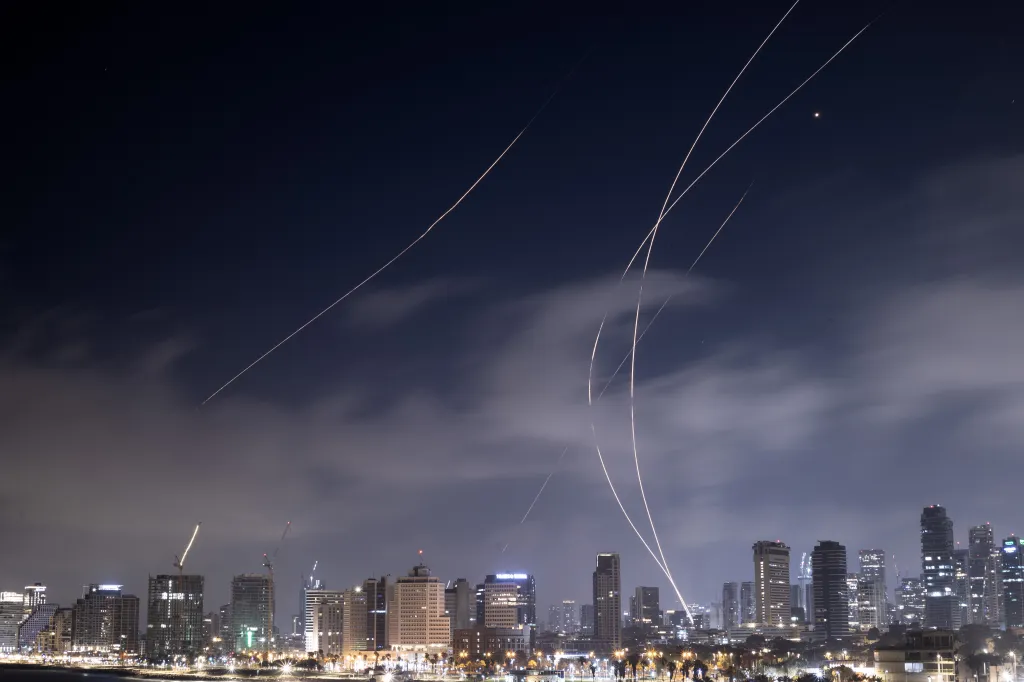
TEL AVIV, ISRAEL - JUNE 18: Israel's 'Iron Dome' air defense system responds to incoming Iranian ballistic missiles as seen from Tel Aviv, Israel on June 18, 2025. (Photo by Mostafa Alkharouf/Anadolu via Getty Images)
Israel’s ‘Iron Dome’ air defense system responds to incoming Iranian ballistic missiles as seen from Tel Aviv, Israel on June 18, 2025. (Photo by Mostafa Alkharouf/Anadolu via Getty Images) Anadolu

Wilsbach offered some concrete suggestions about how to make improvements. 

“First, we will establish the point defense weapon system, bringing together kinetic and non-kinetic capabilities to secure our air bases,” the general said. He did not offer any specifics. 

While Wilsbach offered no details about what a point defense weapons system would entail, we recently wrote that the Air Force is seeking an anti-aircraft gun system to help defend its air bases around the world from drones and cruise missiles. Introduced via a Request for Information (RFI) recently posted on the government’s contracting website, the gun system concept is part of a larger Air Force effort to play a greater role in air base defense via ground-based air defenses (GBADs). This role is largely performed by the U.S. Army, most notably with surface-to-air missile systems like Patriot and the Humvee-based Avenger system. The Terminal High Altitude Area Defense (THAAD) system can also provide broader area defense against incoming ballistic missiles. Other short-range systems optimized to swat down drones and even incoming rockets include the Centurion Counter-Rocket, Artillery, Mortar (C-RAM) system, Coyote counter-drone interceptors and more.

The Air Force currently has no such systems. Now it is set on changing that.

The Air Force is also looking at directed energy weapons like lasers for force protection and especially for defending bases overseas. While gaining traction across the services due in large measure to the much lower cost of delivering effects, these systems are still works in progress.

A U.S. Army Terminal High Altitude Area Defense (THAAD) in Guam. (U.S. Army)

It’s one thing to have equipment, but another to have experts that know how to use it, Wilsbach noted.

“Second, we have established a new career field of point defense airmen,” he added. “This new career field will be operational in two years. Together, these two new initiatives will strengthen our defenses, reinforce our ability to generate air and space power under fire, and protect our greatest advantage: our airmen and guardians.”

“Protecting the force and generating combat power are inseparable,” Wilsbach explained. “We need our airmen trained, equipped, and ready to fight from the opening moments of a conflict.”

“Don’t you think we ought to have them at every base?” he suggested when asked about point defenders during a media engagement at the symposium. “Because if every base is going to be threatened, we have to have somebody that knows how to defend it. So, obviously, that’s a long-term objective. But what I’ll tell you for right now is we’re going to develop the career field and push it forward to the critical bases that need protecting most, and then we’ll expand it beyond there.”

Airmen assigned to the 319th Reconnaissance Wing, prepare to execute a Point Defense Battle Lab exercise on the flightline at Grand Forks Air Force Base, North Dakota, Feb. 13, 2026. The PDBL serves as a hub for collaboration, pushing boundaries in Couter-small Unmanned Aircraft System capabilities, ensuring the Air Force maintains tactical superiority against evolving threats, and is a key part of the service’s effort to develop and evaluate advanced technologies to defend installations from sUAS threats. (U.S. Air Force photo by Airman 1st Class Emma Teel)
Airmen assigned to the 319th Reconnaissance Wing prepare to execute a Point Defense Battle Lab exercise on the flightline at Grand Forks Air Force Base, North Dakota, Feb. 13, 2026. (U.S. Air Force photo by Airman 1st Class Emma Teel) Airman Emma Funderburk

Though he wants the Air Force to come up with new defensive systems and personnel with the know-how to operate them, Wilsbach is not quite as sold on building out hardened aircraft shelters (HAS). This is his long-standing position that he reiterated on Monday.

“If you know where you’re going to fight from, hardened shelters aren’t that bad of an idea,” the general posited. “Deeply buried are even better. But if you are like us, and we don’t necessarily know where we’re going to fight from, if you build a hardened shelter and you don’t happen to be there, then you perhaps wasted that money.”

“So, given a resource-constrained environment, I would like to put my dollars in systems that can go anywhere in the world and protect you with basically the same level of security by shooting down incoming rounds versus making a hardened shelter that is impervious to an attack,” Wilsbach explained. “You have to put it 200 or 300 feet underground. Any hardened shelter that you show me that’s above the ground, I can blow up. So unless it’s really deeply buried, and then if it is, it’s expensive. And so that’s my logic: the best bang for the buck.”

An F-16 in a shelter.
A U.S. Air Force F-16 Fighting Falcon, assigned to the 480th Fighter Squadron, sits inside a hardened aircraft shelter during exercise Turbo Weasel at Spangdahlem Air Base, Germany, April 14, 2025. (U.S. Air Force photo by Senior Airman Demi M. Ebert) Senior Airman Demi M. Ebert

To speed up the fielding of defensive systems, the service is interested in building out a procurement process specifically designed to develop weapons and other equipment needed to defend bases.

“How do you make sure that [airmen] have the kit they need to do the job?” Air Force Secretary Troy Meink asked rhetorically at a separate symposium session.

The Air Force, he said, is considering creating a new base defense Portfolio Acquisition Executive (PAE). The service created PAEs at the beginning of the year as part of an overhaul of its acquisition process ordered by Defense Secretary Pete Hegseth. 

“The creation of PAEs is a central element of that direction,” according to an Air Force memo on the topic. “By organizing acquisition leadership around portfolios of capability, rather than discrete programs alone, the Department seeks to improve integration, decision speed, and outcome-focused execution across the acquisition enterprise.”

(U.S. Air Force)

Meink acknowledged that there are challenges to creating a new PAE, most notably the overhead cost of establishing a new office with its associated personnel and infrastructure.

“Probably not going to do it right away, but obviously I think we’re on a path to something like that in the future,” the secretary suggested. “But there definitely has to be a continually increasing focus on making sure we can defend our airmen and guardians wherever they are in the world. This is not just an overseas problem; it’s a U.S. problem as well.”

Though we have been raising the alarm for years about the need for domestic base protection, the issue came into sharp focus in December 2023 after Langley Air Force Base in Virginia was beset by mysterious drone incursions for much of that month. The nature of those flights, which we were the first to report, remains publicly unknown. Since then there have been incursions at several other bases in the U.S., including Barksdale Air Force Base in Louisiana, home of B-52 Stratofortress bombers and nuclear weapons storage facilities, and a key part of the airborne leg of America’s nuclear triad. There have also been numerous incursions over U.S. bases in Europe, many of which we were the first to report.

As we noted earlier in this story, the U.S. is already facing a challenge defending against Iranian threats. A war with China would be more devastating and, when it comes to the Air Force protecting its bases, require more robust defenses and a lot more of them at many more locations. At the same time, the Air Force is still very early in the process of taking on more responsibility for protecting its assets.

Meanwhile, the Army has its issues when it comes to air defense. Its existing Patriot battalions have already been shown to be worryingly inadequate to meet heavy existing operational demands, something TWZ has been calling attention to for years now. We have also been raising concerns for a long time about its lack of SHORADS.

For the Air Force, recognizing the problem and taking steps to fix it are important steps. Whether these are the right approaches is something we will keep an eye on.

Contact the author: howard@twz.com

Howard is a Senior Staff Writer for TWZ. He writes frequently about conflict, focusing heavily on the Middle East and Ukraine, and interviews with military and intelligence officials and industry leaders from around the globe. He lives near Tampa, Florida, home of U.S. Central Command, U.S. Special Operations Command.


Source link

YFQ-44A Fury Has Been Fit Checked With Air-To-Ground Munitions

New imagery shared with TWZ by Anduril shows its YFQ-44A Fury Collaborative Combat Aircraft (CCA) configured with air-to-ground weapons, underscoring the fact that the CCA could take on an air-to-ground role in the future in addition to its current air-to-air focus. Yesterday, Anduril executives revealed that the company had begun integration and fit checks for a range of air-to-ground weapons, although they confirmed to us that those weapons had not yet been flight-tested aboard Fury.

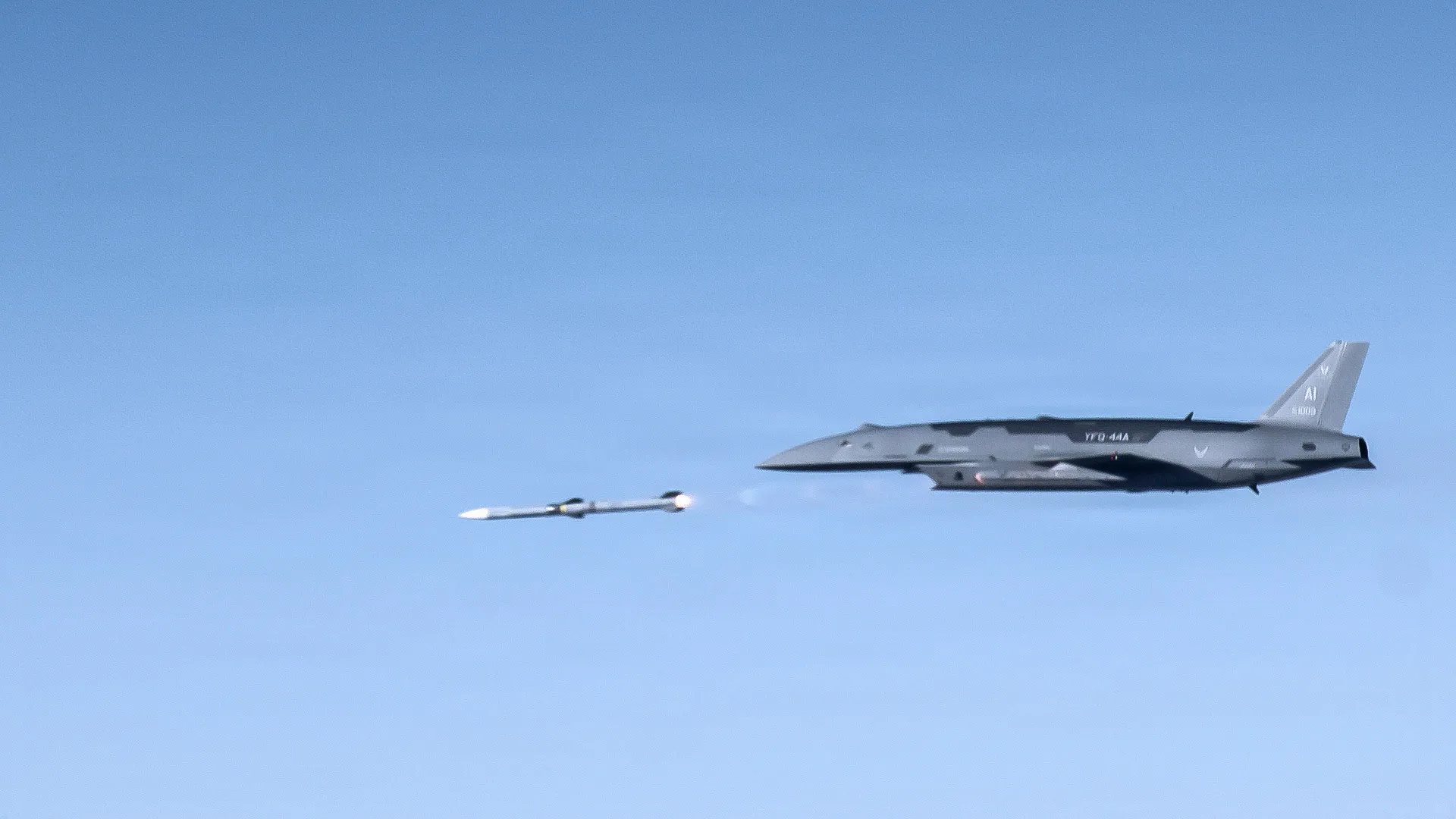
The YFQ-44A is one of two aircraft selected by the Air Force for its CCA Increment 1 program, alongside General Atomics’ YFQ-42A Vengeance. The service’s stated priority for the initial aircraft is air dominance, and Anduril says the production FQ-44 will have four external hardpoints capable of carrying four AIM-120 AMRAAM air-to-air missiles. The YFQ-44A, which currently has two underwing pylons for two AMRAAMs, has already conducted a live AIM-120 firing as part of testing with the Air Force’s Experimental Operations Unit.

A YFQ-44A Collaborative Combat Aircraft fires an AIM-120 weapon in secluded airspace over the Mojave Desert. The live-fire test of the YFQ-44 aircraft is the latest milestone in the rapid development of safe and effective CCA operations. (U.S. Air Force photo by Jennifer Healy)
A YFQ-44A fires an AIM-120 weapon in secluded airspace over the Mojave Desert. U.S. Air Force photo by Jennifer Healy Tech. Sgt. Jennifer Healy

The new imagery, however, points toward a substantially broader weapons envelope, with the aircraft shown carrying different air-to-ground stores on its two external stations. The weapons are shown fitted to the aircraft during a ground-based fit check, an important step in the integration process before captive-carry and, ultimately, live-release testing, if Anduril and the USAF choose to go down that route.

During a recent roundtable with reporters yesterday at the Air & Space Forces Air, Space and Cyber Symposium that TWZ is attending, Anduril’s Jason Levin, senior vice president for Air Dominance and Strike, and Erin Simpson, vice president for Strategy for Air Dominance and Strike, said the company had already begun integration and fit checks of 500-pound Joint Direct Attack Munitions (JDAM), 250-pound Small Diameter Bombs (SDB), and low-cost cruise missiles. Pods for 2.75-inch guided or unguided rockets are also seen fitted to the aircraft. In each case, the stores are mounted on a twin adaptor rack.

A twin rack loaded with two GBU-39/B Small Diameter Bombs (SDB) under the wing of the YFQ-44A. Anduril

Furthermore, Anduril’s plans extend to testing the Fury with other air-to-air weapons and targeting pods.

Importantly, the diversity of weapons will give Fury a range of potential missions beyond high-end air-to-air combat, including counter-UAS, counter-cruise-missile, and air-to-ground or air-to-surface strike missions.

“We’ve begun integration and fit checks of a lot of other munitions,” an Anduril executive said. “We’ve done 500-pound guided bombs. We’ve done Small Diameter Bombs.”

The company said it had also begun engineering work to integrate its Barracuda 500 offering for the Air Force’s emerging low-cost cruise-missile effort.

Introducing: Barracuda-M Family of Cruise Missiles thumbnail

Introducing: Barracuda-M Family of Cruise Missiles

It should be noted that giving the YFQ-44— or YFQ-42A — the ability to deliver a JDAM or SDB against a predetermined fixed target is not particularly complex. This type of austere air-to-ground capability should be relatively straightforward to add, providing a useful secondary strike function without requiring the aircraft to take on the far more demanding requirements associated with dynamic targeting or more sophisticated air-to-ground missions. This could also allow for these increment one CCAs to be used independently as air-to-ground ‘weapons trucks’ if their air-to-air assistance isn’t needed.

When the production FQ-44 arrives, it will have four hardpoints, compared with the two currently fitted to the YFQ-44A. Anduril says loading all four stations with AIM-120s for the Air Force’s air-dominance mission would reduce the range of the aircraft but would not require a larger engine or otherwise push the aircraft outside its basic takeoff, landing, climb, and flight-envelope requirements.

New imagery shared with TWZ by Anduril shows its YFQ-44A Fury collaborative combat aircraft prototype configured with air-to-ground weapons, providing the clearest indication yet that the CCA is being developed for strike missions in addition to its primary air-to-air role. The imagery is particularly notable because Anduril executives recently told The War Zone that the company had begun integration and fit checks for a range of air-to-ground weapons, but had not yet flight-tested those weapons from Fury.
Anduril

While the Air Force’s initial CCA requirement is heavily focused on air dominance, the same aircraft could potentially be configured for different missions by changing its external stores and sensors. Anduril is already positioning Fury as something more than a single-purpose “missile truck.”

That flexibility could become increasingly important as the Air Force considers how CCAs will be employed alongside crewed fighters. During a July Experimental Operations Unit (EOU) exercise at Creech Air Force Base, Fury flew in the same airspace as crewed fighters and other CCAs while Air Force personnel operated its Mission Autonomy system. Anduril says the aircraft has also flown in formation alongside F-35s, although the fighters were not yet controlling Fury.

The company is now working toward what it calls “quarterback integration,” in which a crewed aircraft will direct autonomous aircraft as part of a larger combat formation. Anduril says that work has already progressed through hardware- and software-in-the-loop environments and onto the aircraft itself, with live testing expected in the near term.

Another view of the twin rack loaded with two GBU-39/B Small Diameter Bombs (SDB) under the wing of the YFQ-44A. Anduril

A Fury operating under the direction of an F-35 could potentially carry air-to-air missiles for counter-air missions, while other aircraft in the formation could be configured for strike or other effects. Alternatively, the same autonomous aircraft could be reconfigured for a different mission before being dispersed to another operating location. Having four pylons would also give the production Fury greater scope to undertake “swing-role” missions, flexing between prosecuting air and surface targets as required.

The July EOU exercise also demonstrated a rapid “hot reload” capability, with two Air Force personnel replacing an AIM-120 on a running Fury and reducing the turnaround between sorties to single-digit minutes. The demonstration was intended to show how CCAs could be rearmed and returned to the fight without the large maintenance and ground-support footprint associated with traditional combat aircraft. This will be vital as the Air Force integrates CCAs into its Agile Combat Employment concept, in which the drones can be dispersed across multiple operating locations rather than relying on a single large ground footprint.

Carrying inert AMRAAMs, a YFQ-44A flies together with an F-35A from an Air Force test unit. via Anduril

Also speaking yesterday at the Air & Space Forces’ Air, Space and Cyber Symposium was Air Force Chief of Staff Kenneth Wilsbach, who confirmed that the service hasn’t necessarily made any decisions on Increment 2 of the CCA program yet, but it could include air-to-ground capabilities.

“We’re going through some thought processes about what Increment 2 should be able to do. Increment 1 is air-to-air, so do we want air-to-ground? Maybe, maybe not. Do we want it to have more sensors? Do we want it to be a lot cheaper? Do we want it to be more attritable or expendable, or do we want it to be more exquisite? Do we want shorter range or longer range? Do we want something that can be dropped from another platform, or does it take off and land by itself?”

“These are all considerations,” Wilsbach continued. “It’s still a bit early to make any definitive decisions on that, especially before we really get our hands on the current Increment 1 aircraft and learn from them.”

It’s also important to note that export customers for Fury may demand an air-to-ground capability set, especially if they will only be buying a limited number of CCA types. Having this option ready to go is relevant to prospects beyond the U.S., which are certainly growing.

Fury’s air-to-ground weapons work is part of a broader effort to make the aircraft a flexible combat system rather than simply an uncrewed air-defense adjunct for crewed fighters. The Air Force’s immediate priority may be air dominance, but the weapons integration underway suggests that the same four hardpoints could eventually support a much wider range of missions. This weapons flexibility could ultimately be central to the broader CCA concept, especially as the Air Force works out what it wants Increment 2 to deliver.

Contact the author: thomas@thewarzone.com

Thomas Newdick is a staff writer at TWZ, where he covers military aviation, defense technology, weapons systems, and international security. Based in Berlin, Germany, he reports on conflicts, military modernization efforts, and emerging aerospace technologies around the world, with a particular interest in airpower and its role in contemporary warfare. His reporting is informed by deep expertise in modern and historical airpower, particularly in Europe, with a focus on military aviation, air campaigns, and aerospace developments across the continent and beyond.


Source link

Lockheed Flexes To Modular AGM-158 JASSM Missile Concept

Lockheed Martin has unveiled a modular airframe concept for its stealthy and combat-proven AGM-158 Joint Air-to-Surface Standoff Missile (JASSM) family that could support multiple configurations, launch methods, and sensor packages while making use of the existing JASSM and Long-Range Anti-Ship Missile (LRASM) production infrastructure. Highly survivable, the missiles are an incredibly important and staple weapon for the U.S. military, and for select export customers.

Called AGM-158 FLEX, the new concept is centered on a common airframe with interchangeable components. Lockheed Martin says it has invested more than $35 million of its funds in the effort so far, including airframe design, testing, prototype production, subsystem qualification, and work with suppliers.

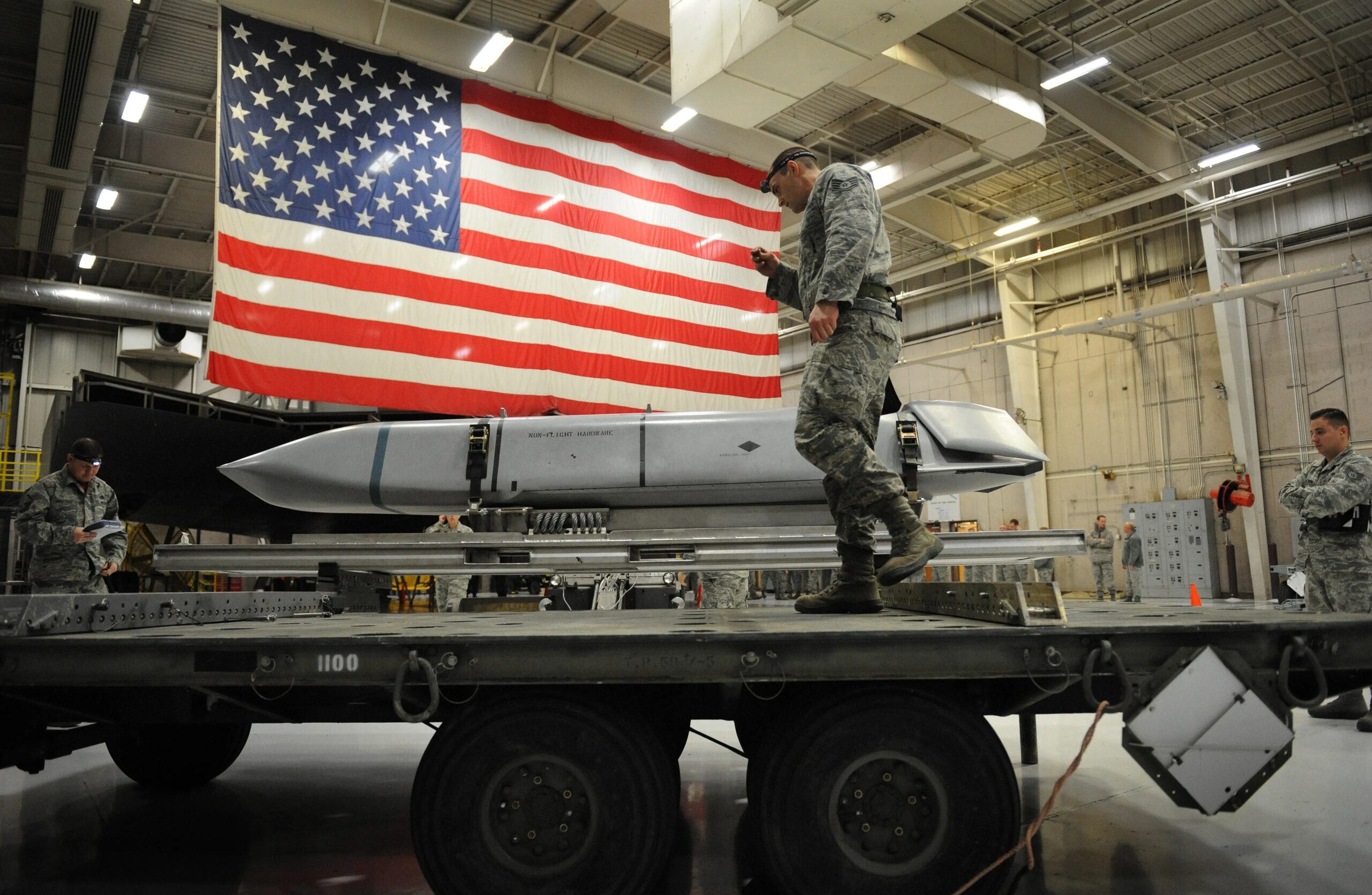
U.S. Air Force Staff Sgt. Joseph Herdliska, 131st Aircraft Maintenance Squadron load crew member, prepares to load an AGM-158 Joint Air-to-Surface Standoff Missile onto the B-2 Spirit weapons load trainer during a weapons load competition at Whiteman Air Force Base, Mo., Jan. 23, 2015. The competition is designed to showcase the teamwork, precision and attention to detail amongst Airmen in support of nuclear deterrence and global strike operations. (U.S. Air Force photo by Airman 1st Class Joel Pfiester/Released)
An Air Force load crew member prepares to load an AGM-158 Joint Air-to-Surface Standoff Missile onto the B-2 Spirit weapons load trainer during a weapons load competition at Whiteman Air Force Base, Missouri. U.S. Air Force photo by Airman 1st Class Joel Pfiester/Released Tech. Sgt. Joel Pfiester

The company says the FLEX design will use removable nose sections that can accommodate sensor suites associated with the AGM-158 family. A removable boat tail would allow the same basic airframe to be configured for different launch methods, including air, surface, and subsurface launch. That would open the AGM-158 architecture up to ground-, ship-, and submarine-launched applications, although Lockheed Martin has not provided details on the specific launchers, platforms, or configurations envisioned. It’s worth noting the LRASM has been tested in vertical launch configuration for vessels equipped with the Mk 41 launch system.

A 2016 test of LRASM from a Mk 41 launcher on the Navy’s Self Defense Test Ship. Lockheed Martin

In addition to the Navy vertical launch tests, the idea of moving the JASSM family beyond its traditional combat aircraft launch platforms is not new. The Air Force’s Palletized JASSM concept, better known as Rapid Dragon, has demonstrated the ability to deploy JASSM-ER from palletized launchers carried inside cargo aircraft, using an expendable airdrop system. FLEX takes a different approach by building those kinds of launch options into the airframe architecture itself, with modularity supporting various launch configurations for the same basic weapon.

Rapid Dragon Flight Test thumbnail

Rapid Dragon Flight Test

For aircraft-launched weapons, Lockheed Martin says FLEX will retain compatibility with current and future JASSM and LRASM launch platforms.

NAS PATUXENT RIVER, Md. -- An F-35 Lightning II test pilot conducts the first flight test to certify the F-35B short takeoff and vertical landing variant of the fighter aircraft for carrying the AGM-158C Long-Range Anti-Ship Missile (LRASM). As part of ongoing weapon integration efforts, the Pax River F-35 Integrated Test Force (Pax ITF) team for the first time flew test flights Jan. 14 with two AGM-158 loaded on external stations. LRASM is a defined near-term solution for the Offensive Anti-Surface Warfare (OASuW) air-launch capability gap that will provide flexible, long-range, advanced, anti-surface capability against high-threat maritime targets. The Pax River ITF’s mission is to effectively plan, coordinate, and conduct safe, secure, and efficient flight test for F-35B and C variants, and provide necessary and timely data to support program verification / certification and fleet operational requirements.
An F-35B carrying the AGM-158C Long-Range Anti-Ship Missile (LRASM). U.S. Marine Corps Kyra Helwick

The company is also proposing multiple airframe lengths. A 206-inch configuration is associated with the supersized JASSM-XR, while a 168-inch version is consistent with the dimensions of JASSM-ER. Lockheed Martin says JASSM-XR will be the first configuration of the FLEX airframe.

The Brand New AGM-158 Extended Range thumbnail

The Brand New AGM-158 Extended Range

The AGM-158 family has already grown well beyond the original JASSM. The AGM-158A is the baseline stealthy air-launched land-attack missile, with a publicly reported range of roughly 230-330 miles, while the AGM-158B JASSM-ER uses a more efficient engine and additional fuel to roughly double that reach, to around 575 miles or more.

Alongside the land-attack variants is the AGM-158C LRASM, which uses the JASSM airframe but substitutes a sophisticated imaging infrared anti-ship seeker, electronic support measures, datalink, and other capabilities, for operations against heavily defended surface combatants.

A U.S. Air Force B-2 Spirit Stealth Bomber, assigned to the 509th Bomb Wing, deploys an AGM-158C Long Range Anti-Ship Missile to support a live-fire sinking exercise as part of Valiant Shield 2026 over the Philippine Sea, June 27, 2026. The B-2 flew into the Mariana Island Range Complex to successfully employ the AGM-158C LRASM and demonstrated flexibility across the globe and hold maritime vessels at risk. (U.S. Air Force photo by Tech Sgt. Thomas Barley)
A B-2 deploys an AGM-158C Long Range Anti-Ship Missile to support a live-fire sinking exercise as part of Valiant Shield 2026 over the Philippine Sea, June 27, 2026. U.S. Air Force photo by Tech Sgt. Thomas Barley Tech. Sgt. Thomas Barley

Finally, the much larger JASSM-XR is being developed with a substantially stretched fuselage to carry more fuel and a larger 1,000-pound-class warhead, with a range expected to approach or exceed 1,000 miles. This would give it a similar striking capability as the Tomahawk cruise missile, although in a stealthier package.

Beyond range and launch options, the company is pitching its new FLEX concept as a way to simplify future upgrades. Components could be replaced as they become obsolete or new capabilities become available without necessarily requiring a completely new missile design.

That approach could have an industrial-base advantage, particularly as the United States seeks to increase production of long-range weapons. Lockheed Martin says FLEX would use the existing JASSM/LRASM production line, supply chain, mission-planning infrastructure, and software ecosystem rather than establishing an entirely new manufacturing and support architecture.

The company says its JASSM/LRASM production infrastructure includes a 225,000-square-foot facility opened in 2022 with increased automation and a robotic paint line.

Notable, however, is the fact that FLEX is being proposed at a time when the U.S. Air Force is pursuing affordable mass as a key priority.

For example, as part of a slew of low-cost cruise missile offerings, the service has been moving ahead with the Extended Range Attack Munition, or ERAM, a new air-launched missile explicitly intended to provide a relatively low-cost, rapidly producible standoff weapon. The Air Force conducted a live-warhead ERAM test in January of last year, less than 16 months after the program received its initial contract, and described the weapon as a means of generating mass against fixed targets. ERAM is understood to have a range of between 150 and 280 miles, putting it below the reach of the baseline JASSM, let alone the JASSM-ER or XR.

The Extended Range Attack Munition live-fire test on Jan. 22, 2025, at Eglin Air Force Base, Florida. via U.S. Air Force

However, the emerging class of lower-cost weapons are intended very much more to complement than compete with JASSM. While the Air Force plans to buy thousands of the cheaper missile, the JASSM will still be needed to take up the higher end of the cost and capability list.

Lockheed Martin mentions that FLEX should “unlock future cost savings,” but this sounds more about giving customers the ability to swap out components and upgrade capabilities on existing missile rounds, to avoid obsolescence, rather than facilitate mass production.

As it stands, JASSM has evolved into a family of increasingly capable and longer-range weapons, but those capabilities necessarily come with a different set of cost and production considerations than a weapon designed from the outset around large-scale production. Lockheed Martin’s announcement does not disclose a target unit cost for FLEX, nor does it explain how the eventual cost of a FLEX-derived weapon would compare with a baseline JASSM or LRASM. The unit price of the latest subvariants of the JASSM-ER is around $1.2 and $1.5 million, according to official budget documents.

The new weapon is a way of getting more variants and launch options out of the established JASSM/LRASM architecture, potentially with less development work than creating entirely new weapons. Whether that translates into enough savings or production capacity to satisfy the military’s growing demand for large numbers of standoff weapons remains to be seen.

For Lockheed Martin, the proposal also offers a way to extend the relevance of the AGM-158 family as the company and the Pentagon pursue additional range, new launch platforms, and potentially new launch methods.

The flexibility of the missile could be particularly relevant to the Agile Combat Employment concept, and the wider U.S. military in the Indo-Pacific, where forces are expected to operate from a larger number of dispersed and potentially austere locations. A common missile architecture that can be adapted to different launch platforms and different target sets could allow weapons to be positioned and employed across a distributed force rather than tying particular missile variants to particular launchers.

The original JASSM/LRASM has also become a significant export weapon, with Australia, Finland, Poland and several other U.S. allies cleared to acquire variants of the missile. While the advanced capabilities of the weapon have seen its export opportunities carefully controlled, FLEX could potentially open up the market to more customers, including less-advanced, ‘sanitized’ versions.

Pilot and Weapon Systems Officer conduct a pre-flight check on the JASSM-ER loaded to a Royal Australian Air Force F/A-18F Super Hornet at RAAF Base Amberley, Queensland. Australian Department of Defense LAC Campbell Latch

Lockheed Martin’s announcement provides few details on FLEX’s eventual cost, production rate, schedule, or specific performance beyond the stated airframe dimensions. For now, the concept demonstrates that the company is seeking to create a more adaptable architecture around an established missile family, one that has played a critical role in numerous operations since its introduction.

Contact the author: thomas@thewarzone.com

Thomas Newdick is a staff writer at TWZ, where he covers military aviation, defense technology, weapons systems, and international security. Based in Berlin, Germany, he reports on conflicts, military modernization efforts, and emerging aerospace technologies around the world, with a particular interest in airpower and its role in contemporary warfare. His reporting is informed by deep expertise in modern and historical airpower, particularly in Europe, with a focus on military aviation, air campaigns, and aerospace developments across the continent and beyond.


Source link

New Details On How Space Force Has Waged Electronic Warfare Against Iran

U.S. Space Force’s top officer has shared new details about his service’s use of electronic warfare capabilities during Operation Epic Fury against Iran earlier this year. This underscores how space is steadily becoming an arena where conflict actually occurs, and the implications this has for forces operating inside and outside of the Earth’s atmosphere.

Chief of Space Operations Gen. Douglas Schiess highlighted the actions of a member of the 42nd Electromagnetic Warfare Combat Detachment (EWCD) in support of Epic Fury during a keynote speech earlier this morning. Schiess’ remarks came at the Air & Space Forces Association’s (AFA) 2026 Air, Space & Cyber Conference, at which TWZ is in attendance. This is his first major engagement since taking over as head of Space Force less than two weeks ago.

A previously released picture showing a member of the 42nd Electromagnetic Warfare Combat Detachment forward-deployed somewhere in the Middle East in 2024. USAF/Senior Airman Zeeshan Naeem

“During Operation Epic Fury, our components, notably at U.S. Central Command and Space Command, with support from our components at European Command and Pacific Command, demonstrated that Guardians [the official term for uniformed Space Force personnel] are not supporting from the sidelines as a nice-to-have [sic], but we are delivering space power directly into the fight as a need-to-have,” Schiess said. “One of those impressive Guardians is Specialist Gray, who hails from Tampa, Florida. She joined the Space Force just two years ago, but listen to the impact she [has] made in her short term already.”

“She deployed to the CENTCOM AOR [Central Command area of responsibility] as a part of the 42nd Electronic Warfare Detachment [sic], and within hours of OEF kicking off, she received a top priority target package with one critical objective: reconfigure her weapon system and execute critical non-kinetic fires,” he continued. “She locked onto the target, optimized her weapon system, and waged electromagnetic warfare against a determined adversary. Even as ‘Alarm Red’ sirens were blaring, and incoming missiles targeted her site, she courageously held the line, protecting forces, denying adversary capability, and delivering space effects, until her commander had to literally pull her from the console to safety.”

“Specialist Gray is just one of the outstanding members of the entire enterprise of dedicated guardians, including the acquisition professionals that developed and fielded the weapon system that she operated, the intel Guardians that developed the targeting package that she used, and the cyber guardians who ensured communication, connectivity, and network defense for the command and control, the guardian instructors who trained her for combat, and the list goes on and on,” the Chief of Space Operations added.

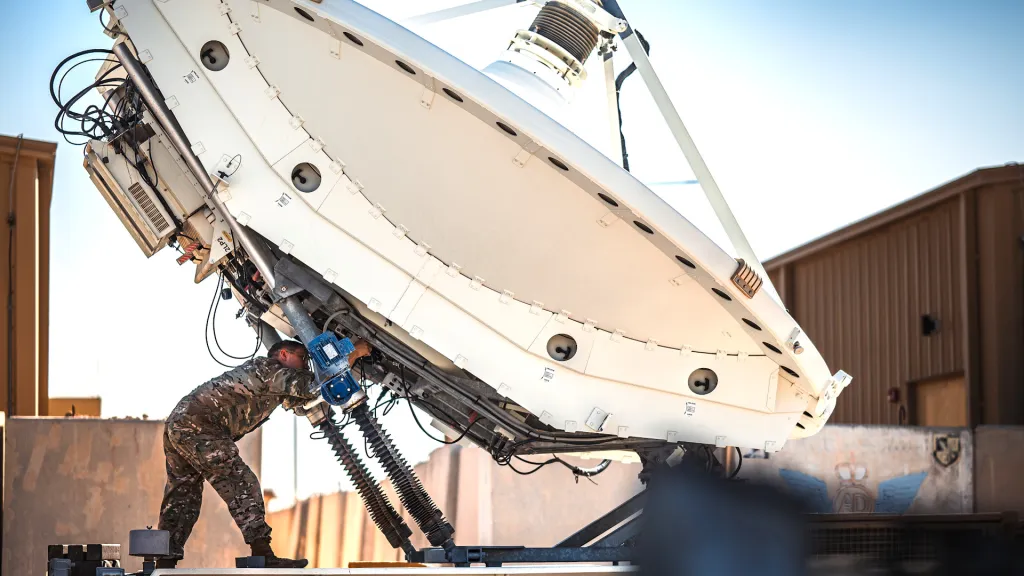
Schiess did not name the system in question or elaborate further on how it was employed. However, previously released pictures of elements of the 42nd EWCD in the Middle East have shown personnel working with trailer-mounted multi-band antennas that have been associated in the past with variants of the Counter Communications System (CCS). CCS is a family of ground-based electronic warfare jammers primarily designed to disrupt enemy space-based communications capabilities. Prior to yesterday, CCS was the U.S. military’s only publicly acknowledged anti-satellite weapon. Space Force has now confirmed it also has weapons in orbit, which we will come back to later on.

Members of the 42nd EWCD pose in front of a trailer-mounted antenna at an undisclosed location in the Middle East in 2024. USAF/Senior Airman Zeeshan Naeem
A picture released in 2020 showing members of the 4th Space Control Squadron standing in front of what is explicitly said to be an element of the Block 10.2 version of the Counter Communications System. USAF

The 42nd Electromagnetic Warfare Combat Detachment has been operating in the Middle East since at least 2024 under the umbrella of Space Force’s main headquarters in the region, U.S. Space Forces – Central (SPACECENT). President Donald Trump briefly called attention to the detachment’s “cutting-edge defense activities” during a Christmas Eve conference call with deployed service members last year.

“Sometimes we have to be within the footprint of the satellite, and so that’s why Guardians go into harm’s way,” Gen. Schiess did tell TWZ and other outlets at a roundtable after his speech this morning when asked for more details about the 42nd EWCD’s role in Operation Epic Fury, and what lessons Space Force has been learning from the conflict more broadly.

“Electromagnetic warfare was a big part of that, but also satellite communications,” he added. “The ability to keep communications, obviously GPS and PNT [positioning, navigation, and timing], were important there.”

“And then, really, missile warning and missile tracking was [sic] incredibly important. Both [Air Force Chief of Staff] Gen. Wilsbach and I talked about ‘Red Alarm’ situations,” the Chief of Space Operations continued. “Being able to tell our forces to be able to take cover was extremely important. And as we’ve seen from Ukraine to Iran, the amount of missiles and the amount of things, the folks that are doing that each and every day are incredible, and they are saving lives.”

Chief of Space Operations Gen. Douglas Schiess. USAF

Gen. Schiess’ anecdote about Specialist Gray and the 42nd EWCD did highlight how Iran, especially in the opening phases of the conflict earlier this year, was able to deal real blows to U.S. and allied facilities and forces across the Middle East. Iranian missiles, drones, and other capabilities were able to damage and/or destroy a variety of high-value assets, including aircraft and radars, and cause hundreds of casualties, as TWZ has drawn attention to on several occasions in the past. This has already been a sobering wake-up call with serious implications for potential future conflicts against larger and even more capability opponents, especially China.

“I think the whole joint force is learning a lot from Operation Epic Fury, the previous operation there, on exactly what needs to be in underground facilities, [and] what maybe can we do from remote locations,” the head of Space Force said at the roundtable today. “You could also look at what can we do from space to do some of those things? And so we’re looking at all those [lessons learned].”

Gen. Schiess mentioning subterranean facilities and remote operations is particularly notable. Even before Operation Epic Fury began, the U.S. Air Force had been working to expand options for directing operations in the Middle East from a command center in the United States. The service had also been looking to push certain command and control functions at Al Udeid Air Base in Qatar underground. Al Udeid was among the many bases Iran subsequently targeted.

Operation Epic Fury has already added new fuel to a larger ongoing debate about balancing U.S. military base defense priorities globally, including the relative value of investing in new physically hardened infrastructure. TWZ has been following these discussions very closely in recent years. The conflict with Iran has raised serious questions about future operations of any kind at certain bases across the Middle East, and there have been reports that a larger reorientation of America’s force posture in the region could be coming.

For Space Force, operations against Iran have provided a broader opportunity for the service to demonstrate its active role in forward-deployed operations. That, in turn, has generated its own lessons learned beyond just steps needed to help better protect units in the field.

Then-Lt. Gen. Douglas Schiess meets with forward-deployed members of the 42nd Electromagnetic Warfare Combat Detachment in 2025. Schiess was head of US Space Forces – Space (S4S) and the Combined Joint Force Space Component Commander at SPACECOM at the time. Space Force

This extends to “reconstitution [of forces] in a combat environment, the logistics and the importance of that relationship with TRANSCOM [U.S. Transportation Command] and to be able to get supplies and replenishment into the theater,” Chief Master Sergeant of the Space Force John Bentivegna also said today, speaking alongside Gen. Schiess at the roundtable. That is “something we haven’t really worked on before. So definitely, it was a great lesson learned.”

Space-based capabilities including early warning, general intelligence gathering, weapons guidance, near-real-time communications, and more, are already absolutely central to U.S. military operations. America’s long-standing dominance in space is also steadily being eroded, with China, in particular, surging ahead in the deployment of new satellites to support a host of mission requirements, including intelligence-gathering and long-range targeting. The ability to leverage space is also proliferating to smaller adversaries, including Iran.

In addition, as mentioned, the space domain is no longer limited to just supporting operations within the atmosphere, but is a place where real engagements happen. The U.S. military is now capable of generating so-called counter-space effects using forces and assets within the atmosphere as well as in orbit, as was just disclosed yesterday.

Overall, Gen. Douglas Schiess’ comments today about the role played by Specialist Gray and the 42nd EWCD during Operation Epic Fury are indicative of not just what is to come in future operations, but how the Space Force is already engaged in combat missions now.

Contact the author: joe@twz.com

Joseph is TWZ’s Deputy Editor, helping to oversee the site’s highly experienced and dedicated team, while also writing informative and impactful defense and national security content. He lives right in the thick of it in the Washington, D.C. area.


Source link

NATO Air Commander Details Thinking Behind The Alliance’s New Air Defense Plan

The top U.S. Air Force officer in Europe, who also serves as the NATO Allied Air Command leader, said he has been tasked with enacting new alliance plans to defend against cruise missiles and drones. He was responding to questions about a drone that NATO had to shoot down after it entered Lithuanian airspace overnight. European Commission President Ursula von der Leyen said Tuesday morning that the incident was “part of a broader pattern of Russian aggression and provocation against Europe, testing our readiness and our resolve.”

The drone incursion into Lithuania took place against the backdrop of the ongoing Russian war on Ukraine and amid a spate of so-called ‘hybrid’ or ‘gray zone’ actions Moscow has been accused of carrying out throughout Europe, including a recent attempted drone attack on the Leipzig-Halle airport in Germany.

“I don’t know what’s in the mind of Putin or his fielded forces about those one-way attack drones or even cruise missiles, like we’ve seen enter Polish airspace just a few months ago. In July, we had an AS-23 cruise missile enter Poland,” Lt. Gen. Jason T. Hinds, Commander, U.S. Air Forces in Europe/U.S. Air Forces Africa (USAFE), and Commander of the Allied Air Command, said in response to a question about the drone shootdown over Lithuania. He was speaking during a media roundtable at the Air & Space Forces Air, Space and Cyber Conference that TWZ is attending.

This video grab taken from footage of TVN Poland on July 30, 2026 shows the Polish army securing a large crater, the probable impact site of a projectile linked to the strikes carried out in Ukraine overnight by Russia, in Tarnawa-Kolonia, eastern Poland. Residents of this locality in the Lublin region heard, shortly before 4:00 a.m. (2:00 a.m. GMT), a powerful explosion that shook the windows of their homes. The impact site is located around 80 km from the Ukrainian border. NATO said on July 30 it was in close contact with Warsaw as it blamed Russia for a missile that crashed in Poland, and vowed to "continue to take all necessary measures to defend" alliance territory. (Photo by various sources / AFP via Getty Images)
This video grab taken from footage from TVN Poland on July 30, 2026, shows the Polish army securing a large crater from a Russian missile that crashed in Poland. (Photo by various sources / AFP) –

Hinds added that while he doesn’t “know the why behind” the drone incursion into Lithuania, he has been tasked by U.S. Air Force Gen. Alexus G. Grynkewich, who serves as NATO Supreme Allied Commander Europe (SACEUR), “to fully implement EVA [Enhanced Vigilance Activity] Eastern Sentry and now its Standing Defense Plan 12000, which gives the nations the capabilities that they need to defend their airspace against either one-way attack drones like the one that you described last night, or a cruise missile.”

EVA Eastern Sentry is a mission NATO stood up in September 2025 after “an unprecedented number of Russian drones and planes violated the airspace of several NATO Allies,” according to the alliance. “Allies are contributing additional capabilities and assets to NATO’s deterrence and defense – for instance, more fighter jets, helicopters, transport aircraft, air defense systems, surveillance aircraft and frigates – and improving the coordination of these assets through NATO.”

Is the Kremlin testing Europe's defenses with drone incursions? | DW News thumbnail

Is the Kremlin testing Europe’s defenses with drone incursions? | DW News

Standing Defense Plan 12000 is a new plan for integrated air and missile defense across the alliance. Grynkewich introduced the concept during testimony to Congress in March.

Hinds acknowledged that Russia could be testing the alliance.

“It’s not about the small UASs; that’s typically a national responsibility, and it could be probing,” the Air Force general noted. “Regardless of the intent behind it, what we want to be prepared for is the second that a one-way attack drone or a cruise missile is first and foremost detected – hopefully well before it enters NATO territory – we want to know it. We want to know where it’s coming from. We want to have the capability to sense it. We want to be able to have the C2 [command and control] systems to be able to decide what to do about it, and then have the right kit to be able to act.”

Despite an integrated air and missile defense system that includes Patriot surface-to-air missile batteries, NATO currently is primarily “using air power” against drones and cruise missiles “and that’s not putting us on the right side of the cost curve,” Hinds stated. “But we want to get there.”

Using NATO jets to take down drones “is very effective, just like what you saw last night, and many other times,” but not necessarily efficient, Hinds explained. 

Video shows debris after NATO jets shoot down a drone over Lithuania thumbnail

Video shows debris after NATO jets shoot down a drone over Lithuania

“I think there’s been at least five other cases of allied nations providing air power to shoot down one-way attack drones,” he proffered. “I want to get to the point where we’re doing it efficiently, using lower-cost interceptors, hopefully ground-based, and in some cases air-based that are cheaper to use, so we’ll see what the intent may be. Intelligence organizations are going to provide us with that intelligence later on, but I just don’t know yet.”

You can see one of those NATO jet engagements with drones in the following video.

It should be noted that Europe is starting to follow the American lead in using less expensive laser-guided, air-to-air rockets as drone-killing weapons. TWZ was the first to report about the use of 70mm Advanced Precision Kill Weapon System (APKWS) rockets by the U.S. The U.K. Royal Air Force announced in May of this year that its Typhoons were now equipped with APKWS rockets while the French recently tested their own 68mm laser-guided rockets from Rafale fighters.

As the threats have evolved, NATO has “transitioned away from air policing, and we’ve transitioned to air defense for some specific reasons,” the general pointed out. “One is readiness. Air policing is a readiness decrementing mission that the alliance has done for years. There’s also an assurance mission that we did for 32 nations. That’s transitioned to air defense now. Air defense means we have the right kit, multi-domain, to be able to be put in the right place based on indications, warnings, or real threats, like you saw last night, inside of the Baltic nations, to be able to respond decisively and quickly.”

“There’s also a deterrence value there,” Hinds added. “So if Russia does fly a one-way attack drone or a cruise missile, they know that we’re going to be in the right spot to be able to detect it and then defend against it.”

“These are limited incursions, right? Small numbers. Here’s what I see: hybrid activities may, in fact, only be one of the few levers that Putin has available to him, because he sees that he does not have an advantage in geography, domain, or readiness,” Hinds suggested.

“Think about that,” he urged. “So what are we seeing? We’re not seeing a massing of forces across the opposite side of Finland, a new NATO nation. We’re not seeing a massing of forces whatsoever in any domain opposite of Poland, Latvia, Lithuania, or Estonia. You’re seeing a significant number of one-way attack drones in the Black Sea targeting Ukraine. Some of them are entering Romania. What you’re not seeing is a direct confrontation in geography. We’re not seeing direct competition in domains. And I think Putin knows that we are ready. I know he knows that we’re a defensive alliance. I know he knows that we have an advantage in every domain against them, and I think that’s likely why you’re seeing things like what you’re seeing with hybrid activity.”

NEW DELHI, INDIA - SEPTEMBER 11: Russian President Vladimir Putin speaks during a Russian-South African bilateral meeting, on September 11, 2026 in New Delhi, India. Russian President Vladimir Putin is in India for a three-day visit starting Friday, 11 September 2026. The high-profile trip revolves around Russia's participation in the 18th BRICS Summit, which India is hosting at the Bharat Mandapam this weekend. The trip marks Putin's second face-to-face engagement with Indian Prime Minister Narendra Modi in less than two weeks, following their bilateral meeting at the SCO Summit in Bishkek. (Photo by Contributor/Getty Images)
Russian President Vladimir Putin. (Photo by Contributor/Getty Images) Contributor#8523328

Though below the level of armed conflict, these Russian activities raise the potential for something worse, Hinds posited.

“The risk about hybrid activity, from my perspective, is it could lead to escalation, and that’s where I hope that we get back towards deterrence again, and that the nations they’re going to decide to do what they want to do when it comes to these hybrid activities,” the general said. “Some of them are law enforcement. Some of them are military responses, and that’s up to the nations to decide how they’re going to deal with that. Not me.”

“But what I owe General Grynkewich is to ensure that we are demonstrating our deterrence each and every day, and we’re doing that effectively across all domains,” Hinds added. “And to ensure that Putin knows that if he tries something against the alliance, that we will be there, and we’re ready to win decisively if challenged.”

Contact the author: howard@twz.com

Howard is a Senior Staff Writer for TWZ. He writes frequently about conflict, focusing heavily on the Middle East and Ukraine, and interviews with military and intelligence officials and industry leaders from around the globe. He lives near Tampa, Florida, home of U.S. Central Command, U.S. Special Operations Command.


Source link

Israel Is Bringing SPICE 1000 Standoff Weapon To The F-35

Israel’s Rafael and Lockheed Martin are working to accelerate integration of the 1,000-pound-class SPICE standoff weapon with the Israeli Air Force’s F-35I Adir. The development could potentially open the door for the precision-guided munition to be offered to other Joint Strike Fighter operators.

Rafael Advanced Defense Systems announced the effort September 15 during the Air & Space Forces Air, Space and Cyber Symposium that TWZ is attending. The work is being conducted as a joint project with Lockheed Martin at the U.S. contractor’s facilities in the United States and is expected to take several months.

Rafael says the effort could eventually make the weapon available to other F-35 operators. “At a later stage, F-35 operators worldwide will be able to field SPICE 1000,” the company said.

The effort was previously referenced in U.S. government documentation before Rafael’s announcement. Published in August, the Pentagon F-35 Modernized Selected Acquisition Report identified the weapon as the “Israel-unique Smart, Precise Impact, Cost-Effective 1000B,” or SPICE 1000B, and said its integration was progressing “with a strategy to accelerate the implementation via a SPICE Lite process.”

The report does not explain what the “SPICE Lite” process entails.

SPICE — which stands for Smart, Precise Impact, and Cost-Effective — is a family of electro-optically guided standoff weapons developed by Rafael. The family includes SPICE 2000, SPICE 1000, and SPICE 250, with the numbers corresponding broadly to the weight class of the underlying warheads.

SPICE 250, SPICE 1000 & SPICE 2000 Air-to-Surface Missiles thumbnail

SPICE 250, SPICE 1000 & SPICE 2000 Air-to-Surface Missiles

Based around a 1,000-pound-class bomb, SPICE 1000 uses pop-out wings to achieve a manufacturer-stated range of approximately 125 kilometers, or 78 miles. Rafael gives the weapon a claimed circular error probable of around three meters.

The glide bomb combines inertial and satellite-aided navigation with an electro-optical seeker. During the terminal phase, its seeker can compare the observed target area with stored imagery using scene-matching algorithms, allowing the weapon to continue its attack without relying exclusively on GPS. That feature allows it to engage targets autonomously, offering the launch aircraft a true ‘fire and forget’ capability, and provides resilience in GPS-denied or GPS-degraded environments.

SPICE can also be programmed to approach a target from a particular azimuth and impact angle. This provides flexibility in selecting the terminal attack geometry and can support steep attack profiles against targets where penetration from above is desirable.

SPICE 1000 is not a new Israeli capability. It has been operational with the Israel Air Force since 2017 and is already integrated with Israeli F-16I Sufa, F-16C/D Barak, F-15I Ra’am, and F-15 Baz fighters.

An F-15 Baz configured for precision strike, with a pair of 2,000-pound Rafael SPICE standoff weapons on the underwing pylons. Amit Agronov

“SPICE 1000 has been sold to several countries and is in operational service with a number of air forces worldwide,” Rafael said. “It has served as a primary munition of the Israeli Air Force for several years, including extensive use in recent long-range operations flown from F-15 and F-16 aircraft.”

The Israeli Air Force has released footage showing SPICE weapons being used during recent operations, including imagery from the weapon’s own perspective during its terminal attack.

Israel’s F-35I is already unusual within the international Joint Strike Fighter fleet. The IDF has developed and demonstrated an external Joint Direct Attack Munition (JDAM) carriage capability, and said in March 2025 that the Israeli Adir was the only F-35 to have conducted operational strikes with an external weapons configuration. You can read more about that here.

The unique instrumented F-35I assigned to the Israeli Flight Test Center carrying four external 2,000-pound class GBU-31 JDAMs. A single AIM-120 AMRAAM air-to-air missile can be seen in one of the internal weapons bays, which may also house another internal JDAM. Israeli Air Force

However, according to The Jerusalem Post, the SPICE weapon is expected to be carried internally by F-35Is equipped with Technology Refresh 3, or TR-3, hardware, which would maintain its low-observable configuration. Neither Rafael nor Lockheed Martin has publicly detailed the specific carriage configuration, aircraft modifications or software associated with the current integration effort.

The long-delayed TR-3 is a major upgrade to the F-35’s computing architecture and provides the processing infrastructure required for subsequent Block 4 capabilities. Israel received its first three F-35Is equipped with TR-3 hardware in January of this year.

Lockheed Martin describes Block 4 as the F-35 program’s “most significant evolution of F-35 capabilities to date,” encompassing more than 70 major upgrades, including increased weapons capacity, advanced electronic warfare capabilities, and improved target recognition.

Some of the unclassified upgrades within Block 4. The exact configuration has not been publicly disclosed. U.S. Department of Defense

It remains unclear if the SPICE 1000 integration itself requires the full Block 4 configuration.

The potential significance of the Israeli integration extends beyond the Israel Air Force. If SPICE 1000 ultimately becomes available to other F-35 operators, the completed Israeli integration could provide those countries with another pathway toward fielding a precision standoff weapon rather than requiring them to begin an integration effort entirely from scratch.

Integrating national weapons onto the F-35 can be a lengthy process. It involves not only the weapon itself, but aircraft software, interfaces, weapons-bay compatibility, flight testing, mission-system integration and certification within the U.S.-led F-35 program.

The United Kingdom’s experience with MBDA’s SPEAR 3 provides a good example of the challenges.

In 2022, the U.K. Ministry of Defence said that scheduled delivery dates for SPEAR 3 had been delayed because of “prioritisation in the overall F-35 development programme,” which is managed by the U.S.-led F-35 Joint Program Office.

An artist’s impression of an F-35 armed with SPEAR 3 and Meteor missiles. MBDA

The program has continued to progress, including F-35B integration work and flight testing. But in June 2026, the U.K. government said that completion of mission-systems integration and jettison trials remained part of a wider weapons-integration program and that SPEAR 3 integration and subsequent release to service would occur in the early 2030s.

The United Kingdom has consequently approved the acquisition of the GBU-53/B Small Diameter Bomb II as an interim standoff weapon for the F-35B until SPEAR 3 enters service.

Nevertheless, another F-35 operator would not be able to adopt the Israeli SPICE integration without additional work. National configurations, software baselines, certification requirements, weapons procurement, and export approvals would still have to be addressed.

Already, however, aided by its uniquely configured test jet, Israel has demonstrated an unusual ability to integrate nationally developed capabilities onto its F-35I. This has been aided by privileged access to the Joint Strike Fighter’s closely guarded software codes.

The Israeli Air Force F-35I test jet on the flight line together with an F-15I strike fighter. Amit Agronov/Israeli Air Force

A U.K. parliamentary report noted delays in integrating British weapons onto the F-35B while contrasting that with Israel’s ability to integrate domestic electronic warfare systems, sensors, and communications technology onto its Adir.

Meanwhile, Rafael and Lockheed Martin already have experience working together on the SPICE family.

The companies signed a teaming agreement in 2019 covering the joint development, marketing and manufacture of SPICE guidance kits for the U.S. market. In 2021, they expanded the agreement to include SPICE 250, including development for potential sales to the United States and Poland. With some unque capabilities, SPICE could be of particular interest to the U.S. military, especially as it seeks to leverage multiple sources of precision munitions.

The SPICE family also extends beyond the 1,000-pound-class weapon now being integrated with the F-35.

At the other end of the family is SPICE 250, a much smaller weapon designed around a 250-pound-class payload. It incorporates a man-in-the-loop capability that allows an operator to redirect the weapon during its flight and abort the attack if necessary.

SPICE 250 - Stand-Off Air-to-Surface Weapon System thumbnail

SPICE 250 – Stand-Off Air-to-Surface Weapon System

Its smaller dimensions also allow substantially greater weapon carriage. Rafael has marketed configurations in which a fighter can carry as many as 16 SPICE 250 weapons.

SPICE 1000, by comparison, is a substantially heavier weapon intended to provide longer-range precision attack capability with a larger warhead.

The SPICE effort is taking place alongside several other Israeli initiatives aimed at extending the F-35I’s range and weapons capabilities.

The Pentagon’s F-35 documentation has referenced ongoing work on extended-range fuel tanks and electronic warfare pods for the Israeli Air Force, although it did not provide fielding dates.

In May 2026, Israel’s defense ministry awarded an extended-range capability development contract for the F-35I to Elbit Systems subsidiary Cyclone. The capability is intended to increase the aircraft’s radius of action and reduce its reliance on aerial refueling during long-range missions.

Israel has also announced a major expansion of its F-35I fleet, with plans to increase the number of aircraft from 50 to 100. The country is simultaneously expanding its forthcoming F-15IA fleet from 25 to 50 aircraft.

A rendering of the F-15IA for Israel. Boeing

For the F-35I, SPICE 1000 adds a long-range strike option that pairs the aircraft’s low observability with substantial standoff range and a relatively heavy warhead. This offers a survivability advantage in increasingly contested environments, allowing attacks from farther outside capable air defense systems and under heavy electronic warfare conditions. This factor will only become more important as integrated air defense systems become more capable and the F-35 more detectable.

Exactly how the weapon will be integrated remains undisclosed. Rafael and Lockheed Martin have not announced the final carriage configuration, aircraft software requirements, flight-test schedule, or expected date for operational clearance.

At the same time, Rafael is explicitly positioning the effort as a potential pathway for SPICE 1000 to become available to the wider F-35 community. This would conceivably give other operators another option at a time when integrating a new standoff weapon onto the fighter can take years.

Contact the author: thomas@thewarzone.com

Thomas Newdick is a staff writer at TWZ, where he covers military aviation, defense technology, weapons systems, and international security. Based in Berlin, Germany, he reports on conflicts, military modernization efforts, and emerging aerospace technologies around the world, with a particular interest in airpower and its role in contemporary warfare. His reporting is informed by deep expertise in modern and historical airpower, particularly in Europe, with a focus on military aviation, air campaigns, and aerospace developments across the continent and beyond.


Source link

Pentagon Cuts New AIM-260 Air-To-Air Missile Production Deal, Testing Accelerating

The Pentagon has reached an agreement with Lockheed Martin to lay the groundwork for stepped-up production and delivery of new AIM-260 Joint Advanced Tactical Missiles (JATM) to the U.S. military and allied air arms in the coming years. The AIM-260 is still in development, but the head of the Air Force Test Center also touted efforts to further accelerate that work just earlier this week. From the start, the U.S. military has presented JATM as especially critical for ensuring China, with its own growing array of longer-range air-to-air missiles, does not gain an edge in future air combat.

The new framework agreement announced today “is critical to ensuring long-term demand signals flow to key suppliers, allowing Lockheed Martin and the munitions supply chain to invest in manufacturing capacity, workforce, and production efficiencies,” according to a Pentagon press release. “It establishes a framework for future Multi-Year Procurement (MYP) of JATM, executing congressional authority to secure the nation’s highest-priority missile systems.”

“This agreement forms the foundational agreement for a multiyear procurement contract, pending Congressional approval, that provides long-term demand to strengthen and expand the defense industrial base for the program,” according to a separate release from Lockheed Martin.

A US Navy F/A-18F Super Hornet seen carrying an AIM-260 Joint Advanced Tactical Missile (JATM). Jonathan Tweedy/ @flightline_visuals

In response to questions from TWZ, the Pentagon declined to comment on the projected number of JATMs covered under this agreement, as well as estimated costs and delivery schedules.

U.S. Navy F/A-18E/F Super Hornets and U.S. Air Force F-22 Raptors are expected to be the first types to fly operationally armed with AIM-260s. Integration on other platforms, such as variants of the F-35 Joint Strike Fighter and the Air Force’s forthcoming F-47 sixth-generation fighter, is expected to follow. JATM, which is designed to have the same general form factor as the existing AIM-120 Advanced Medium Range Air-to-Air Missile (AMRAAM), has been discussed as part of the arsenal for the Air Force’s future Collaborative Combat Aircraft (CCA) drones, as well.

A rendering depicting an F-22 Raptor firing an AIM-260 JATM. USAF

The releases today from the Pentagon and Lockheed Martin confirm that the new framework deal also includes planned foreign military sales of AIM-260s. Australia, one of America’s top allies, is the first confirmed international customer for the JATM, and plans to integrate the missiles on its F/A-18Fs, F-35As, and EA-18G Growler electronic warfare jets. The Royal Australian Air Force’s MQ-28 Ghost Bat CCA-type drones, initial versions of which are already capable of firing AIM-120s, might be another AIM-260 launch platform in the future.

Uncrewed MQ-28 Ghost Bat showcases its combat capability thumbnail

Uncrewed MQ-28 Ghost Bat showcases its combat capability

The AIM-260 remains in development, with the Navy and Air Force test communities supporting that work.

“We are accelerating weapons development from high-end air dominance weapons like the JATM to hypersonic strike systems like the Hypersonic Attack Cruise Missile,” Air Force Brig. Gen. Mark Massaro, head of the Air Force Test Center (AFTC) at Edwards Air Force Base in California, told TWZ and other outlets at a media roundtable yesterday. The roundtable took place at the Air & Space Forces Association’s (AFA) 2026 Air, Space & Cyber Conference.

“We’re actively testing JATM, and it’s progressing along its program path. In test, we are working through the development stages there,” Massaro added. “So, we’re testing it in [sic] the ground with models, like I mentioned. We’re testing it in the air on aircraft. So, from a performance standpoint, I’ll hold on to that from an operational security perspective. But we’re happy seeing where it’s going, and we expect that to be a key piece of capability for our warfighters to have.”

“Just from a testing perspective, we’re always looking at making sure that we’ve got the throughput,” he added when asked if he could talk about challenges or other issues AFTC has run up against in work on the AIM-260. “So, from a test perspective only, infrastructure and throughput to make sure that we can get things out … and make the testing happen. But I’m not, from a capabilities perspective, worried about the system.”

Another look at the AIM-260 loaded on the Navy Super Hornet. Jonathan Tweedy/ @flightline_visuals

It is unclear when the first operational AIM-260s may begin entering the U.S. inventory. When the program was first disclosed to the public in 2019, the stated goal was to start fielding the missiles in 2022. There were also reports in late 2025 that funding issues had caused a three-month delay, based on a fact sheet distributed to some members of the U.S. House Committee on Armed Services. The committee later said that the information was incorrect.

Work to date on JATM has been conducted under a heavy veil of secrecy, with the existence of the program only being announced in 2019. The first public glimpse of the missile only emerged in May of this year. Beyond the aforementioned size requirement and that the new missile will offer significantly greater engagement range over the AIM-120, details remain limited. Readers can learn more about what we do know so far here.

What is clear is that the growing reach of Chinese air-to-air missiles has been a key driver behind the JATM program, with Air Force officials having explicitly mentioned the PL-15 in the past. China continues to pursue even longer-ranged and otherwise more advanced air-to-air missiles, as you can learn more about in this past TWZ feature. The Air Force has previously raised the prospect of a general threat ecosystem that includes anti-missiles with ranges of up to 1,000 miles emerging by 2050.

The AIM-260 is not the only longer-ranged air-to-air missile known to be in development in the United States, either. In 2024, the Navy revealed it had begun fielding an air-launched version of the surface-launched Standard Missile-6 (SM-6), called the AIM-174B Gunslinger, at least on a limited level. Just in August of this year, the service disclosed the existence of another very long-range air-to-air missile, the AIM-424 Malice, which has already reached the flight testing phase of development.

A US Navy F/A-18F Super Hornet test jet with four AIM-174B missiles under its wings. point_mugu_skies
A US Navy Super Hornet test jet carrying a load of AIM-424 Malice missiles. USN

An Air Force spokesperson told Air & Space Forces Magazine last month that the service was “closely following” the Navy’s work on the AIM-424. In June, the Air Force itself shared details about another potential future air-to-air missile, dubbed the Air Force Long Range Weapon (AFLRW), including a target requirement for a maximum range of at least 1,000 nautical miles.

Based on past experiences with public disclosures about the AIM-260, AIM-174B, and AIM-424 programs, additional work on advanced longer-range air-to-air missiles is certainly ongoing in the classified realm.

Today’s announcement about the new framework agreement, together with Brig. Gen. Massaro’s brief update yesterday, makes clear there is a continued commitment to JATM amid a still-growing field of new, longer-range air-to-air missiles.

Contact the author: joe@twz.com

Joseph is TWZ’s Deputy Editor, helping to oversee the site’s highly experienced and dedicated team, while also writing informative and impactful defense and national security content. He lives right in the thick of it in the Washington, D.C. area.


Source link

New Details About Secretive RQ-170 Sentinel Drone Squadron Shared With New Award

An annual award has gone to one of the U.S. Air Force’s most secretive drone squadrons, offering a very rare window into its activities. The 30th Reconnaissance Squadron is one of two units known to operate the stealthy RQ-170 Sentinel, and it is unusual to hear anything about its operational exploits. Much about the RQ-170 itself remains highly classified 17 years after its existence was first officially acknowledged.

The General Atomics Remotely Piloted Aircraft (RPA) Squadron of the Year award for 2025 was presented to the 30th Reconnaissance Squadron at the Air & Space Forces Association’s (AFA) 2026 Air, Space & Cyber Conference on Tuesday, at which TWZ was in attendance. The AFA’s Mitchell Institute for Aerospace Studies works together with General Atomics’ Aeronautical Systems, Inc. division (GA-ASI) to recognize an Air Force drone unit in this way each year.

“The RPA Trophy is awarded annually at the USAF level for outstanding performance of active duty, Air Force Reserve, and Air National Guard … squadrons in achieving persistent attack and/or reconnaissance over the preceding calendar year,” the Mitchell Institute told TWZ in a statement. “Squadrons are judged on performance across their specified mission sets, exercise participation, and squadron and individual achievements.”

The RPA Squadron of the Year trophy seen at the 2026 Air, Space & Cyber Conference this week. The name and unit insignia of the 30th Reconnaissance Squadron are seen on a plaque on the front of the base. Air & Space Forces Association

The institute sent an additional statement regarding this year’s particular award to the 30th Reconnaissance Squadron, which is as follows:

“Through relentless combat support, operational agility, and enterprise leadership, the 30th Reconnaissance Squadron – known as the Blackbirds – has set the standard for the remotely piloted aircraft community and strengthened the Joint Force’s intelligence advantage. In 2025, the 30th Reconnaissance Squadron conducted intrusive intelligence, surveillance, and reconnaissance missions across three areas of responsibility, filling critical intelligence gaps and disrupting enemy networks. In the face of urgent deployment requirements, the squadron demonstrated exceptional agility, rapidly pivoting resources to establish forward operating locations and execute critical missions under severely compressed timelines. The Blackbirds’ accomplishments paved the way for future remotely piloted aircraft capability, distinctly identifying them as the Air Force’s most outstanding RPA squadron.“

Larry Stutzriem, the AFA’s Executive Vice President, while presenting the award to representatives of the 30th Reconnaissance Squadron ahead of a panel at the Air, Space & Cyber Conference.

“In 2025, the 30th Reconnaissance Squadron conducted 87 ISR [intelligence, surveillance, and reconnaissance] missions across three different AORs [areas of responsibility], filled critical intelligence gaps, and disrupted enemy networks,” Stutzriem said. “On the unit mobility side, the Blackbirds executed 7.2 million dollars worth of airlift in six movements across four combatant commands, moving 250 tons of personnel, top secret material, and equipment to provide low-observable RPA support for a critical Secretary of War-directed mission.”

“With their deployments, the Blackbirds demonstrated exceptional agility under extremely compressed timelines,” he added.

The official unit insignia of the 30th Reconnaissance Squadron, with its prominent blackbird motif. USAF

Furthermore, during 2025, the squadron “also executed six large force exercises to develop tactics, techniques, and procedures; validated joint force tactical objectives in land and maritime environments; and provided combat-relevant training,” according to Stutzriem. “Instructors and evaluators graduated the largest ever combat mission-ready class, 30 percent ahead of schedule, and accelerated mission-ready status 33 percent, while increasing total unit aircrew by 26 percent.”

Though Stutzriem noted that the 30th Reconnaissance Squadron provided “low-observable RPA support,” no explicit mention was made of the RQ-170. Whether or not the squadron may now operate other kinds of low-observable (stealthy) drones is unknown. As mentioned, to date, the Air Force has only confirmed that Sentinels are assigned to two units, the other being the 44th Reconnaissance Squadron. Both the 30th and 44th are assigned to the 432nd Wing at Creech Air Force Base in Nevada. Between 20 and 30 RQ-170s, in total, are understood to be in the Air Force’s inventory.

What three specific AORs the 30th Reconnaissance Squadron operated in during 2025 is also not known.

However, at least one, and possibly two, RQ-170s took part in the mission to capture Venezuelan dictator Nicolas Maduro in January of this year, as you can read more about here. It’s very likely that the Sentinels were tracking Maduro ahead of the operation. In December 2025, Air Forces Southern (AFSOUTH) had also made a post on X that included a picture of an individual wearing a name patch with the silhouette of Sentinel and the sleeve insignia of the 432nd Wing, prompting questions about whether the drones were operating in the region. The post was subsequently deleted.

Further in the past, RQ-170s are also known to have been deployed to the Middle East, Central Asia, and the Pacific. The Sentinel first emerged publicly in Afghanistan in the late 2000s, prompting the U.S. military to confirm its existence in 2009. Sentinels are notably understood to have surveilled Al Qaeda founder Osama Bin Laden’s compound in Pakistan in the lead-up to the raid that led to his death in May 2011.

Later in 2011, one of the drones infamously went down in Iran while presumed to be on a mission to monitor aspects of that country’s nuclear program. With that in mind, it is possible, if not extremely probable, that RQ-170s likely played a role in relation to the Operation Midnight Hammer strikes on Iranian nuclear sites last year. Sentinels could have provided direct surveillance over the sites in question, as well as collecting post-mission bomb damage assessments and other intelligence. These are exactly the kinds of missions the drones were designed for and that operators have trained for.

A satellite image available through Apple Maps, seen below, also shows an RQ-170 at Naval Air Station Sigonella in Italy, likely in the 2023-2024 timeframe, based on the state of construction visible elsewhere at the base. It is not known how many Sentinels were deployed to Sigonella and for how long. The Apple Maps image does lend some credence to earlier reports that these drones may have flown missions in the Black Sea region, gathering intelligence on Russian forces on the heavily defended, occupied Crimean Peninsula, between 2022 and 2023.

Apple Maps

Overall, the RQ-170 does still appear to be a go-to for performing penetrating tactical reconnaissance missions, especially when there is a need to provide persistent surveillance in denied areas, resulting in extremely important intelligence collection.

Again, it is important to reiterate here that we do not know if the 30th Reconnaissance Squadron operates any other stealthy drones beyond the RQ-170, or has in the past. A very stealthy high-altitude, long-endurance (HALE) surveillance and reconnaissance drone commonly and unofficially referred to as the RQ-180, or an evolution thereof, burst into the public eye in March after it was spotted landing in broad daylight at a base in Greece. Much about the drone, including what units are involved in its operation and where the home base of the fleet is, as well as the reasons for its deployment to the region, has yet to emerge. It does seem unlikely that the 30th would have taken on operation of the RQ-180, which is a larger strategic reconnaissance-focused platform compared to the smaller, tactically-minded, and less exquisite RQ-170. This is also just one example of what could still be lurking in the classified realm.

Whether or not the awarding of the 2025 RPA Squadron of the Year trophy to the 30th Reconnaissance Squadron might now point to a new willingness to talk about that unit’s activities and/or the RQ-170 remains to be seen. Regardless, the award and its description are yet more reminders of just how important the Sentinel remains nearly two decades after it first appeared.

Contact the author: joe@twz.com

Joseph is TWZ’s Deputy Editor, helping to oversee the site’s highly experienced and dedicated team, while also writing informative and impactful defense and national security content. He lives right in the thick of it in the Washington, D.C. area.


Source link

How The USAF Is Preparing For European Allies To Join The Collaborative Combat Aircraft Club

Senior U.S. Air Force leaders in Europe say NATO allies are increasingly looking to participate in the development and employment of collaborative combat aircraft (CCAs), even as several of those same countries pursue their own indigenous fighter and drone programs. American commanders say they are looking forward to CCAs expanding the alliance’s overall capacity, and are already pushing for such systems to work together from the outset.

Speaking yesterday at the Air & Space Forces Air, Space and Cyber Symposium that TWZ is attending, Lt. Gen. Jason T. Hinds, commander of U.S. Air Forces in Europe, U.S. Air Forces Africa, and NATO’s Allied Air Command, and Chief Master Sgt. Joshua J. Wiener, USAFE-AFAFRICA’s command chief, discussed how the command is preparing for an eventual European role in the U.S. Air Force’s planned fleet of hundreds of CCAs.

RAMSTEIN AIR BASE, Germany – U.S. Air Force Lt. Gen. Jason T. Hinds, U.S. Air Forces in Europe – Air Forces Africa commander, and U.S. Air Force Chief Master Sgt. Joshua J. Wiener, USAFE-AFAFRICA command chief, pose for a group photo with the Association of African Air Forces representatives from Kenya, Nigeria and Tunisia during the AAAF planning conference at Ramstein Air Base, Germany, Sept. 3, 2026. The weeklong conference strengthened multinational partnerships and advanced planning for future AAAF initiatives, including AAAFEX27 in Kenya.
U.S. Air Force Lt. Gen. Jason T. Hinds, U.S. Air Forces in Europe – Air Forces Africa commander (far left), and U.S. Air Force Chief Master Sgt. Joshua J. Wiener, USAFE-AFAFRICA command chief (second from left), pose for a group photo with the Association of African Air Forces representatives from Kenya, Nigeria, and Tunisia at Ramstein Air Base, Germany, earlier this month.

The issue is particularly significant for USAFE, which operates a fraction of the fighter force it maintained in Europe during the Cold War, even as many of its NATO allies contend with shrinking fleets of crewed combat aircraft. This comes against a backdrop of deepening tensions with Russia and the emergence of new kinds of threats. Autonomous aircraft that can augment crewed fighters could provide the alliance with additional combat mass without requiring a corresponding increase in the number of crewed aircraft and personnel permanently based in Europe.

“I’m excited about what CCAs have in store for the Air Force,” Hinds said, pointing to recent comments from the Secretary of the Air Force Troy Meink, including the aim of having at least 500 CCAs in service by 2032.

He added that European interest in these kinds of platforms is already growing.

“I think you’re going to see a lot more interest from other nations inside Europe about what is America doing with CCAs and how they can join this party, if you will,” Hinds said.

Germany is “heavily involved,” he said, while Scandinavian countries and the Netherlands are also showing interest.

In the case of Germany, we have previously explored how that country is looking to procure CCAs by 2029. Sweden, too, recently unveiled a concept for a high-end, stealthy CCA-type drone, while the Dutch are looking to become more closely alligned with U.S. Air Force CCA efforts.

Saab has produced a full-scale concept model of a future uncrewed combat air system, known as aircraft A3. Saab

USAFE is currently using two broad operational scenarios to explain to allies how CCAs could fit into NATO’s force structure.

The first is defensive. A CCA could operate as part of an integrated air and missile defense network, potentially engaging one-way attack drones or cruise missiles without the need for expensive crewed fighters.

The second is offensive. In that scenario, autonomous aircraft could help suppress or destroy integrated air defense systems and potentially attack fielded forces during an effort to repel a hostile incursion into NATO territory.

Allies are interested in both missions, Hinds said, and want the ability to incorporate CCAs into their own force designs. Interestingly, only yesterday, Anduril shared photos of its YFQ-44A Fury configured with air-to-ground weapons, underscoring the fact that the CCA could take on an air-to-ground role in the future in addition to its current air-to-air focus.

A YFQ-44A carrying pods for 2.75-inch rockets and 500-pound Joint Direct Attack Munitions (JDAM) under the wings. Anduril

That kind of interest has already prompted work at the NATO level. Hinds pointed to a study by the Joint Air Power Competence Center, the alliance’s airpower think tank based in Kalkar, Germany, examining how NATO members could employ CCAs in a modular fashion, including issues such as sustainment, training, and exercises.

“It was a pretty long paper, but the nations wanted it,” Hinds said.

Initial experimentation is expected to take place in the United States, but European experimentation could follow, including by Sweden and potentially other NATO members.

At the same time, European countries are not simply waiting for an American CCA to arrive.

The United Kingdom has launched its own Storm Fighter CCA program. Germany is pursuing a separate loyal-wingman effort, while the United Kingdom, Italy, and Japan are meanwhile jointly embarked on the Global Combat Air Program, or GCAP, which is intended to produce the Tempest next-generation crewed fighter and associated uncrewed systems.

A rendering of a CCA concept released at the launch of the U.K. Royal Air Force Storm Fighter program, earlier this year. BAE Systems

The proliferation of national programs raises an obvious question: How does NATO prevent a growing fleet of autonomous aircraft from becoming a collection of incompatible national systems?

Hinds said the answer starts with commonality.

“The first and foremost thing is we want to strive for commonality,” he said. “Commonality means we don’t even have to worry about interoperability.”

Where common equipment is not possible, however, USAFE wants interoperability built into national systems from the beginning.

“Interoperability by design” is the preferred approach, Hinds said, with NATO data standards and other requirements incorporated before a system enters service rather than retrofitted later.

The good news for USAFE is that NATO already has extensive experience establishing common standards for interoperability, covering everything from tactics and procedures to communications, datalinks, weapons employment, and other technologies. That existing framework gives the alliance a foundation for integrating increasingly diverse national systems without requiring every member to field identical equipment.

F-35A Lightning II aircraft from the U.S. Air Force’s 48th Fighter Wing and the Royal Norwegian Air Force fly tandem after a formation flight near Lofoten, Norway, March 10, 2026. The formation flight symbolized the partnership and degree of interoperability displayed between participating NATO militaries during exercise Cold Response 26. A key component of NATO's enhanced vigilance activity Arctic Sentry, exercise Cold Response 26 is a Norwegian-led winter military exercise designed to enhance collective defense capabilities and ensure U.S. readiness to rapidly deploy and seamlessly operate alongside NATO Allies in challenging arctic conditions. (U.S. Marine Corps photo by Cpl. Mya Seymour)
F-35A from the U.S. Air Force’s 48th Fighter Wing and the Royal Norwegian Air Force fly tandem after a formation flight near Lofoten, Norway, March 10, 2026. The formation flight was intended to symbolize the partnership and degree of interoperability displayed between participating NATO militaries during Exercise Cold Response 26. U.S. Marine Corps photo by Cpl. Mya Seymour Cpl. Mya Seymour

Hinds did warn that some countries have previously acquired equipment that was not compatible with NATO systems, leaving them with the choice of paying to modify their own equipment or forcing the alliance to adapt its systems around it.

That problem becomes particularly important as autonomous aircraft are connected to increasingly complex sensor and weapons networks. Even more important is the requirement for a baseline command-and-control network for CCAs themselves, allowing different platforms to manage them seamlessly.

The ability to share and control CCAs across a complex battlespace is already emerging as both a major opportunity and a significant integration challenge. The U.S. Air Force and Navy, for example, have made clear that their respective CCAs are being developed with the ability to be controlled seamlessly across services, pointing toward a future in which autonomous aircraft need not remain tied to the service or platform that launched them.

Hinds described a potential kill chain in which an F-35 detects a target, passes the information to another node in the network, and a ground-based system operated by another NATO country ultimately launches the weapon.

In such an architecture, the aircraft, sensor, command-and-control network, and weapon do not necessarily have to belong to the same country.

As an example, Dutch F-35s, operating in Europe, have used a data-exchange system to transmit targeting coordinates to Israeli-made PULS (Precise and Universal Launch System) rocket artillery. The system, developed by Lockheed Martin is known as Keystone, and you can read more about it here.

A Dutch F-35A brandishing its AIM-120 AMRAAM missiles during a NATO air policing drill. Bartek Bera

USAFE is making “significant advances” in areas including cross-servicing, cross-loading, and cross-flying allied aircraft, Hinds said, all of which are intended to make multinational operations more seamless.

U.S. Air Force A1C Dylan Montgomery, 493rd Fighter Generation Squadron crew chief, conducts post-flight operations/checks with Lt Col Dustin Merritt, 493rd Fighter Squadron commander at Pirkkala Air Base, Finland, June 3, 2026. As Allied Air Command's premier tactical exercise, Ramstein Flag 26 tests the ability of U.S. and NATO forces to respond to emerging threats with immediate, decisive airpower. (U.S. Air Force photo by 2nd Lt. Sarah Hedgman)
A U.S. Air Force F-35 crew chief conducts post-flight checks at Pirkkala Air Base, Finland, during the tactical exercise, Ramstein Flag 26. U.S. Air Force photo by 2nd Lt. Sarah Hedgman

The same philosophy applies to weapons.

“We want to have all the fires, right? Whether it’s U.S. built or built inside European nations,” Hinds said.

That could prove increasingly important as European countries expand domestic production of missiles, drones, and other weapons alongside their aircraft programs.

The growth of GCAP and other European defense programs comes amid broader debate over how much Europe should depend on U.S. military equipment.

But Hinds rejected the idea that allies developing indigenous aircraft and autonomous systems necessarily signals a move away from American equipment.

“No, I don’t,” he said when asked whether allies were moving away from U.S. systems.

Instead, Hinds characterized the trend as an expansion of the transatlantic defense-industrial base.

Sweden was one example he cited. The country, which recently joined NATO, continues to produce new military equipment, including Gripen fighters, while those aircraft are already being operated by NATO members.

Swedish Gripens are currently leased to Hungary, and other countries are considering the aircraft, Hinds said.

A Hungarian Air Force JAS 39 Gripen participating in NATO exercise Ramstein Flag 24 flies over the west coast of Greece, Oct. 4, 2024. Over 130 fighter and enabler aircraft from Greece, Canada, France, Hungary, Italy, Poland, Portugal, Romania, Spain, Sweden, United Kingdom and United States are training side by side to improve tactics and foster more robust integration, demonstrating NATO’s resolve, commitment and ability to deter potential adversaries and defend the Alliance. (U.S. Air Force photo by Tech. Sgt. Emili Koonce)
A Hungarian Air Force JAS 39C Gripen participating in NATO Exercise Ramstein Flag 24 flies over the west coast of Greece, in 2024. U.S. Air Force photo by Tech. Sgt. Emili Koonce

The broader trend toward co-manufacturing and co-production is also something he welcomed.

“I’m seeing a lot of discussions about co-manufacturing and co-production, and I welcome those discussions as well,” Hinds said.

That approach could become increasingly important as NATO tries to expand its available combat power without relying exclusively on additional U.S.-built platforms.

For USAFE, the objective is to ensure that whatever aircraft NATO countries develop or purchase can plug into a common architecture, sharing data, receiving targeting information, drawing on common logistics networks, and contributing weapons effects across national boundaries.

For a U.S. Air Force command that has spent decades trying to cover Europe with far fewer fighters than it once had, hundreds of autonomous wingmen, whether American-built or allied, could provide a significant way to generate additional combat mass.

Senior U.S. Air Force officials are now working to ensure that the networking, weapons integration, logistics, and command-and-control architecture will be in place once those aircraft start to come online.

Contact the author: thomas@thewarzone.com

Thomas Newdick is a staff writer at TWZ, where he covers military aviation, defense technology, weapons systems, and international security. Based in Berlin, Germany, he reports on conflicts, military modernization efforts, and emerging aerospace technologies around the world, with a particular interest in airpower and its role in contemporary warfare. His reporting is informed by deep expertise in modern and historical airpower, particularly in Europe, with a focus on military aviation, air campaigns, and aerospace developments across the continent and beyond.


Source link

USAF Assessing Feasibility Of Restarting C-17 Production As Part Of Its Future Airlift Vision

The U.S. Air Force has been taking a new look at the feasibility of restarting production of the C-17 Globemaster III cargo plane as part of its still-evolving next-generation airlift plans. The service also continues to explore a wide range of next-generation aerial refueling concepts, including new stealthy and/or uncrewed tankers, but a firm vision for the way forward there has yet to emerge.

Air Force Lt. Gen. Daniel Tulley, head of Air Mobility Command (AMC), shared new details about future airlift and aerial refueling efforts, with TWZ and other outlets at a roundtable at the Air & Space Forces Association’s (AFA) 2026 Air, Space & Cyber Conference.

On the airlift side, the Air Force’s stated plan to date is to replace both the C-17A and C-5M Galaxy with a single Next-Generation Airlift (NGAL) platform, starting in the mid-2040s. Separately, the service is pursuing what could be a family of future aerial refueling capabilities under what is now called the Advanced Tanker Systems (ATS) program. Very broadly speaking, ATS presents a path toward what might come after the retirement of the aging KC-135 tanker fleet, though those aircraft are still expected to keep flying for years to come. The Air Force is also moving to further expand its fleet of newer KC-46A tankers in the interim, but persistent technical and other issues with that design continue to present hurdles.

A US Air Force C-5, at left, together with one of the sevice’s C-17s, at right. USAF
A KC-135, at right, prepares to link with a KC-46, at left, during a test. USAF

At the roundtable today, Lt. Gen. Tulley was asked explicitly about restarting C-17 production. The manufacturer of those aircraft, Boeing, shuttered that line in 2015. The company also just marked the 35th anniversary of the design’s first flight yesterday.

“Heck yeah, but with a caveat, right?” Tulley said in response. “So we were just asking this question over the course of last week, and it’s in the context of next-generation airlift. So we are about to embark on the Analysis of Alternatives to replace the C-17 and replace the C-5. All options are on the table.”

“There’s always the option to service life extend the C-17, but the [production restart] question came up,” he continued. “I’ve heard this my entire career. Once we terminate an assembly line, can we ever bring it back? Does somebody store all the machinery and the dies and whatnot, and can you bring that out? So we’re asking that question.”

“But then whatever that answer is from the vendors, what will be the price tag associated with that?” he added. “You have to ask yourself, okay, is rebuilding a C-17 even if you make improvements – and there’s a loose analogy with the C-130J, [a] much more modern, capable variant of the C-130E [author’s note: the C-130J evolved more directly from the C-130H variant] I first learned to fly – if you do that with the C-17, is that the best move? Or are there new technologies that we can incorporate into it so that it can defend itself, so that it’s connected, it’s networked, it does all the things that maybe the current C-17 doesn’t do?”

“We’re looking into it as part of the Analysis of Alternatives. I’m hopeful that we’ll get to answer that question.”

In June, the House Armed Services Committee also directed the U.S. Air Force to prepare a formal briefing on the matter of new C-17 production in a report accompanying a draft of the annual defense policy bill, or National Defense Authorization Act (NDAA), for Fiscal Year 2027.

Boeing Pieces Together the Last C-17 on the Line thumbnail

Boeing Pieces Together the Last C-17 on the Line

The RAND Corporation did conduct a detailed, independent analysis more than a decade ago that assessed the costs and complexities that could come from Boeing building more C-17As, as well as other variants and derivatives of the design. RAND’s conclusion was that any of the courses of action would require billions of dollars of new investment and entail risks, as you can read more about in more detail here.

Foreign participation in a new C-17 production run could help at least defray costs. Australia, Canada, India, Kuwait, Qatar, the United Arab Emirates, and the United Kingdom all currently fly Globemaster IIIs. The Strategic Airlift Capability (SAC) initiative, a multinational arrangement with several European members, as well as the United States, also operates three of these aircraft.

Boeing told TWZ directly in June that unnamed C-17 operators had been reaching out about the prospect of restarting the production line, and that the company was “encouraged” by those discussions.

As Lt. Gen. Tulley stressed, there are significant questions about whether buying new-production C-17s, even with substantial improvements, is not only feasible, but a good use of resources. The Air Force’s Globemaster III fleet today continues to prove itself to be critical to the U.S. military’s ability to project power globally, and is in very high demand right now, especially amid the ongoing conflict with Iran.

The Air Force’s desire to replace both the C-17 and C-5, which are very different aircraft in form and function, could still easily lead the service down a different route. Boeing is not the only one looking at future NGAL opportunities. Another company, Radia, has been very actively pitching a clean-sheet design that is physically bigger than either the C-17 and the C-5, and that is geared toward greater operational flexibility, at the Air Force. Radia is targeting a first flight of its aircraft, called Windrunner, by the end of the decade, but it is still in a very aspirational stage at present.

A rendering of Radia’s Windrunner design. Radia

Many questions also still remain about how the Air Force will ultimately proceed on the next-generation aerial refueling front.

“So thinking beyond the current KC-46 buy and the program extension, whatever that next tanker looks like, our Advanced Tanker System, it’s got to be connected. It’s got to be able to defend itself,” Lt. Gen. Tulley said at the roundtable. “But it begs the question: does it need to be manned? Could it be optionally manned? Could it be autonomous? Or is there a family of solutions maybe that would answer that question? So I do not believe that it has to be manned.”

The AMC head was responding to a specific question about how autonomy could play into the Air Force’s future aerial refueling plans, which included a reference ot the U.S. Navy’s MQ-25 Stingray tanker drone. The Navy just announced its first low-rate initial production contract for MQ-25s on Monday.

“I think you’re seeing that with the MQ-25 and the Navy’s work, but then, how do we, the U.S. Air Force, bring that to bear in scope, scale, and range?” Tulley continued. “An optionally manned or an unmanned tanker, at range, the ranges we need to operate at, it’s a very large aircraft. And we’re not yet to where we’re employing fully autonomous large aircraft, but the technology, I would say, is there and rapidly getting there if it’s not.”

The MQ-25 is another Boeing product, and that company has shown a rendering of a larger, land-based derivative in the past. Lockheed Martin’s Skunk Works has also put forward several advanced tanker concepts in the past, including stealthy and potentially uncrewed designs.

A rendering of a larger, land-based derivative of the MQ-25, depicted refueling from a KC-46 tanker. Boeing
One of the advanced tanker concepts Lockheed Martin’s Skunk Works has shared publicly in recent years. Lockheed Martin Skunk Works

“We will be going after how to make the tanker survive,” William Bailey, the Air Force official currently performing the duties of the Assistant Secretary of the Air Force for Acquisition, Technology and Logistics, had also told TWZ and other outlets at a separate roundtable at the Air, Space & Cyber Conference yesterday. Bailey was responding to a direct question about whether the service was moving away from the idea of a stealthy tanker as part of the ATS plan.

“So, lots of work around what do we do in the future for our tankers, and we spent a pretty dedicated effort to go through and look at what do we think those design solutions could look like,” Bailey also said. “We looked internally. We went out to industry, had those guys come back with their thoughts on how to provide a more survivable aircraft.”

“The stuff that was coming in for me might have been an incremental improvement, but [it was] not clear that that represented the next step, the next phase,” he added. “What you’ll see is we’ll take our efforts, and we’ll look at, hey, if the real question is tanker access, then let’s not constrain ourselves to just the aircraft itself and trying to make a stealthy tanker. We need a tanker to have access, so we’ll talk about all those systems that it would take to protect that tanker.”

Bailey said the question of operational “access” applied to next-generation discussions, as well.

As is the case with the Air Force’s airlift fleets, the service tankers are in high demand due to the conflict with Iran and other current operational requirements. Stress on the existing tanker force, compounded by the ever-advancing age of the KC-135s, has been a steadily growing point of concern for years now. U.S. military officials have long been drawing attention to the limits of available aerial refueling capacity to meet even routine peacetime demands. The Air Force, as well as the U.S. Navy, have also expanded their use of contractor-owned and operated tankers to perform certain non-combat aerial refueling missions to help ease this strain.

This ex-French Air Force KC-135FR tanker, now operated by private contractor Metrea, is an example of the outside aerial refueling capacity the U.S. military has been increasingly leveraging in recent years. Metrea

In the meantime, the Air Force is still pursuing upgrades for its existing airlift and tanker fleets, with heavy focus on increased network connectivity and improved self-protection capabilities.

Greater connectivity “can be a game changer, and it has been a game changer in Operation Epic Fury [against Iran],” Lt. Gen. Tulley said at today’s roundtable. “The ability for air crews to communicate, to coordinate tanker orbits and rendezvous, to pass threat information, to save lives and save aircraft has been everything we expected it to be and more.”

“We have MAF NEXUS that we’re pursuing. The goal is to have this on all mobility aircraft, whether they’re future-built and it’s incorporated, or it’s an add-on capability to existing aircraft,” he continued. “It brings edge compute, the ability to then employ AI [artificial intelligence] and much more computing core power forward on the aircraft, and it does network with the rest of the joint force and the Air Force’s battle management system.”

A picture of a US Air Force KC-135 tanker spotted earlier this year with a new large satellite communications antenna (further highlighted in the inset), underscoring work underway now to improve the network connectivity of those aircraft. Alessandro Ledda

When it comes to new options for protecting existing tankers, “nothing’s off the table,” the AMC boss added. “Whether it’s [in the] electromagnetic spectrum, whether it’s kinetic self-defense, a layered approach, we’re looking at everything to come up with what might be the best system. But it’s got to be a system that we can afford, and it’s got to be one that we can put on all the aircraft we have and the ones we’re about to build.”

Using Collaborative Combat Aircraft (CCA) or other types of drones to help provide localized defense for airlifters and tankers could be another option. The Air Force has already experimented with this, at least to a degree.

The Air Force is otherwise still clearly continuing to shape its future airlift and aerial fueling visions. As part of that work, the service is now at least considering the possibility of rebooting C-17 production.

Contact the author: joe@twz.com

Joseph is TWZ’s Deputy Editor, helping to oversee the site’s highly experienced and dedicated team, while also writing informative and impactful defense and national security content. He lives right in the thick of it in the Washington, D.C. area.


Source link

Cessna Cuts Cockpit Out Of SkyCourier Cargo Hauler For Uncrewed Logistics

A new drone collaboration by Cessna owner Textron and autonomy provider Merlin Labs aims to offer the U.S. military a hot production line and a familiar platform for uncrewed aerial logistics, including in contested environments.

The product is SkyCourier UX, a drone version of the Cessna 408 SkyCourier that has flown for FedEx, foreign special operations forces and small remote commercial airlines during its six years of active service. TWZ previously covered how the SkyCourier would likely end up taking on military applications when it was first announced, which you can read here.

Introducing SkyCourier UX thumbnail

Introducing SkyCourier UX

A partial full-size model on the show floor at the Air & Space Forces Association’s Air, Space & Cyber Conference in Washington, D.C., this week showed a nose that opened with hydraulics to a cargo bay in lieu of a cockpit. We have seen this same front door conversion concept for uncrewed cargo-carrying helicopters as of late. This allows for easy loading of outsized cargoes without specialized equipment, according to the company, though it does not increase the payload. Like the original SkyCourier, it’s good for about 6,000 pounds, or three standard containers.

(Hope Hodge Seck)

The form factor of the uncrewed SkyCourier variant is otherwise identical to its crewed counterpart, with twin turboprops, a high-wing configuration and an aluminum body. 

As with the base SkyCourier, a major advantage of the aircraft is its optimization for loading and carrying standard pallets. This means that cargoes don’t necessarily have to be downloaded, broken up and repackaged for movement to forward positions. This is a big logistical advantage and can speed the flow of critical supplies to where they are needed most. 

The aircraft’s range is about 900 nautical miles, which the makers say suits it well for Pacific island-hopping, allowing for refueling stops on austere runways. It can take off on runways as short as 3,300 feet and land in just 2,500 feet, according to a spec sheet.

SkyCourier can hold three standard LD3 pallets. (Textron)

The Textron/Merlin collaboration aims to differentiate itself with proven capability in the missions it intends to fulfill, along with the ability to roll out a new drone variant fast and one it can sustain consistently. Bob Gibbs, Textron’s vice president of special missions sales, told reporters in a Monday briefing that the conventional SkyCourier was now fulfilling new orders, not previously announced, to deliver modified aircraft to foreign nations for medical evacuation, casualty evacuation and environmental protection.

“The aircraft’s being operated literally from the Arctic to the Amazon,” Gibbs said. “There are three different island nations in the Pacific that have airline fleets of them. We support our aircraft in 170 countries around the world. So, just like a Cessna Caravan or a Beechcraft King Air, they’re ubiquitous. You find them anywhere, and we support them anywhere in the world.”

The $7 Million Flying Box: Inside the Cessna SkyCourier thumbnail

The $7 Million Flying Box: Inside the Cessna SkyCourier

While the 900-mile range can’t take the loaded-up aircraft the nearly 2,000-mile stretch between the first and second island chains, Merlin and Textron executives said they don’t need to accomplish that to make it effective.

“This is the ability to disperse the forces among the second island chain … to do the island-hopping to be able to get to, whether it’s Palau, Tinian, Saipan, pick your various islands there,” Kyle Kremer, a retired Air Force major general who now advises Merlin, said. “With the range that it has, it has the ability to agilely move through there” and connect logistics pipelines.

SkyCouriers are flying all over the world, including in some very harsh environments. (Textron)

The autonomy package, Merlin Pilot, is already in use under a $105 million U.S. Special Operations Command contract to develop autonomy for the C-130J Super Hercules transport aircraft. It’s been flown aboard four different single and multi-engine airframes, the company says. A promotional web page for Merlin Pilot shows tanker-class and commercial cargo applications with developing and future capabilities.

Merlin has also teamed with the Air Force to develop an AI copilot for KC-135 tankers that can decrease crew workload and even possibly fly the aircraft on its own in the future. TWZ reported on planned tests for these autonomy-enabled tankers in 2024, with the flights set to begin the following year.

However, the Air Force has not confirmed the completion of any flight tests for the effort since. And on Wednesday, Lt. Gen. Daniel Tulley, commander of Air Force Mobility Command, appeared to confirm that the tests had never taken place.

“There’s some companies out there who have offered to develop things where they can bring a carry-on kit onto old KC-135s and other aircraft, but we haven’t seen them test those successfully,” he said. 

He added that autonomy technology may lack the maturity needed for tanker missions.

“An optionally manned or an unmanned tanker at range, [at] the ranges we needed to operate at. It’s a very large aircraft, and we’re not yet to where we’re employing fully autonomous large aircraft. But the technology, I would say, is there and rapidly getting there,” he said.

Tulley did stress that the Air Force saw a need for unmanned aircraft in the last-tactical-leg delivery.

“I’m wrestling with that as we develop an AMC strategy,” he said. “There is absolutely room for some sort of autonomous or other small light lift capability, and that’s just one domain in the air, right? This could be by sea, could be by land, but there is absolutely some requirement for distribution from those major points of debarkation.”

In addition to autonomous takeoff, landing and navigation, and protection of the flight envelope, Merlin Pilot, the company says, has digital copilot human-machine teaming characteristics that include pilot health monitoring, gaze tracking and fatigue detection; pilot incapacitation and contingency response; and flight monitoring and assistance.

A military variant concept of the SkyCourier. (Textron)

Some of Textron’s new features are making light steps toward autonomy already. Gibbs pointed out that the company’s Cessna Citation Gen3 business jets now include standard Garmin auto-land technology.

“Obviously, it’s a different scale than what Merlin’s doing as far as automation,” he said. “But … as we develop new products, we try to future-proof them, and so that’s where you get this nice transition between us.”

The SkyCourier can cost up to $8.5 million, depending on modifications, and while the SkyCourier UX sports GPS-denied navigation and the ability to seek different flight paths to avoid danger, it doesn’t have other built-in defenses. For contested logistics missions, it’s not clear how much risk the services are willing to tolerate for a relatively small logistics payload capability. Kremer maintained, though, that a drone of this size could be a mission-saving capability when dispatched to austere locations. And, in a Pacific conflict, it may reduce demand on already-stretched C-130 transports, now the smallest platform capable of carrying standard containers and long overtasked.

A U.S. Military C-130 prepares for takeoff at Pohakuloa Training Grounds, Hawaii, Oct 28, 2022. JPMRC 23-1 is a regional combat training center (CTC) rotation that builds combat readiness in Americas Pacific Division and is a key way the Army forces engage in a joint environment with our regional allies and partners. (U.S. Army photo by Pfc. Wyatt Moore / 28th Public Affairs Detachment)
A U.S. Military C-130 prepares for takeoff at Pohakuloa Training Grounds, Hawaii, Oct 28, 2022. (U.S. Army photo by Pfc. Wyatt Moore / 28th Public Affairs Detachment) Spc. Wyatt Moore

“If you can’t get the spare tire, if you can’t get the component, that small thing where you need it in these dispersed operations, they don’t keep the big logistic supply chain built up in these locations,” Kremer said. “You have to be able to get it where you need it, when you need it, and that’s what this provides.”

Nonetheless, the Air Force has a clear appetite for a capability like this. Last year, it signed a $17.5 million contract to put a Reliable Robotics autonomy package on a Cessna 208B Caravan. 

On Monday, Air Force Chief of Staff Gen. Ken Wilsbach reiterated the Air Force’s interest in unmanned aerial logistics platforms.

“We’re doing testing on them,” he said in response to an audience question. “We believe that there’s some value in that as well. It certainly could be valuable in the Pacific with the ranges that we’re talking about, and so we’re looking at several different options and evaluating them. But I would say nothing, no program of records just yet, but [we’re] certainly taking a look at some demonstrators and the like to see what’s available to us.”

Notably, China has made significant advancements in developing logistic drone capabilities, with reported successful flight tests of massive heavy-lift uncrewed aircraft, including a 7-ton cargo plane that’s currently the world’s largest uncrewed freighter to take flight. Among them is China’s CH-YH1000, a medium-altitude cargo drone developed by the China Academy of Aerospace Aerodynamics that boasts, like SkyCourier UX, a hatch in lieu of a cockpit for ease of flat-pallet loading up to a weight of 1.2 tons. These are just some of an increasing number of similar systems being developed in China that aim to take the crew out of lower-end logistical missions over short, medium and long distances.

China’s big CY-8 uncrewed logistics aircraft undergoing testing. (Chinese Internet)

Though Textron and Merlin have yet to build a SkyCourier UX prototype, Merlin CEO Matt George emphasized that the company had chosen to partner with Textron because they could start delivering aircraft fast.

“You’ll see over the course of the show a lot of concept aircraft. You’ll see a lot of renders. You’ll see a lot of people who have big empty factories all around the country,” he said. “But I also want to be very clear about the fact that none of this matters without production … There’s 14,000 Americans working in Wichita, Kansas, on a production line where these aircraft, at least in the crewed configuration, are coming off the production line. So when we talk about capability, we’re talking about that capability and bringing that capability to bear soon, rather than in the future.”

Next in the development process, executives say, will be an optionally piloted version of SkyCourier that will allow users to develop comfort with the platform and open the door to further iteration. 

The Textron/Merlin team is also leaving its options open in terms of which U.S. military customer might find its platform most useful.

“I hope [the Army and Air Force] fight over it,” Gibbs said.

Contact the editor: Tyler@twz.com

Source link

How The Air Force Patched Up A Shrapnel-Damaged KC-135

The head of Air Mobility Command (AMC) on Wednesday offered some new details about what went into repairing a KC-135 Stratotanker riddled with shrapnel holes from an Iranian attack. We have previously written about a couple of these jets damaged during Operation Epic Fury (OEF) as they came through RAF Mildenhall in the U.K. on their way back to the U.S. for comprehensive repair work. We are also getting new information of how AMC kept its fleet operating at such a prolonged high-tempo ahead of and during OEF.

The discussion about the damaged tanker took place during a panel at the Air & Space Forces’ Air, Space and Cyber Conference that TWZ is attending. The tanker in question was damaged as it was preparing for a mission, explained AMC commander Lt. Gen. Daniel H. Tulley.

A U.S. Air Force maintainer performs preflight maintenance on a KC-135 Stratotanker refueling aircraft at a base in the Middle East, April 30, 2026. (U.S. Air Force photo by Master Sgt. James Cason)
A U.S. Air Force maintainer performs preflight maintenance on a KC-135 Stratotanker refueling aircraft at a base in the Middle East, April 30, 2026. (U.S. Air Force photo by Master Sgt. James Cason) Master Sgt. James Cason

“A KC-135 ops crew is in the jet,” he said. “KC-135 maintenance team is about to launch this jet. Unexpected Alarm Red [an attack warning]. Everyone jumps in a bunker.”

After the barrage, the airmen emerged from their bunkers and checked out the plane.

“That aircraft is smoking,” Tulley said. “There are holes in it, and it’s a fully loaded KC-135. Two hundred thousand pounds of jet fuel. Took 48 hours for that [fuel] to be drained out of that aircraft. In the meantime, first on the scene was I think the pro super [production superintendent] and the expediter. They immediately began to collect the fuel… They start to patch the holes. They start to fix all the systems. Long story short, they were eventually able to get that plane to make a transoceanic flight back home to be fully repaired.”

Tulley did not say where the attack took place. However, as we have previously reported, five tankers were reportedly damaged in an Iranian long-range strike on Prince Sultan Air Base (PSAB) in Saudi Arabia on March 14. That was later confirmed in a Department of War Inspector General report released earlier this week.

You can see two of the shrapnel-damaged KC-135s as they passed through the UK on the way home in the following photographs shared with us by aviation photographer Andrew McKelvey. We do not know if either of these is the one discussed by Tulley.

(Andrew McKelvey)
Another battle-damaged KC-135 Stratotanker aerial refueling jet arrived at RAF Mildenhall.
(Andrew McKelvey)

Lt. Gen. Linda Hurry, Commander of Air Force Materiel Command (AFMC), followed Tulley’s comments with additional details about the repair work.

“I’ll pick right up on that because it was our aircraft battle damage repair team that was actually able to patch their aircraft back together to get it back to Tinker [Air Force Base in Oklahoma] that can put it completely back where it needed to be,” she noted. Tinker is home to the Expeditionary Depot Maintenance (EDMX), which is “responsible for maintaining the Air Force’s sole source for Aircraft Battle Damage Repair (ABDR) rapid repair capabilities for the entire tanker and bomber fleets,” according to the Air Force.

“So with Operation Epic Fury, we’re asking those questions: What can we sustain for how long? And it begs a question about regeneration,” Tulley further explained. “You know, our new teammates have regeneration as part of their doctrine, so readiness in contact is the way we’re approaching this. What can we do to improve how we generate capability while under fire, in contact, persistently in an extended or protracted conflict? Lots of great examples of work being done to get after this. General Hurry’s team has brought a lot of capability forward at Mildenhall Air Base.” 

One example of how this has worked has been repairing damaged aerial refueling booms in the U.K. instead of all the way back to the U.S., Tulley highlighted. The booms, which extend from the back of tankers so that receiving aircraft can get their gas, can be damaged by the process, especially during combat refueling.

“I think we turned 30 booms instead of bringing them all the way back to the states,” Tulley noted.

A KC-135 refueling boom. (USAF)

Repairing battle damage is certainly a unique situation for AMC airman, but keeping hundreds of the command’s tankers and cargo aircraft moving at such a high rate prior to and during the war was a huge undertaking that was helped by new maintenance concepts. The Air Force sent maintainers and parts to bases in Europe to drastically speed up major maintenance that would have demanded the aircraft return stateside.

“We moved some maintenance actions forward, so they didn’t have to – the aircraft didn’t have to go all the way back to the states,” Air Force Chief of Staff Gen. Kenneth S. Wilsbach said during his keynote speech earlier this week. “We put some of them in Europe, so they could get through some normal safety inspections that were either due or deferred. Got those done, and the aircraft doesn’t have to go all the way back to the states. They can go somewhere in Europe, get the thing done, and then get right back to the flight. And so, those measures by Air Mobility Command paid dividends in the readiness of our mobility fleet.”

Air Force Global Strike Command (AFGSC), which maintains the service’s fleet of strategic bombers and its ICBM force, did something similar at RAF Fairford in the U.K., AFGSC commander Gen. Stephen L. Davis explained.

“It’s a complex problem,” said Davis. “I would say in the past we probably didn’t do this the right way. When we thought a conflict was kicking off, the first thing we do is start sending bombers forward, and that actually consumes our readiness. So I think we got it right during OEF.”

“We pushed maintainers and support personnel forward to RAF Fairford, and then we actually took the bombers, we loaded them up in CONUS [Continental United States]. We took them to the Middle East. They actually did a mission. They employed, deployed, conducted a combat mission, and then landed at Fairford. And then for the next, well, I guess they’ve been there for now six-plus months.”

“They’ve been conducting nearly daily operations out of there,” Davis proffered. “When bombers are back at home base, they build readiness. When we deploy it forward, they consume readiness. And then, as [Gen. Hurry] said, we’re getting great support in terms of parts, in terms of supplies, and in terms of forward depot support. So that fleet remains healthy.”

A U.S. Air Force B-1B Lancer assigned to the 37th Bomb Squadron, Ellsworth Air Force Base, S.D., arrives to participate in the Royal International Air Tattoo at Royal Air Force Fairford, England, July 15, 2025. The Lancer is slated to participate in RIAT, which has more than 80 aircraft are scheduled to attend from July 18-20, 2025. (U.S. Air Force photo by Tech. Sgt. Robert M. Trujillo)
A U.S. Air Force B-1B Lancer at RAF Fairford, England, July 15, 2025. (U.S. Air Force photo by Tech. Sgt. Robert M. Trujillo) Tech. Sgt. Robert Trujillo

Being able to do as much repair and maintenance work as close to the front lines as possible will be hugely important in any future fight against China, and, unfortunately, repairing battle damaged aircraft will be necessary too. Clearly, the Air Force has learned some very important lessons from Epic Fury.

Contact the author: howard@twz.com

Howard is a Senior Staff Writer for TWZ. He writes frequently about conflict, focusing heavily on the Middle East and Ukraine, and interviews with military and intelligence officials and industry leaders from around the globe. He lives near Tampa, Florida, home of U.S. Central Command, U.S. Special Operations Command.


Source link

Apache Crew Rescue Highlights Need For AI In Combat Says Joint Chiefs Chairman

The U.S. military’s top officer on Wednesday talked about how AI is changing the character of warfare and offered two examples to illustrate his points. His comments included new insights into how two U.S. Army AH-64 Apache crew members were rescued after being shot down by an Iranian drone near the coast of Oman in June. The recovery effort involved America’s first known use of an uncrewed surface vessel (USV) executing a personnel recovery action as part of a military search and rescue operation.

“Information moves so fast that leader decision times have compressed from weeks down to days down to seconds,” explained Air Force Gen. Dan Caine, chairman of the Joint Chiefs of Staff, during his keynote speech at the Air & Space Forces Air, Space and Cyber Conference that TWZ is attending. “In the future fight, advantage will go to the side who can see first, who can understand first, decide first, and act first, and along the way, be a learning organization, and no factor is accelerating change as fast as artificial intelligence and advancing cyber capabilities.”

“AI is here now, and it’s already changing the way militaries see, sense, decide, and act across the joint force,” the chairman proclaimed.

The first example Caine used to highlight these changes took place on June 8. After the Apache went down, “U.S. CENTCOM launched a rapid, responsive joint search and rescue effort to recover the crew. That response drew on the totality of the joint force, and ultimately was required to use enabled unmanned vessels to participate in the rescue of downed U.S. service members for the first time ever.”

A flight of U.S. Army AH-64 Apache attack helicopters, armed with rockets and Hellfire missiles, taxi out to conduct a scheduled flight in the U.S. Central Command area of responsibility. In addition to rockets and missiles, the Apache is additionally armed with a 30mm chain gun. (U.S. Army photo)
A flight of U.S. Army AH-64 Apache attack helicopters, armed with rockets and Hellfire missiles, taxi out to conduct a scheduled flight in the U.S. Central Command area of responsibility. In addition to rockets and missiles, the Apache is additionally armed with a 30mm chain gun. (U.S. Army photo) U.S. Army Central

As we noted in our previous coverage, CENTCOM deployed “a U.S. Navy Corsair unmanned surface vessel,” the command’s spokesman told us at the time.

The Corsair uncrewed surface vessel (USV) (Saronic)

The ability to pull off that rescue mission “did not appear overnight,” Caine pointed out. “It came from the men and women of Task Force 59, CENTCOM’s forward-leaning unmanned joint maritime unit who spent the last several years testing, integrating, and operationalizing unmanned systems and AI in one of the most demanding and kinetic environments on Earth right now.”

“What helped make this possible was not a bunch of general officers and flag officers,” Caine continued. “What made this possible was a bunch of entrepreneurial sailors and members of the joint force on watch floors, at piers, managing networks of unmanned systems across thousands of miles of water, and using AI to turn massive amounts of data into a crisp, clear, perfect maritime picture that allowed us to go grab those two soldiers in the water.”

A top-down view of the Saronic Corsair USV. (Saronic)

The second example Caine shared about the use of AI “points in the other direction, not how quickly we are using these tools, but how quickly these tools are changing the threat.”

In Ukraine, “we see first-person view drones operating in heavily contested EMI [electromagnetic interference] environments. Some now using AI-enabled computer vision to continue to drive towards targets, even when there’s no GPS or the links are cut. That gives small units affordable precision and shows how quickly software and autonomy are changing what is possible at the tactical edge, and the results are stark.”

The use of AI to enable lower-end drone warfare is a topic TWZ has been among the first to point out.

“In certain locations on the front line of troops right now, the life expectancy of a new Russian recruit arriving on the front lines is as little as 20 to 30 minutes,” Caine added. “Think about that. This is what happens when low-cost precision is fielded fast, adapted quickly, and scaled across the battlefield.”

“The price of lethal exchange is decreasing day over day,” the chairman noted. “One wonders what the future of close air support looks like, but I am comforted by the fact that each and every one of you are in this room thinking about that. Taken together, these examples from the Straits of Hormuz to the front lines in Ukraine show how quickly technology is changing the character of war, and this means our joint force needs to do two things at one time.”

“[W]e need to prepare the joint force to win in this kind of conflict,” the general stated. “We have to assume from now on that our formations will be hunted by autonomous systems, jammed across the spectrum, and tracked in real time, and we have to transition the joint force to be prepared to fight and win our future war by generating and delivering lethality at scale with an agile, optimized, high-low mix of combat capabilities to give the young members of the 2.8-million member all volunteer joint force the tools that they need before they need them.”

Contact the author: howard@twz.com 

Howard is a Senior Staff Writer for TWZ. He writes frequently about conflict, focusing heavily on the Middle East and Ukraine, and interviews with military and intelligence officials and industry leaders from around the globe. He lives near Tampa, Florida, home of U.S. Central Command, U.S. Special Operations Command.


Source link

Industrial Base Concerns Over Building F/A-XX And F-47 Remain: Top Pentagon Procurement Officer

As both the Navy and the USAF were racing to field a new generation of advanced tactical jets, the seagoing service’s program hit a wall. A major reason behind this from the Pentagon was concern that the U.S. industrial base could not handle simultaneous final development and production of two extremely complex new fighter aircraft. This was a controversial justification that many had a hard time swallowing. The Navy’s program, dubbed F/A-XX, is supposedly back on and a down-select on who will build it is coming soon, but that concern appears to linger among at least one of the Department of War’s top acquisition officials.
Though he remains confident that the U.S. Air Force F-47 sixth-generation fighter will fly in the next two years, Air Force Gen. Dale R. White, Director, Critical Major Weapon Systems — the service’s leading weapons procurement advisor — remains concerned about the overall capacity of industry to provide the military with the aircraft it needs, including two new fighters. His comments were in response to questions about the Navy’s challenges in building its own sixth-gen fighter alongside F-47.

The concerns are “not unique” to the F-47 or the Navy’s program but the problem exists to various degrees across the industrial base too, White told reporters Tuesday during a media roundtable at the Air & Space Forces Air, Space and Cyber Conference that TWZ is attending.

White has a dual-hatted role, serving as the Pentagon’s top weapon’s procurement officer and as the senior acquisition advisor to the Secretary of the Air Force for all acquisition matters.

With the first example of Boeing’s F-47 sixth-generation stealth fighter for the U.S. Air Force now in production, a company official has highlighted how its prototyping effort allowed the program to move forward at a rapid pace. Winning the Next Generation Air Dominance (NGAD) program was “humbling,” said Steve Parker, president and CEO of Boeing Defense, Space and Security. He added that the fact the F-47 is now in production is testament to “the maturity of our design and pedigree coming off the prototype.”
A rendering of the F-47. (U.S. Air Force) U.S. Air Force

“We’re seeing it in multiple platforms,” said White, who did not elaborate. “And so what we’re having to do is, at some point, we’re having to make some trade space in between some of these.”

“I see Boeing making smart investments,” White said of the prime contractor of the F-47, selected for the U.S. Air Force’s Next Generation Air Dominance (NGAD) ‘fighter’ initiative. “They have a lot of CAPEX [capital expenditure] that they’re pouring in, but we have to get through the process of the design piece, getting that completed and closed out. Then we all hit some major milestones with things like flight tests and software and those things.”

F-47 specifications infographic (USAF)

“Really, it’s just being able to manage the overall resourcing as it relates to number one, people resources,” the general added. “Number two, when you start getting into the production conversation, do we have enough capacity to be able to produce at that rate? And so, by and large, I have concerns. I have concerns about the capacity of our industrial base, but they are not unique to F-47 or to any program.”

As for the F-47, White said the program “continues to progress exceptionally well.”

“As you know, many, many years in tech maturation and risk reduction gave us a tremendous head start on this program,” White explained. “Extremely proud of what the team has done, what they continue to do each and every day. We are still absolutely on path to be able to hit the mark of flying within this administration. So we see no issues in front of us right now.”

While the first example of the F-47 has been in production for about a year now, the Navy has yet to even select a prime contractor for its next generation fighter. The current competitors for the F/A-XX are Boeing and Northrop Grumman. A decision was supposed to have been made by last month.

“The F/A-XX program remains on track, and we have no further information to provide at this time,” a Navy official told us last week.

Despite intervention from Congress, the next-generation carrier-based fighter has remained in question since the Pentagon moved to effectively shelve the program last year.

In response to a question from TWZ earlier this year, the Chief of Naval Operations acknowledged the uncertainty over the F/A-XX program.

“One of the challenges we’re seeing is, not only [are] our peer competitors improving their capability for anti-air, either air-to-air or surface-to-air, but the lower cost of entry of very capable weapons is also making more players on the field in which that level of stealth and technology is required,” Adm. Daryl Caudle told us back in April at the Sea-Air-Space 2026 exposition. “So this is not about the need for a peer adversary. This is just having an aircraft that can operate with a level of uncertainty and with the acceptable level of risk.”

With Boeing as a finalist, it is also possible that F/A-XX could be a variant of the F-47. As we noted in a past story, the Boeing render for its F/A-XX concept is remarkably similar to artwork for its F-47.

Last year, Steve Parker, Boeing Defense and Space CEO, said he didn’t see a problem with his company building both jets stating that this had been part of the strategy all along.

If this is the case, the company’s claim that it would not have a problem building both the Navy and Air Force next-generation fighters would make more sense. There are a number of advantages when it comes to establishing a high-degree of commonality between F/A-XX and F-47, although there would also be challenges, especially when it comes to getting the most out of a design that was not meant to operate from a carrier deck and scaling production up for both services. There is already significant sharing of elements of both the Navy’s and Air Force’s sixth-generation fighter programs. So commonality in some subsystems and interoperability is already baked in.

We should hopefully finally get a clearer picture in the coming weeks about the status of the F/A-XX and possibly the answer to who will actually build it, which will give us a better idea of what the industrial base impact actually will be.

Contact the author: howard@twz.com

Howard is a Senior Staff Writer for TWZ. He writes frequently about conflict, focusing heavily on the Middle East and Ukraine, and interviews with military and intelligence officials and industry leaders from around the globe. He lives near Tampa, Florida, home of U.S. Central Command, U.S. Special Operations Command.


Tyler’s passion is the study of military technology, strategy, as well as foreign policy, and he has fostered a dominant voice on those topics in the defense and national security space. Tyler was the creator of the hugely popular defense site Foxtrot Alpha before developing TWZ, which he continues to lead as the Editor-In-Chief to this day.


Source link

USAF’s Fighter Drones To Make Debut In A Large Scale Exercise

U.S. Air Force Collaborative Combat Aircraft (CCA) are set to take part in a large-force employment (LFE) exercise for the first time later this year. Sending CCAs to the next iteration of the Emerald Flag test exercise is another important new stepping stone toward fielding the drones operationally.

“We have not yet done a LFE with these [CCAs], for real. The first one is going to be Emerald Flag. That’s in December,” Lt. Col. Lyndon “OTTO” Bartlett, Director of Operations for the Experimental Operations Unit (EOU) at Nellis Air Force Base in Nevada, said earlier today. “That’ll be our first tip dip of the toe in an actual force integration.”

One of the Air Force’s YFQ-44A Fury CCA drones flies together with an F-35 Joint Strike Fighter. Anduril

Bartlett was speaking during a panel at the Air & Space Forces Association’s (AFA) 2026 Air, Space & Cyber Conference, at which TWZ is in attendance. The EOU has been leading Air Force efforts to lay the groundwork for future CCA operations. The unit has already been conducting various types of testing using prototypes of the General Atomics FQ-42A Vengeance and Anduril FQ-44 Fury. The Air Force announced in June that its initial operational CCA fleet would consist of a mix of FQ-42s and FQ-44s.

The Air Force’s 96th Test Wing at Eglin Air Force Base in Florida first began hosting Emerald Flag exercises in 2020. The exercise series has historically focused heavily on demonstrating new and improved aerial networking architectures and other command and control capabilities, which will be especially critical elements for future CCA operations. Emerald Flag, with its not purely limited to the air domain, is often tied in with other large force test exercise series. Other branches of the U.S. military regularly take part, as well.

It is worth noting here that Boeing’s MQ-28 Ghost Bat, a CCA-type design, did take part in Valiant Shield 26, another LFE exercise, earlier this year. The EOU was also involved. However, the MQ-28, originally developed for the Royal Australian Air Force, is not officially part of the Air Force’s CCA program at present.

Emerald Flag in December “will, in OTTO’s mind, be the first time that we will ever do some CCA end-to-end chain [demonstration] live. That’s the first time we’ll ever be integrated in a fourth- and fifth-gen combined OCA [offensive counter air] push,” Lt. Col. Bartlett added. “It’ll be small, but those type [sic] of building blocks are where I think you get the intangibles like trust in the CCA.”

“Those learnings are going to be just as valuable as the technical, [like] does the radio work properly? Does the button I push to say ‘target’ work properly?” he continued.

A General Atomics YFQ-42A CCA drone during an earlier test flight. General Atomics

U.S. military officers, including tactical jet pilots, regularly talk about the critical need for trust in autonomous systems to perform as expected when directed in future operations. Establishing that trust, and doing so in real-world environments, is seen as foundational to answering larger outstanding questions about how CCA-type drones will be deployed, launched, recovered, supported, and otherwise operated, let alone employed tactically.

The EOU, together with other partners within the U.S. military and industry, have been working for years now to validate and improve autonomous capabilities in the virtual realm, and then test in more limited real-world contexts. Virtualized testing does offer immense benefits for rapid iterative development of the underlying software ahead of live demonstrations.

“If it’s in a simulated environment, it’s immediate,” Lt. Col. Bartlett said during the panel when asked about the “feedback loop” in testing the EOU is already taking part in. In that environment, “when the mission autonomy iterations are happening, our guys are literally with the programmers … They give the feedback, and if it’s possible to do immediately, they take that feedback. If not, then they work on it on the next turn of the software.”

Real-world testing, of course, offers opportunities to explore additional aspects of future CCA operations, including when it comes to loading weapons and maintenance. A key component of the Air Force’s vision for CCA employment is being able to forward deploy the drones to far-flung locations, including airstrips with limited infrastructure and access to logistics chains. Rapid, distributed deployments like this are central to still-evolving concepts of operations currently referred to collectively as Agile Combat Employment (ACE). The EOU has been involved in at least two rounds of ACE-focused testing this year, one at Edwards Air Force Base in California in April and another at Creech Air Force Base in Nevada in July. TWZ was the first to report on the latter event.

Visualizing ACE thumbnail

Visualizing ACE


During the panel today, Lt. Col. Bartlett also talked more generally about work EOU has done to date. This has included exploring “sortie generation, how easy they are to maintain, [and] how small a footprint could be.”

“We’ve been pleasantly surprised. The jets are extremely easy to maintain,” he continued. “We’re at a one-to-one maintainer-to-airplane ratio, which is crazy small.”

With “CCAs, [it] seems like because they’re a little bit simpler, because their role is so focused, what we found is that just about any – not just about, but we found that any AFSC [Air Force Specialty Code; alphanumeric codes used to identify specific jobs within this service] can be trained to generate sorties to load weapons, and we’ve done some of those things already,” he further explained. “It’s our job to bring them [CCAs] out and make sure that, beyond the technical specifications of it, that we’re kind of experimenting with the more complex things like logistics, and C2 [command and control], and how do we battle manage these things.”

Airmen prepare to load an inert AIM-120 Advanced Medium Range Air-to-Air Missile onto a YFQ-44A CCA drone. USAF/Senior Airman Renee Blundon

The head of the EOU did acknowledge challenges that still have to be surmounted. This notably includes hurdles currently imposed by Federal Aviation Administration (FAA) regulations on the operation of fully uncrewed aircraft, even by the U.S. military, within U.S. airspace. This is further compounded by the explicit intention to operate CCAs with far more minimal human engagement compared to most existing drones.

“Mission autonomy is going to be the secret sauce that lets these things become decisive or not, and we’ll know that over the next couple years as that develops,” according to Bartlett. “If I were to identify the two biggest problems from the trenches of the EOU, [one] is FAA integration or policy implications to an autonomous airplane.”

“So these things don’t have pilots. They’re not RPAs [remotely-piloted aircraft]. They’re not manned fighters. They have no pilots,” he continued. “Our system is not set up for that, and that is a challenge that we are finding extremely hard to navigate through, and to not go around, but to make a policy.”

“We need to make sure the Air Force is ready for these things, to set policies that make sure the enterprise and the country is [sic] ready to receive these, and internalize an autonomous fighter that does not have a pilot that is running on a mission autonomy agent that doesn’t listen to ATC [air traffic control],” he added.

Another look at a YFQ-44A prototype during at test in 2026. USAF

The second problem, per Bartlett, is making sure the Air Force develops new internal policies and doctrine that are not “copy and pastes from old regulations” that do not take into account the specific nuances that CCAs will bring. What the service needs is “something that enables us to move quickly with these things, to weigh what we need, and to experiment with novel types of air superiority.”

All of this circles back to the discussion of trust in autonomous capabilities. It also speaks to the potential for future operations where CCAs could operate far more independently.

“It’s in the name that they’re collaborative,” Bartlett said. “Taking them out of that could technically be effective, but would not enhance the joint force the way that we see a collaborative, integrated force package to be.”

“What we need autonomously to do is written down. I won’t discuss the particulars in this forum, but we know what we need it to do, or we know what we think it really needs to do,” he noted. “We’ve structured our experimentation game plan to analyze ‘can it do those things?,’ and if not, then how do they need to be different? And then as they iterate on it, which we’ve already seen a couple times, we get that at the EOU, we get the new version down, we fly it again. Is it fixed? Yes or no.”

A General Atomics YFQ-42A seen from another angle during earlier testing. General Atomics

Some members of industry are clearly envisioning futures with different definitions of ‘collaborative’ that could lean more toward independent operations involving highly autonomous drones.

What “the whole entire program is trying to do is [figure out] what is the requirement to put out into the field to get to the warfighter and to start operating this thing this [sic; in] real time?” Robert “Otis” Winkler, Vice President of Corporate Development & National Security Programs at dronemaker Kratos, another one of the panelists, said. “The collaborative part of this makes it a much easier, I think, technical problem to be able to limit and grow the autonomy as you field this.”

“I think eventually we may see these aircraft utilized as collaborative aircraft, but not in conjunction with your traditional pulsed operation, but in support of that pulsed operation when the pulse isn’t there yet. But I do think that that is a bit of a stretch goal that’s going to be down the road.”

CCAs “have been designed really around increasing both survivability and lethality of current force packages. So there are many manned platforms that you would describe in the exact same fashion,” Jason Levin, Senior Vice President for Air Dominance and Strike at Anduril, who was also on the panel, said. He was responding here to a specific question about whether his use of the term “fighter” to describe these drones implied more emphasis on independent operations.

All of this underscores the importance of bringing CCAs to Emerald Flag in December, as well as other events in the future offering opportunities to see how the drones really fit in with other crewed platforms. The Air Force is hoping to start seeing CCAs enter operational service around the end of the decade, and have 500 of them, at least, in inventory by 2032.

During the panel today, the EOU’s Lt. Col. Bartlett made clear that “we’re going to learn a lot over the next couple years.”

Contact the author: joe@twz.com

Joseph is TWZ’s Deputy Editor, helping to oversee the site’s highly experienced and dedicated team, while also writing informative and impactful defense and national security content. He lives right in the thick of it in the Washington, D.C. area.


Source link

Airmen Under Fire: Stories From Iranian Barrages On U.S. Bases

Air Force Chief of Staff Gen. Kenneth S. Wilsbach offered some new insights on Monday into the challenges faced by airmen during Operation Epic Fury as Iranian missiles and drones rained down on them. His comments came during a keynote speech at the Air & Space Forces Air, Space and Cyber Symposium that TWZ is attending. 

“Since becoming the chief, I’ve had the privilege of spending time with airmen throughout CENTCOM [U.S. Central Command],” said Wilsbach, who assumed the position in November. “I have walked flight lines, visited maintenance hangars, and stood inside operations centers where young Americans were managing missions overhead. Let me tell you about a few courageous airmen I met on my recent trip to the Middle East. They told me about their experience on the flight line during an attack.”

Burning Hangar

“As missiles were inbound, airmen sprinted toward bunkers,” the service chief said, without providing details about which base. “Moments later, a missile struck nearby in a hangar, and the aircraft inside burst into flames. The bunker withstood the blast, but the force of the impact damaged the door so badly it wouldn’t open, trapping the airmen inside.”

“Picture the scene,” Wilsbach explained. “Fire was spreading, an aircraft was burning only feet away, their teammates were trapped inside, and they had no way out. Despite the danger, airmen ran toward the flames.”

“A security forces NCO grabbed a pry bar and forced the door open,” he continued. “Calmly communicated with the airmen trapped inside. Seconds later, the ejection seat on the burning aircraft ignited, sending glass and metal fragments through the air. Finally, the door gave way, and the airmen escaped and ran for cover.”

“Wherever I went, I saw airmen with that steely-eyed look of warriors, determined to get the mission done and protect their fellow airmen,” the chief noted. “More than 30,000 airmen deployed in support of Epic Fury to a dozen locations. They served alongside soldiers, sailors, Marines, Guardians, and Coalition partners.”

Launching F-15Es Under Fire

“Operation Epic Fury will be studied for its scale, precision, and speed,” said Wilsbach. “Over 38 days of combat operations, the Joint Force struck more than 13,000 military objectives. Five hundred aircraft executed 10,000 sorties, an average of more than 250 sorties every day. Our airmen accomplished this through 1,200 alarm reds while executing 48 airfield repairs and completing more than 420 reportable explosive ordnance disposal, long lonely walks.”

“That walk is exactly what the name suggests,” Wilsbach proffered. “EOD technician leaving a place of relative safety and approaching a suspected bomb or unexploded munition to render it safe for everyone else.”

“Behind those numbers were thousands of decisions made by airmen who had to keep the mission moving while the enemy was actively trying to stop them,” Wilsbach stated. “One was Garrett, a staff sergeant F-15E crew chief from East Texas. He joined the Air Force to travel and see the world. We sure allowed him to achieve that goal, but I’m not sure the Middle East was exactly what he had in mind. On the second day of Epic Fury, Garrett was on the flight line launching four Strike Eagles when alarm red sounded. Airmen around him started running for shelter. Garrett’s adrenaline spiked. He knew exactly what that alarm meant. Danger was inbound, but his launch was not complete.”

A U.S. Air Force F-15E Strike Eagle conducts a routine combat air patrol over the U.S. Central Command area of responsibility, Jan. 24, 2025. The F-15E is deployed within the CENTCOM AOR to help defend U.S. interests, promote regional security, and deter aggression in the region. (U.S. Air Force photo by Staff Sgt. Gerald R. Willis)
A U.S. Air Force F-15E Strike Eagle in the CENTCOM region. (U.S. Air Force photo by Staff Sgt. Gerald R. Willis) Tech. Sgt. Gerald Willis

“A young airman was working with him, and Garrett sent him to the bunker,” the service chief continued. “Garrett stayed. The rest of the team was separated, so he armed the weapons and cleared the jet. Proceed… While everyone else ran for cover, he decided to stay. Garrett understood why those Strike Eagles were in theater. He knew they were one of their best lines of defense, so he stayed until the job was done. Only after the last fighter taxied out, Garrett finally took cover. Later, when someone asked why, his answer was simple: his fellow airmen needed those airplanes in the air.”

Swatting Down Drones Under Fire

“Hundreds of miles away, two senior airmen, Shanae and Nolan, tracked a swarm of enemy drones headed toward their base,” Wilsbach pointed out. “Shanae joined the Air Force to provide for her family. During the opening days of Epic Fury, she found herself protecting another family – the hundreds of airmen depending on her.”

“People sprinted for shelter as alarm red announced an incoming attack, but Shanae and Nolan stayed focused on the screens in front of them because every inbound track could be a weapon aimed at their teammates,” the general said. “Shanae is 27 years old, and Nolan is 21. Think about the responsibility we placed on these two airmen. Hundreds of lives depended on them to identify the threats and employ countermeasures. Every second mattered. The stakes were life and death. Together, Shanae and Nolan achieved more than 10 surface-to-air kills that night, defeating threat after threat before it could reach the airmen they were protecting. There were moments when they were afraid, and most people would be, but courage is not the absence of fear. Courage is overcoming it. They stayed locked on, trusted their training, and did the job everyone around them was counting on.”

Picking Up The Pieces After An Attack

“Peter is a senior airman from New York who spent nine months in the Middle East as an air transportation airman,” Wilsbach said. “With his team, he moved heavy ordnance, prepared missile systems, and downloaded Patriot equipment, while ballistic missiles and attack drones repeatedly target their airfield.”

“One of those attacks became very personal,” the service chief noted. “Enemy fire destroyed Peter’s living quarters and nearly everything he had brought from home. Imagine coming back after a 12-hour shift to find the wreckage of your hooch. The few pieces of home he carried halfway around the world were gone. Peter’s response told me everything I needed to know about him. He said that his possessions could be replaced, but the mission could not.”

Keeping The Reapers Flying

“More than 4,000 dynamic targets had to be found, identified, validated, and engaged,” Wilsbach said. “Remotely piloted aircraft, airborne ISR platforms, cyber operators, space professionals, and countless others turn enormous amounts of data into intelligence commanders could use.”

“Suit is a first lieutenant with a family tradition of excellence,” Wilsbach said of one MQ-9 Reaper pilot. “Both of his grandfathers served in the Army. I’m sure they wanted a better life for their kids, which is why his parents chose the Air Force. Today, Suit flies the MQ-9 and carries his family tradition forward. He also scored a perfect 100 on its physical assessment this year, so apparently excellence runs in the family.”

MQ-9 Reaper (USAF)

“MQ-9s flown by pilots like Suit supplied critical ISR and kinetic strike capabilities, launching them from bases within range of enemy fires,” said Wilsbach. “Suit planned and launched an MQ-9 combat sortie during an active attack. While missiles hit the airfield, Suit taxied out and got his Reaper airborne. He handed off control to another crew, then switched to the ground control station to recover a different MQ-9. His crew destroyed a priority target and then turned their sensors back toward their own airfield to inspect the runway for damage and determine whether operations could continue.”

“The MQ-9 was a workhorse for combatant commanders during Epic Fury. It provided real-time intelligence, struck 860 targets, and gave our forces the edge while denying the enemy freedom of movement. Airmen-like Suit made sure this asset stayed in the fight and maximized its impact. The MQ-9 success demonstrates the need for a capable follow-on aircraft that achieves the same effects with greater survivability, adaptability, and at a lower cost.”

Rescuing An F-15E Crew Shot Down Over Iran

“Peaches is an air battle manager from Texas,” the chief stated. “During Epic Fury, she found herself in the middle of a story of her own her family will be telling for generations. Peaches led 134 joint and coalition operators responsible for command and control across a complex battle space. Her team supported operations involving more than 1,000 one-way attack drones and 1,200 enemy ballistic missile threats. Those numbers are difficult to comprehend, but for Peaches, command and control was not a collection of symbols moving across the screen.”

“Every symbol represented something real: an aircraft, a threat, a crew, an airman,” he explained. “It was during this time two of those airmen became isolated inside of Iran. What followed became one of the defining moments of the operation. Over 50 hours, Peaches was one of the many who coordinated the combat search and rescue effort, leading her team to integrate 176 aircraft, fighters, bombers, tankers, intelligence platforms, and Air Force Special Operations Command forces that converged on one objective: bringing those Americans home.”

“Think about the complexity of that problem,” Wilsbach noted. “Aircraft operating at different speeds, altitudes, fuel states, with different sensors, weapons, and responsibilities, while an adversary was actively trying to stop them. Maintenance teams generated additional fighters. Tanker crews extended the range and endurance of the force, intelligence professionals track the threats. AFSOC [Air Force Special Operations Command] airmen brought specialized capabilities need[ed] to reach out to our isolated teammates and get them out. Every one of those airmen was doing something different, yet all were contributing to the same mission.”

“The Dude 44 rescue demonstrates why integration matters,” Wilsbach added. “To someone outside of our profession, committing that much combat power to recover two people might appear extraordinary. To an airman, the reason is simple: we make a promise to one another in our Airman’s Creed. I will never leave an airman behind. If you are isolated, injured, or trapped behind enemy lines, we are coming to get you. The courage and performance displayed during that mission was so impressive that 10 airmen received battlefield promotions. I had the distinct honor of promoting six of those heroes, ranging from staff sergeant to chief master sergeant during a recent trip. Everyone understood that their success depended on someone else doing their job. That is how our air and space forces fight.”

Contact the author: howard@twz.com 

Howard is a Senior Staff Writer for TWZ. He writes frequently about conflict, focusing heavily on the Middle East and Ukraine, and interviews with military and intelligence officials and industry leaders from around the globe. He lives near Tampa, Florida, home of U.S. Central Command, U.S. Special Operations Command.


Source link

U.S. Nuclear Control Mission Could Dramatically Evolve Under Looking Glass-Next

America’s nuclear weapons deterrent and how it is controlled is increasingly critical in the face of the rapidly-expanding arsenals across multiple adversaries. A new fleet of E-4C nuclear-hardened survivable airborne operations center aircraft is now in development, as is the U.S. Navy E-130J, which will provide next-generation communications with nuclear ballistic missile submarines deep beneath the waves. Focus is also turning to a mission that’s dedicated to emergency communications with the U.S. nuclear forces in times of crisis, a role known as Operation Looking Glass, which is also poised for updating under a program dubbed Looking Glass-Next.

The comprehensive modernization of America’s nuclear strike muscle involves three major elements – new B-21 Raider stealth bombers, the LGM-35A Sentinel intercontinental ballistic missile (ICBM) program to replace Minuteman IIIs, and new Columbia-class nuclear ballistic missile submarines. A fourth facet that ties all these new elements, as well as existing ones, together is the next generation nuclear command, control, and communications (NC3) architecture. It securely connects nuclear weapons systems to decision-makers. Without it, America’s nuclear deterrent isn’t a deterrent at all.

A U.S. Air Force E-4B assigned to the 595th Command & Control Group, Offutt Air Force Base, Neb., flies on a training sortie over the Midwest, May, 15, 2024. The E-4B "Nightwatch" serves as the National Airborne Operations Center and is a key component of the National Military Command System for the President, the Secretary of Defense and the Joint Chiefs of Staff. In case of national emergency or destruction of ground command and control centers, the aircraft provides a highly survivable command, control and communications center to direct U.S. forces, execute emergency war orders, and coordinate actions by civil authorities. (U.S. Air Force photo by Tech. Sgt. Codie Trimble)
A USAF E-4B assigned to the 595th Command & Control Group at Offutt Air Force Base, Nebraska. USAF/TSgt Codie Trimble

America’s nuclear modernization is set against a backdrop of rapidly-developing nuclear strength across adversaries and pacing threats, which could threaten not only U.S. fighting forces, but also the existing aging NC3 infrastructure. This could impede the collective responsiveness and effectiveness of the American nuclear enterprise. For example, a coordinated attack on NC3 could degrade the National Command Authority chain, which could prevent communications that are necessary to conduct a retaliatory strike.

If fixed underground command posts are targeted and rendered inoperable, the current strategy would involve turning to a set of highly-survivable air assets that are designed to be on hand to execute emergency war orders. This includes the U.S. Air Force’s E-4B National Airborne Operations Center (NAOC) “Nightwatch” aircraft, and the E-6B Mercury that is operated by the U.S. Navy.

A major recapitalization effort is already underway for the NAOC E-4Bs, which are being superseded under the E-4C Survivable Airborne Operations Center (SAOC) contract. It is being led by defense contractor SNC. The new SAOC aircraft are based on the far more modern 747-8i, and are planned to have a much broader mission set than the four E-4B Nightwatch types they are set to replace, as you can read more about here.

The Navy’s E-6B Take Charge and Move Out (TACAMO) aircraft have a primary role of strategic connectivity with the ballistic missile submarine fleet. These converted 707s also execute another mission known as the Airborne National Command Post (ABNCP), more recently renamed “Looking Glass.” For this they are manned by U.S. Air Force missileers and U.S. Strategic Command (USSTRATCOM) battle managers who are responsible for running the airborne nuclear NC3 systems.

U.S. Navy Ohio-class ballistic missile submarine USS Tennessee (SSBN 734), an United Kingdom Royal Navy Vanguard-class nuclear submarine, an E6-B Mercury assigned to the "Shadows" of Fleet Air Reconnaissance Squadron (VQ) 4 and an MH60R Sea Hawk helicopter attached to the “Proud Warriors” of Helicopter Maritime Strike Squadron (HSM) 72 conducted bi-lateral at sea training designed to validate tactics, techniques, and procedures which strengthens the relationship between uniquely close Allies in support of deterrence and collective security. The United States and the United Kingdom have a long-standing agreement of cooperation in the development and deployment of strategic weapons and supporting system. (U.S. Navy photo by Naval Aircrewman (Operator) 1st Class Aaron Abbott/Released)
An E-6B Mercury flies over U.S. and UK submarines during a joint exercise. U.S. Navy

The joint service team on Looking Glass mirrors some operations performed by USSTRATCOM’s underground command posts, and a small portion of what the NAOC executes. The Looking Glass mission is really focused on performing an airborne backup mission solely for USSTRATCOM to ensure another means of communicating with fielded nuclear bombers, their assigned tankers, ICBMs and deployed nuclear submarines. It is best known for its ability to supply airborne communications connectivity to the USAF’s ICBM force on the ground and can command remote launches of those weapons if necessary.

Additional NC3-related modernization is coming on the heels of SAOC, with the new E-130J set to assume the Navy’s TACAMO role from the ageing E-6Bs, assuming strategic connectivity for nuclear ballistic submarines. It means that at some point roughly two-thirds of the E-6 current mission will go to the new E-130J aircraft – raising the question of what will fulfill the critical Looking Glass mission.

Since the E-130J is not planned to take on the Looking Glass role, the USAF is in the early stages of what’s dubbed Looking Glass-Next (LG-N), which presents the future pathway for USSTRATCOM’s mobile contingency operations. This could take on a number of forms, including NC3 communications functions being increasingly moved to space-based assets and more distributed operations across the ground, although an air platform is still likely to form a major part of the overall capability.

The need to modernize America’s NC3

Brian Golden is a retired USAF colonel who intimately understands nuclear command and control (NC2) and the associated NC3 equipment and processes from both a service and industry perspective. As a subject matter expert for SNC, he draws on his extensive experience as a former E-4B NAOC commander and he commanded much of the USAF’s multi-domain NC3 systems, including the Airborne Launch Control System onboard the current E-6B Looking Glass. He is also extremely familiar with all the nation’s continuity of government and continuity of operations missions for both Congressional and executive branches of the U.S. government.

“Everyone referred to the nuclear triad as the platforms that were controlled through the NC3 architecture,” Golden told TWZ during a detailed discussion. “Those platforms received their messages and executed their missions. But this isn’t just about that platform triad. The U.S. nuclear enterprise has four primary pillars, and nuclear command, control, and communications is a critical part of it. Without a robust NC3 system, it’s like having a brand new Bugatti Veyron but without the keys! It looks awesome on the driveway, but you can’t drive it.”

Secretary of Defense Pete Hegseth signs a memorandum aboard an E-4B Nightwatch aircraft while flying over the Pacific Ocean, March 28, 2025. (DOD photo by U.S. Air Force Senior Airman Madelyn Keech)
Secretary of War Pete Hegseth working aboard an E-4B Nightwatch. USAF/SrA Madelyn Keech

Golden explains that the current NC3 enterprise consists of a series of exquisite systems that are extremely reliable, but that are in need of modernization to stay ahead of the steepening threat curve, and stay in front of supply chain constraints. “What we have currently is very reliable, robust, and very survivable, but it can be difficult to maintain some of our legacy systems. Additionally, as threats evolve we must ensure our communications pathways also evolve. 

“Our nation’s industrial base engineers figured out extremely robust methods of nuclear communications when these systems were fielded. Looking at the overall command and control [NC2], and then the NC3 communications pathways, any new systems that we introduce must be sustainable, scalable and modular.”

The U.S. nuclear enterprise is facing greater threats than ever with adversaries challenging U.S. nuclear infrastructure in multiple domains: space, cyber, ground, air. Because of this, NC3 demands a continuous process of improvement.

Going forward, the NC3 enterprise will likely need to integrate upgraded proven legacy systems with all-new technology. “Sometimes the physics of radio waves may dictate the need for a legacy approach with upgraded systems, such as communicating with a submarine that’s very deep in the ocean.”

Golden’s view is that NC3 requires a layered, open architecture approach as modernization is evaluated. “Applying those same physics and then adding new layers such as artificial intelligence may determine a better way of doing things.”

Upgrading to SAOC

Golden points to the SNC-led E-4C SAOC program as a clear example of critical NC3 modernization, while emphasizing that the NC2 mission is far from being the primary role of the E-4B and its forthcoming successor. “Nuclear command and control is only a fraction of what the current NAOC does and what the future SAOC will do for our nation and our allies and partners.”

An E-4B Nightwatch taxis on the flightline during U.S. Secretary of War Pete Hegseth’s visit to Japan at Yokota Air Base, Japan, Oct. 28, 2025. Engagements from distinguished visitors are designed to reinforce ongoing efforts to strengthen alliances and partnerships in support of a free and open Indo-Pacific. (U.S. Air Force photo by Airman 1st Class David S. Calcote)
An E-4B Nightwatch at Yokota Air Base, Japan. USAF/A1C David S. Calcote

The E-4B initially featured just a handful of communications systems, which have grown over time, leading to what Golden calls the “King Kong” of communication capabilities today. The E-4 is not a battlefield communications platform, its mantra is all about supporting Presidential-level requirements across the board. It does possess an extensive NC3 suite, but it also serves the White House Communications Agency (WHCA) and the Department of Homeland Security, through the Federal Emergency Management Agency (FEMA), in many other crisis roles. Another mission the E-4B fleet performs is to safely transport the Secretary of War on trips within the United States and abroad.

The E-4B NAOC and Looking Glass are two complementary tiers of the same survivable architecture. The NAOC (and future SAOC) is designed to anchor national-level decision-making and government continuity from the very top, while Looking Glass provides USSTRATCOM with the dedicated airborne command and battle-management capacity required to direct forces. Both roles are critical and non-negotiable.

An artist’s rendition of the new E-4C SOAC. SNC

“The new E-4C SAOC, like the E-4B before it, will deliver an expansive communications suite and increased capacity supported by a larger fleet,” Golden explains. “SAOC is built to ensure the President and national leadership can direct the entire country through any crisis. Looking Glass supports an equally vital and highly specialized mission. It is dedicated to USSTRATCOM’s operational needs, connecting directly to bombers, ICBMs and submarines. Attempting to merge these unique missions on a single airframe would compromise the unique, essential role that each was created to perform.”

Looking Glass-Next

The Looking Glass role and the platform that fulfills it is not classified as a national-level mission. As Golden alluded to earlier, it’s not assigned to the Chairman of the Joint Chiefs or to the Secretary of War. It’s exclusively assigned to USSTRATCOM; however, without the Looking Glass mission being upgraded soon, America has a gaping hole in its nuclear architecture.

United States Navy Boeing E-6B Mercury of Strategic Communications Wing ONE, Task Group 114.2, based at Tinker Air Force Base, Oklahoma, high over Colorado Aug. 23, 2019. The E-6B was refueled by a Boeing KC-135R Stratotanker of the 507th Air Refueling Wing, Air Force Reserve Command, also from Tinker AFB. (U.S. Air Force photo/Greg L. Davis)
An E-6B Mercury flying over Colorado. USAF/Greg L. Davis

The commander of USSTRATCOM is the customer and ultimately the decision-maker when it comes to Looking Glass-Next, and the USAF has been tasked by the Secretary of War to develop and field it. SNC is looking at several options for the requirement, with some sort of air platform at its core, which Golden refers to as an “E-6C.” He endorses that the current E-6B is one of the “cogs in the wheel that has to be replaced,” but adds that this doesn’t mean the next-generation Looking Glass is just an aircraft.

“At SNC, we have significant expertise and experience with mission system integration,” says Golden, adding that SNC is evaluating what he calls “aggressively creative options,” for the modernization requirement. He further noted that the modern threat is driving a requirement for Looking Glass-Next to be very difficult to target and must be dispersed.

“Having an aircraft as the only option for this USSTRATCOM mission is a legacy mindset,” Golden states. “We have advanced multi-domain capabilities, including numerous space capabilities available through the Sierra Space Corporation. Future mission resilience requires a creative and integrated approach.”

“We believe a creative approach to provide NC3 options will ensure a robust, reliable, survivable and cost-effective solution.”

Golden endorses this approach to creativity and development and indicated that SNC will continue to inform and respond to the ongoing Looking Glass-Next requests for information that may result in a future program.

One of the 747-8is that is being modified by SNC in Dayton, Ohio, to become an E-4C SAOC. SNC

“SNC has leaned heavily into the nuclear command, control, and communications architecture and it’s a natural fit for us, building on our work with the Department of War and our subcontractors on the E-4C SAOC. Our Looking Glass-Next responses and inputs will leverage relevant work and experience gained from SAOC, but we are also focused on being creative. We’re small enough to be agile, but big enough to deliver. That’s why we think we’re very well positioned in the NC3 space.”

The majority of SNC’s work on the E-4C SAOC is being completed at the NC3 Center of Excellence, housed in the Aviation Innovation and Technology Center (AITC) in Dayton, Ohio. 

Golden believes the timing couldn’t be better to deliver bold and creative NC3 solutions. “The USAF is already asking the right questions, and industry is really able to innovate, which will result in a transformational era for nuclear command, control and communications.”

Jamie is TWZ’s Branded Content and YouTube Editor, overseeing the content side of the site’s industry partner programs and our expanding video programs. He lives in London, U.K. but is regularly on the road particularly with our international trade show presence.


Source link