WASHINGTON — For Mary Fisher–mother, artist, philanthropist and HIV-positive woman–the moment is now.
She tries hard not to think about the future: her future, or the possibility that her children will face their future without her. When she feels the fear, it comes “in that reflective place you find yourself in at night, when you’re forced to find a quiet time,” she said.
“I allow my work and my children to fill my time, so I don’t have to think about those things on a daily or hourly basis,” she said. “I couldn’t get through the days if I did.”
Nor does Fisher dwell on her medical situation with her two young sons, who are now 6 and 4. Neither of them is infected with the human immunodeficiency virus, which causes AIDS.
“The best thing I can do for them is be with them, look them straight in the eye, answer their questions as best I can and be here, be involved in their lives as best I can,” she said. “They know I have a disease. I don’t know if they’re relating it to what their dad had–and I don’t know if I want them to relate to it, because I’m not sick.
“I don’t want to instill my fears–if I have them–in my children,” she added.
It has been nearly two years since Fisher, 45, seared the public consciousness with her speech before the Republican National Convention.
Standing before her fellow Republicans, she spoke in calm, gentle tones–but delivered a personal story that shocked the hall into silence.
“I think she reaches people that activists like myself can never reach, which is people who respond to maternal warmth and not to yelling,” said playwright Larry Kramer, a close friend of Fisher’s who is a founding member of ACT UP (AIDS Coalition to Unleash Power).
“That’s why she is as important as we are, maybe more so,” he said. “We’re a funny pair because she’s always saying to me: ‘Larry, I wish I had some of your anger.’ And I’m always saying to her: ‘Mary, I wish I had some of your compassion.’ I see her speeches on TV and say: ‘Mary, why don’t you get angrier?’ And she says: ‘Larry, I can’t.’ But I think she’s exceedingly effective being as she is, and I don’t want her to change a decibel.”
Fisher challenged the Republican Party to confront the AIDS epidemic with candor and compassion and to make the issue its own.
Since then, she has traveled the nation, speaking in churches, schools, prisons–wherever there is an audience that can learn from her message: If it can happen to me, it can happen to you.
In many quarters, “people perceive AIDS as a depressing subject and don’t want to take personal responsibility,” Fisher said from the home she now rents in a Maryland suburb outside Washington, where she moved her family from Boca Raton, Fla., last summer.
“They try to make me an exception,” she said. “I am not unusual. I am unusual only because I am speaking out. . . . The point is, there are a lot of me’s out there, women with small children who are (HIV) positive, women who are devastated, women who are scared to talk about it. I know, because they come to me when I am traveling. It’s truly amazing.”
In some ways, Fisher is wrong–she is unusual in the framework of the AIDS epidemic: She is wealthy — the daughter of longtime GOP fund-raiser and Detroit real estate mogul Max Fisher — and she works for herself at home (she creates art using handmade paper) so she has no “workplace problem” with AIDS.
And she has enough money to keep her children sheltered, although she has not isolated them.
Moreover, she is a longtime Republican with impeccable political credentials and connections.
Fisher includes former Presidents Gerald R. Ford and George Bush and their families among her closest friends. She once worked in the Ford White House, and photographs of Ford and her two sons, Max and Zachary, adorn her living room.
But AIDS is the great leveler, so she is also right–in many ways, she is no exception at all.
Fisher was infected by her former husband, Brian Campbell, who reportedly was at one time an intravenous drug user. He has since died of AIDS. Women infected through heterosexual contact have become a rapidly growing population.
Fisher said it took a long time for her to come to grips with her infection–and to speak about it.
“The discovery that we are HIV-positive tends to divide our lives into ‘before’ and ‘after,’ ” Fisher wrote in a newly published collection of her speeches, “Sleep with the Angels,” subtitled, “a mother challenges AIDS.”
The book, she says, “is not just about AIDS, it’s about children. It’s about religion. It’s about how we as a people deal with each other, and it’s about my life, my relationships with others and the unconditional love that’s out there.”
Kramer, who is quick to criticize others involved in AIDS activities, has only praise and affection for Fisher.
“It’s impossible not to like Mary because she is so caring and loving and motherly and interested, and because she puts her arms around you and gives you wonderful hugs,” he said.
Fisher learned in July, 1991, that she was infected, but she said it took six months before she was ready to tell her story publicly.
After she did, and after she spoke to the GOP convention, Bush appointed her to the now-defunct National Commission on AIDS, replacing Earvin (Magic) Johnson, the HIV-positive retired Los Angeles Lakers star who quit over what he said was an unresponsive Administration.
Fisher also founded the Family AIDS Network, a nonprofit organization dedicated to raising AIDS awareness nationwide.
The network, she says, plans to give “care-giver” awards this spring because “they are the people who take care of us. They are the people who do not leave this epidemic.” She also said she hopes that the organization can raise enough money for small AIDS research grants.
Currently, Fisher has no symptoms and takes no AIDS medication. “I feel really healthy, and am doing fine,” she said. “As far as I know, everything is good.”
Fisher said she intends to keep doing everything she is doing for as long as she can, speaking quietly and forcefully about the epidemic to whoever will listen.
“If we can create a dialogue and keep it going, I believe it’s the only way we can make a difference,” she said.
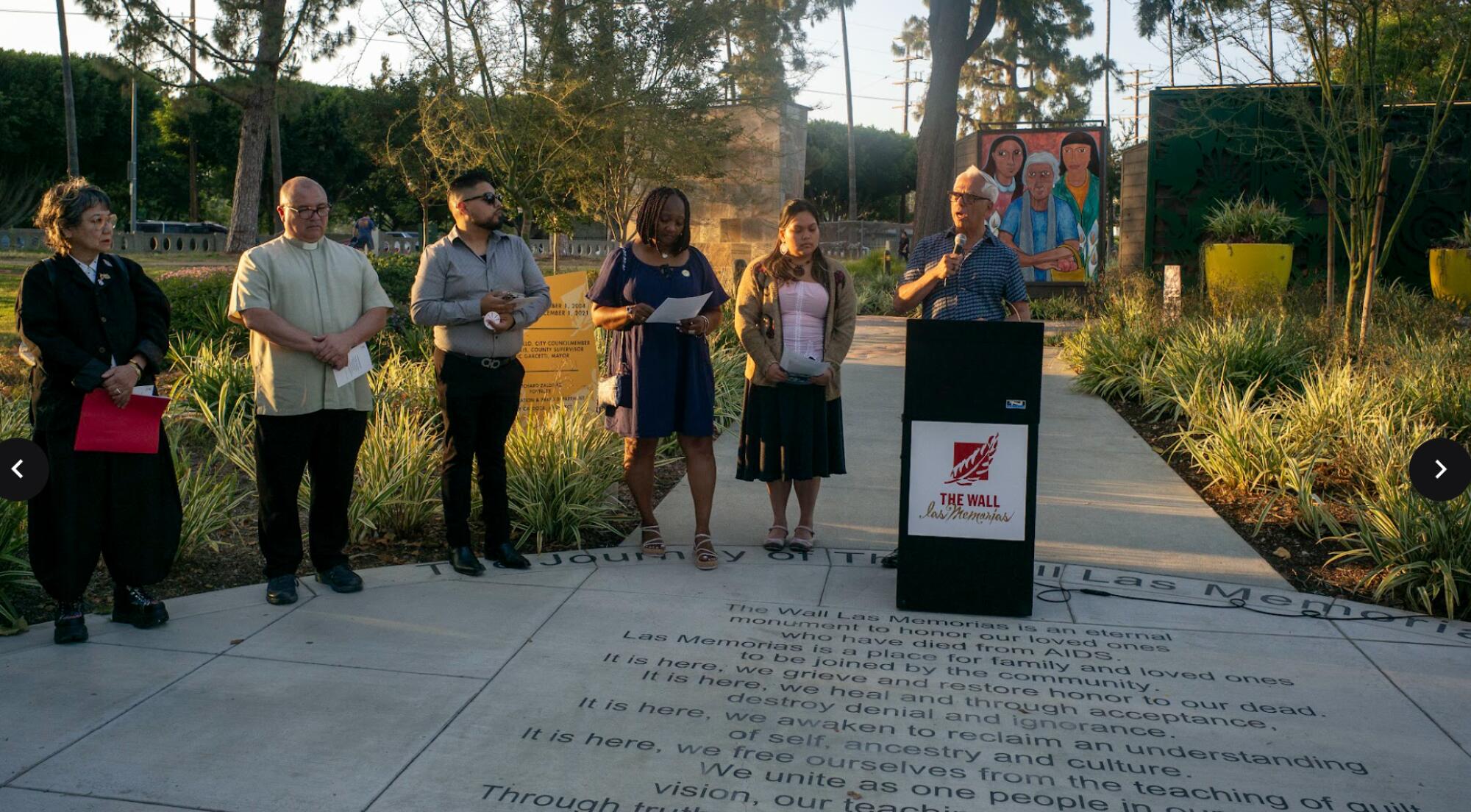
In Lincoln Park, past Plaza de la Raza cultural center and under swaying pine trees, stands a row of 10-foot wooden panels etched with names. Robert Zaldivar stood quietly in front of the names, surrounded by community members holding lit candles as memories of old friends resurfaced.
The panels bear nearly 2,000 names, and more are added every year. Each one represents an Angeleno, mostly Latinos, who died of AIDS. Zaldivar led the movement to erect this monument, named the Wall Las Memorias, which was finalized in 2004.
Inspired by his late best friend, who was HIV-positive, the Wall represents to Zaldivar the power of remembering those in his community affected by HIV and AIDS. It was designed in the shape of Quetzalcoatl, or the “Feathered Serpent,” an Aztec deity and symbol of rebirth.
Robert Zaldivar leads a sunset vigil at the Wall Las Memorias AIDS Monument in Lincoln Park on the anniversary of the first HIV diagnosis in L.A. on June 4, 2026.
(The Wall Las Memorias)
That day in early June, he hosted a sunset vigil, joined by AIDS Memorial Quilt founder and Harvey Milk mentee Cleve Jones, to recognize the lives lost since AIDS was first diagnosed 45 years prior, when the Centers for Disease Control and Prevention published a report detailing immunodeficiency in five young gay men in Los Angeles.
At Zaldivar’s feet was a poem, one he wrote in 1995 with his friend Anna Contreras.
It reads:
It is here, we free ourselves from the teaching of guilt. We unite as one people in our vision, our teaching, and our truth. Through truth we live, through knowledge we survive.
Contending with stigma and misinformation has been a constant struggle for people who are HIV-positive, he said, a struggle that Zaldivar hopes to make more visible now than it has been in previous decades.
“Sometimes it feels like there’s no other way to draw attention to this problem than to have a physical reminder,” Zaldivar said of the monument. “This reminds us of real people, as more than statistics.”
The statistics Zaldivar refers to include the continuing rise in HIV diagnoses in Latinos across the United States. The most recent CDC data show 39,000 people across the U.S. received an HIV diagnosis. And a Kaiser Family Foundation analysis revealed that between 2010 and 2022, there was a 24% increase in new cases among Latinos. In 2022 alone, Latinos made up 31% of new diagnoses, despite only representing 19% of the American population, the KFF study found.
“Just last week, we had two new diagnoses of HIV in our clinic,” said Bernardo Gomez, assistant manager of HIV resources at the Wall Las Memorias Project. “For context, we had 15 in the past six months, including straight women … I think what we’re seeing is a dangerous loss of support for outreach and education.”
Last year, President Trump released his presidential fiscal year budget for 2026, much of which went into effect last October. In it, he revealed significant cuts to HIV health programs — amounting to $1.5 billion.
The budget recommendation signaled the administration’s yearly priorities, and Trump’s fiscal plan and staffing cuts to HIV teams under the so-called Department of Government Efficiency (DOGE) showed a shift away from HIV prevention and healthcare, which advocates say has led to providers losing jobs and places for testing and resources to shrink. In L.A., the Latino community is feeling the brunt of the loss, Zaldivar said.
The biggest cut to HIV care in the 2026 budget affected the CDC, which lost around $3.6 million. Another devastating loss was $1.7 million cut from the Ryan White HIV/AIDS Program, which many L.A. resource centers report relying on to fund part of their programming and staffing.
Robert Gamboa, associate director of public policy at the L.A. LGBT Center, said that in Trump’s first term, his “Ending the Epidemic” program created hope for soon seeing the end of HIV in the U.S. — a hopefulness that he said was quickly dashed in his second term.
“Now there’s this 180-degree shift in policy, we see these enormous proposals pulling away from funding, and his lack of acknowledgment of World AIDS Day, and Pride in general,” Gamboa said. “The message of that is loud and clear: [The Trump administration] is telling our LGBT community, ‘We don’t care about you.’”
Since Trump’s inaugural address last year, Gamboa said executive orders have only solidified Trump’s shift away from LGBT organizations, “challenging the structural integrity of almost everything we’ve done.”
Gamboa said that last spring, the Department of Public Health, Division of HIV and STD Programs), which supplemented L.A. organizations with substantial HIV funding, sent out a notice that all of their contracts were terminated.
“Well, this caused a massive alarm all across L.A. County. Everyone started freaking out. We had to say, ‘We need an emergency allocation [from state funds] so that we can continue providing HIV services across California,’” Gamboa said. “We’re used to getting upwards of around $20 million in funding at the county level, and it wasn’t happening.”
Robert Zaldivar leads a sunset vigil at the Wall Las Memorias AIDS Monument in Lincoln Park on the anniversary of the first HIV diagnosis in L.A on June 4, 2026.
(The Wall Las Memorias)
Since then, nonprofit representatives have confirmed that the contracts were restored at reduced rates. However, the impact of the uncertainty shook the health services community and only caused further distrust among Latino patients.
“We’re already seeing [the impact in L.A.]. In the Latino community, there’s so much fear from the ICE raids. People are afraid to even leave their homes,” Gamboa said. “We’ve worked so hard in building trust and relationships with our communities of color. Now, they’re afraid to even come in. Many of the places they’ve gone to in L.A. County have already closed their doors and ceased services.”
Most recently, the Trump administration announced plans to cut millions in public health funding. This includes $1.1 million that would be slashed from the National HIV Behavioral Surveillance Project, an early-warning system for HIV outbreaks, established by the L.A. County Department of Public Health.
On the White House website, a page called “Cuts to Woke Programs” reads: “President Trump is committed to eliminating radical gender and racial ideologies that poison the minds of Americans.”
Gamboa said that organizations have been discouraged of using “LGBT” in their programming to avoid being defunded as part of the targeted “woke” programs.
“It really affects me,” said Gomez, who has been living with HIV since 1996. “How long will I have medicine?”
Gomez, who is the breadwinner of his family, says his monthly supply of medication costs $1,500 a bottle. “It’s so expensive, and I have insurance. For people without insurance, [the Ryan White program] is the only way they can afford treatment,” Gomez said. “I’m afraid of what will happen to them.”
Gomez takes antiretroviral therapy, a lifesaving medication that reduces the number of infected cells, making the disease less transmissible and prevents HIV from developing into AIDS. According to 2024 HRSA data, the Ryan White program provided antiretroviral therapy to 602,000 people, preventing the spread of HIV.
As the program loses funding, jobs providing HIV care have become more sparse — and programs like the Wall and the L.A. LGBT Center have become more essential to support the thousands left without life-saving care.
HIV program funds are trickling back into L.A. County for nonprofits this year; although some, like the Wall, maintain that it’s “not enough to address the need.” Up until last May, the organization shared that the county funded $1 million of its annual HIV reduction efforts. This year, that number was drastically reduced to $100,000 per six-month contract.
“Many of my social worker friends are off the streets [where they helped at-risk communities] due to just not having enough funding to do their jobs,” said Miguel Rodriguez, program coordinator of HIV testing and prevention at the Wall. “People think only gay men are affected, but basic sexual health for everyone is at risk here. Less [testing] means more infections and transmissions across the board.”
As Robert Zaldivar stresses, the only way to protect L.A.’s Latino HIV-positive community is to support remaining HIV services to get tested or donate to local service organizations.
“What we saw in the ’90s, I’m scared that it will repeat. I want people to remember how serious [HIV] is, and to educate,” Zaldivar said. “Keep getting tested. We don’t report your immigration status or sexuality. Just come in.”
GK Barry was yelled out by a celebrity teammate during Soccer Aid after she ignored a pass to instead dance with the crowd just seconds into her time on the pitch
Tom Grennan and GK Barry at Soccer Aid(Image: Shutterstock)
GK Barry appeared to leave a Soccer Aid teammate frustrated just moments into her time on the pitch. The Loose Women star was yelled at by Tom Grennan after she was too busy dancing with the crowd to see him pass her the ball.
The 26-year-old influencer, whose real name is Grace Keeling, was on England’s team at this year’s charity match and came on after replacing Tom Hiddleston in the 41st minute of the game. She quickly got the ball and passed it to Grennan, then turned to the crowd to celebrate, but missed Grennan’s return pass.
As Keeling celebrated, Grennan kicked the ball back to her and it rolled out of play. He appeared to yell something at her, gesturing to where the ball had rolled out of bounds, before turning his back.
Fans thought Keeling’s antics were “hilarious”. One said: “GK Barry in soccer aid is absolutely sending me”. Another added: “Literally love GK Barry so much”. A third said: “GK Barry is hilarious”. One called it an “all time soccer aid moment”.
Prior to the match, GK Barry sat down with Mirror to talk about Soccer Aid, particularly what her footballer girlfriend Ella Rutherford thought of it. “She’s really excited,” Keeling revealed. “I’ve never been one to understand football; I’ve never had the chance, but I feel like she’s loving telling me about it. She’s like ‘This is a corner’, and I’m like ‘OK’.”
Keeling joked that she and Rutherford were “swapping roles” and she was going to be “signing up to Portsmouth”. She also revealed how her girlfriend was helping her prepare for the match.
“I’m learning how to dribble,” she laughed, adding: “Learning what goal is ours that we have to shoot in. Ella’s got me on a high protein diet, which is hell – I’ve been doing a lot of that, a lot of eggs, a lot of mince, it’s disgusting but I’m hoping that will make me automatically become a footballer.”
As for advice on how to be on the pitch, Keeling says she’s noticed Rutherford is “very good at stopping people getting the ball”. But Barry is a “wuss”. “Her main thing is, you need to control the ball,” she explained, adding: “I get scared – if I’ve got a six-foot man coming towards me trying to get the ball, he might have to have it.”
Despite her excitement for Soccer Aid, Keeling joked it wasn’t her “bag”. She said: “Because I’ve watched Ella do it i sort of maybe kind of know what to expect a little bit, that’s what I’m telling myself.” But, the thought of 60,000 people attending is giving Grace the fear.
“I have a thing, I forget how to walk if I think someone behind me is looking at me,” she said, adding: “I do fear that I may skip onto the pitch or something like that. But it should be exciting, it’s the biggest thing I’ve done.” And despite being terrified she may embarrass herself, that doesn’t matter for Keeling as she’s taking part in an “amazing” event.
And Keeling admits that aligning herself with such a positive cause is “nice” for her due to the ages of her audience. “I think it’s amazing to tie in with that,” she said, adding: “Our team, there are so many types of people in different bits of the industry, so the amount of people we’ll be able to bring in and donate to the charity is amazing.”