Agency

ICE acting director Todd Lyons will resign at end of May, DHS says

U.S. Immigration and Customs Enforcement acting director Todd Lyons, a key executor of President Trump’s mass deportations agenda, will resign at the end of May, federal officials announced Thursday.

Homeland Security Secretary Markwayne Mullin announced Lyons’ departure, calling him a great leader of ICE who helped to make American communities safer. Mullin said Lyons’ last day will be May 31.

“We wish him luck on his next opportunity in the private sector,” Mullin said in a statement. The Department of Homeland Security did not immediately respond to an email from the Associated Press asking why he is resigning.

Lyons, who was named acting director in March 2025, led the agency at the center of President Trump’s plans to reshape immigration to the U.S.

Under his leadership, the agency was granted a massive infusion of cash through Congress, which it used to expand hiring and detention capabilities, and it ramped up arrests to meet demand from the administration.

ICE was also central to a series of high-profile immigration enforcement operations in American cities, including Chicago and Minneapolis, a deployment that ended after backlash erupted over the deaths of two American protesters at the hands of federal immigration officers.

Stephen Miller, the president’s deputy chief of staff and the main architect of his immigration policy, called Lyons a “dedicated leader.”

“His courageous work at ICE has saved countless thousands of American lives and helped deliver safety and tranquility to millions of Americans,” Miller said in a statement.

White House spokesperson Abigail Jackson described Lyons in a post on X as “an American patriot who made our country safer.”

It’s not clear who might replace Lyons. But whoever does will take over an agency flush with cash while still a flashpoint for controversy. ICE is at the center of a battle in Congress, with Democratic lawmakers demanding restraints on immigration officers before agreeing to restore routine funding for DHS.

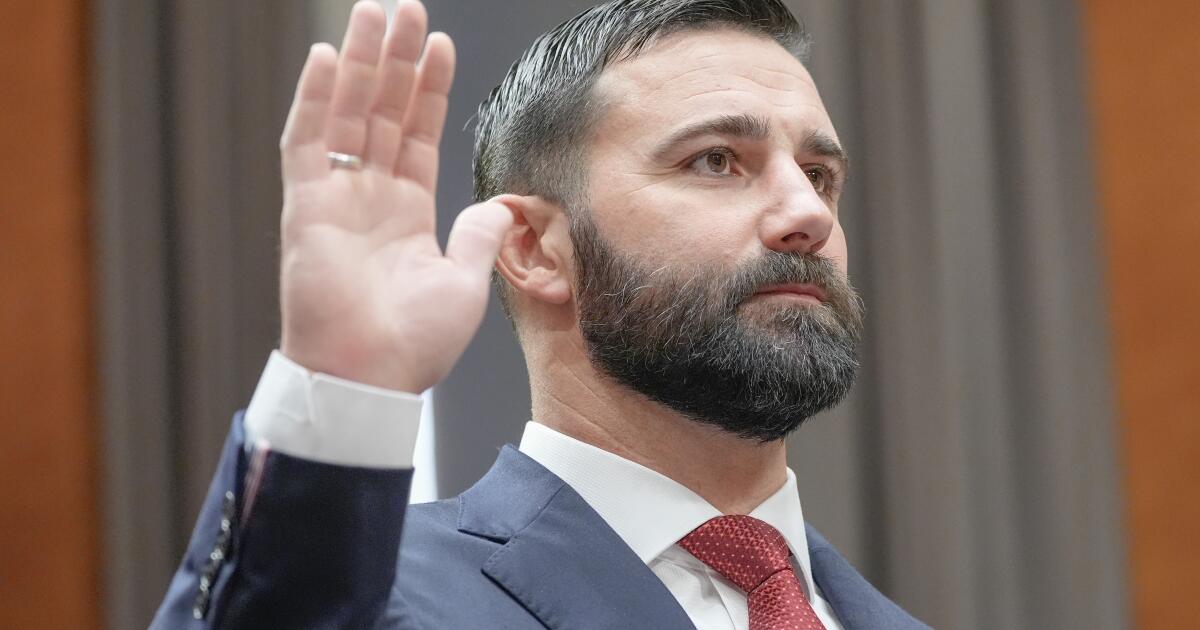
On Thursday, Lyons, along with two other top immigration officials, appeared before a House subcommittee to argue for his agency’s budget and faced continued scrutiny from lawmakers of ICE’s actions.

Lyons’ departure also comes as DHS is under new leadership after Trump fired former Secretary Kristi Noem, who led the department through the administration’s major immigration policy changes.

Mullin, who took over as secretary last month, is likely to continue to advance the president’s agenda but has struck a softer tone on some of the administration’s most contentious policies.

Public perceptions of ICE during Lyons’ tenure were low. In a February AP-NORC poll, most U.S. adults, including independents, said they have an unfavorable view of the agency.

Lyons faced questions in Congress over the shooting deaths of Renee Good and Alex Pretti and was asked if he would apologize for the way some Trump administration officials characterized Good as an agitator. He declined to do so.

“I welcome the opportunity to speak to the family in private. But I’m not going to comment on any active investigation,” Lyons said.

Lyons said he had seen video that captured Pretti’s shooting but said he could not comment, citing an active investigation.

Lyons, who joined ICE in 2007 as an immigration enforcement agent in Texas, signed off on a memo, first obtained by the Associated Press, that granted federal immigration officers sweeping powers to forcibly enter homes and make arrests without a judge’s warrant.

Trump’s border advisor Tom Homan described Lyons as serving selflessly and “a highly respected and effective acting Director of ICE.”

Goldenberg and Golden write for the Associated Press. Golden reported from Seattle.

Source link

ICE went on a hiring spree. Sterling credentials were not required, AP investigation finds

Their backgrounds stand out. And not in a good way.

Two bankruptcies and six law enforcement jobs in three years. An allegation of lying in a police report to justify a felony charge against an innocent woman — an incident that led to a $75,000 settlement and criticism of his integrity. A third job candidate once failed to graduate from a police academy, then lasted only three weeks in his only job as a police officer.

Their common bond: All were hired recently by U.S. Immigration and Customs Enforcement during an unprecedented hiring spree — 12,000 new officers and special agents to double its force — after the agency received a $75-billion windfall from Congress to enact President Trump’s mass deportation campaign.

The president put a premium on swift action, and for ICE that meant rapid-fire recruitment and hiring, which in turn led to new employees with questionable qualifications. Their backgrounds and training have come under scrutiny after numerous high-profile incidents in which ICE agents used excessive force.

“If vetting is not done well and it’s done too quickly, you have higher risk of increased liability to the agency because of bad actions, abuse of power and the lack of ability to properly carry out the mission because people don’t know what they are doing,” said Claire Trickler-McNulty, who served as an ICE official during the Obama, first Trump and Biden administrations.

The agency has said the majority of new hires are police and military veterans. But evidence is mounting that applicants with questionable histories were either not fully vetted before they were brought on or were hired in spite of their past, an investigation by the Associated Press found.

ICE’s acting director, Todd Lyons, said during a congressional hearing in February that he was proud of the hiring campaign, which drew more than 220,000 applications. “This expansion of a well-trained and well-vetted workforce will help further ICE’s ability to execute the president’s and secretary’s bold agenda,” he said.

Unlike many local law enforcement agencies, ICE said it shields the identity of employees to protect them from harassment, making a full accounting of the new hires impossible.

The AP focused on more than 40 officers who recently made public their new jobs as ICE officers on LinkedIn pages, using public records to check their backgrounds. All but one were male.

While most of them had conventional qualifications as former correctional officers, security guards, military veterans and police officers, it’s unclear how many should have potentially been disqualified because AP did not have access to their full personnel files. But several had histories of unpaid debts that resulted in legal action, two had filed for bankruptcy and three others had faced lawsuits that alleged misconduct in prior law enforcement jobs, the AP found.

Marshall Jones, an expert on police recruiting at the Florida Institute of Technology, said it’s hard to get a full picture of ICE’s new employee pool without more data. But he said ICE has likely hired some “less than ideal candidates” who meet minimum requirements but would be passed over in a normal hiring cycle.

“If you’re hiring hundreds or thousands of people, even with the best of background processes, there are going to be outliers,” he said. “The question is, are these normal outliers from human beings doing things, or is there a systemic challenge in properly vetting folks if there are issues?”

DHS says ‘vetting is an ongoing process’

The Department of Homeland Security, ICE’s parent agency, did not answer questions about specific hiring decisions. But it acknowledged some applicants received “tentative selection letters” and offers to begin working on a temporary status before they had been subjected to full background checks.

“ICE is committed to ensuring its law enforcement personnel are held to the highest standards and rigorously vets them throughout the hiring process,” the department said. “Vetting is an ongoing process, not a one-time occurrence.”

The process includes reviewing their criminal histories and credit scores and conducting background investigations that include interviewing prior employers and other associates, which can take weeks. But the deluge of hires has strained the agency, which promised signing bonuses of up to $50,000 and advertised that college degrees were not required.

An internal memo, first reported by Reuters in February, told ICE supervisors that if they receive “derogatory information about a newly hired employee’s conduct” they should refer the allegations to an internal affairs unit for investigation. Such information could include the employees’ termination or forced resignations, the memo said.

Two bankruptcies, six jobs before ICE hired him

Among the new hires is Carmine Gurliacci, 46, who resigned as a police officer in Richmond Hill, Ga., to join ICE in Atlanta in December, according to a resignation letter obtained by AP.

He filed for bankruptcy in 2022, saying he had no income and had been unemployed for two years after moving from New York to Georgia, court filings show. He said he was living with a friend and doing chores in exchange for housing, listing tens of thousands of dollars of unpaid loans, bills, child support and other debts. He also had filed for bankruptcy in 2013 in New York, when he listed $95,000 in liabilities, records show.

Serious financial problems are “a pretty big red flag” because they might make employees susceptible to bribes or extortion, which have been problems at ICE, Trickler-McNulty said.

After his 2022 bankruptcy petition was approved, Gurliacci rejoined the work force, hopping to six Georgia law enforcement agencies within three years, each time resigning before moving on, records obtained by AP show.

He left one campus security job in 2023, citing “unforeseen personal issues that render me unable to fulfill my duties,” a resignation letter shows. But he then began working for the Butts County Sheriff’s Office soon after.

He lasted months there before moving to the Chatham County Sheriff’s Office, where he quit after two months on the job, records show. The federal government recently obtained his Chatham County personnel file as part of a background check, two months after he started at ICE.

Reached by phone, Gurliacci told a reporter he would call back. He never did and did not respond to follow-up messages.

Critic says new ICE hire ‘abuses his power’

Another new hire is Andrew Penland, 29, who joined ICE after resigning in December as a sheriff’s deputy in Greenwood County, Kansas.

Penland had spent most of his career as a deputy in Bourbon County, Kansas, but left last year after facing a lawsuit alleging he arrested a woman on false allegations in 2022. The county’s insurer paid $75,000 to settle the case, the agreement shows.

The woman, June Bench, recounted in an interview what happened. One of her neighbors, a county official, claimed Bench had purposely made a wide turn and nearly hit him with her car.

Penland responded to the property. Body camera video shows he urged the neighbor to press charges and told the man Bench would go to jail but he would not have to testify in court because it would get resolved through a plea.

Bench denied the allegation and said it was part of a personal dispute. But Penland arrested her on a felony assault charge, took her to jail and seized her car. Penland wrote in a report that he watched surveillance video showing her neighbor jumping out of the way of her speeding car.

It took a week for Bench to get out of jail and more than a year to defeat the charge, which was dismissed for lack of evidence. When she obtained the video Penland cited as proof, it showed her car appearing to make a routine turn and no near-collision with the neighbor.

Bench said she was outraged to learn Penland had been hired by ICE.

“That’s scary to me. He abuses his power,” she said.

After being reached for comment, Penland deactivated his LinkedIn account and alerted ICE to the inquiry but did not respond to AP.

New hire struggled at police academy

A third new ICE hire, Antonio Barrett, initially failed to graduate from a Colorado law enforcement academy in 2020, one of two students who did not “complete portions of the academy” and received “an incomplete grade,” an email obtained by AP shows.

He finished the program after a community college arranged a special one-day training and test for him, and landed a job at the police department in La Junta, Colo., in July 2020. But he worked only three weeks before resigning and never worked in local policing again.

Previously, Barrett worked as a corrections officer at a Colorado prison.

He was accused in a lawsuit of excessive force for inflicting pain on a handcuffed inmate when he and another colleague forcibly removed the man from a wheelchair in 2017. But state officials argued their actions were not excessive and a court agreed, dismissing the case.

Barrett didn’t respond to a message seeking comment.

Ex-ICE instructor says training is inadequate

ICE has denied removing any training requirements, saying new recruits receive 56 days of training and 28 days of on-the-job training. The agency said that most of the new officers have already completed law enforcement academies.

But former ICE academy instructor Ryan Schwank testified in February that agency leaders cut training on the use of force, firearms safety and the rights of protesters. He said the new recruits include some as young as 18 who lack college degrees and whose primary language is not English.

“We’re not giving them the training to know when they’re being asked to do something that they’re not supposed to do, something illegal or wrong,” he said.

Foley writes for the Associated Press.

Source link

Trump nominates Erica Schwartz, former deputy surgeon general, to serve as CDC director

President Trump on Thursday nominated Erica Schwartz, a former deputy surgeon general, to be the next director of the Centers for Disease Control and Prevention.

In a social media post, Trump described Schwartz as “incredibly talented” and said, “She is a STAR!”

The Atlanta-based CDC, which is charged with protecting Americans from preventable health threats, has been in turmoil since Trump returned to office more than a year ago, with a succession of mostly temporary leaders.

The agency is overseen by Health Secretary Robert F. Kennedy Jr., who had promised not to change the nation’s vaccination schedule. But shortly after taking office, Kennedy said he was going to investigate the childhood vaccine schedule and went on to attempt a substantial rewrite of vaccine recommendations for kids. Some of those efforts were put on hold recently by a federal judge.

The administration’s first pick to run the CDC was former Florida congressman Dr. David Weldon, but his March 2025 Senate confirmation hearing was canceled an hour before it was to begin. Weldon said at the time that he’d been told not enough senators were willing to vote for him.

The White House then moved on to Susan Monarez, who had been serving as the CDC’s acting director. Monarez was confirmed by the Senate, but she was ousted in less than a month. Trump administration officials said she wasn’t aligned with their agenda so they terminated her.

Several key CDC scientific leaders resigned in protest, saying Monarez’s dismissal dashed their hopes that a CDC director would be able to guard against political meddling in the agency’s scientific research and health recommendations.

Since then, there’s been a revolving door in agency leadership, with the short-term role of acting director being passed from one Washington-based Health and Human Services official to another. National Institutes of Health Director Jay Bhattacharya has been overseeing the CDC the past several weeks.

During a House Appropriations Committee hearing Thursday, Kennedy said the new CDC team was “extraordinary.”

“I think this new team is really going to be able to revolutionize CDC and get it back on track,” he said.

Schwartz holds multiple academic credentials, including both medical and law degrees. Her career has largely been spent in military uniform, including in a leadership position at the U.S. Coast Guard where she oversaw the organization’s system of 41 clinics and 150 sick bays.

She later served as deputy surgeon general, where she helped lead uniformed medical and health professionals posted at the CDC and government health agencies that serve the general public.

Schwartz could not be reached for comment.

Trump also announced the appointment of Sean Slovenski, a former Walmart executive, as CDC deputy director and chief operating officer. Dr. Jennifer Shuford, Texas health commissioner, was named the CDC’s deputy director and chief medical officer. And Dr. Sara Brenner, a former Food and Drug Administration administrator, was designated as a senior counselor for public health to Kennedy.

In a social media post Thursday, Kennedy congratulated Schwartz and the other appointees and said he looks “forward to working together to restore trust, accountability, and scientific integrity” at the CDC.

But Aaron Siri, a lawyer and ally of Kennedy in attacking vaccines and pharmaceutical companies, criticized Schwartz’s selection. In a social media post, Siri lambasted Schwartz’s past promotion of vaccinations and said “she lacks the basic ethics and morals to lead the CDC.”

Schwartz’s nomination comes as Dr. Casey Means, Trump’s pick for another key health-related role, U.S. surgeon general, has had difficulty getting confirmed.

Means’ languishing nomination after appearing for a confirmation hearing in February reflects the skepticism that lawmakers of both parties have expressed toward the direction in which Kennedy has taken his department.

Stobbe writes for the Associated Press. AP writer Ali Swenson contributed to this report.

Source link

FDA to weigh looser rules on unproven peptides touted by RFK Jr., MAHA

The Food and Drug Administration will hold a meeting in the summer to consider easing restrictions on more than a half-dozen peptide injections, a group of unapproved therapies that have become popular among wellness influencers, fitness gurus and celebrities.

The meeting announcement Wednesday follows repeated pledges by Health Secretary Robert F. Kennedy Jr. to loosen regulations on peptides, which are often pitched as a quick way to build muscle, heal injuries or appear younger. There’s little research behind those claims and most peptides have not been reviewed for safety by the FDA.

Kennedy has discussed using peptides for his own injuries. And some major supporters of his Make America Healthy Again movement are big proponents of them, including Gary Brecka, a self-described “longevity expert” who sells various peptide formulas through his website.

The FDA said in a federal notice Wednesday that it will ask a panel of outside advisors to review seven peptides at a meeting in July, specifically whether they should be added to a list of substances that can be safely produced by pharmacies. In the meantime, the agency said it would soon remove the chemicals from a restrictive list reserved for unapproved, high-risk drugs. The peptides under discussion include some of the most popular among influencers, such as BPC-157, which is marketed to heal injuries and reduce inflammation.

“The Wild West is about to become wilder,” said Dr. Peter Lurie, a former FDA official who now leads the Center for Science in the Public Interest. In an interview, Lurie said allowing peptides on the market without clinical testing poses a “profound threat” to FDA’s decades-old system for vetting drugs.

“I don’t see why one would take the path of a proper drug approval if there is now this less rigorous, alternative path to market,” he said.

Under President Biden, the FDA added nearly 20 peptides to the federal list of substances that should not be produced by compounding pharmacies — businesses that mix medications that aren’t available from drugmakers.

At the time, the FDA’s panel of pharmacy advisors voted overwhelmingly that the peptides did not meet the criteria for substances that can be safely compounded. And FDA regulators agreed, saying later that the substances “present significant safety risks,” because most have not been extensively tested in humans.

Many of the FDA advisors and internal staff who oversaw those decisions no longer work for the agency. The FDA’s pharmacy panel currently has a number of vacancies, which Kennedy could fill before the July meeting.

Kennedy previewed Wednesday’s move in an interview with podcast host Joe Rogan. Both men have repeatedly spoken about peptides and claimed to have benefited from their use.

RFK Jr. claims personal benefit from peptides

“I’m a big fan of peptides,” Kennedy told Rogan. “I’ve used them myself and with really good effect on a couple of injuries.”

Given Kennedy’s statements, Lurie said it was doubtful the drugs would receive real scrutiny from FDA.

“Everybody knows the outcome that the secretary wants,” Lurie said. “I don’t believe for one moment that what’s going on here is an honest investigation of whether these products should be compounded.”

Scott Brunner of the Alliance for Pharmacy Compounding said the coming meeting will be the start of a “protracted process.” Even if the panel votes to make the peptides available, and the FDA agrees, the agency will still have to draft and publish rules on the change, he noted.

Peptides are essentially the building blocks of more complex proteins. Inside the human body, peptides trigger hormones needed for growth, metabolism and healing.

In recent years peptides have become widely known through the blockbuster success of GLP-1 medications, which the FDA has approved for treating obesity and diabetes. Other FDA-approved peptides include insulin for diabetics and hormone-based drugs for several medical conditions.

But many of the peptides promoted online have never been approved, making them technically illegal to market as drugs. Several peptides, such as BPC-157 and TB-500, are banned by international sports authorities as doping substances.

But that has not stopped them from gaining a foothold in the burgeoning marketplace for wellness hacks and alternative remedies.

“I think this is a disaster in the works,” said Dr. Eric Topol of Scripps Research Translational Institute, who has studied the issue. “These peptides have no data to support their safety and efficacy.”

Meanwhile, some dietary supplement makers have begun mixing peptides into capsules, protein powders and gummies. At a recent FDA meeting, the industry argued for expanding the federal definition of supplements to permit the use of newer ingredients such as peptides in their products.

Safety risks were cited previously

When the FDA added a number of injectable peptides to its list of restricted substances in 2023, it cited safety risks including cancer and liver, kidney and heart problems.

That triggered pushback from wellness entrepreneurs, compounding pharmacies and their allies in Washington.

Last year several members of Congress, including Republican Sen. Tommy Tuberville of Alabama, sent letters to Kennedy asking him to lift limits on peptide production.

Some in the compounding industry argue that FDA restrictions have given rise to an illicit market of imported chemicals from China and other countries, which are not subject to U.S. drug standards.

Kennedy has echoed those concerns.

“With the gray market you have no idea if you’re getting a good product,” Kennedy told Rogan. “And a lot of this stuff that we’ve looked at is just very, very substandard.”

Perrone writes for the Associated Press.

Source link

Federal agency approves concept for Trump’s plan for a Triumphal Arch in Washington

President Trump’s design for the Triumphal Arch he wants built at an entrance to the nation’s capital moved a step forward Thursday after a key agency reviewed the proposal for the first time. One commissioner suggested changes, including losing the Lady Liberty-like statue and pair of eagles that would sit on top of the arch and add to its height.

The arch is one of several projects that the Republican president is pursuing alongside a White House ballroom to leave his lasting imprint on Washington.

The U.S. Commission of Fine Arts voted to approve the concept design for the arch. The seven commissioners, all appointed by Trump, will review an updated version of the design before taking a final vote at a future meeting.

Trump said last week on social media that the arch “will be the GREATEST and MOST BEAUTIFUL Triumphal Arch, anywhere in the World” and a “wonderful addition to the Washington D.C. area for all Americans to enjoy for many decades to come!”

Also on the agenda for the commission’s monthly meeting was his plan to paint the gray granite exterior of the Eisenhower Executive Office Building, which is next to the White House, white.

A third White House-related project, construction of an underground center to conduct security screenings of tourists and other guests, was also up for consideration.

Triumphal Arch

The arch would stand 250 feet tall from its base to a torch held aloft by a Lady Liberty-like figure atop the structure. That figure would be flanked up top by two eagles and guarded at the base by four lions — all gilded. The phrases “One Nation Under God” and “Liberty and Justice for All” would be inscribed in gold lettering atop either side of the monument.

The commission’s vice chairman, architect James McCrery II, said he preferred the arch without the figure and eagles on top. McCrery also objected to the lions on the base.

The arch would be built on a human-made island managed by the National Park Service on the Virginia side of the Potomac River at the end of Memorial Bridge from the Lincoln Memorial in Washington. The arch would dwarf the Lincoln Memorial, which is 99 feet tall, and be close to half the height of the Washington Monument, an obelisk that is about 555 feet tall.

White House press secretary Karoline Leavitt said Wednesday that the arch’s 250-foot height will honor America’s 250 years of existence.

A group of veterans and a historian has sued in federal court to block construction on the grounds that the arch would disrupt the sightline between the Lincoln Memorial and Arlington House at Arlington National Cemetery, among other reasons.

Underground screening center for White House visitors

The U.S. Secret Service, Interior Department, National Park Service, and the Executive Office of the President want to start construction in August on a 33,000-square-foot (3,066-square-meter) center to screen tourists and other visitors to the White House.

It would be built beneath Sherman Park, federal land southwest of the White House, to provide a more secure place to screen those going on White House tours or attending events. The new facility would have seven lanes to ease processing and reduce wait times.

Officials want it operating by July 2028, six months before Trump’s term ends.

Eisenhower Executive Office Building paint job

Trump said the Executive Office Building is beautiful, but he does not like its gray exterior.

“It’s one of the most beautiful buildings anywhere in Washington,” Trump said in August. “I think it’s just incredible, but you have to get past the color because the stone they used was a really bad color.”

Two proposals were given to the commission: Cover the entire building in bright white or paint most of it white while leaving untouched the granite on the exposed basement and subbasement.

In written materials, the White House said the building has been largely neglected since its construction. It said the building’s color, design and massing do not “align visually with the surrounding architecture” and lack ”any symbolic cohesion with the White House.”

The paint job is also the subject of litigation in federal court.

The building sits across a driveway from the West Wing. It was completed in 1888 after 17 years of construction, and its granite, slate, and cast iron exterior makes it one of America’s best examples of the French Second Empire style of architecture.

It originally housed the departments of State, War and Navy. It currently houses offices for the vice president and the National Security Council, among others.

The building is a National Historic Landmark and is also listed on the National Register of Historic Places.

Superville writes for the Associated Press.

Source link