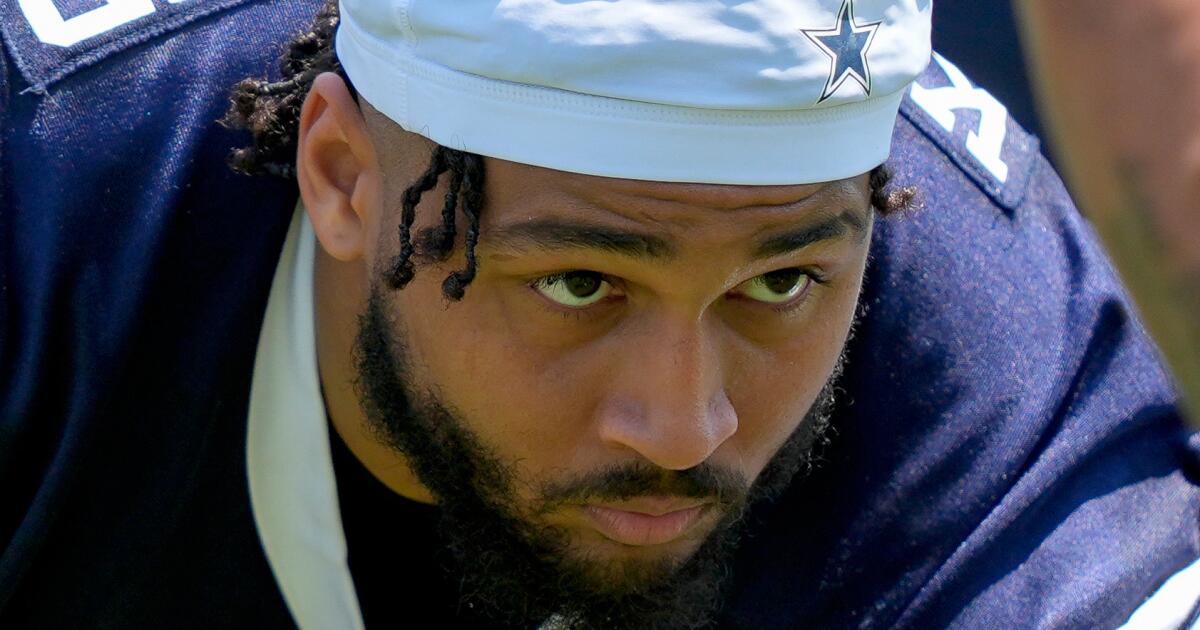
“While this diagnosis does not change the tragedy of his passing, it provides important context about some of the struggles he may have been facing,” Kneeland’s family, including girlfriend Catalina Mancera, said in a statement.
CTE is a degenerative brain disease that has been found in people who experience repetitive head trauma and can be diagnosed only after death.
“We share this information to help people understand what NFL and other high contact sport athletes might be struggling with,” the family said. “Raising awareness is important to us. We continue to remember Marshawn with compassion for the person he was, rather than defining him by the final moments of his life. One Love.”
Frisco, Texas, police said Kneeland didn’t stop when state Department of Public Safety troopers tried to pull him over on Nov. 5 for a traffic violation. The 2024 second-round draft pick was pursued by authorities in his vehicle and then on foot before being found “deceased with what appeared to be a self-inflicted gunshot wound,” Frisco police said in a statement at the time.
Police-dispatch audio from the incident revealed that Kneeland had sent out a group text to say goodbye to his family.
Researchers at the Boston University CTE Center analyzed Kneeland’s brain tissue and determined that the athlete, who started playing tackle football at age 7, was in stage one of four of CTE.
“Unfortunately, I was not surprised to find CTE in the brain of Mr. Kneeland, because we have found this progressive brain disease in nearly half of the athletes we’ve studied who have died before the age of 30,” Dr. Ann McKee, the center’s director, said in a statement.
“Thanks to the generosity of our brain donor families, we now better understand the earliest stages of CTE, and it is bringing us closer than ever to diagnosing it during life. My team and I are fully dedicated to finding effective treatments and a cure for CTE.”
The Associated Press contributed to this report.
Suicide prevention and crisis counseling resources
If you or someone you know is struggling with suicidal thoughts, seek help from a professional or call 988. The nationwide three-digit mental health crisis hotline will connect callers with trained mental health counselors. Or text “HOME” to 741741 in the U.S. and Canada to reach the Crisis Text Line.
• American playwrights, recognizing that identity is more complicated and slippery than ideology, have been shedding fresh light on what it means to be an American. • Writers such as Young Jean Lee, Tarell Alvin McCraney, Quiara Alegría Hudes, Branden Jacobs-Jenkins, Jeremy O. Harris, Ayad Akhtar, and Bess Wohl have been creating drama from the multidimensional, intersectional realities of characters whose backgrounds refuse to be compartmentalized into a single category.
The American democratic experiment stands on shaky ground. Not since the Civil War have these proverbially United States been so disunited. As the nation throws itself a grand old 250th birthday bash in Washington, the mood in much of the country is more funereal than festive.
All-out partisan warfare has sown chaos. Republican legislators, taking their lead from a president who sees half the nation as his personal enemy, have put their own party’s interests over the republic’s. Staying in office has become the only thing that matters. The values imparted to me throughout my public school education — equal opportunity, impartial justice, respect for expertise, basic honesty — have been abandoned by a new breed of politician that has turned governance itself into a blood sport.
Where can one turn for reassurance that America’s best years are still ahead? Would you believe me if I said the theater? I’m not toeing the line for my field. I’m merely calling attention to a development that’s been gaining strength since I first reported on it in 2015. A cohort of playwrights, breathtakingly diverse demographically as well as aesthetically, has been rejuvenating American theater.
These writers aren’t on a sociological mission. They’re not trafficking in grievance or appealing to a particular political base. They let their plays do the talking. And they’ve been trying to have a conversation that isn’t hijacked by the most doctrinaire voices in the room.
From an institutional perspective, the American theater is in bad shape. The triple whammy of the COVID-19 closures, inflation and technological disruption has left everyone hurting. The Mark Taper Forum had to suspend programming for more than a year, smaller companies still in operation are producing fewer shows, and producers everywhere are gravitating toward the bankably familiar.
But despite this difficult terrain, it has been a boom time for American playwriting. For more than a decade, I’ve been teaching a course at the California Institute of the Arts called American Drama Now, and each year the selection of plays has become harder to whittle down. I designed the seminar partly around theater offerings in Los Angeles to connect students to recent developments in the field and to consolidate awareness that something special is happening in the American theater.
The current generation of playwrights has revealed itself to be remarkably resilient and independent. It has had no other choice. By the time many of these rising talents were accruing debt in graduate writing programs, the dream of a sustainable career in the nonprofit theater had already gasped its last breath.
When Wendy Wasserstein, Tony Kushner,Craig Lucas and Jon Robin Baitz emerged in the late 1970s and ’80s, it was still imaginable that a chosen few playwrights could make a living via the regional theater circuit, that constellation of companies founded as an alternative to the Broadway model.
That prospect was growing dimmer a few years later when playwrights such as Suzan-Lori Parks and Lynn Nottage came into prominence. But hope was still alive in the late 1990s and early 2000s. Regional theaters such as Seattle Rep, the Guthrie, the Goodman and Baltimore Center Stage remained committed to their missions while New York nonprofit companies continued to hold the line off-Broadway.
When did the picture change? In 2009, “Outrageous Fortune: The Life and Times of the New American Play” was published by the Theatre Development Fund, and one of the key findings in this study written by Todd London with Ben Pesner and Zannie Giraud Voss is that “there is no way to view playwriting as anything but a profession without an economic base.” A chasm had opened between the network of increasingly corporate-minded nonprofit theaters and the artists this system was built to serve.
The situation has grown bleaker in the last decade and a half as commercial pressures have ramped up and media consolidation and digital shortsightedness have obliterated arts coverage. Yet there’s been an unexpected upside. Theater artists who have come of age in this period have been released from the burden of having to conform to notions of regional theater respectability.
Instead of worrying about the timid taste of subscription audiences, these dramatists have been writing for themselves and their communities, dreaming up plays that don’t have to fit into institutional slots or stay within the staid bounds of traditional proscenium house decorum. The irony is that in not trying to pass muster with more conservative theatergoers (and their fastidious institutional guardians), playwrights have been winning over not just critics but also formerly squeamish artistic directors and perennially nervous Broadway producers.
The politics of identity for them is a lived experience. And as dramatists, they’re uniquely positioned to appreciate the conflicted loyalties and communal tensions of American life in dramatic rather than dogmatic terms. Whatever agendas they may personally espouse, these writers are too alert to the messiness of history and human nature to be rigidly ideological in their work.
The ongoing war between woke and anti-woke factions is a fatuous melodrama best left to the satirists. The goal of playwrights grappling seriously with what it means to be an American today isn’t to score social media points but to shed light on the fractured reality of our collective experience.
Characters in plays by Young Jean Lee, such as “Straight White Men,” are often “trying on masks to see what might prove effective in a given situation.”
(Lawrence K. Ho / Los Angeles Times)
Identity is not a fixed fact but a raucous collision of parts. No single category can contain the Whitmanesque multitudes jockeying for position inside us. Race, religion, ethnicity, gender, age, sexuality, class, disability and geography don’t line up in perfect political harmony, and each social marker tells only a fraction of the whole story. (Money, the great unequalizer, may be the most taboo subject of all.) “We are not only but also,” the sociologist and cultural historian Todd Gitlin wrote in his 1995 book “The Twilight of Common Dreams: Why America Is Wracked by Culture Wars.” We also overlap and often even clash with ourselves.
Discussion around identity can be dangerous. How can anyone be expected to navigate the minefield? Tribalists and traditionalists have controlled the terms of the battle, one by simplifying, the other by denying, the way privilege has shaped our compound selves.
Playwrights know better. They understand the way oppression, which falls disproportionately on the marginalized, has warped all of us. History, whether acknowledged or not, is etched in our souls.
It is a long-held tenet of the theater that the most interesting characters, like the most interesting people, are defined by their schisms and paradoxes. (How else could Hamlet have maintained his centuries-long hold?) Dramatists are more cognizant than ever of the sociopolitical import of these contradictions and they’ve been chronicling the way this historically freighted baggage emerges in the drama of everyday life.
All the world is indeed a stage and all its inhabitants merely stock players, as Jaques lays out in “As You Like It.” Hegel described Shakespeare’s characters as “free artists of their own selves.” The truth where we and our contemporary stage surrogates are concerned is somewhat more constrained. Culture and representation largely determine the range of our performance possibilities.
Plays such as Branden Jacobs-Jenkins’ “Appropriate” reexamine “the canon of great American family dramas … to uncover the stories that have been suppressed.”
(Craig Schwartz)
Jacobs-Jenkins has recognized perhaps more acutely than any of his peers the way dramatic forms have locked us into set scripts about our lives. He tackles genres — adapting a Dion Boucicault melodrama in “An Octoroon,” reexamining the canon of great American family dramas in “Appropriate” — to uncover the stories that have been suppressed in the dominant white middle-class narratives that would prefer not to think of themselves as political.
Lee’s standout identity plays — “Straight White Men,” “The Shipment” and “Songs of the Dragons Flying to Heaven” — reject the illusion of stable, coherent characters propagated by psychological realism. The figures in her uncategorizable works are in experimental flux, trying on masks to see what might prove effective in a given situation. Even “Straight White Men,” which uses the old home-for-the-holidays genre as a springboard, can’t help spinning away from the drama’s droll hyper-naturalism toward something resembling performance art. (Not even straight, white men want to be confined to a box, even a relatively plush one.)
“Fairview,” by Jackie Sibblies Drury, “theatricalizes the experience of the white gaze.”
(Jeff Lorch)
In “Fairview,” Jackie Sibblies Drury theatricalizes the experience of the white gaze, ultimately reversing the comfortable position white theater audiences have traditionally held. Bess Wohl’s “Liberation,” this year’s most decorated play, reanimates the history of the 1970s feminist movement by questioning what it could be leaving out of the picture. “The Balusters,” by David Lindsay-Abaire, brings the current culture wars to the stage with unique sensitivity through the squabbles of a neighborhood association torn between protecting its town’s heritage status and coming to terms with the more pluralistic demands of the 21st century.
“Fairview,” “Liberation,” and “The Balusters” are extremely funny plays that also happen to be deadly serious. If philosophy begins in wonder, trenchant social drama seems to start in laughter.
What do theatergoers want? They don’t just want to look; they also want to be seen. Isn’t that what any of us wants when gazing into the mirror held up to nature, as Hamlet describes the theater? To be granted a more expansive view of ourselves and others?
E pluribus unum, the motto of the United States, is so fundamental that it’s printed on our currency. There’s perhaps no place where the truth of this phrase — out of many, one — is more regularly realized than at the theater, where strangers transform over the course of a show into that mysterious organism we call an audience.
Gitlin ends “The Twilight of Common Dreams” with a plea: “For too long, Americans have busied themselves digging trenches to fortify their cultural borders, lining their trenches with insulation. Enough bunkers! Enough of the perfection of differences! We ought to be building bridges.”
A coalition mindset doesn’t mean denying history or pretending that America has been a level playing field. It’s been anything but in this “melting pot where nothing melted,” to quote the rabbi whose eulogy sets Kushner’s “Angels in America” in motion. But history happens to all of us, not just a select few. And to be an American is to be embroiled in the great democratic experiment that has been defined by division from the beginning. Empathy, the nuclear fusion of playwriting, is expanded when we’re allowed to take in more of our patchwork selves. Today’s dramatists have been extending a generous invitation to their compatriots: We’ll show you our complexity, if you’ll show us yours.
WASHINGTON — President Trump and his fellow Republicans are reviving a line of attack against Democrats heading into the midterm elections: They’re communists.
In just the past week, Trump has issued dark warnings that members of the Democratic Party’s ascendant left are communists who want to “completely destroy the traditional American way of life” and even engage in assassinations. Vice President JD Vance has similarly called out communism as a political shift that is “something we haven’t seen in the U.S.” House Speaker Mike Johnson has decried “radical candidates” who are “self-described, self-identifying Marxists.”
The GOP’s ideological focus conflates democratic socialism, which often centers on securing universal healthcare, higher taxes on the wealthy and stricter corporate regulation, with communism, under which private ownership is largely eliminated. It has been building since Zohran Mamdani, a democratic socialist, won the Democratic nomination for New York City mayor last year.
But it’s kicked into a higher gear recently after democratic socialists won several New York City congressional primaries last week. The primary victory on Tuesday by another democratic socialist, Melat Kiros, for a Denver congressional seat suggested the trend may extend beyond Manhattan liberalism.
“The Democrats are making this easy for us,” Rep. Richard Hudson, the North Carolina Republican who leads the House GOP’s strategy and fundraising arm, said in an interview. “They’re nominating extreme liberals, leftists who are out of touch even with mainstream Democrats.”
Republicans are holding onto slim majorities
The messaging effort comes as Republicans scramble to hold onto threadbare congressional majorities in the November midterms. It risks overlooking public frustration, particularly among younger voters, with unfettered capitalism at a time of growing income inequality and rising costs.
But it also gives Republicans a much-needed opportunity to shift the conversation back to territory that is more comfortable for them after their party has spent much of the year on defense over the fallout from Trump’s decision to launch a war against Iran, which contributed to widespread price spikes.
Ralph Reed, the longtime conservative activist who hosted Trump last week at a Faith and Freedom Coalition conference, acknowledged that Republicans are facing steep headwinds this year. But the recent string of wins by democratic socialists, he said, allows Republicans to present a contrast between “common sense and crazy.”
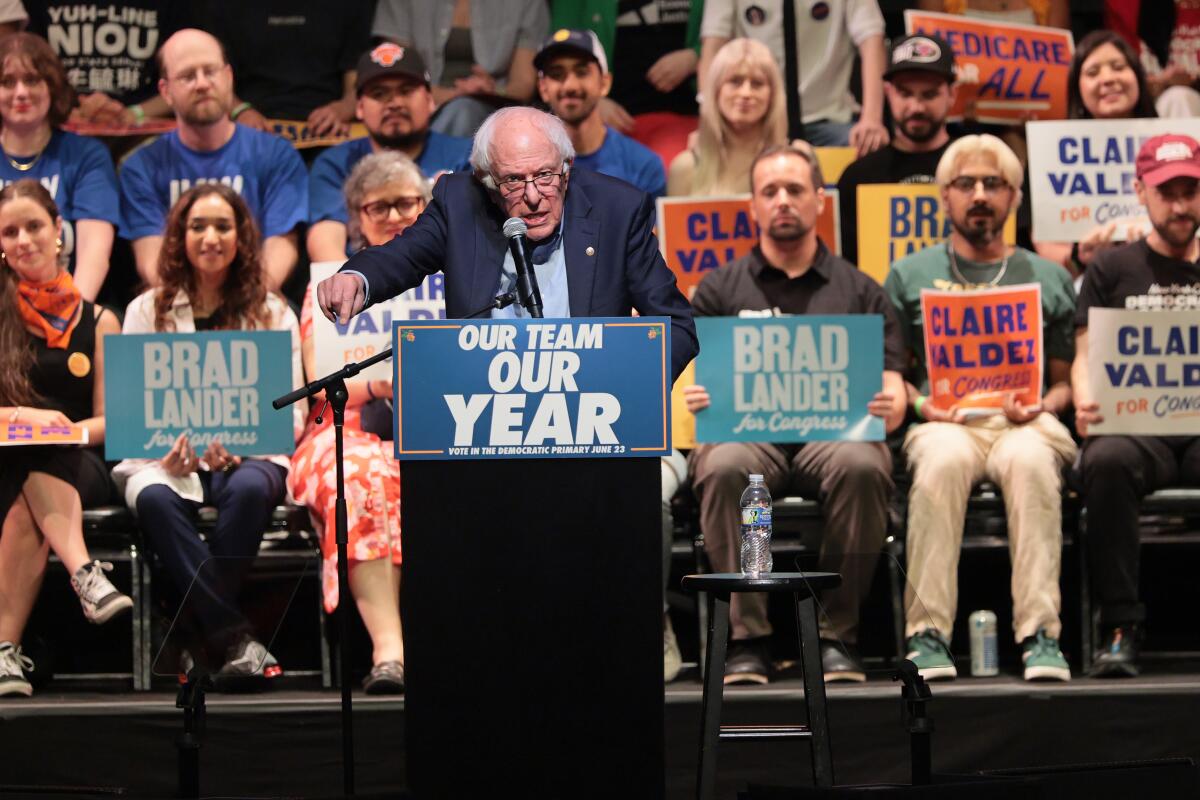
Sen. Bernie Sanders (I-VT) speaks during a Get Out the Vote (GOTV) rally at Kings Theater on June 18, 2026 in New York City. Sanders joined Mayor Zohran Mamdani ahead of next week’s primary, and the start of early voting on Saturday, as the pair campaigned for Brad Lander, Claire Valdez and Darializa Avila Chevalier, who are challenging incumbents in Democratic primary contests.
(Michael M. Santiago / Getty Images)
Democrats are uncertain over the party’s direction
The renewed push could tug at tensions among Democrats who are largely united in their loathing of Trump but are divided over the party’s direction. This year’s primaries are shaping up as a referendum between centrists who are eager to course correct from what they see as progressive overreach earlier in the decade and a left-wing pushing for even more sweeping change.
“A lot of this anger has been boiling under the surface,” said Joseph Geevarghese, executive director of Our Revolution, which was founded by U.S. Sen. Bernie Sanders, a Vermont independent who caucuses with Democrats. “It’s coming to the fore in this moment in a very powerful way.”
But Rep. Josh Gottheimer, a centrist New Jersey Democrat, called the victories in Colorado and New York “aberrations.”
“We’ve got to fight like hell to keep our party from being hijacked by socialists,” he said. “Most of them are bomb throwers, not problem solvers.”
Nevada Atty. Gen. Aaron Ford easily dispatched a more progressive rival earlier this year in his Democratic bid for governor in a state Trump carried in 2024. As he eyes a general election challenge to Republican Gov. Joe Lombardo, he insisted candidates like those who won in New York don’t represent all Democrats.
He said the Democratic Socialists of America “is not the face of our party.”
Rep. Suzan DelBene, a Washington Democrat who chairs the House Democratic campaign committee, said in a statement that Republicans were “resorting to desperate attacks that aren’t actually about the pocketbook issues.”
Trump risks overreaching with communism argument
Trump and fellow Republicans risk missing the mark when the public’s embrace of capitalism might not be as strong as it was decades ago.
About half of U.S. adults, 54%, have a positive view of capitalism, according to an August poll from Gallup, a slight decline from 61% in 2010. Democrats have driven some of the shift, but favorable opinions of capitalism have fallen among independents as well.
Only 42% of Democrats viewed capitalism favorably, while 66% had a positive view of socialism. The poll found that both younger and older Democrats have warmed slightly on socialism since 2010, but Democrats under age 50 are much less likely to view capitalism favorably. Democrats age 50 or older didn’t shift meaningfully.
“Young voters, who I would argue are driving a lot of the electoral energy that we’re seeing, came of age politically in a post-Soviet world,” Geevarghese said. “The attacks don’t land in the same way when Donald Trump was politically of age.”
Hudson, who is running the House GOP campaign committee, acknowledged the communism line might not resonate in the same way with all voters, particularly younger people. That’s why, he said, it’s important for Republicans to tailor their message to the needs of individual districts.
“I’ve never run cookie-cutter campaigns where we just say one thing over and over everywhere,” he said.
Still, the argument was high on Trump’s mind again on Wednesday as he visited the newly built Theodore Roosevelt Presidential Library in North Dakota. He called the former president a “ferocious opponent of a thing called communism.”
“It’s the biggest threat to our country, including World War I, World War II, Pearl Harbor, September 11,” he said. “It’s a bigger threat, potentially a bigger threat than that, because it’s like a cancer that spreads, and you better stop it fast.”
Beverly Gage, a history professor at Yale University who has written on the rise and fall of Sen. Joe McCarthy, said earlier eras of anti-communism politics took hold because there was a large and active Communist Party in the U.S. and the Soviet Union was the country’s primary foe. But she said Trump’s focus on the issue is notable given his ties to Roy Cohn, a onetime confidant of Trump who earlier worked for McCarthy.
“It’s not very many steps to get from McCarthy to Roy Cohn to Donald Trump,” she said.
California Gov. Gavin Newsom, a potential Democratic presidential candidate, shrugged off Trump’s communism focus as “bunk.” In an interview, he said the direction of the party isn’t all that different from the dynamics he’s navigated for decades in California politics.
“I governed in an environment where the DSA was otherwise known as progressives,” he said. “This dialectic is so deeply familiar to me, and I don’t over read any of it.”
Sloan writes for the Associated Press. AP writer Michelle L. Price contributed to this report.
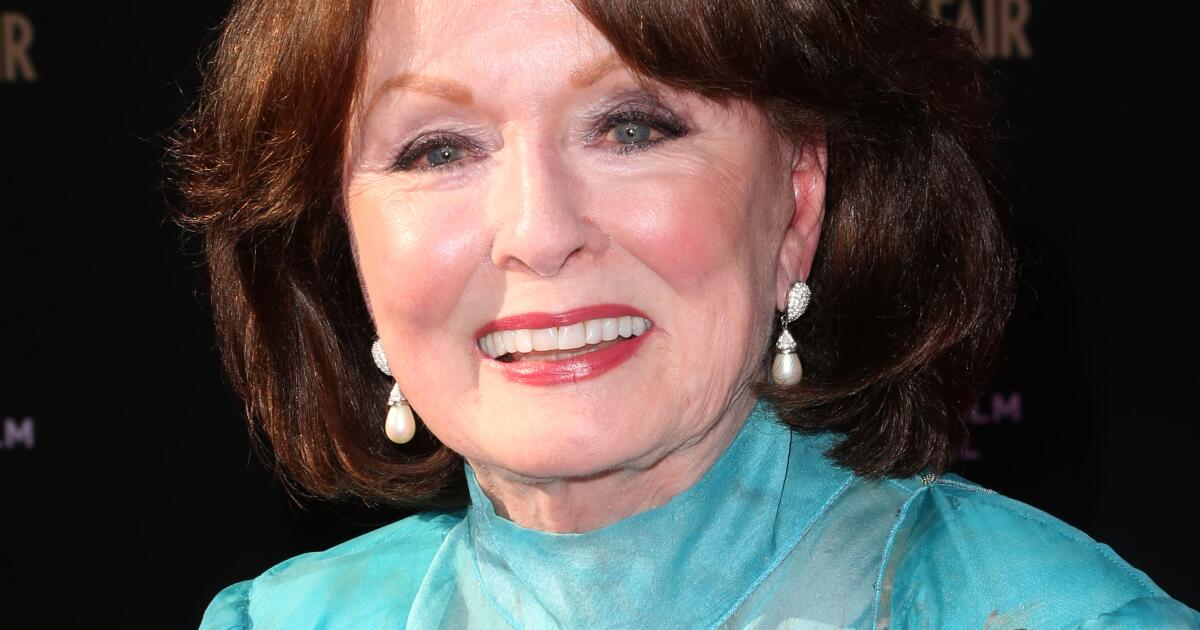
Appearing as the amoral daughter of Joan Crawford at only age 17, Blyth’s short film career saw her work with many top stars of Hollywood’s classic era.
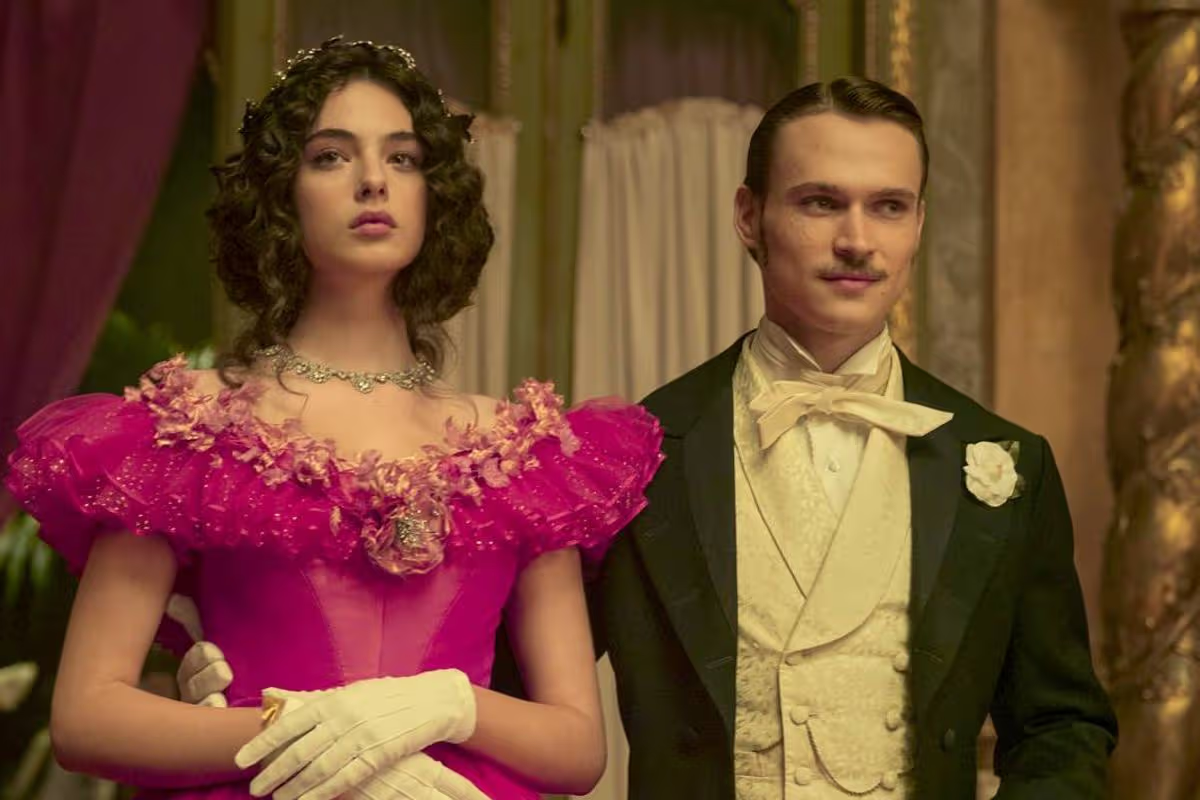
Adapted from Giuseppe Tomasi di Lampedusa’s 1958 novel of the same name, The Leopard is a lavish period drama set in 19th century Sicily, reports the Express.
The six-part Italian series charts the fortunes of the Prince of Salina and his aristocratic family during a turbulent era of great change.
The Leopard unfolds against the backdrop of the Risorgimento, or the unification of Italy, as various states across the Italian peninsula were brought together to form the Kingdom of Italy.
During this momentous period, widespread political and social upheaval, along with rebellions and revolutions, preceded the formation of the Kingdom of Italy.
A synopsis of the show from Netflix reads: “Based on what many consider to be one of the greatest Italian novels of all time, The Leopard is a dazzlingly sensuous epic, set against the backdrop of revolution in 1860s Sicily.
“At its heart is Don Fabrizio Corbera, the Prince of Salina, who leads a life surrounded by beauty and privilege. But as Italy moves towards unification and the old aristocratic order is threatened, he realizes that his family’s future is in jeopardy.
“New allegiances must be made, each one a threat to his principles. Eventually Don Fabrizio is faced with an impossible choice.
“He has the power to engineer a marriage, between the rich and beautiful Angelica and his nephew Tancredi, that could secure his family’s legacy, but doing so he would break his favorite daughter, Concetta’s heart.
“The series will be a modern exploration of timeless themes – power, love, and the cost of progress.”
The Leopard boasts an outstanding ensemble cast, including Everybody Loves Diamonds star Kim Rossi Stuart as Don Fabrizio Corbera, Prince of Salina, Benedetta Porcaroli from Netflix’s Baby as Concetta Corbera di Salina, Love & Gelato’s Saul Nanni as Tancredi Falconeri, and The Beautiful Summer star Deva Cassel as Angelica Sedara.
Further cast members include Astrid Meloni, Paolo Calabresi, Gaetano Bruno, Francesco Di Leva, Alessandro Sperduti, Jozef Gjura, and Romano Reggiani.
One viewer posted in their 10/10 review: “Cinematography is absolutely stunning. What a beautiful period piece ; costumes magical, This is a stunningly visually crafted masterpiece of a series.”
A second glowing review proclaimed it a “masterpiece”, with the critic stating: “This is an absolute must-see series! It could have actually been a cinema film, this is the perfection of its film making. An epic construction of story telling, acting, costumes, scenery and music offers an utter delight to watch.”
Get Netflix free with Sky
This article contains affiliate links, we will receive a commission on any sales we generate from it. Learn more
Sky is giving away a free Netflix subscription with its new Sky Stream TV bundles, including the £15 Essential TV plan.
This lets members watch live and on-demand TV content without a satellite dish or aerial and includes hit shows like Stranger Things and The Last of Us.
A third top-rated review described it as an “absolute masterpiece”, elaborating: “The journey is beautiful, poignant, and brutally honest.”
Yet another awarded it 10/10 and celebrated it as a “masterpiece”, writing: “I wish there were MORE series like this: based on literature, ravishingly beautiful and (99%) aesthetically accurate.”
They went on to draw a comparison with Downton Abbey creator Julian Fellowes’ other notable series, remarking: “The Gilded Age could learn a lesson from “The Leopard’s” creative team.”
The Leopard is available to stream on Netflix now.
The best weapon in the “Jackass’” arsenal isn’t the taser, the beehive or the booby-trapped latrine. It’s the explosion of relief when a prank ends, often in humiliation, always with hoots and claps. The first film, 2002’s “Jackass: The Movie” was slow to discover that carnage without camaraderie is painful; several injuries limped off-screen in horrified silence. Laughter heals, except for the brain hemorrhage that Johnny Knoxville suffered in 2022’s “Jackass Forever” when, dissatisfied by the clobbering he took from a bull, requested a second ramming that knocked him out cold.
Hence “Jackass: Best and Last,” the goon squad’s alleged final film, is underwhelmingly tame. Shot quickly by stalwart director Jeff Tremaine this spring, half of it is a clip reel of past hits, like the time fan favorite Steve-O slingshotted into the sky in a port-a-potty. The rest is scraps of hastily assembled chaos, the most elaborate of which is a puppet show in which veterans Ehren McGhehey, Dave England and Jason “Wee Man” Acuña dangle helplessly from strings, trying to recite cue cards while being pummeled by tropical fruit. “A pineapple!” Wee Man moans.
I’m no sadist. They’ve suffered plenty for our amusement. Still, it’s a shame that for the first time in two and a half decades of cringe comedy, the guffaws feel forced.
Acknowledging the Jackasses’ age, if not maturity, are a couple skits about prostate and rectal checkups. (The gnarliest involves clear pants, colonoscopy prep liquid and a game of Twister.) Modern technology enters the arena with a nimble-fingered robot. If the team had invested any actual energy into brainstorming this entry, they’d have played paintball with a sniper drone. At least for the sake of torch-passing, someone should have thought of something for the newish members introduced in “Jackass Forever” to do besides stand around and applaud.
These fresher faces — Jasper Dolphin, Rachel Wolfson, Zach Holmes — prove brave and resilient when allowed to participate. Only one of them, Sean “Poopies” McInerney, a surf bro so gullible that I’m not sure he’s capable of informed legal consent, fits into “Best and Last” like a well-worn punching bag. (When Poopies yelps that “my mind is getting to me” while wearing a shock collar around a sensitive area, people snort because, as sweet as he seems, the only thing rattling inside his cranium is a moth.) Early on, Poopies gets swollen lip injections that, someone claims, will last the whole movie. You expect his trophy wife pout to be a running sight gag. But his disfigurement never even gets another closeup.
“Jackass” started with a bang. In January of 1998, Knoxville, then a 26-year-old aspiring actor, strapped on a cheap bulletproof vest padded with a stack of “Hustler” magazines and fired a gun point-blank into his chest. His dumb derring-do went viral on VHS tapes, earning him an MTV show and five feature films. Watching that Rosetta Stone-cold stupid footage here, you’re struck not only by his audacity, but by the scene’s excruciating comic pacing. As there’s only one bullet in the pistol, empty chambers click multiple times before the bullet finally fires. Logically, you know Knoxville will live long enough for his hair to turn fright-wig white. Yet the lizard brain making you gawk is shrieking.
Do not attempt any of the stunts you’re about to see, the prefatory caution blares. Absolutely. The thing is, no one else could. “Best and Last’s” flashbacks are a walloping reminder that Knoxville is inimitable: a telegenic and extroverted entertainer with a charisma he wields like a skunk aims its stink. Upset him at your own risk. Like Buster Keaton before him, Knoxville has an uncanny awareness of how his death-defying escapades appear on camera. Even in that near-suicidal early segment, note how Knoxville stays on his feet, enduring agony with a magician’s “Ta-da!” He might have given himself a bruise the size of a baseball but he’s focused on the audience’s delight.
Over the years, the visuals dramatically improve, from snuff film aesthetics to confidently silly splendor. “Jackass Number Two,” released in 2006, expended major energy on a musical homage to Old Hollywood that nodded to Keaton and bathing beauty Esther Williams who, in MGM’s “Million Dollar Mermaid,” plunged 50 feet into a pool and broke her neck. By 2010’s “Jackass 3D,” which riffed on classic cartoons with Knoxville strapping himself onto an Acme-style red rocket, one could admit they went to see a Jackass movie for the cinematography with even more sincerity than if Knoxville claimed he bought “Hustler” for its life-saving properties.
The new movie doesn’t have any artistic ambition. The charitable excuse for its reliance on old material is that the gang wanted one more film that summed up their entire legacy — from the impact of seeing them age to the opportunity to include departed colleagues Ryan Dunn, who died in 2011, and Bam Margera, fired in 2020. The other explanation is it’s a cash grab made for pennies. Still, Steve-O strives for memorable moments, gathering the gang in a generic office building corridor to watch him take off his pants and pop out a ping-pong ball. There’s a lot of nudity but the setting feels half-assed.
“Best and Last’s” intro splat-tacular, typically a highlight of each film, hinges on the posse standing still on a moving floor. But the monochrome staging — white walls, white ground — looks almost like CGI, the antithesis of their appeal, and it takes us a minute to understand what’s actually going on. Worst, it lacks both suspense and surprise, that no-they-aren’t–oh-god-they-are drama that once elevated the franchise to the peak of pure cinema.
There is — and I mean this — existentialism in witnessing a person embrace shame and terror. Actors have won Oscars without achieving the transcendence of, say, misery glutton McGhehey in “Jackass Forever,” bound to a chair and coated in salmon and honey, realizing that his friends have released a bear into the room. Meryl Streep could never do that (and wouldn’t have to). McGhehey’s sole path to stardom is that he did.
Not everything in a “Jackass” movie needs to be that sublime. One of my few genuine howls in “Best and Last” came in a three-second rehash of someone stepping on a rake; another was the percussion Chris Pontius makes with his swinging nethers before attempting a naked Fosbury flop. There’s a great accidental gag in a cut bit from the original MTV pilot when a deputy pulls up to arrest Knoxville and forgets to put her car in park. Yet the snippet I keep thinking about is a throwaway beat in a new skit when McGhehey willingly gets into the wrong chair again and, once freed, attacks Knoxville who coolly knees him in the nuts. Everyone chuckles.
Once, in anthropology class, my professor lectured on an insular island tribe that cackled whenever someone got hurt. Schadenfreude was the community’s way to vent tension. I thought of that village throughout “Best and Last,” especially during Knoxville’s nonchalant disarmament of his pal. Team Jackass has stayed united even while at each other’s throats. In bad times, they’ve borne each other’s struggles with sobriety and mental health. In good, they’ve seen the inequality of success that’s left Knoxville in a better financial position to retire than the rest.
While “Best and Last” is a whiff, I can forgive this band of bozos’ urge to make it. No one seems happy to still be zapping themselves with electrodes. They just want to rally together for the final time to choke out one last laugh.
‘Jackass: Best and Last’
Rated: R, for extremely dangerous stunts and crude material throughout, graphic nudity, pervasive language and sexual material
MADONNA oozed youthful glam in a see-through mini dress as she made a striking appearance at Paris Fashion Week.
The Vogue songstress, 67, looked half her age in the cobalt blue frock, opting to go braless in the sheer attire as she headed to an evening bash in the French capital.
Sign up for the Showbiz newsletter
Thank you!
Madonna oozed glam in a blue mini dress as she stepped out in ParisCredit: BackGridShe finished off her look with a pair of futuristic silver bootsCredit: Splash
She finished off her stylish look with thigh-high silver boots, nude fishnet tights and matching jewellery.
Madge pulled on a pair of sunglasses and threw a metallic jacket over her arm as she exited the French venue, with her blonde hair styled in heat curls flowing over her shoulders.
The American chart star – who recently showcased her huge video which launched her comeback – kept a serious expression as she walked out of The Ritz flanked by bodyguards.
Yet she did flash a pout as she took a brief glance over her shoulder.
The Like A Prayer hitmaker, 67, flashed her toned figure in her striking frockCredit: BackGridShe kept a serious expression as she left The RitzCredit: SplashShe was flanked by bodyguards as she exitedCredit: SplashMadonna has been pulling out all the stops at a variety of Paris Fashion Week eventsCredit: Splash
Three Brazilians with a combined age of 316 have been recognised as the world’s longest-living trio of sisters. Researchers are studying their DNA to better understand the genetic factors behind healthy aging and exceptional genetic longevity.
“After a few years of contemplating whether I wanted to continue chasing a dream I had as a little kid, I have decided to go for it,” Ohashi wrote. “I’m taking it one day at a time; one skill, one event, one dream. I don’t have any regrets in my career and I want to be able to continue saying that no matter what happens. So here goes nothing!”
Katelyn Ohashi accepts the trophy for best play during the 2019 ESPY Awards at Microsoft Theater in Los Angeles.
(Kevin Winter / Getty Images)
Ohashi thanks Pacific Reign Gymnastics, a U.S. national training center in Woodinville, Wash., “for taking a chance on me.” Her post also includes a video of herself at the gym performing a couple of floor skills — with her signature broad smile across her face. The clip uses the same audio of a phone buzzing and ringing as the video Serena Williams posted earlier this month to announce her return to competitive tennis.
Also on Tuesday, Pacific Reign posted on Instagram several photos of Ohashi working out at its facility, along with the caption, “Queen Kate trains to reign.” The gym also announced on its Instagram Story that Ohashi would compete Saturday at the American Classic event in Minneapolis.
Little else is known about Ohashi’s comeback plans. The Times reached out to an agency that represents the gymnast but received no immediate response. Pacific Reign referred questions pertaining to Ohashi to the same agency.
Born in Seattle, Ohashi made her senior elite gymnastics debut at the 2013 American Cup, where she outscored U.S. teammate Biles for all-around gold. Later that year, Biles would win the first of her record six world championships in the all-around.
Ohashi became a fan favorite while competing for the Bruins from 2015 to 2018. She earned nine perfect scores on the floor and two on the beam, with video from a January 2019 floor routine reportedly garnering 240 million views across various platforms (including a repost from future Vice President and Democratic presidential candidate Kamala Harris).
The same routine won Ohashi two 2019 ESPY Awards, for best play and best viral moment.
In 2018, Ohashi was the co-national champion in the floor exercise and helped the Bruins win their seventh and most recent NCAA title. The 10-time All-American last competed in the 2019 national championships, where she placed third on the beam and helped UCLA finish third in the team competition.
She’s back!!! Two-time NCAA champion @katelyn_ohashi will be competing in this weekend’s American Classic, marking her return to elite gymnastics after 13 years!
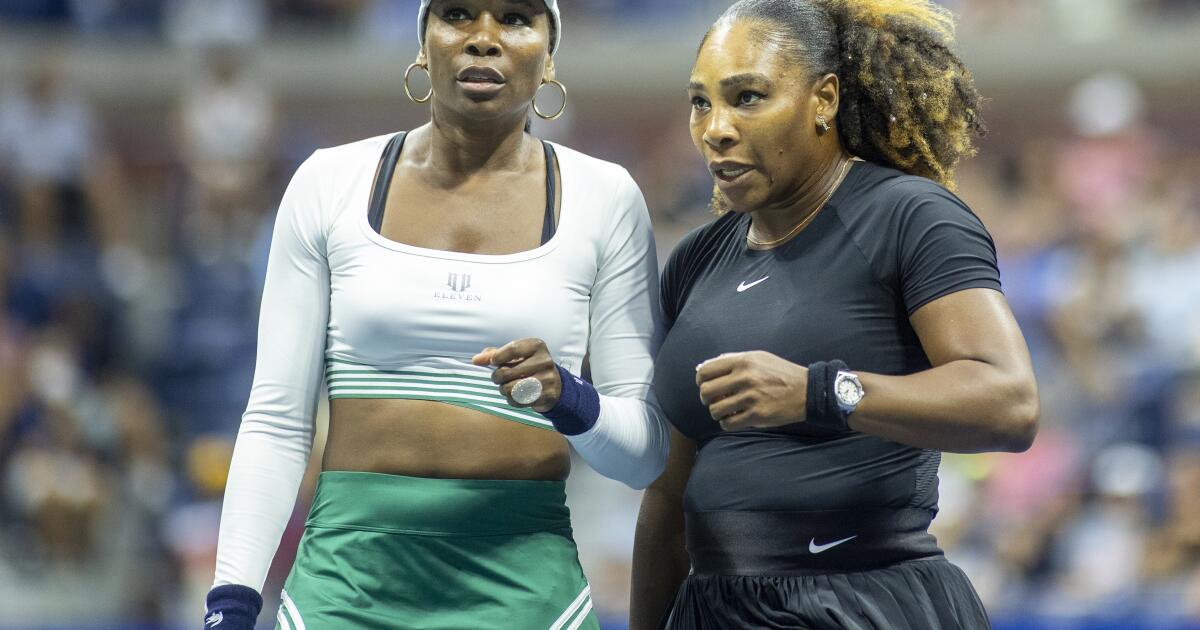
The Williams sisters — Venus, 45, and Serena, 44 — will bring back their doubles partnership at Wimbledon in under two weeks. The All England Club announced the doubles wild card invitation on Tuesday.
Should they win for a record seventh time, the Williams sisters would make history as the oldest Grand Slam-winning doubles combo by nearly 16 years.
The record of 74 years and 303 days is held by Hsieh Su-wei and Barbora Strýcová, who won at Wimbledon in 2023. Venus will turn 46 on Wednesday and Serena will be 45 on Sept. 26, putting their combined age by the tournament’s end at 90 years and roughly 290 days.
The Williams sisters have won six doubles titles together at Wimbledon, most recently in 2016 with the first coming in 2000. They have won 14 Grand Slam doubles titles together, the second most by any women’s team in the Open Era behind the 20 won by Martina Navratilova and Pam Shriver.
Serena recently returned to competition after almost four years away from professional tennis. She will compete in the Berlin Open doubles alongside world No. 10 singles player Karolína Muchová on Tuesday against Erin Routliffe and Giuliana Olmos.
The initial tournament in Serena’s comeback was abbreviated. Her playing partner, Canadian teenager Victoria Mboko, suffered a knee injury that ended their effort at the Queen’s Club Championship after one match, a 7-6(2), 6-2 victory over No. 3 seeds Erin Routliffe and Nicole Melichar-Martinez.
Venus, who will turn 46 on Wednesday, is in the midst of her record 33rd consecutive WTA season. She has been eliminated in the first round of singles at several tournaments while faring better in doubles.
The pairing at Wimbledon will be the first since 2022 for the Williams sisters. Serena took a long hiatus beginning that year and gave birth in 2023 to her second child, Adira River Ohanian.
Many of the sisters’ career highlights have come at Wimbledon. Serena has 14 titles on the hallowed grass court — six in doubles, one mixed doubles and seven in singles. Venus Williams has won 11 Wimbledon titles — five in singles and six in doubles.
Neither Williams sister is slated to play singles in this year’s tournament, although one women’s singles wild card has not been allocated.
JOHANNESBURG — Globally celebrated South African jazz icon Abdullah Ibrahim has died at age 91, his family announced in a statement Monday.
Ibrahim, formerly known as Dollar Brand, passed away peacefully in Germany following a short illness, surrounded by loved ones, the statement issued on behalf of his family said.
As one of South Africa’s most respected jazz figures, he famously played at Nelson Mandela’s 1994 presidential inauguration. Mandela referred to Ibrahim as “our Mozart.”
His final public concert in South Africa took place at the Cape Town International Jazz Festival in March, when he once again captivated audiences with the musical skill that defined his career.
Paying tribute to her partner, Dr. Marina Umari said he “passed away peacefully with South Africa and its people in his heart.”
“His love for his country never wavered, no matter where in the world he found himself,” she said.
His family said that even though his life is over, his influence and voice would continue to resonate around the world.
South African President Cyril Ramaphosa paid tribute to the musician, praising his contribution to the anti-apartheid struggle and acknowledging his lasting impact through music.
“Today our nation mourns the passing of an international icon and global citizen whose profound creations honored the South Africa that shaped his political commitment and musical brilliance,” said Ramaphosa.
Born Adolph Johannes Brand in Cape Town on Oct. 9, 1934, Ibrahim rose to international prominence as a pianist, composer and bandleader. With a career spanning more than seven decades, he forged a unique blend of jazz and South African musical traditions, making him a cultural ambassador whose music struck a chord with listeners worldwide.
Ibrahim’s mother Rachel Brand was mixed-race and under the apartheid system he was classified as “colored,” which afforded him certain social privileges that were denied Black South Africans. He was raised by grandparents and was told Rachel was his sister, only learning the truth in adulthood. Influenced by his grandmother and mother playing piano at the AME Church in Kensington, a Cape Town suburb, Irbrahim began piano lessons at age 7 and made his professional debut at 15.
In 1959 and 1960, he played with saxophonists Kippie Moeketsi and Mackay Davashe, trumpeter Hugh Masekela, trombonist Jonas Gwangwa, bassist Johnny Gertze and drummer Makaya Ntshoko in the Jazz Epistles. The group recorded the first full-length jazz LP by Black South African musicians, “Jazz Epistle — Verse 1.” The South African government began targeting jazz groups as part of increasing state repression, and following the Sharpeville massacre in March 1960, the Jazz Epistles broke up.
During this time, Ibrahim met jazz singer Sathima Bea Benjamin and the pair moved to Europe. The following year, in Zurich, Switzerland, Benjamin convinced Duke Ellington to come see Ibrahim perform with the Dollar Brand Trio. Impressed, Ellington helped arrange a recording session with Reprise Records, later released as “Duke Ellington presents The Dollar Brand Trio.”
In 1965, Ibrahim and Benjamin married and moved to New York. He played at the Newport Jazz Festival and toured throughout the U.S. In addition to playing with, and, on occasion, leading the Duke Ellington Orchestra, Ibrahim interacted with such musicians as Don Cherry, Ornette Coleman, John Coltrane and Pharoah Sanders, and was influenced by the Black Power movement, incorporating African elements into his jazz. His compositions also reflected the influence of Ellington and Thelonious Monk.
The musician returned briefly to Cape Town in 1968 and converted to Islam, changing his name from Dollar Brand to Abdullah Ibrahim. As an expatriate, he toured the world for decades, appearing at major venues and working with classical orchestras in Europe. His composition “Mannenberg” became noteworthy as an anthem of South Africa’s anti-apartheid movement.
In 2009, Ibrahim received an honorary doctorate in music from Wits University and the Order of Ikhamanga, a prestigious civilian award, from former President Jacob Zuma in the same year.
Ibrahim was named a Jazz Master by the National Endowment for the Arts in 2019.
Alan Winde, the mayor of the Western Cape, where Ibrahim’s hometown is located, honored the performer and commended him for capturing South Africa’s cultural richness and history in his music.
“South Africa has lost a legend,” Winde said. “Abdullah Ibrahim represented everything that makes South Africa and the Western Cape so remarkable. His music told the story of our unique cultural diversity and past.”
Ibrahim is survived by Umari; his son, Tsakwe, a musician; and his daughter, Tsidi, a rapper who goes by Jean Grae.
According to his family, Ibrahim will be laid to rest in the German state of Bavaria, where he lived.
One day, when people say “they don’t make ’em like they used to,” they will be saying it about “Industry.”
First filmed before the pandemic and launched in its throes, a survivor of the era of streaming wars, corporate consolidation and Hollywood strikes, HBO’s addictively dissolute workplace drama remains as ambitious and authoritative as ever. Indeed, despite being divided from predecessors like “Mad Men,” “Succession” and “The Leftovers” by a series of epochal crises, it more closely resembles a vestigial tail of the medium’s past than most of its current counterparts: Out of place and out of time, “Industry” can best be understood as the last great drama of TV’s golden age.
Cast member and “Game of Thrones” alum Kit Harington, resident expert on series that reshaped the medium, agrees that “Industry” is a bit of a throwback in this respect.
“If you scroll back to ‘Game of Thrones’ in the first two seasons, it wasn’t a massive Goliath success, and it exploded after Season 3 with the Red Wedding. I think there’s a similar story going on here,” he says. “So often in TV at the moment, you’re given one season and everyone needs to pack in f— everything to get people hooked. But they’re burning through too much story. Season 2 is then done; the characters haven’t got anywhere to go. I think this is where this show has been successful, is that it was given that time to breathe.”
Earlier this spring, I convened “Industry’s” creators and cast in a conference room at The Times to walk me through its evolution into one of the best shows on television, and what to expect from its impending end.
Marisa Abela, left, Kit Harington and Myha’la.
(Jason Armond / Los Angeles Times)
‘What the f— are you thinking, guys?’
Atrading-floor knife fight of hot, young strivers, or “grads,” competing for a permanent place at the fictional Pierpoint investment bank, the first season of “Industry,” filmed in 2019, premiered in the waning months of 2020 as a warped love letter to office culture. But for Konrad Kay and Mickey Down, the emerging writers at the helm, the voice of the series didn’t fully take shape until they’d found their main cast, including Myha’la, as hard-charging American Harper Stern, and Marisa Abela, as privileged publishing heiress Yasmin Kara-Hanani.
Kay: Season 1, me and Mickey were really green.
Down: We actually pitched HBO on the idea that it was going to be eight episodes, it was going to be in different months, and the big-bang dramatics were going to happen between the episodes. A bit like “Boyhood.” Huge things would happen in between episodes, and the episode would be about the reaction to those huge things. And they were like, “What the f— are you thinking, guys?” It was so antidramatic.
Abela: I had a lot of rounds of auditioning for Yasmin. They weren’t sure about me at all. I think part of it was because they were quite hellbent on her being vulnerable, on her being soft, and that was what I was playing in those first two, three episodes. … And what happens in any functional collaboration is you start to see what they really want from you — what it is that they need from your character. And in those moments of conflict, the moments of change, Yasmin has to stand up for herself at some point, otherwise it’s too wet.
Mickey Down.
(Jason Armond / Los Angeles Times)
Down: Yasmin was all vulnerability masked by Prada in script, and then you came in and you were very hard. [Laughs.]
Abela: There is one scene with [Yasmin’s abusive supervisor] Kenny [played by Conor MacNeill] in Season 2 where … Yasmin turns around to him and tells him to f— off, basically: “You don’t have a disease, you’re a narcissist, with a new excuse to lord it over people. You’re weak.” I think that’s the first time that Yasmin became a gangster. I was watching “Real Housewives of New Jersey” at the time, being completely honest. She can go really mob wife really quick.
Myha’la: I had almost the exact opposite experience in terms of finding or deciding who Harper was. When I read the scripts initially, I just thought, “There’s no way in hell that Harper can’t be steely and [on offense], because she’s clearly feeling out of her depth, and as a young woman of color going into a new space like this, you can’t show up like you’re vulnerable. You’re already expected to do poorly.” … On the page, Harper was an anxious person when I first met her in the pilot episode. She was sweaty and clammy and stammering. And I just thought, “Hell no!”
Down: Sometimes when we write the character, we focus on one thing, and then the actor comes in and then that one thing we thought the character was becomes the artifice that they have to play.
Harington: Great TV writers genuinely learn their actors as well as their characters, and they tie those things in as it goes through.
Abela: As much as they know how we speak now, we know how they speak. If Yasmin has a “F— off,” I know what they want with that. If she says “F— off,” it’s very different to “F— you.”
Down: It’s like playing the piano with the foot pedal, blindfolded.
Kay: When you get super-talented actors doing your writing, you sort of fall in love with them doing everything. There’s no story we can’t tell with them.
‘Am I being fired?’
The series’ second season, which opens with Pierpoint’s post-COVID return to office, found the grads established enough to become “active characters,” and the creators confident enough to begin breaking the mold they’d set for themselves in Season 1. From the nail-biting trade sequence with which Harper wins over hedge fund manager Jesse Bloom (Jay Duplass) to her firing from Pierpoint in the Season 2 finale, it marked the arrival of “Industry’s” distinctive, go-for-broke aesthetic.
Kay: [In] Season 2 we were still figuring out what the show was, and we had Jami O’Brien as our co-showrunner, who really professionalized me and Mickey towards the American system, towards how to be producers, curbed some of our more bombastic instincts, made us more professional in terms of some of the style of the writing we were doing, found a cleaner version of the show and a cleaner version of the story.
Konrad Kay.
(Jason Armond / Los Angeles Times)
Down: [The Bloom trade] was one of the first times in the show where we were like, “Wow, we’ve actually created something kind of singular,” in that we were able to create scenes of people trading, [using] financial jargon that no one understands, and make it feel like a car chase. The contrast between the Harper that’s on the trading floor being able to be in command of that with all the people looking at her, and then the Harper that’s in the loo afterwards in floods of tears, that for me was kind of the moment where we thought that we had a completely 3D, rounded character.
Myha’la: If you asked me to do the Jesse Bloom trade scene again, I’d piss myself. Because at least when I did it two seasons ago, I could have anxiety and fear percolating inside me. If I had to do it today, I’d have to do it confidently, and I would have to try really hard because so much of the language is truly blind memorization and being able to juggle particularly the f— phones. … You have to get the choreo[graphy] so good and you have to know the words so well so that you can do the important part, and that’s the subtext — communicating the feelings of the thing, which are not in the words. Which I love. It is so hard.
Harington: When you first read the scripts, you can’t understand a lot of what’s on the page. … You look at it, you go, “This is f— impossible.”
Myha’la.
(Jason Armond / Los Angeles Times)
Myha’la: This is not spoon-feeding the audience. “I’m sorry that you’re hurting because I know last summer your mom died in a car crash.” They don’t do that.
Kay: Do you know who hates that about us? Network executives. [Laughs.]
Down: We had a kind of mantra the first season especially, and then going into the second, that we would never have a scene that didn’t have one of our four main leads in it. And then, just for the necessity of the storytelling, we said, “We have to pop out of that perspective.” I don’t think HBO realized what a big decision that was, because I don’t think they’d actually realized we’d kept this mantra that we were never going to go away from the perspective of the grads.
Kay: It’s also where we broke the rule of, “We’re not going to just tell the bottom-up story; we’re going to go to the top.” When we sold the show, we were like, “This is a bottom-up story,” and then by that point we were like, “Actually, we have these older characters who might have these really rich inner lives that we should also explore.”
Myha’la: We blew the s— up. [Harper’s firing] forced us all outside the bank, which was dangerous and scary for me and really exciting and was how we got to see all the other things that Mickey and Konrad are capable of doing. I think they didn’t tell me before, so I was like, “Am I being fired?” [Laughs.]
Down: We thought we were all being fired. The reason the show evolves so much is because we basically never know whether we’re coming back, so we just blow up everything. We try to leave the audience with a satisfying conclusion. And then we get renewed, and then we have to basically write ourselves out of a corner. So Harper getting fired could have ended the whole show.
‘Oh, poor Henry’
Given time to develop its characters, refine its style and grow its audience, “Industry” returned for Season 3 with all the trappings of a series that had finally arrived: effusive critical acclaim, proliferating fan accounts and buzzy arcs by Sarah Goldberg and Harington, as playboy and erstwhile green–energy executive Henry Muck. Had it premiered just a few years later, “Industry” may have ended up on the chopping block before finding its footing; instead, it was allowed to achieve “terminal velocity.”
Kay: What happened between Seasons 2 and 3 was, we got renewed. We didn’t think we were going to get renewed. We operated from the principle of, “We might never get to do this again.” And that was incredibly freeing for me and Mickey because it was just like, “We’re gonna get eight hours, let’s just do everything we possibly can within that eight hours. Let’s indulge every creative impulse we’ve ever had. Let’s take the stabilizers off the story. Let’s not necessarily keep it within Pierpoint.” What we felt like was a perfect marriage of creative latitude, trust in ourselves and the right point in our arc of writing the show and directing and producing. We reached terminal velocity, where we could actually do all of the stuff that we were pretending we could do in the first two seasons.
Kit Harington.
(Jason Armond / Los Angeles Times)
Harington: When I joined up in Season 3, I had a good handful of friends who watched the show. It may be bigger than you think it was from the inside. It’s been fascinating for me, joining when I did and seeing it grow again … We all want to do stuff that people actually watch. We’d be lying if we said we didn’t. We’ve all done jobs that we really love and no one’s f— seen. When there’s a focus in on something that you know is good and you love, that’s more rare than you think. I started in this job in “Game of Thrones” and just assumed, “That’s, like, how jobs go. You get invited to the Emmys every year and everyone frigging watches it.”
Kay: The softness in Henry was a function of Kit playing the character and us writing to that vulnerability. There’s a totally different version of that character which never unlocks that kind of thinking in me and [Mickey].
Harington: You know that moment where it’s all going to s— with Lumi and he just gets up and he’s like, “None of this is real” and he f— off? For me, that was it. Because it was like, “Wait a minute, he can’t just leave the f— room” — and he does. I think that kind of sums him up. I got a handle of him properly then, and that was quite an early one we shot.
Down: He has a sense of entitlement most of the other characters don’t have.
Myha’la: But you still manage to make me feel bad for you. I’m like, “Oh, poor Henry.” Do you know what I mean? Isn’t that psychotic?
Down: I said it to him in an email recently. Somehow he managed to make an ex-Tory minister who bankrupted his company twice and needed bailouts from the British public — [a] junkie, adulterer — the most vulnerable and probably most empathetic character on the show, in some respects.
Harington: He’s one of the few characters who is actually trying to do good. Even if it’s about him being perceived as doing good. … It’s also very smartly done in how you demarcate addiction and drug-taking. You’ve got most of the characters, who can kind of put it down, but then you’ve got Rishi [a Pierpoint trader played by Sagar Radia] and Henry, who are a different kettle of fish. And also how it creeps up.
Kay: As a sober person playing that stuff, is there a psychic trigger in your brain that sort of feels like it’s happening?
Harington: I was very worried about coming in and doing some of this stuff, but quite quickly realized I was A) sober enough for long enough to go back there safely; and B) it was a sort of muscle memory, a lot of it. I get to exorcise this stuff in my job. How many ex-addicts get to do that? It was a kind of cathartic thing.
Marisa Abela.
(Jason Armond / Los Angeles Times)
Abela: There’s a real freedom that comes with drugs, alcohol, whatever it is, for the character. Those are the moments when you can really open the lid on something.
Myha’la: When you’re f— up, you’re uninhibited, so you can do your own thing, but I think you’re also taking the other person at face value. I feel like it sort of takes the judgment away. It creates a kind of childlike innocence.
Down: If you’re in a situation like that, you can skip like five stages of relationship if there’s a big bag of drugs in front of you. That’s something we try to capture.
‘Where we leave the characters feels so perfect’
Earlier this year, HBO announced that “Industry” had been renewed for a fifth and final season. But it was Season 4 — which finds Harper and Yasmin’s friendship in tatters, Yasmin and Henry’s marriage at an end, and the structure of the show evolving yet again to draw on new characters and genre influences — that led Down and Kay to determine that the series’ time had come.
Kay: We did think to ourselves, “OK, so we’re going to do a Season 4, which means the show is a kind of success in and of itself, which means we can start to think about ending. If you get four seasons, you’re probably going to get five. So we felt that it created latitude there. What we thought to ourselves was, “We meet these two women in the pilot. If you’re going to spend five seasons of TV with them, what is the starkest contrast you can do between how you meet them and where they end up?” … When we started, the show was about not having power. Five seasons in, they have it. Then what do you do with it? The phrase me and Mickey have been talking about is this idea of “arrival fallacy.” You climb and climb, you’re at the top of the mountain. Is there another peak? Do I sit here and enjoy the view?
Down: We’re writing Season 5 right now, and without giving too much away, we’re approaching that season very differently in terms of how information’s parceled out.
Kay: It’s very dense, though, isn’t it? Honestly, it might be the densest season. There’s a lot of theology in it, actually.
Down: We talked about doing a sixth [season], and then quite honestly we thought that was going to be diminishing returns. … We would have been pulling our punches constantly. This has been one of the most creatively fulfilling versions of the show, because we are writing towards a conclusion that we know is the conclusion. We’re thinking of images for the last 10 minutes that we know are going to be what the audience is left with, and that’s really, really thrilling for us as writers. I’ve never once thought, “God, I wish we were doing a sixth one,” as much as I love writing and making the show. Where we leave the characters feels so perfect.
As soon as enough votes were counted to officially knock Tom Steyer out of the California governor’s race, the anti-billionaire schadenfreude kicked in.
Social media and legacy media, conservative and liberal, all seemed to have a rare melding of the minds, delivering endless variations of, “How dare he try to buy elected office! We showed him.”
“I hope you received the message from California that a power-hungry communist billionaire cannot buy the state!” wrote one detractor on social media. “How much money did you waste spamming Californians? Do you know how many hundreds of millions of dollars you wasted?”
“What a waste,” screamed a New York Times headline, slamming Steyer for not donating that money directly to building houses or funding Planned Parenthood — one-off actions that prop up broken systems instead of changing them.
I get it.
In an age when income inequality is reaching serf-lord levels, hating the rich seems easy and reasonable. You could take several zeros off the $200 million Steyer spent on his campaign and it would still be more than most of us make in a lifetime. That’s a rage-inducing reality for many, if not most of us, for whom pairing a full tank of gas with a restaurant dinner seems like careless luxury these days.
I’m not here to defend the nine-zeroes class. But maybe we should take a beat and make sure our outrage is working for us, not against us. While Steyer has spent the last few months advocating for universal healthcare, better pay and protections for workers, and putting curbs on out-of-control corporations from the energy sector to AI, other billionaires have spent that time actively undermining democracy and our financial system. Heck, some even seem to be undermining humanity. Why aren’t we raging at them?
Take, for example, a certain billionaire who seemingly would prefer to be a trillionaire: Elon Musk.
Last week, his SpaceX held an IPO in which somehow the rules of Wall Street meant to protect small investors and pension plans were set aside to his benefit. Like it or not, if you hold a public pension or a 401(k) in America that uses index funds (which most do) you will likely be an investor in his unproven and possibly risky business. I’m sure that will work out fine.
Or consider the hundreds of millions of dollars right-wing AI and surveillance-company billionaires, some Californians, are dumping into political races across the country right now to ensure that their dangerous and unpredictable technologies are not regulated, or regulated in largely meaningless ways. It’s a situation so dire that one wealthy insider last week warned in his own op-ed that if his former colleagues are successful, “It could concentrate economic power in ways that would make the Gilded Age look quaint.”
Then there’s our president, king of self-enrichment, whose wealth has skyrocketed to more than $6 billion during his time in office. Much of that moola is in opaque cryptocurrency holdings, an industry he has championed as his fortunes in it have increased.
But don’t think Trump is in it only for himself: He’s enriching his family, too.
But sure, hate the goofy guy in the vintage Nikes pointing all this out.
“I’m proud of the enemies we made,” Steyer said in his concession. “In this race, those corporations revealed that they see a government that puts working people first as an existential threat — even when proposed by a billionaire. By spending $55 million — the most ever against a single candidate in a California primary — they showed the lengths they would go to in order to protect a status quo that only serves them and their profits.”
I don’t like the amount of money in our political system either, but the truth is, it’s there. And worse, the majority of those who have it seem intent on diminishing the political and economic power of those who don’t.
We are increasingly moving toward a country where the well-being of the majority of people will depend on the largesse of the few — Silicon Valley’s tech industry now talks about a universal basic income as a great boon for the coming mass unemployment they are creating.
But is existence off a charity-pittance really what we want for ourselves and our children? Do we really want these ultra-wealthy overlords to use their money unchecked to make decisions that will shape our future, diminish our rights and ultimately leave us without the power to fight back?
If Steyer wants to use his money to join this battle to keep power by the people and for the people, then the enemy of my enemy is my friend.
Like it or not, us average worker bees need money to fight money. In this age when animus eats discernment like the rich eat caviar, the luxury we really can’t afford is hating the good guys just because it’s easy — even if they’re billionaires.
This is the fourth year of the LA Card Show, and my, how it has grown.
The venue has grown larger and bolder with each year, beginning at the Mayan Theater in 2023. The Intuit Dome held the event in 2024 and Dodger Stadium in 2025. This year’s show will take place this weekend at the L.A. Convention Center West Hall.
Roughly 700 collectibles vendors are expected, almost double the number at Dodger Stadium. Food and drink will be available and the card show is open to all ages.
Pokémon cards and items continue to be the most popular to trade and purchase, according to show officials. All sorts of sports collectibles will be plentiful, with Shohei Ohtani — unsurprisingly — the most popular card, and card grading will be available on-site.
“More than just a card show, it is a cultural event built around the art of collecting,” LA Card Show co-founder Adam Derry said.
Trading Card Game (TCG) deck-building is increasingly popular, with players competing in games such as “Magic: The Gathering” using cards that represent spells, monsters and resources. Comic collectibles will also be traded and sold.
Other attractions include activations with the Clippers, Kings, Sparks and LAFC, and fashion and streetwear from HYPLAND, Holiday, Vandy The Pink and Research Vintage.
The card show will take place from 10 am. until 5 p.m. Saturday and Sunday with VIP access at 9 a.m. A two-day general admission pass is $50 (VIP $100), with one-day passes $30 (VIP $50). Ages 8 and younger are free.
HEIDI Klum looks half her age in a tiny zebra-print bikini for a sizzling and steamy beach photoshoot.
The America’s Got Talent alum, 53, has posed in an array of tiny bikinis as part of a brand collaboration with Calzedonia.
Sign up for the Showbiz newsletter
Thank you!
Heidi Klum has posed in an array of stunning Calzedonia bikinisCredit: CalzedoniaThe blonde beauty wore tiny string bikinis as she posed for the racy photoshootCredit: Calzedonia
Posing on a sandy beach, the ageless beauty looked sensational as she smiled for the camera.
In one photo, Heidi rocked a zebra print number which showed off her sensational figure thanks to the plunging bikini top and low rise bottoms.
Another snap saw her lounging around in a brown glittery two-piece string bikini.
Heidi then rocked a bronze string bikini, which left very little to the imagination.
Heidi looked half her age in the shootCredit: CalzedoniaThe photoshoot took place on a sandy beachCredit: CalzedoniaHeidi looked sensational in the array of sun-soaked snapsCredit: Calzedonia
She also wore a yellow gold number, which displayed her svelte figure seamlessly.
Heidi was accompanied by her husband, Tokio Hotel guitarist Tom Kaulitz, who wore what appeared to be a polka-dot pyjama top and sunglasses before taking off his shirt.
One more day and it’ll all be over. I’m referring to the primary election, of course, and the unremitting campaign ads that have infiltrated every aspect of our being as Californians.
Authentic or paid influencers promoting candidates on TikTok and Instagram. Facebook ads vilifying or praising various measures. Incessant, repetitive TV campaigns that get nastier with every election, yet still manage to feel like an analogue remnant from 1982. The worst? Those sponsored leaflets and postcard mailers that end up as makeshift coasters, mosquito swatters or unread refuse that goes straight from the mailbox into the blue recycle bin.
The king of ad spending is Democratic gubernatorial candidate Tom Steyer. He’s behind the most expensive political advertising campaign in the country this year. A former hedge fund manager, Steyer has reportedly spent more than $200 million on his campaign, with a major chunk of that for broadcast TV, cable and radio — 20 times the amount spent by fellow Democrat, former U.S. Secretary of Health and Human Services and California Atty. Gen. Xavier Becerra. And Steyer is still polling behind Becerra.
I never thought I’d write this but it’s not always about the money.
Xavier Becerra, front-runner in the race for California governor, speaks before a crowd at UFCW Local 1167 Union Hall.
(Genaro Molina/Los Angeles Times)
Voters have more resources than ever should they choose to actually research and learn about who and what is poised to shape the future of their city, county and state.
There’s no shortage of broadcast, cable, digital and print reporting about former reality TV personality turned mayoral candidate Spencer Pratt. He uses AI!
The battle between incumbent Karen Bass and her closest Democratic competition, Los Angeles city council member Nithya Raman, dominates local newscasts. And there’s pundits from both sides arguing for and against these choices on every available platform.
Given the amount of information now at voter’s fingertips, we should be the most informed voting populace in the history of ballot casting. But are we?
A new poll by UC Berkeley’s Institute of Governmental Studies that was co-sponsored by the Los Angeles Times asked 8,578 registered voters across California what sources they rely on to get news and information about election-related issues. The poll, which was conducted online May 19-24 in English and Spanish, found that nearly half of the state’s electorate (47%) said they refer to the official voter information guide that is mailed to voters in advance of each election.
Discovering that a nonpartisan, non-sponsored source of data topped the list is a welcome surprise. Today’s media-verse is so fractured and bifurcated along political lines, I just assumed that confirmation bias would drive most folks toward friendly sources, i.e. what they want to hear.
Not as surprising is that 44% of those polled said they use Google or other search engines to seek out election-related information, and greater than 3 in 10 obtain election-related information from social media (39%). Traditional means of information weren’t far behind search engines. Those polled said they still rely on national or cable TV news (39%), newspapers, online or in print (37%), and local TV news (35%). One in three (33%) get information word-of-mouth from family, friends, neighbors or co-workers.
Gubernatorial candidate and billionaire Tom Steyer, right, meets with supporters at a campaign stop.
(Sara Nevis/For The Times)
“The substantial differences in news sources across generation, education and partisanship suggest that we are a considerable distance from the information environment that dominated most of the 20th century, where local newspapers, network news and local television stations dominated,” said Professor Eric Schickler, co-director of the Institute of Governmental Studies. “This fragmentation means that voters may no longer share a common frame of reference when evaluating candidates and election issues.”
The increasingly splintered ways in which voters seek information, fueled by the rapid changes in technology and media, has kept political campaign strategists on their toes.
“Getting attention is the first barrier, and then once you have that attention, how do you convert that into support?” says Democratic campaign consultant and strategist Brian Brokaw. “You have to create a surround-sound effect in order to persuade the voter to go for your candidate or your issue, and they have to hear from multiple avenues. Voters are innately skeptical of advertising, especially when it’s a very direct sale from a candidate. That’s why you’re seeing the use of more influencers in campaigns, particularly paid influencers, who may or may not be disclosing that they are being paid. That’s been a prominent issue in the governor’s race.”
Age, or generational differences, are another deciding factor in where voters look for more intelligence on issues and candidates. The poll found that two-thirds of voters under the age of 30 (67%) and a majority of those ages 30-39 (52%) use social media such as Facebook, X, Instagram, or TikTok to get their information.
Getting to know a candidate, particularly via social media, isn’t necessarily part of a rigorous, fact finding mission. Laughing at Pratt’s Batman-themed video or Gov. Gavin Newsom’s satirical X posts are more about bonding with the person than unpacking their policies. Real or perceived, discovering a candidate via one’s Instagram feels more organic than seeing them on billboard or TV ad.
“One way that politics has changed is that people are craving authenticity. Someone like [Zohran] Mamdani, was very successful and promoted himself from the back of the pack to mayor of New York City. But what people are seeing doesn’t mean that’s the truth,” warns Republican consultant and campaign strategist Kevin Spillane. “I’ve been involved in politics for 40 years. A lot of people are not how they present themselves. But we still crave authenticity, we want to believe [in someone], we want that connection.”
We’ll soon see who Californians choose to represent them and their concerns — or which candidate waged the best campaign warfare, substantive political arguments be damned. But it may take a minute to count all the votes. California reached a record number of registered voters ahead of Tuesday’s primary election, according to the Secretary of State’s office. Officials say more than 23.1 million Californians are now registered to vote statewide.
West Coasters who want to understand what they’re voting for have infinite resources to turn to, some more useful than others. Sponsored mailers (the aforementioned mosquito swatters) only appealed to 9% of those polled as a useful source of information. But did you really need a poll to tell you that?
WASHINGTON — President Trump had another medical exam Tuesday, putting his health under renewed public scrutiny as he has worked to dismiss concerns over his age and stamina.
The 79-year-old president spent more than three hours at Walter Reed National Military Medical Center for what the White House described as preventive medical and dental checkups. It was Trump’s fourth publicly disclosed medical exam since he returned to office for a second term, and it comes as he tries to project strength ahead of midterm elections that will test his sway with voters.
In a social media post after the visit, Trump said he just finished his “6 month physical” and “Everything checked out PERFECTLY.”
For decades, administrations have released selected results from presidential physicals, offering the public a glimpse at the commander in chief’s health. But the results are filtered through the White House and must be approved by the president, raising questions about what the public does and doesn’t get to see.
Trump turns 80 next month and was the oldest person elected president. His immediate predecessor, President Biden, was 82 when he left office, dropping out of the 2024 race because of widespread concerns he was too old for the job.
A Washington Post/ABC News/Ipsos poll conducted in April found that less than half of U.S. adults think Trump has the mental sharpness or physical health to serve effectively as president.
“I think concern for the president’s physical health is probably at an all-time high, and I think advanced physical age is the No. 1 concern,” said Dr. Jeffrey Kuhlman, who served as a White House physician for more than a decade under Presidents Obama, George W. Bush and Clinton.
For a president of Trump’s age, a complete physical would be expected to include advanced heart testing, screening for common cancers and a cognitive assessment, along with basics like height, weight and blood pressure, Kuhlman said.
The White House has not disclosed what the visit entailed but expressed confidence in what it will show.
“President Trump is the sharpest and most accessible President in American history who is working nonstop to solve problems and deliver on his promises, and he remains in excellent health,” White House spokesperson Davis Ingle said in a statement.
No law requiring presidents to disclose medical records
In the weeks leading up to his visit, Trump has been saying he feels as good as he did five decades ago — even as he jokes about his fondness for fast food and his minimal exercise regimen. Yet he’s also sensitive to perceptions about his age, noting that he takes extra caution descending the steps from Air Force One to avoid headlines about a stumble.
There is no law requiring presidents to publicize their health records, and the degree of transparency has varied by administration. Trump’s past reports have been criticized for offering scant detail and providing statistics that some medical experts eyed with skepticism.
At public appearances, Trump often is seen wearing makeup to conceal bruising on his hands, which the White House attributes to handshaking and regular aspirin use. He sometimes has appeared drowsy during meetings and closed his eyes for long stretches, though he denies having fallen asleep.
Trump often boasts of having “aced” cognitive tests while frequently deriding Biden, who faced questions about his mental acuity. Biden and his aides pushed back aggressively against doubts raised about his fitness for office.
Some of Trump’s previous physicals have included the Montreal Cognitive Assessment, used to screen for dementia and cognitive impairment. His physicians reported a score of 30 out of 30 for him at 2018 and 2025 checkups.
Yet critics have pointed to Trump’s meandering speeches and sometimes bellicose rhetoric as evidence of cognitive decline.
Last month, a statement from more than 30 neurologists, psychiatrists and other medical experts — who acknowledged they’ve never examined him — said Trump was mentally unfit to serve and warned of an “increasingly dangerous decline” in his behavior based on what they called “objectively observable signs of serious medical concern.″
“Any so-called medical professionals engaging in armchair diagnosis or false speculation for political purposes are clearly breaking the Hippocratic Oath they’ve sworn to,” Ingle said.
Just like any other patient, presidents get to choose what’s disclosed about their health, said Sara Rosenthal, a bioethicist at the University of Kentucky who studies presidential health. Questions about transparency have become more acute as America elects aging presidents like Trump and Biden, she said.
“We can expect very little disclosure about the true health status of any president unless they’re in perfect health,” said Rosenthal, who has suggested an independent medical organization to review and report on the health of the president and those in the line of succession.
‘Nothing should be hidden’
Trump’s first medical report in his second term was released in April 2025. In July, he was diagnosed with chronic venous insufficiency, a common condition in older adults that causes blood to pool in his veins. Photographs have shown the president with swollen feet, ankles and calves, described by the White House as a symptom of chronic venous insufficiency leading to “mild swelling” in his lower legs.
Following his last publicly disclosed exam, described as a routine follow-up in October, Trump’s physician issued a one-page summary saying the president was in “exceptional health” without divulging many specific results.
The frequency of Trump’s medical checkups is not uncommon for someone his age, according to S. Jay Olshansky of the University of Illinois-Chicago, who has studied the health of past presidents. It’s part of a strategy to catch problems while they’re still treatable, Olshansky said.
Olshansky says the public deserves to see more than White House medical summaries that “may be subject to editorial discretion.” Full, unredacted medical records should be made public, he said. “Nothing should be hidden.”