affiliate

Medicaid funding is resuming for Planned Parenthood after being cut off for most of a year

Planned Parenthood and two smaller regional abortion providers are resuming billing Medicaid for services other than abortion after being cut off for most of a year.

The defunding, which was mandated in President Trump’s big tax and policy law last year, has been blamed in the closure of multiple clinics as well as a reduction in the number of Planned Parenthood patients being screened for breast cancer or tested for sexually transmitted infections.

The Medicaid billing was allowed to resume last weekend.

The restored funding does not mean the battle over federal abortion policy has ended, and not all services that were cut will return.

Here’s what to know about the situation.

Planned Parenthood closed clinics and saw fewer patients

Many abortion providers, including Planned Parenthood affiliates, have struggled financially since the 2022 Supreme Court decision that overturned Roe v. Wade and allowed state abortion bans to be enforced. Clinics have closed in states with abortion bans and restrictions as well as those without.

Planned Parenthood says its affiliates have closed nearly 30 of its roughly 600 clinics over the past year, citing the funding change as a key reason.

Over that period, affiliates dispensed about 25% fewer packs of birth control pills and conducted about 20% fewer breast cancer exams than the previous year.

Many patients — especially in places where healthcare can be hard to access — may not have had care at all because of the defunding, the organization said.

Planned Parenthood Action Fund spokesperson Angela Vasquez-Giroux said the cuts have also led to limited abortion access in some places.

Planned Parenthood of Wisconsin halted abortions for about a month, then dropped its status as an “essential community provider” so it could resume seeking reimbursement. The Arizona affiliate paused offering many of its services to patients covered by Medicaid.

Two smaller providers were also impacted

The defunding provision also affected two other healthcare providers that met the criteria in the law because the were nonprofit family planning organizations that provided abortion and received more than $800,000 yearly in Medicaid reimbursements.

Their experiences were very different.

Maine Family Planning closed three primary care clinics that served about 1,000 patients in the largely rural state.

Evelyn Kieltyka, a senior vice president of program services, said that even with help, their former patients had to wait an average of four to six months to be established with new providers.

Meanwhile, the number of abortions the group provided held steady, she said. Maine is one of several states where state-funded Medicaid covers abortion.

Patients at Health Imperatives in Massachusetts may not have noticed the change, as no services were dropped.

The state government funded Medicaid reimbursements that the federal government stopped — something that Planned Parenthood says happened in some form in 14 states. On top of that, the clinic system received a grant from Melinda Gates’s foundation.

Some services are returning but others may not

Planned Parenthood’s Arizona affiliate has already announced expanded hours and more telehealth options linked to the ability to bill Medicaid again.

Some other services are not likely to be restored.

Kieltyka said Maine Family Planning isn’t planning to bring back its primary care practices again.

“When you close something down and you lose positions,” she said, “it’s very difficult to bring that back and build it back up again.”

And Michelle Quesada, vice president of communications, brand and marketing for the Planned Parenthood affiliate in Florida, said a closed clinic in Lakeland isn’t expected to reopen, partly out of concern that Congress or the Trump administration could cut Medicaid reimbursements for the organization again.

“There’s no telling with this uncertainty,” she said. “It’s like a yo-yo effect.”

Abortion opponents want to stop the Medicaid reimbursements again

The political battle isn’t over.

Abortion opponents are pushing Congress to adopt another defunding policy.

“They’ve defunded Big Abortion before,” Kelsey Pritchard, a spokesperson for Susan B. Anthony Pro-Life America, said Monday, “and they should do everything in their power to do it again.”

Planned Parenthood contends that most general election voters don’t want the organization to be defunded. Pritchard said that the Republican base does.

Mulvihill writes for the Associated Press.
Source link

SK Telecom to invest $481 million in SK hynix’s U.S. affiliate

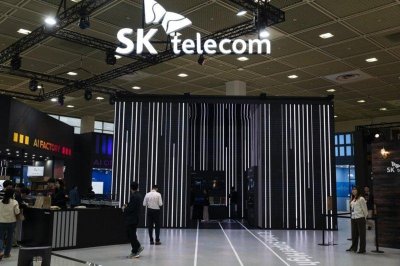
People visit the SK Telecom pavilion during the World IT Show 2025 at the COEX convention center in southern Seoul. File Photo by Jeon Heon-Kyun/EPA

June 26 (UPI) — South Korea’s leading mobile operator SK Telecom said Thursday that it would invest $481 million in a U.S. subsidiary of SK hynix as part of the group’s efforts to concentrate on the artificial intelligence strategy.

SK Telecom said that it agreed to purchase a 0.9% stake in SK hynix NAND Product Solutions, a company geared toward investing in innovative AI enterprises in North America.

“To secure synergies with our AI business, we are pursuing the acquisition of an equity stake in SK hynix NAND Product Solutions,” SK Telecom said in a regulatory filing.

This is not the first time that SK Group affiliates channel fresh funds into the U.S. unit. In March, SK Corp. and SK Innovation injected capital amounting to $250 million and $380 million, respectively.

In 2021, SK hynix spent around $9 billion to take over Intel’s NAND flash business and subsequently formed SK hynix NAND Product Solutions, which is now being restructured into an AI-focused investment company.

Earlier this January, SK hynix said that it would commit $10 billion to the company, with the funds to be deployed on a capital-call basis.

“The planned establishment of the AI company is aimed at securing opportunities in the emerging AI era,” SK hynix said in a statement at the time. “The company will continue to work closely with global partners while proactively creating value for customers.”

The share price of SK Telecom edged down 0.88% on the Seoul bourse on Friday, while that of SK hynix plunged 8.36%. The benchmark KOSPI declined 5.81%.

Source link

South Korean food conglomerate, Harim affiliate deals top $938 million

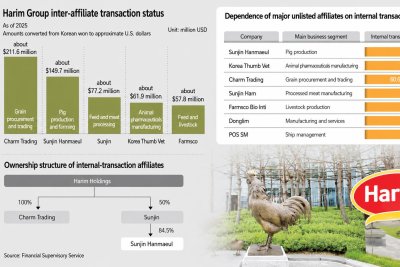
Harim Group’s internal affiliate transactions reached high levels in 2025, with Charm Trading recording about $211.6 million in internal transactions and some unlisted affiliates depending on group transactions for more than 80% of sales. Data from Financial Supervisory Service. Graphic by Asia Today and translated by UPI

June 3 (Asia Today) — Harim Group’s domestic transactions among affiliates exceeded 1.4 trillion won, or about $914 million, last year, raising concerns that some unlisted units remain heavily dependent on business from within the group.

An analysis of Financial Supervisory Service filings and affiliate transaction data showed Harim Group’s domestic internal transactions totaled 1.44 trillion won, or about $938 million, in 2025.

That accounted for about 11.5% of the group’s total revenue of 12.41 trillion won, or about $8.11 billion.

Harim Group has a vertically integrated business structure spanning feed production, livestock, food processing, distribution and logistics. The structure has drawn attention because several unlisted affiliates reported high levels of sales from transactions with other group companies.

Sunjin Hanmaeul, an agricultural company involved in pig farming, generated 229.2 billion won, or about $150 million, of its 256.6 billion won, or about $168 million, in total revenue last year through transactions with affiliates including Harim Holdings and Sunjin. That means 89.3% of its sales came from internal group transactions. Sunjin Hanmaeul is a sub-subsidiary of Harim Holdings.

Korea Thumb Vet, an animal pharmaceutical affiliate, also generated 94.8 billion won, or about $62 million, of its 130.1 billion won, or about $85 million, in total revenue from affiliate transactions. The company is also a sub-subsidiary of Harim Holdings.

Charm Trading, a Harim Holdings subsidiary responsible for grain procurement and trading, posted 323.9 billion won, or about $212 million, in internal transactions out of 534.5 billion won, or about $349 million, in total revenue last year. That was the largest amount among the group’s affiliate transactions.

Sunjin, a core affiliate in the feed and processed meat businesses, recorded 118.138 billion won, or about $77 million, in sales through affiliate transactions. Sunjin also owns an 89.4% stake in Sunjin Hanmaeul, whose internal transaction dependence reached 89.3%.

Other unlisted affiliates also showed high dependence on internal transactions. Sunjin Ham, a processed meat manufacturer, posted an internal transaction ratio of 99.9%. Farmsco Bio Inti, a livestock production affiliate, recorded 85.8%, while ship management company POS SM reported 85.4% and manufacturing and services affiliate Donglim posted 80.2%.

Harim Group was sanctioned by the Fair Trade Commission in 2021 over allegations that affiliates steered business to Orpum, a private company wholly owned by Kim Jun-young, the eldest son of Harim Chairman Kim Hong-kuk and an assistant managing director at Pan Ocean.

At the time, the commission said affiliate support provided unfair economic benefits to the owner family and imposed corrective orders and fines. Harim challenged the decision and the case is currently in administrative litigation.

The continued transaction structure involving major affiliates such as Charm Trading, Sunjin Hanmaeul and Korea Thumb Vet has drawn attention because it appears to have changed little since the commission’s sanctions.

Harim Group’s succession structure is widely seen as centered on Kim Jun-young. Through Orpum and Korea Investment, Kim has secured influence within the ownership structure of Harim Holdings, and key affiliates are also included under that structure.

Some level of internal transactions may be inevitable in a vertically integrated industry. But critics say it is a separate issue when some unlisted affiliates continue to depend on internal group transactions for 60% to nearly 100% of their revenue, especially as regulators strengthen oversight of tunneling and unfair support involving owner families.

The Fair Trade Commission says it does not determine illegality based only on the share of internal transactions.

“Internal transactions become a problem when illegal conduct such as unfair business steering or private benefit-taking is involved,” a commission official said. “If unfair support or private benefit-taking is found, the transaction can be subject to sanctions under relevant laws.”

— Reported by Asia Today; translated by UPI

© Asia Today. Unauthorized reproduction or redistribution prohibited.

Original Korean report: https://www.asiatoday.co.kr/kn/view.php?key=20260604010001065

Source link