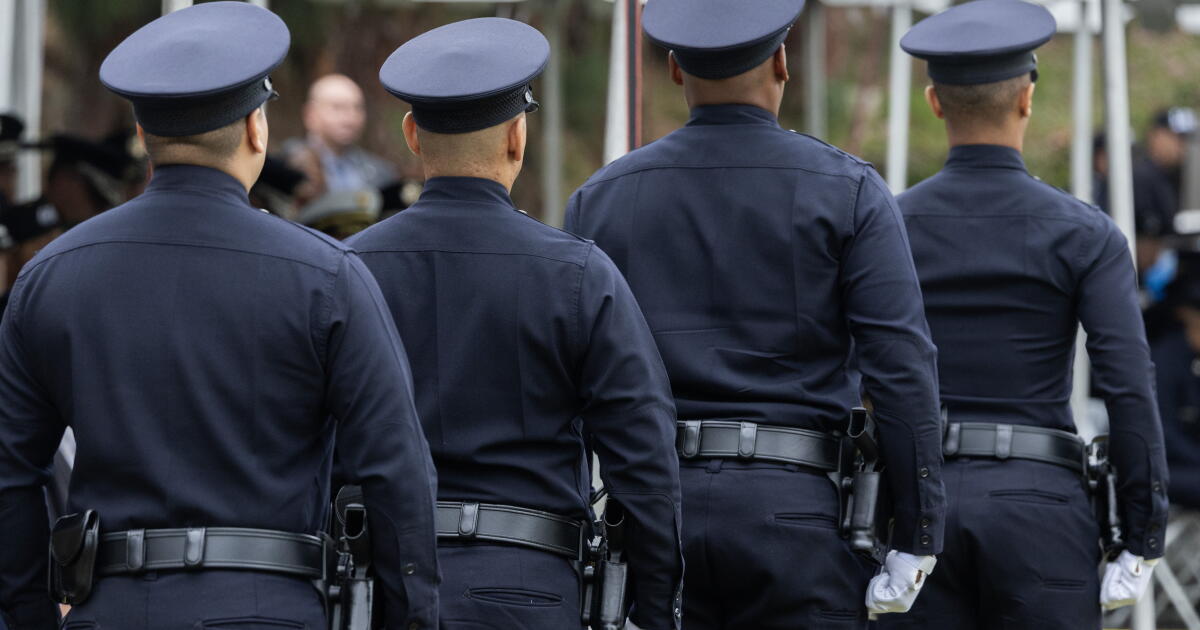
After LAPD recruitment officers were accused of making racist, sexist and homophobic comments — some of which were caught on tape — department leaders promised to look into whether they improperly disqualified any police applicants.
More than a year and a half later, the city is still waiting on the report.
But the contents of a separate LAPD internal affairs file reviewed by The Times has shed new light on the unit at the center of the scandal and how its officers responded to investigators who were looking into the matter.
No clear explanation has been given for the delay in publicly addressing the scandal’s effect on recruitment efforts.
In response to a records request from The Times, the city’s personnel department, which is conducting the inquiry, said it had not yet finished its review and had no timeline for doing so.
Last month, Los Angeles County Dist. Atty. Nathan Hochman charged Daniel Flores, the LAPD whistleblower who secretly recorded his colleagues, with 16 felonies, alleging he violated a state eavesdropping law. But, after criticism from Mayor Karen Bass and others, the district attorney downgraded the counts to misdemeanors with a diversion agreement that will probably allow Flores to avoid any time behind bars.
Flores’ recordings captured Los Angeles Police Department recruitment officers referring to Black people as “monkeys,” describing a female job applicant as “rapeable,” and saying “F—ing deport them, call ICE” during a conversation about Latinos, among a long list of other offensive remarks.
Asked about the pending LAPD report into the fallout from the tapes, Bass said in a statement that the review “has gone on too long.” The mayor said she had directed the personnel department to “complete the report and release it without further delay.”
Flores alleged in a complaint he filed with the LAPD in January 2025 that some recruits had been improperly rejected, adding to ongoing concerns about the department’s struggle to replenish its ranks.
As of last week, the LAPD had 8,507 sworn personnel — its lowest total since October 1995.
Even after efforts under Bass to streamline hiring and boost recruitment, Chief Jim McDonnell has warned that the department may not be adequately staffed in time for the 2028 Olympics.
McDonnell said after Flores’ allegations were made public in early 2025 that the personnel department would conduct a “biopsy” to examine “any adverse impacts” of the scandal on recruitment.
In a brief statement, the department said that it wouldn’t comment on what discipline, if any, had been meted out to the officers involved, citing state privacy law.
“The Department takes allegations of discriminatory or biased conduct seriously,” the statement read. “We are committed to ensuring the workplace is professional, respectful and free from misconduct.”
The Police Commission said in a statement that it is still waiting on the report, adding that “fair and equitable hiring of sworn and civilian employees remains a priority.”
The LAPD internal affairs investigative file reviewed by The Times described a frat-like office atmosphere in the Hiring and Evaluation Section in which Flores worked.
According to the internal affairs report, Flores claimed that at least one colleague, Shirley Burgos, had inappropriately disqualified candidates based on their appearance.
The report said that Burgos was captured in several recordings making fun of overweight candidates who were “ugly, creepy” people.
Another officer, Ayron McKay, told internal affairs investigators about an instance in which the unit’s officers were discussing a candidate who they believed was overweight.
Burgos then looked up the woman’s driver’s license picture on the DMV database, which several officers told internal affairs probably violated department policy, according to the report.
Burgos and McKay did not respond to inquiries to their work email accounts.
The internal affairs file said Flores recorded another officer saying he wanted to go to Big Bear, a popular winter sports destination in the San Bernardino National Forest, and roll the candidate down the ski slope. Meanwhile, according to the report, McKay asked the others how much they would pay to sleep with the woman, and referred to her as “Jabba the Hut.”
When asked about the conversation by internal affairs, the report said, McKay told investigators that the conversation started with Burgos venting about an applicant, but acknowledged that it should not have been allowed to continue.
In one recording made on Nov. 13, 2024, the report said, Burgos told her colleagues that she had released information about disqualified candidates to a friend of hers at the Los Angeles Sheriff’s Department, which is against LAPD policy.
The officers were all required to sign a confidentiality agreement that barred them from discussing candidates’ personal information with anyone outside the office.
During her internal affairs interviews, Burgos denied providing information to other agencies, saying it was clear from her laughter on the recording that she was joking.
Burgos told investigators that the only time she’d ever discussed a candidate with someone outside the department was during a conversation with an unnamed background investigator with the Sheriff’s Department or Santa Monica police — and said that was only to confirm that the candidate had in fact applied to the LAPD, according to the report.
The LAPD investigation noted that she and the other involved officers all denied that their office conversations had ever caused them to inappropriately disqualify a candidate.
The internal affairs report quoted the unit’s supervisor, Sgt. Denny Jong, a 20-year-department veteran, as describing his relationship with the officers under his command as friendly and professional; none of them had ever expressed discomfort about their work environment, he reportedly said.
Jong did not respond to emailed questions from The Times.
Several officers told investigators that they used gallows humor as a way to deal with the stress of working long hours in a small, windowless basement office.
According to the report, some officers, including Jong and McKay, acknowledged that the office banter sometimes crossed the line, but they denied that there was anything malicious about their comments. They also contended that the unit had little authority about which applicants advanced in the recruitment process — decisions, they said, that had to go through several layers of review.
During his internal affairs interviews, Jong often told investigators that he didn’t recall making certain inappropriate comments. The report said he also denied ever making any of the inappropriate comments that were contained in Flores’ complaint.
When he was confronted with audio of comments in which he referred to a candidate of Chinese descent as a terrorist, Jong said he was joking.
“He explained that this was based on current news stories at the time, which involved concerns over Chinese nationals attempting to infiltrate the country,” the internal affairs report said. “Jong was not serious and did not believe the candidate was a terrorist, but admitted the remark was an off-color joke and inappropriate for the workplace.”