The UK’s Foreign, Commonwealth and Development Office (FCDO) has issued new ‘limited to two’ guidance for Thailand
More than a million Brits head to Thailand each year(Image: Chadchai Ra-ngubpai via Getty Images)
Thailand Foreign Office travel advice change – what UK holidaymakers need to know:
The Foreign Office has issued updated travel advice for British tourists heading to Thailand – here’s what you need to know.
Thailand attracts over a million British holidaymakers annually, with tens of thousands living and working in popular destinations like Bangkok, Phuket and Chiang Mai.
Your passport must have at least six months’ validity from arrival date and one blank page. The FCDO warns: “You will be denied entry if you do not have a valid travel document or try to use a passport that has been reported lost or stolen.”
British tourists can stay up to 30 days under the visa exemption scheme for tourism only. Business travellers need appropriate visas before departure.
New restrictions limit visa-exempt land border entries to twice per calendar year. Air arrivals aren’t generally affected by this rule.
All travellers must complete a digital arrival card online up to three days before arrival.
Overstaying carries hefty penalties of 500 Thai baht (around £11) per day, rising to a maximum of of 20,000 baht (around £449). You also risk potential detention, deportation and 10-year bans.
Steve Tatham always wanted to work in theme parks. And growing up in Anaheim, some sort of career associated with Disneyland seemed readily attainable.
“Disneyland was the local business,” Tatham says. “It’s where everyone ended up when they were students and working part-time, and I was no exception.”
You’re reading Mr. Todd’s Wild Ride newsletter
Todd Martens’ newsletter delivers news and commentary on the past, present and future of theme parks, right from the theme park capital of the world — Southern California.
By continuing, you agree to our Terms of Service, which include arbitration and a class action waiver. You agree that we and our third-party vendors may collect and use your information, including through cookies, pixels and similar technologies, for the purposes set forth in our Privacy Policy such as personalizing your experience and ads.
While in college, he got a job as a Jungle Cruise skipper, and since then, he has never looked back. Over the course of his career, Tatham has spent nearly 30 years with the Walt Disney Co., many of them in theme park design with Imagineering. More recently, Tatham worked at Universal Creative for more than a decade and was the executive creative director of Epic Universe, the company’s impressive new Florida park.
Today, Tatham is turning his focus toward the next generation of theme park designers, having recently been tapped by USC to lead the Bachelor of Fine Arts in Themed Entertainment program, which is offered out of the cinema school. The four-year program is designed to prep students for a myriad of fields — modern theme park design firms work not only on new attractions but readily contribute to museums, zoos, immersive marketing events and more.
And yet theme park designer can feel like an elusive dream job, one based on connections, mentoring or even just luck. Part of that myth was shaped by the initial Disney Imagineers, many of whom were simply making up the job as they went along. As a longtime admirer of Tatham’s work, I recently chatted with the newly crowned academic leader on how one should prep for a career in the field, hoping to demystify it just a little bit.
Steve Tatham, photographed in Florida’s Epic Universe, is leading USC’s undergraduate program in theme park design.
(Steve Tatham)
You don’t need to major in themed entertainment to work in theme parks
There aren’t too many universities that offer a theme park design degree. (Along with USC, Purdue offers a themed entertainment design major and the Savannah College of Art and Design has one of the best-known and longest-running programs in the country.)
But Tatham notes that when he began his career in the industry, it generally wasn’t a field accounted for by universities. And many theme park designers I meet as a reporter, whether relatively new to the industry or veterans, created their own paths into the biz.
Tatham’s own background still provides a solid template for those students looking to enter themed entertainment design, as not everyone will have the means or the ability to attend a program such as USC’s. “I wrote my own major,” he says of his time as an undergrad at UC Berkeley, where he targeted theme parks as his career goal. He majored in film design but took courses that combined theater, architecture, environmental psychology and film studies. After graduating, Tatham went to UCLA for a masters in architecture.
Architecture was a career path pushed to Tatham by longtime scenic designer Henry May, who was his advisor at Berkeley. It was an early recognition that theme park design is an offshoot of urban design, requiring principles necessary in both stagecraft and real-world planning.
Think beyond theme parks
People are hungry for themed experiences. Global theme park attendance topped 246 million in 2024, a 2.5% increase, according to the Themed Entertainment Assn., which also charted a nearly 15% growth in attendance at the world’s top 20 museums, which are often a fertile industry for theme park designers. And that says nothing of the domestic trend of smaller, more locally-focused entertainment centers (think Netflix House or Meow Wolf).
It’s why Tatham tells his USC students to think beyond a Disney or Universal creation.
“If you look in the world out there, there’s marketing firms doing pop-up retail and pop-up dining, and they are doing immersive design in museum spaces,” Tatham says. “In addition to theme parks, there are opportunities within marketing and within architecture. Students who get this interdisciplinary training, which involves coding, architecture, design, exhibition work, landscape architecture and lighting, it’s a growing field.”
Steve Tatham once served as a tour guide on Universal Studios Hollywood’s behind-the-scenes tram tour.
(Genaro Molina / Los Angeles Times)
The best lessons come from observing guests
Long before Tatham was designing Epic Universe, he was working as a tour guide at Universal Studios Hollywood. As a film buff, he enjoyed the early-career job, but says one lesson from those days continues to stick with him.
“I would go on and on, because I love movie history, and I would be like, ‘Right here is where Jimmy Stewart worked, and Edith Head designed costumes,’” Tatham says. “They would politely listen, but then when ducks walked across, they would get excited and take pictures. People love things that are alive and immediate and happening now. People respond to what is immediate.”
The best theme park design is in conversation with guests. I think of Epic’s “How to Train Your Dragon”-inspired land and the bounty of movement found in the space via animatronic dragons (if you promise dragons, guests better see dragons!), or Disneyland’s New Orleans Square, where the curved, winding paths encourage constant discovery.
AI won’t replace great original ideas
Tatham is careful when speaking on the subject of artificial intelligence. He doesn’t want to dismiss its potential to be used as a development tool. And yet Tatham is direct when it comes to AI and creativity.
“I think there are a lot of challenges with AI. I think there are a lot of things that are scary,” he says. “But I think, ultimately, if it’s used as a tool, it can be useful to artists.”
But there are limits.
“AI is never going to come up with a great idea,” he says. “It’s just going to recombine and reconfigure and spit back to you ideas that others have had. So I think this is an opportunity for original thought to stand out even more than it has in the past.”
Jennifer Bascom of Disneyland, gives a telegram to Disneyland guest Keith Kocienski of Fullerton while playing a live-action role-playing game in Frontierland called Legends of Frontierland back in 2014.
(Christina House / For The Times)
But the integration of smartphones remains a challenge
While Disney recently shuttered its Play Disney Parks mobile app, the park is experimenting with connectivity between the video game “Fortnite” and its attraction Millennium Falcon: Smugglers Run. Tatham cautions that any time a theme park invites someone to use a smartphone during their day at the park, designers are then pulling them away from the curated experience.
“The problem is when you’re in Universal or Disneyland, you’re now competing with all the opportunities that people have to explore their own entertainment,” Tatham says. “Are they going to be on Instagram or playing Solitaire online? So now you’re competing with that.”
And yet Tatham thinks there are lessons to be learned from the interactive world, as long as designers focus on real-world play. Tatham, after all, worked on what was once of my favorite Disneyland projects, the great but short-lived Legends of Frontierland. Some of those who contributed to it brought it to Knott’s Berry Farm, where it has been fine-tuned into the terrific Ghost Town Alive! The latter is a rarity in the theme park space.
Yes, it’s possible to make a decent salary
So how much can one expect to make? This isn’t an easy question to answer, as there’s only so many slots at Walt Disney Imagineering and Universal Creative, and the theme park design industry encompasses so much more.
There are independent themed entertainment firms to marketing outposts to studios to museums to architecture companies to theaters and more. And salaries can vary greatly between the public or private sector, as well as entry level versus senior positions. Even recruiting sites have a broad range, from around $50,000 to above $200,000.
The good news, says Tatham, is there is a high ceiling. Additionally, that there is a breadth of industries to work in should help any potential graduates. “There are many different job descriptions with different salaries in the themed entertainment field,” Tatham says.
And yet he knows it’s a concern of parents.
“I want students and parents to know that it is possible to make a solid steady income in the arts and that they shouldn’t focus on a backup plan but rather on putting together a killer portfolio because there is work for those who have honed their skills,” he says. “I would tell them that they should be prepared to live in Orlando, Fla., or Glendale, Calif., and be open to international assignments. Top directors can make in excess of $250,000 a year, but they should be prepared for starting salaries similar to architecture, graphic design or similar creative fields.”
A Disneyland cast member playing the role of Alice in Wonderland interacts with guests.
(Christina House / Los Angeles Times)
Remember why theme parks still matter
Anytime I have an opportunity to chat with someone with Tatham’s experience I want to hear their take on one question in particular, and that’s why they love theme parks and why they believe the spaces resonate with so many people. As someone charged with creating passion among the next generation of theme park designers, I was especially interested in Tatham’s response.
“If you go to a theme park, there is something for every demographic,” he says. “There are things for kids. There are things for grandparents. There are things for everyone in between. People can enjoy those times together, which was the original intent of Walt Disney. He was looking for a place while in Griffith Park where he could go do things with his daughters. He created it because it did not exist.”
For Tatham, it’s about the memories.
“If you ask people about their experience in theme parks, they will remember in great detail which parks they went to and who they were with,” he continues. “Ask them about going to the movies, they might say, ‘Sure, I went with my family, but can’t tell you what movies and who I was with.’ But they will remember those moments with theme parks. It’s a great bonding experience. That’s the reason they exist and the reason I love to create them.”
This week in SoCal theme parks
Plans are underway to refurbish the Griffith Park merry-go-round.
(Christina House / Los Angeles Times)
The Griffith Park carousel will spin again. Assessments are underway to see what it will cost to once again get the Griffith Park merry-go-round spinning. Theme park fans best know it as the site that is said to have inspired Walt Disney to dream up what would become the Disneyland Resort, and it has been shuttered since 2022. Curiously, there’s also a Disney connection with the carousel today, as some of those who work at Walt Disney Imagineering are volunteering their time and efforts to restore this treasure in Griffith Park. Read my story here.
Six Flags Magic Mountain shuts down second coaster. Six Flags is closing several rides across the U.S. and Canada — including the Goliath roller coaster at Six Flags Magic Mountain in Valencia — after a man fell to his death from a roller coaster at one of its parks in Georgia. Park officials said Tuesday that the closures were out of an abundance of caution and were temporary. Times writers Hailey Branson-Potts and Fedor Zarkhin have more on this story.
Merry Minions. Universal Studios Hollywood has unveiled its slate of holiday of programming, and returning this year are its popular “Grinchmas” offerings, including the 65-foot winding, drooping, Dr. Seuss-inspired Christmas tree. There will be meet-and-greets, including a reading of “How the Grinch Stole Christmas,” as well as holiday carolers and ornament decorating. New this year will be holiday festivities in the park’s kid-focused Minion Land, complete with Minions in holiday attire. Super Nintendo World, Wizarding World of Harry Potter and other areas will also be dressed for the season, beginning Nov. 21 and lasting through Jan. 3.
A heads-up for ‘Cars’ fans. It’s the 20th anniversary of the “Cars” franchise, and those with a special affinity for the series will want to find their way to Disneyland’s Pixar Place Hotel and park themselves on the hotel’s second floor art gallery. That’s where the hotel is hosting an exhibit honoring the film with drawings, paintings, sculptures and behind-the-scenes footage that document how Radiator Springs Racers was brought to life. And before you go, read my story on how Route 66 inspired the film and Cars Land.
Step into the world of ‘Dune.’ Tickets are now on sale for an immersive “Dune” exhibition in downtown L.A. that promises spectacle, as well as a bit of mystery. Step around, and potentially inside, awe-inspiring vehicles from the film, or come face-to-face with the Bene Gesserit, a group of priestesses who possess, among other things, the ability to bend the will of others. “Dune: The Experience” opens Nov. 20 and and is currently set to run through Dec. 20, although an extension is likely. Standard tickets start at $42 but there are various ticket packages available.
Ride Report
The dinosaurs on the Disneyland Railroad.
(Todd Martens / Los Angeles Times)
It’s always a good idea to hop on a Disneyland attraction that has been recently refurbished. It’s generally a chance to see the ride in tip-top shape. And so I was eager to get on the Disneyland Railroad on a recent trip to the park, as the dinos in the Primeval World world section of the attraction had recently been hidden behind illustrated tarps. Good news, as the dinosaurs are looking as sharp as they ever have. No real changes were made to the figures, but they’re all moving as they should, be it munching on grass, rattling out of an egg or getting ready for battle.
The theatrical lighting overall feels a little brighter, and the few digital effects — a volcano erupting in the background, for instance — are all in working order and bring an added sense of dimension to the diorama scenes. Be sure to add it to your day. The Disneyland Railroad is also a fine reminder to slow down during your Disneyland visit.
Tell us your stories. Ask us your questions.
Have a theme park tale to share? Whether it was a good day or less-than-perfect day, I would love to hear about it. Have a question? A tip? A fun photo from the parks to share? Email me at todd.martens@latimes.com. I may feature your note in an upcoming newsletter.
Ride on,
Todd Martens
P.S.
What is “Eggs in Space”?
(Todd Martens / Los Angeles Times)
A cinematic mystery is brewing, one that seemingly has connections to the local immersive entertainment community. What, for instance, is “Eggs in Space”? A recent sci-fi event at indie nonprofit movie theater and store Vidiots ended with the beginnings of a puzzle.
The screening appeared to be interrupted by a film that was taking control of the projectors. The film? “Eggs in Space.” As an abstract image of an egg appeared on screen, performers began walking toward the front of the theater in a transfixed, cult-like fashion.
There is, of course, no record of a film titled “Eggs in Space,” although there is a website dedicated to its disappearance. So dig in. A new alternate reality game just dropped. I have a hunch you’ll want to know where it leads.
—
This newsletter is free thanks to the support of L.A. Times subscribers. If you’re not yet a subscriber, explore subscription packages to unlock unlimited digital access and support award-winning local reporting.
Was this newsletter forwarded to you? Sign up here to get it in your inbox.
SAUDI Arabia has been targeted by missile attacks over the weekend – some of which hit the King Khalid International Airport in Riyadh.
It has led to a change in FCDO advice – so what happens if you have a holiday booked, or a flight stopover?
King Khalid International Airport was targeted in a missile attack over the weekendCredit: APAs a result, the FCDO for Brits advises against all travel to Saudi ArabiaCredit: REUTERS
What is happening in Saudi Arabia?
Over the weekend, Houthi forces in Yemen launched an attack on in Saudi Arabia’s capital city, Riyadh.
The FCDO advises against all travel to parts of Saudi Arabia.
It read: “Following a serious incident at King Khalid International Airport on 10 October 2026 at approximately 1500 (local time), we advise British nationals to stay away from King Khalid International Airport until the airport is secure and to monitor the advice of the Saudi authorities.”
It adds that it advises against:
all but essential travel to all airports within Saudi Arabia except for Medina International Airport
all travel to within 10km of the border with Yemen
all but essential travel to Aseer province, Riyadh province, Najran province, Jizan province and the cities of Taif, Jeddah and Dammam
It continued to say: “There is a heightened threat against airports, military bases, ports and energy infrastructure across Saudi Arabia, including Abha, Jizan, Najran, Riyadh, Taif, Jeddah and Yanbu, as well as Saudi shipping vessels in the Red Sea.”
“Further attacks against airports are very likely. Follow Saudi Civil Defence alerts.”
Riyadh is frequently used as a stopover destination for BritsCredit: Getty
Are flights still going to Saudi Arabia?
King Khalid International Airport closed on Saturday following the missile strikes and remains closed with flight disruption across the region.
While the Saudi Arabia air space remains open, there is a high risk of short-notice airport closures, diversions and airspace disruption.
Reuters has reported that certain airlines have suspended flights to Riyadh.
Lufthansa Group has suspended flights to Riyadh until October 16.
Air France-KLM has halted services to the Saudi capital until the end of the month.
Emirates which flies Brits to Riyadh via Dubai has been affected by cancellations.
What if I’m currently in Saudi Arabia?
The FCDO advice reads that any British national in the Middle East should prepare for flight cancellations and possible airspace closures.
The advice also states:
follow advice from the local authorities and sign up to FCDO Travel Advice email alerts
refrain from capturing or sharing images of conflict-related incidents
monitor local and international media for the latest information, including updates relating to airports and airspace which could close at short notice
stay away from areas around oil infrastructure and military facilities. Exercise caution at transport hubs
keep your travel plans under review and ensure your travel documents are up to date
before you travel, check that your route does not include travelling through areas or airports where FCDO advises against all but essential travel and, if it does, consider whether your travel is essential
if travelling by air, check that your reservation is confirmed and the status of your flight before travelling to the airport. Remain alert at airports and follow instructions from local authorities
if you are advised to take shelter, stay indoors or find the nearest safe building or designated shelter. An interior stairwell or a room with as few external walls or windows as possible may provide additional protection. The greatest risk is from falling debris caused by intercepts, and you are safest inside a secure structure
Saudi Civil Defence may issue early warning alerts to people in affected areas
Head here to read the latest guidance on ‘how to prepare for a crisis’ and what to include in emergency supplies.
What if I have a holiday booked and can I cancel my trip?
Before you cancel a flight or holiday booking, speak to your travel provider first – especially if it’s a stopover flight as it may be rerouted.
In places where the FCDO advises against all but essential travel, you may be able to cancel a package holiday and get a full refund.
The most forgotten hero in Dodger history stepped out of the shadows in 1987 as their instant general manager and created the miraculous monster that came to be in 1988.
The resuscitation of a Dodger brand during what was quite possibly its darkest moment? It all started with Fred Claire, the longtime Dodger executive who died Monday in his Pasadena home on his 91st birthday.
His quiet presence will forever be missed. His audacious impact should never be forgotten.
Claire was an endlessly kind, disarmingly honest and eternally humble sort whose love for the Dodgers was perhaps best illustrated by the story of his most prized souvenir.
After the Dodgers clinched the 1988 World Series championship in a stunning victory over the heavily favored Oakland A’s, catcher Rick Dempsey approached Claire in the champagne-soaked clubhouse. In Dempsey’s back pocket was the game ball used by Orel Hershiser to strike out Tony Phillips for the game’s final out.
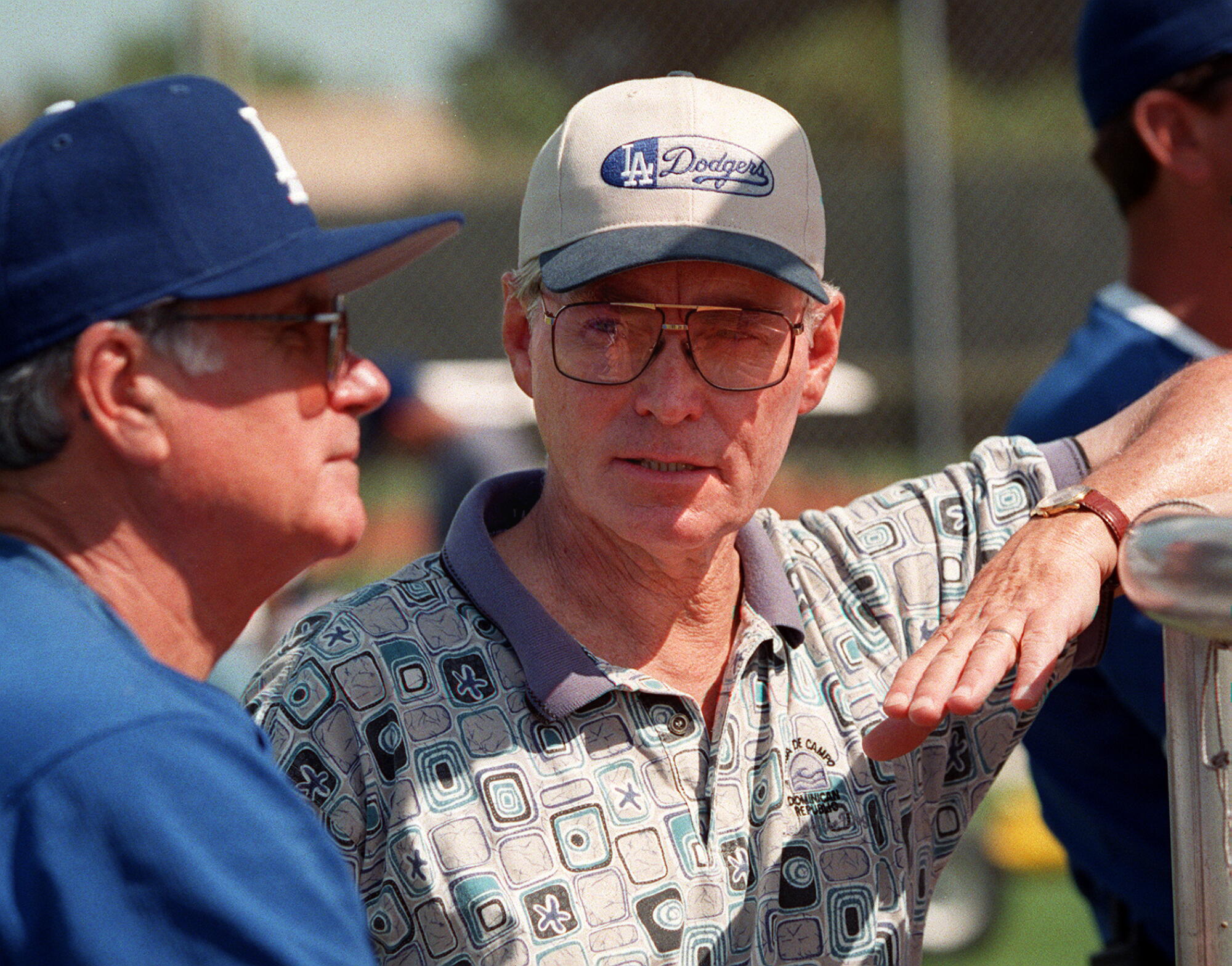
Fred Claire talks with Dodgers coach Joe Amalfitano at a batting cage during spring training.
(Kirk McKoy / Los Angeles Times)
Dempsey handed the ball to Claire in gratitude for the belief shown by the general manager in signing Dempsey and several other journeymen who helped lead the team to the title.
Claire quietly accepted the ball, took it home, put it on a shelf, but several years later realized it was needed elsewhere. At the time, the National Baseball Hall of Fame only had two final-out balls. Once again believing that the Dodgers were more important than himself, he donated his jewel to Cooperstown. The shelf remained empty.
“I just played one role in all this,” Claire told me several years ago. “In getting through our difficult times, I always believed in ‘We.’”
Referring to the Dodgers’ 1987 season as a difficult time was an understatement.
In April, longtime general manager Al Campanis was fired for making racist remarks about Black Americans on the TV show, “Nightline.”
Peter O’Malley, the Dodgers’ president at the time, made the sudden and strange choice to replace Campanis with Claire, the team’s public relations boss who had spent the first 11 years of his career as a sportswriter.
There was much criticism. There was overwhelming disbelief. But instead of apologizing for the promotion, Claire ran with it. One day after taking the job he cut popular pitcher Jerry Reuss and signed unemployed Mickey Hatcher and set the stunt man tone.
”I wanted some fire, and Mickey was the guy who could give us that,” Claire told me. “I don’t know if there were people who doubted me, but I never doubted myself. I knew I had the job for today, and I was going to make the most out of that day.”
He slowly turned a stuffy and entitled team into a lean and scrappy one, and by the time he made the brilliant move of signing free agent Kirk Gibson in January of 1988, the stage had been set.
Nine months later, it was only fitting that Gibson’s famous walk-off homer against Dennis Eckersley of the A’s in the World Series opener scored Mike Davis, who was also signed by Claire.
And the most valuable position player in that series? None other than the guy Claire signed first.
“Fred Claire was amazing,” Hatcher told me. “For a guy who was suddenly put into the limelight, he asked all the right questions, listened to everyone, and believed in all of us.’’
It was this great belief in collaboration that burned Claire in 1993 when he traded seemingly frail pitcher Pedro Martínez for second baseman Delino DeShields on the advice of his medical staff.
Martínez, of course, became a Hall of Famer while Claire became saddled with the stain of one of the worst trades in Dodger history. The perception surely irked a man who was just following organizational advice, but Claire never backed down from his role in the deal.
“The facts have to be the facts, and those facts are, I traded Pedro,” Claire told me.
That was Fred Claire personified, honest to the end, refusing to sacrifice his integrity, never surrendering his dignity.
Because he was too modest for acclaim and too quiet for headlines, Claire essentially disappeared from the Dodgers orbit for nearly two decades after his firing, instead focusing on teaching, consulting, and co-writing an autobiography entitled, “Fred Claire: My 30 Years in Dodger Blue.”
During this time he also became a touchstone for all Dodger alumni, as many former players contacted him daily for advice or help or just to remember the good old days. He never failed to answer a call, never turned down a request, seemingly every former Dodger knew his number and leaned on his goodness.
He was finally honored at Dodger Stadium in the summer of 2017 in an emotional ceremony that was long overdue. By then, he was heavily involved in the last great fight of his life, a battle against cancer that led him to become an important advocate and fund raiser for City of Hope.
In one of his final visits there last month, Claire didn’t focus on his illness, but rather his room number. He was quite proud that it was 4217, because Jackie Robinson was 42. Claire was with Robinson shortly before his death and constantly stressed the connection between the icon and his franchise.
In our final correspondence, on the day before he died, Claire texted me and several others with seven photos.
There were images of him with wife Sheryl, with Lasorda, with Dave Roberts, with several champagne-stained Dodgers in a celebratory clubhouse.
There was also a picture that did not contain him but spoke volumes about his character. It was a simple photo of a plaque bearing the number 42 and accompanied by a quote.
“A life is not important except in the impact it has on other lives.”
New rules have been introduced at some UK airports, and holidaymakers have been issued a warning ahead of the busy October half-term, as thousands are expected to jet off abroad
A travel warning has been issued to Brits jetting off abroad(Image: Getty Images/Stock Image)
Airports across the nation will be bracing for another busy travel season as we head towards the October half-term, with thousands of families set to jet off abroad on a sun-soaked getaway. But amid the excitement, holidaymakers have been issued a warning and advised to be well prepared for the new rules.
Some UK airports have upgraded their security scanners, meaning that travellers can carry up to 2 litres of liquid through security and no longer need to remove liquids from their hand luggage. Additional rules have also been introduced for security checks, which can vary from airport to airport, making it even more confusing when travelling abroad.
To ensure that holidaymakers are fully prepared before jetting off abroad in the coming weeks, Heathrow Airport issued an update to all travellers. Taking to X, formerly Twitter, the UK’s largest airport shared its “top tips” for going through security and warned: “Security requirements may vary by destination, both within and outside the UK.”
It comes as Heathrow has upgraded its security scanners. On the airport website, they confirmed: “You can now keep liquids and large electronic items in your cabin bag, so getting through security is quicker and easier”. They then outlined that passengers passing through Heathrow should:
Keep liquids in your cabin bag
Carry liquids in containers of up to 2 litres each
Empty metal and insulated bottles before security. You can refill them after security
Keep laptops, tablets and other large electronic items in your bag
The change is thanks to new CT scanners that provide security staff with detailed 3D images of bags, allowing travellers to keep their two-litre liquids in their hand luggage when passing through airport security. However, it’s important to understand that “not all airports use the same security equipment”, as Heathrow warned.
They said: “If you’re flying from another UK or international airport, check the local security rules before you travel. Liquid limits and security checks may be different.” They further explained that “many airports outside Heathrow still have a 100ml liquids limit” and it’s best to check the rules before travelling. This also applies to UK airports, with many still obtaining the 100ml rule.
UK airports that have ditched 100ml rule
Belfast International
Belfast City
Birmingham
Bournemouth
Bristol
Edinburgh
London Gatwick
London Heathrow
UK airports that still have 100ml liquid rule
Aberdeen
Bournemouth
Cardiff
East Midlands
Glasgow International
Glasgow Prestwick
Inverness
Isle of Man
Leeds Bradford
Liverpool
London City
London Stansted
London Luton
Manchester
Newcastle
Norwich
Southampton
Teesside
While many UK airports still have the 100ml liquid rule in place, some have relaxed measures. A number of airports no longer require travellers to store their liquids in a clear plastic bag, and they can also be kept in their hand luggage when going through security. However, as specific rules can vary, it’s best to check directly with the airport you’re flying from, especially in the run-up to the October half-term.
Do you have a travel story to share? Email webtravel@reachplc.com
SEVERE storms have caused flooding on a popular Greek holiday island.
Crete in Greece is currently suffering from mass flooding causing widespread disruption across the island including some tourists being evacuated from coastal accommodation.
Severe storms have caused mass flooding in CreteCredit: ReutersThe popular holiday island has even had to evacuate some resortsCredit: Reuters
Some cars and trees have even been washed into the sea.
Here is the current advice for travel to or from Crete right now:
Sign up for the Travel newsletter
Thank you!
Where is the flooding?
Flooding in Greece right now is mainly impacting the island of Crete.
Massive storms have been battering the island since October 1 and resulted in torrential rainfall with bad flooding and mudslides.
Worst hit areas include the Milopotamos district and the village of Zoniana, as well as Kato Gouves, Finikia, and Heraklion city.
In Chania, there have been big waves as well which have damaged seafront restaurants.
Is it safe to travel to Crete right now?
There is currently a Red Alert warning in Crete, which has been issued by the local authorities and the Hellenic National Meteorological Service (EMY).
Emergency services are still currently clearing mudslides and damage caused by the flooding.
There is currently a Red Alert in place for weatherCredit: AP
“Greece can experience extreme natural phenomena such as earthquakes, wildfires, extreme heat and flash floods.
“To be alerted to events near where you are located in Greece, make sure your mobile phone is set to allow emergency alerts.
“For instructions on how to do this see:
for iPhones go to Settings > Notifications and enable the ‘Emergency Alerts’ option at the bottom
for Android 11 and higher go to Settings > Notifications > Advanced Settings > Wireless Emergency Alerts
for Samsung devices go to Settings > Apps > Messages > Notifications > Emergency Notifications and enable the ‘Emergency Alerts’ option
“This will allow the Greek government’s Emergency Communication Service alerts to reach you. Always keep your phone with you as you will receive alerts according to the location of your phone.
“Adverse weather conditions, including floods, can happen quickly. Register for Emergency alerts and follow ‘112 Greece’ on X for official updates.”
Are flights still going to Crete?
Currently, flights are not impacted to or from Crete.
However, if you are already in Crete and need to get to the airport you may want to allow for more extra time.
If you are due to fly in and have concerns, it may be worth contacting your airline to check if they are operating normally.
Though flights are not being cancelledCredit: EPAIf you have a holiday to Crete booked, it is worth checking with your travel insurance if you wish to cancel itCredit: EPA
What if I have a holiday to Crete booked?
As the Foreign Office has not warned against travel to Greece, there are no special circumstances in place for holidaymakers to cancel their trip and receive a full refund.
Depending on what travel insurance you have, your policy might include natural disaster cover.
If so, your insurance policy should cover you for when you are unable to reach your holiday destination due to natural disasters, like wildfires.
So it is worth checking your travel insurance policy.
Can I cancel my trip?
If you do choose to cancel your trip, it is best to contact your airline or holiday provider.
There is no obligation for companies to refund bookings unless government advice changes.
Most UK holidaymakers still consult and trust their family and friends’ recommendations over AI for travel advice
08:00, 29 Sep 2026Updated 13:37, 29 Sep 2026
Three-quarters of Brits said having a holiday booked gives them a ‘sense of purpose’(Image: Hilton)
A landmark study of 14,000 travellers from countries including the UK and Australia found that in the UK, family (84%) and friends (81%) trumped AI (45%) for travel tips and holiday hotspots.
Just one in 10 rely on influencers for travel advice – highlighting ‘The Travel Trust Equation’ will be a strong theme emerging for 2027. Artificial intelligence is seen to be transforming the way we travel, but it hasn’t quite replaced the human touch. It also revealed they are set to prioritise things like balance, flexibility and trips that leave a lasting impact.
Of the 1,000 Brits surveyed as part of the Hilton 2027 Trends Report, The Great Rebalance, three-quarters said having a holiday booked gives them a ‘sense of purpose’.
This reflects ‘The Beforeglow’, with booking a trip giving people a much-needed psychological boost and offering them a sense of excitement, motivation and escape weeks, or even months, ahead of departure. More than a quarter (27%) also seek a new perspective through travel, which changes how they view everyday life when they get back home.
Simon Vincent CBE, executive vice president and president, EMEA, Hilton, said: “Travellers are increasingly focused on making their time away count. Rather than chasing a one-size-fits-all idea of the perfect trip, they’re looking for experiences that reflect their own interests and priorities.
“Our job is to help guests make the most of every trip; whether they’re exploring a new destination, reconnecting with loved ones, taking time to switch off – or even a little bit of everything.”
The study also found 60% of all Brits claimed having a holiday booked helps them stick to personal goals, while 53% use them to mark important life moments, meaning travellers are well into their ‘Optimisation Era’.
But 28% of Gen Z travellers see holidays as a chance to kick-start a healthier lifestyle, whereas 63% are more likely to make a significant life change after returning home from their travels.
Nearly three quarters of this generation (74%) also feel motivated to stick to personal goals knowing a holiday is on the cards, and 32% regarded maintaining their fitness routine while away as ‘non-negotiable’.
But the Morning Consult research found 29% of younger travellers feel pressure to plan the ‘right’ kind of trip – compared with just 6% of 62-80-year-olds, showing a rise in ‘Boomer Goals’.
Only 18% of this older generation stick to a strict itinerary, compared with 41% of Gen Z, with 53% of Boomers favoured a spontaneous approach instead. And 72% never feel pressure when making travel decisions, compared with only 27% of Gen Z.
Travel loyalty is emerging as another status symbol among younger holidaymakers, with 27% of Gen Z belonging to a points or miles programme.
The rise of ‘Status Seekers’ suggests travel loyalty programmes have entered a new era, where status matters as much as savings.
With 37% even admitting to feeling jealous of friends with a higher travel status, as 41% see that status as a sign of personal success.
A further 58% of 18-to-29-year-olds believed people with elite travel status have greater influence over group travel decisions.
Where travellers stay is changing too, as gardens were named as an accommodation ‘must-have’ by 40% of Brits, placing them ahead of hotel pools at 33%.
Fresh air and time outdoors were key to holiday relaxation (76%), while 47% will use travel to spend more time immersed in settings such as forests, mountains and coastlines.
UK adults are also reconsidering the traditional big annual getaway in favour of shorter, more flexible breaks, with 65% planning to take more short trips over the next year.
Among these “micro-travellers”, 35% want to tick more destinations off their travel lists, and 26% value the spontaneity offered by shorter breaks.
A further 56% will plan a micro-trip around one standout experience, rising to 74% of Gen Z travellers.
Simon Vincent added: “With a portfolio spanning everything from luxury retreats and city-centre collection hotels to family-friendly resorts and extended-stay brands, we offer travellers the choice and flexibility to find the experiences that are right for them.”
Seven travel trends for 2027
The Travel Trust Equation – AI may be transforming travel, but it hasn’t replaced the human touch.
Status Seekers – Travel loyalty programmes have entered a new era: where status matters as much as savings.
Boomer goals – In contrast to the younger generation’s optimisation obsession, Boomers are making a compelling case for doing less.
The Beforeglow – Booking a trip is giving people a much-needed psychological lift, offering a sense of excitement, motivation and escape weeks, or even months, ahead of departure.
Optimisation Era – Self-optimisation culture continues as travellers will see time away as an opportunity to return home levelled-up.
Wellness Rewired – Nature is the new must-have, with outdoor spaces now valued more than hotel pools.
The Micro-Travel Mindset – More Brits are swapping one big annual holiday for a series of shorter, experience-led escapes throughout the year
TWICE-divorced Ben Affleck has revealed the brutal response he gets from his children when he tries to give them relationship advice.
The actor, who was previously married to Jennifer Garner and Jennifer Lopez, revealed his kids are quick to put him in his place when he weighs in on their friends’ love lives.
Ben Affleck’s marriage to Jennifer Lopez ended in 2024Credit: GettyBen has revealed the brutal response he gets when he offers his kids relationship adviceCredit: Splash
Speaking on Jimmy Kimmel Live!, Ben, 54, recalled trying to offer his opinion during a conversation at the dinner table.
He said: “I said, ‘Well, the thing about that relationship there with that person is…’ and the 17-year-old just turns to me and goes, ‘Oh, like you’re the expert on relationships?’”
Sign up for the Showbiz newsletter
Thank you!
Ben added: “I give advice and try to talk to them, parent them as you do. What I found is that now it’s not only one teenager rolling their eyes.
“I’ll kind of launch into something at the dinner table and I’ll catch them giving each other looks and I realise I’m the caricature in this story.”
Ben and Jennifer Garner remain close as they co-parent their three childrenCredit: AP:Associated PressBen has admitted his children aren’t afraid to roast him over his relationship historyCredit: Splash News
Ben shares Violet, 20, Fin, 17, and Samuel, 14, with his ex-wife Jennifer Garner.
The pair married in 2005 and divorced in 2018.
Ben later married Jennifer Lopez, 57, in 2022, almost two decades after they called off their first engagement.
Their marriage ended in 2024.
Last year, Ben told GQ he had “nothing but respect” for JLo and described the breakup as having “no scandal, no soap opera, no intrigue”.
He said there was no single dramatic event behind it, but stopped short of sharing the private details.
Meanwhile, the actor remains close to Jennifer Garner and had hoped to cast her as his on-screen wife in his new film Animals.
He told Entertainment Weekly: “I thought, God, Jen Garner would be amazing for this role.”
Jennifer ultimately did not take the role, which went to Kerry Washington.
However, he added: “I would love to work with her, frankly. She’s fabulous, and we’re really good friends, and I’m profoundly grateful to her, and we have a great thing.
“I still would wanna work with her in the future, but what you don’t wanna do is take the audience’s baggage and have it work against you, you know?”
Nearly every summer, Tove Lo finds herself itching for a change.
Typically, the sweltering season will prompt the Swedish singer-songwriter to do something new, like dye her hair black or switch up her personal style. But even in the midst of this annual metamorphosis, she tends to find her way back to the same place: a small Swedish fishing village called Torekov.
Between recovering from her first heartbreak and overcoming burnout from her debut album “Queen of the Clouds,” the remote town has offered her a seaside refuge ever since childhood. Yet, with the making of her latest studio album “Estrus,” Torekov officially solidified itself as a mainstay in the singer’s artistic process.
“It’s kind of an emotionally triggering place for me, both good and bad,” Lo said, as she sank farther into the booth at Thai Angel on a humid August afternoon. “I needed a second to be in a place without distractions, where I’m more like a person than an artist … It almost offers a creative force field that I need to enter every process now.”
Torekov, as Lo describes it, is what the neighborhood in “‘The Truman Show’ is like before they hit record.” It’s somewhat of an idyllic place where the seashore is lined with wooden houses; sheep graze along the grassy cliffsides and residents wander around the shops in bathrobes and clogs, right after their morning swims.
However, when Lo visited during the off-season, its emptiness was “ominous” — unintentionally stirring her inner want to cause chaos. In true Tove Lo fashion, the surrounding serene village made her turn to the familiar sounds of heavy club electronica, further building on the contradictory ethos that comprises “Estrus.”
“Every song feels different. It’s like every feeling I’ve ever felt condensed into 13 songs,” Lo said, in between sips of her iced tea. “[Listeners] are getting this horny, rolly, aggressive bass line, and these super intimate, knife-to-the-heart kind of emotions in a very intimate way. I feel like they’re going to be emotionally exhausted.”
Under the dim red light of the Koreatown bar, the singer exuded an air of comfort, as she’s somewhat of a Thai Angel regular. The Swede, who’s lived in L.A. for nearly a decade, hosts a secretive, recurring party at the bar called SOUP. Usually the bar is a rowdy reprieve filled with sweaty bodies and pounding bass lines, with Lo situated behind the DJ decks. But on that Monday afternoon, hours before the bar opens, she had the place almost entirely to herself.
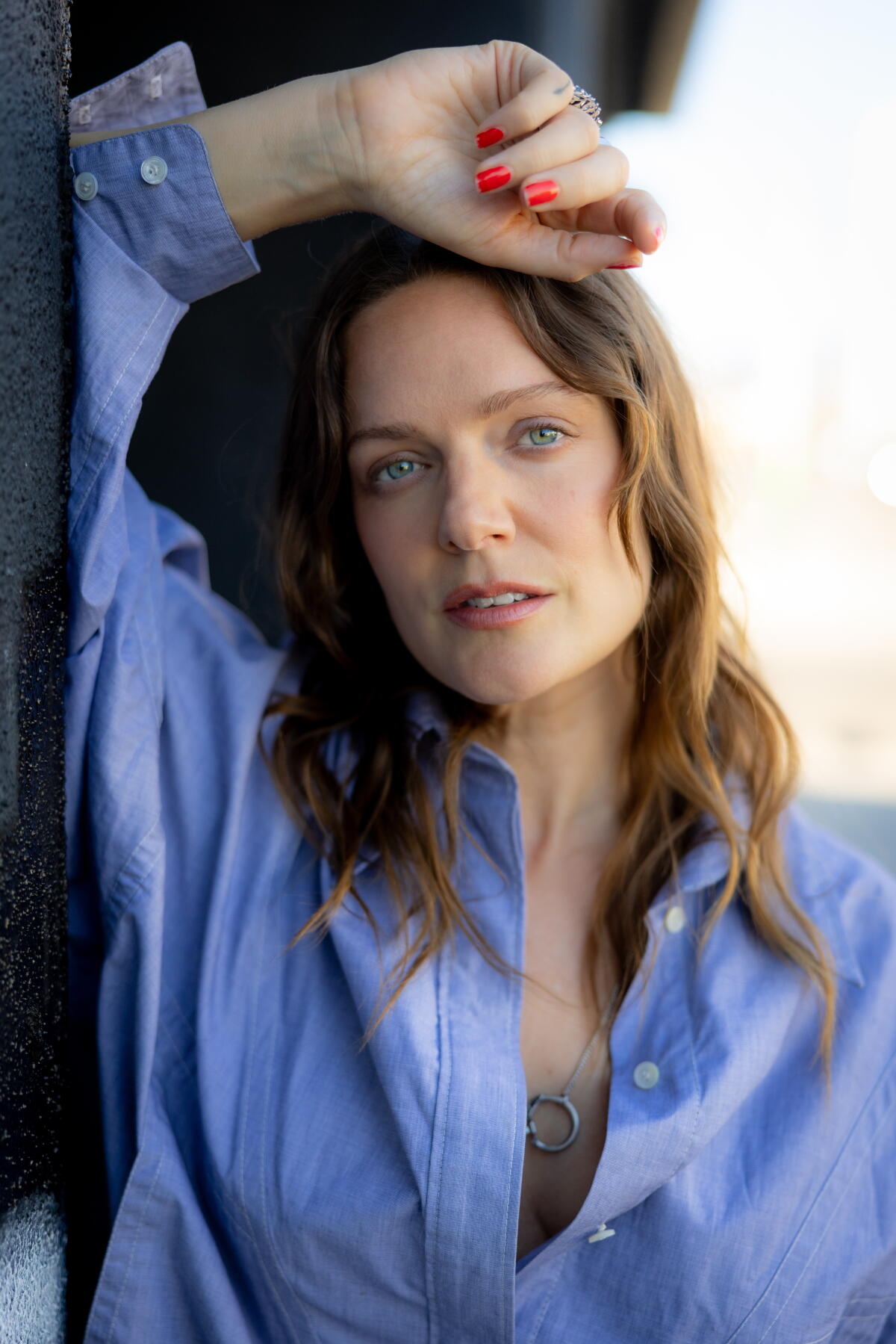
Tove Lo outside Thai Angel, a Koreatown bar where she hosts a recurring party.
(Jason Armond / Los Angeles Times)
With only the swirling sounds of an overhead air conditioning vent to cloud her thoughts, she explained that, at the beginning, “Estrus” was bogged down by an unprecedented wave of writer’s block. The singer had initially tried to get a head start on her sixth studio album at home in Los Angeles, but she felt a new kind of pressure hanging over her head.
“I had this feeling that this is my sixth album and I had something to prove, like I needed to have a message or some kind of advice,” Lo said.
She credits the newfound tension to her career’s longevity. The 38-year-old, raised in the suburbs of Stockholm, got her start in music as a songwriter in the early 2010s, earning credits on tracks including Ellie Goulding’s “Love Me Like You Do” and Lorde’s “Homemade Dynamite.”
She gave in to her pop-star ambitions in 2014, with the release of her debut album, “Queen of the Clouds.” The record featured her breakout hit “Habits (Stay High),” which details her getting the munchies, throwing up in a tub and going to sex clubs to get over a heartbreak. Lo said she likes to think that, with the early success of the rebellious anthem, she was “very clear from the start.”
“I’m a hot mess,” Lo remarked, between laughs. “Here you go.”
Since then, she’s continued to develop her raw pop sound by collaborating with DJs like Flume and SG Lewis, while adding to her library of cult-classic tracks like “disco tits” and “Glad He’s Gone.” But at this point in her career, she said it also felt like she “should’ve had all the answers” by now.
“I had this idea that I had to prove that I had become a better, bigger person,” Lo said. “But I’m just the same f— messy girl.”
And the sound of “Estrus” follows suit. Immediately, the opening song, “a lot of feelings, no solutions,” hits listeners with a punchy bass line and blatant lyrics about having no advice to offer. Throughout the 13-track record, she flip-flops between being vulnerable and playful while also being hedonistic and making sacrifices. For example, on “the bad one,” she takes accountability for being a “problematic” partner over staccato percussion and a cinematic synth, while also being grateful she got out of the relationship. Similarly, on “F.A.M.T,” she leans into her avoidant tendencies on top of a choir of high-pitched cyber chimes and resorts to sexual endeavors instead of looking inward.
Tove Lo is set to perform at the Greek Theatre on September 27 as part of the Estrus tour.
(Jason Armond / Los Angeles Times)
“We suppress a lot to be respectful to other people, and there’s nothing bad in that,” Lo said. “But if you never let your vices drive you for a night or a day, I think you’ll go absolutely crazy. You just need to have moments where you don’t think about the consequences. Just be hedonistic for a second. Indulge.”
Like much of Lo’s music, the new project, named after a female mammal in heat, is centered around the age-old tension between the body and mind. On her previous album “Dirt Femme,” released in 2022, she opened up about being unsure if she wants children, while denouncing the societal expectations that come with being a married woman.
And it’s still something she’s trying to figure out on “Estrus.” The album’s final track, “source of life,” offers up a mantra of contradicting adjectives like “feral,” “euphoric” and “fragile,” while questioning if she ruined her chances of motherhood by “partying late.”
“My body [says] well, maybe we should just have like one baby, and my mind is like, absolutely not,” said Lo. “I don’t know who’s gonna win. But I do feel like I’m in the final boss of adventures.”
By the end of “Estrus,” it’s apparent that the tug-of-war between her body and mind isn’t over. And she’s not sure if there will be a resolution. It’s still an ongoing battle — and it’s precisely what Lo says she was aiming for.
“There’s no good advice on this album,” she playfully reiterated. “Just don’t ask me.”