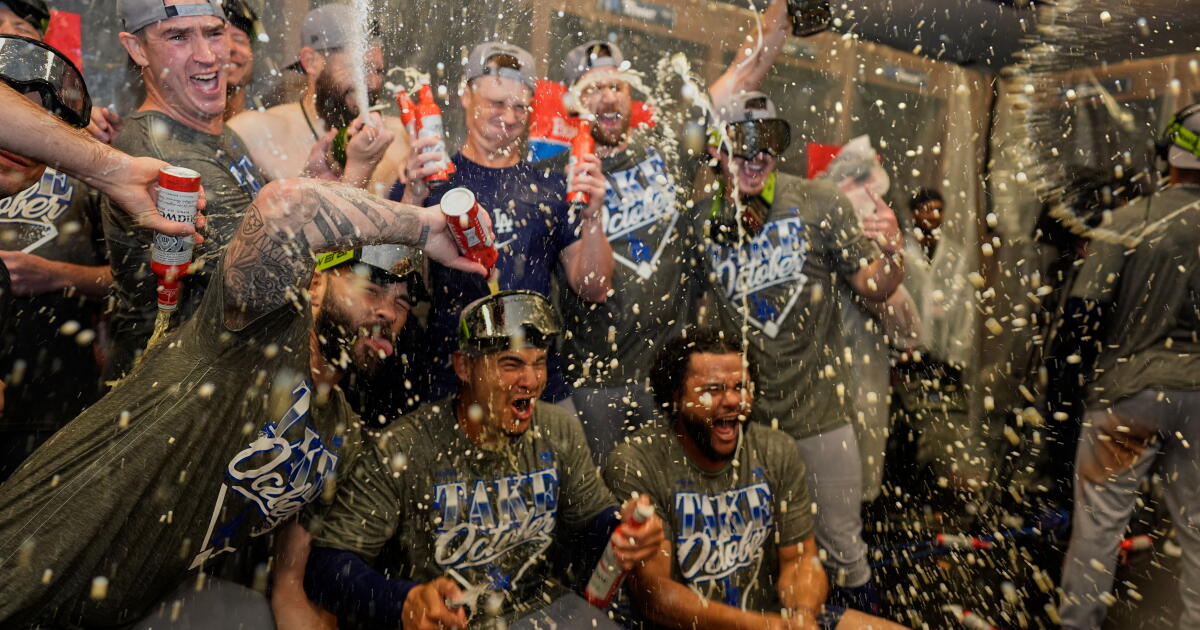
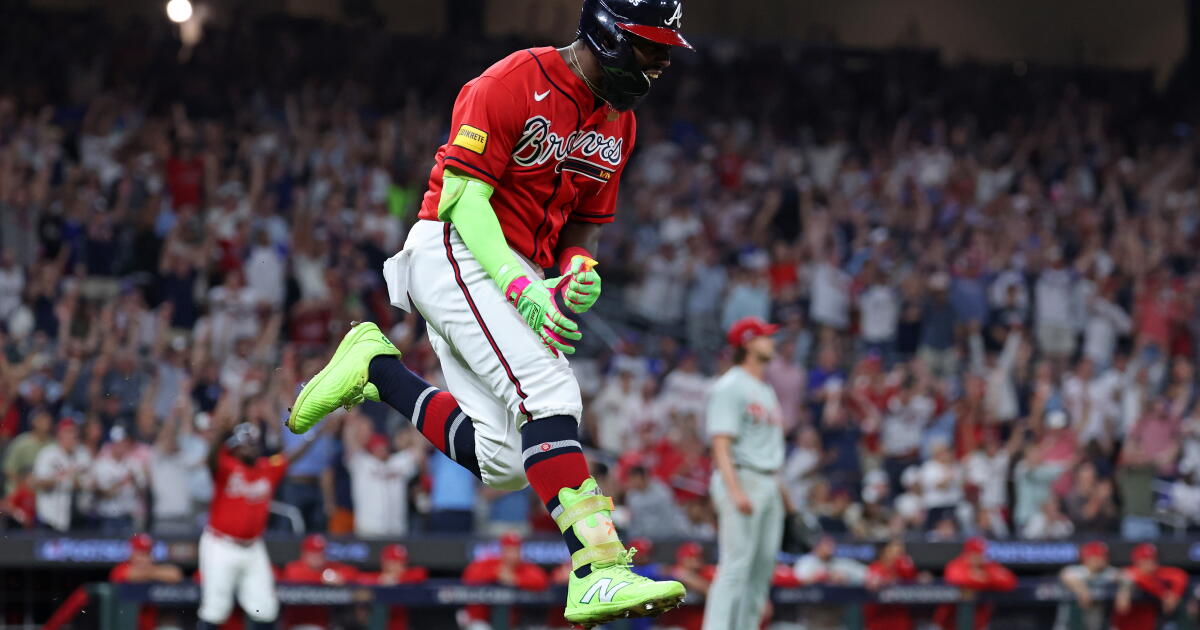
Dodgers advance to the NLCS
From Maddie Lee: Without Andy Pages, the Dodgers wouldn’t have popped champagne in the Truist Park visiting clubhouse Wednesday night.
His October track record suggested he was an unlikely hero. He entered Wednesday with a .123 playoff batting average. He was benched in Game 5 of the World Series last year. He’d even started this postseason hitless in the first two games of the National League Division Series against the Atlanta Braves, and was given the red light on ABS challenges.
He didn’t carry any of that up to the plate with him in the seventh inning, with the score tied, the bases loaded and hard-throwing Braves reliever Robert Suarez entering the game to face him.
“I like being in those at-bats,” Pages said in Spanish after the Dodgers’ 4-1 win in Game 4 of the NLDS. “There are times the result comes, sometimes not, but I prepare to be in those spots. And today I was able to get the result.”
He was patient, working a full count as he fouled off and then foul-tipped a pair of fastballs in the zone.
The next one, he sent through the middle of the infield for a two-run single to finally give the Dodgers the lead in the deciding moment of the series.
The Dodgers are headed to the NL Championship Series for the ninth time in 14 seasons. They will play the Milwaukee Brewers, who finished off the San Diego Padres in four games, starting Sunday. And they came one step closer to their goal of winning a third straight World Series.
Continue reading here
Plaschke: He finally did it! Dodgers’ Andy Pages ends two-year postseason slump at the perfect time
Nine concerns the Dodgers should have about facing the Brewers in the NLCS
Dodgers box score
Get the latest on L.A.’s teams in the daily Sports Report newsletter.
By continuing, you agree to our Terms of Service, which include arbitration and a class action waiver. You agree that we and our third-party vendors may collect and use your information, including through cookies, pixels and similar technologies, for the purposes set forth in our Privacy Policy such as personalizing your experience and ads.
Lincoln Riley says Jayden Maiava in not hurt
From Ryan Kartje: USC quarterback Jayden Maiava has been playing above-average football, but the signal-caller’s deep throws have not been as sharp lately and he has shied away from some contact after taking a big hit to his shoulder during a 39-0 shutout of Fresno State on Sept. 4.
When asked about his quarterback Tuesday, Trojans coach Lincoln Riley quickly replied that Maiava is not injured.
“Jayden has been pretty healthy,” Riley said. “They’ve kept him upright all season long.”
Maiava has adapted to shifting receiving options, calling it a learning experience as he connects with new pass catchers. USC freshman Trent Mosley was an early breakout star, but Maiava has had to look to others with Mosley out the past two games because of injury.
Continue reading here
Jeanie Buss’ siblings fight back
From Thuc Nhi Nguyen: The five Buss siblings who voted to sell the family’s shares of the Lakers filed their formal opposition to team governor Jeanie Buss’ attempts to block the sale on Wednesday, calling Jeanie’s petition “legally and factually baseless” in a statement provided to The Times.
“While discussions among the siblings continue, their focus remains on facilitating the proposed transaction and the Trust’s participation in it, while ensuring that all beneficiaries, including Jeanie, are treated equally,” Jimmy, Johnny, Janie, Joey and Jesse Buss said in the statement.
“Today’s filing is a necessary step to protect those interests and ensure the transaction proceeds on schedule.”
Continue reading here
Ducks lose to Oilers
Evan Bouchard had two goals and an assist to become the second defenseman in NHL history with at least six goals through the first four games of a season, and the Edmonton Oilers used a five-goal second period to beat the Ducks 5-2 on Wednesday night.
Bouchard has a league-leading six goals through four games. Harry Cameron had eight goals in four games for the Toronto Arenas during the NHL’s inaugural season in 1917-18.
Leon Draisaitl had four assists, Connor McDavid had a goal and two assists, Kasperi Kapanen and Vasily Podkolzin also scored, and the Oilers overcame a sluggish start to win their third straight game. Devon Levi made 28 saves.
Continue reading here
Ducks summary
NHL standings
MLB postseason schedule
Division series
National League
No. 2 Dodgers vs. No. 3 Atlanta
at Dodgers 5, Atlanta 3 (box score)
Atlanta 3, at Dodgers 2 (box score)
Dodgers 3, at Atlanta 1 (box score)
Dodgers 4, at Atlanta 1 (box score)
No. 1 Milwaukee vs. No. 4 San Diego
at Milwaukee 3, San Diego 2 (box score)
at Milwaukee 4, San Diego 3 (box score)
at San Diego 4, Milwaukee 3 (box score)
Milwaukee 3, at San Diego 1 (box score)
American League
No. 1 Tampa Bay vs. No. 4 New York
at Tampa Bay 1, New York Yankees 0 (box score)
at Tampa Bay 5, New York Yankees 2 (box score)
Tampa Bay 4, at New York Yankees 3 (box score)
No. 2 Cleveland vs. No. 6 Chicago White Sox
Chicago White Sox 3, at Cleveland 0 (box score)
Chicago White Sox 4, at Cleveland 3 (box score)
Cleveland 9, at Chicago 3 (box score)
Thursday at Chicago, 2 p.m., TBS/truTV/UniMas/HBO Max
*Saturday at Cleveland, 2 p.m., TBS/truTV/UniMas/HBO Max
NLCS
No. 1 Milwaukee vs. No. 2 Dodgers
Sunday at Milwaukee, TBD, FOX/FS1/FOX Deportes/FOX One
Monday at Milwaukee, TBD, FOX/FS1/FOX Deportes/FOX One
Wednesday at Dodgers, TBD, FOX/FS1/FOX Deportes/FOX One
Thursday at Dodgers, TBD, FOX/FS1/FOX Deportes/FOX One
*Friday, Oct. 16 at Dodgers, TBD, FOX/FS1/FOX Deportes/FOX One
*Sunday, Oct. 18 at Milwaukee, TBD, FOX/FS1/FOX Deportes/FOX One
*Monday, Oct. 19 at Milwaukee, TBD, FOX/FS1/FOX Deportes/FOX One
ALCS
No. 1 Tampa Bay vs. Cleveland/Chicago winner
Monday, at Tampa Bay, TBD, TBS/truTV/UniMas/HBO Max
Tuesday at Tampa Bay, TBD, TBS/truTV/UniMas/HBO Max
Thursday at Chi/Cle, TBD, TBS/truTV/UniMas/HBO Max
Friday, Oct. 16 at Chi/Cle, TBD, TBS/truTV/UniMas/HBO Max
*Sat., Oct. 17 at Chi/Cle, TBD, TBS/truTV/UniMas/HBO Max
*Monday, Oct. 19 at Tampa Bay, TBD, TBS/truTV/UniMas/HBO Max
*Tuesday, Oct. 20 at Tampa Bay, TBD, TBS/truTV/UniMas/HBO Max
* if necessary
World Series starts Friday, Oct. 23
This day in sports history
1933 — Cliff Battles of the Boston Redskins becomes the first NFL player to gain more than 200 yards rushing with 215 yards in a 21-20 win over the New York Giants.
1949 — Walt Pastuszak has five of Brown’s 11 interceptions in a 46-0 rout of Rhode Island.
1950 — Bill Grimes of the Green Bay Packers gains 167 yards in 10 carries in a 44-31 loss to the New York Yankees.
1966 — Jerry DePoyster of Wyoming becomes the first player in college football to make three field goals of 50 yards or more in a game. DePoyster connects on two 54-yard tries and a 52-yarder in the Cowboys’ 40-7 rout of Utah.
1961 — Paul Hornung scores 33 points, with four touchdowns, six extra points and a field goal, to lead the Green Bay Packers to a 45-7 romp over the Baltimore Colts.
1977 — No. 7 Alabama beats No. 1 USC 21-20 in Los Angeles. USC fullback Lynn Cain scores with 38 seconds remaining but the 2-point attempt fails.
1992 — Doug Smail scores two goals and the expansion Ottawa Senators rock the Montreal Canadiens 5-3 — the first regular-season NHL game by an Ottawa franchise in 58 years.
1993 — The Anaheim Mighty Ducks, before 17,174 at the Arrowhead Pond, lose 7-2 to the Detroit Red Wings in their first NHL game.
1995 — Dolphin’s Dan Marino breaks Fran Tarkenton’s NFL career completions record.
1997 — Adam Oates reaches 1,000 points with three goals and two assists as the Washington Capitals post a 6-3 victory over the New York Islanders.
2005 — Baylor wins a Big 12 road game for the first time in the league’s 10-year history, beating Iowa State 23-13. The Bears had been 0-37 on the road in the Big 12 Conference.
2006 — Randy Moss’ 22-yard TD catch between two defenders 51 seconds before halftime is the Oakland receiver’s 100th touchdown reception. He’s becomes the seventh receiver in NFL history with 100 TD catches.
2011 — Howard scores all its points in the fourth quarter, including 16 in the final 1:27 to beat 29-28 Florida A&M. Parker Munoz caps the improbable comeback by hitting a 21-yard field goal with 4 seconds left following FAMU’s Damien Fleming fumble on the 28-yard line.
2015 — Tampa Bay’s Jason Garrison scores his second goal of the game at 2:17 of the extra period to lead the Lightning past the Philadelphia Flyers in the first 3-on-3 overtime game in NHL history.
2016 — Will Worth and Navy stuns No. 6 Houston, romping to a 46-40 victory. Worth runs for 115 yards and throws two scoring passes for the Midshipmen. Navy hadn’t beaten a top 10 team since 1984, when it topped then-No. 2 South Carolina in Annapolis.
2017 — Aaron Rodgers throws a 12-yard touchdown pass to Davante Adams with 11 seconds remaining, lifting Green Bay over the Dallas Cowboys 35-31 in another thriller nine months after the Packers’ divisional playoff victory on the same field.
2018 — Drew Brees’ 62-yard touchdown pass to rookie Tre’Quan Smith makes him the NFL’s all-time leader in yards passing and sends the New Orleans Saints well on their way to a 43-19 victory over the Washington Redskins. Brees enters the game needing 201 yards to eclipse Peyton Manning’s previous mark of 71,940 yards. He finishes 26 of 29 for 363 yards and three touchdowns.
Compiled by the Associated Press
This day in baseball history
1956 — Don Larsen of the New York Yankees pitches the only perfect game in World Series history, a 2-0 triumph over Brooklyn.
2018 — Red Sox utility player Brock Holt becomes the first MLB player to hit for the cycle in a postseason game.
Compiled by the Associated Press
Until next time…
That concludes today’s newsletter. If you have any feedback, ideas for improvement or things you’d like to see, email me at houston.mitchell@latimes.com. To get this newsletter in your inbox, click here.