
Adopt

House votes to adopt Department of War renaming in annual defense bill

The House on Wednesday passed a defense policy bill that incorporates President Trump’s request for a historic $1.15 trillion in spending for national security and would designate the Department of Defense as the Department of War.

It also would provide for a pay raise next year ranging from 5% to 7% for service members, depending upon their rank.

The National Defense Authorization Act is generally one of the more bipartisan bills that Congress takes up on an annual basis. That’s not the case this year. The vote was 216-212.

Democrats took issue with steep spending increases for the Pentagon as Republicans attempted to cut numerous non-defense programs through other bills. They also opposed some of the conservative social policy riders that were included.

For example, the bill includes a prohibition on gender-related medical care under the military health program known as TRICARE. It also eases hurdles for service members to carry a privately owned firearm on base, following Defense Secretary Pete Hegseth’s lead on the issue.

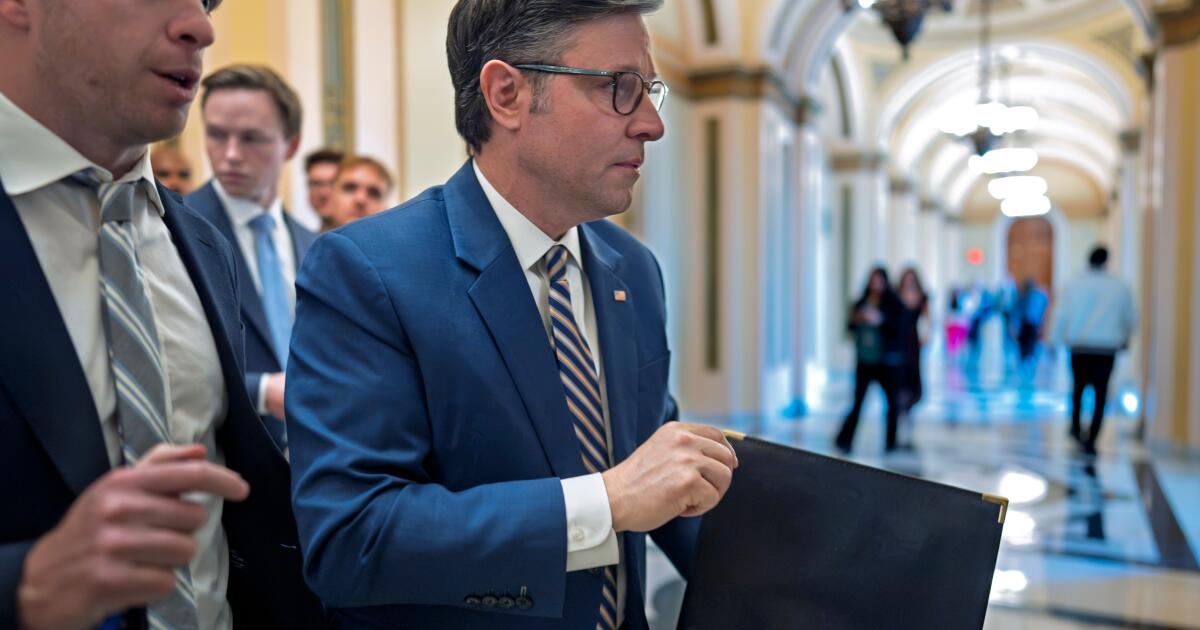
Republican leaders’ decision to attach Trump’s elections overhaul bill to the defense bill upon its passing also amplified the partisan divide. Speaker Mike Johnson is working to accommodate Republican lawmakers who are angry that the Senate won’t pass the SAVE America Act and are insisting that it be included in must-pass bills until the Senate relents.

House bill tests a normally bipartisan process

Rep. Mike Rogers of Alabama, the Republican chairman of the House Armed Services Committee, said he knows there were areas of disagreement, but emphasized that Wednesday’s vote was a step in a long process. He promised to work in a bipartisan manner on a final product that can pass both chambers and be signed into law.

Rogers said the United States needs to reverse decades of underinvestment and neglect in the nation’s armed forces and defense industrial base.

“This bill will do that and much more,” he said. “It will build the ready, capable and lethal fighting force we need to deter China and other adversaries.”

Rep. Adam Smith of Washington, the ranking Democratic lawmaker on the Armed Services Committee, said the defense spending the administration has asked for this year is approaching $1.6 trillion including separate efforts to pay for the war in Iran and boost weapons stockpiles.

“The American people are struggling to pay their bills and we’re going to put $1.6 trillion into the defense budget. It’s not a reasonable thing to ask,” Smith said.

Smith also expressed concern about the war with Iran and that in supporting the defense bill, lawmakers are “de facto supporting this war with no end in sight.”

“We are in an incredibly, incredibly dangerous time,” Smith said. “I want to maintain the bipartisan nature of this bill. I do. And I know that the chairman does. But if we’re going to do this, we’re going to need some Republicans to stand up to the president of the United States and say, ‘No. No, we’re not going to get you $1.6 trillion. No, we’re not just going to give you a blank check for a war that is totally out of control.‘”

White House backs parts of the legislation

The spending increases authorized in the bill would not take effect until Congress follows up with a separate defense appropriations bill. The Senate has not yet approved its version of the defense measure. It’s possible a final product won’t be ready until after the midterm elections.

The White House applauded the spending levels authorized in the House bill and the Department of War designation that it says recognizes the “willingness to fight and win wars on behalf of our nation.”

The president issued an executive order last year renaming the Defense Department, but it’s up to Congress to make the change official. The Congressional Budget Office has projected that the renaming could cost taxpayers as much as $125 million.

The White House’s statement also said that the administration has a number of concerns with certain provisions in the bill and would work with Congress before a final bill is presented to the president. Among those concerns was a section of the bill it said would limit or undermine the president’s ability to name military installations and property.

In 2023, during a national reckoning on issues of race in America, seven Army bases’ names were changed because they honored Confederate leaders. Last year, those bases reverted to their original names, but with different namesakes who share Confederate surnames. The Army found other service members with the same last names to honor.

Freking writes for the Associated Press.
Source link

House Republicans adopt $95-billion package for Iran war, Trump priorities

The House adopted a Republican-only $95-billion budget proposal Wednesday, a long-shot effort to fund the Iran war and other White House priorities over objections from Democrats and a few GOP holdouts in a final push before the midterm elections.

House Republicans were divided over the plan, with conservatives wary because there are no offsetting budget cuts. But Speaker Mike Johnson (R-La.) plunged ahead, viewing the go-it-alone process as the best chance to usher President Trump’s priorities through the split Congress, despite skepticism in the Senate.

The vote tally was 216-214, with two Republicans and one independent joining Democrats in opposition.

“Just bullets and bombs to finish the job,” said Rep. Jodey Arrington (R-Texas), the chairman of the Budget Committee.

Democrats argued the money should be spent at home, particularly on efforts to lower costs for Americans.

“Republicans plan to spend tens of billions of dollars on Trump’s failed war in Iran,” Rep. Pete Aguilar (D-Calif.), chairman of the House Democratic caucus, said this week. “Think about what we could spend with these resources instead.”

Congress is at a standstill over the U.S. war against Iran — unable to stop Trump’s military strikes, but not having authorized the use of American military force — and politically torn over having to provide billions of taxpayer dollars to pay for it. Most Americans disapprove of Trump’s Iran strategy, according to a recent AP-NORC poll.

The budget battle comes as Trump attended the dignified transfer of four service members killed in the Middle East, bringing the military death toll to 18. Defense Secretary Pete Hegseth told senators at a fiery hearing this week that the Pentagon is running short of cash, despite a massive $150 billion one-time allotment in last year’s big budget bill.

Even as the House action advanced the resolution, Johnson’s strategy faces uncertainty in the Senate.

The package has $60 billion for the Pentagon and $13 billion for other national security needs, $12 billion for farmers struggling under Trump’s tariffs and $10 billion for voting law changes aligned with the SAVE America Act and proof-of-citizenship requirements that are Trump’s top priority.

Republicans are relying on the budget reconciliation process, which enables approval on a majority vote in Congress, bypassing the Senate’s ability to filibuster the measure to stall or kill it.

Once rare, the reconciliation process is now Johnson’s preferred strategy for pushing proposals through Congress. It’s the way Republicans approved Trump’s big tax breaks and spending cuts bill last summer and funded Homeland Security this year over Democrats’ refusal to fund Trump’s mass deportation agenda.

“No matter how you feel about current events, these funds are necessary to ensure our fighting forces remain ready, our troops are paid and our nation is safe,” said Rep. Mike Rogers of Alabama, the Republican chairman of the Armed Services Committee.

But House Minority Leader Hakeem Jeffries (D-N.Y.) said, “Republicans have literally ripped food from the mouths of hungry children, seniors and veterans to sustain the Trump war machine.”

Among those opposed was Rep. Kevin Kiley of California, a former Republican turned independent who said he felt any war funding bill should be bipartisan. He also wanted to ensure Congress had a “much higher level of involvement” in bringing the war to an end, and he said this proposal did not set that process in motion.

Republicans Rep. Thomas Massie of Kentucky and Rep. Warren Davidson of Ohio also voted against.

This is the third time GOP leaders have relied on reconciliation, dubbing this version 3.0, and it’s a lengthy process. If the House approves the budget resolution, it next goes to the Senate for a round-the-clock session to consider politically tough amendments — something senators would rather avoid in an election year.

The budget resolution sets out instructions for the various committees to draft legislation, which Johnson hopes could be done this summer, with final voting on the package once lawmakers return after the August recess.

Senators pan House’s budget and have their own ideas

Senate Majority Leader John Thune (R-S.D.) has been noncommittal on the House package that also divides his own GOP majority, with some Republican senators preferring more money for the military and others demanding the costs be offset with cuts elsewhere.

“We’ll see,” Thune said this week.

Thune’s focus, at the moment, is avoiding another government shutdown. He wants the Senate to approve a stopgap funding measure, called a continuing resolution, to provide routine government funding before lawmakers leave for the summer break.

If senators are unable to reach agreement on government funding, Thune has said he may hold onto the House’s budget resolution and use it later in the fall as a way to push the resolution through the Senate over objections. He wants to prevent a federal shutdown when current funds expire on Sept. 30.

“It’s a possibility that, if necessary, we could pull that budget resolution passed by the House and use it to fund government,” Thune said. “I hope that’s not necessary.”

Thune has also clashed with Trump over the president’s push for the SAVE America Act, which would require proof of citizenship for voting. The measure, while popular among Trump’s most ardent supporters, does not have enough support among Senate Republicans for passage.

It’s already against the law for noncitizens to vote in federal elections and experts warn the proposed new rules could make it more difficult for eligible Americans to cast ballots.

Mascaro writes for the Associated Press.

Source link

Cuba Forced to Adopt Free-Market Reforms

Facing a 7% GDP contraction, the socialist island nation opens up to private banking and investment.

In June, the Cuban National Assembly unanimously passed 176 economic reforms aimed at staving off an economic crisis partly caused by U.S. sanctions.

Prime Minister Manuel Marrero announced the reforms, which aim to reduce the state’s presence in the economy and attract foreign investment in agriculture, banking, and tourism. Officially, they are described as the most significant attempt to update the current state-socialist economic system.

“Times have changed, geopolitics have changed, and the United States’ aggression toward Cuba has changed,” President Miguel Mario Díaz-Canel Bermúdez told the Dominican Republic’s Telenoticias. “We cannot remain the same; we must transform. These are times of transformation.”

Economic Crisis Prompts Action

A multitude of internal and external crises plagued the island economy during the first half of this year. Prolonged blackouts due to an electricity system in severe need of modernization, and chronic shortages of fuel and basic goods, partly caused by a U.S. oil blockade, top the list.

Economists project a 7% contraction in GDP for this year.

Faced with capital flight by foreign businesses due to U.S. sanctions, the Cuban government felt the pressure to change. Hotel chains, international commerce, and airlines had left Cuba, and in early June, the Central Bank of Cuba announced it could no longer accept Visa and Mastercard transactions.

Dismantling State Monopolies

The Cuban government grouped the 176 reform measures into 23 pillars. They include expanding the private sector by removing the 100-employee limit on companies.

Additionally, the reforms allow corporate and multi-ownership structures; reforming state-owned enterprises; authorizing private banks to enter the financial system; partially dollarizing the economy; transitioning from universal to targeted subsidies; facilitating foreign direct investment; and opening up foreign trade and real estate tourism.

“Today, our banking and financial system creates obstacles, hinders development, and does not facilitate investment, development, or agricultural production,” said Díaz-Canel.

Arguably, the measures represent the most significant changes to the economic system since the 1959 Cuban Revolution, dismantling longstanding state monopolies and allowing investors to acquire stakes in state-owned businesses.

No less a figure than Raúl Guillermo Rodriguez Castro, grandson of Fidel Castro, told The National, the United Arab Emirates’ English-language newspaper, “Our country must seek a path to economic development where we must inevitably diversify our economy, diversify the way we do business, and diversify the way we do investments.”

Nic Wirtz is a contributing writer based in Guatemala.

Source link