Just a few months ago, amidst the avalanche of uncertainties surrounding the kidnapping of Nicolás Maduro by the US military in collusion with Venezuelan forces, we identified six indicators pointing to a clear political reality: the remaining chavista leadership was successfully adapting to the new board under conditions of vassalage to the invading power.
Since then, the core underlying conditions have not changed—the government continues to prevail over the conflict—but new windows of opportunity have opened for the opposition, and new situations have arisen that put this new, Rodríguez-led neochavismo in a tight spot.
Alex Saab has a substitute
The first sign of chavismo’s remarkable capacity for subservience was the sacrifice of some of its own key figures in exchange for US validation. Handing over Alex Saab was a well-calibrated move by the interim government. The primary financial operator of late chavismo had transformed into the manager of an opaque economy, eventually elevating himself into a political actor and a banner of anti-imperialism. Yet his fall came with a successor, a new financial lobbyist bearing the same signature of corruption, but who does not answer solely to chavismo: Alejandro Betancourt is a hinge operator, a pragmatic and elastic figure whose nature allows him to serve multiple partners with conflicting interests at the same time. Thus, the ideological flexibility of chavismo’s newest protagonists aligns perfectly with its broader mutation from a political project into a commercial consortium.
Rising social demands
In our previous analysis, we identified supervised economic liberalization as the government’s biggest gamble to buy time. Accelerating economic recovery was seen as a critical opportunity to relieve political and social pressure. However, the expected results have failed to materialize on schedule. No matter how many headlines trumpet investments in the oil, energy, and mining sectors, and regardless of the photos documenting memorandums of understanding with international capital, the revival of the economy remains a fantasy—just as it has been for the past twenty years. If Venezuelans are accustomed to anything, it is chavismo’s delusions. Today, the government faces a scenario in which the domestic economy and access to basic public services deteriorate at the exact same rate that rejection of foreign tutelage grows. Simply put: the strategy of accelerating economic recovery to defuse political pressure has been a complete failure.
In the electricity sector alone—one of the main triggers of protests and street pressure in recent weeks—there is a stark divide between grand announcements and actual binding agreements. Throughout 2026, investment announcements in Venezuela’s electrical grid were measured in megawatts, nearly all framed as recovery agreements with state-owned Corpoelec. In April, talks with Siemens and General Electric were announced to address the crisis in Zulia, but to date, no public contract exists with either company, and the situation remains critical: blackouts lasting between 5 and 12 hours (or more) persist.
On one hand, we see the return of exiled politicians who were persecuted for years. On the other, isolated attempts at arrests.
To date, no agreement has disclosed financial amounts or funding sources. Furthermore, megawatt figures vary depending on the source, and it remains unclear how INSA and Impsa are dividing the work at the Tocoma hydroelectric plant. All of this is unfolding against a backdrop of undeniable social demands that cannot be pacified by press headlines and investment promises. The timeline for economic relief is slipping away, while the timeline for public demand is accelerating.
The repressive apparatus doesn’t wane, it just loosens its grip
Ten months later, we can affirm that the relaxation of the repressive system and the amnesty law were purely symbolic gestures directed at Trump, carrying no real dismantling of the persecution apparatus. That tactic of erecting façade after façade regarding human rights has been maintained. Repression cooled down and political prisoners were released—some only partially—during these months under foreign tutelage. However, based on several statements from Washington detached from reality, the interim government confirmed that human rights are simply not on the US agenda. In that sense, there have even been small trial balloons replicating the repression of past months, testing American indifference. The Trump administration is not dismantling the repressive apparatus in Venezuela because its own government is also repressive—one that, in many cases, shares victims with chavismo: Venezuelans on US soil.
Nevertheless, a novel phenomenon is taking place that sends contradictory signals. On one hand, we see the return of exiled politicians who were persecuted for years. On the other, isolated attempts at arrests. This tension within the security apparatus has yet to show a clear trend and will ultimately be defined by the political force deployed by the actors involved.
Ambiguity toward China
In the initial months of US tutelage, the most dramatic shift in the interim government’s foreign policy—and the clearest sign of its ability to mutate to survive—was severing its alliance with Cuba. That move brought an alarming deterioration to the island’s economic situation, which had depended on Venezuelan oil for more than two decades. Remaining Chavismo did not hesitate to drop its oldest ideological partner when the cost of sustaining it became Washington’s disapproval. In that sense, it was primarily an existential rupture: one that demonstrated their capacity to sacrifice even their own founding narrative to guarantee the continuity of power.
In Venezuela, China is not competing in the short term. Instead, it is waiting for its window of opportunity to open.
With the discursive framing of the divorce from Cuba settled, this new period in international affairs—beyond the relationship with the US—is marked by the positioning and balancing act required regarding China, particularly concerning its oil assets amidst U.S. penetration into the sector. Unlike Cuba, China is not an ally that can be abruptly discarded without consequences. It is the country’s primary creditor following years of loans repaid with crude oil, and it holds stakes in joint ventures across the Orinoco Petroleum Belt.
For now, the interim government operates in the realm of pure pragmatism: avoiding any signal of alignment with China that might irritate the US, while simultaneously leaving existing Chinese investments untouched. That balance can hold only as long as Washington refrains from directly targeting Chinese assets in the country. Should that happen, Rodriguez-led Neochavismo would find itself trapped between its tutor and its creditor, with no room left to manage ambiguity. China, for its part, is in no rush. Its strategy in the region has long been defined by patience and long-term calculation: it is not competing in the short term; instead, it is waiting for its window of opportunity to open. And under a government that has proven its loyalties are entirely negotiable, that window will open sooner or later.
The alliance with Trump consolidates
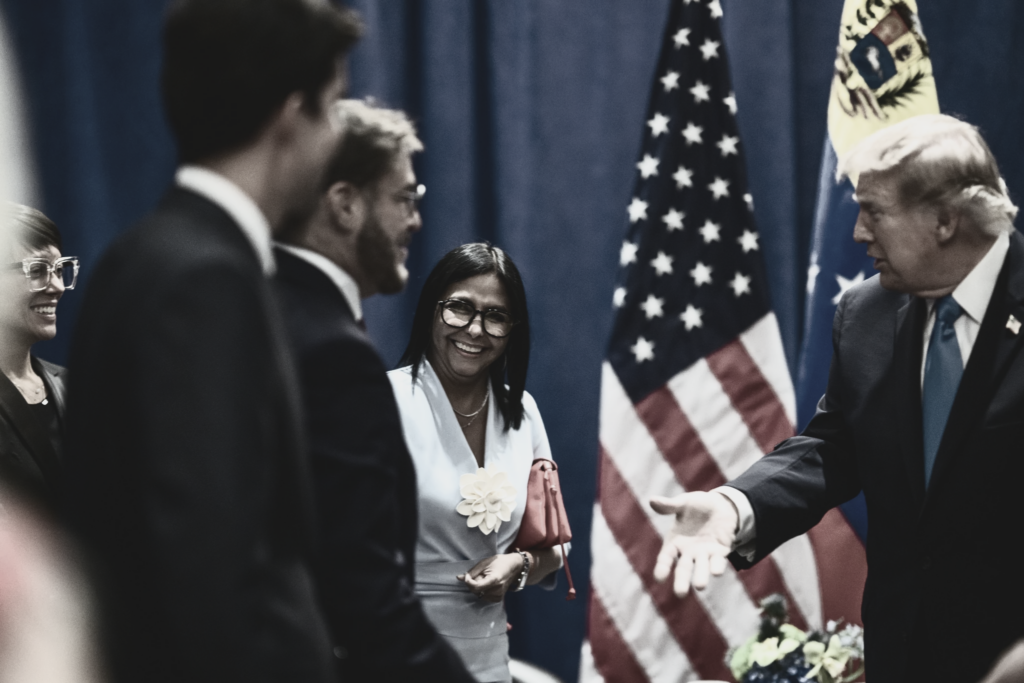
The other major successful mutation for chavismo coming into view this year has been the dissolution of its anti-imperialist rhetoric. For over two decades, confrontation with the United States served as the narrative anchor of the movement’s project, the story that justified shortages, explained sanctions and failures, unified the militant base, and gave chavismo a distinct place on the international map. Today, that story is entirely untenable for a government cooperating directly with those who kidnapped its president and bombed its country: chavismo can no longer posture as a fortress against empire.
This shift carries heavy political costs. Internally, it opens deep fractures: segments of the rank-and-file and mid-level cadres trained on that narrative watch as their leadership cuts deals with the very enemy they were taught to fight for years, eroding the loyalty that the narrative once guaranteed. Externally, it means losing international alliances that relied precisely on that shared identity. Chavismo can no longer offer its former partners the epic tale of resistance.
The opposition’s challenge lies in constructing a vision of its own—one capable of appealing to an exhausted society that has watched both the revolutionary narrative and promises of a swift transition collapse.
Yet the dissolution of anti-imperialism also poses a serious dilemma for the opposition. For years, the opposition built its moral standing in direct opposition to a regime that simultaneously claimed the anti-imperialist mantle, violated human rights, and destroyed the economy. Now, with chavismo falling in line with Washington, that contrast becomes blurred. The opposition can no longer define itself solely by its antagonism to chavismo, nor can it present alignment with the U.S. as its own unique banner, because the interim government occupies that exact same space.
This forces the opposition to transform, which brings its historical weakness to the surface: its limited capacity for transformation. The Venezuelan opposition has proven effective at resisting, denouncing, and mobilizing during high-tension moments, but it has struggled immensely to renew its discourse, leadership, and strategies when the political terrain shifts. On this new board, its challenge is no longer to prove that chavismo is illegitimate, but to construct a vision of its own. A vision capable of appealing to an exhausted society that has watched both the revolutionary narrative and the promises of a swift transition collapse. If it fails to do so, it risks remaining trapped in a political language aimed at a chavismo that no longer exists.