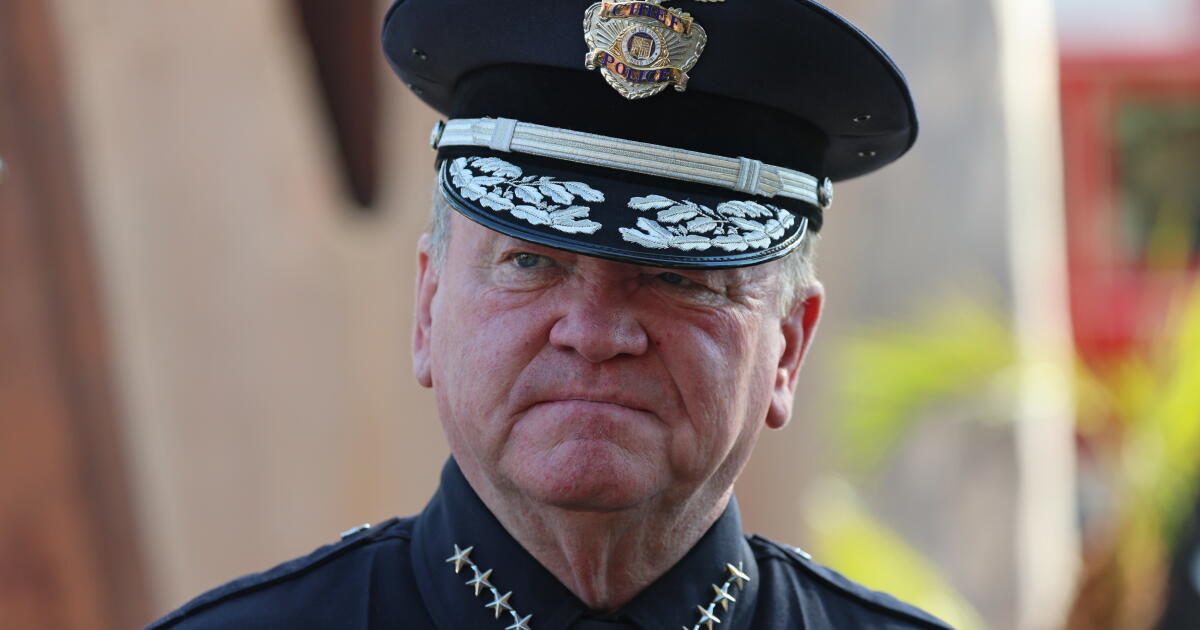
Raman says the LAPD has grown more secretive under Chief McDonnell
When Los Angeles mayoral candidate Nithya Raman was asked recently about the ways the LAPD was falling short, she pointed out that the agency had stopped posting neighborhood-level crime statistics. The lack of data, she said, gives an incomplete picture of how safe the city is — and also undermines the public’s already shaky trust in police.
Her comments during a recent mayoral debate thrust the issue of police secrecy into the spotlight, while giving voice to a growing number of critics of LAPD Chief Jim McDonnell who argue that his department is moving in the wrong direction when it comes to transparency.
Frustration by neighborhood groups over the missing crime data has boiled over in recent weeks, thanks in part to Raman’s comments. But it also comes as free press advocates complain that the department’s responsiveness to public records requests has slowed, and as officers increasingly face accusations of targeting journalists in the field during protests.
When Mayor Karen Bass and LAPD officials were asked about the disappearing crime data at a news conference last week, a senior department official fielded the question and chalked it up to a “software issue,” which the department was working on and hoped to have resolved soon. A Bass spokesperson did not immediately respond to a request for comment Friday afternoon.
In an interview with KNX radio this week, McDonnell claimed that changes to internal policies and state law had made the LAPD more transparent today about its operations and functions than ever before.
McDonnell declined an interview request through a spokesperson on Friday.
“The Department remains committed to transparency and to keeping the public informed,” the spokesperson, Officer Jeff Lee, wrote in an email. “That includes public access to crime data, timely handling of California Public Records Act requests within available resources, and respect for the rights of members of the media covering public events.”
In the spring of 2025, roughly a year after the LAPD released thousands of police officer photos that it later tried to claw back, the department quietly stopped posting files released in response to public records requests, cutting off access to a trove of documents that were once available through the the city’s data portal. Department watchdogs have long argued that such records allow residents to evaluate how the LAPD and other agencies are performing.
Reports based on the investigations of police shootings and other serious uses of force that used to be released shortly after they were presented to the Police Commission, the LAPD’s civilian oversight body, now take months to be produced.
The department’s inability to respond to records requests in a timely fashion seems designed to defuse public outrage, critics argue; dragging out the time it takes to release records means that information becomes available long after most citizens have moved on, they contend. Activists routinely pack the Police Commission’s Tuesday meetings to decry what many refer to as “secret police.”
McDonnell has acknowledged delays in producing records, saying that the unit tasked with reviewing and releasing the information is “grossly understaffed.” But progress on filling some of these vacancies has been slow.
LAPD officials have said that a recent change to state law that now requires police departments to release more information about officer misconduct and cases that involve serious uses of force has placed additional burden on the unit. Adding to the backlog are prolific requesters who flood the department with complex and time-consuming inquiries, all of which have to undergo several levels of review to avoid the release of private data, they argue.
McDonnell has also come under fire for his officers’ behavior toward journalists during protests last year against President Trump’s immigration crackdown. In July 2025, a federal judge issued an order prohibiting LAPD officers from targeting media members with crowd-control weapons.
In the months since, media groups have denounced the department for continuing to violate the order, which has deepened the tensions between police leaders and the press. Since June 2025, the city has been hit with dozens of legal claims from protesters and journalists who claim that LAPD officers used excessive force against them.
Police officials have accused some independent journalists of behaving more like demonstrators than reporters, and argued that the use of less-lethal weapons was justified after officers were provoked or had their commands disobeyed in chaotic situations.
Press freedom advocates say that under McDonnell, the department’s relationship with the local news media has gotten increasingly strained.
McDonnell, some argue, has made himself available only to news outlets that provide favorable coverage of the department.
In more ways than one, McDonnell seems out of step with modern expectations around government transparency by a public that is increasingly wary of public institutions, said Adam Rose, a deputy director of advocacy for the Freedom of the Press Foundation.
Rose said he often disagreed with McDonnnell’s predecessor, Michel Moore, but that the former chief at least made himself accessible. Moore used to opine on national issues and occasionally tried to get in front of brewing controversies, Rose said, but he was also willing to hear out concerns about the treatment of journalists.
McDonnell, he said, hasn’t even bothered to give out his cellphone number.
“[Moore] had at least the courtesy and dignity to address groups speaking on behalf of journalists who while trying to cover the department were injured,” Rose said.
Last November, McDonnell abruptly ousted the department’s former top civilian spokesperson, Jennifer Forkish. Some of her duties were reportedly absorbed by Robert Port, a veteran documentary filmmaker with no PR experience whose own hiring was shrouded in secrecy. Port’s job proposal suggested that he was sought to use his Hollywood connections to help burnish the department’s battered public image.
Port told the news outlet L.A. Material that he was working on a reality show that promises to take viewers behind the scenes of patrolling the city’s streets. The department has sought $15,000 from the City Council to hire an outside law firm to represent the city with negotiations with a company called 44 Blue Productions LLC.
Forkish, the former spokesperson, told The Times that she has heard from journalists “here in Los Angeles and around the world who say they’re struggling to get responses to media inquiries and public records requests.”
“As an Angeleno, that concerns me,” she wrote in a text message. “Responding to the press is part of being accountable to the public, and transparency is essential to maintaining public trust.”
Attorneys who have sued the department, either on behalf of aggrieved officers or members of the public, argue that maintaining secrecy allows the LAPD to dismiss criticism on the grounds that outsiders don’t understand what’s happening.
“The LAPD has now evolved into an inward-facing organization.” said Jorja Leap, a professor of social welfare at the UCLA Luskin School of Public Affairs. “It’s a pivotal moment. I still see people within the department working on community relations — I don’t want this to be a lost opportunity.”